How Does a Hymn Become a Classic?

Archbishop Cordileone’s Very Marian Advent Prayer Service Launches World Premiere of Two New Christmas Carols

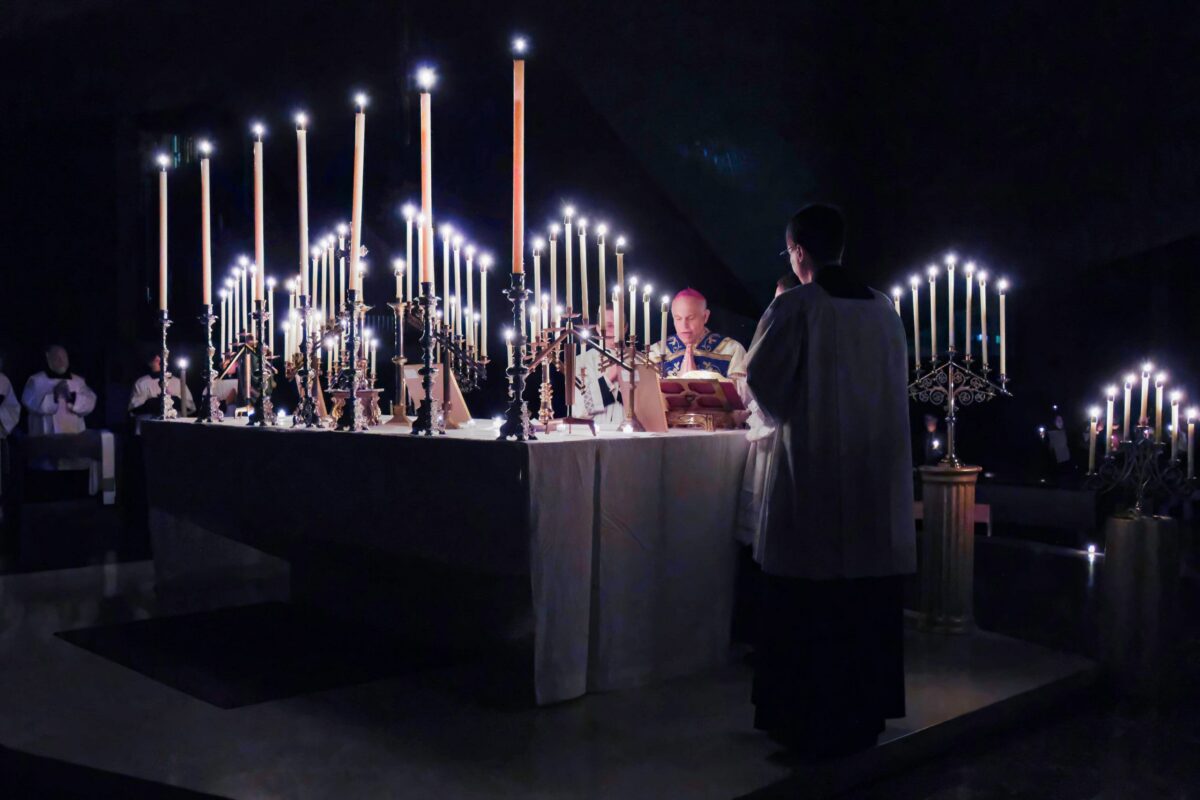
On December 15th, at Star of the Sea Church in San Francisco, Archbishop Salvatore J. Cordileone will lead an innovative Very Marian Advent Prayer Service featuring the world premiere of two new hymns by major Catholic artists commissioned through the Benedict XVI Institute. James Matthew Wilson teams up with composer Frank La Rocca for a new hymn While All the Earth in Darkness Sleeps, which was inspired by the 6th century Akathist Hymn to Mary. Fr. Dwight Longenecker created Our Lady’s Lullaby with new lyrics to an old Welsh hymn Suo Gan (best-known for its appearance in the Disney film Empire of the Sun) and a new arrangement by composer William J. Fritz. The two hymns are part of a lessons and carols worship format, featuring a magnificent 8-voice schola led by Hillsdale College’s Maestro Timothy McDonnell.
Archbishop Cordileone and the Benedict XVI Institute’s ambitious goal? To create new Advent hymns that enter the canon of the Catholic church.

“Many of our best hymns and carols were composed first as poems and later set to music,” said James Matthew Wilson, poet-in-residence at the Benedict XVI Institute “How daunting as a poet to have to say to myself, this has to work as the kind of language people will want to sing, want to remember specifically as musical, as pure song.”

All ancient, worldly wisdom
Exults before your son,
And lays three gifts before you,
Virgin who nurse the One.
May gold forever glimmer
From both his crown and yours;
May prisoner and pauper
Greet angels at their doors.

Rejoice, o virgin watching through the night.
Rejoice, the gate that opens all to light.
Rejoice, whom even cherubim attend.
Rejoice, seraphic queen and sinners’ friend.
Rejoice, whose breast the food of all once fed.
Rejoice, our lady, stars anoint your head.
Rejoice, for on this night you bore a son.
R. Rejoice, for on this night you bore a son.

~While All the Earth in Darkness Sleeps
James Matthew Wilson

How does a poet even begin to approach such daunting task of adding to the canon of Advent and Christmas music?  “By trying to impart a classic quality to the setting,”  Composer-in-Residence at the Benedict XVI Institute Frank La Rocca answered. “One that sounds like a bit of fresh air flowing through a long and great tradition – a tradition one approaches with a certain reverence and gratitude.”

The second world premiere Advent carol is Our Lady’s Lullaby. “How did you approach this?” I asked Fr. Longenecker. “To write something one hopes will stand the test of time, one looks to the great tradition and tries to write from within that—without either copying or challenging the tradition. For this piece I looked to the great images of the Madonna and child and that connected me instinctively with lullabies,” he replied.

Sleep my Child
In the manger
Sleep my child
Free from Harm
Sleep my child
Free from Danger
Sleep my child
In my arms

~Our Lady’s Lullaby
Father Dwight Longenecker

“When mothers hum to their little ones as they’re putting them to sleep,” added composer William J. Fritz, “many times they improvise without knowing it. I changed the rhythm of the original tune to make it feel like a mother rocking her child to sleep; there is also a departure from the tune in the middle when Mary contemplates her Son’s passion and death. My hope was to hint at the ecstacy that the Mother would feel at the Son’s triumph over death. This is an Advent/Christmas Hymn much like the Messiah – it’s all of Christ’s mystery wrapped in one.”

Last year’s first Very Marian Advent service saw the debut of two other brand new Advent carol:  The Chesterton Carol, by composer Mark Nowakowski, and Our Lady Expectant, composed by Wilhelmina Pariseau from a poem by Roseanne T. Sullivan. Both will be performed again this year.  Mark Nowakowski’s Chesterton Carol has taken a step towards becoming a classic by generating 22,000 views on YouTube and being adopted by many in the Chesterton Schools Network.

The new hymns this were made possible by the support of two new patrons of the arts: James and Kristy Hudon, who commissioned While All the Earth in Darkness Sleeps, and Michael and Sarah Trela, who supported Fr. Longenecker and Mr. Fritz’s new Christmas carol.

Why support new works of art amid that many other urgent needs in the world, I asked them.

“Most of the religious hymns we sing today were composed long ago, borrowed from past generations,” said Mr. Trela. “While these old hymns are excellent, it is time for this generation to humbly contribute with a new Christmas hymn that shares in the joys and tears of Our Lady.”

“We are meant not only to enjoy Art, but to participate in it,” said Mr. Hudon. “A thriving arts culture unites us as Catholics and brings us into fuller communion. A city set on a hill cannot be hidden, and so it is important that we help make our city—the Church—beautiful, as beauty attracts people who have otherwise closed themselves off to the truth of the Gospel.”

Those in the greater Bay Area can register to attend; the Benedict XVI Institute also offers a virtual option: those who register will receive a link to the professional recording of the event, including the new Advent /Christmas carols.

Praying the O Antiphons

            Some parts of the Christian liturgy are so ancient that we just assume they grew organically all by themselves, like plants. But in fact, every single word of the liturgy is the work of an inventive human mind that somewhere, at some point in time, forged a prayer out of Scripture, very often music as well, and very often even older prayers. Such was the origin of the “O” Antiphons, the seven short prayers to the yet-unborn Christ that precede the recitation of the Magnificat in the Vespers, or Evening Prayer, liturgy of the Latin Church during the last days of Advent, from December 17 through December 23.

            The O Antiphons, with their rich compression of images, are gems of human creativity poetic and musical. Exactly when and where they were composed is uncertain. They were chanted at the Benedictine abbey at Fleury, on the Loire River in central France, during the eighth century, although some scholars believe that they date to the fifth century or even earlier, since the Christian philosopher Boethius seemed to quote a phrase from the first O Antiphon in his treatise Consolation of Philosophy (A.D. 524). By the ninth century, the O Antiphons were part of the Vespers liturgy for Advent at monasteries and churches all over Western Europe, including Rome. The composer was clearly a man of learning, probably a monk, who knew the texts of the Latin Vulgate Bible intimately. Nearly all the words in each of the seven antiphons are direct quotations from or paraphrases of a huge range of Latin Scripture, mostly the Old Testament, since that was the time of waiting for the coming of the Messiah. Sources included the writings of Isaiah and other prophets, the “wisdom” books of the Old Testament (Wisdom, Proverbs, Sirach), the books of Genesis, Exodus, Leviticus, and Chronicles, the Gospels of Matthew and Luke, and the letters of Paul.

            Since the O Antiphons were designed for antiphonal chanting (a cantor and a choir, or possibly two alternating choirs), each has two parts. The first part begins with the vocative “O” (hence the antiphons’ collective name) and a Scripture-derived title for Christ: “O Sapientia (O Wisdom),” “O Adonai (O Adonai, or Lord),” “O radix Jesse (O stock of Jesse),” “O clavis David (O key of David,” “O Oriens (O Dayspring, or rising sun),” “O Rex gentium” (O king of all peoples),” “O Emmanuel (O Emmanuel).” The second part begins with the word “veni (Come!),” evoking intense longing for the coming of Christ as Christmas draws near.

Here is a sample, the Latin text of the first O Antiphon, the one that Boethius might have quoted:

O Sapientia,
quae ex ore Altissimi prodiisti,
attingens a fine usque ad finem,
fortiter suaviterque disponens omnia:
veni ad docendum nos viam prudentiae.

Here is the English translation, from the iBreviary website:

            O Wisdom,

            You come forth from the mouth of the Most High.

            You fill the universe and hold all things together

            in a strong yet gentle manner.

            O come teach us the way of truth.

Here is the Latin text of the seventh and final O Antiphon, for Vespers on December 23:

O Emmanuel,

Rex et legifer noster,
exspectatio gentium, et Salvator earum:
veni ad salvandum nos, Domine, Deus noster.

Here is the English translation from iBreviary:

            O Emmanuel,

            You are our king and judge

            the One whom the peoples await, and their Savior.

            O come and save us, Lord our God.

Together, the initial letters of Christ’s titles in Latin in all seven O Antiphons (S, A, R, C, O, R, and E), when read backwards, form an acrostic: ero cras, or “I shall be [with you] tomorrow.” Early-medieval writers delighted in acrostics, and this one pointed specifically to the birth of Christ at midnight on the night of Christmas Eve.

            The O Antiphons—the “Great O’s”—have been so beloved over the centuries that they have generated their own waves of creativity among musicians, writers, and artists inspired by them. As the Middle Ages progressed, liturgists composed additional O antiphons for Advent; an “eighth” antiphon for Christmas Eve honoring Mary, “O virgo virginum (O Virgin of Virgins)” became standard in English churches and remains part of the Anglican Advent liturgy to this day. Some medieval churches and religious houses developed as many as twelve different O antiphons honoring saints, other titles of Christ, and even the holy city of Jerusalem. The post-Vatican II Catholic liturgy not only retains the original seven O Antiphons in Latin and vernacular Evening Prayer but incorporates shorter versions of their texts into the Alleluia of the daily Mass for December 17 through December 23.

Musical settings for the antiphons have proliferated, in Gregorian chant, of course, but also in Renaissance and Baroque polyphony (Josquin de Prez, Marc-Antoine Charpentier) and works by contemporary composers Arvo Pärt and James MacMillan. The most famous—and most familiar—musical adaptation of the O Antiphons, however, is the Advent favorite, “Veni, veni Emmanuel (O come, O come, Emmanuel),” which incorporates five of the seven, although in a different order. It is a hymn that sounds medieval (its music dates from the fifteenth century) but its Latin text was actually composed closer to the early eighteenth century. The standard English carol version that everyone knows and sings did not appear until 1851.

Arvo Pärt: Sieben Magnificat - Antiphonen
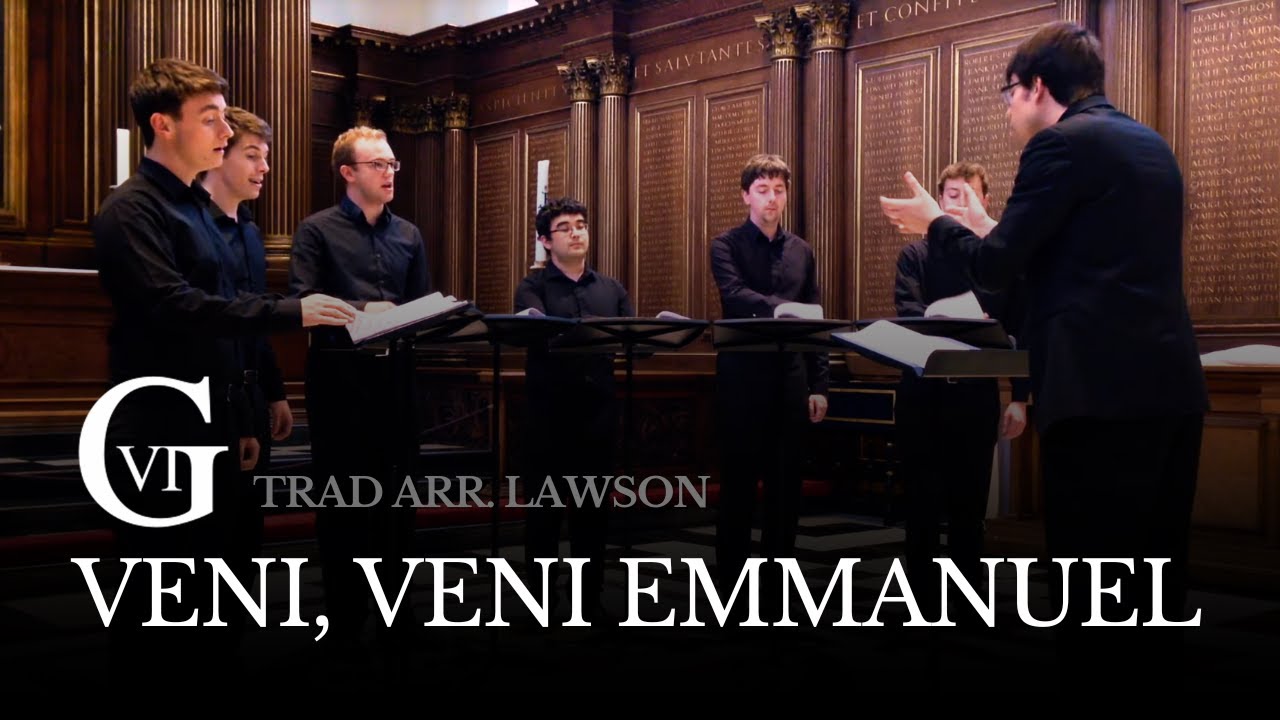
The Gesualdo Six: Veni, Veni Emmanuel arr. Lawson
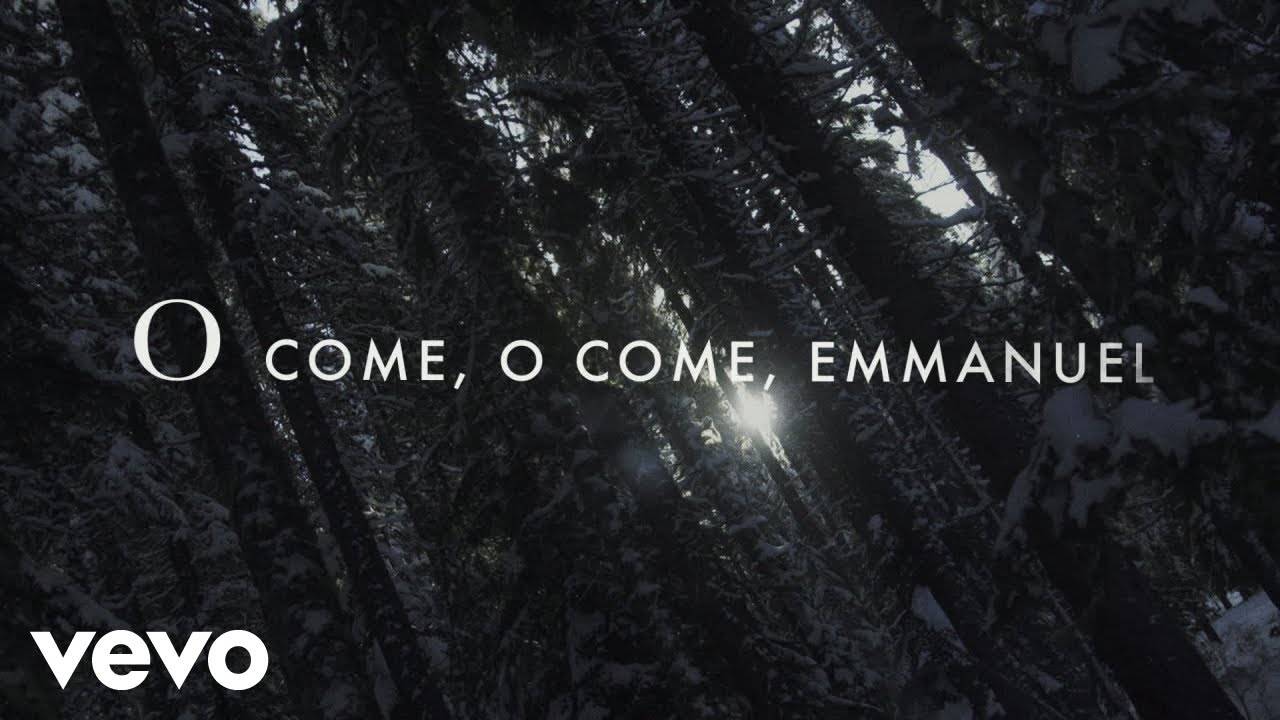
Chris Tomlin - O Come, O Come Emmanuel (Lyric Video)

            Some of the most creative works inspired by the O Antiphons have been extended meditations on their content and meaning, meditations that are works of literature in themselves. One of the first was a ninth-century Anglo-Saxon poem of 439 alliterative lines by an unknown author that literary scholars call Christ I. Its theme is Advent—scriptural history before Christ’s birth—it has twelve sections that are actually independent poems, and each of the sections is based upon an O antiphon, either one of the original seven or one of the many medieval extras. I recommend the blog A Clerk of Oxford, maintained by an anonymous scholar of Anglo-Saxon literature who has translated Christ I from its Old English original:

Now that child is come,
born to relieve the works of the Hebrews,
brings joy to you, unlooses the chains
fastened by evil.

“Here, the…words close a poem confident that comfort and joy have come, that winter’s fetters will be loosened, that the nearoþearfe, ‘pressing, terrible need’, will be met,” the blogger writes. The Clerk’s blog also displays photos of beautiful medieval manuscript illuminations inspired by the O Antiphons. The capital letter O itself turns out to be a generous and symmetrical frame for gorgeous miniatures.

            But Advent meditations deriving from the O Antiphons aren’t just for scholars. Katy Carl, novelist and editor of the literary quarterly Dappled Things, has a book, Praying the Great O Antiphons: My Soul Magnifies the Lord, that is aimed as people who might not know Latin, who might not have time to pray Vespers, and who might not be experienced in contemplative prayer, but might wish to recite an O Antiphon while lighting the candles on an Advent wreath or adding the text to daily prayers. It was an out-of-the blue assignment—“not my field of expertise”–for Carl, she said in a phone interview. Her husband, Brian Carl, director of the Center for Thomistic Studies at the University of St. Thomas in Houston, had been posting his own translations of the antiphons on social media, and they caught the attention of the London-based Catholic Truth Society, which, through connections, contacted Katy Carl to write the book (she did not use translations by her husband, however).

             Carl decided to connect the antiphons to the Magnificat, which she said was the pregnant Mary’s exercise in the kind of verbal creativity that is the stuff of writers. “The creativity of the O Antiphons is a Marian creativity,” Carl said. “They’re read through a Marian lens. The Magnificat is a unique distillation of Old Testament prophecies in a distinctly poetic voice.” In her book Carl writes: “Mary spent time being educated in the Temple; she would have been deeply familiar with the Scriptures. St. Augustine tells us that she conceived Christ in her heart and mind before she conceived him in her body.”

            Mary, the mother of Jesus, as the first Christian poet. And what a torrent of Christian creativity she loosened on that very first Advent.  

The Love Song of Our Lady of O

Expectans Expectavi

With expectation I have waited for the Lord, 
and he was attentive to me.— Psalm 39:2,
Douay Rheims Bible 


Knowing you so near, I yearned to know you,
O Wisdom.
Trembling, I bent and bowed towards you,
O Lord.


Searching the Scriptures, I sought you,
O Root of Jesse.
Awaiting David’s son, I awaited you,
O Key of David.


Longing for light, I long longed for you,
O Dayspring.
Hoping, I hoped with all who hoped for you,
O King of Nations.


Expecting now, I expect you, tomorrow,
You are coming—through only human me—
Long desired One, to make your people free.
O God with us—Emmanuel.


Roseanne Sullivan writes on art, culture, and liturgy for Latin Mass Magazine, the New Liturgical Movement, Regina MagazineNational Catholic Register, and the Dappled Things blog. She serves as a Facebook page editor at both the Benedict XVI Institute and Catholic ArtsToday.

Editor’s Note:

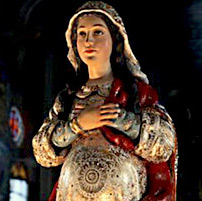
On December 18, in the waning days of Advent,  a feast was dedicated to Our Lady’s expectation of her son’s birth. Because an ancient law of the Church prohibited the celebration of feasts during Lent, the Tenth Council of Toledo in 656 A.D. transferred the feast of the Annunciation from March 23 to December 18. Eventually, Annunciation regained its former day. So December 18 later came to be known as the Feast of the Expectation of the Blessed Virgin Mary,  commonly called Santa Maria de la O, even in the liturgical books. Though seemingly related to the O Antiphons (of which O Come, O Come Emmanuel has become the most well-known) the 1909 Catholic Encyclopedia states that name “Our Lady of O” stems from the custom of the clerics in the choir after Vespers on that day to utter a loud and protracted “O,” expressing the longing of the universe for the coming of the Redeemer. The statue above, presenting the roundness of the pregnant Virgin,  naturally represents Our Lady of O, although its provenance is unknown. Our Lady of O was chosen for honorable mention in the Catholic Literary Arts Advent Sacred Poetry Contest in 2020.

New Poem: Nativity

Nativity

Forget your Christmas cards and little creche
the cutesy donkey, sheep and shepherd boys.
Put away the twinkle lights and all that trash;
the candy, carols, cards and tacky toys.


For there in your safe familiar manger
lies something that should shock and terrify—
a mewling, interstellar stranger,
an undercover agent—infant spy.


He promises to turn every table
and become an unrelenting master.
making the satisfied world unstable
and lashing the complacent with disaster.


Here shivers something unpredictable—
divine but defined, swaddled yet wild.
Here is something tender and terrible—
a feisty girl and her dangerous child.


Fr Dwight Longenecker is a parish priest, blogger, author, playwright and poet. Follow him at dwightlongenecker.com

Subscribe to Our Emails