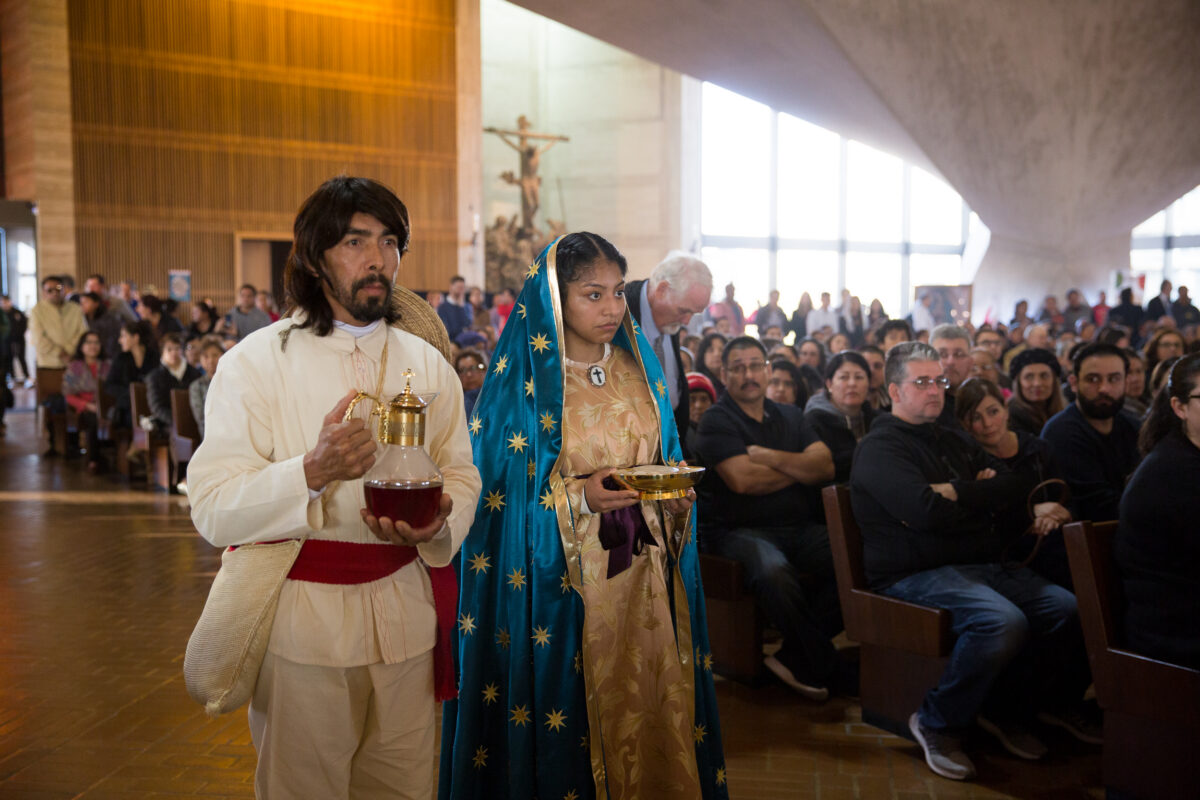
“Gloriosa Dicta Sunt De Te”


“Gloriosa Dicta Sunt De Te”
When we think of our land, we often think
Of those bare wilds waiting to be claimed,
As if it were a force of will alone
That made it ours, and mixing sweat with dust,
Its matter with our labor, what was nothing
Becomes somehow a thing that might be loved,
Be built upon and put to use, defended.
I have been one of those who stand in awe
Of pioneers and makers of great things,
Of those who slice a sharp spade through thick roots.
How much less often do we think of land
Not as the stuff lain idle to be grabbed,
But as a stage, a platform where we stand.
Not empty, for upon it we depend;
Not arbitrary, for it’s all been formed
So long before our dawning that we sense
A hundred histories have gone to dust
Deepening the hillsides, carving out its rivers.
How rarely do we think of it as place,
As scene where destinies are shaped by grace.
So, in my childhood, the lakeside chapel,
Modest and plain, shaped like a wooden boat,
Where I heard Mass in summertime, was named
For St. de Porres, and he prayed for us,
Though all I knew about him was his name.
And so, in Maryland and San Francisco,
The place is named not for what we have done there,
But for what we hope we might still receive:
The walls of city, home, and church designed
Just to contain what grace will fill them with.
So, sitting in my classroom, as a boy,
The school named for Saint Thomas of Aquino,
I heard my teacher speak of Michigan,
Of Joliet, Doblan, and Père Marquette.
And, telling us their stories, she unfolded
Another history than the one we’re used to.
One in which, by the Holy Spirit’s grace,
Men slipped along the wilderness’s veins,
Bearing such names as, hitherto unspoken,
Might be, to consecrate a land of saints.
For, naming is a kind of grace not deed.
It clarifies what was not understood,
Such that, what outwardly remains the same
Becomes itself more fully and more truly,
Transformed within by the articulate light.
To lay above a saint’s bones on the shore;
To pray the words that saints have prayed before;
To name and know what comes forth from the darkness;
These are the occupations of a place,
Its purpose and its glory and its grace.
Editor’s Note: This is part 5 from James Matthew Wilson’s new song cycle, The River of the Immaculate Conception which may be purchased from Wiseblood Books. The title translates as “Glorious Things Have Been Said of You.” This is first a quotation from Psalm 87, where it refers to “The City of God.” But it is also a quotation from a Gregorian chant celebrating the Immaculate Conception: “Glorious things have been proclaimed concerning you, O Mary; for the Almighty has
done marvelous things on your behalf.”
done marvelous things on your behalf.”