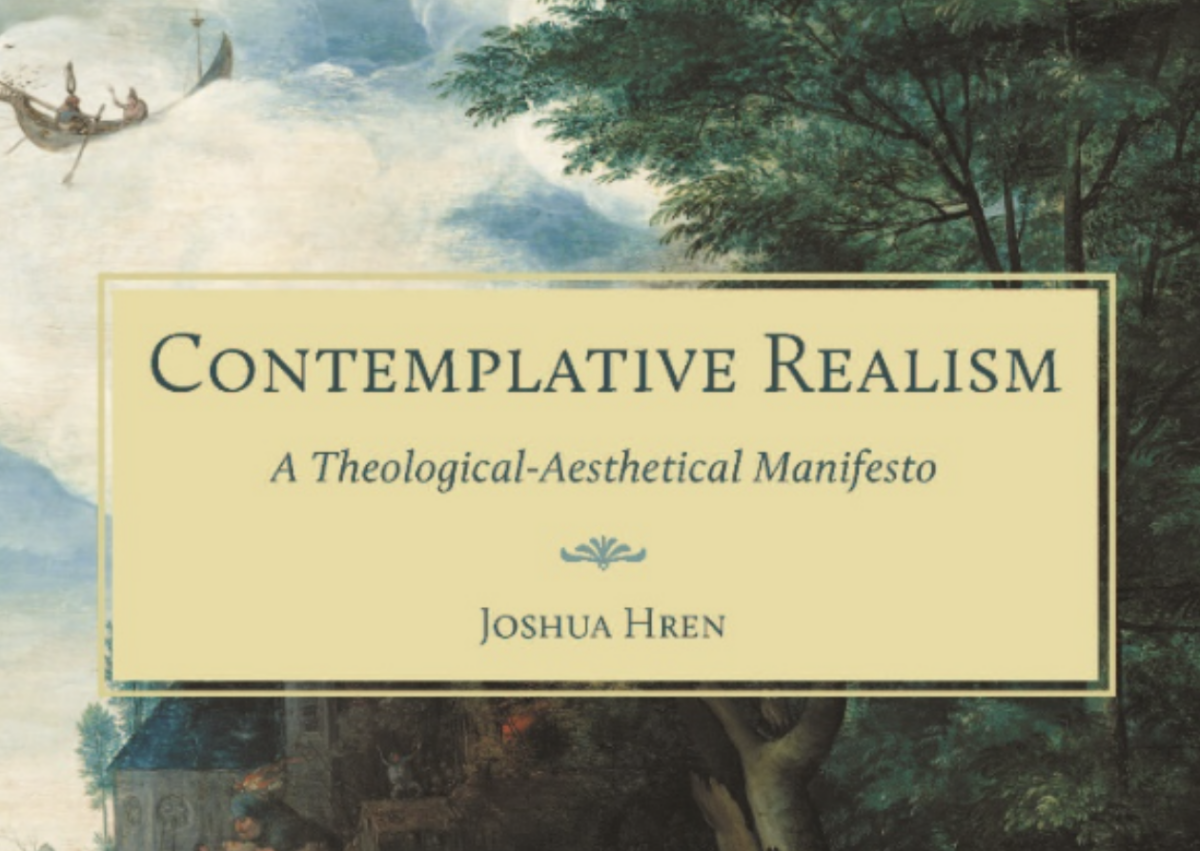
In February 2022 the Benedict XVI Institute published Joshua Hren’s Contemplative Realism: A Theological-Aesthetical Manifesto, by Joshua Hren, founder of Wiseblood Books, co-founder of the Master of Fine Arts in Creative Writing program at the University of St. Thomas in Houston, and prolific novelist, poet, and essayist. His essays and poems have appeared frequently in such periodicals as First Things, America, Commonweal, National Review, Catholic World Report, and Law & Liberty. His books include two collections of short stories, This Our Exile (2017) and In the Wine Press (2020); the book of poems Last Things, First Things, and Other Lost Causes (forthcoming, 2022); Middle-Earth and the Return of the Common Good: J.R.R. Tolkien and Political Philosophy (2018); How to Read (and Write) Like a Catholic (2021); and the novel Infinite Regress (2022).
A recent article in Mere Orthodoxy explains Contemplative Realism’s germinal yearning. John-Paul Heil reviews the report in The University Bookman, “Only the Lover Writes,” and, a review of both Contemplative Realism and Benjamin Myers’ book appeared over at Voegelin View: “Literature for the Recovery of Reality: Joshua Hren and Benjamin Myers’ Christian Vision for Literature.”
Contemplative Realism is Hren’s response to Pope Benedict XVI’s summons to writers to “ask rather more carefully what ‘the real’ actually is.” “Are we not interested in the cosmos anymore?” Benedict asks. “[T]he man who puts to one side the reality of God is a realist only in appearance.”
Hren takes up this challenge. Since its origins in the eighteenth century, Western fiction has for the most part eschewed the metaphysical—the presence of the divine behind the scrim of the visible world—to present a “reality” limited to the surface conditions of day-to-day modern life and thus often, although not always, infused with bleakness, black humor, cynicism, and despair. Any sense that some other reality might exist is reserved for the genre of fantasy. Contemplative Realism aims to define the response that a Christian writer of fiction might have to this self-imposed limitation: crafting a distinctive literature that includes ultimate as well as surface reality. The models already exist: Dostoevsky, Flannery O’Connor, Marilynne Robinson. Hren writes:
The underbellies of our civilizations and the cesspools rank in the pockets of our souls are real. They rightly make us reel. Sometimes the vestiges of God in the world can seem scarce or scattered relative to the apparent success of raw evil. At this juncture the contemplative realist seeks to stoke reverence for the reality of the Paschal mystery—a passion, death and Resurrection that is more real than an infinite tally of the sins and the frightening fissures, the apparently irreversible cracks in existence. But, countenancing the same absurdities that unnerved Camus and the existentialists, the contemplative realist will prevent his story’s perspective from relishing the farcical or capitulating to the cruel to the point of souring cynical even as (fiction being largely a record of man in rebellion), a large part of his work consists of drawing out the spiritual intensities of man’s refusal to serve.
and:
The contemplative realist, considering the actual existence of things, at once sees them as we were meant to see them and also shows the rest of us how to see them. Sometimes he shows us the same thing several times, in several ways, leading us up the ladder of perception to a fuller share in the beauty of being: superficially first, operating in the mode of “how things are” in their apparent blasé “nothing to see here” state, or scattered in apparent disorder; then, as St. Bonaventure puts it, “he considers things in themselves,” namely, in their matter and substance, power and activity, measure and motion, and from here “the observer can rise, as from a vestige, to the knowledge of the immense power, wisdom, and goodness of the Creator.” The contemplative, as contemplative, can achieve this ascent without needing to communicate it at all. No one, says Bonaventure, “arrives at contemplation except through penetrating meditation, holy living, and devout prayer.” The contemplative realist surely needs these things and more. Wedded to the word and world in a different manner, the contemplative realist must manifest this perception in his prose.
Hren’s Manifesto, besides being a beautifully written and passionately argued 64-page book, is an actual manifesto. Hren has garnered the signatures of a number of Catholic writers who endorse his theory of a distinctively Christian approach to literature.
Catholic Arts Today has decided to engage Hren’s intriguing and challenging theories. To that end, we have posed some questions his manifesto raises to its signatories. What follows is a kind of symposium, a conversation we have cobbled together from our questions and the responses of five of the signatories.
Besides Joshua Hren himself, the signers of the Manifesto participating in the conversation include:
–Glen Arbery, president of Wyoming Catholic College and author of Why Literature Matters (2001) and the novels Bearings and Distances (2015) and Boundaries of Eden (2020).
–Katy Carl, editor-in-chief of Dappled Things and author of the novel As Earth Without Water (2021) and Praying the Great O Antiphons: My Soul Magnifies the Lord (2021).
–Sarah Cortez, author or editor of 14 collections of poems and essays, including Tired, Hungry, Standing in Spot for Twelve Hours: Essential Cop Essays (2019), third-place winner of the National Federation of Press Women’s nonfiction award.
–Benjamin Myers, professor of literature at Oklahoma Baptist University, author of three books of poetry, and 2015-2016 Poet Laureate of the state of Oklahoma.
–James Matthew Wilson, poet-in-residence at the Benedict XVI Institute, director of the Master of Fine Arts program at the University of St. Thomas in Houston, and author of eleven books, including six books and chapbooks of poetry.
Catholic Arts Today: How would you distinguish contemplative realism as a fictional mode from realistic fiction that happens to have been written by a Catholic writer? For example, there’s Flannery O’Connor’s wonderful story “Everything That Rises Must Converge,” about the black and white mothers who meet on a newly integrated Southern bus and have no ability to understand or even perceive each other (not to mention the white mother’s oh-so-sophisticated but comically obtuse son). We know that O’Connor was a Catholic writer who took seriously the mysterious workings of grace in the human heart–so we might classify this story as a work of contemplative realism. But a secular admirer of O’Connor–and there are many–might see the story as a strictly secular story of the tragedy of the human condition–something that all good secular writers as well as Christian writers recognize. Why is this story an example of contemplative realism–in contrast to just plain realism as explicated by a talented and observant writer?
James Matthew Wilson: In my view, Contemplative Realism is not a manifesto positing a new or specialized literary practice or poetics, though it may have touches of that. It is rather an insistence that contemporary literature recover the fullness of breadth and depth proper to the great literature of every age. Odysseus descends to the underworld. Aeneas descends to the underworld. Since Dante, our knowledge of the real comprehends the descent into mystery and the ascent to the divine essence. Not all art can have such a cosmic scope; the minute, particular, and immanent is also a worthy theme for literature. But once we have seen those grand or awesome vistas, art is itself transformed. The weakness to which Joshua is responding is that, with full knowledge of how revelation and grace have transformed what we know about nature, so much contemporary art proceeds as if nothing had changed. It shies away from grandeur, it fumbles in knowing ignorance, and settles for a foreshortened horizon that even the unbeliever knows is not the full range of the spirit. Art does not tolerate special pleading, but it becomes a lie when it pretends to be utterly unaware of things just because its authors do not like them or believe in them or feel capable of speaking of them.
Katy Carl: This question helps to clarify that contemplative realism is not being presented as though it were the one and only “right” way to be a “Catholic writer” (that fraught, much-contested term) or even a spiritual writer. Rather, it serves to articulate one aesthetic approach to literature that is deeply consonant with the best of the Catholic intellectual and spiritual tradition. We can locate it among a multiplicity of “Christian realisms” whose emphases may vary. O’Connor, who considered herself a “Christian realist” and as such also a “prophet of distances,” has a voice so sui generis that any imitation must pale beside the original. The secret of her genius was not “violence” or even “hillbilly Thomism” but the gift to see things as only she could see them.
As you rightly notice, this is the work of any writer worth her salt, regardless of that writer’s other beliefs. But for a writer who starts from a position not of habitual doubt or materialist skepticism but of enthusiastic assent that what the Church proposes and believes in the Creeds is essentially true, what is seen and how it is seen will shift. This is what O’Connor meant when she said doctrine was an instrument of vision, not an obstacle to vision. Jacques Maritain is also on to this when he speaks of the altitude from which an artist is able to see. To my mind, a contemplative realist seeks to dramatize the point of intersection between the vertical axis of human experience, the aspiration toward God, and the horizontal axis of the observable world.
Catholic Arts Today: Conversely, what’s to distinguish a work by a secular writer who happens to “show the rest of us how to see…the actual existence of things” and a work by a contemplative realist? Take Hemingway’s 1927 story “Hills Like White Elephants,” about a young woman being pressured by her boyfriend into having an abortion. This story is an extraordinary narrative of “the actual existence of things”: the girl’s horrifying realization of the ultimate sterility–and shallowness–of the pair’s months-long relationship that is in fact like the dry, barren condition of the hills in the Ebro Valley. Was Hemingway a writer of contemplative realism manqué? Or just a secular writer who could see inconvenient truths? How would a Catholic writer have handled the story any differently?
Katy Carl: The virtue and the liability of Hemingway’s pared-down style both dwell in the power of suggestion by omission. Speaking just for myself as a reader, I find this power can be brilliantly used or pursued to a fault, depending on the context, and in “Hills Like White Elephants” the brilliance all comes across in the felt absence of love. This absence is only too realistic in the story’s context, but if it were all we could expect from reality on or off the page, we’d be right to despair. It’s much harder to write unsentimentally, truthfully, about the presence of love than about its frequent absences and failures in human behavior. This is especially true when you’re dealing with characters who have numbed themselves beyond the reach of feeling or connecting with any love that may be present in the situation. The contemplative realist is always on the search for a suggestion of the “Love that moves the sun and other stars,” whether or not a particular story’s characters are similarly inclined.
To return to O’Connor, think of her Haze Motes in Wise Blood, charging through the streets of Taulkinham, as hellbent on sustaining his own misery as either of Hemingway’s lovers here—but O’Connor calls our attention beyond and above the misery in a way Hemingway might have considered cheating because it reaches beyond the senses, though you couldn’t with any justice call it distanced from the senses either. Again, O’Connor makes that attempt to discover the sensorially rendered intersection of the vertical and horizontal planes, which Hemingway might have seen as a pointless exercise but which, to a contemplative realist, is almost the whole point.
Benjamin Myers: I think it is important to note that the signs of the transcendent are in the reality depicted by the fiction not just in the words of the story. Two photographers might capture two images of the same bright light, one calling it a trick of the lens and one calling it an angel, but it cannot be both. If it is an angel, then they have both taken a photograph of an angel, regardless of one photographer’s ignorance of that truth. In other words, the more talented and observant a writer is, the more difficult it would be for that writer to be merely a “plain realist,” regardless of the writer’s awareness of what true reality he or she may be capturing in fiction. (Of course, the artist who knows what he or she is depicting has an advantage). Nihilism and materialism require scant attention to the nature of things, but many great writers have been of God’s party without knowing it.
Sarah Cortez: Especially within the Catholic (Christian) worldview, intentionality is paramount because sin requires intentionality, just as not sinning does. Therefore, I would say that great or even good writers who undercover layers of meaning in their work, even metaphysical meaning, may not necessarily have the contemplative realist goal in mind due to lack of intentionality.
Catholic Arts Today: Joshua has pointed to a cynicism, nihilism, and despair that he suggests is a cornerstone of the realistic tradition. He cites the novels of Balzac, Flaubert, Camus, and Jonathan Franzen as some of his examples. But is this dichotomy the only way to contrast the realistic tradition with contemplative realism? What about novelists and story-writers of manners, such as Trollope, George Eliot, Chekhov, Nabokov, A.S. Byatt, and others who simply aren’t interested in metaphysical reality? Where do they stand in the realism vs. contemplative realism dichotomy?
Benjamin Myers: The signs of the transcendent are not always spectacular. The bread and the cup are household things. When a writer is observant of what is, even in the “mundane,” the transcendent can come through, though a writer such as Trollope or Chekhov will certainly often, whether consciously or unconsciously, attempt to stifle that transcendence. That is one kind of materialist realism, a blessedly failing kind at times– or blessed to the extent that it fails. In Nabokov I sense a greater awareness of what is missing, a yearning for transcendence that the writer feels as near but refuses to believe in. In such cases the frustrated yearning itself can become a kind of sign of the transcendent, when the writer is sharp enough.
James Matthew Wilson: Hans Urs von Balthasar says that the Christian must be the guardian of metaphysics in the present age. So is it with the Catholic or contemplative-realist writer. Some authors have little or no metaphysical scope to their work and the work suffers for it, even if the work can still — and with ease — be affirmed as good, or even very good. Literature always faces the temptation to become secular, whether in an imitation of classical humanism or a vulgar politicization of aesthetic form or in a mere playful romanticism. One does not need to deny the value that may be found in each of these secular visions to observe that they do not tell the whole story. It’s my hope that my work celebrates the discipline and reason of the human spirit in keeping with the best aspects of classicism, while it also keeps the work open to the transcendent. A vision of the secular, and of the merely human, always implies by its own internal essence and existence, the presence of that which transcends it. Paul Claudel wrote of this often in his poetry: to study the nature of things is to study causality, and, for Claudel, the only cause was that of the God who created all things and held them in relation to one another.
Catholic Arts Today: Can you be a Catholic novelist (or poet or screenwriter) without being a contemplative realist? What about such Catholic novelists as Robert Stone, Alice McDermott, Phil Klay, and Kirsten Valdez Quade, who have brought their Catholicism to their writing and dealt with serious questions of faith, salvation, and morality in their fiction. What might separate them from contemplative realists?
Joshua Hren: Many contemporary Catholic writers operating in different veins contain considerable goods. As I note in a piece for University Bookman, Phil Klay’s Missionaries contains a stunning intrusion of Christ onto the scene. I also appreciate much that is happening in the realism of Christopher Beha–both in What Happened to Sophie Wilder and The Index of Self-Destructive Acts. And then there’s Randy Boyagoda’s comic contributions to contemporary Catholic letters, Dante’s Indiana, which I’ve reviewed at Law & Liberty.
In How to Read (and Write) Like a Catholic, I outline three main ways that we can approach the goods of literature:
1. The study of literature as the study of human nature, which is to say the study of ancient texts in order to obtain a greater understanding of human passions and ends, possibilities and limits, to witness man’s innate social nature, to hear the whispers of natural law as it chastens man in rebellion, and to consider how the human story unfolds outside of a direct encounter with Christian revelation. (This does not exclude reading the deep meanings of these works according to the light of Christ.)
2. The study of literature that is intrinsically Catholic. This can be undertaken through an examination of the presence of metanoia (conversion) in great literary texts; through a consideration of the way in which writers dramatize the workings of grace upon nature; and through a sacramental approach that sees the ways in which seen images point to unseen realities–a cultivation of the capacity to, in Flannery O’Connor’s words, see evil as “a mystery to be endured” and “not a problem to be solved.”
3. The study of “Christ-haunted” fictions–the persistence, often in traces or in veiled form, of Catholic ideas, images, and tradition in purportedly secular or postmodern poetry and stories, as well as literature grappling with faith within an increasingly secularized literary canon.
Catholic Arts Today: Is there a temptation for the contemplative realist to be complacent, to write simple dichotomies of faith versus its lack, to elide over despair and doubt? How can a contemplative realist avoid that trap?
Glenn Arbery: Chaucer makes fun of such complacency and such “dichotomies of faith versus its lack” in “The Prioress’s Tale,” the horrifically pious story of a sweet Catholic boy killed by demonic Jews. He mercilessly satirizes the Prioress herself in the General Prologue of The Canterbury Tales, but he is just as satirical about the Miller, whose tale of sexual antics remains both hilarious and outrageous.
Contemplative realism means taking the world as we actually experience it. When Joshua coined the term, I don’t think he meant to suggest a new approach but rather to emphasize that the Catholic writer has never needed to be afraid to face the whole truth of things, which necessarily includes spiritual levels. I get the impression that some Catholics are horrified by depictions of eros or bad language or violence–I think of Flannery O’Connor’s Wise Blood or her stories “Good Country People” or “Greenleaf” (not to mention most of Walker Percy)–as though the faith could not stand up to them. But, even more than when O’Connor or Percy were writing, the culture we inhabit promotes “expressive individualism,” which negates the very idea of transgression, and one thing we need is to see sin as sin.
The imaginations of children might need to be protected (even from some passages in the Bible), but the mature imagination needs the real world of beauty and transgression, misery and grace. It’s important to present people in their self-consciousness and the allure of sin without glamorizing evil, and also to present them in their prayer, their doubt, their suffering, because these are realities that must be worked through with fear and trembling.
I would argue that the Catholic writer has this advantage: he or she does not have to invent the whole meaning. The world is given and given with intention — it already has meaning. If fiction is any good, it is patterned upon real observation, which means that it is the interpretive discovery of what is already there. Instead of having to force layers of meaning into the fiction, the Catholic open to givenness and divine intention can trust that in pursuing the beauty of the work, he or she does not have to intend every meaning consciously. As Jesus says, “a good measure, packed together, shaken down, and overflowing, will be poured into your lap.”
Sarah Cortez: Simplicity of both worldview and of artistic expression can always be a wily seducer. Within the context of this manifesto, however, the only “simplicities” stated are spiritual truths which because of their inherent nature defy their apparent simplicity due to their origin in the Divine nature of God. Thus, the writer, in particular, is left with the task of bringing to the page truths grounded in the many mysteries God has placed within human nature, and each person’s torments and joys as his individual salvation is worked out within a luminous but crazy world.
Joshua Hren: My manifesto on behalf of a “contemplative realism” makes no claims to create, ex nihilo,a new aesthetical species. Nor does it advance this rough school of literary fish as some preeminent or sole “way forward” for fiction in our time. It makes the case for an aesthetic that does not negate so much as it develops the goods of realism. It makes the case for an aesthetic that is consciously committed to unflinchingly gazing at the brokenness and terrifying aspects of nature, resisting the notion that what is “most real” is most evil or difficult to countenance, and yet representing the innumerable crosses in nature and the startling fissures in nature, even as it also gives witness to what St. Bonaventure calls the “vestiges of God” found in the creative world, and the heroic sanctity that can be cultivated even in unpropitious environs.
My manifesto seeks to articulate a literary approach that exists already in diffuse books and also in the potencies of living artists. It seeks to gather and galvanize those souls. It is a soul cry to break through restrictive bonds of the culture we inherited, and yet to be in conversation with our fellow artists who are not believers but who have tremendous natural insights into the state of contemporary fiction or the prospects of the novel in an age of diminishing readers. Amidst this conversation, we necessarily critique the deficiencies of those realisms that reduce what is most real to the seen.