Expectans Expectavi
With expectation I have waited for the Lord,
and he was attentive to me.— Psalm 39:2,
Douay Rheims Bible
Knowing you so near, I yearned to know you,
O Wisdom.
Trembling, I bent and bowed towards you,
O Lord.
Searching the Scriptures, I sought you,
O Root of Jesse.
Awaiting David’s son, I awaited you,
O Key of David.
Longing for light, I long longed for you,
O Dayspring.
Hoping, I hoped with all who hoped for you,
O King of Nations.
Expecting now, I expect you, tomorrow,
You are coming—through only human me—
Long desired One, to make your people free.
O God with us—Emmanuel.
Roseanne Sullivan writes on art, culture, and liturgy for Latin Mass Magazine, the New Liturgical Movement, Regina Magazine, National Catholic Register, and the Dappled Things blog. She serves as a Facebook page editor at both the Benedict XVI Institute and Catholic ArtsToday.
Editor’s Note:
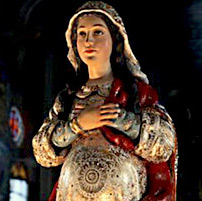
On December 18, in the waning days of Advent, a feast was dedicated to Our Lady’s expectation of her son’s birth. Because an ancient law of the Church prohibited the celebration of feasts during Lent, the Tenth Council of Toledo in 656 A.D. transferred the feast of the Annunciation from March 23 to December 18. Eventually, Annunciation regained its former day. So December 18 later came to be known as the Feast of the Expectation of the Blessed Virgin Mary, commonly called Santa Maria de la O, even in the liturgical books. Though seemingly related to the O Antiphons (of which O Come, O Come Emmanuel has become the most well-known) the 1909 Catholic Encyclopedia states that name “Our Lady of O” stems from the custom of the clerics in the choir after Vespers on that day to utter a loud and protracted “O,” expressing the longing of the universe for the coming of the Redeemer. The statue above, presenting the roundness of the pregnant Virgin, naturally represents Our Lady of O, although its provenance is unknown. Our Lady of O was chosen for honorable mention in the Catholic Literary Arts Advent Sacred Poetry Contest in 2020.