Daniel Knaggs Composes Music as an Icon for the Sacred

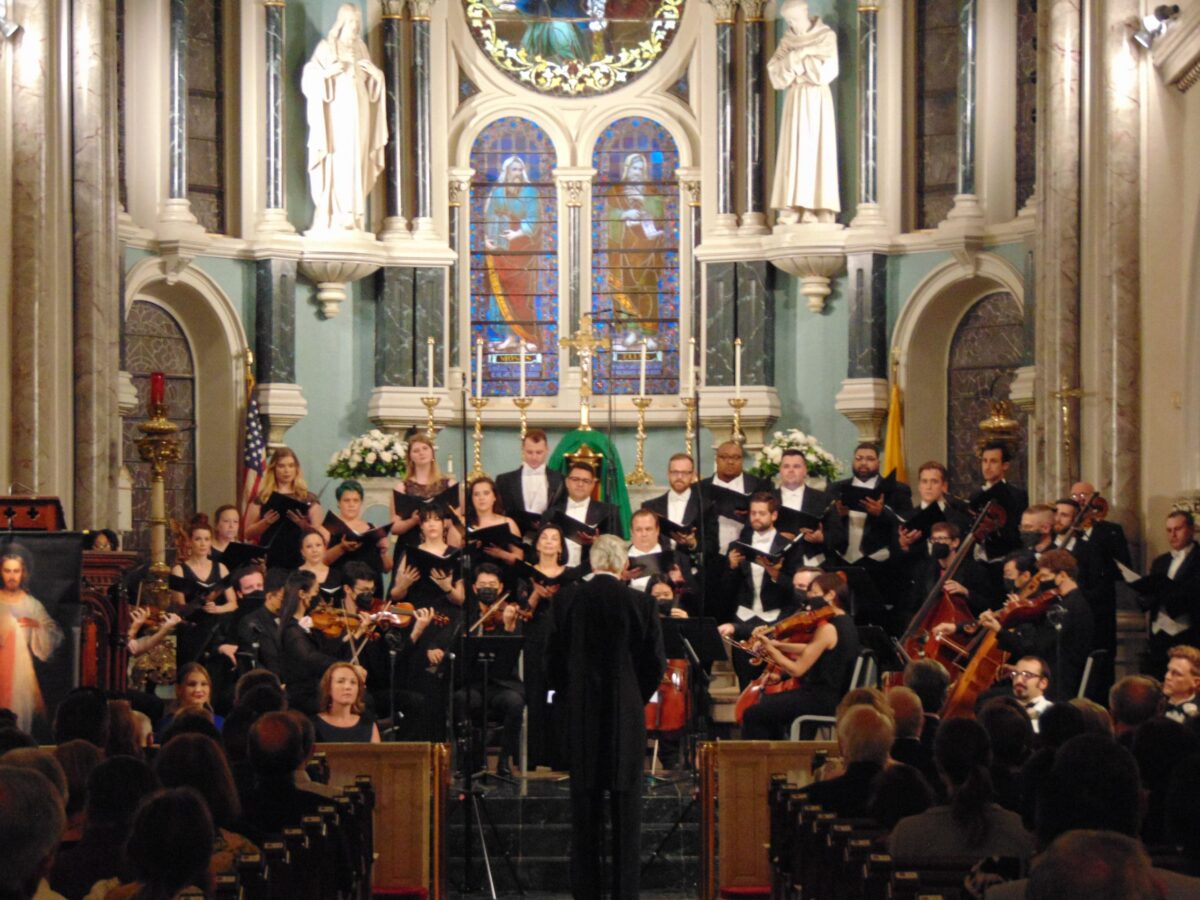
American composer Daniel Knaggs premiered his Two Streams, a cantata based on Jesus Christ’s message of Divine Mercy for mankind, last fall in Houston, Texas.  The concert celebrated the historic Church of the Annunciation’s 150-year anniversary in a gala evening event with almost 400 in attendance. The interior of the Romanesque-Gothic Church, a virtual jewel-box of carved marble, serene statues, and the original 19th-century stained glass, showcased the sacred music within vibrant architectural beauty.
Knaggs - Two Streams trailer

            Two Streams is Knaggs’ most substantial project in an award-winning career that includes commissions, prizes, and awards for composition from around the globe.  The initial impetus for the piece arose from Knaggs’ desire to compose music in response to his experiences in the Polish cities of Kracow, Warsaw, and Gdansk, the city now famous for the Solidarity movement’s founding and contribution to the downfall of Soviet Communism. Knaggs’ strong attraction to the Diary of St. Maria Faustina Kowalska, which revealed God’s message of Divine Mercy, provided the touchstone for the piece’s ultimate grounding and spiritual context. He says, “The idea of a God who is merciful to a fault disarms me. This is our God whose greatest attribute is His unending mercy for us and which He wants us to spread throughout the world.”  The sudden and premature death of Knaggs’ father just after the commissioning of the piece brought a deeply felt personal dimension to the spiritual reassurance of Christ’s Divine Mercy. The title of the piece, Two Streams, evokes the two rays emanating from the image Christ asked St. Faustina to have painted of His Divine Mercy: a white stream of life-giving grace and the red stream of purifying grace flowing from His heart.

            For Knaggs, the composition of music is a painstaking process.  He says, “You have to be in it for the long haul—to be able to work with a piece until every feature is right.”  Both spiritual and practical aspects influence a composer, like Knaggs, whose goal is participation in conveying metaphysical or spiritual aspects beyond daily reality.  He says, “In composing, we are indebted to what has come before us, for example, chant, polyphony. When you write music, you have the ability to bring in the register and range of voices, dynamics of soft and loud, keys and tonality to add to the meaning. One movement of Two Streams has no words, but I believe things are being conveyed. If someone tried to write music without a belief in the spiritual truths, the audience would know.”

            Two Streams has 14 movements based on texts from three sources: the Diary of St. Faustina, Scripture, and liturgical texts. The movements are arranged symmetrically with the first and last movements related, the second and the 13th, and so on.  Four hymns (songs) of Mercy are interspersed between the movements to ground the listener in both trust and joy. Each song  features a hymnic stanza sung in English with a subsequent hymn of Mercy sung in Latin. The intention is to depict a timeless scriptural echo of the content in each hymn’s stanza which then ripples eternally throughout the past, present, and future. An example of this structure is the Song of Mercy II sung by the mezzo-soprano soloist. While it is joyous, the hymn spills over into the contemplative Latin section with the words: “Show us your mercy, O Lord, and grant us your salvation.”

                        You gush forth from the Divine Trinity,

                        But from one single womb filled with love.

                        The mercy of the Lord will be revealed in the soul

                        In all its fullness when the veils falls.

                        Ostende nobis Domine misericordiam tuam. Et

                        salutare tuum da nobis.

While Knaggs, who has studied six languages, simultaneously composed versions of the entire cantata in English and Polish, the liturgical texts of both are in Latin and Greek with the Scriptural texts in Latin. The simple yet powerful words within the composition were chosen by Knaggs. He says, “[The words] speak to the fragility of the human experience. And they speak to the transcendent hope that God offers us.” The music forms a seamless and rich tapestry weaving together threads from many eras including Medieval, Renaissance, Baroque, Classical, Romantic, and contemporary to explore the much needed message of Divine Mercy. The beauty of the music during the premiere is already an argument in favor of its continued appeal to audiences, whether believers or non-believers in the Christian-Catholic faith. 
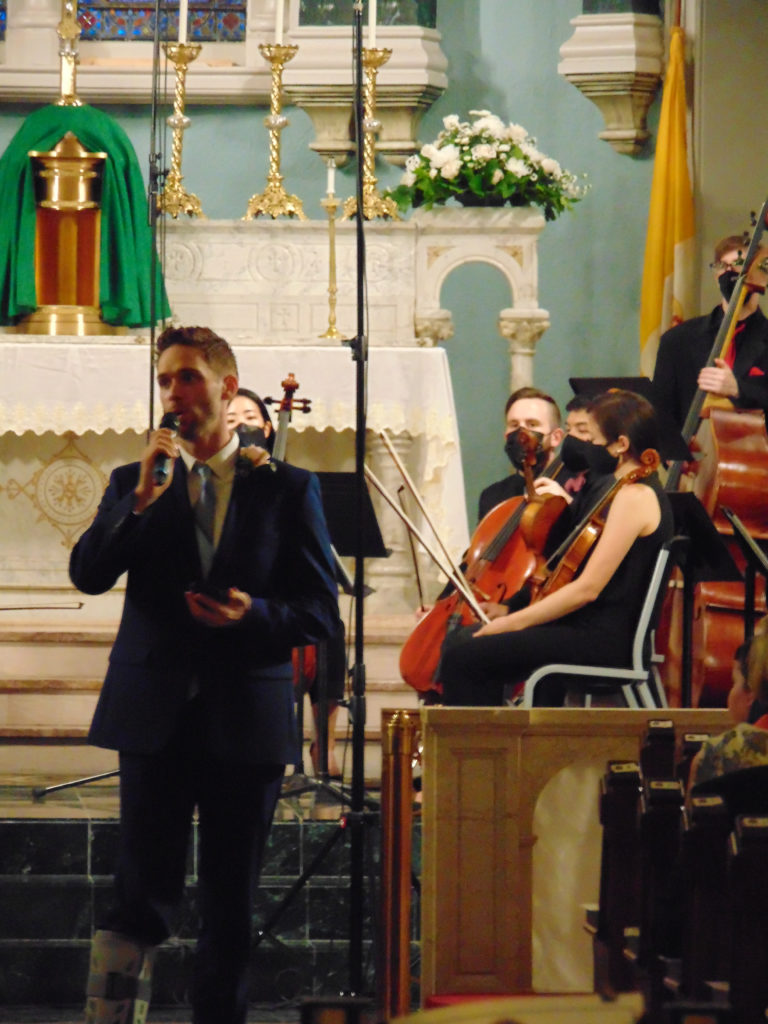
            The location of the Church of the Annunciation in the heart of Houston’s frenetic downtown entertainment district provided yet another way for Two Streams to reach out with its message of Divine Mercy to the surrounding community. The pastor of Annunciation, Rev. Fr. Paul Felix, says, “Our parish can feel the heartbeat of our community.  We want to facilitate and promote the positive interaction of faith and culture. We want to bring the culture into a regard of the deeper issues of faith and a consideration of substantive issues. I heard that even the singers during rehearsals were deeply touched by the message of Divine Mercy. This message was heard by the audience which included parishioners, benefactors, many new visitors, seminarians, priests, and faculty members from several universities.”  

            The Two Streams premiere included the Houston Chamber Choir with director Robert Simpson, the 16-piece Kinetic string ensemble, the Annunciation Schola, and soloists Sasha Cooke, Chris Bozeka, Mark Diamond, and Caitlin Aloia. For Rev. Fr. Paul Felix, the experience of hearing the music for the first time was “very powerful and moving” with its harkening back to the eternal theme of Divine Mercy which informs so much of the daily work of a parish priest’s spiritual and corporal works of mercy, such as hearing Confessions, providing spiritual direction, visiting the sick, etc.  Rev. Fr. Felix says, “The Lord intervened to make St. Faustina the apostle of Divine Mercy.  It is so important for our time to listen.  God gave this message so people could find their way out of sin and evil through the redeeming love of Jesus.”

Knaggs’ most ardent wish for sacred music is that “the music conveys its own eloquence.” The mysterious resides inside music; the experience of hearing the metaphysical or spiritual content allows what Knaggs refers to as “music as an icon.  It is a window that points to a great reality. When people experience music that is not just about itself, they can experience realities beyond the music itself.  Maybe that person then sees there is more to life that just what’s here.  Music is a shared experience. It has a unique ability to reach inside the human heart.”

Sarah Cortez is president and founder of Catholic Literary Arts, www.catholicliteraryarts.org. A freelance writer and editor with fourteen award-winning books to her credit, she resides in Houston, TX. www.poetacortez.com

Return to Liturgical Glory?

How does an artist approach the annals of history, walk amongst the hallowed treasures of Western society, and dare to deposit a work which may remain?

We can’t know what history will say, but we do know the circumstances which often surround the begetting of masterworks: institutional support, financial patronage, initial exposure, and ultimately an artist who does not shrink from embracing the weight of history.

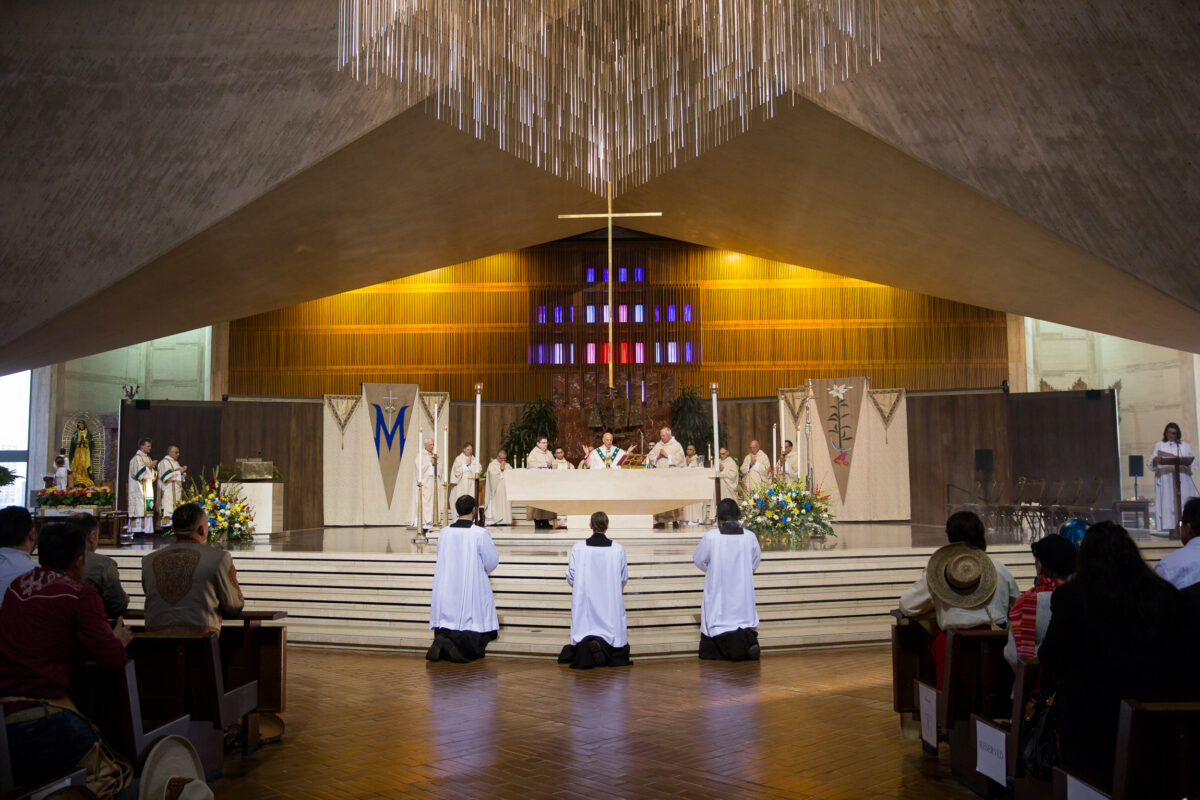
On December 8 at St. Mary’s Cathedral we may have witnessed just such a confluence of forces: a new, magnificent collaboration between the Benedict XVI Institute, the Archdiocese of San Francisco, and the composer Frank LaRocca which birthed the new The Mass for the Americas.

The Mass of the Americas came into being this December 8 on the Feast of the Immaculate Conception. It was also the 25th anniversary of the “Cruzada Guadalupana”, the annual 12-mile pilgrimage through the streets of San Francisco in honor of our Lady of Guadalupe.

And so in honor of Our Lady, Frank La Rocca created what he described as an “intertwined tribute to our Lady of the Immaculate Conception as Patroness of the United States and our Lady of Guadalupe as Patroness of the Americas”.

Whereas new classical music concerts are often happy to draw a dozen attendees, thousands packed the pews at the Mass of the Americas, making it (in one sense) one of the best attended new music events of the 21st century.

And yet in the hands of a lesser composer, it might have been a very public disaster.

The immense crowd entered the cathedral tired from the long walk, excited by the Aztec feathered dancers performing on the Cathedral plaza, entertained by Caballeros on horseback and in many cases making the final march up the aisle to the altar of Our Lady of Guadalupe on their knees.

The reverence of the faithful attending was palpable. But would they really want to sit through a full choral setting at the end of their journey? Would they experience high sacred music as an awe-inspiring beauty or something alien to their cherished community and culture?

These tensions made the Mass of the Americas’ setting as risky as it was ingenious.

Just before the Mass was scheduled to begin, the Aztec dancers processed up the aisle, the large heuhuetl drums pounding, the smaller teponaztli drums keeping time, leg rattles made of shells and seeds shaking, along with native flutes and horns, surely a very strange prelude for a Mass in the high sacred music tradition of the Church.

While the display was impressive, it was also long, and as it died away the unfocused murmur of the tired congregation was evident.

It was precisely in this moment of disarray and disconnect that La Rocca’s quiet Introit began: a stunning combination of hushed strings and gentle tolling hand-bells, murmuring rather than shouting devotion to Christ. A sudden and telling wave of silence rolled across the crowd of the faithful: La Rocca had their attention, with expressions from surprise to the outright riveted visible from this watcher’s vantage point.

It was a fitting rebuke to those who fear our sacred music tradition is somehow unsuited to the contemporary diverse Faithful.

Archbishop Salvatore Cordileone was the principal celebrant, a leader whose vision and patronage set Frank La Rocca to work as the Benedict XVI Institute’s composer-in-residence on “The Mass of the Americas”. Written in Latin, English, Spanish, and the Aztec Nahuatl language, one could easily imagine that La Rocca was simply asked to do too much and to wrangle together too many disparate elements in a liturgical setting neither he nor anyone else had ever attempted.

It was ultimately the unabashed reverence and deep individual devotion of La Rocca’s approach which would carry the day, somehow wrapping up a potentially overambitious idea into a Mass setting which was intimate, personal, deeply considered, and unapologetically beautiful.

If the Introit was hushed in nature, the remainder of the Mass setting moved us all through a narrative arc, all within Frank’s clearly identifiable musical style.

The Kyrie – half in Spanish and half in English – pleaded with simple earnestness, the tolling strings in the accompaniment drawing the congregation further into the penitential aspect of the text.

The Gloria – in Latin – springboarded from the ascetic musings of the Kyrie into an optimistic setting which alternatively proclaimed and soared, giving the skilled sopranos in the choir a chance to move confidently into their upper registers.

One discordant note:  I would have preferred that the Psalm setting, like the Credo, was spoken not sung. Instead, the choice was made to use a second amateur choir to sing a GIA-published setting which (like much of such music) simply could not live up to the full dignity of the liturgy, let alone La Rocca’s deeply considered work or (naturally) a 16-voice professional choir.

I observed, and so did many around me, that a vital bridge between folk culture and the high culture of the liturgy was being rebuilt in La Rocca’s work.  It reminded one of the impressive examples of authentic liturgical and aesthetic enculturation in the south American Baroque sacred music tradition.

As the Mass of the Americas continued, an absolutely stunning setting of the Ave Maria in the Aztec Nahuatl language washed over us.  Set for soprano voice, violin, marimba and organ, this luminous musical exploration seemed to emerge out of the earth itself. The work somehow represented both an ancient people turning to God and the simple prayer of a single person, as if spoken from the heart for the very first time.

La Rocca writes of the piece: “When Our Lady of Guadalupe spoke to Juan Diego, it was in his native tongue.  And so I thought it was important to include the predominant language spoken at that time, in that part of the New World, into the Mass of the Americas.  And this same language, spoken also by Aztec priests in their rituals, is now blessed by the one Catholic faith as it is brought into the celebration of Holy Mass for the Cruzada Guadalupana.”

Soprano Arlyss Hays learned the work quite late in the rehearsal schedule, yet nevertheless delivered a polished and deeply human performance for which the young singer deserves ample praise.

The closing recessional – La Rocca’s Alma Redemptoris Mater – functioned as a stylistic bookend with the opening Introit, with the handbells returning to a similar instrumentation and a comparatively hushed and reverent atmosphere. The opening lines of the work – with tenors and sopranos singing in octaves – echoed plainchant as the strings slowly evolved into a fugal reflection of the opening melodic material, in turn, to be imitated by cascading entrances in the full choir.

During the brief postlude, the Alma Mater Redemptoris melody continued on the organ and the strings began to croon the La Guadalupana. And somehow miraculously, they harmonized.

The Archbishop later confided that he had to hold back tears, such was the power of the Mass of the Americas; many were similarly visibly moved.

For a composition to become something for the ages, the biggest chasm is between the first performance and the elusive and the (for most) unattainable second performance.  Here again, the vision and patronage of Archbishop Cordileone and the Benedict XVI Institute are inspiring. “We’re looking to take this on a Marian cathedral tour,” Maggie Gallagher, executive director of the Benedict Institute, told me.

It’s an immense undertaking for a small startup organization, but already planning is in the works (donors willing) for Our Lady of Guadalupe Cathedral in Dallas. A professionally recorded CD is also in the works. Meanwhile, you can listen to the Mass here and judge for yourself.

What beyond the piercing witness of divine Beauty are the lessons of this first great musical effort from the Benedict XVI Institute for Sacred Music and Divine Worship?

First, that the great Catholic tradition is alive and well, and is only waiting for courageous pastoral leadership and visionary patronage to continue its great story where it most belongs: in the bosom of the Church.

Second, that the lack of such creative enterprises by those most qualified to support and compose them leave us at the mercy of aesthetic ignorance and mediocrity.

Finally, on a personal note as a composer, I cannot help but underscore the privilege it was to attend this event. It had all the feeling of a turning tide and inspired me and the other artists in attendance to labor anew in our own vineyards. A new Mass setting which somehow brings an atmosphere of devotion and quietude to a congregation of thousands, all while inspiring the other artists in attendance to continue to faithfully create their own new work, is a musical project which was worth shepherding into existence.

Frank La Rocca, the Benedict XVI Institute, the Archdiocese of San Francisco and their great Archbishop Cordileone all deserve praise for boldly reembracing the Church’s great witness of Beauty in a difficult age. It is, simply put, among the most essential work that can be done in our world today.

Dr. Mark Nowakowski (www.marknowakowski.com), is Assistant Professor of Music at Kent State University. A prolific composer of sacred and concert works, his 2017 Naxos “American Classics” release – “Blood, Forgotten” – was praised as “at once fierce, haunting, and mystical” by Gramophone magazine.

Listen to the Aue Maria in Nahuatl below. Or see and hear the main parts of the Mass of the Americas here. 

Subscribe to Our Emails