Hymn: Cathedral of Light

Upon this rock

Our cross and spire,    

built in a land

of quake and fire.

Fragile as glass,

bright as the air,

the angled walls

folded in prayer.

Under the sun

of western skies,

we re-enact

the sacrifice.

Bread of the earth,

fruit of the vine,

the tortured flesh

revealed divine.

The ancient words

fill this new space,

redeeming us

with unearned grace.

Rededicate

this crystal spire

built in a land

of quake and fire.

Amen.

Dana Gioia is an American  poet, literary critic, translator, essayist and libretticist. He served as Chairman of the National Endowment of the Arts and California’s Poet Laureate. Gioia’s poetry has been anthologized in The Norton Anthology of Poetry and The Oxford Book of American Poetry. Dana Gioia’s latest book is a translation of Seneca’s play “Seneca: The Madness of Hercules” published by Wiseblood Books.

Lazarus Box

Here, from my box of precious things:
a handful of rose petals dry and wither-burnt;
a smooth stick in the shape of a perfect “y;”
a tarnished ring, once gold;
a small keepsake vial filled with ash.

[Paltry offerings from a has-been box.]

You can see it, can’t you:
the rose when it sang with its sisters
before it was cradled in a hand, and deeply inhaled;
the twig when it branched and bloomed buds,
the small trumpet of Spring;
the ring in its days of luster; and
my father when he stood strong-boned,
skin flush with the flow of blood.

I am told; with time
these things will rise again
and blush full-bloom,
that the thin song of memory
will thicken into harmony,

and that for You,
everything is at once
ash and becoming.

Tamara Nicholl-Smith is currently pursuing an MFA in Creative Writing at the University of Saint Thomas in Houston. Her poetry has appeared on two Albuquerque city bus panels, one parking meter, numerous radio shows, a spoken-word classical piano fusion CD, and in several publications, including the Mutablis Press anthologies Enchantment of the Ordinary and Chaos, Dive, Reunion (forthcoming), Kyoto Journal, The Examined Life Journal, Catholic Arts Today and America. 

The Beha Option

Flannery O’Connor; Walker Percy; J.F. Powers: young Catholic novelists may dream of joining the pantheon of 20th century greats, openly Catholic, yet acknowledged by the literary world. But is that even possible any more?

In 2015 Piers Paul Read, a bestselling novelist published by international giant Bloomsbury, suggested that in the UK the answer was “no”:

A novel with an overtly Catholic theme now finds it difficult to find a British publisher: the fine English Catholic novelist Lucy Beckett, having failed to find a publisher in the UK, has her work published by Ignatius Press in San Francisco. My own novel, The Death of a Pope, was published in the U.S. by Ignatius after I was advised by my agent that it was too Catholic in content to be submitted for publication in the UK.

And so a parallel literary world, a “Catholic ghetto,” has emerged in recent years to cope with this new reality. In the US, journals like Dappled Things and Image and publishing houses like Ignatius, Wiseblood, Angelico, and Slant offer Catholic authors a forum, and, perhaps even more crucially, a sense of community. Inspired by Dana Gioia, Catholic scholars, novelists, and poets now gather biannually in cities across the US to celebrate and discuss the “Catholic Literary Imagination.”

This mini-Catholic literary revival is a wonderful thing, and I am one of its many grateful beneficiaries. But for many of us, some nagging doubts remain: shouldn’t we be trying to escape the Catholic ghetto? Shouldn’t we write novels of the human condition that appeal to all kinds of readers, and not just to fellow churchgoers?

I don’t know whether Christopher Beha’s new novel, The Index of Self-Destructive Acts, deliberately sets out to be such a Catholic novel for all seasons, but the results speak for themselves.

Set among the New York media and financial elite after the 2008 financial crisis, The Index is one of those ambitious, era-capturing sagas that recalls Tom Wolfe and Jonathan Franzen. But Beha’s new novel is also concerned with faith in a thoroughgoing way that’s increasingly rare.

Beha, a cradle Catholic who, after falling away, recently reverted, is the author of two previous novels and a 2010 memoir, The Whole Five Feet: What the Great Books Taught Me About Life, Death, and Pretty Much Everything Else, about the year he took off to read the Harvard Classics. In 2019 Beha was appointed the editor at Harper’s, which The New York Times, in reporting on his elevation, called “a hot seat in the world of highbrow journalism.”

Thus, he is a rare believer in the midst of the literary scene, bringing a Catholic perspective to a disenchanted world.

What that entails, exactly, is worth teasing out. The Index is not about what Beha has elsewhere termed “the Catholic experience.” True, the Doyle family at the heart of the book is Catholic. But they are hardly devout.

Kit, the mother, conceives of prayer as a form of relaxing meditation and doubts its power to act in the world. She goes to Mass every few months at best, and avoids the confessional.

By and large, Catholic practice doesn’t play a major role in the book, except when its patterns resurface under other guises in the behavior of former believers whose longing for meaning has outlived the lapse of their faith.

Instead of hagiography, Beha holds up a mirror in which readers full of ambitious dreams and little faith can see themselves flailing in self-deception, addiction, and sickness.

Walker Percy observed that the pleasure that a novel gives is equal to the recognition it inspires: the more the truth of our condition is revealed in the characters, the more we are elated to find our sins exposed and transcended. Beha puts his finger on the human tendency to tragicomic dysfunction, our compulsion to behave in ways no data-driven model would predict, often at great cost to ourselves and others.

This idea, a close cousin to the doctrine of original sin, is expressed in the titular “index,” a baseball stat that refers to hit batsmen, balks, and other pitching miscues. When Frank and “the kid” attend a ballgame, they argue about whether numbers capture the sport’s essence:

“Unbelievable,” Frank said. “We’re going to lose this game on a balk. How many of your computer simulations would you have to run before that happened?”

“Quite a few,” the kid admitted.

Like that hapless losing team, almost everyone in Beha’s novel meets with self-inflicted disgrace: Frank Doyle, a pundit and baseball writer, torpedoes his career by making offensive jokes on live television (the jokes are objectively offensive, rather than just perceived as such by an indignant mob, which anchors this episode firmly in 2009 rather than 2020). Journalist Sam Waxworth, despite his self-declared coolly rational worldview, embarks on an affair that puts his marriage and new job in jeopardy. Other characters get involved in shady schemes, hit “reply all” when they know they shouldn’t, or suffer illness or addiction without recognizing how weakened and enslaved they have become.

“Something in us wanted to be irrational,” Waxworth thinks at one point. “Something wanted, perhaps, to be wrong.”

Beha suggests these unforced errors are symptoms, the sort of glitch that happens when we don’t face up to our longing for eternity. “Nothing would be returned to us in the fullness of time, because time had no fullness,” Frank thinks despairingly on his deathbed. “It was a constant emptying.” He yearns for “a recording angel” to preserve the instants slipping away, the memories and unrealized projects that will die with him.

When a self-styled prophet named Herman Nash predicts the end of the world, Frank’s daughter Margo reflects that his “great mistake was not to believe that the world would come to an end, but to think that it wasn’t ending every day.” Camus once wrote something similar: “Do not wait for the Last Judgment. It takes place every day.”

Christianity, in Beha’s novel, is less an objective truth that breaks into our lives, compelling assent, than the answer to a subjective, existential predicament. Repeated self-sabotage breaks down trust in the sovereign individual self, leading to a quest—“the search,” as Walker Percy put it—for a transcendent lifeline. Similarly, Frank’s desire to have his life omnisciently transcribed is a sign that we are, inescapably, religious beings, straining toward the infinite.

Nash, the streetcorner preacher with an internet following, is a touchstone for these longings. When a benefactor launches a full-fledged PR campaign to push Nash’s forecast of doom, billboards and even a television spot during the World Series ask a portentous question: “What would you change if you knew it was all going to end? November 1, 2009, 10 o’clock?

Is Nash a lunatic or a con artist? He could be either. Yet his call to repentance resonates, both in our world and in Beha’s fictional one. We live in a culture which distracts us from—and lures us to—death, but the great questions nag at our hearts.

Frank Doyle’s son, Eddie, an Iraq War vet, is one of those touched by Nash’s message. Eddie first sees the preacher performing ad hoc baptisms in the fountain in Washington Square and ends up following him home. There Eddie makes an impromptu confession (“God’s power is greater than any sin,” Nash assures him) and is dunked in a bathtub:

Eddie had anticipated a sense of peace coming over him, but he felt instead exhilaration, as though he’d been walking around with weights on, and now that they had been removed he had a great store of energy and strength. Nash handed Eddie a towel from the rack by the sink, and he retreated discreetly from the room while Eddie dried off his face and hair. When he’d finished, Eddie didn’t go straight outside. He stayed by himself, seated on the edge of the bath, trying to catch his breath.

Eddie grew up Catholic. He has not so much repudiated the faith as found his parents’ lukewarm way of living it out unpersuasive. When eventually he moves in with Nash, the man’s preaching has “a kind of familiarity. So much of it was already somewhere inside of Eddie. He’d thought he’d left the church behind when he went off to college, but thirteen years of Catholic school had left more traces than he’d imagined. He felt as though he were coming home, rather than embarking on an entirely new practice.”

A true seeker, Eddie is humble enough to admit his desire for God, and willing to give of himself. He simply never encountered models of holiness who could make the Christian message vibrant and plausible. His scripture-quoting roommate turns out to be less reliable than anticipated, but through him Eddie rediscovers the power of the sacraments, if only in ersatz form.

Suffering from both crippling jealousy and a strange physical ailment, Waxworth’s wife Lucy also turns to a healer. Someone presses a flyer into her hand on the street: “Ms. Clara Luna says: DON’T GIVE UP!! […] SHE […] can bring the SPIRIT OF RELEASE and CONTROL […] There is a Doctor of all doctors. WHEN YOUR CASE SEEMS HOPELESS THERE IS A REMEDY FOR YOU.

Lit by candles and fragrant with incense, Lucy’s awkward, comical visit with Clara Luna isn’t as satirical as it sounds. Rather than mocking alternative liturgies, Beha seems to be asking what their existence says about our craving for sacramental absolution.

Nash ends up being wrong, of course—the world does not end. But his prophecy comes true individually for Frank, Kit, Eddie, and the rest.

At first, these minor apocalypses produce a rosy foretaste of resolution. Disaster thickens family bonds. Margo and Sam experience moments of clarity—they seem to have come through a decisive ordeal. Yet just when the story seems poised to leave at least some characters sitting pretty, Beha resists the temptation to tidiness. Fortunes are lost; redemptive arcs unravel; couples split up, in spite of rectified intentions and sincere apologies.

While this life offers many good things, ultimate happiness is not among them.

Beha’s ability to reveal upward yearnings and sacramental patterns, as well as his refusal of what Joshua Hren has called “easy exits,” bespeaks a Catholic sensibility no less palpable for being largely implicit. What is missing here, perhaps, is confidence in what lies beyond the secular, a sense that not only do we long for the infinite, but that the infinite also longs for us.

In our days of diversity quotas and cancel culture, we need a “Benedict Option,” wherein Catholic talent can stretch its limbs freely. But to ensure the work is not only well-intentioned but also really good, we shouldn’t shy from the standard of the “Beha Option,” which wins readers who don’t necessarily share the author’s faith. No work can succeed, commercially but also aesthetically, unless it touches what all of us share: the inescapable human condition.

For today’s believing writer, Beha’s achievement in The Index of Self-Destructive Acts strikes me as an unavoidable reference point.

Trevor Cribben Merrill is the author of a novel, Minor Indignities (Wiseblood Books, 2020). His writing has appeared in The University Bookman, Dappled Things, and The American Conservative, among others.
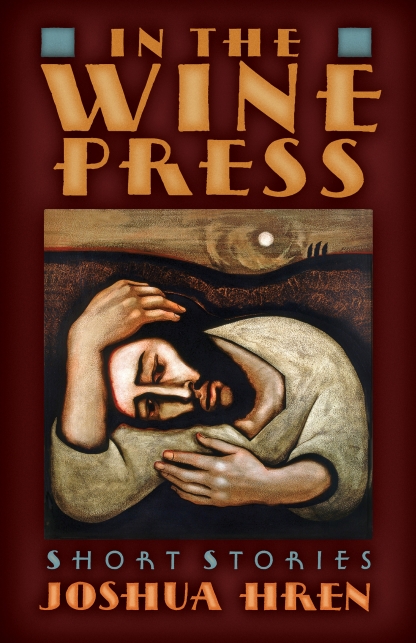
Joshua Hren’s In The Wine Press: ‘Not for Radical Autonomy But For Communion and Transcendence’

In a recent essay Joseph Bottum pins the novel’s decline less on screens and social media than on metaphysical flatness. Much contemporary fiction either inhabits a character at close range or—in a more recent trend—zooms out to offer 30,000-foot omniscience. But at its best the art of fiction is both subjective and objective, getting into the characters’ heads and hearts while detaching us enough to confer a superior understanding. To achieve this depth, however, requires both a sense of the distortions of our age and a clear vision of the good life.

Few writers have either; fewer still possess both. Joshua Hren (editor of Wiseblood Books which is about to publish my novel Minor Indignities) is one of those who both sees clearly and is equipped to interpret what he sees.  His new collection takes us to the heart of dysfunctions—familial, clerical, intellectual—that plague our world while offering a revivifying sanity.

“Horseradish,” the opening story, is just shy of twenty pages. It presents a nighttime conversation between a father and his son on the rickety porch they built together. They’ve gone out to watch a comet, but as they stand physically “closer than they had been in years” they have the sort of serious, awkward exchange that most of us in the same position would do our best to flee. The son goes on the attack, forcing his dad to confront past abdications, but while their oversharing dredges up memories, some fond (the father grew up in what he recalls with pride as the “Slovenian ghetto”), others troubling, what eventually emerges is a more recent trauma: the son is there because he decamped after losing his temper with his wife and hurling a salt shaker through a window.

With this revelation, the see-saw tilts. The father takes control, admonishing and firm, but also paternally tender:

“I maybe never gave you enough. Affection,” he said.

“Dad, “ I said. “Oče.”

“Don’t,” he commanded me, cuffing my wrist with his hand. “Listen. Maybe I never did. But listen. I don’t want to hear how you never touched your wife like that. How you never laid your hands on her. I’m not interested too much in what you didn’t do. But I’ve been wondering one thing for a long time. Do you ever? Touch her. Why am I going to die without ever having held a grandchild? Are you two…”

My arms stuck out like a poorly-clad scarecrow, and I swear I saw him look up, a terse search of the sky, as though he hoped a bird would blind me with dung for failing to give him descendants.

There may be nothing so tricky to represent without mawkishness as the fall of barriers between two people so close as to make intimacy unbearable. By story’s end Hren has given us reconciliation without sentimentality, and symbols—the porch as unstable artifact of the father-son bond, the once-in-a-lifetime comet mirroring a brief window for genuine connection—that work on every level.

Another story, “Old Blood,” reaches toward reconciliation with similar tact: a school shooter’s almost-but-not-quite-girlfriend phones her Vietnam vet uncle in a nursing home to invite him to move in with her. She is spurred to this act of charity by loneliness, yes, but above all by reflecting on what could have driven her former online paramour to such evil. If in his previous collection Hren trod ground more familiar to partisans of Catholic fiction—the spiritual physics of self-mortification—here he telegraphs his intentions less, and shows more restraint. The action of grace is there, but not so much in the parting of the sea within the story’s frame as in the reader’s awareness that blocked exits in the here-and-now point to liberations that fiction most successfully represents discreetly, or even a contrario.

In “Work of Human Hands,” a widow seeks healing for her twelve-year-old son, Rudy, sexually abused by their parish priest, whose predations are described with excruciating but muted realism. We are then privy to Rudy’s encounter with the virtuous but decrepit Father Sun, a wheelchair-bound traditionalist (he has Mosebach’s Heresy of Formlessness by his bedside) who nods off in mid-conversation before snapping awake again to lay hands on the boy in a very different sense, adding another layer to the story’s title:

Balancing his body with his good arm, Father searched the bureau somewhat frantically until, nodding, he heaved out an old black book whose edges were light red like the priest’s face. Father Sun’s eyes flitted fiercely across the pages. His shoulders scrunched up and his neck shot out as he searched. Peering into a prayer at the very end, he nodded again and mouthed the words, ignoring the absence of sound, and in the naked room his rasps came out loud. He pressed his hands against the boy’s head, rubbing in the water he had sprinkled there, holding his hands against Rudy’s temples until the trembling in his hands ceased, then until the boy stopped shaking.

Finally, we eavesdrop on the offending priest’s own fantasies of doing penance through bloody, self-inflicted violence—followed by his realization that a first, faint stirring of justice could be achieved only by expressing contrition directly to his victims. The story’s use of multiple viewpoints offers a sense of orchestration and design.

There is maturity in the idea running through In the Wine Press that unspectacular words and gestures contain still greater spiritual power than needed but secondary acts of physical penance. The collection’s title suggests that providence will in the course of our everyday lives devise mortifications more effective than any we invent for ourselves. And it is under the pressure they place on us that drops of precious mercy are squeezed out of our otherwise hardened hearts.

Two of Hren’s stories—“Some Other Exit” and “Their Fire is Not Quenched”—feature adolescents in rebellion. One rages against a world of spreadsheets, self-help mantras, and pyramid schemes, doctoring his Harvard t-shirt to read “Hatred” and fronting a rock band called CORIOLANUS; the other dreams of cold political mastery and a plum job with a Washington think tank but lives with his parents, whose piety he despises. Other stories address the cover-up of clerical misdeeds, the innocence tarnished by pornography, and the damage casually inflicted by political ambition. Such are the subjects—at once weighty and ticklish—Hren has taken on. We’d rather look away, but his ethic as a writer is to cut through discomfort and depression with brutal honesty. As St. Thomas knew, contemplating the truth is among the best remedies for sadness.

Set in a corner store, the collection’s last story, “Proof of the Immortality of the Soul, with Reference to Beeswax Soap,” is a high-degree-of-difficulty piece that blurs the lines between prose and poetry:

Look a broomstick-thin man with two packs of cigars bulging out of his chest, pockets fatter than his frame, man he’s chewing on his sleeves, stepping up to the clerk who’ll be here until close, squinting under the beams that illumine the things that his ma clicked her tongue at as he flicked up his finger. But he still can’t quite shake that sharp tsk when he sees unclad ladies on the covers of shellacked magazines and the color-code condoms claiming pleasures and ease and he clings, cleaves condemned, to the counter’s cliff-edge like a cold-blood-caught criminal on apocalypse eve, feeling heat if you will like a fried nervous chicken with five bona fide furies biting after his heels.

As the scene shifts to a smelly church bathroom,  physical grime is likened to the buildup of sin on the soul, and you feel genuinely elated when “you” (the story is told in the second person) ends up joining a confession line. As for Hren’s method of delivering impressions in a relentless staccato, with plentiful alliteration—is it over the top? Yes. Does it work? Yes, at least for this story.

Most of the book, however, relies on more familiar narrative techniques and requires only as much investment from the reader as the author can pay back, with interest, in the currency of storytelling pleasure. This, I think, is the route forward for Catholic writers: mastery of craft united with a vision informed by faith, but never the latter without the former—and the former above all.

The Czech writer Josef Skvorecky once said that all great novels are thesis novels—and they all have the same thesis. As liberalism’s success breeds its own failure, we need works that lead our society to reexamine its basic anthropological premises, reminding us that we are wired not for radical autonomy but for communion and transcendence. Of course, such works make their point not through abstract statements but by artfully selecting details, characters, actions. Any attempt at paraphrase falls short—their intellectual meaning is accessible only by experiencing them in their entirety. While some recent novels published by mainstream houses meet this description (Christopher Beha’s Index of Self-Destructive Acts comes to mind), in the end we may have to rebuild our literary culture from the ground up.

It is with fiction like Joshua Hren’s that we can undertake this essential task.

Trevor Cribben Merrill’s reviews and essays have appeared in The University Bookman, Dappled Things, and The American Conservative, among others.

The Wounded Surgeon: Suffering the Little Children in Dana Gioia’s “Special Treatments Ward”

But Jesus said to them: “Suffer the little children, and forbid them not to come to me: for the kingdom of heaven is for such.”

—Matthew 19:14

“Evil,” wrote Flannery O’Connor, “is not a problem to be solved but a mystery to be endured.” Pains can either be borne in emulation of Christ crucified or they can be borne bitterly, like arbitrary afflictions lacking meaning and mystery.

Dana Gioia, the poet and public intellectual who has done more than any other living figure to galvanize the Catholic literary tradition, prompts this either / or in a number of his poems, not a few of which unveil him as no stranger to suffering. Gioia, once a business executive and former Chairman of the National Endowment for the Arts, acquired a keen knowledge of loss when in December of 1987 his four-month-old son Michael Jasper died of sudden infant death syndrome.

As he said after the death, “I saw poetry differently. Writing took on a spiritual urgency I had never experienced before.” Often this urgency leads us through hellish landscapes, lairs of despair. And yet, as Janet McCann observes, if Gioia’s poetry can be dark, it “isn’t nihilistic, nor is it unforgiving.” “Special Treatments Ward”  is one striking example.  In this poem, the narrator’s reduced state leaves the reader rattled; the suffering of innocents has left him lost. Taken as a whole, however, the poem elevates us above this world’s ceiling, ameliorating our losses through the dead children’s healing.

So this is where the children come to die,
hidden on the hospital’s highest floor.
They wear their bandages like uniforms
and pull their IV rigs along the hall
with slow and careful steps. Or bald and pale,
they lie in bright pajamas on their beds,
watching another world on a screen.

Read More about The Wounded Surgeon: Suffering the Little Children in Dana Gioia’s “Special Treatments Ward”

“Hasten to Aid Thy Fallen People”

“Hasten to Aid Thy Fallen People”

How does one make a song of holiness?
  Or speak of music without spoiling it?
They both seem more than our tongues can confess
  And, born above, in our world do not fit.
    What’s more, those who ascend with them
    Are closed in on themselves, struck dumb,
And all in ecstasy that they have heard
Seems flailing, foolish in a fallen word.


But every rising strain must strain indeed
  To lend a form to what in truth is light,
And manifest peace as if it’s a deed
  And give transcendence some arc of a flight.
    The purity of every saint
    Will be daubed on with sloppy paint,
And what no thought may comprehend or say
Must be taught in the staging of a play.


The gift of form, because so fascinating,
  As we bend down to work with knife or ruler,
Reminds us that beyond it’s always waiting
  Some piercing light. Consider how the jeweler
    Makes every cut upon a stone
    For its sake but not that alone,
His patient labor wasted if a line
Does not refract and multiply and shine.


And, any humble implement may serve
  To figure-forth and yet conceal that light,
So that high thought is felt upon each nerve
  And mystery is given to our sight.
    Just this way, things are lifted up:
    A chalice wrought from wooden cup;
A little dust and water, mixed to clay,
Are molded into birds that fly away.


The Mass is first His earthen sacrifice,
  But also taste of peace and heaven’s throne,
The gift that leaves behind all thought of price
  Yet where, no less, we raise a plangent groan,
    For at its finish we are sent
    Into the world both dark and bent
That bearing out the Virgin’s hastening aid
From ruined choirs some good may be remade.


This is the seventh and final poem from James Matthew Wilson’s new book of poems, The River of the Immaculate Conception (Wiseblood Books, 2019), commemorating the Mass of the Americas and rooted in his childhood vision of America as a Catholic Country. “Hasten to Aid Thy Fallen People” is a line from the Marian antiphon for the Advent season, the Alma Redemptoris Mater, which begins:
O loving Mother of our Redeemer, gate of heaven, star of the sea,
Hasten to aid thy fallen people who strive to rise once more.

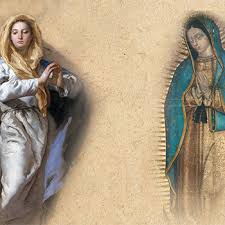
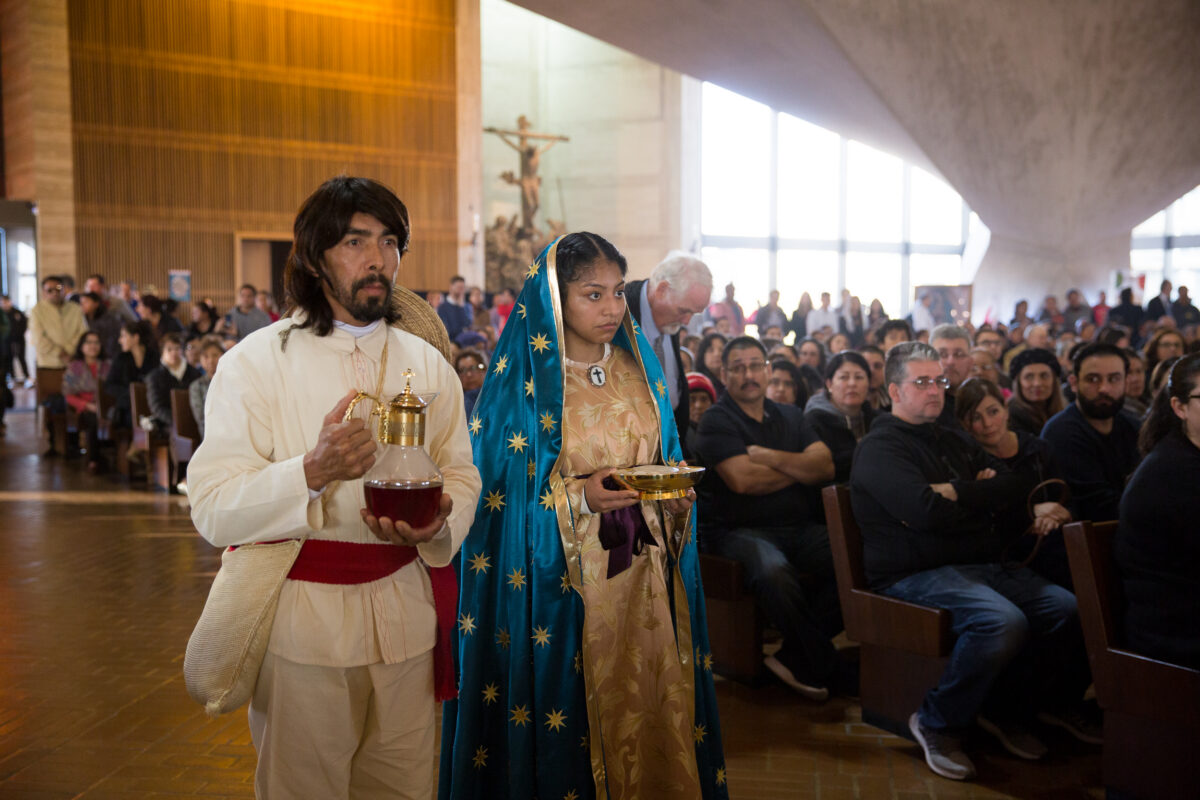
The Hymn of San Juan Diego

[Editors note: This is the second poem in the song cycle by James Matthew Wilson inspired by the Mass of the Americas, called “The River of the Immaculate Conception.” The book may be purchased from WisebloodBooks.com.]

The Hymn of Juan Diego

Thus it is said that Juan Diego
Saw first the Aztec girl,
Her shoulders cloaked in starry mantle
Her hair dark as the merle.


The hill whereon she stood had been
An ancient mother’s home,
Laid low with all Tenochtitlan
When stout Cortez had come.


Light sprang from dull rocks at her feet
And birdsong filled the place,
While she herself eclipsed the sun,
Its blaze about her face.


And every color of the stones
For which the Spaniards killed
Became the turquoise and the gold
With which the sky was filled.


“All those who seek me, Little One,
Will have me for their mother;
And those by pride or greed estranged
Will someday call you brother.”


Juan begged the bishop build a church,
Received a doubtful smile;
And felt his own unworthy bones
As ignorant and vile.


The bishop’s jeweled servants scorned him,
Said he was telling lies.
A second time the bishop’s asked,
A second time denies.


Some thought to beat Juan for his words;
He found his uncle ill,
So every claim upon him led
Him to avoid her will.


But she met him upon the way:
“Why do you run from me?
My mantle covers you already,
And sets your uncle free.”


“Gather these roses in your cloak
As your land’s never seen,
Then, lay them at the holy feet,
And he’ll know what they mean.”


The brute crowd at the bishop’s door
Stood in his way and sneered.
They saw his breast of flowers and snatched;
The petals disappeared.


So, Juan Diego was let in
To stand before the throne,
To show his harvest of the rose
Where rose had never grown.


“I’ve done as she, the mother of God
Told me to do,” he said,
And poured out at the bishop’s feet
The bright abundant red.


But, as these fell, the bishop saw
Juan’s rough-stitched cloak unfold
The image of that placid queen
Ablaze with teal and gold.


He fell upon his knees in praise
And wept for love of her
Who on that land of rock and thorn
Her great care should confer.


Beneath her mantle and her banner
All those vast lands are warmed,
But what we seek in them must be
First by her love transformed.


And so, Diego’s cloak poured forth
Not conquest but sweet flowers
And Mary chose a tattered cloth
To first unveil her powers.


This is the second poem from James Matthew Wilson’s new book of poems, The River of the Immaculate Conception (Wiseblood Books, 2019).

James Matthew Wilson, “Let Us Tune Our Instruments”

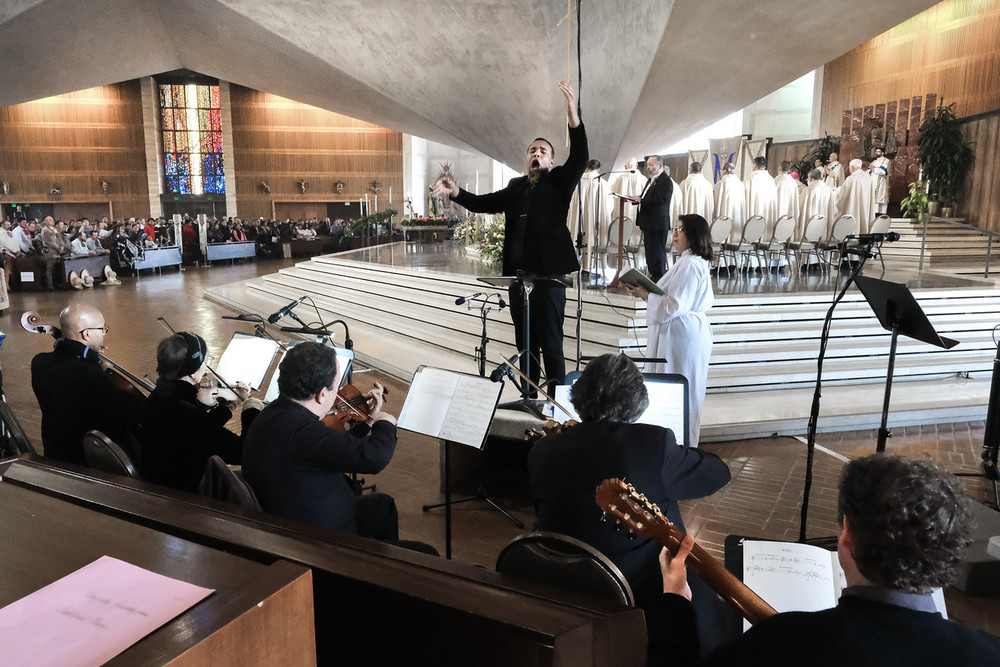
Editors note: This is the first poem from James Matthew Wilson’s song cycle, The River of the Immaculate Conception (WisebloodBooks.com, 2019), commemorating the Mass of the Americas premiere celebration at the Cathedral of St. Mary’s of the Assumption, December 8, 2018. 

I. “Let Us Tune Our Instruments”

Sunlight flows through St. Mary’s windowed corners
With such a grace it seems that all commune
In brilliance, and every surface serves
      Only to magnify with its reflection
      The holy self-expression of the One.


And, in this light-filled place, the cellists tune
As if sweet union’s what the world deserves;
And beauty’s never beat down by its scorners;
     A vain thought never warped our first affection
     Or concrete weighed the hillsides ton by ton.


Such possibility the introit preserves
With its notes raised for brides as well as mourners,
Remembering and transcending that dark noon,
     Where Judas hanged himself for his defection
     And all the rest stared on a dying son.

Who is James Matthew Wilson? Dana Gioia Speaks

From the editors:

Our present to you this Lent is to publish a series of poems by James Matthew Wilson. They commemorate The Mass of the Americas and are inspired, as James wrote in First Things, by his childhood sense of America as a Catholic country.  He doesn’t mean, of course, that America is only a Catholic country.  But the Catholic roots of this country run very deep and include many underappreciated heroes.  He calls this song cycle “The River of the Immaculate Conception.”  That river is known by its official name: The Mississippi River. Yet early on, Jesuit missionaries consecrated it to Our Lady.  Purchase the book of poems at WisebloodBooks.com.

We are very proud and excited to give you this gift. James Matthew Wilson is not just a good poet. He is one of our finest rising Catholic artists and intellectuals. 

You don’t have to believe us.  Believe Dana Gioia on the video below:

“James Matthew Wilson is the most conspicuously talented young poet-critic in American Catholic letters…When you hear James’s work, you’re hearing the kind of tradition that’s in Anthony Hecht, Robert lowerll, William Butler Yeats. Certainly this new poem, it’s as if James has set down in this new work with a great organ keyboard and he’s decided he’s going to play every key, he’s going to pull out every stop in the course of creating this new poem each of the sections of which is in a different form, a different line length, a different rhyme scheme, a different perspective; and it’s an incredibly difficult act to bring off because at every moment you’re taking risks. But I think that it is a successful and exciting work. You know there is, at the moment, an exciting rebirth of Catholic poetry in the United States and it’s full of talented young writers but even in this interesting cohort James Matthew Wilson, I think, is one of the leading people that you are really going to watch in the future.”  Dana Gioia


Subscribe to Our Emails