How Does a Hymn Become a Classic?

Archbishop Cordileone’s Very Marian Advent Prayer Service Launches World Premiere of Two New Christmas Carols

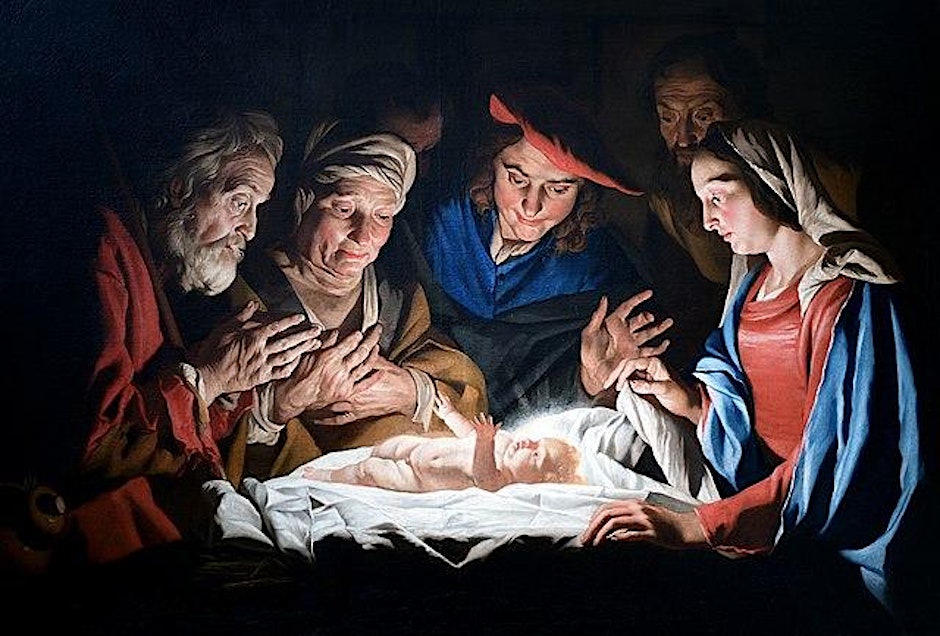
On December 15th, at Star of the Sea Church in San Francisco, Archbishop Salvatore J. Cordileone will lead an innovative Very Marian Advent Prayer Service featuring the world premiere of two new hymns by major Catholic artists commissioned through the Benedict XVI Institute. James Matthew Wilson teams up with composer Frank La Rocca for a new hymn While All the Earth in Darkness Sleeps, which was inspired by the 6th century Akathist Hymn to Mary. Fr. Dwight Longenecker created Our Lady’s Lullaby with new lyrics to an old Welsh hymn Suo Gan (best-known for its appearance in the Disney film Empire of the Sun) and a new arrangement by composer William J. Fritz. The two hymns are part of a lessons and carols worship format, featuring a magnificent 8-voice schola led by Hillsdale College’s Maestro Timothy McDonnell.
Archbishop Cordileone and the Benedict XVI Institute’s ambitious goal? To create new Advent hymns that enter the canon of the Catholic church.

“Many of our best hymns and carols were composed first as poems and later set to music,” said James Matthew Wilson, poet-in-residence at the Benedict XVI Institute “How daunting as a poet to have to say to myself, this has to work as the kind of language people will want to sing, want to remember specifically as musical, as pure song.”

All ancient, worldly wisdom
Exults before your son,
And lays three gifts before you,
Virgin who nurse the One.
May gold forever glimmer
From both his crown and yours;
May prisoner and pauper
Greet angels at their doors.

Rejoice, o virgin watching through the night.
Rejoice, the gate that opens all to light.
Rejoice, whom even cherubim attend.
Rejoice, seraphic queen and sinners’ friend.
Rejoice, whose breast the food of all once fed.
Rejoice, our lady, stars anoint your head.
Rejoice, for on this night you bore a son.
R. Rejoice, for on this night you bore a son.

~While All the Earth in Darkness Sleeps
James Matthew Wilson

How does a poet even begin to approach such daunting task of adding to the canon of Advent and Christmas music?  “By trying to impart a classic quality to the setting,”  Composer-in-Residence at the Benedict XVI Institute Frank La Rocca answered. “One that sounds like a bit of fresh air flowing through a long and great tradition – a tradition one approaches with a certain reverence and gratitude.”

The second world premiere Advent carol is Our Lady’s Lullaby. “How did you approach this?” I asked Fr. Longenecker. “To write something one hopes will stand the test of time, one looks to the great tradition and tries to write from within that—without either copying or challenging the tradition. For this piece I looked to the great images of the Madonna and child and that connected me instinctively with lullabies,” he replied.

Sleep my Child
In the manger
Sleep my child
Free from Harm
Sleep my child
Free from Danger
Sleep my child
In my arms

~Our Lady’s Lullaby
Father Dwight Longenecker

“When mothers hum to their little ones as they’re putting them to sleep,” added composer William J. Fritz, “many times they improvise without knowing it. I changed the rhythm of the original tune to make it feel like a mother rocking her child to sleep; there is also a departure from the tune in the middle when Mary contemplates her Son’s passion and death. My hope was to hint at the ecstacy that the Mother would feel at the Son’s triumph over death. This is an Advent/Christmas Hymn much like the Messiah – it’s all of Christ’s mystery wrapped in one.”

Last year’s first Very Marian Advent service saw the debut of two other brand new Advent carol:  The Chesterton Carol, by composer Mark Nowakowski, and Our Lady Expectant, composed by Wilhelmina Pariseau from a poem by Roseanne T. Sullivan. Both will be performed again this year.  Mark Nowakowski’s Chesterton Carol has taken a step towards becoming a classic by generating 22,000 views on YouTube and being adopted by many in the Chesterton Schools Network.

The new hymns this were made possible by the support of two new patrons of the arts: James and Kristy Hudon, who commissioned While All the Earth in Darkness Sleeps, and Michael and Sarah Trela, who supported Fr. Longenecker and Mr. Fritz’s new Christmas carol.

Why support new works of art amid that many other urgent needs in the world, I asked them.

“Most of the religious hymns we sing today were composed long ago, borrowed from past generations,” said Mr. Trela. “While these old hymns are excellent, it is time for this generation to humbly contribute with a new Christmas hymn that shares in the joys and tears of Our Lady.”

“We are meant not only to enjoy Art, but to participate in it,” said Mr. Hudon. “A thriving arts culture unites us as Catholics and brings us into fuller communion. A city set on a hill cannot be hidden, and so it is important that we help make our city—the Church—beautiful, as beauty attracts people who have otherwise closed themselves off to the truth of the Gospel.”

Those in the greater Bay Area can register to attend; the Benedict XVI Institute also offers a virtual option: those who register will receive a link to the professional recording of the event, including the new Advent /Christmas carols.

Return to Liturgical Glory?

How does an artist approach the annals of history, walk amongst the hallowed treasures of Western society, and dare to deposit a work which may remain?

We can’t know what history will say, but we do know the circumstances which often surround the begetting of masterworks: institutional support, financial patronage, initial exposure, and ultimately an artist who does not shrink from embracing the weight of history.

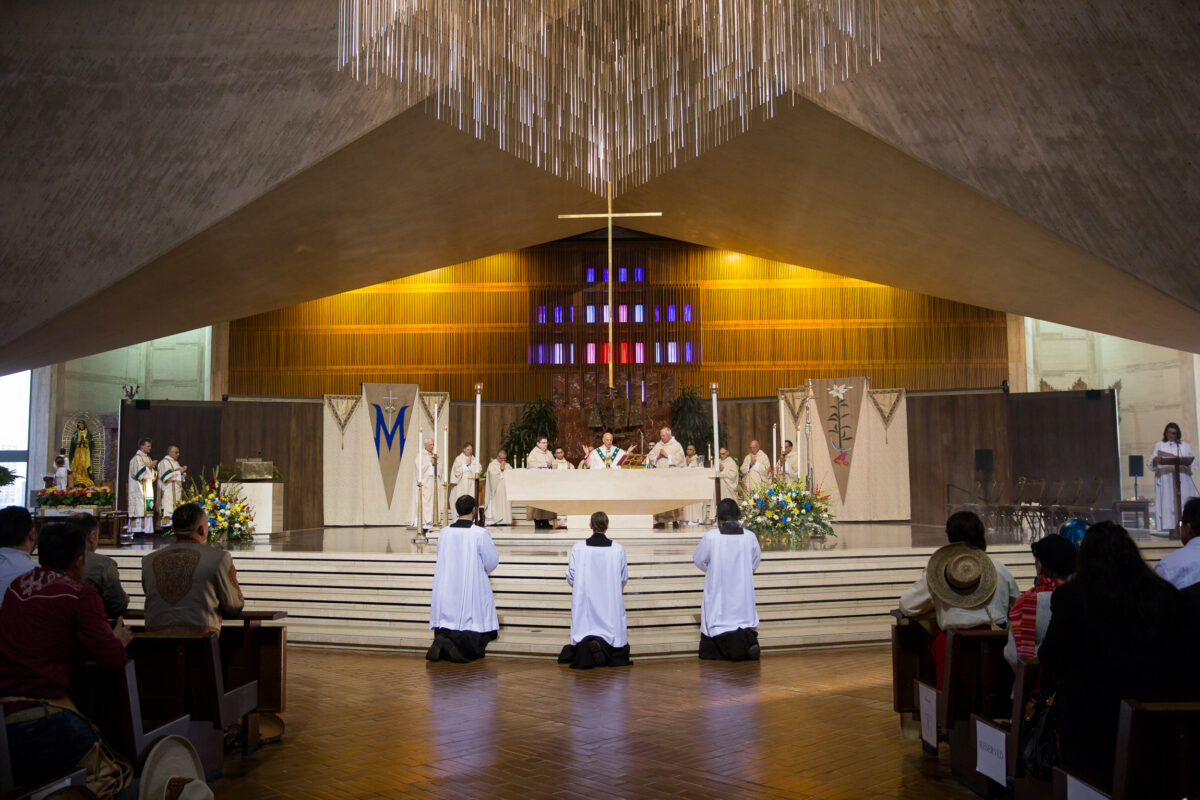
On December 8 at St. Mary’s Cathedral we may have witnessed just such a confluence of forces: a new, magnificent collaboration between the Benedict XVI Institute, the Archdiocese of San Francisco, and the composer Frank LaRocca which birthed the new The Mass for the Americas.

The Mass of the Americas came into being this December 8 on the Feast of the Immaculate Conception. It was also the 25th anniversary of the “Cruzada Guadalupana”, the annual 12-mile pilgrimage through the streets of San Francisco in honor of our Lady of Guadalupe.

And so in honor of Our Lady, Frank La Rocca created what he described as an “intertwined tribute to our Lady of the Immaculate Conception as Patroness of the United States and our Lady of Guadalupe as Patroness of the Americas”.

Whereas new classical music concerts are often happy to draw a dozen attendees, thousands packed the pews at the Mass of the Americas, making it (in one sense) one of the best attended new music events of the 21st century.

And yet in the hands of a lesser composer, it might have been a very public disaster.

The immense crowd entered the cathedral tired from the long walk, excited by the Aztec feathered dancers performing on the Cathedral plaza, entertained by Caballeros on horseback and in many cases making the final march up the aisle to the altar of Our Lady of Guadalupe on their knees.

The reverence of the faithful attending was palpable. But would they really want to sit through a full choral setting at the end of their journey? Would they experience high sacred music as an awe-inspiring beauty or something alien to their cherished community and culture?

These tensions made the Mass of the Americas’ setting as risky as it was ingenious.

Just before the Mass was scheduled to begin, the Aztec dancers processed up the aisle, the large heuhuetl drums pounding, the smaller teponaztli drums keeping time, leg rattles made of shells and seeds shaking, along with native flutes and horns, surely a very strange prelude for a Mass in the high sacred music tradition of the Church.

While the display was impressive, it was also long, and as it died away the unfocused murmur of the tired congregation was evident.

It was precisely in this moment of disarray and disconnect that La Rocca’s quiet Introit began: a stunning combination of hushed strings and gentle tolling hand-bells, murmuring rather than shouting devotion to Christ. A sudden and telling wave of silence rolled across the crowd of the faithful: La Rocca had their attention, with expressions from surprise to the outright riveted visible from this watcher’s vantage point.

It was a fitting rebuke to those who fear our sacred music tradition is somehow unsuited to the contemporary diverse Faithful.

Archbishop Salvatore Cordileone was the principal celebrant, a leader whose vision and patronage set Frank La Rocca to work as the Benedict XVI Institute’s composer-in-residence on “The Mass of the Americas”. Written in Latin, English, Spanish, and the Aztec Nahuatl language, one could easily imagine that La Rocca was simply asked to do too much and to wrangle together too many disparate elements in a liturgical setting neither he nor anyone else had ever attempted.

It was ultimately the unabashed reverence and deep individual devotion of La Rocca’s approach which would carry the day, somehow wrapping up a potentially overambitious idea into a Mass setting which was intimate, personal, deeply considered, and unapologetically beautiful.

If the Introit was hushed in nature, the remainder of the Mass setting moved us all through a narrative arc, all within Frank’s clearly identifiable musical style.

The Kyrie – half in Spanish and half in English – pleaded with simple earnestness, the tolling strings in the accompaniment drawing the congregation further into the penitential aspect of the text.

The Gloria – in Latin – springboarded from the ascetic musings of the Kyrie into an optimistic setting which alternatively proclaimed and soared, giving the skilled sopranos in the choir a chance to move confidently into their upper registers.

One discordant note:  I would have preferred that the Psalm setting, like the Credo, was spoken not sung. Instead, the choice was made to use a second amateur choir to sing a GIA-published setting which (like much of such music) simply could not live up to the full dignity of the liturgy, let alone La Rocca’s deeply considered work or (naturally) a 16-voice professional choir.

I observed, and so did many around me, that a vital bridge between folk culture and the high culture of the liturgy was being rebuilt in La Rocca’s work.  It reminded one of the impressive examples of authentic liturgical and aesthetic enculturation in the south American Baroque sacred music tradition.

As the Mass of the Americas continued, an absolutely stunning setting of the Ave Maria in the Aztec Nahuatl language washed over us.  Set for soprano voice, violin, marimba and organ, this luminous musical exploration seemed to emerge out of the earth itself. The work somehow represented both an ancient people turning to God and the simple prayer of a single person, as if spoken from the heart for the very first time.

La Rocca writes of the piece: “When Our Lady of Guadalupe spoke to Juan Diego, it was in his native tongue.  And so I thought it was important to include the predominant language spoken at that time, in that part of the New World, into the Mass of the Americas.  And this same language, spoken also by Aztec priests in their rituals, is now blessed by the one Catholic faith as it is brought into the celebration of Holy Mass for the Cruzada Guadalupana.”

Soprano Arlyss Hays learned the work quite late in the rehearsal schedule, yet nevertheless delivered a polished and deeply human performance for which the young singer deserves ample praise.

The closing recessional – La Rocca’s Alma Redemptoris Mater – functioned as a stylistic bookend with the opening Introit, with the handbells returning to a similar instrumentation and a comparatively hushed and reverent atmosphere. The opening lines of the work – with tenors and sopranos singing in octaves – echoed plainchant as the strings slowly evolved into a fugal reflection of the opening melodic material, in turn, to be imitated by cascading entrances in the full choir.

During the brief postlude, the Alma Mater Redemptoris melody continued on the organ and the strings began to croon the La Guadalupana. And somehow miraculously, they harmonized.

The Archbishop later confided that he had to hold back tears, such was the power of the Mass of the Americas; many were similarly visibly moved.

For a composition to become something for the ages, the biggest chasm is between the first performance and the elusive and the (for most) unattainable second performance.  Here again, the vision and patronage of Archbishop Cordileone and the Benedict XVI Institute are inspiring. “We’re looking to take this on a Marian cathedral tour,” Maggie Gallagher, executive director of the Benedict Institute, told me.

It’s an immense undertaking for a small startup organization, but already planning is in the works (donors willing) for Our Lady of Guadalupe Cathedral in Dallas. A professionally recorded CD is also in the works. Meanwhile, you can listen to the Mass here and judge for yourself.

What beyond the piercing witness of divine Beauty are the lessons of this first great musical effort from the Benedict XVI Institute for Sacred Music and Divine Worship?

First, that the great Catholic tradition is alive and well, and is only waiting for courageous pastoral leadership and visionary patronage to continue its great story where it most belongs: in the bosom of the Church.

Second, that the lack of such creative enterprises by those most qualified to support and compose them leave us at the mercy of aesthetic ignorance and mediocrity.

Finally, on a personal note as a composer, I cannot help but underscore the privilege it was to attend this event. It had all the feeling of a turning tide and inspired me and the other artists in attendance to labor anew in our own vineyards. A new Mass setting which somehow brings an atmosphere of devotion and quietude to a congregation of thousands, all while inspiring the other artists in attendance to continue to faithfully create their own new work, is a musical project which was worth shepherding into existence.

Frank La Rocca, the Benedict XVI Institute, the Archdiocese of San Francisco and their great Archbishop Cordileone all deserve praise for boldly reembracing the Church’s great witness of Beauty in a difficult age. It is, simply put, among the most essential work that can be done in our world today.

Dr. Mark Nowakowski (www.marknowakowski.com), is Assistant Professor of Music at Kent State University. A prolific composer of sacred and concert works, his 2017 Naxos “American Classics” release – “Blood, Forgotten” – was praised as “at once fierce, haunting, and mystical” by Gramophone magazine.

Listen to the Aue Maria in Nahuatl below. Or see and hear the main parts of the Mass of the Americas here. 

Subscribe to Our Emails