Reflections on the Chesterton Carol

Sometime around 2010, contralto Imelda Franklin Bogue approached me to set the Christmas poem of G.K. Chesterton’s “A Christmas Carol” to music.

I was newly married, working on my doctorate, and glad for any paid commission during struggle times. I had also just finished reading Chesterton’s Orthodoxy, a very sophisticated intellectual work. So, reading the lyrics of the Chesterton’s A Christmas Carol, I was shocked at first by the seeming child-like simplicity in the text.

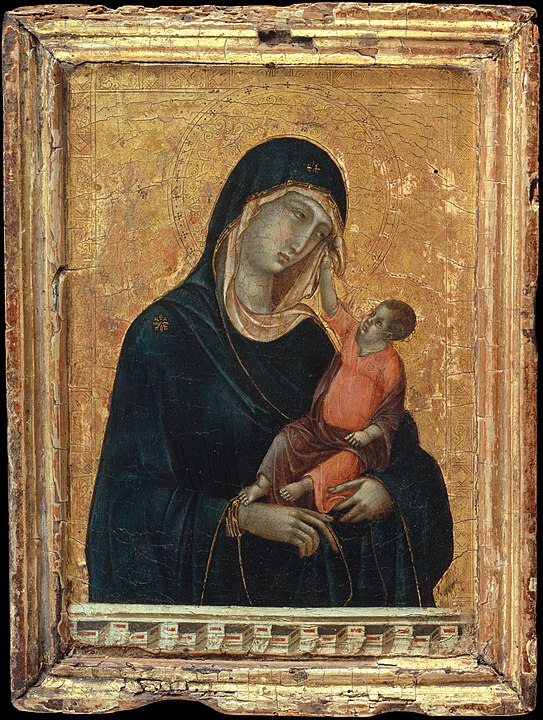
Yet on closer read, this simplicity is deceptive: Chesterton’s carol opens up into a deep contemplation on the shattering nature of the Incarnation.  There is also the sweet Marian devotion subtext, and the way the Christ child seems to grow in each stanza, from infancy (laying in Mary’s lap) to being a small child standing on her knee. In the first three stanzas, the parenthetical sections of each stanza look outward towards the world, disappearing in the second half of the final stanza, which strikes me either as the Parousia or its anticipation.

Naturally as a composer this excited me: a gorgeous rhythmically simple text with deep, intertwining theological themes. Chesterton’s words called to me for an introspective and complex setting. And yet Imelda wanted more of a simple carol, and so I set to work trying to imitate Chesterton’s approach in music: that of simplicity illuminating a deeper, richer meaning.

Writing a Christmas carol had always been a secret dream of mine:  As the son of Polish immigrants our holy days were saturated with singing the deep and rich carols of that region: deeply Catholic songs of clear mourning or soaring exaltation. Later I grew very fond of the English carol tradition, and I marinated in these two traditions as I set about to find the music for Chesterton’s Carol.

And so as is typical in the life of a modern classical or sacred music composer I hear the Carol sung beautifully once by Imelda in Christmas of 2011.  I hear a few encouraging compliments, and then it went on the shelf as most new compositions do. Today’s classical music and sacred music composers will spend months – even years – toiling away at works which are only performed once and then shelved.  Why?  I think this a logical consequence of the sundering between composers and audiences which took place as a result of the modernist revolution: we know longer “know” each-other; Meanwhile audiences naturally distrust new music after the near century of abuse they’ve been put through. The public have retreated into the safe haven of the dependable classics, which leaves composers who would dare to humbly submit new works to the tradition feeling marginalized and of course seeking outside sources of income.

Then there is the reality that the Church itself is no longer a major patron of the arts and the connect between composers and Catholic cathedrals and parishes has been severed.  The Benedict XVI Institutes remarkable efforts to heal this breach are deeply encouraging to me and to other sacred music composers.

Credit for the survival of the “Chesterton Carol” here goes to my wife, who insisted that the “Chesterton Carol” was some of my best work, and periodically pressed me to do more with it.

Its revival came in the most unlikely time: the Covid shutdowns. A daring small group of Catholic musicians I had worked to gather on Facebook brainstormed the question: how do we keep the music alive as the world shuts down? And so the Vos Omnes Virtual Choir was born. Our first virtual choir performance our own Frank LaRocca’s Agnus Dei from the Mass of the Americas. For the group’s third effort, we did the “Chesterton Carol.”

The Benedict XVI Institute’s sponsorship of this recording by the Vos Omnes Virtual Choir has generated more than 9,000 views, a very big concert hall that encourages all the musicians involved.  Our latest joint venture, a new setting of “Let All Mortal Flesh Keep Silence” has jumped to more than 7,000 views in just a few weeks.

Listen to the “Chesterton Carol” this Christmas here. May this beautifully performed rendition bring you close to the knee of Mary, moving from the tender beauty of the contemplation of a newborn infant to the apocalyptic adulation of the singing of the stars.  Merry Christmas.

Dr. Mark Nowakowski is a composer whose work has been performed across Europe and the United States. A professor at Kent State University at Stark, he will soon release his second portrait disc – Metanoia – through DUX Records; it is a follow-up to his critically acclaimed 2017 Naxos album “Blood, Forgotten.” He is also the composer for the Mass of the Ages trilogy.

[Editors Note: You can find the score of the Chesterton Carol by contacting Mark Nowakowski at his website below. The piece is currently available in three configurations (with the composer granting his permission for other arrangements):
*Voice & Piano
*SATB, Organ, Strings (with piano reduction)
*SATB and Chamber Orchestra (the version from this video)

WEBSITE: http://current.marknowakowski.com/available-pieces/]

Gleaming Brightly: T.M. Doran’s Catholic Imagination (INTERVIEW)

Editor’s Note:

T.M. Doran is a professor of engineering at Lawrence Technological University, but in recent years he has also managed to become one of the most exciting voices in Catholic literature. His novels Circling the Turtle, Terrapin, and Iota represent a bold breadth of thematic storytelling, while his novel Toward the Gleam has launched an entirely new series of Tolkien-related literature which teams with life and originality. Mark Nowakowski is a rising young Catholic composer of sacred music and a professor of music technology at Kent State.  Listening to these two Catholic creators converse is fascinating and revealing.

Mark Nowakowski: Thanks, Mr. Doran, for your valuable time today! What are significant things about Mr. Doran which animate him as a person and an author?

T.M. Doran: I’ve been married to my beautiful wife for over 40 years. She’s too good for me, and I’m not the only one who says that. My areas of specialty are the environment and infrastructure, having worked on hundreds of such projects over the years, and these subjects sometimes seep into my stories. I’m keenly interested in history/archaeology, astrophysics, and the natural sciences, and always have a book on one of these subjects at hand.

Mark Nowakowski: When and why did you start writing fiction?

T.M Doran: I began composing short stories before I was ten. As a boy, I loved to read, and I suppose that inspired me to try my hand. Many of these early stories had surprise endings.

Mark Nowakowski: How do you think about the relationship of your faith (Catholicism) to your art?

T.M. Doran: I strive to compose rousing, provocative, mysterious stories that people want to read. A common subtext in my stories is that moral choices have transcendent meaning, and consequences that migrate like cracks on an ice-covered pond.

Modernist literature may go so far as to admit that choices produce physical or psychological consequences, but can’t admit that such choices are inherently good or bad, right or wrong. So modern literature often depicts human beings as intelligent animals programmed by natural processes to respond in predictable, albeit dramatic, ways.

Authors with religious faith have to be careful not to fall into a similar trap where good choices are always rewarded in this life and bad choices are always punished in the here and now. Another thing I love to explore in my stories is the arc of human growth, often in fits and starts, and never complete in this life: “The road goes ever on and on.”

Mark Nowakowski: I myself am not an author of fiction, but fiction for me was an introduction to creative thought. As a creative kid, I for instance drew incredible solace and inspiration from the idea that an old English professor like JRR Tolkien felt free to spend incredible amounts of time contemplating an imaginary world. Even today, when I compose music, having good fiction at my side is often a wellspring from which inspiration rises (your books too!). Did you experience anything like this as well, given that you were writing at such a young age? And given the importance of Tolkien to some of your published work, when did you discover this pivotal Catholic author?

T.M. Doran: I first read The Lord of the Rings in my early twenties as a fantasy/adventure story. Subsequently, I’ve read The Lord of the Rings and Tolkien’s connected stories as dense, interwoven sagas and songs of a mythological world, as a caution about the lure of pride and power, and more recently, as a stark depiction of human frailty and our utter dependence on grace.

The hero of Middle Earth, Frodo Baggins is the person best suited to take on that terrifying and daunting mission. But he could not have fulfilled his mission without the “assistance” of Gollum, and only mercy made it possible for Gollum to be present at that moment. As for Frodo, there is no peace for him in victory over the Enemy. Will a boat come for me at the end? is a deeply spiritual question many of us ask in times of trial.

Mark Nowakowski: One can often sense the (often hidden) Catholicity of a writer or filmmaker based on how they approach the idea of the consequence of our actions. It’s really a different way of seeing the world. Could you perhaps speak more to the question of moral choice in fiction?

TD: I perceive this Catholic perspective in many creative people: Vivaldi, Michelangelo, Eliot, O’Connor, Capra, Hitchcock, Brubeck, and Graham Greene among them.

I’ve read many reviews of Greene’s “The Quiet American” but none of these mark this essential last-page reflection of the atheistic journalist who contributed to the death of the American in the story: “I thought of the first day and Pyle sitting beside me at the Continental…Everything had gone right with me since he had died, but how I wished there existed someone to whom I could say that I was sorry.”

Greene’s journalist has a sense of honor and contrition, but without God honor falls prey to desires and fears: Where does one go to confess and receive forgiveness when there is no God?

Mark Nowakowski: Speaking of Tolkien: Toward the Gleam is so successful because you a create a plausible prehistory of Tolkien’s created world which seems like it must have actually happened. Then you spin another tale around it which, while imagined, adds another layer of “this could easily be real” to the formula. Was this your intent?

T.M. Doran: Yes, this is what I intended with Toward the Gleam, though I’m not sure I’d have the courage to compose and submit such a story today. Someone once said that I took the easy path by choosing a Tolkien-like character for Toward the Gleam, not realizing how difficult John Hill was to write.

Even though John Hill was a fictional character, I felt severely constrained by what I could do with him. Jan Skala in Iota and Lyle Stuart in The Lucifer Ego were much easier to write because of the creative freedom I enjoyed with these characters; I could let them go in directions I hadn’t expected when I embarked on these stories.

For Toward the Gleam, I spent countless days researching and matching the era of the world of the manuscript with known biology (flora and fauna), geography, climate, even anthropology, thus John Hill’s meetings with Pepin Hermann (who features again in The Lucifer Ego) and Greta Erickson (who features again in book three). As the prehistoric civilization continues to affect characters in Toward the Gleam, so characters in Toward the Gleam continue to affect characters and events in The Lucifer Ego and Kataklusmós.

“This could easily be real” plays out in book three, something I had intended even as I began composing Toward the Gleam fifteen years ago.

Mark Nowakowski: Music has taught me that great art has some manner of pre-existence, and that the great works feel “necessary” in their own existence. When I think of the poetic, I think of a stream of something objectively real and yet entirely beyond our capacity to describe, one into which artists are allowed to dip despite not understanding. Considering the way in which the palpable realism of Toward the Gleam built upon the palpable history of the Lord of the Rings, can you perhaps speak to something like this? Have you had such a sense or experience?

T.M. Doran: I love how you describe the creative experience. In my writing, I’ve experienced this powerful sense of Truth and Beauty beyond understanding, and I’ve also sensed it in music and visual art: An invitation to a larger life, you might say, a life one is permitted to glimpse/hear for brief periods of time, and something that remains with us as a deep yearning.

When I’m writing, I often listen to classical music or instrumental jazz, as music inspires and invigorates me. Without faith, these glimpses of an “unattainable” larger life can lead to despair, as has often occurred in the lives of artists.

Mark Nowakowski: You speak so lovingly of your wife. Was your own marriage perhaps a model for how you depicted the main character’s marriage in Toward the Gleam, especially the closing chapters when they are old?

T.M. Doran: For John Hill and E.M., I did indeed draw on what I had learned about the Tolkien marriage and on my own marriage, as both marriages involve strong-minded people who are deeply in love. When someone spends “incredible amounts of time contemplating an imaginary world (art that transcends the physical world)” it is bound to affect those close to them, even if not a matter of mortal danger as it was for John and E.M.

Mark Nowakowski: Earlier on you mention Iota. As somebody who visited Communist Poland and heard many stories of this world and subsequently later studied it as an adult, I was beyond struck by the accuracy of the “feeling” you achieved in this novel, set in a Soviet prison shortly after World War II. What lead you down the path to pick this setting for a story? And how did you pursue the particular tone and tenor of the Soviet ideological atmosphere?

T.M. Doran: I embarked with the thought of contrasting heroic mercy, which doesn’t come naturally to man, with man’s unspeakable brutality when he rejects the true God. Doing so in the cauldron of a detention camp with men representing many ways of looking at life, and a world with so much chaos, seemed an appropriate setting for these ideas to play out.

There were so many influences on this story. I read a great deal on the Soviet and Nazi ideologies and regimes: Shirer, Churchill, Gilbert, Weigel’s biography of St. John Paul II among them. I have a friend who escaped from Communist Czechoslovakia via North Africa. Solzhenitsyn’s and Pasternak’s writings. The character of Father Petrenko was influenced by the priest depicted in the German film, “The Ninth Day” who was released from Dachau for nine days with the expectation that if he cooperated with the Nazis he wouldn’t be returned to the camp.

Heroic mercy is the central thread in the story: Fr. Petrenko, the guard Piotr, and finally Drewniak. Then, there is the Major, who is full of schemes, illusions, petty aspirations, and yet so empty of life. And yes, I write about the diabolical influence that accompanies extreme depravity. These were my themes.

Mark Nowakowski: How far do you think we are from an Iota setting in America and the West?

T.M. Doran: The totalitarian inclination has persisted throughout history, and particularly in eras where religious faith has waned or is under attack. Soon after the American Revolution, many actually wanted to emulate the brutal radicalism that triumphed in France. They were unsuccessful but came closer to prevailing than many now realize.

For myself, I’m dumbfounded that, so soon after witnessing the viciousness of 20th-century totalitarian ideologies in action, there is so much ignorance (including the so-called highly educated) of where this path inevitably leads.

Sometimes, I feel like George Orwell must have felt in the 1940s. There’s an irreverent story told about Robert Conquest who unmasked Stalin’s brutality in his book, “The Great Terror” (1968) and was roundly criticized/ridiculed for it at the time. Years later, after the fall of the Soviet Union, when the book was reissued, Conquest was reported to have suggested the title: “I Told You So, You ###### Fools”. Irreverent but to the point.

Mark Nowakowski: What (if any) has been your experience with secular publishers?

T.M. Doran:  I’ve reached out to secular publishers/agents without success. I think it’s harder today to sell a story that goes against the strong secular/materialist spirit of today’s world. On the other hand, I don’t consider myself a strong enough writer (certainly not a Greene or O’Connor or Waugh) to be a good test. Furthermore, I don’t have the traditional education/experience of most authors, a significant shortcoming to many in the publishing world. I’m at peace with this today.

Mark Nowakowski: What can the world expect from T.M. Doran next?

T.M. Doran: I’m in the production phase for Kataklusmós, a story that completes the Toward the Gleam saga. A demanding story to write, 3-4 years composing, a dozen versions, lots of research, and challenging themes. I’m always working on several longer or shorter stories, but after Kataklusmós I may step back from publishing.

Mark Nowakowski: We wish you luck on that, sir, and hope that your step back from publishing may not be too long a hiatus. Thank you for your time today!
Gwyneth Thompson-Briggs: The Catholic Arts Today Interview

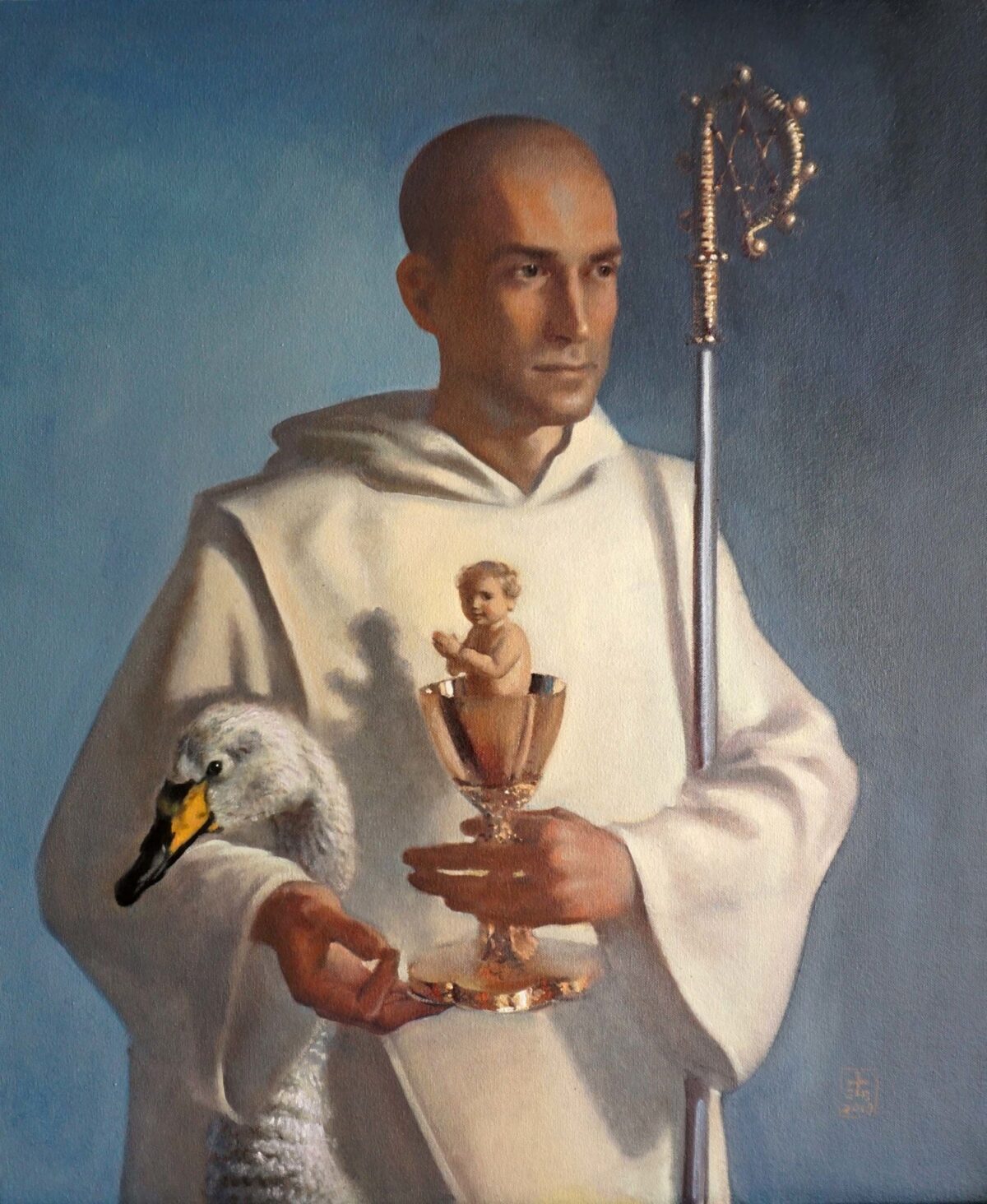
Editors Note: We have here Catholic Arts Today at its finest: a conversation between a significant young Catholic composer of sacred music and a significant young Catholic painter of sacred art. A feast for the mind and an inspiration (we hope) to the next generation of Catholic artists.  The painting by Gwyneth Thompson-Briggs above, St. Hugh of Lincoln, has never been published before.

Gwyneth Thompson-Briggs is a painter with a rising profile in the world of sacred art. But not content to promote only her own work, Gwyneth recently launched a new Catholic Artists Directory, featuring a carefully curated selection of Catholic creatives in the sacred music and visual arts world.  This new Catholic Artists Directory has two big purposes: First, pastors, church committees, Catholic schools and institutions, and private patrons of the arts now have a one-stop forum to find artists of the highest caliber to adorn their churches, chapels and homes. Second, the Catholic Artists Directors provides an online home for artists and art-lovers to network and discover and learn from each other’s work.

Sacred Music Composer and Kent State Professor Mark Nowakowski recently sat down with the artist Gwyneth Thompson-Briggs, founder of the Catholics Artists Directory, to discuss her new initiative and her work.

Mark Nowakowski: Why did you start this new Catholic artist directory?

Gwyneth Thompson-Briggs: When I began doing sacred art full-time this year I realized that there was a need for both patrons and sacred artists. Patrons needed a single place where they could find a curated selection of professional sacred artists and many talented artists needed exposure. I’d like artists to exert their time and talent making art rather than planning marketing strategies. It has been a pleasure to be able to help raise the profile of Catholic artists today who are reviving traditional techniques.

Mark Nowakowski: So your own experience seems to mirror my own as a composer: One must become a businessman and entrepreneur and voracious networker to find way to even start to get one’s art out into the general public. I can’t help but feel that God has called and equipped a veritable small army of talent, and that this army of Beauty is just waiting for fertile soil (and appropriate support) to start a new Renaissance. What is your experience surveying and now representing the broader field of Catholic art, music, architecture, and related disciplines?

Gwyneth Thompson-Briggs: Yes! There is a small army of talent that is standing at the ready. It is really exciting to get to know my other comrades-at-arms and the patrons who are helping us. I used to think that patrons were, for the most part, older, affluent, and part of a disappearing population of individuals with good taste. It has been a happy surprise that new patrons are coming forward who are in their thirties. They are not particularly affluent, but are willing to sacrifice in the name of beauty.

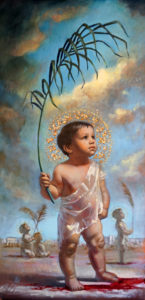
Gwyneth Thompson-Briggs, Holy Innocents, oil on canvas, 24 x 48 in, 2019

Mark Nowakowski: I think your own art is truly wonderful. What were the most beneficial as well as challenging aspects to developing your craft and establishing your professional career?

Gwyneth Thompson-Briggs: For me the great key was experiencing sublime works of art in person: Michelangelo’s Medici Tombs in Florence, the Van der Weyden diptych at the Philadelphia Museum of Art, and the portrait of Luis de Gongora by Velazquez at the Boston Museum of Fine Arts, among others. My skill also underwent extraordinary transformation each time I was able to see a master artist demonstrate the execution of a particular technique.

When I was five, a local watercolor artist taught me to “let the water do the work” when painting flowers; when I was a teenager, a life-drawing instructor took the charcoal from my hand and merged all the different shadow regions of my fragmented sketch into one unified form; as an adult, Paul Ingbretson solved a problem I had struggled with for a decade by observing that I needed to mix a bit more linseed oil into my whites “until the mixture was like a heavy cream.”

The most challenging part of growing as an artist has been gaining access to masterpieces and master artists. Sensors and over-zealous guards in museums tend to keep visitors too far back from the canvas to truly observe strokes and paint quality. While there are some masters working today, I haven’t found anyone truly conversant in Baroque technique. So, one must cobble together what one can learn from old paintings with what one can learn from contemporary masters.

Another challenge is the sense of inadequacy. As a mid-career artist, one always feels that there is more to learn before one is really qualified to accept commissions, but I now realize that it is by accepting commission that I am able to grow most quickly. Each commission is just a bit out of my comfort zone. Each commission requires me to study art history, to learn more about a particular technique or the archival nature of the materials involved, and to perform technically better than the time before.

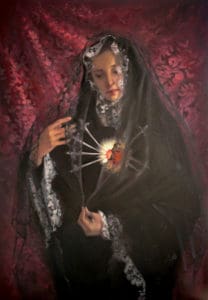
Gwyneth Thompson-Briggs, Our Lady of Sorrows, oil on canvas, 24 x 34 in, 2019

Mark Nowakowski:  In a society where there is endemic poverty, where there is suffering, where there are major social issues such as abortion and the defense of marriage to tackle, how do we justify taking money for the arts? How do we convince others of the importance of patronage? I have my own answer, but I’d love to hear your own perspective.

Gwyneth Thompson-Briggs: I live in St. Louis, a city with profound economic problems. I often meditate on the poor children that grow up in run-down neighborhoods, crumbling school buildings, and are culturally nourished exclusively by online treacle.

If only they knew that in the center of one particularly depressed area, the beautiful church of St. Francis de Sales run by the Institute of Christ the King welcomes both rich and poor and provides a respite from the oppression of daily life. As long as we are in this world, we are going to suffer from economic, physical, or emotional problems. A beautiful church or a moving work of art allows us to perceive our sufferings in the light of eternity and gives us the strength to go on.

Beautiful art is a gift especially for the poor but it is the responsibility of the rich to fund the art and to demand the highest standards from the artist.

Mark Nowakowski: What is leading to this new potential renaissance in Catholic art?

Gwyneth Thompson-Briggs: Perhaps one of the paradoxes of our times is that the darker the crisis in the Church and the world, the more brightly the beauty of Tradition shines and attracts. This paradox was strikingly illustrated on the final weekend of October this year, when the conclusion of the Amazon Synod coincided with the 8th annual Populus Summorum Pontificum pilgrimage. More and more people, especially young people, realize that the only way out of the dead-end of modern life is Tradition, including the traditional arts that are fostered by and at the service of divine worship.

I think that the very severity of the crisis–what several commentators have called the Passion of the Mystical Body–is helping people to distinguish orthodoxy from heterodoxy, holiness from worldliness, beauty from ugliness, and excellence from dross.

After sixty years of detente with the world, a renewed polarization is emerging. There is a renewed militancy in the Church Militant, even if only among a fragment of the baptized. These souls know that they can’t trust the bishops or the pope to teach them the Faith or to fund genuine sacred art; they must learn the Faith from old books and from the small but growing ranks of traditional priests, and they must themselves become discriminating patrons–because the worship of God demands the greatest artistic treasures we can offer to His majesty.

Similarly, young people know that they can’t expect a real formation in the arts in the conventional art schools or university art departments, including the nominally Catholic ones; they know that the mainstream art world, the mainstream media, and mainstream academia are ideologically perverse and technically ignorant. So, they are seeking out genuine artistic formation outside of the old structures.

In the midst of what Dietrich von Hildebrand called “the devastated vineyard,” even as those who should be tending the vineyard continue to devastate her, there are new shoots on the old grapevines.

To see more of Gwyneth Thompson-Briggs work, visit https://gwyneththompsonbriggs.com/. To explore the emerging generation of Catholic painters and other sacred artists visit CatholicArtistsDirectory.com.

Dr. Mark Nowakowski is a composer and scholar whose musical works have been premiered globally by the Kronos Quartet, the Cleveland Chamber Symphony, the Silesian Quartet, and other luminaries, while his 2017 Naxos debut album “Blood, Forgotten” earned critical praise in Gramophone magazine. His writings are regularly published in CatholicArtsToday, Sound on Sound, CDN, and OnePeterFive.

Subscribe to Our Emails