“Can we break out of this prison of self?” The CAT interview with Phil Klay

Phil Klay is a novelist and a Marine Corps veteran. His short story collection Redeployment won numerous important prizes: the 2014 National Book Award for Fiction, the National Book Critics’ Circle John Leonard Prize for best debut work in any genre, and one of the 10 Best Books of 2014 by The New York Times. His novel Missionaries was named to the Wall Street Journal’s best 10 books of 2020 list. His writing has appeared in The New York Times, The Washington Post, The Wall Street Journal, The Atlantic, The New Yorker, and the Brookings Institution’s Brookings Essay series. He currently teaches fiction at Fairfield University. His latest work, the essay collection Uncertain Ground was released in May of 2022 with Penguin Press.

Catholic Arts Today’s contributing editor, Sarah Cortez, interviewed Klay about his vision as an artist and as a Catholic artist in Dallas during the 2022 Catholic Imagination Conference.

Sarah Cortez: In the story “Prayer in the Furnace” a line written by an older priest to a younger priest, an Army chaplain, caught my attention. It says: “Sin is a lonely thing.” I wondered if this is the appropriate lens through which to read all the stories in Redeployment, through the lens of the spiritual detachments that your characters endure: meaningful sex, memories of home, security of training, security of location, faith in God, faith in fellow humans. Are you consciously stripping away a man’s spiritual struts?

Phil Klay: It’s not that all these things must fail. Some props are more false than others. Sex with a prostitute is not going to do it in terms of connection or meaning. But the isolation, the alienation people experience was important to me. A central drama of the book is that the characters are trying to make contact. Are we isolated atomized creatures only experiencing things that are only ours? Is there a way to break out of this prison of self?  Are there points of contact?

It is important that the old priest (though he has never been to war) is not impressed with the horrors of war; not because war is not horrific but because horrible things are what humans often do: This is sin and its consequences. It is not fundamentally different than what he’s dealt with back at home, maybe more extreme, but the question remains the same: Can we escape from the prison of the self? Can contact can be made?

So in the longer story “Psychological Operations,” there are intertwined narratives of a character telling stories to a woman that he’s attracted to and a story of his relationship with his father along with multiple stories about insurgents. I did that not because I was interested in playing a metaphysical game of nesting Russian-doll narratives, but because of the way that language is being used in each of those iterations of the story while the character moves closer and closer to a space of genuine vulnerability.

Sarah Cortez:  One thing I enjoyed in your stories was the male humor: the visceral roughness and crudity. The fact that the characters are often facing death or dealing with its aftermath seems to ratchet up the humor?

Phil Klay: Rough humor is one way of bonding, a way of bluntly acknowledging a difference, then agreeing to laugh about it.  On the other hand, humor can also be used as a way to make distinctions and create barriers. Sexist humor often functions like that in male groups: You tell the joke that is inherently demeaning in front of the one woman who is present. That woman is then put in a bind: Either she laughs loudly and accepts the underlying premise of the joke, which is demeaning to women. Or she pushes back against it, in which case, she’s not a team player.

You can also see humor as positive. The amount of racial humor that went around among a very diverse Marine population was, and is, enormous. But humor was also a way of bluntly acknowledging differences and then making a conscious decision, like “we’re going to laugh about this rather than make an issue of it.”  I don’t want to overly idealize it, because it’s not like there wasn’t a double-edged sword to it, but humor could be a method for dealing with this distance and difference that results in bonding. If somebody says something that sort of bothers you or offends you, turning it into a joke is one way of acknowledging it without insisting on it being your way. The humor then is another way of saying, “Let’s just get past these things, together.”

Sarah Cortez: One of the moments that hit me the hardest in Redeployment was in “Bodies” when the young soldier at home on leave lies down on top of the covers of his ex-girlfriend’s bed with her. He knows she’s a pacifist and no longer loves him. When he held her hands a few moments earlier, her only response was to say, “I didn’t shave my legs today.” The way that she reacts is so far from what he needs.

Phil Klay:  But it’s also related to what he needs. It’s that hairline moment. It’s Frank O’Hara’s line: “I want to be at least as alive as the vulgar.” It’s not supposed to be where you stop. But it is being alive.

There’s something about sex for a lot of these characters who want connection. Sex often feels to people like it is the epitome of intimacy. That’s why sex can also be the most alienating thing, as it is in some of the stories, because the thing that is supposed to be most intimate is actually the moment when you feel most alone.

At a visceral level, the opaqueness of the other body in front of you makes the failure that much greater. And yet the characters come back to sex because it does have that aura that it will be a portal to connection. When it’s working, sex is about vulnerability, it’s about connection and intimacy. It’s about love. Sex can be about family and community, and so it can be about building a family, making sexual intimacy not just a moment of connection, but about your future, and your past as well. Sex is this thing, and, of course, sex is often this kind of substitute for experience, right? It’s often a substitute for God. But there’s a reason for that, right? Sex is sort of like a key to the self, a key to understanding. What matters most about sex is that it’s not like other human acts.

Sarah Cortez: You’ve said you consider yourself a Catholic writer. Tell us more about this.

Phil Klay:  Readers are free to take what they can from my work; if somebody who’s not interested in the religious themes isn’t necessarily missing everything about the book, they’re just focusing on something different. There are reviews of my novel Missionaries that were all about it being Catholic, and then there were reviews that were all about American military policy.  You’d almost think there were two different books, and to me that is fine. In some ways, I like that, I like the readers coming with different things that they’re interested in and taking different things away.

In fiction, it’s not like there’s a correct answer that everybody is supposed to come to. That’s not the point. Fiction is something that you come with your own world view and understanding, then you enter into this other world that has been created for you, and then you make something out of it. You have a creative response to it, so not everybody’s supposed to have the same response. Hopefully, a writer is able to hit different people at different levels.

But I do want people to be aware that the Catholicism is important to me, and not just because a priest shows up in the book, which is the most obvious thing. When you read a novel like Andre Dubus’ The Lieutenant, (which is being re-issued and is a wonderful novel), you can read it without any idea that he’s a Catholic author, or that religion is extremely important to him because there’s not a whisper of it in the book. It’s a military novel full of ritual and purpose and an institution that provides those things within a collective setting—and it’s about a character who is trying to find himself and his identity and a source of meaning in life through that purely secular institution. If you understand more of Dubus’ worldview and what matters to him, you understand that he’s writing about a world that his interest in is deeply related to his faith. He’s also showing skepticism about the depth and the extent to which a purely secular world can satisfy someone in those regards. It’s also deeply related to his faith, and so it adds a different layer and a different way of reading the book, and a different way of understanding what matters to the author. So, yes, of course, I want be known as that kind of author; I want to write in that way.

Sarah Cortez: You’ve said that stories that engage with the world and engage with the faith can be tools for the faithful to use. Could you tell us how you might see this happening?

Phil Klay: I wouldn’t still be a Catholic except for Flannery O’Connor’s “Parker’s Back.” In this story you find characters really grappling with the difficulties that people encounter. What drew me back to the faith was not a set of intellectual propositions, but rather more of a sense that a world view that is informed by Catholic sensibility is richer and truer to the beauty of reality and to real evil. The Catholic sensibility is attuned to the characters’ struggles.  You can have a character that is no longer Catholic that is struggling with the same crises.

Stories are deeply important to our faith. What we have are traditions, rituals, communal practices…and stories, stories. The Bible is a cacophony of stories that must be appreciated through literature. The stories about the saints. We are story-telling animals. For each age we must find stories that grapple with the world as we find it.

Sarah Cortez: Why do you teach creative writing?

Phil Klay: I like it. What’s not to like when you take your favorite thing in the world, and you share with students who are trying to express things that are important to them now? Storytelling is the best way for us to express that which is most vital to us. You can become utterly vulnerable on the page in fiction in a way that you can’t in any other form—and that is a glorious thing. It’s a thing that keeps us human.

Sarah Cortez is president and founder of Catholic Literary Arts, www.catholicliteraryarts.org. A Houston writer and editor with fourteen award-winning books to her credit, she is a fellow of the Dallas Institute of Humanities and Culture, a Scanlan fellow at the University of St. Thomas, and a former fellow of the Virginia Center for the Creative Arts. www.poetacortez.com

“Are We Not Interested in the Cosmos Anymore?” James Matthew Wilson, Katy Carl, Glenn Arbery and More: A Contemplative Realism Symposium

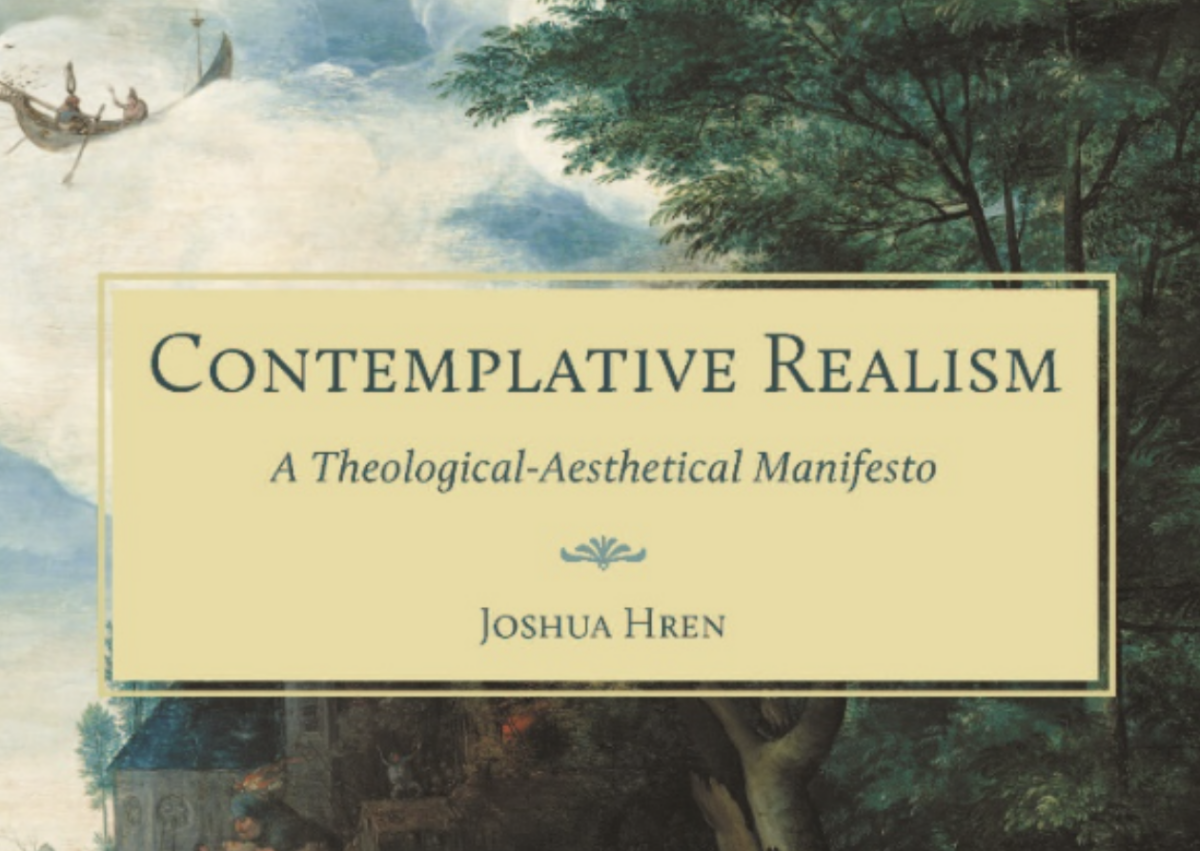
            In February 2022 the Benedict XVI Institute published Joshua Hren’s Contemplative Realism: A Theological-Aesthetical Manifesto, by Joshua Hren, founder of Wiseblood Books, co-founder of the Master of Fine Arts in Creative Writing program at the University of St. Thomas in Houston, and prolific novelist, poet, and essayist. His essays and poems have appeared frequently in such periodicals as First Things, America, Commonweal, National Review, Catholic World Report, and Law & Liberty. His books include two collections of short stories, This Our Exile (2017) and In the Wine Press (2020); the book of poems Last Things, First Things, and Other Lost Causes (forthcoming, 2022); Middle-Earth and the Return of the Common Good: J.R.R. Tolkien and Political Philosophy (2018); How to Read (and Write) Like a Catholic (2021); and the novel Infinite Regress (2022).

A recent article in Mere Orthodoxy explains Contemplative Realism’s germinal yearning. John-Paul Heil reviews the report in The University Bookman, Only the Lover Writes,” and, a review of both Contemplative Realism and Benjamin Myers’ book appeared over at Voegelin View: Literature for the Recovery of Reality: Joshua Hren and Benjamin Myers’ Christian Vision for Literature.”

            Contemplative Realism is Hren’s response to Pope Benedict XVI’s summons to writers to “ask rather more carefully what ‘the real’ actually is.” “Are we not interested in the cosmos anymore?” Benedict asks. “[T]he man who puts to one side the reality of God is a realist only in appearance.”

            Hren takes up this challenge. Since its origins in the eighteenth century, Western fiction has for the most part eschewed the metaphysical—the presence of the divine behind the scrim of the visible world—to present a “reality” limited to the surface conditions of day-to-day modern life and thus often, although not always, infused with bleakness, black humor, cynicism, and despair. Any sense that some other reality might exist is reserved for the genre of fantasy. Contemplative Realism aims to define the response that a Christian writer of fiction might have to this self-imposed limitation: crafting a distinctive literature that includes ultimate as well as surface reality. The models already exist: Dostoevsky, Flannery O’Connor, Marilynne Robinson. Hren writes:

The underbellies of our civilizations and the cesspools rank in the pockets of our souls are real. They rightly make us reel. Sometimes the vestiges of God in the world can seem scarce or scattered relative to the apparent success of raw evil. At this juncture the contemplative realist seeks to stoke reverence for the reality of the Paschal mystery—a passion, death and Resurrection that is more real than an infinite tally of the sins and the frightening fissures, the apparently irreversible cracks in existence. But, countenancing the same absurdities that unnerved Camus and the existentialists, the contemplative realist will prevent his story’s perspective from relishing the farcical or capitulating to the       cruel to the point of souring cynical even as (fiction being largely a record of man in rebellion), a large part of his work consists of drawing out the spiritual intensities of man’s refusal to serve.

 and:

The contemplative realist, considering the actual existence of things, at once sees them as we were meant to see them and also shows the rest of us how to see them. Sometimes he shows us the same thing several times, in several ways, leading us up the ladder of perception to a fuller share in the beauty of being: superficially first, operating in the mode of “how things are” in their apparent blasé “nothing to see here” state, or scattered in apparent disorder; then, as St. Bonaventure puts it, “he considers things in themselves,” namely, in their matter and substance, power and activity, measure and motion, and from here “the observer can rise, as from a vestige, to the knowledge of the immense power, wisdom, and goodness of the Creator.” The contemplative, as         contemplative, can achieve this ascent without needing to communicate it at all. No one, says Bonaventure, “arrives at contemplation except through penetrating meditation, holy living, and devout prayer.” The contemplative realist surely needs these things and more. Wedded to the word and world in a different manner, the contemplative realist must     manifest this perception in his prose. 

Hren’s Manifesto, besides being a beautifully written and passionately argued 64-page book, is an actual manifesto. Hren has garnered the signatures of a number of Catholic writers who endorse his theory of a distinctively Christian approach to literature.

            Catholic Arts Today has decided to engage Hren’s intriguing and challenging theories. To that end, we have posed some questions his manifesto raises to its signatories. What follows is a kind of symposium, a conversation we have cobbled together from our questions and the responses of five of the signatories.

Besides Joshua Hren himself, the signers of the Manifesto participating in the conversation include:

–Glen Arbery, president of Wyoming Catholic College and author of Why Literature Matters (2001) and the novels Bearings and Distances (2015) and Boundaries of Eden (2020).

–Katy Carl, editor-in-chief of Dappled Things and author of the novel As Earth Without Water (2021) and Praying the Great O Antiphons: My Soul Magnifies the Lord (2021).

–Sarah Cortez, author or editor of 14 collections of poems and essays, including Tired, Hungry, Standing in Spot for Twelve Hours: Essential Cop Essays (2019), third-place winner of the National Federation of Press Women’s nonfiction award.

–Benjamin Myers, professor of literature at Oklahoma Baptist University, author of three books of poetry, and 2015-2016 Poet Laureate of the state of Oklahoma.

–James Matthew Wilson, poet-in-residence at the Benedict XVI Institute, director of the Master of Fine Arts program at the University of St. Thomas in Houston, and author of eleven books, including six books and chapbooks of poetry.

 Catholic Arts Today: How would you distinguish contemplative realism as a fictional mode from realistic fiction that happens to have been written by a Catholic writer? For example, there’s Flannery O’Connor’s wonderful story “Everything That Rises Must Converge,” about the black and white mothers who meet on a newly integrated Southern bus and have no ability to understand or even perceive each other (not to mention the white mother’s oh-so-sophisticated but comically obtuse son). We know that O’Connor was a Catholic writer who took seriously the mysterious workings of grace in the human heart–so we might classify this story as a work of contemplative realism. But a secular admirer of O’Connor–and there are many–might see the story as a strictly secular story of the tragedy of the human condition–something that all good secular writers as well as Christian writers recognize. Why is this story an example of contemplative realism–in contrast to just plain realism as explicated by a talented and observant writer?

James Matthew Wilson: In my view, Contemplative Realism is not a manifesto positing a new or specialized literary practice or poetics, though it may have touches of that. It is rather an insistence that contemporary literature recover the fullness of breadth and depth proper to the great literature of every age. Odysseus descends to the underworld. Aeneas descends to the underworld. Since Dante, our knowledge of the real comprehends the descent into mystery and the ascent to the divine essence. Not all art can have such a cosmic scope; the minute, particular, and immanent is also a worthy theme for literature. But once we have seen those grand or awesome vistas, art is itself transformed. The weakness to which Joshua is responding is that, with full knowledge of how revelation and grace have transformed what we know about nature, so much contemporary art proceeds as if nothing had changed. It shies away from grandeur, it fumbles in knowing ignorance, and settles for a foreshortened horizon that even the unbeliever knows is not the full range of the spirit. Art does not tolerate special pleading, but it becomes a lie when it pretends to be utterly unaware of things just because its authors do not like them or believe in them or feel capable of speaking of them.

Katy Carl: This question helps to clarify that contemplative realism is not being presented as though it were the one and only “right” way to be a “Catholic writer” (that fraught, much-contested term) or even a spiritual writer. Rather, it serves to articulate one aesthetic approach to literature that is deeply consonant with the best of the Catholic intellectual and spiritual tradition. We can locate it among a multiplicity of “Christian realisms” whose emphases may vary. O’Connor, who considered herself a “Christian realist” and as such also a “prophet of distances,” has a voice so sui generis that any imitation must pale beside the original. The secret of her genius was not “violence” or even “hillbilly Thomism” but the gift to see things as only she could see them.

As you rightly notice, this is the work of any writer worth her salt, regardless of that writer’s other beliefs. But for a writer who starts from a position not of habitual doubt or materialist skepticism but of enthusiastic assent that what the Church proposes and believes in the Creeds is essentially true, what is seen and how it is seen will shift. This is what O’Connor meant when she said doctrine was an instrument of vision, not an obstacle to vision. Jacques Maritain is also on to this when he speaks of the altitude from which an artist is able to see. To my mind, a contemplative realist seeks to dramatize the point of intersection between the vertical axis of human experience, the aspiration toward God, and the horizontal axis of the observable world.

Catholic Arts Today:  Conversely, what’s to distinguish a work by a secular writer who happens to “show the rest of us how to see…the actual existence of things” and a work by a contemplative realist? Take Hemingway’s 1927 story “Hills Like White Elephants,” about a young woman being pressured by her boyfriend into having an abortion. This story is an extraordinary narrative of “the actual existence of things”: the girl’s horrifying realization of the ultimate sterility–and shallowness–of the pair’s months-long relationship that is in fact like the dry, barren condition of the hills in the Ebro Valley. Was Hemingway a writer of contemplative realism manqué? Or just a secular writer who could see inconvenient truths? How would a Catholic writer have handled the story any differently?

Katy Carl: The virtue and the liability of Hemingway’s pared-down style both dwell in the power of suggestion by omission. Speaking just for myself as a reader, I find this power can be brilliantly used or pursued to a fault, depending on the context, and in “Hills Like White Elephants” the brilliance all comes across in the felt absence of love. This absence is only too realistic in the story’s context, but if it were all we could expect from reality on or off the page, we’d be right to despair. It’s much harder to write unsentimentally, truthfully, about the presence of love than about its frequent absences and failures in human behavior. This is especially true when you’re dealing with characters who have numbed themselves beyond the reach of feeling or connecting with any love that may be present in the situation. The contemplative realist is always on the search for a suggestion of the “Love that moves the sun and other stars,” whether or not a particular story’s characters are similarly inclined.

To return to O’Connor, think of her Haze Motes in Wise Blood, charging through the streets of Taulkinham, as hellbent on sustaining his own misery as either of Hemingway’s lovers here—but O’Connor calls our attention beyond and above the misery in a way Hemingway might have considered cheating because it reaches beyond the senses, though you couldn’t with any justice call it distanced from the senses either. Again, O’Connor makes that attempt to discover the sensorially rendered intersection of the vertical and horizontal planes, which Hemingway might have seen as a pointless exercise but which, to a contemplative realist, is almost the whole point.

Benjamin Myers: I think it is important to note that the signs of the transcendent are in the reality depicted by the fiction not just in the words of the story. Two photographers might capture two images of the same bright light, one calling it a trick of the lens and one calling it an angel, but it cannot be both. If it is an angel, then they have both taken a photograph of an angel, regardless of one photographer’s ignorance of that truth. In other words, the more talented and observant a writer is, the more difficult it would be for that writer to be merely a “plain realist,” regardless of the writer’s awareness of what true reality he or she may be capturing in fiction. (Of course, the artist who knows what he or she is depicting has an advantage). Nihilism and materialism require scant attention to the nature of things, but many great writers have been of God’s party without knowing it.

Sarah Cortez: Especially within the Catholic (Christian) worldview, intentionality is paramount because sin requires intentionality, just as not sinning does.  Therefore, I would say that great or even good writers who undercover layers of meaning in their work, even metaphysical meaning, may not necessarily have the contemplative realist goal in mind due to lack of intentionality.

Catholic Arts Today: Joshua has pointed to a cynicism, nihilism, and despair that he suggests is a cornerstone of the realistic tradition. He cites the novels of Balzac, Flaubert, Camus, and Jonathan Franzen as some of his examples. But is this dichotomy the only way to contrast the realistic tradition with contemplative realism? What about novelists and story-writers of manners, such as Trollope, George Eliot, Chekhov, Nabokov, A.S. Byatt, and others who simply aren’t interested in metaphysical reality? Where do they stand in the realism vs. contemplative realism dichotomy?

Benjamin Myers: The signs of the transcendent are not always spectacular. The bread and the cup are household things. When a writer is observant of what is, even in the “mundane,” the transcendent can come through, though a writer such as Trollope or Chekhov will certainly often, whether consciously or unconsciously, attempt to stifle that transcendence. That is one kind of materialist realism, a blessedly failing kind at times– or blessed to the extent that it fails. In Nabokov I sense a greater awareness of what is missing, a yearning for transcendence that the writer feels as near but refuses to believe in. In such cases the frustrated yearning itself can become a kind of sign of the transcendent, when the writer is sharp enough.

James Matthew Wilson: Hans Urs von Balthasar says that the Christian must be the guardian of metaphysics in the present age. So is it with the Catholic or contemplative-realist writer. Some authors have little or no metaphysical scope to their work and the work suffers for it, even if the work can still — and with ease — be affirmed as good, or even very good. Literature always faces the temptation to become secular, whether in an imitation of classical humanism or a vulgar politicization of aesthetic form or in a mere playful romanticism. One does not need to deny the value that may be found in each of these secular visions to observe that they do not tell the whole story. It’s my hope that my work celebrates the discipline and reason of the human spirit in keeping with the best aspects of classicism, while it also keeps the work open to the transcendent. A vision of the secular, and of the merely human, always implies by its own internal essence and existence, the presence of that which transcends it. Paul Claudel wrote of this often in his poetry: to study the nature of things is to study causality, and, for Claudel, the only cause was that of the God who created all things and held them in relation to one another.

Catholic Arts Today: Can you be a Catholic novelist (or poet or screenwriter) without being a contemplative realist? What about such Catholic novelists as Robert Stone, Alice McDermott, Phil Klay, and Kirsten Valdez Quade, who have brought their Catholicism to their writing and dealt with serious questions of faith, salvation, and morality in their fiction. What might separate them from contemplative realists?

Joshua Hren: Many contemporary Catholic writers operating in different veins contain considerable goods. As I note in a piece for University Bookman, Phil Klay’s Missionaries contains a stunning intrusion of Christ onto the scene. I also appreciate much that is happening in the realism of Christopher Beha–both in What Happened to Sophie Wilder and The Index of Self-Destructive Acts. And then there’s Randy Boyagoda’s comic contributions to contemporary Catholic letters, Dante’s Indiana, which I’ve reviewed at Law & Liberty.

In How to Read (and Write) Like a Catholic, I outline three main ways that we can approach the goods of literature:

1. The study of literature as the study of human nature, which is to say the study of ancient texts in order to obtain a greater understanding of human passions and ends, possibilities and limits, to witness man’s innate social nature, to hear the whispers of natural law as it chastens man in rebellion, and to consider how the human story unfolds outside of a direct encounter with Christian revelation. (This does not exclude reading the deep meanings of these works according to the light of Christ.)

2. The study of literature that is intrinsically Catholic. This can be undertaken through an examination of the presence of metanoia (conversion) in great literary texts; through a consideration of the way in which writers dramatize the workings of grace upon nature; and through a sacramental approach that sees the ways in which seen images point to unseen realities–a cultivation of the capacity to, in Flannery O’Connor’s words, see evil as “a mystery to be endured” and “not a problem to be solved.”  

3. The study of “Christ-haunted” fictions–the persistence, often in traces or in veiled form, of Catholic ideas, images, and tradition in purportedly secular or postmodern poetry and stories, as well as literature grappling with faith within an increasingly secularized literary canon.

Catholic Arts Today: Is there a temptation for the contemplative realist to be complacent, to write simple dichotomies of faith versus its lack, to elide over despair and doubt? How can a contemplative realist avoid that trap?

Glenn Arbery: Chaucer makes fun of such complacency and such “dichotomies of faith versus its lack” in “The Prioress’s Tale,” the horrifically pious story of a sweet Catholic boy killed by demonic Jews. He mercilessly satirizes the Prioress herself in the General Prologue of The Canterbury Tales, but he is just as satirical about the Miller, whose tale of sexual antics remains both hilarious and outrageous.

Contemplative realism means taking the world as we actually experience it. When Joshua coined the term, I don’t think he meant to suggest a new approach but rather to emphasize that the Catholic writer has never needed to be afraid to face the whole truth of things, which necessarily includes spiritual levels. I get the impression that some Catholics are horrified by depictions of eros or bad language or violence–I think of Flannery O’Connor’s Wise Blood or her stories “Good Country People” or “Greenleaf” (not to mention most of Walker Percy)–as though the faith could not stand up to them. But, even more than when O’Connor or Percy were writing, the culture we inhabit promotes “expressive individualism,” which negates the very idea of transgression, and one thing we need is to see sin as sin.

The imaginations of children might need to be protected (even from some passages in the Bible), but the mature imagination needs the real world of beauty and transgression, misery and grace. It’s important to present people in their self-consciousness and the allure of sin without glamorizing evil, and also to present them in their prayer, their doubt, their suffering, because these are realities that must be worked through with fear and trembling. 

 I would argue that the Catholic writer has this advantage: he or she does not have to invent the whole meaning. The world is given and given with intention — it already has meaning. If fiction is any good, it is patterned upon real observation, which means that it is the interpretive discovery of what is already there. Instead of having to force layers of meaning into the fiction, the Catholic open to givenness and divine intention can trust that in pursuing the beauty of the work, he or she does not have to intend every meaning consciously. As Jesus says, “a good measure, packed together, shaken down, and overflowing, will be poured into your lap.”

Sarah Cortez: Simplicity of both worldview and of artistic expression can always be a wily seducer. Within the context of this manifesto, however, the only “simplicities” stated are spiritual truths which because of their inherent nature defy their apparent simplicity due to their origin in the Divine nature of God. Thus, the writer, in particular, is left with the task of bringing to the page truths grounded in the many mysteries God has placed within human nature, and each person’s torments and joys as his individual salvation is worked out within a luminous but crazy world.

Joshua Hren: My manifesto on behalf of a “contemplative realism” makes no claims to create, ex nihilo,a new aesthetical species. Nor does it advance this rough school of literary fish as some preeminent or sole “way forward” for fiction in our time. It makes the case for an aesthetic that does not negate so much as it develops the goods of realism. It makes the case for an aesthetic that is consciously committed to unflinchingly gazing at the brokenness and terrifying aspects of nature, resisting the notion that what is “most real” is most evil or difficult to countenance, and yet representing the innumerable crosses in nature and the startling fissures in nature, even as it also gives witness to what St. Bonaventure calls the “vestiges of God” found in the creative world, and the heroic sanctity that can be cultivated even in unpropitious environs.

My manifesto seeks to articulate a literary approach that exists already in diffuse books and also in the potencies of living artists. It seeks to gather and galvanize those souls. It is a soul cry to break through restrictive bonds of the culture we inherited, and yet to be in conversation with our fellow artists who are not believers but who have tremendous natural insights into the state of contemporary fiction or the prospects of the novel in an age of diminishing readers. Amidst this conversation, we necessarily critique the deficiencies of those realisms that reduce what is most real to the seen. 

Mr. Tanner (A Short Story by T.M. Doran)

“MR. TANNER!” an eager voice called out from behind a dense Buttonbush in its red and green glory.

Mr. Tanner knew Betty’s voice as well as he did his own, but he was in hot pursuit of a pea-sized predator on a flowering Blackhaw Vibernum so he didn’t respond.

Mr. Tanner’s chief interests were making things grow, nurturing butterflies, eliminating killer insects and other pests, and the tenor saxophone. He had been a Detroit Zoo gardener for thirty-three years, now responsible for tending the Wildlife Interpretive Gallery’s indoor butterfly gardens and the zoo’s outdoor butterfly garden. He was a sturdy sixty-nine year old, five-foot-eight inch tall man, hitting the scale at exactly one-hundred-seventy pounds. When he’d started working at the zoo, Mr. Tanner had been the only Black man in a crew of twenty gardeners and had stuck out like a praying mantis on a red Hibiscus flower. Now, he drew attention only for the neatly buttoned white shirt and thin tie he always wore beneath his zoo jacket, and the dingy yellow backpack he had carried to work for as long as anyone could remember.

Mr. Tanner debated with himself: Pluck the larvae from its leafy roost by hand? Or use his puffer. The latter would destroy the little thing. Plucking the bug, albeit a more delicate operation, would allow the gardener to retain the living pest for Carla’s examination. Viburnum Leaf Beetle larvae were smaller than caterpillars but if allowed to become full egg-laying beetles could kill a mature shrub in one season.

Mr. Tanner had pruning to do, too, but pests once detected became the first order of business. Who knew how many progeny this creature would beget if he didn’t begot it first—an original saying of his.

Betty burst out from behind the blooming Buttonbush like a trotting ostrich, and Mr. Tanner had to put a finger to his lips to prevent her from interrupting the search-and-destroy operation. A fellow veteran of such missions, the dark-haired, olive-skinned woman in her mid-forties halted in place and, for good measure, held her breath.

Mr. Tanner placed the bug in the plastic container he kept handy for such invaders. “Mission accomplished,” he said to Betty. “How is our prize-winning photographer today?”

She blushed, though Mr. Tanner could tell that Betty appreciated his appreciation. Betty lived alone and could come off as haughty and prickly to those who only knew her superficially. To Mr. Tanner, who knew this woman as well as anyone at the zoo did, she was a person of intriguing contradictions, an adventurer who dared to flout a State Department ban to encounter wild gorillas in the Congo’s Virunga National Park but wouldn’t drive her car half a mile in the snow.

“Here…look,” she said, showing him her camera viewer.

“Oh!” exclaimed Mr. Tanner, observing a young Lion-tailed macaque plucking a snack from a spectacular Blue Celeste Ficus. “Zoo magazine cover material,” he added, and the two shared a smile.

Betty loved the zoo but she hadn’t been an employee there in the sixteen years he’d known her. Rather, she spent hours photographing the animals while serving as a docent in the primate and butterfly exhibits. To Betty, the zoo was a sanctuary rather than a job.

Betty’s smile became a dark frown: “You won’t believe what those people did.”

Per usual, when Betty was preparing to rail against someone, her spine stiffened and she gained an inch on her already towering frame. “The power company cut down that beautiful maple. Now, I have no shade on that side of my house, and I have to look at those ugly poles and electrical equipment!”

For a moment, Betty waved a prefectorial digit at him. Then, mortified and red-faced, she clenched her fists. Mr. Tanner had seen this side of Betty often enough, being the only person upon whom she felt comfortable enough to unload. Mr. Tanner didn’t like the indiscriminate cutting down of mature trees either, but he didn’t know the facts.

“Can you just plant something to replace it?” he asked Betty.

“Nothing as mature and lovely as that maple. What a disaster!”

“Or you could plant a sun garden,” he suggested. “You love the smell of our Bush Honeysuckle.”

“But a bush won’t shade my windows,” Betty objected. “Besides, it won’t overwinter.”

With his mini-snips, Mr. Tanner dead-headed a Blanket Flower, absentmindedly palming the shriveled floral corpse. “I know a woman who keeps a Cape Jasmine in a large pot and winters it in her dark garage. Not cold enough to kill the plant, and no frost. She lets it go dormant for four months. Or what about Hollyhock or Queen of the Prairie? They grow tall.” But mollifying Betty was impossible now, so Mr. Tanner resigned himself to hearing her out, and that took another twenty minutes. He had learned that sympathetic listening was a balm that took some of the sting out of Betty’s chronic frustration.

After lunch, Carla showed up, as she always did. As the zoo’s herpetology curator and Lepidoptera keeper, Carla spent mornings at the larger reptile and amphibian exhibits, and when she’d finished with the snakes and frogs, joined Mr. Tanner in the indoor butterfly garden.

“All well?” she asked him, her standard greeting.

“Very well,” he responded.

“The shipment should arrive tomorrow, and the Malachites. Our first.”

“Beautiful!” he rejoiced with her, and then showed Carla the object of his successful morning hunt. “You might want to add some Spined Soldier Bugs to the next order if you want our butterflies to have healthy Viburnum.”

Mr. Tanner had met Carla twenty-seven years before when the zoo hired her as their reptile keeper. Apart from a gimpy knee, Carla had changed little since that time. Single and stout, with a forceful personality that sometimes put off colleagues, Carla’s demeanor softened, her eyes sparkled, and her voice fairly sang when she showed off her winged and scaly creatures to young people. And Mr. Tanner had witnessed Carla’s generosity when a colleague or one of her staff was in need.

“I’ll keep an eye out for the shipment,” Mr. Tanner said. “How’s your knee?”

“I could help matters by losing some weight. In the meantime, I’ll keep this knee brace handy. Have you solved our water problem?”

“Not yet,” the gardener admitted. “I plan to text Ron.” Fixing things was Ron’s special talent.

She nodded. “Light crowd today.”

“Rain in the forecast.”

Their many years together meant the two were thinking the same thought. Carla had seen Mr. Tanner’s saxophone in the office. That meant today was Friday, and if the weather held out, Mr. Tanner would perform his Jazzy Jingles in the outdoor butterfly garden at three p.m., as he’d been doing for close to ten years; music everyone recognized, even if performed by a solo saxophonist: “These Are A Few of My Favorite Things,” “Put On a Happy Face,” “Honey Please Don’t Be That Way,” Tunes that brought smiles to people’s faces. Some annual passholders visited the zoo on Fridays just to hear Mr. Tanner’s evocative music.

They’re not Coltrane jazzy but they jingle was another of Mr. Tanner’s sayings.

Carla started to walk away but paused and looked back. She exhaled audibly, and said, “My sister lost her job. Third time this year.”

“Laid off?” Mr. Tanner asked.

“No, fired. Not exactly how she explained it, but that’s what it amounts to.”

Mr. Tanner had only met Carla’s sister on two occasions and had decided that two sisters couldn’t be more different in temperament and priorities than those two women.

“I’m washing my hands of the whole business,” Carla remarked. “Why bother when she can’t keep a job for more than six months? And that Barry of hers is worthless…irresponsible.”

“Don’t give up on her,” Mr. Tanner urged his boss.

If Carla was surprised to hear her gardener say this, she didn’t let on. Instead, she said, “What do you suggest I do?”

“Stay connected. What she does with your help…” He turned his palms upward.

“It’s frustrating!”

“Yes, but less frustrating if you admit you can’t control what she does.”

“You think I like to be in control?”

They both smiled.

“I’ll hand-water until the irrigation is fixed. Early, so the visitors aren’t disturbed,” he promised her.

Carla returned to the Reptile House while the gardener made for the office.

Mr. Tanner’s work space was a modest affair. In the corner of the office, he had a locker where he kept his once-neon yellow backpack—now faded to the color of straw—his zoo boots, gloves, and stormy-weather gear. Propped against the wall was a camp chair he occasionally used for Jazzy Jingles. When he needed a computer, he used the one on the office desk.

Mr. Tanner updated the butterfly garden’s Predators and Pests spreadsheet on the computer, then went back to work. He was on his knees and surprised to realize that two hours had passed when Ron tapped him on the shoulder.

“The tigers need me,” Ron announced, “but tell me what’s wrong. I’ll come back tomorrow.”

“The watering system’s acting up,” Mr. Tanner answered. How like Ron this was—a man who had recently passed the half-century mark, handsome and a magician with mechanical equipment—to stop in, rather than texting the gardener that he was too busy. Did anything short of a nuclear reactor exist that Ron couldn’t fix? He’d been at the zoo for twenty-one years and had married for the first time two years earlier—a younger woman with two children.

“I bumped into Betty at the primate exhibit. What rattled her?”

When Mr. Tanner didn’t answer, Ron shook his head. “You don’t have to say it—anxiety. Instead of having one wholesome disease, psoriasis or allergies, she has a new one every month. Like my Aunt Tilly.” The mechanic glanced around the butterfly garden, and said, “We’ll take care of you.”

“You always do, my friend.” The gardener removed his work glove and the two men shook hands.

Mr. Tanner looked at the clock. He’d be late for Jazzy Jingles if he didn’t get a move on.

MR. TANNER WAS SURPRISED TO HEAR someone moving about the exhibit as the zoo was not yet open for visitors, and Carla always attended to her frogs and snakes before she made an appearance here.

Carla’s assistant? Ron? But when the girl emerged from the lush greenery, he recognized her: the bear keeper Suzanne Wayne’s ward, as Carla had referred to her—Benji by name.

They had spoken once before without introducing themselves. Then, the exhibit had been busy with visitors, but unlike most this girl had not looked past the old gardener but had greeted him and asked several insightful questions—“What’s the rarest butterfly in the world?” “What’s the difference between a chrysalis and a cocoon?”

Today’s version of the girl looked troubled and wary, and Mr. Tanner wasn’t convinced she’d say anything unless he spoke first. Carla hadn’t told him much about Benji but enough to suggest the girl had come from a chaotic domestic situation and that Suzanne’s taking her in had been an act of mercy. She was wearing new clothes and shoes—not runaway clothes, and surely provided by Suzanne Wayne. He guessed she was in her early teens, though her eyes were older.

“Hello, Benji,” said Mr. Tanner.

The girl made a little wave, but her features remained cloudy.

He would keep talking. “Want to see who can find the stick first?”

He had surprised her, as he’d hoped. “We have several stick insects in the exhibit. People rarely notice them. Something Curator Carla dreamed up to keep things interesting.”

Benji shrugged.

“Is something wrong?” he inquired delicately.

Maybe she needed to release some of the emotion that fairly oozed out of her because the girl said, “Everything!”

“I’m sorry about that,” Mr. Tanner responded in surprise.

For a moment, he thought she was going to rush off, but a Monarch settling on her shoulder produced a meager smile.

“I want to stay with Suzanne,” she muttered.

“Does she know this?” asked Mr. Tanner, laying down his hand spade. Today, sunlight was rushing into this century old glass-domed building, the beams of light making the colors of the flowers and butterflies more vibrant.

Benji nodded. “But she said she doesn’t know if they’ll let her.”

“Does your mother or father object?” He didn’t think this question would be well-received but had decided to plow ahead anyway.

“I don’t have a father, and Destiny is worse than not having a mother.”

That docile butterfly finally ascended from Benji’s shoulder. Before the girl could step away, the gardener asked, “Why do you say so?”

“The usual…worthless men, drugs, yelling…” Her voice trailed off.

“I know what you mean,” he responded, and before she could fire back, he added, “Yes, I do. I’ve been in such places. But you’re here now, with Suzanne.”

“I love the zoo. I want to be a keeper like Suzanne and Stella.”

Mr. Tanner was acquainted with Stella, the other ursine keeper. “If I know Suzanne, she’ll do her best for you—”

“But will it be enough?” asked Benji, passion in her voice. “I won’t go back. If they make me, I’ll run away again!”

She expected him to caution her, but he didn’t. Mr. Tanner said, “You’re welcome here anytime. The more you learn, the better prepared you’ll be for a keeper’s or curator’s job…or to be a vet like Dr. Bogardus.”

“That’s what Suzanne told me,” the girl said, more engaged now.

“Who could ask for better training?”

“But why?” she pleaded.

Mr. Tanner knew exactly what she was asking—he had that sixth sense. Furthermore, he knew the question wasn’t directed at him. Rather, that question preyed on the girl. He said, “Would you help me clean up before the visitors arrive?”

When Benji hesitated, the old man pointed to the old-fashioned clock on the wall, and said, “Ten years ago, I used to finish all my getting-ready-for-visitors work in plenty of time. Now, those clock hands seem to move faster.”

Without saying anything, Benji picked up a broom and began to sweep the cuttings on the floor.

“Where does your mother live?” Mr. Tanner asked her.

When she told him, he cringed because that area of the city was notorious. “How long have you been staying with Suzanne?”

“Two weeks,” she replied, emptying her sweepings into the plastic bin.

“Does Suzanne live near the zoo?”

“Not far. I sleep all night now. I never did before.”

With Benji’s assistance, the cleaning didn’t take him long, and when they put the tools away and removed the plant debris to the compost bin, Mr. Tanner said, “May I show you something before you go?”

The girl followed the gardener to a corner of the exhibit where the zoo displayed many of its chrysalises. Every day, Carla offered a half-hour learning session here, often accompanied by an emergence, where a bin of butterflies was released to the exhibit, an event that never got old to Mr. Tanner.

“I’ve seen these before,” Benji observed.

Undeterred, Mr. Tanner kept his eyes fixed on the display, as if he expected a butterfly to pop out any minute. Finally, he said, “I wonder what it feels like to be pupae inside chrysalises. I try to imagine how I’d feel…dark, confined, all alone and scared.”

“I don’t think caterpillars feel any emotions,” she observed.

“Probably not, but I imagine how I’d feel.”

Now, they were both gazing at the chrysalises, eyes close to the Plexiglass.

“A caterpillar could crawl from one end of the zoo to the other but until it goes inside a chrysalis—that dark lonely place—it can never become a butterfly.”

Benji’s phone rang. She looked at Mr. Tanner. “It’s Suzanne. I’m late.”

“Thanks for helping me,” he said to her back as the girl ran off.

Mr. Tanner made his normal rounds, less conspicuously with visitors in the exhibit, and tending the outdoor butterfly garden when the building was busiest. He spent at least an hour every day cleaning, sharpening, and repairing his tools. A while back, the zoo’s maintenance chief had been amazed to learn that the gardener had been using several of these tools for thirty-three years.

“Like old friends,” Mr. Tanner had told him. “Reliable. Predictable…don’t talk much though.”

When the Malachite chrysalises arrived, Mr. Tanner quarantined them in the exhibit’s reserve box, making sure the habitat was ready for Carla’s inspection. In the coming days, both he and Carla would be carefully watching their new arrivals for signs of distress.

Near the end of the workday, Ron showed up, asked a few questions, and made for the mechanical room, accompanied by Mr. Tanner.

Ron exuded competence, not because of anything he said but by how he took charge when something needed fixing. If Ron didn’t always think before he spoke, Mr. Tanner had never heard anything vindictive escape the mechanic’s lips.

“Not too many aches and pains?” Ron asked him.

“You know” was Mr. Tanner’s equivocal answer. These days, his left shoulder ached most nights, a different sensation than his normal aches and pains. Occasionally, the pain woke him at night.

Ron nodded. “I’m getting to know. I turned fifty last month, remember?”

“And the kids?” the gardener inquired.

“Yah. Hand me that wrench, please…no, the other one. Thanks…”

Ron worked in silence for several minutes but something told Mr. Tanner to keep the mechanic company. As it turned out, his instinct was good because, without looking up, Ron said, “Those kids are driving me crazy. Their own father left them for Christ’s sake, and I’m not good enough?”

“They’re teenagers, right?”

“It’s the water pump—a metal chip. David’s thirteen and Sara’s twelve. Always mouthing off to their mother, and when I say something, the conversation really gets ugly. I don’t care about honest mistakes, but I won’t stand for disrespect.”

Mr. Tanner could hear the suppressed anger in Ron’s voice—the very first time he’d experienced such fire in this even-tempered man. Mr. Tanner said, “Young people can’t always control themselves.”

“I don’t care about that,” Ron snapped.

Mr. Tanner let Ron work a while before he spoke again. “You have a few years with them before they’re grown. What you say and do will make a big difference in who they become.”

Ron dropped the wrench and looked at Mr. Tanner. “You have children, right?”

The gardener nodded in reply. Ron responded with, “Well, these aren’t my kids.”

Already, Mr. Tanner was shaking his head back and forth. “Not your physical children, but when you married their mother they became your kids.”

“I don’t see it that way.”

“Then, try to see it that way for their sakes…and for yours. Your wife will honor you for it.”

“She’s just trying to keep the peace.”

“Someday, she will honor you for it. She’s worth it, isn’t she?”

Ron’s face was red, and his jaw was clenched, but after a bit the color receded.

“What are you working on for fun these days?” Mr. Tanner asked to lighten the exchange.

“I’m rebuilding a twentieth century military radio…using vintage parts. I’ll bring the radio in and show you when I’m finished.”

Mr. Tanner did his best to conceal the alarm he suddenly felt. His heart started thumping. He took several deep breaths and tried to concentrate on Ron.

The mechanic didn’t seem to notice. He returned the wrench to his toolbox, and said, “No more water problem.”

MR. TANNER DIDN’T KNOW WHY the zoo’s chief operating officer had summoned him but he had a funny feeling about it. He’d been tempted to confer with Carla but in the end had decided to see it through on his own.

Not that Art McLeod had a bad reputation. If he wasn’t as congenial as the zoo director, the COO enjoyed the respect of the staff all the same because McLeod was known to let people do their jobs so long as their work was satisfactory.

“Sit down, Mr. Tanner…please.”

Mr. Tanner did as instructed.

The COO’s office wasn’t ostentatious. Rather, it oozed efficiency, having a large primary desk with a computer facing McLeod, a side desk with a smaller laptop, and nothing on the bare walls. Not a binder, folder, or piece of paper in sight.

“You’ve been here for thirty-three years, Mr. Tanner.”

“Thirty-three years last month.”

“You’ve given superior satisfaction.”

Why didn’t this make Mr. Tanner feel any better?

“Carla told me you’re a man who can handle things…anything. So, I’ll be straight with you.”

Straight with him? Mr. Tanner was on guard now.

“You’ll be seventy soon, and starting on that date the zoo’s landscaping company will take on the butterfly gardens.”

Mr. Tanner overcame a pardonable confusion in his ordinary way, by silently repeating McLeod’s words until they sunk in. “I had hoped to work a few more years,” the gardener mused rather than complained.

The COO said, “Carla insisted that you receive a lifetime pass to the zoo. That’s a rare honor, Mr. Tanner. We hope to see you often. And you can be a docent if you desire. You certainly are an expert on many of the animals.”

Was Mr. Tanner listening? All he could think about was waking in the morning and not having his zoo gardens to tend, not seeing Carla, Betty, Ron, and the others who had become dear to him.

Mr. Tanner lifted his head and looked across the desk at McLeod. “Don’t think I’m not grateful because I am. Hardly seems like thirty-three years.”

McLeod was clearly uncomfortable with the message he’d delivered, and Mr. Tanner didn’t like to make anyone feel uncomfortable. He stood and extended a hand.

The COO took the gardener’s hand and mumbled a few more words of praise.

Mr. Tanner closed the door behind him. The end of the month—eighteen days. No more lively times in the butterfly gardens, no more spectacular butterflies emerging from chrysalises, no more conversations with Carla, Betty, and Ron—no more shoe-leather commutes, no more Jazzy Jingles.

You’re seventy, or almost, he told himself. What did you expect? A blue ribbon? Part of him was grateful and part sad. Like a lot of things in life—his wife, that heart scare ten years back, even the war when he’d managed to forge friendships amidst those horrors.

Carla was there when Mr. Tanner returned to the Gallery. It was after hours so she could have gone home. But not Carla.

“I was against it” were her first words.

“It’s alright,” Mr. Tanner said.

He saw tears in Carla’s eyes. “Will you be our docent? Betty will still have the primates.”

“Make sure they do the job right,” Mr. Tanner told her.

THE DOOR BURST OPEN and in came Benji like a storm cloud. She scowled at Carla, ignored Betty and Ron, rushed to Mr. Tanner and gave him a big hug. When she let go she was crying. And in a flash, Benji rushed out of the Gallery office.

Carla had intended a small retirement celebration for Mr. Tanner, but in a matter of seconds Benji had soured the mood.

The girl’s display didn’t do anything to assuage Betty’s worry. Only in recent days, with Mr. Tanner’s retirement looming, had Betty come to realize how much she relied on him. Who would she go to now when she was anxious about something?

Knowing that Mr. Tanner preferred printed photographs to digital images, Betty had prepared him an album filled with her own pictures of the butterfly gardens. And she had embellished the album with her elegant calligraphy.

“Open it,” Ron said to Mr. Tanner, handing him a package. It had been all the mechanic could do to refrain from critical comments about the COO and director. And though Carla had intimated that she’d fought the decision, Ron hadn’t been convinced. Only the sure knowledge that Mr. Tanner didn’t share his critical views held Ron back.

The mechanic had wrapped the present himself, and it showed. Mr. Tanner set the wrapping aside and displayed the book—a thick field guide to butterflies.

Mr. Tanner grasped Ron’s hand and smiled broadly at him.

He looks older, Ron said to himself. Then, he said to Mr. Tanner, “This book has real meat, the way we like it, not…” But glancing at Betty’s gift, Ron bit his tongue before he said, Not just pretty pictures and a few words.

Carla had felt guilty from the day she had grudgingly acquiesced to the COO’s and zoo director’s decision. Oh, she’d pushed back, but ever since that uncomfortable meeting in the executive office Carla had felt that she’d given in too easily. Yes, Mr. Tanner was well past normal retirement age, and yes, his duties had been curtailed in recent years, but who could deny all that he had contributed to the zoo—and was still contributing? She had witnessed Betty’s and Ron’s veiled suspicion of her own complicity in this action, and Benji’s opinion of her had been less subtle. What had Mr. Tanner once told her about the illusion of control? We have so little control that when the matter comes to our own hearts, we cannot so much as make the patter follow the pitter.

“You’ve been an ideal employee…and—” Carla was finding speech difficult, but she bore down—”and a dear friend to all of us.”

“I’ve been blessed to know you,” answered Mr. Tanner.

Carla dried her eyes without shame. “All your children still in town?”

Mr. Tanner smiled benignly. “Oh, yes!”

The curator suddenly realized how little she knew about her gardener’s private life because he preferred to talk about what interested or concerned the person he was with, and also because she—Betty and Ron too, for that matter—were naturally reserved when the subject involved a colleague’s private affairs. “You will be our new docent,” she told him.

“Give me a bit of time to think on that.”

“What’s to think about?” asked Ron.

What was there to think about? Plenty. Earlier in the day, an old memory had come back to Mr. Tanner while he was wiping down his empty locker—the day he’d opened the locker door and discovered a snow monkey perched on top of his backpack, eating his bagged grapes. The two had stared at each other for a moment—not belligerently, as Mr. Tanner remembered it—before the gardener half-closed the door, secured the office door, and went for help. As things turned out, the monkey had escaped from the Animal Health Center on a cold day and had found its way into the comfortable Gallery. That memory had transformed the doleful task of cleaning out his locker into a cheerier one. Mr. Tanner thought he still had the former zoo director’s letter of praise for his “compassionate and measured handling of this sensitive matter.” He didn’t need to be reminded that even those who receive praising citations and give superior satisfaction must one day clean out their lockers or their large offices.

Mr. Tanner said, “Keep an eye out for that girl—young Benji. Suzanne Wayne’s trying to help her and any support you can give Suzanne will be appreciated, I bet.”

“She’s a runaway,” Betty countered. “She won’t be here long.”

Mr. Tanner gave Betty the look she knew she was going to miss. “How long the girl is here doesn’t matter. What matters is what Benji experiences while she’s here. I know your hearts so I needn’t have said that,” he quickly added.

“Here’s your lifetime pass, Mr. Tanner,” Carla said. “We had it specially made. Betty helped with the butterflies.”

Though the day was Friday, Jazzy Jingles had been canceled. Mr. Tanner placed the gifts in his backpack and lifted himself to his feet. He kissed Betty and Carla on their foreheads and shook Ron’s hand, but he didn’t say another word.

The door closed on Mr. Tanner’s ninety-nine-hundred and fortieth day at the Detroit Zoo.


ALL THREE IN THE CAR were thinking about the same thing as Carla drove east—the brief notice from Pastor Simmonds: A mighty oak has fallen. A funeral service will be held for our brother, Cletus Tanner, this Thursday at ten a.m.

An oak they had seen and talked to almost every day and had too often taken for granted was gone. To Carla, he had offered protection from the workday gales, the precious sense that with Mr. Tanner on the job, nothing too awful could occur. Betty had received shade, a respite from the blazing heat of a life that all too often scorched her. For Ron, Mr. Tanner’s gift was the quiet beauty of changing leaves that enlivened drab days and offered him fresh perspectives on people and events.

Only six months after Mr. Tanner had retired.

“Why do you suppose he never came back?” asked Ron.

“Not what you think,” Carla rumbled, immediately sorry for her brisk tone. “He wanted Betty to continue as butterfly docent and he didn’t want to hear that the landscaping company wasn’t giving satisfaction.”

“Did he tell you that?” Ron pressed.

He had, but in the gracious words that had been her gardener’s trademark.

Mr. Tanner may have gone but his footprints were all over the zoo, like the paint-stamped elephant tracks on the lanes that guided visitors. Why, only last week a visitor had told Carla how she missed Jazzy Jingles, and when the curator had remarked that Mr. Tanner was devoted to popular tunes, the visitor had related how a serious jazz quartet on 8-Mile Road sometimes sent a car for Mr. Tanner when their regular saxophonist was indisposed. “And those cats don’t do popular tunes,” the woman had emphasized.

Why did Carla still feel bad about Mr. Tanner? Didn’t his seven children live nearby? But then again, didn’t she have a nagging memory—about the time she had started working at the zoo—when that number had been four, and hadn’t Mr. Tanner been a widower when they first met?

Betty was remembering how Mr. Tanner had asked them to look after Benji. Betty and that girl couldn’t have been more different, but the older woman had shown Benji some of her photos and let the girl use her cameras. And now? A friendship had been kindled based on their mutual love of animals and the art of the camera. Benji’s occasional vulgar eruptions still startled Betty but at those moments she did her best to picture Mr. Tanner, and that shielded her.

Ron hated funerals and he avoided them whenever he could, but both Betty and Carla had seemed quite forlorn when they’d talked to him about the funeral, and that was out of character for both women. Anyway, Ron wanted to whisper a thank you to the man who had helped him adopt a new attitude toward his wife’s children. While he and the kids still exchanged sharp words, and while he still grew frustrated with them, Ron was slowly changing, and he believed they were too. Could all this have transpired without those few words Mr. Tanner had offered him?

Mr. Tanner’s pastor had asked them to come a bit early.

The King Street Praise and Worship Church was nothing special to look at, just a small street corner building that needed some attention, though the yard was a thing of beauty. The visible neighborhood consisted of a mixture of smaller and larger houses, all intact while exhibiting signs that upkeep was a constant challenge. Nonetheless, most of the yards boasted small but lush gardens of Black-eyed Susan, Butterfly Bush, Phlox, Coneflower, Lily, and more.

Pastor Simmonds was a round man with a cluttered office. By the time Carla, Betty, and Ron settled themselves on unmatched chairs, they were shoulder to shoulder.

The pastor’s eyebrows were thick and the hair on his head was closely mown. The desk in the center of the room had seen plenty of use but wherever it had been chipped or scratched, a matching stain had been carefully applied. A homemade bookshelf was propped against one wall. A vibrantly colored rug covered much of the floor. The pastor’s one window looked out on a block wall.

“How did he die?” asked Ron, provoking a gasp from Betty and a frown from Carla.

The pastor took no apparent umbrage at Ron’s question. “Mr. Tanner loved working in our church yard. A week ago, he just tipped over. I saw him out the vestry window but he was gone when I got there…bless him!”

A large woman wearing a blue and yellow dress and expansive yellow hat somehow squeezed into the room behind Ron. Pastor Simmonds stood and said, “I want you to meet our cantor, Sister Ruth.”

When Ron made an attempt to rise, Ruth put a hand on his shoulder and pressed him back into his chair. “We’re happy to have you with us today. Brother Tanner loved you all so.”

“We loved him too,” Betty stammered, surprising Ron and Carla.

“And he loved his work at the zoo,” added the pastor. “Oh, how he loved his work. Why, Sister Ruth, how many in the congregation offered to drive Brother Tanner to work and back, but he wouldn’t hear of it.”

A moment of deep silence ensued when Carla, Betty, and Ron looked from one to the other.

“He didn’t have a car?” Carla asked the pastor.

“Not for twenty years or so. Spent every spare dime he had prettying up the church and neighborhood homes. Don’t think we didn’t try to convince him otherwise, but…well, you know Brother Tanner when he made up his mind.”

Ron said, “Then, how did he get to work?”

“Walked,” answered Ruth. “Two miles each way, in all kinds of weather.”

“Said he used the time to think and pray,” Pastor Simmonds remarked.

“I tried to pick him up on Woodward,” a new voice intruded, “but Brother Tanner just waved me on.” This new voice belonged to a tall lanky man in his later forties who stood just outside the doorway.

“I was hoping you’d look in, Brother James,” said the pastor. “Brother James teaches physics at Cass Tech and sings in our choir. Friend of Brother Tanner’s since he was a boy.”

James bowed his head. “Will surely miss him,” he whispered. “Mr. Tanner was like a father to me.”

“Amen to that on my account too,” Ruth concurred.

The pastor addressed the trio from the zoo. “Brother Quincy, our organist, and Sister Mazie will want to meet you after the service. They were special to Brother Tanner too. We all feel as if we know you because of what Brother Tanner told us about you…his dear ones at the zoo…Oh my, past time for me to robe. Sister Ruth, would you and Brother Quincy kindly assemble the musicians and choir? And Brother James, please have the pall bearers collect in the rear. I’ll signal when you can come forward, and then you can join the choir.” He looked at Carla. “Please sit up front.”

“We couldn’t—” she began, but Pastor Simmonds raised a hand and the rest of Carla’s protest caught in her throat.

They were preparing to move to the worship area when Betty, of all people, spoke up. “Why do you think he loved to garden?”

This innocuous question froze Pastor Simmonds, Ruth, and James in their tracks.

Finally, James answered Betty. “Brother Tanner never spoke to me of his time in Vietnam but my uncle served with him and we talked about those days in Uncle’s later years. Brother Tanner was a radio man who saw plenty of dangerous action—ugly things. He was also assigned to gray missions in Laos, even worse duty. Brother Tanner told Uncle that when he came home he made a solemn vow to live in decency and beauty. He began by helping neighborhood families to beautify their yards, and he took on gardening duties at the church. Then, he became a zoo gardener, but that didn’t slow down his neighborhood beautification efforts. Most of us have a quantum of generosity we use up early in the day, don’t we? Not Mr. Tanner.”

Betty could no more imagine Mr. Tanner amidst the field of corpses than she could imagine a butterfly in a volcano. Ron and Carla were equally stunned.

Betty thought she detected a few suspicious expressions as the three made their way to the front pew. Carla was too deep in thought about what she’d heard from Pastor Simmonds and James to pay much attention. Ron didn’t often concern himself with what other people thought, but seeing the men in suits and ties and the women in fine dresses and crowned with gorgeous hats while he was wearing an open-collared shirt and dress slacks gave him pause.

Dozens of potted flowers: lilies, tulips, honeysuckle, daffodils, and roses bordered the pulpit and a bricked baptismal font. The variety of pots made Carla wonder if the congregation had brought these plants from their homes and yards for the funeral.

On the front wall hung a large picture of a dark-skinned Jesus teaching from a hilltop. To the right were an organ and a dozen chairs for the musicians and choir, with a saxophone resting on a front row chair.

More and more people entered until the church was full. The side windows were then opened so the overflow could at least hear the ceremony. The zoo trio tried to give their seats away but the congregation wouldn’t permit them.

Pastor Simmonds was standing up front in anticipation of the coffin when the sending-off program was distributed.

Carla’s, Ron’s, and Betty’s eyes were immediately drawn to the last line: Mr. Tanner is survived by his beloved daughters Carla, Betty, Mazie, and Ruth, and by his beloved sons James, Quincy, and Ron.

James and the other pall bearers came forward with the coffin. Carla wept. She had prepared herself for all of this, but when the time came, she was overwhelmed by grief. How her world had been changed by this quiet, almost invisible, man.

Pastor Simmonds walked to the coffin, looked out at the congregation, and said, “Mr. Tanner and his wife were unable to have children, and he never remarried when his dear wife passed. So, his beloved daughters and sons were children of the heart, those for whom he had special affection and to whom he gave special care.” The pastor placed his hand on the coffin and lowered his head for a moment before saying, “Shall we begin, Brother Tanner?”

T.M. Doran is a Catholic, a novelist, a member of the College of Fellows at The Engineering Society of Detroit, and one of the most exciting voices in Catholic literature. His novels Circling the Turtle, Terrapin, and Iota represent a bold breadth of thematic storytelling, while his novel Toward the Gleam has launched an entirely new series of Tolkien-related literature which teems with life and originality. His conversation with composer Mark Nowakowski appeared in Catholic Arts Today on November 7, 2020: https://benedictinstitute.org/2020/11/doran/.

Alice McDermott: The CAT Interview

Who is Alice McDermott?


She is or has been: a professor at Johns Hopkins University; a wife, the mother of three children; one of America’s most distinguished novelists; the author of 8 novels, New York Times best-sellers and multiple award-winners among them. There is a story, possibly apocryphal, of the time Alice McDermott’s students went wild with excitement upon learning she had won the National Book Award for her 1998 novel Charming Billy. “I’ll give $100 to anyone who can name last year’s National Book Award winner,” she is supposed to have said. No-one collected. For McDermott, the consummate artist, it’s the work that counts, not the awards.

Following Flannery O’Connor’s lead, McDermott doesn’t particularly like to think of herself as either a “Catholic artist” or as an “Irish-American artist” even though Irish-Catholic characters have played such a prominent role in her work. When Medium interviewer asked her in 2018 about her faith, Alice McDermott responded: “In my life as a writer, Catholicism certainly has shaped how I use language…and metaphor…I’m a practicing Catholic myself — though I probably don’t practice enough to be really good at it. I love the gifts of the Church, and I’m constantly dismayed by its failings. Kind of the same way I feel about people.”

Her latest novel, The Ninth Hour, is about “Nuns,” she told Medium, “And laundry. Other things, too, of course — notions of sacrifice and selflessness and how the past reverberates, or doesn’t.” She went on: “I’ve always balked a little at being labelled a Catholic novelist — much as I balk at being labelled an Irish-American novelist (sorry) — but there were times when I thought about this one, ‘You want a Catholic novel? I’ll give you a Catholic novel!’”

A portion of The Ninth Hour appeared in 2015 as an extraordinary story in the New Yorker, “These Short, Dark Days.” So at the Catholic Imagination Conference at Loyola’s Hank Center for the Catholic Intellectual Heritage this September,  I asked her about that:

Charlotte Allen: I read it twice, and I remember how you made each word in that story count. It was really a remarkable achievement that story, about this nun who had a lot of guts. She was up against people who were not so great. But she knew her own sins and she basically tried to sneak the suicide into the grave but it didn’t work. I hated the suicide, I felt no sympathy for him, but I hated even more the New York Times guy who blew the story.

Alice McDermott: So, I got to write: ‘The New York Times has a big mouth.’ Very seldom do I get to enjoy my own language, but I loved it when she said that. I really loved it.

Charlotte Allen: Did you do a lot of research—archives, old newspapers–to write The Ninth Hour?

Alice McDermott: That was so much fun. The initial impulse for the story was really that a friend of mine told me that he had a childhood memory. He lived way upstate New York. His family had been there forever. And he had a childhood memory of a very old man who lived with a great aunt, or a great-great aunt in the house of theirs. This very old man was not a relative. He had served as a “substitute” [for a draftee] in the Civil War for one of this aunt’s brothers. And when he came back from the war, the family took him in, and he lived with the family until he died. And I loved that.

So that’s really the first research that I did, and that led me to a lot of newspapers from the early part of the 20th century because a lot of men who had served in the Civil War as substitutes as young men had survived. They would be mentioned, mostly in New York, Philadelphia, Boston papers. The Brooklyn Eagle is so much fun to read. I was seeing also at the same time lots of little articles about suicides, and turning on the gas. Thinking about it, it makes sense. Most of these people didn’t have guns, and they wouldn’t have access to drugs. I guess they could hang themselves, but turning on the gas seemed to be the suicide means of choice in that era.

So those two things—the whole idea of a substitute, someone who puts himself in harm’s way so that someone else can live and stay safe, or someone who takes his own life and doesn’t think about who is this going to damage—metaphorically, because we understand now that suicide is not a selfish act, that it’s mental illness, despair and all that. So that’s where the research kind of brought me to the story.

The other thing I did see, especially in the New York papers and some of the Boston papers, was how many little articles there were about nuns taking care of people, raising money, having a raffle for the orphans, all in this era. There were so many nuns in the United States.

Charlotte Allen: There were. And so many of them were selfless people.

Alice McDermott: Nuns were the social safety net for a lot of these immigrant communities, these immigrant ghettos.

Charlotte Allen: And one of the great things in the story was the personalities of the nuns. I went to Catholic school as a kid, and some of the nuns I liked and some I hated. One of them I just loved.

Alice McDermott: Sure, we’re all human. It wouldn’t make any sense if they were all good or all bad.

Charlotte Allen: But I never thought much about the personalities behind them and what it must have been like to have lived their lives, especially in a convent where you’re in close quarters with a bunch of other women with whom you might have nothing in common or not much.

Alice McDermott: Except your vocation.  If you think about it in the context of time and place, a lot of the women who went into religious life with some ambition—to be teachers or to be nurses or to alleviate suffering—were ambitious women who did not have many options for their ambition. Intelligent, ambitious women who did not want to get married and have a pack of kids and maybe die young as they saw their own mothers had done or as they saw their sisters.

Take Catherine of Siena, for example. She had her first visions after she saw her sister die in childbirth. And there was that handsome guy who was waiting to marry her. Like this is my future, or I can be a saint, I can live alone. I don’t have to have some hairy guy coming in and bothering me.

Entering the convent was a way for intelligent, aware, ambitious—and I say ambitious in all the best ways—women at a time when there weren’t too many other options. Even nurses were looked down on. Nursing was not considered a noble profession in that time and place. But then along with ambitions, there is the idea that you’re one of the holy sisters, and the rest of your life will be taken care of, that you’ll have a place to live that’s not provided by your husband or your father.

Most of the congregations that either came to the United States or were founded here were women-led and women-run, like the order founded by Elizabeth Seton. There weren’t many opportunities for women to run that kind of hospital or school, except through religious life. So, yes, Vatican II shook up a lot of things, but also the culture changed. Women who wanted to get a degree in theology didn’t have to sign up to be nuns and be celibate for the rest of their lives in order to take the classes or do the work that they wanted to do.

That’s what made me think: How much more complex these women are than the culture has ever allowed them to be. Ambition and a kind of fearlessness and a tremendous selflessness. But I think you can be selfless and still have ego and still say: I’m good at this. I’m better than most people, and I really should be in charge, and these people—they’re not so good at it.

So that’s what made me fascinated by it: Why are we thinking all these women are alike, and why are we relegating their work to something that’s easy and simple when they took on the hardest tasks?

Charlotte Allen: And you certainly make that clear in that story.

Alice McDermott: It’s suffering. It’s taking a daily stand to alleviate something they know they can never alleviate. So that was the other part of the research, reading about religious orders, and how hidden that history still is. This is something in my patchy education that I did not know. The Mayo Clinic was started by Catholic nuns. The Catholic Church should have been teaching us that. We should know the names of these women.

Charlotte Allen: And then I read a second interview with you about The Ninth Hour, which turned it into more of a feminist parable. I saw it as a story about human weakness. How much feminism was there in the story, or are all these things mixed together in a bag?

Alice McDermott: I don’t know if you can separate it out. If I get a writing assignment about feminism and the Church, I’ll write an essay about that, or an op-ed. But in fiction,  it’s the insistence on the individual humanity of every single character. That is sometimes surprising to readers these days: In fiction, people who are being stereotyped, who are being defined by gender or religious habit, become individuals. I think that’s the obligation of fiction. I know it’s why I go to fiction.

In The Ninth Hour, for example here is a nun in the traditional habit doing the humble work of the “Little Nursing Sisters of the Sick Poor.” She has just been sitting and begging and comes upon this situation of a young man who’s just committed suicide. This nun understands that this poor widow in front of her needs her Church at this moment; she needs to have her spouse buried. She needs the ritual of the Church. This nun knows that her compassionate Church should be there for this widow.  This particular nun, who’s not like any other nun who’s ever existed, because she’s not like any other human being who’s ever existed before except inside this story, feels: I’m going to do the right thing for her.

This nun is a woman who’s seen suffering, who’s given her life to the Church. I don’t see that as a feminist thing because she’s a woman and a nun who’s standing up against a patriarchal institution. I see that as a remarkable woman’s life experience compressed into a single moment: She is doing what she must do. She’s doing the right thing.

Charlotte Allen: That’s the story that I read when I read the story. But your other stories don’t quite have that focus. They’ve been about Catholics, Catholics in New York, so I’ve never thought of you, in fact, as a Catholic writer but as a writer about people who are Catholics.

Alice McDermott: Thank you. I appreciate that. But The Ninth Hour is a novel about redemption. And faith.

Charlotte Allen: So why are you so pleased to have not been regarded as a Catholic writer?

Alice McDermott: It seems that those kind of labels speak to…the wallpaper. They speak to the subjects of the writer. These people are Catholics, yes. They’re New York Irish Catholics. I think more and more we forget to talk about what a novel means rather than what is it about. What the novel is about is just the surface of things. But we’re looking underneath the surface. That’s what fiction is supposed to do. So being labeled a Catholic writer—number one, most people think that you’re out to convince.

Charlotte Allen: That you’re just going to turn out some pious fiction.

Alice McDermott: Right. But also to me, it’s limiting the role of fiction to what it’s about, so that you’re a guy who writes war stories, say.  Tim O’Brien, he’s the war-story guy. But the value of a story is not what the story is about. The subject is just the surface of things. The meaning is how the words work, how the images work, what you do with the subject. More and more I feel like in popular culture we don’t talk about books, because it’s harder.

The other aspect I do not like, is the label implies also that you’re writing for Catholics. If you’re a black writer, you’re just writing about black people for black people. I became a reader at a time when nobody said you should read only about people whom you recognize. Nobody ever said that. The whole point of reading fiction for me is: Become somebody else. Don’t go looking for yourself. Become somebody else.

Part of it is the way literature has been taught in recent decades. If an adolescent goes to the English teacher and says, ‘My parents are getting a divorce, and I think my brother is taking drugs,’ teachers tend to say: ‘Well, here’s a novel about a girl just like you whose parents are getting divorced. Read this, and it will make you feel better.’ Instead of saying, for example: ‘Read Jane Eyre.’ Live that life a little bit. Nothing is going to heal what is happening to you, but that’s not what literature is for. Read Moby Dick, for heaven’s sake, and live somewhere else for a while.

I kind of feel sorry for teachers. I don’t want to come down on them or on any other kind of academic. They have to justify ‘why read’.  Our culture doesn’t seem to understand that art is not just a means to a utilitarian end.

Charlotte Allen: I think that so much literature has become boxed in. There’s black literature for and by blacks, Latino literature, or feminist literature.

Alice McDermott: It’s this whole sort of revival of the Victorian note of reading novels for edification. In the 21st century—I don’t know how we ended up here, but that seems to be…

Charlotte Allen (interrupting): Read something uplifting.

Alice McDermott: That may happen, sure. But if that’s the only point, it diminishes the value, the miracle of entering into someone else’s life through story in a way that we can never know each other in the real world. Through the miracle of the story, you get to hear someone else’s interior voice in your own head, to see through their eyes, just to experience that. Never mind if it makes you a better person after you’ve finished it, or never mind that now I know what it’s like to live in the Deep South. Thinking of literature in this way implies that reading is all about you.

You don’t have to think about yourself. You are going to live this experience. When you’re reading this novel, or you’re looking at this work of art, or you’re listening to this symphony, you’re experiencing the best of life. You’re experiencing this gift of life in whatever we give each other in whatever time it takes. When you leave, it doesn’t mean art is necessarily going to change you. It doesn’t mean it’s going to make you a better boss or student or help you get a job.

I say: Leave yourself alone, forget yourself for a while, and enter into the art of storytelling that will allow you, for whatever time you’re steeped in this novel, never to be yourself.

Charlotte Allen is a D.C. based arts reporter for Catholic Arts Today and the author of The Human Christ: The Search for the Historical Jesus. This is the first of a series of Catholic Arts Today interviews with Catholic writers who attended the 2019 Catholic Imagination Conference at Loyola University’s Hank Center for the Catholic Intellectual Heritage.


Subscribe to Our Emails