Sacred Artists for the Eucharistic Revival

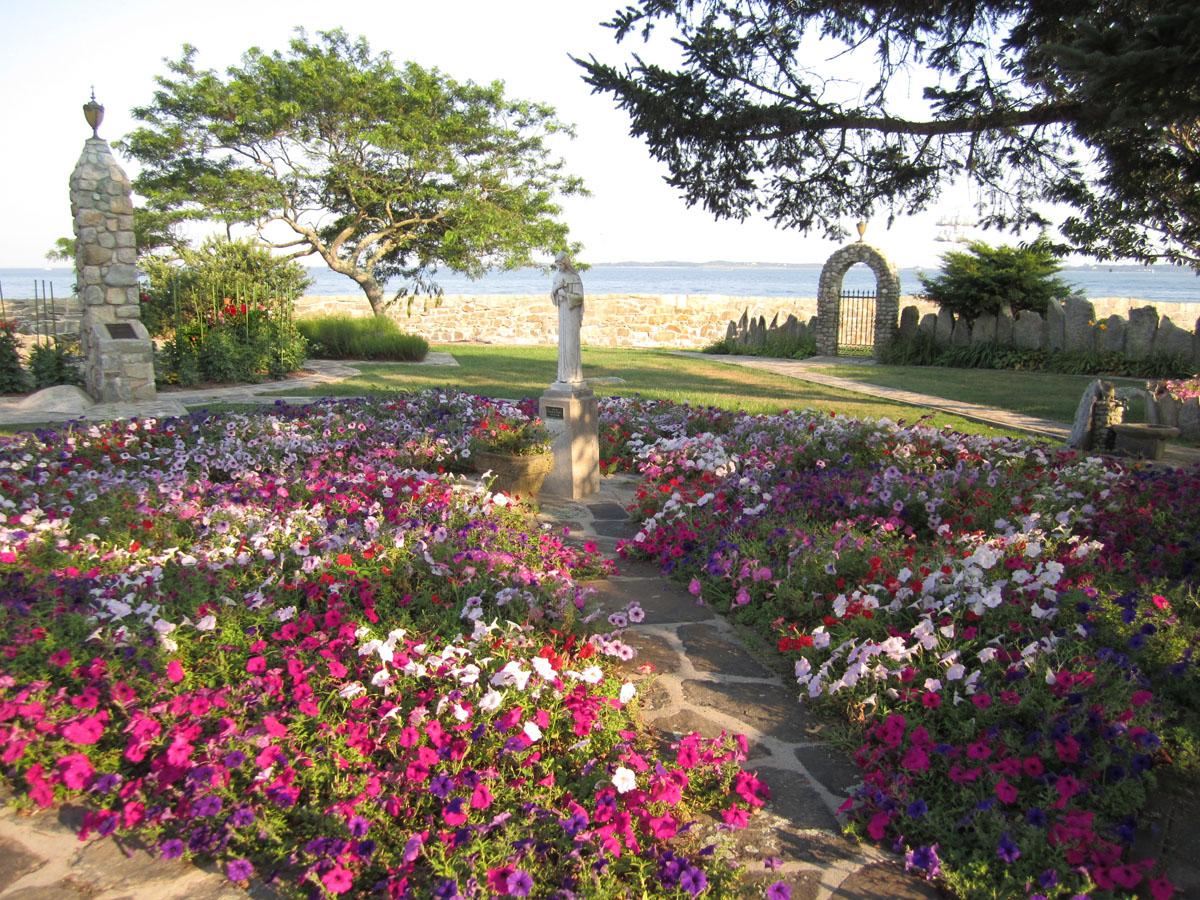
Picture it (above): The St. Edmund’s Sacred Art Institute located in Mystic, CT has issued a call to U.S. artists for entries of artwork for a National Eucharistic Revival Art Exhibit.

“We are working with the National Eucharistic Congress and the Blessed Michael McGivney Pilgrimage Center in New Haven, CT to gather artwork nationally for the exhibit that begins next May 2024,” says Deacon Francis Valliere, executive assistant to the CEO and coordinator of the St. Edmund’s Sacred Art Institute. The Benedict XVI Institute has agreed to cosponsor and promote this contest.  To further this ambitious broad-based national call for entries, the Institute has already benefited from the strong leadership team of Anthony Visco and Dan DeLouise.

As artistic director of the Institute, Anthony Visco brings an international reputation based on decades of teaching, consulting, and fulfilling commissions in liturgical and sacred art.  Recipient of a Fullbright-Hayes grant in Italy, he studied the Florentine School of Art and Architecture as a young man, and his career has continued to soar. Twice awarded the prestigious Arthur Ross Award for sculpture within a Classical setting, Visco has also been awarded the Henry Hering Memorial Medal by the National Sculpture Society. Always in demand as a mentor and teacher, Visco also directs the Atelier for the Sacred Arts in Philadelphia, PA. Of particular importance to the current Eucharistic Revival exhibit, Visco brings his experience participating in the 43rd International Eucharistic Congress in Philadelphia, his hometown, in 1976. “There was an exhibit of liturgical and sacred art at the Convention Center. Many commissions were given to artists and their works can still be seen in our churches.”

Dan DeLouise, the Institute’s artist-in-residence as of October 2023, is a previous gallery artist-owner whose career spanned both the worlds of commercial illustration in the toy and game industry and the plein-air traditions of fine art painting before his transition into the sacred art world. Also an award-winning artist in each phase of his career, DeLouise brings a passion for seeing God’s beauty in the external world of natural creation. “There is something about painting in nature that brings us closer to the hand of God, the ‘Ultimate Creator,’ whose designs we as artists so often strive to imitate. It becomes almost impossible not to contemplate the heart of God as we begin our own works by observing the vast beauty in the gifts of nature.”

Uniting Valliere, Visco, and DeLouise is a love for the sacred arts born in a love of God. This love for the Divine has shored up these men through the hard choices and tough situations engendered by trying to follow God’s will in their own sacred-art careers. “Faith is going to require us, at some point, to step out into the unknown,” says De Louise speaking about his own transition from creating art for the secular world into the world of sacred art. “With each move I made in a direction towards Him [God] in my work, I began to gain confidence watching how He would provide for me each step of the way.”

Another important value uniting these three men is their desire to create opportunities for sacred artists to learn skills, create community, and be ready for commissions, exhibitions, and visibility. This desire to assist artists forms the sturdy foundation of the men’s work at the Institute as they work to create a vibrant center where artists at all stages of their careers can come to learn and be nourished by the joy of advancing in their skills while finding spiritual nourishment in daily Mass, 24/7 Adoration, and the opportunity for spiritual direction. “Our goal is to bring together sacred artists . . . to promote the sacred arts and fill the churches, institutions, homes, and galleries with God’s sacred beauty, “ says Valliere, “With Anthony Visco directing the curriculum and Dan DeLouise onsite, we are working to bring the best instructors to teach on the Island.  We aim to be a nationally known Sacred Art Institute employing the highest caliber of teachers.”

At present, plans for the juried art selected for the Institute’s Eucharistic exhibit include an April 2024 opening exhibition at the Institute’s Enders Island location in Mystic, CT.  Then the exhibit will travel to the Blessed McGivney Center in New Haven, CT from May to August 2024. A selected group of works will travel to the Lucas Oil Stadium in mid-July for the National Eucharistic Congress in Indianapolis, IN.  Negotiations are underway for additional locations.

One of the sacred artists who have responded to the call for entries is Ann Schmalstieg Barrett, an instructor at Franciscan University and the Sacred Art Institute at Enders Island, among other institutions: “I am indebted to artists of previous generations who have revealed the mystery and beauty of the Eucharist through their work. One source that deepened my devotion to the Blessed Sacrament is St. Thomas Aquinas’s prayer ‘Adoro te Devote’  Set to a simple melody, it offers poetic imagery that has greatly enriched my meditation. I see the chant expressed in Jan Van Kessel’s painting entitled ‘Altar Niche with Symbols of the Eucharist,’ created almost 400 years after Aquinas entered into eternal life. It is exciting to continue the work of these artists and the many others who have helped to illuminate the hearts of the faithful to perceive the beauty of the Eucharist.”

Another artist responding to the call is Eric Armusik, a Pennsylvania-based Classical figurative artist for three decades. He says, “We must reanimate the world for Christ. It’s imperative for faithful artists to rebuke the darkness of the modern world that has failed humanity and deprived us of beauty.  There is no greater gift we have received from God than the Eucharist and attending Mass regularly . . . As Catholics and artists, we are responsible for sharing the truth and inspiring faith.”

The call for entries on the Institute’s webpage lists various possibilities of Eucharistic themes from the Old and New Testaments to spark creative ideas, such as the Marriage Feast at Cana, Manna in the Desert, the Miracles of the Loaves and Fishes, and Elijah fed by the ravens. The list is replete with reminders that many great saints had a profound relationship with Jesus Christ in His Eucharistic Presence. From St. Tarcisius, an early Christian boy-martyr in pagan Rome, to the more recent Blessed Carlo Acutis, a soccer-playing teen in Italy, the annals of Christianity contain saints devoted to the Eucharist, such as St. Peter Julian Eymard, St. Padre Pio, St. Teresa of Calcutta, and many others.

Deeper than any list of names, however, is the mystery and miracle of Christ’s Presence in the consecrated bread and wine. The Catechism of the Catholic Church in paragraph 1337 reminds us to see the Eucharist as the fulfillment of Christ’s pledge of love: “The Lord, having loved those who were his own, loved them to the end . . . In order to leave them a pledge of this love, in order never to depart from his own and to make them sharers in his Passover, he instituted the Eucharist as the memorial of his death and Resurrection, and commanded his apostles to celebrate it until his return.”

Grounding the call for entries and the desire to curate such a broad-based Eucharistic Revival exhibit is their wish to bring the spiritual gift of a closer relationship with Jesus Christ to a wide range of viewers across the U.S. All three men express their own love of Jesus Christ in the Eucharist in eloquent terms. For Valliere, “I find no greater peace than when I am in the presence of the Eucharist. As a deacon, I have the honor and privilege of celebrating a Holy Hour with Exposition [of the Blessed Sacrament] . . . I feel a closeness to God and an inner peace surpassing any other experience.”  DeLouise says: “[There is] a spiritual nourishment that I have only found in the reception of our Eucharistic Lord.”  And Visco gives us this peek into one of his experiences during Eucharistic Adoration:  “It was a Sunday afternoon and the only lights were the burning candles. I was alone with a friend who had converted to the Catholic Church. We watched the natural light fade and the church became darker as the sun set . . . afterwards we spoke of how we were watching and experiencing Time and Eternity, how the fading light was Time and the Eucharist remained Eternal . . . the experience stayed with me.”

Just as Visco’s experience in the lowering dusk as he prayed in front of the Eucharist allowed God to speak into his deepest heart, the images in the National Eucharistic Revival exhibit will open people’s hearts and souls to be formed by God’s holy will. The current deadline for the submission of digital entries is February 20, 2024.  Further details are available at https://www.endersisland.org/national-eucharistic-art-exhibition

Sarah Cortez is president and founder of Catholic Literary Arts, www.catholicliteraryarts.org. An award-winning freelance writer and editor, she is a contributing editor at Catholic Arts Today. She writes for the National Catholic Register and Texas Catholic Herald.

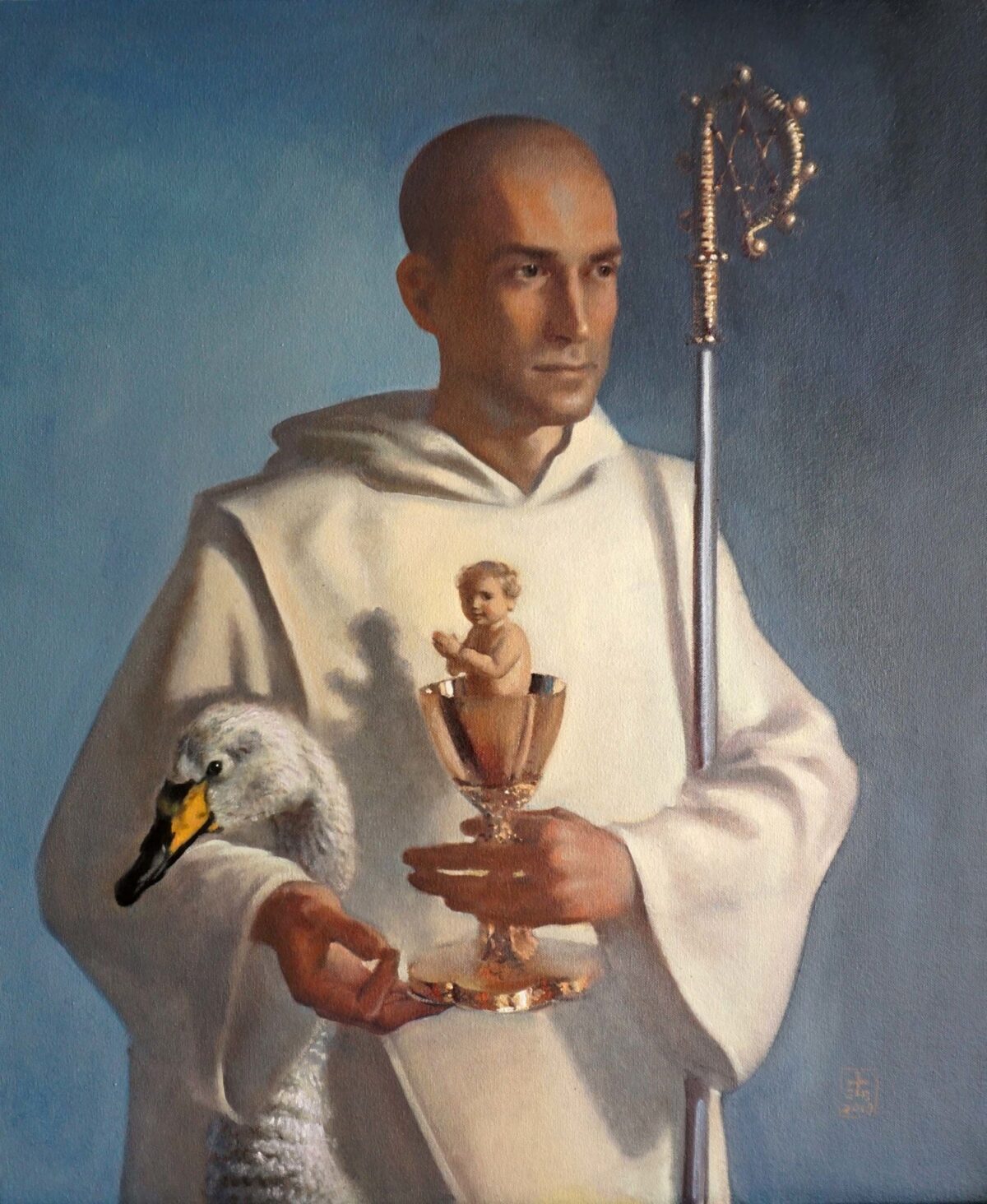
Gwyneth Thompson-Briggs: The Catholic Arts Today Interview

Editors Note: We have here Catholic Arts Today at its finest: a conversation between a significant young Catholic composer of sacred music and a significant young Catholic painter of sacred art. A feast for the mind and an inspiration (we hope) to the next generation of Catholic artists.  The painting by Gwyneth Thompson-Briggs above, St. Hugh of Lincoln, has never been published before.

Gwyneth Thompson-Briggs is a painter with a rising profile in the world of sacred art. But not content to promote only her own work, Gwyneth recently launched a new Catholic Artists Directory, featuring a carefully curated selection of Catholic creatives in the sacred music and visual arts world.  This new Catholic Artists Directory has two big purposes: First, pastors, church committees, Catholic schools and institutions, and private patrons of the arts now have a one-stop forum to find artists of the highest caliber to adorn their churches, chapels and homes. Second, the Catholic Artists Directors provides an online home for artists and art-lovers to network and discover and learn from each other’s work.

Sacred Music Composer and Kent State Professor Mark Nowakowski recently sat down with the artist Gwyneth Thompson-Briggs, founder of the Catholics Artists Directory, to discuss her new initiative and her work.

Mark Nowakowski: Why did you start this new Catholic artist directory?

Gwyneth Thompson-Briggs: When I began doing sacred art full-time this year I realized that there was a need for both patrons and sacred artists. Patrons needed a single place where they could find a curated selection of professional sacred artists and many talented artists needed exposure. I’d like artists to exert their time and talent making art rather than planning marketing strategies. It has been a pleasure to be able to help raise the profile of Catholic artists today who are reviving traditional techniques.

Mark Nowakowski: So your own experience seems to mirror my own as a composer: One must become a businessman and entrepreneur and voracious networker to find way to even start to get one’s art out into the general public. I can’t help but feel that God has called and equipped a veritable small army of talent, and that this army of Beauty is just waiting for fertile soil (and appropriate support) to start a new Renaissance. What is your experience surveying and now representing the broader field of Catholic art, music, architecture, and related disciplines?

Gwyneth Thompson-Briggs: Yes! There is a small army of talent that is standing at the ready. It is really exciting to get to know my other comrades-at-arms and the patrons who are helping us. I used to think that patrons were, for the most part, older, affluent, and part of a disappearing population of individuals with good taste. It has been a happy surprise that new patrons are coming forward who are in their thirties. They are not particularly affluent, but are willing to sacrifice in the name of beauty.

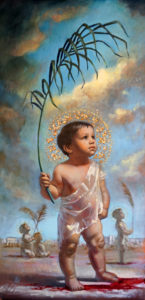
Gwyneth Thompson-Briggs, Holy Innocents, oil on canvas, 24 x 48 in, 2019

Mark Nowakowski: I think your own art is truly wonderful. What were the most beneficial as well as challenging aspects to developing your craft and establishing your professional career?

Gwyneth Thompson-Briggs: For me the great key was experiencing sublime works of art in person: Michelangelo’s Medici Tombs in Florence, the Van der Weyden diptych at the Philadelphia Museum of Art, and the portrait of Luis de Gongora by Velazquez at the Boston Museum of Fine Arts, among others. My skill also underwent extraordinary transformation each time I was able to see a master artist demonstrate the execution of a particular technique.

When I was five, a local watercolor artist taught me to “let the water do the work” when painting flowers; when I was a teenager, a life-drawing instructor took the charcoal from my hand and merged all the different shadow regions of my fragmented sketch into one unified form; as an adult, Paul Ingbretson solved a problem I had struggled with for a decade by observing that I needed to mix a bit more linseed oil into my whites “until the mixture was like a heavy cream.”

The most challenging part of growing as an artist has been gaining access to masterpieces and master artists. Sensors and over-zealous guards in museums tend to keep visitors too far back from the canvas to truly observe strokes and paint quality. While there are some masters working today, I haven’t found anyone truly conversant in Baroque technique. So, one must cobble together what one can learn from old paintings with what one can learn from contemporary masters.

Another challenge is the sense of inadequacy. As a mid-career artist, one always feels that there is more to learn before one is really qualified to accept commissions, but I now realize that it is by accepting commission that I am able to grow most quickly. Each commission is just a bit out of my comfort zone. Each commission requires me to study art history, to learn more about a particular technique or the archival nature of the materials involved, and to perform technically better than the time before.

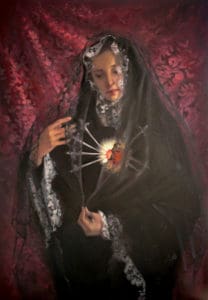
Gwyneth Thompson-Briggs, Our Lady of Sorrows, oil on canvas, 24 x 34 in, 2019

Mark Nowakowski:  In a society where there is endemic poverty, where there is suffering, where there are major social issues such as abortion and the defense of marriage to tackle, how do we justify taking money for the arts? How do we convince others of the importance of patronage? I have my own answer, but I’d love to hear your own perspective.

Gwyneth Thompson-Briggs: I live in St. Louis, a city with profound economic problems. I often meditate on the poor children that grow up in run-down neighborhoods, crumbling school buildings, and are culturally nourished exclusively by online treacle.

If only they knew that in the center of one particularly depressed area, the beautiful church of St. Francis de Sales run by the Institute of Christ the King welcomes both rich and poor and provides a respite from the oppression of daily life. As long as we are in this world, we are going to suffer from economic, physical, or emotional problems. A beautiful church or a moving work of art allows us to perceive our sufferings in the light of eternity and gives us the strength to go on.

Beautiful art is a gift especially for the poor but it is the responsibility of the rich to fund the art and to demand the highest standards from the artist.

Mark Nowakowski: What is leading to this new potential renaissance in Catholic art?

Gwyneth Thompson-Briggs: Perhaps one of the paradoxes of our times is that the darker the crisis in the Church and the world, the more brightly the beauty of Tradition shines and attracts. This paradox was strikingly illustrated on the final weekend of October this year, when the conclusion of the Amazon Synod coincided with the 8th annual Populus Summorum Pontificum pilgrimage. More and more people, especially young people, realize that the only way out of the dead-end of modern life is Tradition, including the traditional arts that are fostered by and at the service of divine worship.

I think that the very severity of the crisis–what several commentators have called the Passion of the Mystical Body–is helping people to distinguish orthodoxy from heterodoxy, holiness from worldliness, beauty from ugliness, and excellence from dross.

After sixty years of detente with the world, a renewed polarization is emerging. There is a renewed militancy in the Church Militant, even if only among a fragment of the baptized. These souls know that they can’t trust the bishops or the pope to teach them the Faith or to fund genuine sacred art; they must learn the Faith from old books and from the small but growing ranks of traditional priests, and they must themselves become discriminating patrons–because the worship of God demands the greatest artistic treasures we can offer to His majesty.

Similarly, young people know that they can’t expect a real formation in the arts in the conventional art schools or university art departments, including the nominally Catholic ones; they know that the mainstream art world, the mainstream media, and mainstream academia are ideologically perverse and technically ignorant. So, they are seeking out genuine artistic formation outside of the old structures.

In the midst of what Dietrich von Hildebrand called “the devastated vineyard,” even as those who should be tending the vineyard continue to devastate her, there are new shoots on the old grapevines.

To see more of Gwyneth Thompson-Briggs work, visit https://gwyneththompsonbriggs.com/. To explore the emerging generation of Catholic painters and other sacred artists visit CatholicArtistsDirectory.com.

Dr. Mark Nowakowski is a composer and scholar whose musical works have been premiered globally by the Kronos Quartet, the Cleveland Chamber Symphony, the Silesian Quartet, and other luminaries, while his 2017 Naxos debut album “Blood, Forgotten” earned critical praise in Gramophone magazine. His writings are regularly published in CatholicArtsToday, Sound on Sound, CDN, and OnePeterFive.

Subscribe to Our Emails