The Great Renaissance Artist You’ve Never Seen Before

The National Gallery of Art has put on an extraordinary exhibit of a great Renaissance artist who is almost unknown outside his native land: Alonso Berruguete (ca. 1486-1561) was the first and greatest sculptor of the Spanish Renaissance.

He is little-known outside of his native country, however, because much of his artwork is embedded in the massive gilded wooden retablos that he built as towering backdrops for the main altars in cathedrals and monastery churches in and around his native Valladolid in central Spain. The retablos, multi-leveled and crammed with multiple images, carved and painted, of Christ and the saints, some of enormous size so they could be seen by worshipers far below, cannot be transported. And the cities of Valladolid and Toledo, where Berruguete did most of his work, are slightly off the tourist trail, so few Americans are familiar with his sculpture.

For me and for many, that just changed as a result of this exhibition:
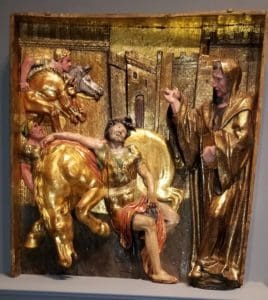
St. Benedict converting the Goth Zalla (monastery of San Benito el Real, Valladolid)

Fortunately for American lovers of art and especially sacred art, during one of its periodic anticlerical phases during the 1830s, the  Spanish government xpropriated and forcibly secularized the site of one of Berruguete’s most impressive altarpieces: the Benedictine monastery church of San Benito el Real in Valladolid.

Berruguete’s 40-foot-high retablo was mostly destroyed in this burst of iconoclasm and many of its sculptures ended up in a municipal museum. That made it possible for them to travel outside of Spain, and their portability has enabled the National Gallery of Art in Washington, D.C., to assemble the first major U.S. exhibition of Berruguete’s work.

The exhibition includes some of his most impressive sculptures from San Benito and nearby churches, together with paintings, drawings, and pieces by other Spanish artists who were contemporaries of his that give his output an artistic context. The exhibition, scheduled to run through February 17, is a small one: just 40 artworks in two rooms. It is complicated by the fact that Berruguete, like many successful artists of his time (and Andy Warhol in our own day), employed a workshop of apprentices to help fill his numerous commissions, so it is difficult to ascertain how much of any particular sculpture is actually the work of his own hand.
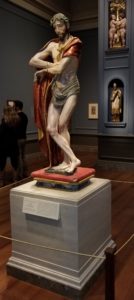
Ecce Homo (monastery of San Benito el Real, Valladolid)

Yet all of them—figures of the crucified Christ and his mother, saints, and Old Testament prophets–bear the mark of Berruguete’s unquestioned ability to meld wood, gilding, classical technique learned from Italian Renaissance masters, and a flair for emotional expressiveness into sculptures of astonishing religious intensity.

Valladolid, about 120 miles north of Madrid, was the capital of the kingdom of Castille during Berruguete’s lifetime and thus, effectively, the capital of Spain itself. Ferdinand of Aragon and Isabella of Castille were married in Valladolid in 1469, and their most famous protégé, Christopher Columbus, died there in 1506. Miguel de Cervantes, author of Don Quixote, lived and worked in Valladolid. Berruguete’s father, Pedro Berruguete (ca. 1450-1504), was also an artist, even more talented as a painter than his son, if a Madonna and Child of his on exhibit at the National Gallery is any indication.

Pedro had brought the Renaissance to Spain in a different fashion, introducing a Flemish “Northern Renaissance” style of painting that influenced many Spanish artists besides himself. After Pedro’s death, his son Alonso, then age 18, took off for Italy, where he lived in Florence and Rome for thirteen years and developed his talent for sculpture, befriending and assisting Michelangelo, Andrea del Sarto, and Filippino Lippi, among others. He also became one of the early promulgators of Mannerism, the 16th-century artistic style that emphasized extreme emotive expression—often via elongated figures in contorted positions–over classical harmony in composition.

When Berruguete returned to Spain and transformed his Italian training into an alabaster relief titled The Resurrection for the cathedral in Valencia, his work suddenly became in high demand. The Holy Roman Emperor Charles V, grandson of Ferdinand and Isabella and heir to the Spanish throne, made him court painter and sculptor in 1520. He turned from stone sculpture to wood, the traditional material of the medieval Spanish retablo, and his workshop in Valladolid, together with other patronage from Charles, made him a wealthy man. He continued to work in wood, marble, and bronze until his death at nearly age 80.
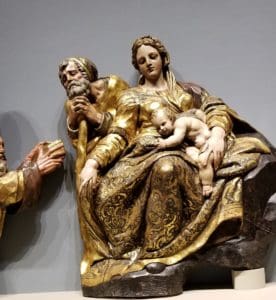
Adoration of the Magi (Chapel of the Epiphany, church of Santiago Apostol, Valladolid)
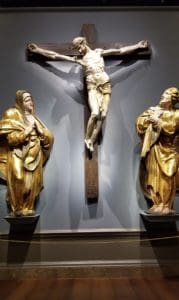
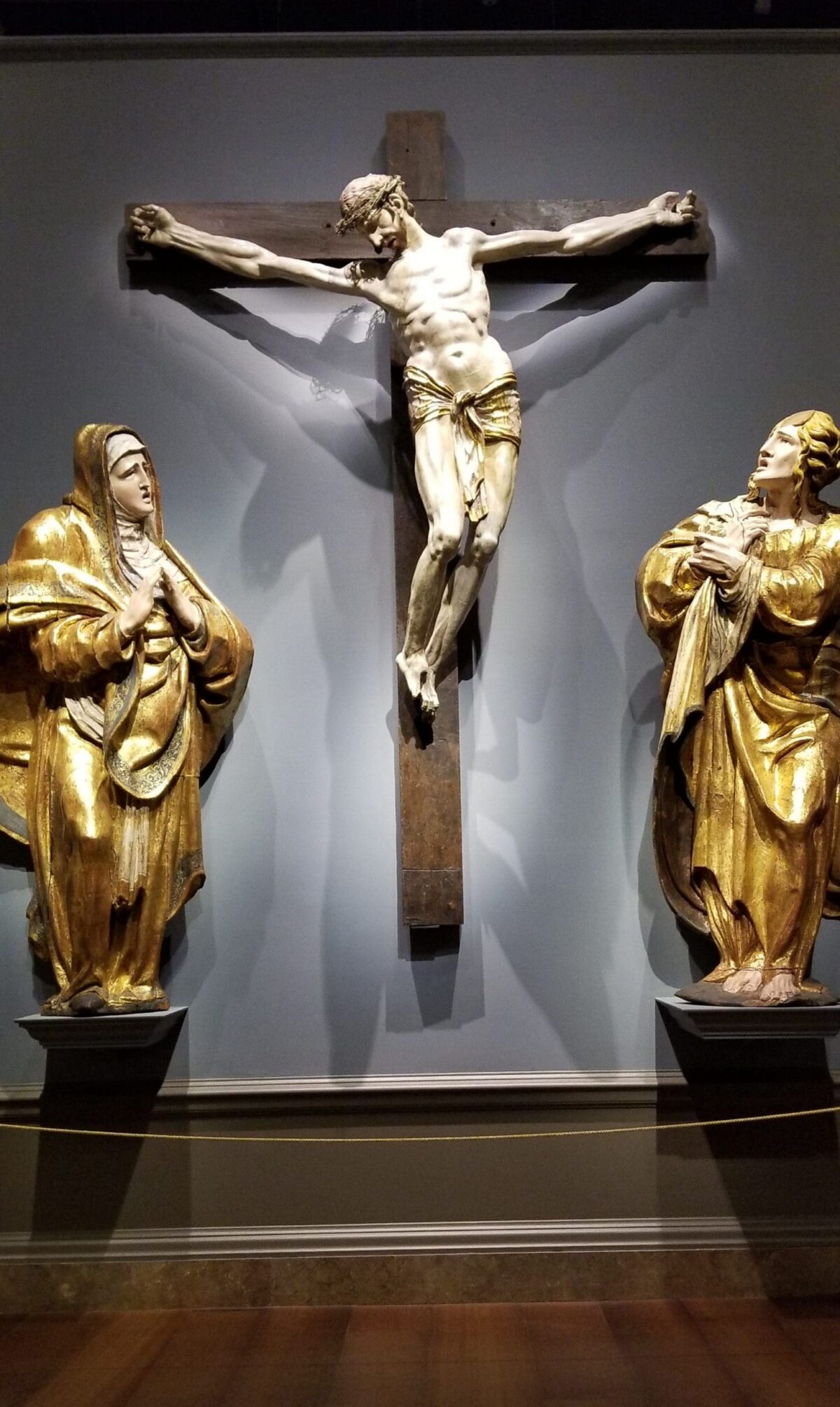
Crucifixion (monastery of San Benito el Real, Valladolid)

The retablo sculptures of Berruguete on display at the National Gallery, lavishly gold-painted and brilliant with color, are nearly always twisted figures caught in moments of emotional agony or religious ecstasy. A sculpture from the San Benito church depicting Abraham about to sacrifice Isaac displays a crouching, open-mouthed, nearly nude Isaac, his hands bound behind him and his body bowed over with terror (his figure resembles one of Michelangelo’s male nudes on the Sistine Chapel’s ceiling), while the gray-bearded Abraham gazes at the viewer in as much torment as his son. Two wooden prophets writhe in the divine power that inspires them. The most thrilling of Berruguete’s statues in this exhibition are his crucified Christ flanked by his mother, Mary, and the apostle John; their enormous figures once crowned the pinnacle of the San Benito retablo. Mary and John, both wrapped in swirling, voluminous gilded garments, grieve for the dead Christ, but more calmly, as seems fitting, than the emotion-charged figures from below. As for Berruguete’s Christ, his body, gray in death and looking as though it were carved from stone, seems utterly at rest, the bloody work of redemption complete.

For Americans—and others of the New World—Berruguete’s sculptures will resonate in an additional way. The Spanish colonizers of the Americas brought their retablo tradition with them to the churches they built there. Artistic styles changed over the centuries, but anyone who has visited the California missions or the cathedrals in, say Mexico City or Cusco, will find Berruguete’s lavishly decorated wooden edifices startlingly familiar. We have one of Spain’s greatest sculptors to thank in part for one of our own architectural traditions.

Charlotte Allen is a D.C. based arts reporter for Catholic Arts Today and the author of The Human Christ: The Search for the Historical Jesus.

Gwyneth Thompson-Briggs: The Catholic Arts Today Interview

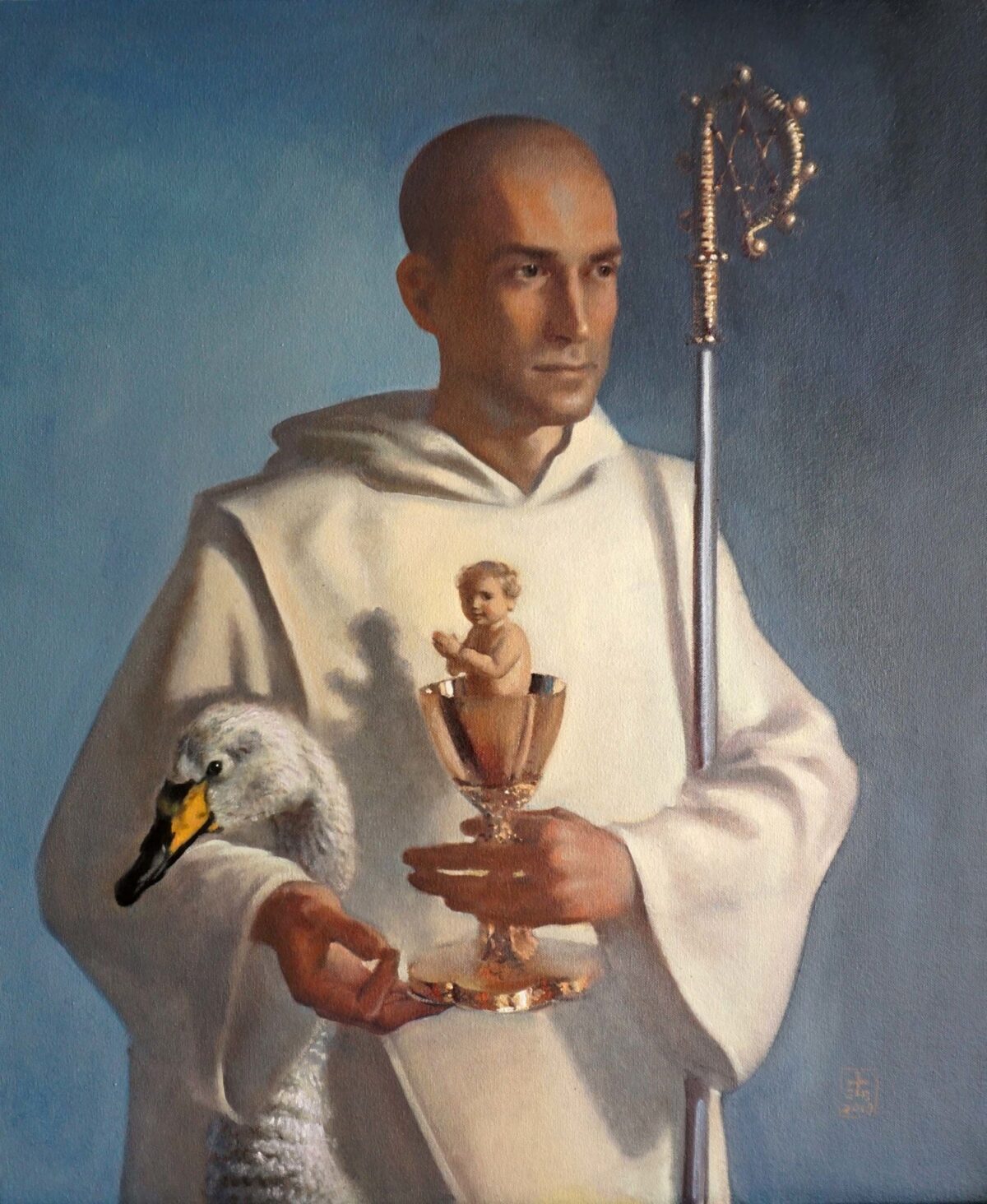
Editors Note: We have here Catholic Arts Today at its finest: a conversation between a significant young Catholic composer of sacred music and a significant young Catholic painter of sacred art. A feast for the mind and an inspiration (we hope) to the next generation of Catholic artists.  The painting by Gwyneth Thompson-Briggs above, St. Hugh of Lincoln, has never been published before.

Gwyneth Thompson-Briggs is a painter with a rising profile in the world of sacred art. But not content to promote only her own work, Gwyneth recently launched a new Catholic Artists Directory, featuring a carefully curated selection of Catholic creatives in the sacred music and visual arts world.  This new Catholic Artists Directory has two big purposes: First, pastors, church committees, Catholic schools and institutions, and private patrons of the arts now have a one-stop forum to find artists of the highest caliber to adorn their churches, chapels and homes. Second, the Catholic Artists Directors provides an online home for artists and art-lovers to network and discover and learn from each other’s work.

Sacred Music Composer and Kent State Professor Mark Nowakowski recently sat down with the artist Gwyneth Thompson-Briggs, founder of the Catholics Artists Directory, to discuss her new initiative and her work.

Mark Nowakowski: Why did you start this new Catholic artist directory?

Gwyneth Thompson-Briggs: When I began doing sacred art full-time this year I realized that there was a need for both patrons and sacred artists. Patrons needed a single place where they could find a curated selection of professional sacred artists and many talented artists needed exposure. I’d like artists to exert their time and talent making art rather than planning marketing strategies. It has been a pleasure to be able to help raise the profile of Catholic artists today who are reviving traditional techniques.

Mark Nowakowski: So your own experience seems to mirror my own as a composer: One must become a businessman and entrepreneur and voracious networker to find way to even start to get one’s art out into the general public. I can’t help but feel that God has called and equipped a veritable small army of talent, and that this army of Beauty is just waiting for fertile soil (and appropriate support) to start a new Renaissance. What is your experience surveying and now representing the broader field of Catholic art, music, architecture, and related disciplines?

Gwyneth Thompson-Briggs: Yes! There is a small army of talent that is standing at the ready. It is really exciting to get to know my other comrades-at-arms and the patrons who are helping us. I used to think that patrons were, for the most part, older, affluent, and part of a disappearing population of individuals with good taste. It has been a happy surprise that new patrons are coming forward who are in their thirties. They are not particularly affluent, but are willing to sacrifice in the name of beauty.

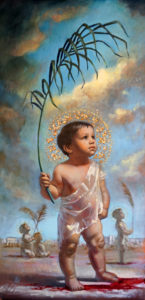
Gwyneth Thompson-Briggs, Holy Innocents, oil on canvas, 24 x 48 in, 2019

Mark Nowakowski: I think your own art is truly wonderful. What were the most beneficial as well as challenging aspects to developing your craft and establishing your professional career?

Gwyneth Thompson-Briggs: For me the great key was experiencing sublime works of art in person: Michelangelo’s Medici Tombs in Florence, the Van der Weyden diptych at the Philadelphia Museum of Art, and the portrait of Luis de Gongora by Velazquez at the Boston Museum of Fine Arts, among others. My skill also underwent extraordinary transformation each time I was able to see a master artist demonstrate the execution of a particular technique.

When I was five, a local watercolor artist taught me to “let the water do the work” when painting flowers; when I was a teenager, a life-drawing instructor took the charcoal from my hand and merged all the different shadow regions of my fragmented sketch into one unified form; as an adult, Paul Ingbretson solved a problem I had struggled with for a decade by observing that I needed to mix a bit more linseed oil into my whites “until the mixture was like a heavy cream.”

The most challenging part of growing as an artist has been gaining access to masterpieces and master artists. Sensors and over-zealous guards in museums tend to keep visitors too far back from the canvas to truly observe strokes and paint quality. While there are some masters working today, I haven’t found anyone truly conversant in Baroque technique. So, one must cobble together what one can learn from old paintings with what one can learn from contemporary masters.

Another challenge is the sense of inadequacy. As a mid-career artist, one always feels that there is more to learn before one is really qualified to accept commissions, but I now realize that it is by accepting commission that I am able to grow most quickly. Each commission is just a bit out of my comfort zone. Each commission requires me to study art history, to learn more about a particular technique or the archival nature of the materials involved, and to perform technically better than the time before.

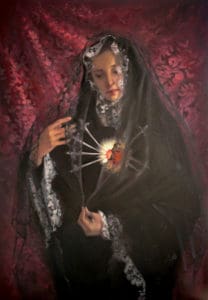
Gwyneth Thompson-Briggs, Our Lady of Sorrows, oil on canvas, 24 x 34 in, 2019

Mark Nowakowski:  In a society where there is endemic poverty, where there is suffering, where there are major social issues such as abortion and the defense of marriage to tackle, how do we justify taking money for the arts? How do we convince others of the importance of patronage? I have my own answer, but I’d love to hear your own perspective.

Gwyneth Thompson-Briggs: I live in St. Louis, a city with profound economic problems. I often meditate on the poor children that grow up in run-down neighborhoods, crumbling school buildings, and are culturally nourished exclusively by online treacle.

If only they knew that in the center of one particularly depressed area, the beautiful church of St. Francis de Sales run by the Institute of Christ the King welcomes both rich and poor and provides a respite from the oppression of daily life. As long as we are in this world, we are going to suffer from economic, physical, or emotional problems. A beautiful church or a moving work of art allows us to perceive our sufferings in the light of eternity and gives us the strength to go on.

Beautiful art is a gift especially for the poor but it is the responsibility of the rich to fund the art and to demand the highest standards from the artist.

Mark Nowakowski: What is leading to this new potential renaissance in Catholic art?

Gwyneth Thompson-Briggs: Perhaps one of the paradoxes of our times is that the darker the crisis in the Church and the world, the more brightly the beauty of Tradition shines and attracts. This paradox was strikingly illustrated on the final weekend of October this year, when the conclusion of the Amazon Synod coincided with the 8th annual Populus Summorum Pontificum pilgrimage. More and more people, especially young people, realize that the only way out of the dead-end of modern life is Tradition, including the traditional arts that are fostered by and at the service of divine worship.

I think that the very severity of the crisis–what several commentators have called the Passion of the Mystical Body–is helping people to distinguish orthodoxy from heterodoxy, holiness from worldliness, beauty from ugliness, and excellence from dross.

After sixty years of detente with the world, a renewed polarization is emerging. There is a renewed militancy in the Church Militant, even if only among a fragment of the baptized. These souls know that they can’t trust the bishops or the pope to teach them the Faith or to fund genuine sacred art; they must learn the Faith from old books and from the small but growing ranks of traditional priests, and they must themselves become discriminating patrons–because the worship of God demands the greatest artistic treasures we can offer to His majesty.

Similarly, young people know that they can’t expect a real formation in the arts in the conventional art schools or university art departments, including the nominally Catholic ones; they know that the mainstream art world, the mainstream media, and mainstream academia are ideologically perverse and technically ignorant. So, they are seeking out genuine artistic formation outside of the old structures.

In the midst of what Dietrich von Hildebrand called “the devastated vineyard,” even as those who should be tending the vineyard continue to devastate her, there are new shoots on the old grapevines.

To see more of Gwyneth Thompson-Briggs work, visit https://gwyneththompsonbriggs.com/. To explore the emerging generation of Catholic painters and other sacred artists visit CatholicArtistsDirectory.com.

Dr. Mark Nowakowski is a composer and scholar whose musical works have been premiered globally by the Kronos Quartet, the Cleveland Chamber Symphony, the Silesian Quartet, and other luminaries, while his 2017 Naxos debut album “Blood, Forgotten” earned critical praise in Gramophone magazine. His writings are regularly published in CatholicArtsToday, Sound on Sound, CDN, and OnePeterFive.

Subscribe to Our Emails