Kim Ki-Chang: A Korean Caravaggio?: Empathy and Intuition in the Life of Jesus Series

Comparing Kim Ki-chang to Caravaggio may seem paradoxical: the one bold and aggressive figures, the other delicate and restrained watercolors. But then, seeing painting across cultures requires empathy, intuition, and perhaps a taste for paradox.

I first encountered Korean artist Kim-Ki-chang’s Life of Jesus series while researching typical images of Jesus, like those of Leonardo da Vinci. Kim created the thirty watercolors during the Korean War as a way to cope with the personal anguish produced by his own and the Korean people’s suffering. Kim died in 2001, but his work still resonates in the contemporary art scene in the East. His paintings have been compared with current artists such as Zeng Fanzhi and others.

Kim portrays Christianity’s key moments as taking place in Korea and personified by Koreans. In The Last Supper, for example, Christ and his apostles are seated in a decidedly Asian architectural setting and the figures are dressed in traditional Korean robes and headwear.

What struck me immediately about Kim’s work is its difference amid the familiar. The Catholic artist and art-lover has this advantage: we are part of a universal Church. Watching our shared tradition inflected through another’s culture is revealing. It makes one think that Christ and his message are a form of collective memory that we all can access.

Take and eat it; this is my body. Do this in remembrance of me.
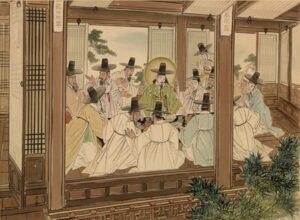
Kim Ki-chang, The Last Supper, 1953, watercolor on silk

These paintings make me wonder: how might an American Catholic appreciate these images from the East? Is it possible for such Asian art to inform the spirituality of the Western mind?

To be sure, there is a long history in Western art of representing Biblical figures in scenes and wardrobes of the period in which the artist lived. Caravaggio dresses St. Matthew in early 17th-century attire. Paul Gauguin’s Yellow Christ (1889) presents the Crucifixion with the Breton women in 19th-century France. Artists who do so are underlining the immediate relevance of Christianity in their time and place. Many other non-European cultures tell the story of Christ clothed in their own people’s faces, such as the dark-skinned Virgin of Ethiopian art.

However, something different and more specific is happening in Kim Ki-chang’s collection. One senses that the use of color in the Life of Jesus is secondary in many ways. Overall, there is a monochromatic patina to Kim’s paintings that emanates an aesthetic sparseness, allowing one to grasp the feeling the paintings convey without theatrical distractions.
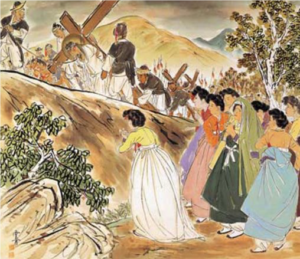
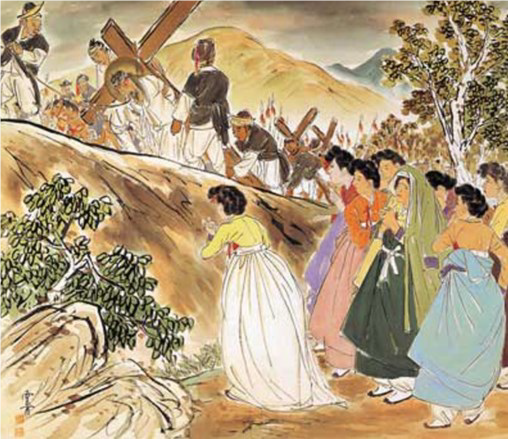
Kim Ki-chang, Jesus Carries His Cross, 1953, watercolor on silk

Color usually emphasizes emotion. Yet, the somewhat limited palette of the series augments the solemnity of the Jesus narrative, as if the artist found common cause with Christ’s suffering and consolation in his ultimate victory over it.

And they spat on Him and took the staff and struck Him on the head repeatedly.

The story of the Catholic Church in Korea is the story of the victory of hope over immense, repeated suffering.

The Korean civil war inflicted untold hardships and suffering on the Korean people. For Kim, Jesus’s story resonated with what his country was experiencing. Jesus Carries His Cross in many ways captures this idea most succinctly. Christ’s cross dominates the upper register of the painting. Its significance is accentuated by the other crosses within the scene, the shapes of which are mimicked by the strong diagonal that amplifies the drama and movement of the biblical episode. Kim emphasizes its weight as it presses down against the bent body of Jesus, heightening our understanding of his burden.

…and they crucified Him.

For Christians, the cross is a symbol of Christ’s suffering. As a sign of hope, it offers reassurance that one’s grief or anguish does not take place in vain. The cross attests to the ability to endure hardship and the reward and justice in doing so. It is a message that must have resounded profoundly to the artist and the Korean people at the time.

The history of Catholicism in Korea, marred by severe persecutions, also has the unique distinction, as Pope John Paul II pointed out as he canonized 103 Korean Martyrs in Seoul in 1984: “The Korean Church…was founded entirely by lay people. This fledgling Church, so young and yet so strong in faith, withstood wave after wave of fierce persecution. Thus, in less than a century, it could boast of 10,000 martyrs.”

In the early 17th century the Jesuits smuggled books into Korea. But a hundred years later when two priests from China finally made it into Korea, they discovered 4,000 Catholics led by a small number of nobles (the only class that knew how to read). The Confucian aristocracy in Korea was appalled by Korean Christians’ unwillingness to show piety to their ancestors in the approved way. Like the early Christians in Rome, Korean Catholics refused to burn even one pinch of incense to save their lives.

By 1866, when religious liberty was finally proclaimed in Korea, there were just 20,000 Catholics in Korea. Ten thousand Korean Catholics had been martyred for their faith.

Korean Catholics were born in and of a willingness to suffer for faith. But the barbaric anguish wreaked on ordinary Koreans during the Korean War, after the humiliations and terror inflicted by Japanese rule, struck deeply into Kim’s soul. His paintings’ solemn hues reflect his own and his people’s suffering.

EMPATHY

Is it conceivable for such a deeply rooted art from an Asian culture to inform the spirituality of the American or European viewer? Quite possibly. The artistic decisions that Kim makes in the Life of Jesus series speak to the bi-directional influences of East and West inherent in his creation: Korean paintings by a Korean artist who finds spiritual solace in a religion with a prominent European aesthetic history.

Kim Ki-chang was deaf and partially mute for most of his life.  He knew suffering. As a result, as an artist he was interested in understanding the story of Jesus with respect to the lives of ordinary Koreans.
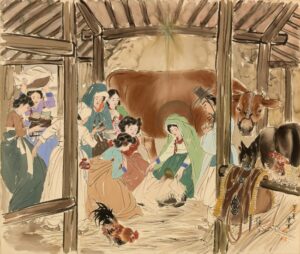
Kim Ki-chang, The Birth of Jesus, 1953, Watercolor on Silk

The simplicity of the everyday scenes he portrays coalesces with the simplicity of rural life for common Koreans. Most Koreans lived in villages in the 1950s. The Birth of Jesus and The Adoration of the Magi capture particularly well the relationship between the pastoral lives of everyday Koreans and the humble beginnings of the Biblical Son of man.
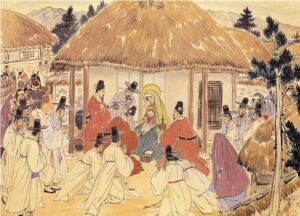
Kim Ki-chang, The Adoration of the Magi, 1953, Watercolor on Silk

INTUITION

The Korean figures in The Adoration of the Magi are thought-provoking. These Asian phenotypes differ in form but ultimately not in content from the well-known story, as the Biblical Magi are understood to come from “the east.” From the western viewpoint, the idea of “wise men” is not inconsistent with the West’s impression of Asia as a place of ancient wisdom. “Confucius says,” has entered even the American child’s vernacular.

To understand these paintings fully, the Westerner must rely on intuition. It is as if Kim’s expression of the scene, and indeed the entire Life of Jesus series, is simultaneously idiomatic and universal. One must cognitively—intuitively—understand what is being shown even though it looks different than expected, sensing that its intended audience is different as well.

Yet, in the end it is more than an idiom.

Asian expressions of the Christian narrative index an imaginative transposition. The sincere dedication to the spiritual meaning attached to these visual forms signifies a religious empathy. The images help express a sincerity of faith that is of a kind with Catholics everywhere, but inserted in a cultural language consistent with the Eastern visual tradition.
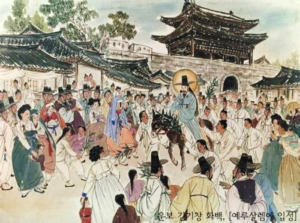
Kim Ki-chang, Triumphal Entry into Jerusalem, 1953, Watercolor on Silk

Kim’s Triumphal Entry into Jerusalem pictorializes this dynamic unambiguously. Jesus is shown entering an Asian landscape in the most literal fashion, although the prominent Eastern architecture might force us to question the identity of the mounted personage.

And when he was come…all the city was moved, saying, Who is this?

In the straightforward faith evoked by these images, Jerusalem becomes not merely a place in the world, but a metaphor for the spiritual home of all Christians. The palm leaves reference a sacral victory that everyone shares, regardless of time, place, or ethnicity.

And the multitude said: This is Jesus the prophet of Nazareth of Galilee.

As the first of its kind on the Korean peninsula, the Life of Jesus situates His story in the Far East. In many ways this is most appropriate. The word “Asia” means “the land of the rising sun,” the East. Christ is identified in Christian art with the rising sun. He is marked by a nimbus of light (or halo) to do so. Catholic churches are traditionally oriented toward the East, in reference to his resurrection. Ad Orientem (the traditional practice of priests saying the Mass facing the altar) means literally to turn to the East. Like the sun, Jesus rose from the dead unconquered.

And they entered in, and found not the body of the Lord Jesus.
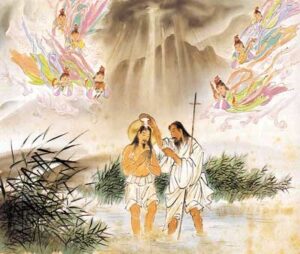
Kim Ki-chang, Baptism of Jesus, 1953, Water Color on Silk

Solace is not a word typically used in art, particularly in the social-justice-warrior club-wielding world that dominates so much of contemporary art and criticism. But in seeking solace for a suffering people, Kim’s series asks for an emotionally or spiritually driven sensibility as opposed to a civic or an aesthetic one.

The paintings make a case for religious empathy, of seeing a situation (in this case the story of Christ) from the point of view of another.

But not just any viewpoint.

for many be called, but few chosen.

Dr. Robert Edward Gordon is an Assistant Professor in the College of Fine Arts at the University of Arizona. Trained as a philosopher and an art historian, he teaches and writes about Catholic and Asian art, art and economics, freedom and its relationship to the fine arts, and humanistic geography.
Andy Warhol: Unconventional, Catholic,Traditionalist

Last year, the Vatican Museums planned—and later postponed—a collaboration with the Andy Warhol Museum in Pittsburgh exploring the spiritual aspects of Andy Warhol.

To which many responded: The spiritual aspects of Andy Warhol?

Many today are still shocked to discover that Andy Warhol was, as Art Newspaper dubbed him in 2018, a “lifelong, closeted Catholic,” as the artist was primarily associated with secular culture and the less virtuous elements of modern society.

It was art historian Sir John Richardson, in his eulogy to Andy Warhol at the 1987 memorial at St. Patrick’s Cathedral, who first let the painter’s bright secret out of the bag: One of the most famous bohemian artists of the twentieth century was a practicing Eastern-rite Catholic, and who attended Mass several times a week at the traditional St. Vincent Ferrer parish on Manhattan’s fashionable Upper East Side.

Richardson, who died only this March at the age of 95, told the assembled Manhattan glitterati: “To my certain knowledge, he was responsible for at least one conversion. He took considerable pride in financing a nephew’s studies for the priesthood. And as you have doubtless read on your Mass cards, he regularly helped out at a shelter serving meals to the homeless and the hungry. Trust Andy to have kept these activities very, very dark.”

Richardson went on. “The knowledge of this secret piety inevitably changes our perception of an artist who fooled the world into believing his only obsessions were money, fame, glamour, and that he was cool to the point of callousness. Never take Andy at face value. The callous observer was in fact a recording angel … uncorrupted, no matter what activities he chose to film, tape or scrutinize.”

Richardson’s eulogy let loose a surprised flood of scholarly reflections on the relationship between Andy Warhol’s faith and his art.

Should it have been so surprising?

It was Andy Warhol, who through Pop Art transformed the wedded cults of celebrity and consumerism into icons for our national and international contemplation.

James Romaine, president of the Association of Christianity in the History of Art, in 2015 summed Warhol’s entire oeuvre: “If I had to describe Andy Warhol’s work in just one or two sentences, I would describe it as the world seen not as it is, but the world seen as it might be transformed by grace.” This fall in Pittsburgh, The Warhol Museum describes its upcoming exhibition, Andy Warhol: Revelation, as “the first exhibition to comprehensively examine the Pop artist’s complex Catholic faith in relation to his artistic production.” An exhibit of Warhol’s Last Supper in the Braccio di Carlo Magno in St. Peter’s Square would have been the capstone of this move to re-examine Warhol’s oeuvre in the light of his faith.

What would such a Warhol exhibit accomplish?

For me, it’s an exciting possibility. I teach the history of art (including the philosophy of art and other things) at the American Culture and Ideas Initiative at the Fred Fox School of Music at the University of Arizona.

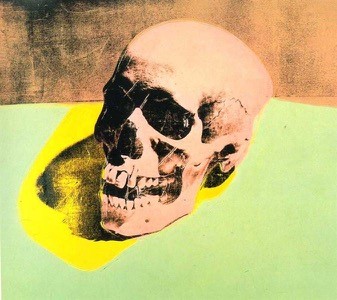
The standard history of art segregates artists by time period into distinct periods and styles. Under this typical conceptual scheme, Warhol and the Vatican’s collection almost never cross paths.  But a Vatican exhibition placing Warhol’s Last Supper and Skulls paintings in St. Peter’s Square breaks through the traditional dividers created by the academy to reveal something deep and important about the whole dynamic history of art.

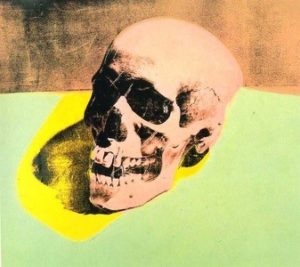
Andy Warhol, Skull, 1976 Photo credit: WikiArt

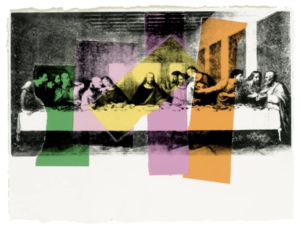
Andy Warhol, Last Supper, 1986 Photo credit: WikiArt

Andy Warhol, Last Supper, 1986 Photo credit: WikiArt

The skull as Memento Mori and the Last Supper as a representation of the institution of the Eucharist:  Each has a deep history in both the Church and Art. Contemplating them through Warhol’s lens reveals something profoundly important: the close association between art, religion and humanity’s success as a civilizing force in the world.

The theory behind the American Culture and Ideas Initiative in which I participate is that the arts are embedded in the very survival of humanity.  The success of the humankind has been intimately tied to our innovations and achievements in the arts. Beauty is not mere decoration or the state of being attractive, but a pathway to meaning, the search for which is after all the core, distinctively human endeavor.

In our righteous celebration of science and technology, Western culture has lost sight of these other deep roots of our humanity. The history of art is overwhelmingly religious in nature. It is the visual record of the human spirit.

This simple, obvious fact surprises many students of mine in art history courses, who register thinking that they will learn sterile facts about Picasso, Rembrandt, and Greek statues as they fulfill their arts and humanities requirements.  Yet, what quickly emerges for young minds is how closely the arts are tied to both the formation of knowledge and culture, and the development of civilization.

The fundamental dynamic at play in the development of art has been our desire to understand and therefore know something about ourselves and the world through experiencing it. Art—as a heightened and rarified instance of cognitive and spiritual experience—has been pervasive within human society for this very reason. Truth cannot merely be said. It must be incarnated to be experienced in fullness by human beings.

The visual and musical arts thus mediate our lonely and separate being with the forces of Creation. Societies around the world have harnessed the order and beauty of cosmos as a way to achieve order and beauty in an earthly setting. Art allows us not to just talk about meaning, but to make it tangible.

That is one of the reasons people who have lost faith in God gravitate to the arts, looking for a near substitute. But for the great majority of human beings, again and again, across time and space and history, the order of creation and creativity was built upon a foundation of religion.

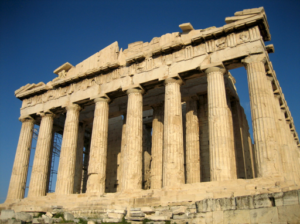
The Parthenon, for instance, is explicitly a tribute to the way in which the forces of chaos were defeated by the cosmic order and justice embodied by the gods. The balance and proportion of Greek statues of the classical period are a representation of how humans are animated with the rhythm and symmetry of the cosmos (Gk. kosmos: order). The Parthenon is often admired as a secular achievement—as an embodiment of rationality and/or democratic life of ancient Athens. But the Parthenon is first and foremost a temple created to host a devotional object: Athena Parthenos, the virgin goddess of war and wisdom.

The Parthenon, Athens, 447-432 BC Pentelic marble Architects: Iktinos; Kallikrates

Yes, power abused can crush the human spirit. But the primordial and chronic enemy of the human spirit is chaos. Amidst the flood of data points, of sensory inputs, and of emotions, the first task of every infant human brain is to organize, to figure out what to pay attention to and what to ignore, to recognize patterns, to discover the order which humans need to survive. Art fascinates because it commands us to master this foundational art of paying attention.

Today, art is most often encountered digitally, or in a gallery or museum. But in the great artistic flourishing of Renaissance and Baroque eras in Europe, art was mostly commissioned by and seen in the Catholic Church.  Church leaders then knew in their bones that, as Pope Benedict XVI reminds us: “The only really effective apologia for Christianity comes down to two arguments, namely the saints the Church has produced and the art which has grown in her womb.”  

So, before antiseptic art history courses and national museums, the arts confronted audiences with urgent and necessary meanings: spiritual didacticism, political moralism, and religious efficaciousness.

The Catholic Church was the driving force for society’s forward movement. It utilized the arts’ experiential and inspirational effectiveness to underwrite both its temporal power and its ability to convey the eternal destiny of one’s immortal soul.

This became particularly important during the Counter-Reformation, where the Church commissioned art “intended to delight, teach, and inspire” Catholics and the world, as art historian Elizabeth Lev writes in How Catholic Art Saved the Faith. The result was a recrudescence of amazing beauty: the paintings of Caravaggio, the sculpture of Bernini, and the sacred music of Thomas Tallis and William Byrd.

But this experience of the close relationship between art, faith, and human civilization is found again and again in diverse times and places: The Pharaohs used the arts to reinforce their status as the intercessor between the gods and Man. In the third century BC, Emperor Ashoka the Great of India’s Maurya Dynasty (circa 268 to 232 BC) built commemorative pillars of exquisite craftsmanship to the Buddha as a way to fortify his reign and to provide inspiration to his people.  Chinese emperors ruled as Sons of Heaven, a celestial mandate embodying the later cognate notion of the Divine Right of Kings of Judeo-Christian thought.

In all these epochs, the arts mediated the way ordinary people have come to know the divine order and to find common cause with it.

In Christian culture, Man is made in the image of God. We come to see who we are meant to be through our conception of who God is: God the Creator. God the Law-giver. God the Lover. Beauty and Order were ethical ideals. Aesthetic reason was a conduit for canonical insight.

In pagan polytheism, as in the Greek myths, the gods were made in the image of Man, since they were considered ineffable in their pure unadulterated essence (consider the Jupiter and Semele myth in this regard). One way to make this relationship knowable was through the experience of beauty (think of the Bust of Nefertiti or the Apollo Belvedere) that the arts could engender.

Even when art is not explicitly religious, as when the rich and powerful (whether Dutch merchants or English nobility) commissioned secular masterpieces to celebrate their success and formalize their elevated role in civil society, art fulfilled these purposes specifically because of the visual language created by its religious heritage.

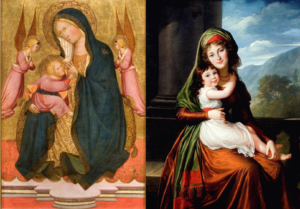
Portraits, still lifes, landscapes, and history paintings often used formal similarities to well-known religious paintings to elevate their own status, as in Madonna and Child conflations. Similarly, later modernist and avant-garde artists used the prestige and elevation of art, garnered from millennia of religious patronage to legitimate their social criticisms while simultaneously undermining traditional modes of artistic production and validation.

On the left: (Follower of) Agnolo Gaddi, Madonna and Child Adored by Two Angels, Tempera on wood panel, late 14th Century
On the right: Elisabeth Louise Vigée-LeBrun, The Countess von Schönfeld with Her Daughter, Oil on canvas, 1793


During the late-19th and early 20th centuries, artists increasingly explored spirituality as a counterpoise to the dramatic materialism of industrialized society. Paul Gauguin, Max Beckmann, Emil Nolde, Odilon Redon, and many others employed religious figures and themes explicitly in their art as a way to tap into the expressionist core of the human soul.

Much abstract art was born of this impulse. Wassily Kandinsky, Piet Mondrian, and Kazimir Malevich and many other artists used the language of abstraction to reject the materialist superstitions of the industrial world. Subjectivism as a style became a portal to spiritual reality. For if a painting does not point to a discernable external object, then all that one has left to refer to is the subjective, an internal yearning and sensory experience that was elicited through pure color and significant form.

Critics who suspect Warhol’s rendition of Leonardo’s Last Supper is disrespectful are missing the point.  Warhol’s Last Supper was born out of the artists’ deep faith and points to the relevance of the Christian worldview amid the materialist culture of our time. Warhol’s Last Supper is an homage.

The Last Supper was Andy Warhol’s very last art exhibition, displayed in a former convent in Milan across the museum where the original is on display.

The French art critic Pierre Restany reported at the opening that Warhol “seemed penetrated by the importance of the moment.  He greatly surprised me when he said to me: ‘Pierre, do you think the Italians will see the respect I have for Leonardo?’” Restany went on, “Consciously or not, Warhol seemed to me to having acted there as a curator of a masterpiece of Christian culture, of maintaining a tradition he was a part of.”

In a 2017 interview in Rolling Stone, Warhol memoirist Natasha Fraser-Cavassoni, who is herself British Catholic literary royalty (Her mother is Lady Antonia Fraser, the historian and novelist; her stepfather was Harold Pinter, the Nobel Prize-winning playwright), pointed out: “Almost everyone who remained relevant in Andy’s life was Catholic … Being brought up Catholic gives a sense of hierarchical order, discipline and faith. Faith, when embraced, anchors the creative”  She continued, “I think it would also be fair to say that the romantically rich and multi-layered religion that forgives all – lest we forget! – allows unconventional traditionalists.”

For Warhol as for every artist deeply imbued with the Catholic imagination, Christ’s message lies underneath everyday life as its very foundation. Warhol’s somewhat unruly compositions are placed in a setting where Christ’s triangular form is displayed as the ordered center of earthly chaos. The material goods of this world find their meaningfulness in the archetype of ingesting the bread and wine—the Body and Blood—of Jesus Christ.

Daily life is an overlay built on this ancient deep truth. If one recognizes this reality, then each informs the other: the profane becomes infused with the possibility of the sacred.

The Memento Mori message, “remember death,” is a reminder of a larger order than the passing senses as well: the transient preoccupations of earthly life take second place to the eternal, divine certitudes. “Eat drink and be merry, for tomorrow we die” is bad psychology as well as morality. Keeping our mortality in mind does not mean living life with reckless abandon, but comporting oneself in accord with the Divine, with the wisdom and spirit that for Catholics is seen as a special Dispensation.

It is this juxtaposition that makes a collaboration between the Vatican Museums and the Warhol Museum so worthwhile, relevant, and crucial. Let us hope that it takes place.

Dr. Robert Edward Gordon is an Assistant Professor in the College of Fine Arts at the University of Arizona. Trained as a philosopher and an art historian, he teaches and writes about Catholic and Asian art, art and economics, freedom and its relationship to the fine arts, and humanistic geography.
 

Source Materials

Benjamin Bennett-Carpenter, “The Divine Simulacrum Of Andy Warhol: Baudrillard’s Light On The Pope Of Pop’s ‘Religious Art’” Journal for Cultural and Religious Theory 1(3) (2001).

Cyrus M. Copeland ed., Farewell, Godspeed: The Greatest Eulogies of Our Time (2003).

Jane Daggett Dillenberger, The Religious Art of Andy Warhol (1998).

Paul Giles, American Catholic Arts and Fictions (2008).

Raymond M. Hebernick, Andy Warhol’s Religious and Ethnic Roots: The Carpatho-Rusyn Influence on His Art (1997).

Peter Kattenberg, Andy Warhol, Priest: The Last Supper Comes in Small, Medium, and Large (2001).

Elizabeth Lev, How Catholic Art Saved the Faith (2018).

Ben Luke, “Andy Warhol Goes to Church” Art Newspaper (January 26, 2018).

Robert Pincus-Witten, “Pre-entry: Margins of Error; Saint Andy’s Devotions” Arts Magazine 63(10):56 (Summer 1989).

Nick Ripatrazone, “‘After Andy’: Getting Warhol’s Religion” Rolling Stone (August 2, 2017).

Wessel Stoker, Where Heaven and Earth Meet: The Spiritual in the Art of Kandinsky, Rothko, Warhol, and Kiefer (2012).

Mark C. Taylor, Disfiguring: Art, Architecture, Religion (1992).


Subscribe to Our Emails