Five Books about Fallen Angels

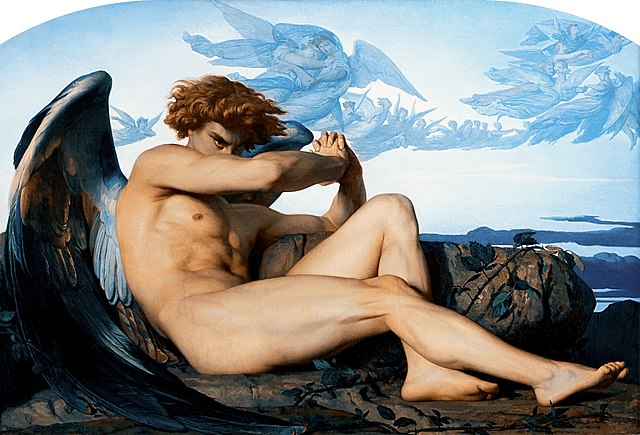
Fallen angels, those beings of a higher order than humans who rebelled against their Creator, have captivated storytellers, audiences, and readers alike for thousands of years, yet storytellers have offered radically different takes on these powerful and destructive beings. Stylistic differences are dramatic too. If we are paying attention, “Know thy enemy” is depicted in myriad ways in these 5 books.  

I refrain from saying “5 best books” because these are favorites of mine, and books with which I am more familiar. As literature, these books are not intended to be theologically accurate; rather, dramatically depicting the choices, attitudes, and behaviors that turned angels into devils.  

“The Iliad”

Attributed to Homer (circa 8th century B.C.)

Few readers of the Iliad see the Greek gods as fallen angels, yet they are a clearly a different order of beings than humans, with powers over nature man doesn’t possess, along with the ability to assume different physical forms. They use humans as pawns in their Great Games and to satisfy their pique and lusts, as depicted by Homer and in many of the Greek myths. In the long war, Aphrodite, Ares, and Zeus support the Trojans, while Hera, Athena, and Poseidon are on the side of Agamemnon and the Greeks. With few exceptions, the Greek gods are egomaniacs to be placated and cajoled by Aegean poleis. In “The Iliad,” thousands of maimed and murdered humans are a small price to pay for the gods’ vanities; interminable intrigues with each other are in keeping with why angels are thought to have fallen from Heaven—pride. Of these 5 books, the gods in “The Iliad” are not intended by the storyteller to be rebellious created beings—fallen angels, yet there is a brief, mysterious passage in the Book of Genesis (6: 2, 4) that reads, “… the sons of heaven saw how beautiful the daughters of man were, and so they took for their wives as many as they chose… At that time the Nephilim appeared on earth (as well as later), after the sons of heaven had intercourse with the daughters of man, who bore them sons. They were the heroes of old, the men of renown.” 

“Faust”

By Johann Wolfgang von Goethe (19th century)

Mephistopheles is a slyly sophisticated, parasitic tempter, preying on his “host’s” weaknesses, in young Faust’s case, pride and despair that make him resentful of human fragility: “I am not like a god!/ Too deeply now I feel this truth. I am a worm stuck in the dust/ Burrowing and feeding, where at last I must/ Be crushed and buried by some rambler’s heel.” 

In “Faust’s” prologue, Mephistopheles says, “The solar system I must leave unsung/ And to mankind’s woes lend my humble tongue,” hearkening to Satan’s dialogue with God in the beginning of the Book of Job. Mephistopheles’ “humble tongue” convinces Faust to trade a momentary experience of transcendence for an eternity of servitude, then wickedly brings about the wreck of Faust and a young maiden.

“The Lord of The Rings” legendarium

By J.R.R. Tolkien (1920s-1950s)

In Tolkien’s mythology, the most talented of all the elves was Fëanor, who made the gemlike Silmarils that awed and delighted even the Valar (angels). In Tolkien’s legendarium, elves are physical creatures of a lower order than the angelic Valar who have put on physical raiment, as did Gandalf in “The Lord of the Rings.” Tolkien’s Lucifer figure, Melkor, stokes and provokes Fëanor’s pride, sundering elves from the Valar, and from each other, producing a catastrophic centuries-long war. As Rod Serling said, “Some people possess talent, and others are possessed by it. When that happens, a talent is a curse.”

How fallen angels prey on human weakness is masterfully depicted in “The Children of Hurin” when Tolkien’s Lucifer mixes truth and lies to curse Hurin, his wretched human prisoner: “I am the Eldar King Melkor, first and mightiest of all the Valar, who was before the world, and made it. The shadow of my purpose lies upon Arda, and all that is in it bends slowly and surely to my will. But upon all whom you love my thought shall weigh as a cloud of Doom, and it shall bring them down into darkness and despair. Wherever they go, evil shall arise. Whenever they speak, their words shall bring ill counsel. Whatsoever they do shall turn against them. They shall die without hope, cursing both life and death.” Thus, cascade consequences from Fëanor’s long-ago rebellion and kin-slaying, even unto the elves’ human allies. 

“The Screwtape Letters”

By C.S. Lewis (1942)

Writing long before the 21st century Device Age, Tolkien’s brother Inkling, C. S. Lewis’, demon and relentless schemer, Screwtape, says, “We will make the whole universe a noise in the end. We have already made great strides as regards to Earth. The melodies and silences of Heaven will be shouted down in the end. But I admit we are not yet loud enough, or anything like it.” Screwtape’s letters give his junior, Wormwood, advise as to how to separate his “Patient” from God. Rather than appearing in the flesh, Wormwood works from the inside-out, so to speak. Referring to using human avarice against us, Screwtape tells Wormwood, “And all the time the joke is that the word ‘mine’ in its fully possessive sense cannot be uttered by a human being about anything. In the long run, either Our Father (the devil) or the Enemy (God) will say ‘mine’ of each thing that exists, and especially of each man… At present, the Enemy says ‘mine’ of everything on the pedantic, legalistic ground that He made it. Our Father hopes in the end to say ‘mine’ of all things on the more realistic and dynamic ground of conquest.”

“Declare”

By Tim Powers (2000)

In Powers’ meticulously crafted spy novel cum fantasy, fallen angels are djinns, albeit light-years from Disney’s “Aladdin” species. Powers’ djinns are utterly alien, and are manifest, for the most part, as elemental terrors that consume humans: “The urge to surrender to this nearly divine being, this higher order, was overwhelming. To oppose his (Andrew Hale’s) will to this force would simply be to shatter his will, shatter his very reason.” Even so, the djinns’ backstory is traditional of fallen angels in the sense of their rebelling against Heaven, and then establishing lairs in the created world, a prominent refuge being the icy peak of Mount Ararat. Involving hyper-secret offshoots of the Soviet and British spy agencies, to coopt and destroy the djinns respectively, the story spans World War II and the Cold War era. “He (Hale) shivered as he remembered at times cowering before tall sandstorms that boomed out the old rhythmic symbols across the dunes…Never surprise them, he had learned; never reason with them.” Though the form that fallen angels take differs in literature, temptation, lies and half-lies, and terror are their common tactics, all of these assaults conducted by a higher order of beings than man. Therefore, humans, in life as well as literature, cannot hope to resist such beings, whether Goethe’s master trickster, Tolkien’s Dark Lord, or Powers’ elemental behemoth, without Divine assistance. All this while bearing in mind that even to see our own guardian angel without its appearance having been altered to suit our human limitations would probably knock us for a loop at the very least, and this a being with our very best interests in mind.

T. M. Doran is the author of “Toward the Gleam” (Ignatius Press) and the forthcoming novel, “Seeing Red” (Ignatius).


Gleaming Brightly: T.M. Doran’s Catholic Imagination (INTERVIEW)

Editor’s Note:

T.M. Doran is a professor of engineering at Lawrence Technological University, but in recent years he has also managed to become one of the most exciting voices in Catholic literature. His novels Circling the Turtle, Terrapin, and Iota represent a bold breadth of thematic storytelling, while his novel Toward the Gleam has launched an entirely new series of Tolkien-related literature which teams with life and originality. Mark Nowakowski is a rising young Catholic composer of sacred music and a professor of music technology at Kent State.  Listening to these two Catholic creators converse is fascinating and revealing.

Mark Nowakowski: Thanks, Mr. Doran, for your valuable time today! What are significant things about Mr. Doran which animate him as a person and an author?

T.M. Doran: I’ve been married to my beautiful wife for over 40 years. She’s too good for me, and I’m not the only one who says that. My areas of specialty are the environment and infrastructure, having worked on hundreds of such projects over the years, and these subjects sometimes seep into my stories. I’m keenly interested in history/archaeology, astrophysics, and the natural sciences, and always have a book on one of these subjects at hand.

Mark Nowakowski: When and why did you start writing fiction?

T.M Doran: I began composing short stories before I was ten. As a boy, I loved to read, and I suppose that inspired me to try my hand. Many of these early stories had surprise endings.

Mark Nowakowski: How do you think about the relationship of your faith (Catholicism) to your art?

T.M. Doran: I strive to compose rousing, provocative, mysterious stories that people want to read. A common subtext in my stories is that moral choices have transcendent meaning, and consequences that migrate like cracks on an ice-covered pond.

Modernist literature may go so far as to admit that choices produce physical or psychological consequences, but can’t admit that such choices are inherently good or bad, right or wrong. So modern literature often depicts human beings as intelligent animals programmed by natural processes to respond in predictable, albeit dramatic, ways.

Authors with religious faith have to be careful not to fall into a similar trap where good choices are always rewarded in this life and bad choices are always punished in the here and now. Another thing I love to explore in my stories is the arc of human growth, often in fits and starts, and never complete in this life: “The road goes ever on and on.”

Mark Nowakowski: I myself am not an author of fiction, but fiction for me was an introduction to creative thought. As a creative kid, I for instance drew incredible solace and inspiration from the idea that an old English professor like JRR Tolkien felt free to spend incredible amounts of time contemplating an imaginary world. Even today, when I compose music, having good fiction at my side is often a wellspring from which inspiration rises (your books too!). Did you experience anything like this as well, given that you were writing at such a young age? And given the importance of Tolkien to some of your published work, when did you discover this pivotal Catholic author?

T.M. Doran: I first read The Lord of the Rings in my early twenties as a fantasy/adventure story. Subsequently, I’ve read The Lord of the Rings and Tolkien’s connected stories as dense, interwoven sagas and songs of a mythological world, as a caution about the lure of pride and power, and more recently, as a stark depiction of human frailty and our utter dependence on grace.

The hero of Middle Earth, Frodo Baggins is the person best suited to take on that terrifying and daunting mission. But he could not have fulfilled his mission without the “assistance” of Gollum, and only mercy made it possible for Gollum to be present at that moment. As for Frodo, there is no peace for him in victory over the Enemy. Will a boat come for me at the end? is a deeply spiritual question many of us ask in times of trial.

Mark Nowakowski: One can often sense the (often hidden) Catholicity of a writer or filmmaker based on how they approach the idea of the consequence of our actions. It’s really a different way of seeing the world. Could you perhaps speak more to the question of moral choice in fiction?

TD: I perceive this Catholic perspective in many creative people: Vivaldi, Michelangelo, Eliot, O’Connor, Capra, Hitchcock, Brubeck, and Graham Greene among them.

I’ve read many reviews of Greene’s “The Quiet American” but none of these mark this essential last-page reflection of the atheistic journalist who contributed to the death of the American in the story: “I thought of the first day and Pyle sitting beside me at the Continental…Everything had gone right with me since he had died, but how I wished there existed someone to whom I could say that I was sorry.”

Greene’s journalist has a sense of honor and contrition, but without God honor falls prey to desires and fears: Where does one go to confess and receive forgiveness when there is no God?

Mark Nowakowski: Speaking of Tolkien: Toward the Gleam is so successful because you a create a plausible prehistory of Tolkien’s created world which seems like it must have actually happened. Then you spin another tale around it which, while imagined, adds another layer of “this could easily be real” to the formula. Was this your intent?

T.M. Doran: Yes, this is what I intended with Toward the Gleam, though I’m not sure I’d have the courage to compose and submit such a story today. Someone once said that I took the easy path by choosing a Tolkien-like character for Toward the Gleam, not realizing how difficult John Hill was to write.

Even though John Hill was a fictional character, I felt severely constrained by what I could do with him. Jan Skala in Iota and Lyle Stuart in The Lucifer Ego were much easier to write because of the creative freedom I enjoyed with these characters; I could let them go in directions I hadn’t expected when I embarked on these stories.

For Toward the Gleam, I spent countless days researching and matching the era of the world of the manuscript with known biology (flora and fauna), geography, climate, even anthropology, thus John Hill’s meetings with Pepin Hermann (who features again in The Lucifer Ego) and Greta Erickson (who features again in book three). As the prehistoric civilization continues to affect characters in Toward the Gleam, so characters in Toward the Gleam continue to affect characters and events in The Lucifer Ego and Kataklusmós.

“This could easily be real” plays out in book three, something I had intended even as I began composing Toward the Gleam fifteen years ago.

Mark Nowakowski: Music has taught me that great art has some manner of pre-existence, and that the great works feel “necessary” in their own existence. When I think of the poetic, I think of a stream of something objectively real and yet entirely beyond our capacity to describe, one into which artists are allowed to dip despite not understanding. Considering the way in which the palpable realism of Toward the Gleam built upon the palpable history of the Lord of the Rings, can you perhaps speak to something like this? Have you had such a sense or experience?

T.M. Doran: I love how you describe the creative experience. In my writing, I’ve experienced this powerful sense of Truth and Beauty beyond understanding, and I’ve also sensed it in music and visual art: An invitation to a larger life, you might say, a life one is permitted to glimpse/hear for brief periods of time, and something that remains with us as a deep yearning.

When I’m writing, I often listen to classical music or instrumental jazz, as music inspires and invigorates me. Without faith, these glimpses of an “unattainable” larger life can lead to despair, as has often occurred in the lives of artists.

Mark Nowakowski: You speak so lovingly of your wife. Was your own marriage perhaps a model for how you depicted the main character’s marriage in Toward the Gleam, especially the closing chapters when they are old?

T.M. Doran: For John Hill and E.M., I did indeed draw on what I had learned about the Tolkien marriage and on my own marriage, as both marriages involve strong-minded people who are deeply in love. When someone spends “incredible amounts of time contemplating an imaginary world (art that transcends the physical world)” it is bound to affect those close to them, even if not a matter of mortal danger as it was for John and E.M.

Mark Nowakowski: Earlier on you mention Iota. As somebody who visited Communist Poland and heard many stories of this world and subsequently later studied it as an adult, I was beyond struck by the accuracy of the “feeling” you achieved in this novel, set in a Soviet prison shortly after World War II. What lead you down the path to pick this setting for a story? And how did you pursue the particular tone and tenor of the Soviet ideological atmosphere?

T.M. Doran: I embarked with the thought of contrasting heroic mercy, which doesn’t come naturally to man, with man’s unspeakable brutality when he rejects the true God. Doing so in the cauldron of a detention camp with men representing many ways of looking at life, and a world with so much chaos, seemed an appropriate setting for these ideas to play out.

There were so many influences on this story. I read a great deal on the Soviet and Nazi ideologies and regimes: Shirer, Churchill, Gilbert, Weigel’s biography of St. John Paul II among them. I have a friend who escaped from Communist Czechoslovakia via North Africa. Solzhenitsyn’s and Pasternak’s writings. The character of Father Petrenko was influenced by the priest depicted in the German film, “The Ninth Day” who was released from Dachau for nine days with the expectation that if he cooperated with the Nazis he wouldn’t be returned to the camp.

Heroic mercy is the central thread in the story: Fr. Petrenko, the guard Piotr, and finally Drewniak. Then, there is the Major, who is full of schemes, illusions, petty aspirations, and yet so empty of life. And yes, I write about the diabolical influence that accompanies extreme depravity. These were my themes.

Mark Nowakowski: How far do you think we are from an Iota setting in America and the West?

T.M. Doran: The totalitarian inclination has persisted throughout history, and particularly in eras where religious faith has waned or is under attack. Soon after the American Revolution, many actually wanted to emulate the brutal radicalism that triumphed in France. They were unsuccessful but came closer to prevailing than many now realize.

For myself, I’m dumbfounded that, so soon after witnessing the viciousness of 20th-century totalitarian ideologies in action, there is so much ignorance (including the so-called highly educated) of where this path inevitably leads.

Sometimes, I feel like George Orwell must have felt in the 1940s. There’s an irreverent story told about Robert Conquest who unmasked Stalin’s brutality in his book, “The Great Terror” (1968) and was roundly criticized/ridiculed for it at the time. Years later, after the fall of the Soviet Union, when the book was reissued, Conquest was reported to have suggested the title: “I Told You So, You ###### Fools”. Irreverent but to the point.

Mark Nowakowski: What (if any) has been your experience with secular publishers?

T.M. Doran:  I’ve reached out to secular publishers/agents without success. I think it’s harder today to sell a story that goes against the strong secular/materialist spirit of today’s world. On the other hand, I don’t consider myself a strong enough writer (certainly not a Greene or O’Connor or Waugh) to be a good test. Furthermore, I don’t have the traditional education/experience of most authors, a significant shortcoming to many in the publishing world. I’m at peace with this today.

Mark Nowakowski: What can the world expect from T.M. Doran next?

T.M. Doran: I’m in the production phase for Kataklusmós, a story that completes the Toward the Gleam saga. A demanding story to write, 3-4 years composing, a dozen versions, lots of research, and challenging themes. I’m always working on several longer or shorter stories, but after Kataklusmós I may step back from publishing.

Mark Nowakowski: We wish you luck on that, sir, and hope that your step back from publishing may not be too long a hiatus. Thank you for your time today!

Subscribe to Our Emails