How Does a Hymn Become a Classic?

Archbishop Cordileone’s Very Marian Advent Prayer Service Launches World Premiere of Two New Christmas Carols

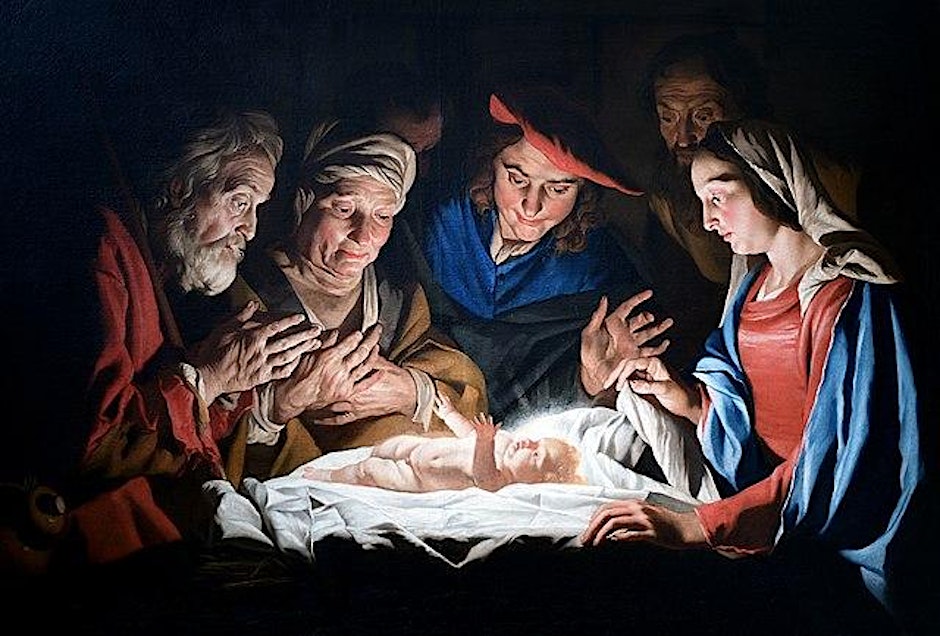
On December 15th, at Star of the Sea Church in San Francisco, Archbishop Salvatore J. Cordileone will lead an innovative Very Marian Advent Prayer Service featuring the world premiere of two new hymns by major Catholic artists commissioned through the Benedict XVI Institute. James Matthew Wilson teams up with composer Frank La Rocca for a new hymn While All the Earth in Darkness Sleeps, which was inspired by the 6th century Akathist Hymn to Mary. Fr. Dwight Longenecker created Our Lady’s Lullaby with new lyrics to an old Welsh hymn Suo Gan (best-known for its appearance in the Disney film Empire of the Sun) and a new arrangement by composer William J. Fritz. The two hymns are part of a lessons and carols worship format, featuring a magnificent 8-voice schola led by Hillsdale College’s Maestro Timothy McDonnell.

Archbishop Cordileone and the Benedict XVI Institute’s ambitious goal? To create new Advent hymns that enter the canon of the Catholic church.

“Many of our best hymns and carols were composed first as poems and later set to music,” said James Matthew Wilson, poet-in-residence at the Benedict XVI Institute “How daunting as a poet to have to say to myself, this has to work as the kind of language people will want to sing, want to remember specifically as musical, as pure song.”

All ancient, worldly wisdom
Exults before your son,
And lays three gifts before you,
Virgin who nurse the One.
May gold forever glimmer
From both his crown and yours;
May prisoner and pauper
Greet angels at their doors.

Rejoice, o virgin watching through the night.
Rejoice, the gate that opens all to light.
Rejoice, whom even cherubim attend.
Rejoice, seraphic queen and sinners’ friend.
Rejoice, whose breast the food of all once fed.
Rejoice, our lady, stars anoint your head.
Rejoice, for on this night you bore a son.
R. Rejoice, for on this night you bore a son.

~While All the Earth in Darkness Sleeps
James Matthew Wilson

How does a poet even begin to approach such daunting task of adding to the canon of Advent and Christmas music?  “By trying to impart a classic quality to the setting,”  Composer-in-Residence at the Benedict XVI Institute Frank La Rocca answered. “One that sounds like a bit of fresh air flowing through a long and great tradition – a tradition one approaches with a certain reverence and gratitude.”

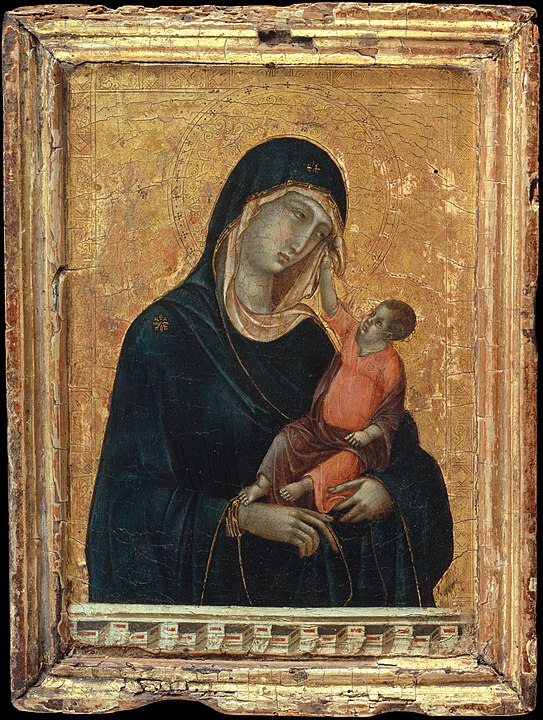
The second world premiere Advent carol is Our Lady’s Lullaby. “How did you approach this?” I asked Fr. Longenecker. “To write something one hopes will stand the test of time, one looks to the great tradition and tries to write from within that—without either copying or challenging the tradition. For this piece I looked to the great images of the Madonna and child and that connected me instinctively with lullabies,” he replied.

Sleep my Child
In the manger
Sleep my child
Free from Harm
Sleep my child
Free from Danger
Sleep my child
In my arms

~Our Lady’s Lullaby
Father Dwight Longenecker

“When mothers hum to their little ones as they’re putting them to sleep,” added composer William J. Fritz, “many times they improvise without knowing it. I changed the rhythm of the original tune to make it feel like a mother rocking her child to sleep; there is also a departure from the tune in the middle when Mary contemplates her Son’s passion and death. My hope was to hint at the ecstacy that the Mother would feel at the Son’s triumph over death. This is an Advent/Christmas Hymn much like the Messiah – it’s all of Christ’s mystery wrapped in one.”

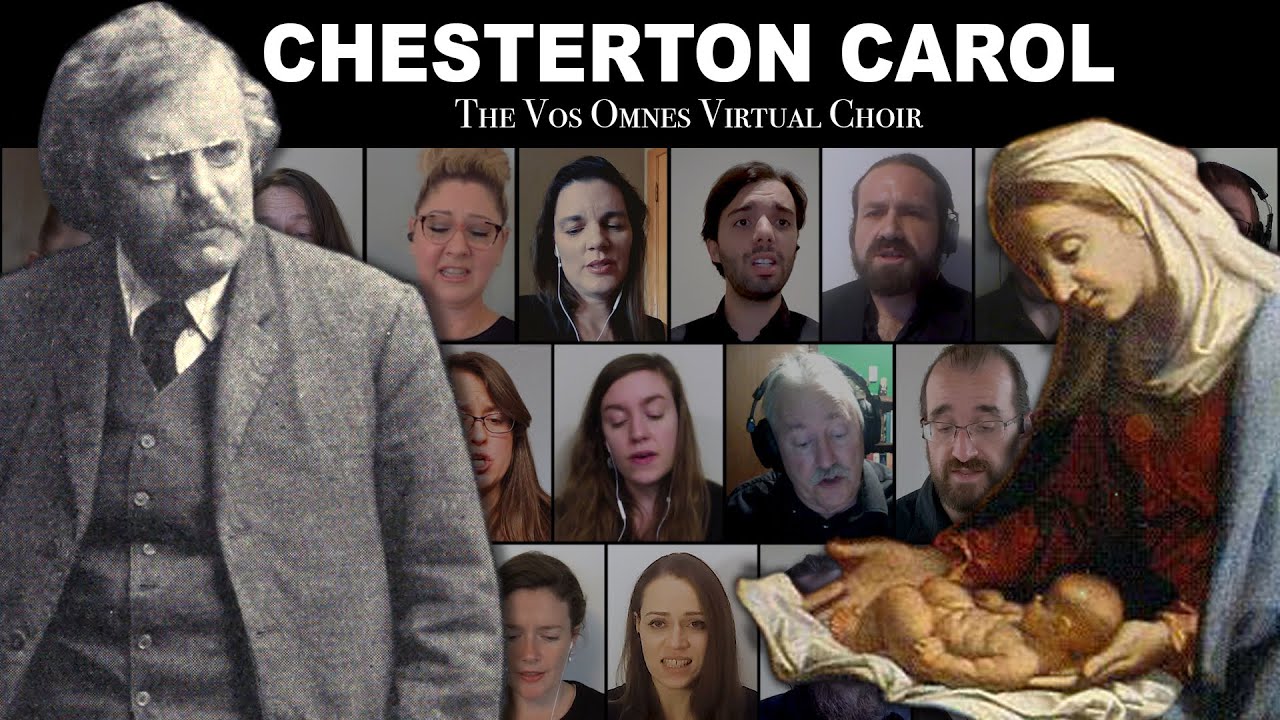
Last year’s first Very Marian Advent service saw the debut of two other brand new Advent carol:  The Chesterton Carol, by composer Mark Nowakowski, and Our Lady Expectant, composed by Wilhelmina Pariseau from a poem by Roseanne T. Sullivan. Both will be performed again this year.  Mark Nowakowski’s Chesterton Carol has taken a step towards becoming a classic by generating 22,000 views on YouTube and being adopted by many in the Chesterton Schools Network.

The new hymns this were made possible by the support of two new patrons of the arts: James and Kristy Hudon, who commissioned While All the Earth in Darkness Sleeps, and Michael and Sarah Trela, who supported Fr. Longenecker and Mr. Fritz’s new Christmas carol.

Why support new works of art amid that many other urgent needs in the world, I asked them.

“Most of the religious hymns we sing today were composed long ago, borrowed from past generations,” said Mr. Trela. “While these old hymns are excellent, it is time for this generation to humbly contribute with a new Christmas hymn that shares in the joys and tears of Our Lady.”

“We are meant not only to enjoy Art, but to participate in it,” said Mr. Hudon. “A thriving arts culture unites us as Catholics and brings us into fuller communion. A city set on a hill cannot be hidden, and so it is important that we help make our city—the Church—beautiful, as beauty attracts people who have otherwise closed themselves off to the truth of the Gospel.”

Those in the greater Bay Area can register to attend; the Benedict XVI Institute also offers a virtual option: those who register will receive a link to the professional recording of the event, including the new Advent /Christmas carols.

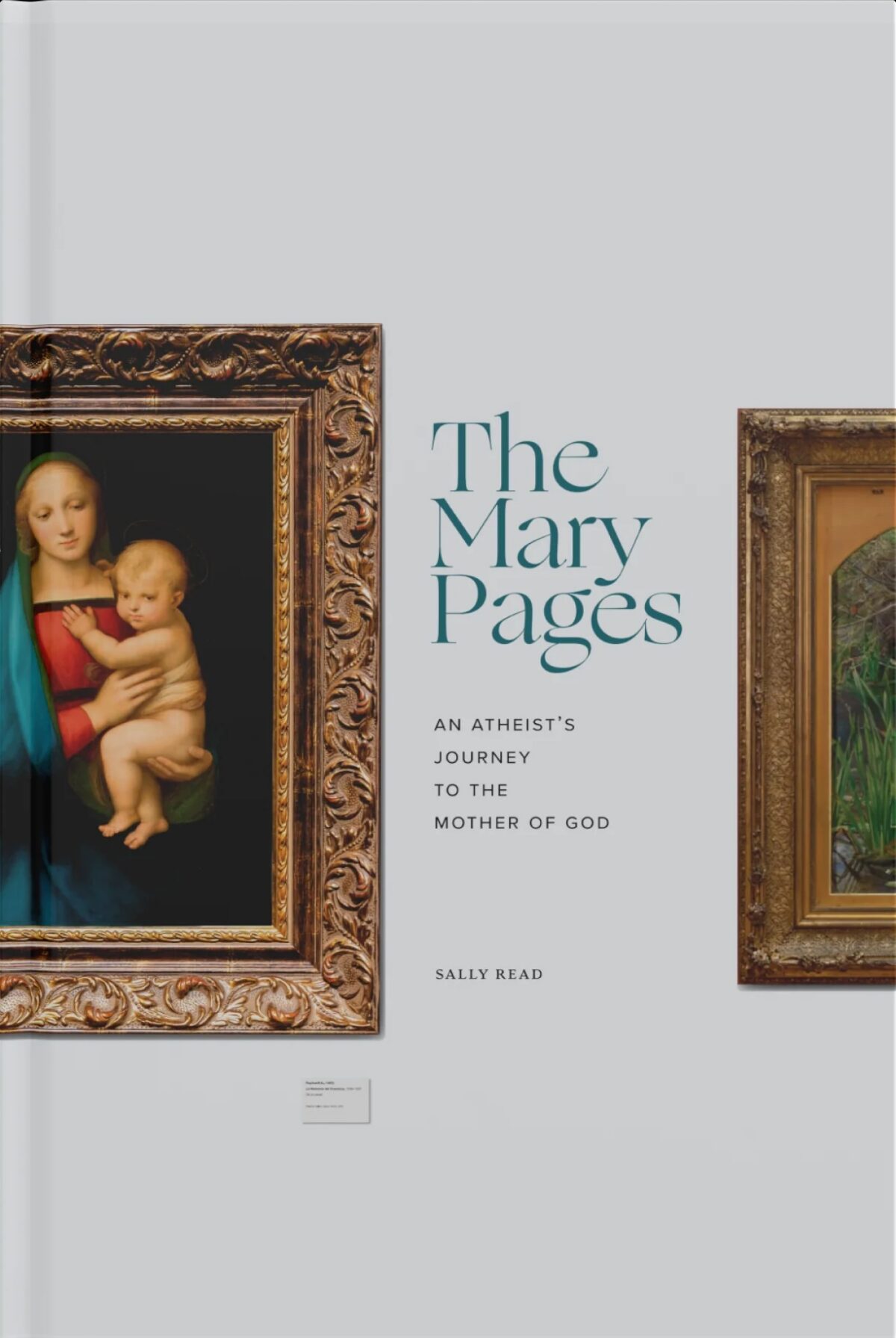
Review: The Mary Pages by Sally Read

Sally Read, born in East Anglia in 1971 and now living near Rome, was a secular poet before she was a Catholic poet. Determinedly secular, too, as she relates in her new memoir, The Mary Pages: An Atheist’s Journey to the Mother of God (Word on Fire). 

Raised by an atheist father who scorned all things religious, in a country that had stripped its churches bare of iconography (especially all that was Marian) centuries before, and imbibing to the full the defiant feminism that marks our current culture, Read unsurprisingly regarded the Mother of God, at least as the Catholic Church views her, with faint contempt. “How best to shut a woman up?” she once mused as she she contemplated Mary’s seeming irrelevance to contemporary women’s issues such as genital mutilation, date rape, and domestic violence. “Put her on a pedestal, and give her a crown.”

The Mary Pages is not a conversion story. Read has already told that story, of her nine-month journey in 2010 from cynical atheism to the Catholic Church, in a 2016 memoir, Night’s Bright Darkness. Nor is The Mary Pages a conventional autobiography; it seems purposely vague on detail. Instead, it is a story, meticulously and beautifully written, of how Mary insinuated herself into Read’s internal life so thoroughly, starting in childhood, that she would be inevitably led to Mary’s Son. The medium was art. Read’s grandmother had a copy of a Raphael Madonna hanging on a wall. The mother and baby mesmerized the unchurched little girl who scarcely knew who Mary was.

Later, Read went to nursing school in London, where she found herself haunting the National Gallery’s Renaissance rooms with their myriad images of Mary—and then hanging a print in her bedroom of Filippo Lippi’s radiant Madonna and Child With Two Angels. The story behind the painting overwhelmed her as much as the painting itself. The model for the Virgin had been a Dominican novice-nun, Lucrezia Buti, with whom Lippi, although a professed friar, had fallen in love. One day he kidnapped Lucrezia from a procession and seduced her. She eventually bore him two children, but even when released from his vows and given ecclesial permission to wed, he refused to marry her.

That resonated with Read, who herself was seeing a man, a doctor she calls Mischa (she has altered identifying information for most of those she writes about), who declined to commit himself to her because he already had a live-in partner, a woman physician at his hospital. Read’s relationship with Mischa was misery (“a kind of slavery,” she writes), but he did one thing for her: He encouraged her to keep writing the poetry she was already starting to write. He brought her books by women poets he thought would inspire her: Sylvia Plath, Sharon Olds. They did. If you have read Read’s poems (some are online), either pre-or post-conversion (where her subjects are nearly entirely Christological), you will find the powerful  rhythms, minutely focused examinations of the natural world and the human body, and the naked emotional engagement that mark the work of Plath and Olds. Read’s years in the secular literary world did not go to waste. 

She got up at 5:30 every morning to write furiously, then worked a shift at a psychiatric hospital tending the human dregs and outcasts no one else seemed to care about. She collected Marian art in her apartment—but at the same time she was composing a feminist poem that would portray the Virgin as a pregnant rape victim who had to invent the Annunciation as a cover story: “I could not tolerate a male God—and Mary, I suspected as much, was inextricable from him.” Read’s mental images of Mary were refracted into other wounded women: Lucrezia Buti; Elizabeth Siddal, the copper-haired model for many a pre-Raphaelite painting of Mary who killed herself like Sylvia Plath when her artist/poet husband, Dante Gabriel Rosetti, had an affair with another of his models; Princess Diana, then at the height of public pity for her and also made violently dead, in 1997. Read enrolled in a graduate writing program on the American “Plains” (the University of South Dakota, according to her Wikipedia biography), where her friends, like her, were women left stranded by men, sometimes with children to raise alone

She returned to London, and then, somewhere and somehow (remember, this is not an autobiography) she met the man who became her husband: Fabio, an Italian. They moved first to his native Sardinia, then to the Roman seaside suburb of Santa Marinella. All over Sardinia—in roadside shrines, bars, schools, grocery stores–were plaster and wooden statues of the Madonna, sometimes wearing a lace dress and blonde wig, like a doll. Read found them repulsive, and she chafed under the unwritten rules of traditional Mediterranean society, where respectable women did not go out at night alone, and her visiting female friends, bohemian free spirits who flirted and more with the local shepherds, drew the wrath of her in-laws, who deemed them loose women. In Santa Marinella a church housed La Madonnina, a small statue of Mary, a souvenir from Medjugorje, that was said to weep human blood from time to time. “This florid thing…only distanced Mary further from me,” Read writes. “The bloody face was like something from a horror movie.”

The turning point came—although it would be another four years formally—when she gave birth to her daughter, Celia Florence, in a Roman hospital. She had had trouble getting pregnant, and the labor was prolonged and excruciating (the baby’s head wasn’t positioned optimally). Alone in her hospital bed in her agony (husbands weren’t allowed bedside in Roman maternity wards), she realized that Mary had also been alone when Jesus was born, because as it is with all women in childbirth, “[n]o one, not even her husband, could possibly imagine what was happening to her.”

“Alone of all your sex,” -[the fifth-century Latin poet] Sedulius wrote, and the feminists seized on this as example of the Virgin’s difference, her exceptionality, her exceptional holiness, her exceptional loneliness—her special subordination to God and man….But what I will arrive at, in a shortening number of days, is Mary’s aloneness as the archetype of every woman’s aloneness: Mary as foundress, as defender, as mother-creator, as collider with the harsh, existing world. For in childbirth, there is no act of creation so similar to God’s as he pulled form out of nothing and watched the world spin.

The only thing that I could have wished for more of in this haunting and gorgeous book is the visual images of Mary that have followed Read since her childhood. There are some of them, to be sure: her grandmother’s Raphael, the Filippo Lippi, the striking 1922 statue of Our Lady of Walsingham, whose shrine in her native East Anglia Read visits as a pilgrim in the book’s final pages. I longed to see a photo of La Madonnina, for example. It is also unfortunate that Read’s oeuvre as a poet has been divided in two by her conversion, with each half perhaps rendered inaccessible to admirers of the other. Her first three books of verse, dating from the early 2000s, were published by Bloodaxe Press, a leading British secular publisher of poetry. Her most recent volume, Dawn of This Hunger (Angelico Press, 2021), as well as her memoirs and other prose works, come from Catholic presses, and it would be unfortunate if her secular readers assumed she was addressing her richly laden recent words solely to a Catholic literary ghetto. Sally Read is too fine a stylist and too penetrating an observer for readers of any religious sensibility or none to miss.

Pre-conversion poem:

Gestation

Post-conversion poem:

Anne: The Coming of the Immaculate

At times prayer is wordless, but it fills
the empty night as water fills a lake
with its own meaning. I pray to break
this body with a child, for my taut pelvis
to open and ache its tight basketwork
apart; to yield. Sometimes I sense God
in the darkness—like a heavy leaning
at the door—always with an inexplicable
tenderness in how he does not burst in.
Perhaps he would break me if he did,

so waits instead to pour into my own undoing—
so just when I would moan, It’s done!
that life did not go well, Perfection rests in me,
and I expand, like wood ticking in the sun.

The Mind of the Maker and the Art of Liturgy: A Poet’s Eye View

…the mind of the maker and the Mind of the Maker

are formed on the same pattern, and all their works are made in their own image.

—Dorothy Sayers, The Mind of the Maker

Hope always draws the soul from the beauty which is seen to what is beyond,

always kindles the desire for the hidden through what is constantly perceived.

—Gregory of Nyssa, The Life of Moses

PROLOGUE

           Asked to write on “liturgy and the artistic imagination,” I find myself rocking on a restless sea. So young in Orthodoxy that I am not even a toddler, I wonder what I can say about liturgy that will be worth a reader’s while; though I have no interest in adding to the liturgy I experience—itself already a work of participative art—I am interested in how liturgy and a maker’s imagination might dance together.

           Yet since many shiploads of words have been written about imagination, what cargo shall I add to these? More, what is meant by artistic imagination? How does it fit into the braid of the human, a winding together of nous—often defined as “the eye of the heart” or “eye of the soul”—sense perceptions, and reason? What happens when we marry liturgy and the urge to make?

1.

THE WISH FOR INFANT SIGHT

The flame of fire, the living spring

              Not long ago, I found myself at a Sunday parlor church deep in the Carolina mountains, sitting between my mother in her wheelchair—she having been felled from walking by a long bout with covid—and an elderly man named Jerry, who had introduced himself to me a few days before by saying that he was lost, and who had kissed me on the cheek when I walked him to his room. We were twelve in that parlor, with a rural Baptist preacher accompanied by his wife and two daughters in mightily spangled red-and-gold dresses. Around me sat the halt and lame, and I remembered the Centuries of Mediation by lovely-minded 17th-Century Anglican poet, priest, and philosoph Thomas Traherne, conveying in a great flow of words the enchantment and beauty of his infant sight, and his adoration of an Edenic realm radiant with signs of divine making:

The corn was orient and immortal wheat, which never should be reaped, nor was ever sown. I thought it had stood from everlasting to everlasting. The dust and stones of the street were as precious as gold: the gates were at first the end of the world. The green trees when I saw them first through one of the gates transported and ravished me, their sweetness and unusual beauty made my heart to leap, and almost mad with ecstasy, they were such strange and wonderful things: The Men! O what venerable and reverend creatures did the aged seem! Immortal Cherubims! And young men glittering and sparkling Angels, and maids strange seraphic pieces of life and beauty! Boys and girls tumbling in the street, and playing, were moving jewels. I knew not that they were born or should die; But all things abided eternally as they were in their proper places. Eternity was manifest in the Light of the Day, and something infinite behind everything appeared which talked with my expectation and moved my desire. The city seemed to stand in Eden, or to be built in Heaven. The streets were mine, the temple was mine, the people were mine, their clothes and gold and silver were mine, as much as their sparkling eyes, fair skins and ruddy faces. The skies were mine, and so were the sun and moon and stars, and all the World was mine; and I the only spectator and enjoyer of it (701.)

           As the rural Baptist pastor sang the old songs praising the solid rock and the flying-away of the soul, as he preached on Christ walking the waves and calling for Peter to come to him on the sea, through the boisterous air, I was surprised to find myself stirred to tears, with a strange, uncanny sense of the parlor being encircled by a great wheel of figures, dim and pale. It seemed that the saints came even to the Carolina coves and hollers, even to those who do not call to their names, and even to those who are losing the powers of speech. We did not need the liturgy to feel the nous stirring. For long moments, I shared Traherne’s intense sweetness and joyful infant sight and could—compassing the world—say with him, “The streets were mine, the temple was mine, the people were mine….”

           What happens at such moments? Is this part of the infant sight, to love and feel our heart go out to others, living and dead, and to be called to walk the uncanny waters of what lies beyond us? In For the Life of the World, Alexander Schmemann – the 20th century Orthodox theologian whose most famous work on liturgy, “For the Life of the World,” was distributed by samizdat in the old Soviet Union – says quite plainly that the church is “the joy of recovered childhood, tithe free, unconditioned, and disinterested joy which alone is capable of transforming the world” (39.) He quotes Romano Guardini on liturgy to say that “It is in the highest sense the life of a child, in which everything is picture, melody, and song…it unites act and reality in a supernatural childhood before God” (40.) I look to the magical vision of little Thomas Traherne, future poet and writer. For some happy period of time in the seventeenth century, he lives at the Edenic mountain peak where a child of time touches eternity, and where the soul streams forth and kisses Creation and its creatures. His Blakean “doors of perception” are bright and clean, and so reveal the infinite. Like Christ in the Eucharist, he is broken into pieces for love of every part of the world, and yet he is not divided: he remains young Thomas, already the poet who has eyes to see.

2.

CHILLING AT THE PALAZ OF HOON

Illuminate our intellect, / Pour forth thy love

           One view of the early church fathers is that imagination is a risk, that it can endanger the soul. This danger appears particularly in the region of contemplative prayer, where stillness and rejection of images is desired. According to the fathers, images may become part of what separates the human from the divine; the contemplative should never image God or find pleasure in imaginary scenes during prayer, lest he fall prey to pride and self-deception and passions. In the seventh-century Ladder of Divine Ascent, Saint John Climacus writes that the very first step in prayer is to shoo away thoughts. Silence of mind is desired. (Note: This idea remains strong in the Orthodox tradition and, yes, is clearly opposed by the mode of Ignatius of Loyola.)

           In our age, when attention spans are fragmented by a quick, frenetic TikTok pace and where no subject is taboo, wildness may be far more appealing than silence of mind. Chaotic seas of our culture may carry us very far from stillness, into ports of our own invention—each creating the self as a proud Wallace Stevens figure, as in “Tea at the Palaz of Hoon”: “Out of my mind the golden ointment rained, /And my ears made the blowing hymns they heard. / I was myself the compass of that sea: / I was the world in which I walked, and what I saw / Or heard or felt came not but from myself”. (Stevens 65.) I am fond of many Wallace Stevens poems, yet I would say that Hoon’s self-born sight is not Traherne’s child sight, easily perceiving and indeed knowing that the world is more than what our senses tell us and catching hold of a divine radiance.

           Instead, Wallace Stevens’ Hoon is a Modernist questioner and answerer who is his own god and his own creation, self-anointed and self-sung: a kind of solipsist-ruler who has yielded utterly to the powers of the imagination. Like his artificer, Stevens, Hoon finds redemption in poetry. He may seem at first glance to be congruent with Maritain’s affirmation that “The mind rejoices in the beautiful because in the beautiful it finds itself again: recognizes itself, and comes into contact with its very own life,” but Hoon has neither sense of himself as creature rejoicing in being a part of Creation, nor sense of Traherne’s the infinite-behind-beauty—God as author of beauty (26.) Gazed at through a Modernist lens, the figure of Hoon recalls Salvador Dali’s prophetic remark that the time appeared to be drawing near when confusion might be systematized and so lead to a complete discrediting of the world of reality.

           So yes, there is a curious danger. The possibility of replacing God with imagination and making is an idea that appears to be passed down by the Romantics, who turned the artist into a secular priest of art.

3.

MADE AND MAKING

Oh, creator Spirit, appear

           What is this element I am asked to discuss, this artistic imagination?

           Made in the image of the Maker, we’re all makers, whether we’re baking or roofing or turning a pot on the wheel. We have the urge to make, to use some Ars, some art, skill, or craft: this is the inner call to imagination, to bodying forth some new thing, some sub-creation. Those of us who want to paint or sculpt or compose or dance or make stories and poems have often—perhaps not so much lately, and certainly not among the institutionalized “avant-garde”—been the wandering pursuers of the great transcendentals inherited from the classical world. Beauty, truth, and goodness would probably be regarded as excessive demands for most making, but perhaps not for, say, a poet pouring his energies into the uncompromising shape of a traditional sonnet. The poet is not thinking about beauty or truth, though he is attempting to capture something—to catch it in a net of words, or as Yeats would say, “a mouthful of air.”

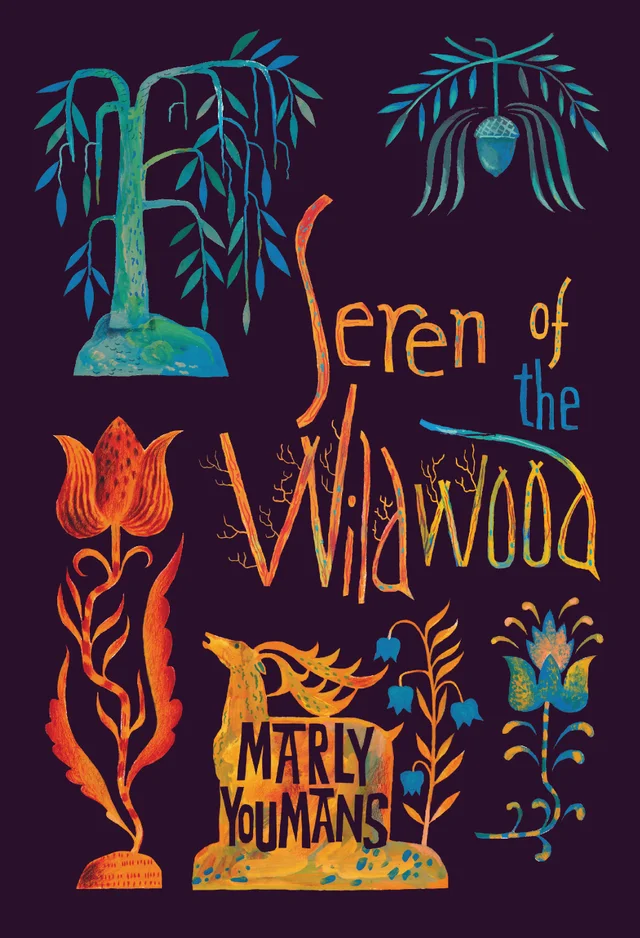
           Ideally, the maker who chases the transcendentals would possess the “wise-heartedness” attributed to the artists of the tabernacle in Exodus, and so use the plait of reason, nous, and bodily senses to create good things that add to the sum of beauty and truth in the world. In my recent book, Seren of the Wildwood, the eponymous heroine achieves something of wise-heartedness after seven years of journeys, peril, and sorrows in Wildwood. Transformation leads to a place where she looks back and retrieves out from raw, tumultuous years a desire to make that streams with soulfulness, yet is grounded in earthly things. She thinks

                                                     . . . how in secrecy

                     She might become a golden bowl of flame

                     In an enchanted world—this one, a place

                     Of paradise and hell and mundane hours,

                     Where she could learn to make, to sing her tale

                                                     Around

                                A hearth and wildwood blaze

                                On nights in winter crowned

                                By the strange, striking lays

                                That hold mortals spellbound (72.)

A wise-hearted pursuit of the transcendentals: yes, I think we might call it artistic. Making, in this view, can be regarded as part of the fulfilling of human nature as formed in the image and likeness of God.

           Wielding the imagination—making—in order to bring something worthy out of the generous profusion and welter of Creation is a simple though profound idea. Making does not need the complication of the Romantic vision of a suffering, unstable creator, nor does it need to proclaim Aestheticism’s “l’art pour l’art,” nor does it need to reject skill and embrace ugliness and transgression. It must not want to hammer out a message, for that is a work’s ruination. It must not try to cram everything the maker knows into the work. Making will fail if a maker does not honor the makers of the past and refuses to learn their craft and technique. Making will fail if a maker lets the unfairness of the present times and particularly in the world of the arts sap his spirit.

           People with the eyes to see the naked emperors of our world—the Repha’im kings of our day—already know that making can miss its mark entirely in execution (as in weak mimesis, ungainly form, axe-grinding, obsession with originality, domination by politics, kitsch, determination to shock or repulse, inappropriate feeling)  or in loveless purpose. We discern that missed mark in Genesis when Adam and Eve believe they can hide the shame of an act by stitching together leaves to make coverings for themselves. We see missed marks all around us, as in graffitied and decaying Brutalist architecture, in new Duchampian works influenced by his “readymades,” in lyrics of political hate, or in slatternly poems of worn-out transgression and shapelessness.

           Such creations are reductive; they diminish beauty and truth, rather than reaching for “the rendering strange of reality in order to make it clearer” (Mosley 23.) When a visionary Traherne sees children as “moving jewels,” he grasps at the strangeness of a paradox, joining together the stillness of gems to the liveliness of children at play, and in doing so reveals the human form as precious, alive with precious, sparkling light and color, a part of the wider Creation that bathes him in glory. This is revelation, “the rendering strange” that summons up beauty and truth.

           A maker should remember that we who make do not only make works that may be labeled as art. We also are co-making ourselves because whatever spirit that flows through a work as it is coming to fruition is also changing us for good or for ill. This, too, is part of what we may call the work of the imagination. Just as all humans ought to have a sound diet in order to thrive, we peculiar humans who have the desire to reach toward a higher making are best fed by strong, fine materials and purposes. And when we are done with a work, we are to yield to others what we have made out of the abundant stuff of Creation, which is our given, our great donnée.

           What does that mean for us as viewers, listeners, readers, receivers of what is made? We cannot experience the essence of a maker through what he or she has made, but we can experience the energies of the person and the beauties of a work. Such an encounter can be, to some greater or lesser degree, an immersion in the flowing energies that birth art, and a kind of renewing of the thing made. (This way of looking is a small reflection of the large Orthodox idea that we cannot know God’s essence but can experience his energies or attributes, for that grace radiates from his essence and is revealed to the soul.) For, “the beautiful does not exist for the artist and poet alone—though these can find in it more poignant depths of meaning than other men—so the world of Reality exists for all; and all may participate in it, unite with it, according to their measure and to the strength and purity of their desire” (Underhill 13.)

           And if the thing made by a poet or painter or choreographer or composer has captured enough of a sense of life, enough of the maker’s vital energies, it may continue to burn brightly and share its light with all for many years. It may even inspire and be generative for other makers, later in our linear time.   

4.

MAKERS AND LITURGY

As we enter now the timeless mystery

           The liturgy is a work of symbolic, participative art—it is a vessel, a form filled with adoration, spirit, and oblations meant to join human beings with the Trinity and the Divine Council, to feed men and women through “the holy and immortal mystery” of “our most essential bread,” filling them with divine, uncreated grace (Liturgy 40, 37.) Like a graft on an apple tree, a communicant is incorporated into the very body of Christ through the mystery of mysteries. In the Cherubic Hymn, those called to the Eucharist mystically “represent the Cherubim,” a reminder that they are one with the Divine Counsel. The liturgy lifts a fragment of Creation toward God, and sees that bread and wine transfigured. What is mortal touches the immortal; time and eternity greet each other. As then-Cardinal Joseph Ratzinger asserts in The Spirit of the Liturgy, “Christ himself is the bridge between time and eternity” (92.) Liturgy is a kind of procession over that bridge, into the strange light of the kingdom beyond.

           So too, in a far more modest way, human making can result in a shape, a vessel that spills over with mortal mystery—the inspired blending of attention, spirit, and human energies. The influx of power that inspires the poet and embodies itself in words has long been compared to the Holy Spirit, and no writer knows where her muse comes from, or where it goes. A writer can fiddle and make something out of words, or she can be borne on the flood of spirit that clothes itself in her very thoughts and words. Such imaging forth is mystery, and a faint, fractal likeness to the God who speaks the world into being. To repeatedly participate in works of art as maker or enjoyer is, like that crossing of a holy bridge into another kingdom, a way to see more clearly. And like the liturgy, words and musical notes and dance can be seen as procession; they move through time toward their right closure.

           Both religion and any art devoted to transcendental qualities are intensely countercultural for us, in a time when the world has been flattened, and all that exists for many has been reduced to material desires. Simultaneously, others have reached a Silicon-Valley hope-for-transcendence where some plot and hope that we can abandon the messiness of life and upload our minds into some technocratic cloud, where we may have faux material pleasures forevermore, or until the plug on the matrix is pulled. Others plan to have their frozen heads revived in some utopian and even more technology-mad age. Surely, we are already veering into that era; iPhones are glued to hands, AI-generated articles appear on Buzzfeed, bad ChatGPT poems pop up online, and we pause to glance at faux retro photographs from Midjourney. Whether pleasing or fleeing the flesh, life is dwindled down to material pleasures bodily felt, or to what can be known without the body, through some fabulous-seeming technology. As Ivan Ilyin warns in his 1937 Foundations of Christian Culture, “a people can stand on the absolute high point of technology and civilization, while in the arrest of spiritual culture (morality, science, art politics, and economy) they can be undergoing a period of degradation (19.)

           Christianity and transcendentally-inclined art resist all reductionism and show by their very presence that this world is more than what it appears to be, that the symbolic landscape around us is constantly speaking to us: that it may be broken but is good, beautiful. For a Christian, every tree rooted in earth and pointed toward heaven can recall the cross, and all water the baptism of Christ. Our home planet is alive with energies and mystery.

           We may look again to literature to find a more-than-seems world; the Gawain poet shows us how the strange and uncanny may crash into a gathering and drop its weird challenge. Rejoicing in human making, Keats gives to us the lovely “still unravish’d bride of quietness”: an urn. Dickinson joys in a route of evanescence, a wheel of emerald and cochineal: the hummingbird, bright spark of Creation. Vaughan recalls the time of his “Angel-infancy” when he felt “bright shoots of everlastingness.”

           Lovely, revelatory images take us back to Traherne’s “Eternity was manifest in the Light of the Day, and something infinite behind everything appeared which talked with my expectation and moved my desire.” In a question that may serve as a response to Traherne’s outpouring of beauty and his sense of a subsequent fall into a “dirty world,” theologian Timothy Patitsas speaks of the necessity of beginning with beauty and pure feeling, and asks whether faith might not be “the memory of theophany, the continuing to launch towards that divine supernova when it seems to have gone dark” (96.)

           The slow, powerful procession of the liturgy leads us to the light of Traherne’s “something infinite,” God the maker and giver, the sacrificer, the server, the one who loves his Creation. It teaches, hands down the apostolic faith, joins the human and divine together into one assembly, and allows what is mortal to brush against the infinite. For centuries, human makers mirrored those actions, serving the good of the thing made, passing down tradition and technique, seeking to learn and surpass their own previous work. The maker’s role began to show distinct signs of change during the Renaissance, a transition especially clear in painting, where artists moved from a focus on holiness to the fleshy and erotic in classical and even biblical subjects. The artist became a special, sensitive figure with a role set apart in the Romantic era, when poets and painters grasped after the sublime in nature. By the time we reach Surrealism, with its writers and painters who fulminate against societal structures of many sorts, “nothing is to be regarded as sacrosanct except the random destructive/creative will of the artist, who as a prime principle and presence eclipses God” (Jeffrey 300-301.)

           Today we often find that tradition, skill and craft, beauty, and the good of the made thing are rejected—tendencies that may be most vividly exposed in our out-of-control art market for “avant-garde” painting and sculpture but are present in other branches of the arts. What can liturgy say to this?

           A unified work of art proclaiming truth and beauty, liturgy upholds and offers the larger life that can be lived in Christ—a corrective to the trivialization, confusion, and technological chaos of the times. Liturgy simultaneously enlarges the maker’s conception of what life is and, thereby, the possibilities of art, while gifting us all with something our rebellious era heartily resists, a kind of modesty: knowledge of our own limits. That is, the liturgy shows useful ways of belonging: our place in family; our place in a community, past, present, and future; and our human limits, our place in the universe as creatures, part of the wider Creation, sharing in its fragility and its need to be stewarded. The journey of liturgy takes us to a place where we know our own modest place, yet can see Traherne’s “Eternity…manifest in the Light of the Day.”

A maker might yet find transformation in the presence of the Maker, and might come to honor not nature, an element outside of us, but Creation, of which she is a part.

O send out thy light and thy truth

___________

Marly Youman’s latest narrative poem Seren of the Wildwood may be purchased at Wiseblood Books: https://www.wisebloodbooks.com/store/p129/seren-of-the-wildwood-by-marly-youmans.html

Bibliography

Ilyin, Ivan. Foundations of christian culture. Translated by Nicholas Kotar, Waystone Press, 2019.

Jeffrey, David Lyle. In the Beauty of Holiness: Art and the Bible in Western Culture. William B. Eerdmans, 2017.

The Divine Liturgy of Saint Gregory the Great according to the usage of Cloud-Bearing Mountain Christian Retreat & Training Center and St. Herman of Alaska Church in the Catskills. 2023.

Maritain, Jacques. 1947. Art and scholasticism. Cluny Press, 2016.

Mosley, David Russell Being deified: poetry and fantasy on the path to god. Fortress Press, 2016.

Ratzinger, Joseph Cardinal. The spirit of the liturgy. Translated by John Saward, Ignatius Press, 2000.

Schmemann, Alexander. 1970. For the life of the world: sacraments and orthodoxy. St. Vladimir’s Seminary Press, 2018.

Stevens, Wallace. 1923. The collected poems of wallace stevens. Alfred A. Knopf, 1954.

Traherne, Thomas. “Centuries of meditation.” Seventeenth-century prose and poetry (4th ed), edited by Witherspoon, Alexander M. and Warnke, Frank J. Harcourt, Brace & World, 1963, 693-704.

Underhill, Evelyn. 1915. Practical Mysticism. Digireads.com Publishing, 2010.

Youmans, Marly. Seren of the wildwood. Wiseblood Books, 2023.
Spoiled

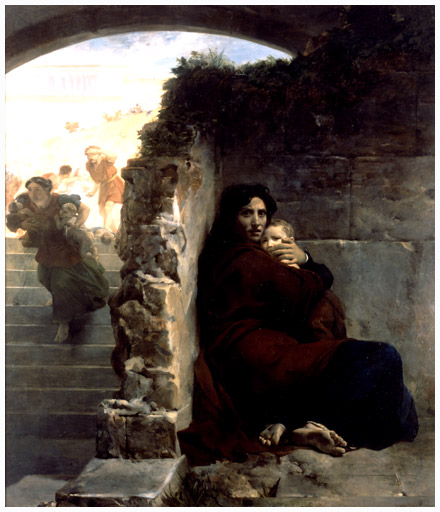
After the painting The Massacre of the Innocents by Léon Cogniet

Once we cradled close in the corner of our room,

folded like prayer-hands, while you nursed.

Your hair feathered my cheek as I sang you sleep-soft,

borne on waves of warm milk to silken slumber.

In the quiet dark, our breaths synced to one heartbeat,

as in the months before I bore you from me.

Then that evil day. Cornered in crumbled rock,

folded tight. You bit the finger I thrust

into your seeking mouth. I clutched you, fear-rigid,

while mothers wailed, babes broken and rent to silence.

I begged the dark to hide you, begged you back

into my depths. But you were ripped from me.

Now, you sleep but do not nurse.

Now, milk spoils to stone in my breasts,

bleeds in rivulets blue-white.

Kierkegaard’s Enormous Paradox: A New Poem

Sloucher crooked like a human question mark.

Flaneur of Copenhagen, Street-corner loafer.

Unscientific method-ist, proto-existentialist

Godseeker labeled philosopher by posterity.

Writing the opposite of what you intend.

Shifting persona. Hinting at ephemera.

Mystifying readers, teasing out truth.

How do I know you? Let me count the ways.

Humanities 101. Brandeis Freshman.

Great-genius-wannabe-me. Why study long-dead

Philosophers like Aristotle and you,

I sniffed, who got so much so wrong years ago?

Now at 77 I know you better, a recent taste

Acquired doing research to write this poem,

You who only knew post-Catholic Danish

Worship services with hours-long sermons.

Congregations dozing behind glazed eyes.

Memorized verses filed in their heads.

You weird-bodied sensitive like some of us who get you,

Heard Scripture as the living Word it is.

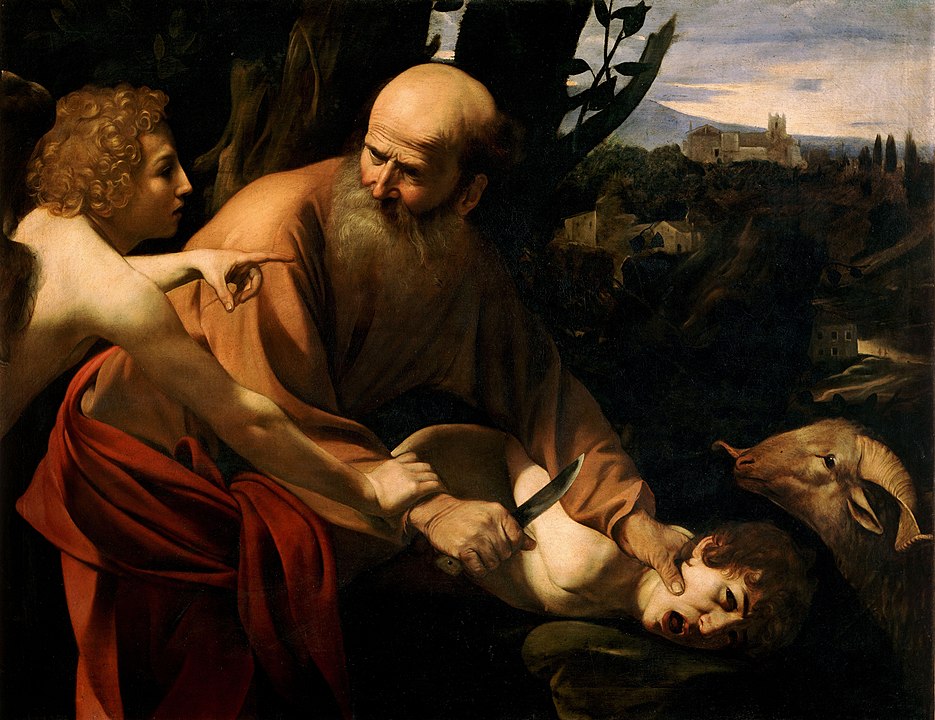
You eavesdropped when God told Father Abraham

To sacrifice Isaac, belov’d child of His promise.

Journeyed with that father, that son, the knife,

The binding rope, the fuel. Until with great relief  . . .

You all caught sight of the ram. Then you pondered

Whether Isaac ever got over his near immolation

By his own father’s hand. And why Abraham

Set his face like flint to do that monstrous deed.

Suspension of morality? Obedience über alles? I think not.

Did you forget or overlook what St. Paul told us?

Abraham walked with Him so long and knew Him so well.

He reasoned God could raise Isaac from the dead.

And why didn’t you consider this either, how later,

Much later after Abraham’s multitudinous offspring

Were long settled in the promised land, astoundingly

God Himself enabled what He asked Abraham to do?

Roseanne T. Sullivan is from the Boston area and currently lives in a Victorian in San Jose, California. Besides writing poetry, Sullivan writes memoir pieces, essays, and articles about sacred music, liturgy, art, and whatever else captures her Catholic imagination. This poem, “Kierkegaard’s Enormous Paradox,” has been selected for publication in Homage to Soren Kierkegaard, an anthology to be published by Wiseblood Books.

Lazarus Box

Here, from my box of precious things:
a handful of rose petals dry and wither-burnt;
a smooth stick in the shape of a perfect “y;”
a tarnished ring, once gold;
a small keepsake vial filled with ash.

[Paltry offerings from a has-been box.]

You can see it, can’t you:
the rose when it sang with its sisters
before it was cradled in a hand, and deeply inhaled;
the twig when it branched and bloomed buds,
the small trumpet of Spring;
the ring in its days of luster; and
my father when he stood strong-boned,
skin flush with the flow of blood.

I am told; with time
these things will rise again
and blush full-bloom,
that the thin song of memory
will thicken into harmony,

and that for You,
everything is at once
ash and becoming.

Tamara Nicholl-Smith is currently pursuing an MFA in Creative Writing at the University of Saint Thomas in Houston. Her poetry has appeared on two Albuquerque city bus panels, one parking meter, numerous radio shows, a spoken-word classical piano fusion CD, and in several publications, including the Mutablis Press anthologies Enchantment of the Ordinary and Chaos, Dive, Reunion (forthcoming), Kyoto Journal, The Examined Life Journal, Catholic Arts Today and America. 

Reflections on the Chesterton Carol

Sometime around 2010, contralto Imelda Franklin Bogue approached me to set the Christmas poem of G.K. Chesterton’s “A Christmas Carol” to music.

I was newly married, working on my doctorate, and glad for any paid commission during struggle times. I had also just finished reading Chesterton’s Orthodoxy, a very sophisticated intellectual work. So, reading the lyrics of the Chesterton’s A Christmas Carol, I was shocked at first by the seeming child-like simplicity in the text.

Yet on closer read, this simplicity is deceptive: Chesterton’s carol opens up into a deep contemplation on the shattering nature of the Incarnation.  There is also the sweet Marian devotion subtext, and the way the Christ child seems to grow in each stanza, from infancy (laying in Mary’s lap) to being a small child standing on her knee. In the first three stanzas, the parenthetical sections of each stanza look outward towards the world, disappearing in the second half of the final stanza, which strikes me either as the Parousia or its anticipation.

Naturally as a composer this excited me: a gorgeous rhythmically simple text with deep, intertwining theological themes. Chesterton’s words called to me for an introspective and complex setting. And yet Imelda wanted more of a simple carol, and so I set to work trying to imitate Chesterton’s approach in music: that of simplicity illuminating a deeper, richer meaning.

Writing a Christmas carol had always been a secret dream of mine:  As the son of Polish immigrants our holy days were saturated with singing the deep and rich carols of that region: deeply Catholic songs of clear mourning or soaring exaltation. Later I grew very fond of the English carol tradition, and I marinated in these two traditions as I set about to find the music for Chesterton’s Carol.

And so as is typical in the life of a modern classical or sacred music composer I hear the Carol sung beautifully once by Imelda in Christmas of 2011.  I hear a few encouraging compliments, and then it went on the shelf as most new compositions do. Today’s classical music and sacred music composers will spend months – even years – toiling away at works which are only performed once and then shelved.  Why?  I think this a logical consequence of the sundering between composers and audiences which took place as a result of the modernist revolution: we know longer “know” each-other; Meanwhile audiences naturally distrust new music after the near century of abuse they’ve been put through. The public have retreated into the safe haven of the dependable classics, which leaves composers who would dare to humbly submit new works to the tradition feeling marginalized and of course seeking outside sources of income.

Then there is the reality that the Church itself is no longer a major patron of the arts and the connect between composers and Catholic cathedrals and parishes has been severed.  The Benedict XVI Institutes remarkable efforts to heal this breach are deeply encouraging to me and to other sacred music composers.

Credit for the survival of the “Chesterton Carol” here goes to my wife, who insisted that the “Chesterton Carol” was some of my best work, and periodically pressed me to do more with it.

Its revival came in the most unlikely time: the Covid shutdowns. A daring small group of Catholic musicians I had worked to gather on Facebook brainstormed the question: how do we keep the music alive as the world shuts down? And so the Vos Omnes Virtual Choir was born. Our first virtual choir performance our own Frank LaRocca’s Agnus Dei from the Mass of the Americas. For the group’s third effort, we did the “Chesterton Carol.”

The Benedict XVI Institute’s sponsorship of this recording by the Vos Omnes Virtual Choir has generated more than 9,000 views, a very big concert hall that encourages all the musicians involved.  Our latest joint venture, a new setting of “Let All Mortal Flesh Keep Silence” has jumped to more than 7,000 views in just a few weeks.

Listen to the “Chesterton Carol” this Christmas here. May this beautifully performed rendition bring you close to the knee of Mary, moving from the tender beauty of the contemplation of a newborn infant to the apocalyptic adulation of the singing of the stars.  Merry Christmas.

Dr. Mark Nowakowski is a composer whose work has been performed across Europe and the United States. A professor at Kent State University at Stark, he will soon release his second portrait disc – Metanoia – through DUX Records; it is a follow-up to his critically acclaimed 2017 Naxos album “Blood, Forgotten.” He is also the composer for the Mass of the Ages trilogy.

[Editors Note: You can find the score of the Chesterton Carol by contacting Mark Nowakowski at his website below. The piece is currently available in three configurations (with the composer granting his permission for other arrangements):
*Voice & Piano
*SATB, Organ, Strings (with piano reduction)
*SATB and Chamber Orchestra (the version from this video)

WEBSITE: http://current.marknowakowski.com/available-pieces/]

CHESTERTON CAROL

My Burden Light: Poem

after François Mauriac

If you wish to resist the cross of Christ

Don’t you dare dream up a casual affair.

Follow Rimbaud. Pulled hair, soul sunken,  

Swear your friends fiends, rival Satan’s refusal,

Gutturally given out of season and drunken,

Scorning the Jesus who slept through the storm,

Spitting at nuns who tend your sad corps.

But deathbed, foul breath, you’ll mouth off bad faith:

Prepare everything in my room just so,

Arrange the candles and needle-worked lace.

Now let the chaplain confess my coarse soul.

White linen must pall every inch of this place.

The priest appears and makes ready the bread.

Consummatum est pax crosses over the dead.


Joshua Hren is founder of Wiseblood Books and co-founder of the MFA at the University of St. Thomas. He regularly publishes essays and poems in such journals as First Things and America, National Review and Commonweal, Public Discourse and LOGOS, Evangelization & Culture and The Lamp. Joshua’s books include: the novel Infinite Regress; the short story collections This Our Exile and In the Wine Press; the book of poems Last Things, First Things, & Other Lost Causes; Middle-earth and the Return of the Common Good: J.R.R. Tolkien and Political Philosophy; How to Read (and Write) Like a Catholic; and Contemplative Realism: A Theological-Aesthetical Manifesto.

Winter’s Still Song

(after hearing Morten Lauridsen’s Magnum Mysterium at a friend’s Wedding)

The hush falls

like soft-feathered snow,

as light takes its leave.


Clamoring thoughts,

like tired children

spent from running

in delirious circles,

take a final spin,

then collapse,

asleep in a pile.


Our Mother, full of stars,

reaches up her gentle

hand to switch on

the crescent moon.

Its sparse light

trails to earth

like a bridal train

and lays like lace upon

the snow-covered ground.


Now, finally,

cloaked in quiet

there is a clearing

not already occupied

by thought

where we are stilled by song

and become

the sweet capture

of two delicate voices

entwined like dancers

turning in the air,

light-footed,

arching heavenward.


Here,

hanging in the air,

like crystals on a

snow-laden tree:

what rough straw

would have whispered

from the manger.

Tamara Nicholl-Smith’s poetry has been featured on two Albuquerque city bus panels, one parking meter, numerous radio shows, a spoken-word classical piano fusion CD, and in several publications, including the Mutablis Press anthology Enchantment of the Ordinary, Kyoto Journal Issue 95, The Examined Life Journal Issue 8, and Catholic Arts Today. She is currently pursuing an MFA in Creative Writing at the University of Saint Thomas in Houston. She enjoys puns and likes her bourbon neat.

Passable Prayer: Witness

Lord, you have searched me and have known
my madness, a wilderness of visions and song.
 

I welter in birthright riddles, my mother
deranged, my father the fool. They claim
I prophesied in wordless gurgles grown
to wails—lament bled with ecstasy.
 

Now I rove, a cockeyed home
for maggots and mutters. Rumors river
and surge through this untamed soul,
ebbing beliefs I still cry without end.
 

When you next pass through, whisper me
from ruins. Say among the rants was a shrapnel
of truth. Name me what you wish
and plunge these tremors beneath your current.
 

And if you insist I risk wrecking the call
—fanatic caressing the unlikely God—
if passion must tightrope peril, I pray
you salt my tongue with light and dove.
 

Whitney Rio-Ross is the author of the poetry chapbook Birthmarks (Wipf & Stock) and poetry editor for Fare Forward. Her poetry has appeared or is forthcoming in The Windhover, Rock & Sling, America Magazine, Psaltery & Lyre, Relief Journal, and elsewhere. She lives in Nashville, Tennessee.

Editor’s Note: We are proud to publish the winning poem of Catholic Literary Arts’s sacred poetry contest, judged by the noted poet Jane Greer, one of the founders of the New Formalist poetry movement.  She commented:

“Whatever formal poetic tools a poem does or doesn’t use, if it doesn’t use evocative imagery, it’s something less than a poem. The language in this work is gorgeous and does the job it is meant to do. ‘I welter in birthright riddles;’ ‘Now I rove, a cockeyed home / for maggots and mutters;’ ‘whisper me / from ruins. Say among the rants was a shrapnel / of truth. Name me what you wish / and plunge these tremors beneath your current.’ The language does not tell us about but leads us to experience the Baptist’s inner and outer turmoil, his suffering, his love. This is poetry.”

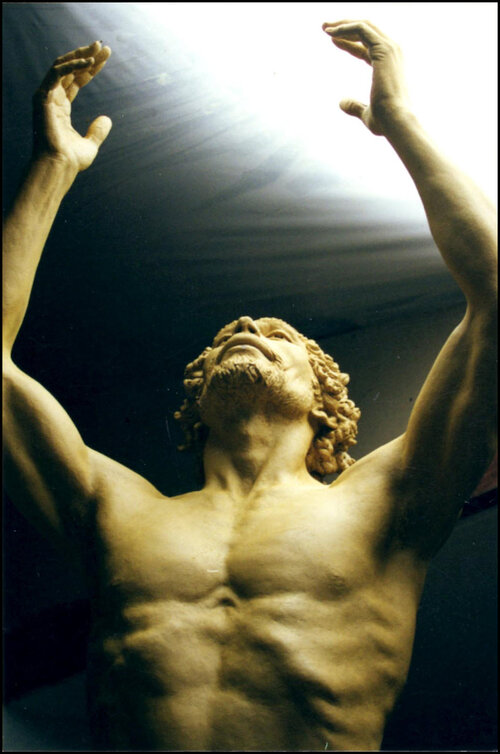
The Catholic Literary Arts contest asks poets to write in response to works of art by living Catholic artists.  In this case, the poet Whitney Rio-Ross chose as her inspiration the above sculpture of St. John the Baptist by Thomas Marsh. His work may be found at: http://thomasmarshsculptor.net/
 

Subscribe to Our Emails