I Point My Tan-Topped Hands To Him, (a God poem)


wind myself up the way my buddy,
Dave, taught me when I was fifteen,
kick my leg toward high heaven
land on it, pivot,
and throw him everything I’ve got,
circuitously wrapped in the hardest,
throwable sphere I can find.
In his perfect swing
(didn’t realize he knew baseball),
he smashes me a line drive
in such a non-elapse of time
that the morsel becomes juicy,
pierces my chest cavity
to lodge in my heart.
I gasp in delight that he takes
so much attention with me.
I throw up my glove –
can’t use it on him.
Everyone * laughs.

*Hebrews 12:1

Fr. Phil Flott is a semi-retired Catholic priest from Omaha. NE. He has written most of his life and been published hundreds of times in journals such as, Pensive Journal, Sangam, and Vita Poetica. He is a member of Catholic Literary Arts.


Mater Dolorosa in Via Crucis

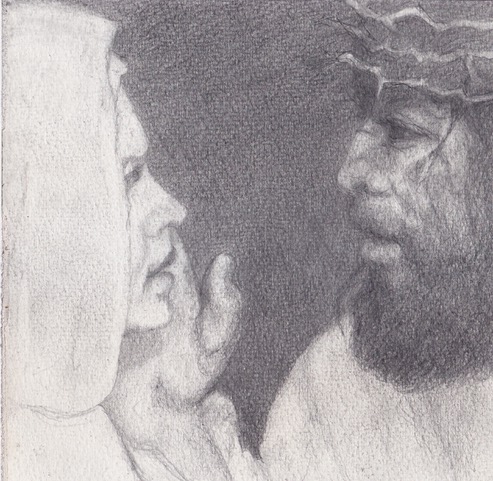
Through her heart, His sorrow sharing,

all His bitter anguish bearing,
now at length the sword has passed.

I. As He Leaves the Palace of Pilate

In agony she can see, He is almost dead already
Lashed, mocked, weakened, pale, unsteady.
Rivulets of blood from thorns in His crown trace
Along his supernaturally patient face.

Skin and flesh in tatters and dried blood adhere
To the seamless garment woven for Him by her.
No one else on earth, but she alone, can hear
His moan as the cross is thrown onto His raw shoulder.

Soldiers scourge Him again, rain curses shrill
To drive Him along the sorrowful way
Towards Calvary, the hill of Adam’s Skull.
The crowd engulfs her, she is torn away.

II. After His First Fall

The crowd now somehow parts for her.
The centurions turn aside for her.

He meets her eyes, in com-passion and love.
Words cannot express the inseparable mix
Of shared anguish and a firm resolve
in the long deep gaze they mutually fix.

This day has redeemed you already, my mother.
To save all Our Father’s children, we will not shrink.
You and I together, only us and none other—
We’ll share this cup between us,                                                                                                                            to the dregs of its bitter sweet drink.

Roseanne T. Sullivan writes on art, culture, and liturgy for Latin Mass Magazine, the New Liturgical Movement, Regina Magazine, National Catholic Register, and the Dappled Things blog. She serves as a Facebook page editor at both the Benedict XVI Institute and Catholic Arts Today.  The drawing accompanying this poem is also Roseanne T. Sullivan’s work.

The Recollection of Claude McKay

He is buried in Calvary Cemetery in Woodside, Queens under a cross and his own words: “Peace O My Rebel Heart”.

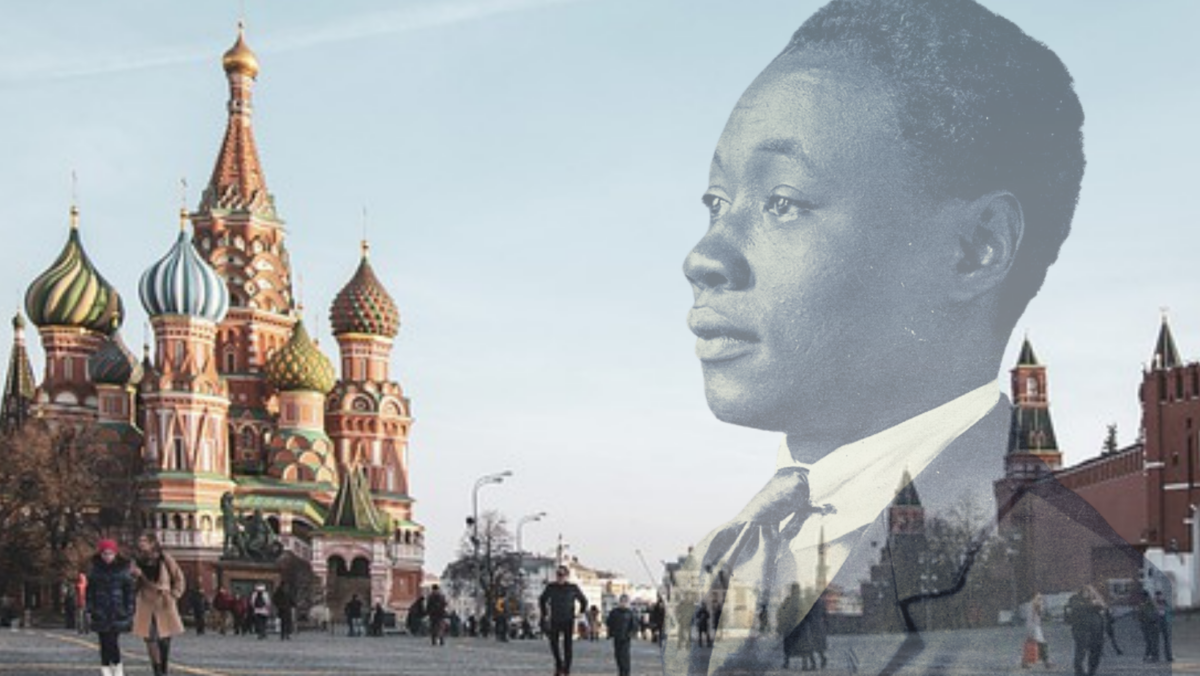
Claude McKay (1889-1948) was the first great poet of the Harlem Renaissance: an immigrant from Jamaica, a socialist tempted by Communism, an angry young man, and by the end of his life, a Catholic.

His aptly named book of poems, Harlem Shadows (1922), included work of great rhetorical power that gives voice to a defiant black consciousness, as in McKay’s two best-known sonnets, “America” and “If We Must Die”; but the most distinguished writings in this volume are short realist sketches in lyric form, at once disillusioned and earnestly sentimental, of African American life in New York City.

The actor Charlie Chaplin, then at the height of his fame as the Little Tramp, in which guise he sympathetically portrayed the poor, working man caught in the great, unfeeling machine of the industrial age, recognized a kindred spirit in McKay’s poems.

At their best, McKay’s sonnets look on urban life with sympathy and love, a quality that the poet Hart Crane would, in those years, dub “Chaplinesque.”

McKay would complement these brief vivid depictions of Harlem life with three novels—Home to Harlem (1928), Banjo (1929), and Banana Bottom (1933)—whose reveling in the seamier elements of African American life earned the criticism of the prominent African American intellectual W.E.B. DuBois.

And yet, McKay remains best known for his poems, whose faithfulness to the English poetic tradition, from Shakespeare and the Renaissance sonneteers to the Romantics, has made them hard to account for in an age such as ours, where literary scholars seem capable of appreciating only those authors whose radical politics find expression in equally avant-garde artistic experimentation.

From the Tropics to New York

McKay was born into a prosperous farming family in Jamaica. His abilities were early recognized by his family and attracted patrons; he came to brief fame as the Jamaican equivalent of Robert Burns, publishing two volumes of ballads in Jamaican dialect, in 1912: Songs of Jamaica and Constab Ballads. His family sent him to the United States to study scientific farming, first at the Tuskegee Institute, and, later, at Kansas State University. He left both institutions without a degree and moved to New York City. There, for several years, he worked in dining cars for the railroad, discovered the lively, crowded, squalid streets of urban life, and began to publish poems in Max Eastman’s socialist magazine, The Liberator.

An early sonnet, “Invocation,” suggests McKay’s aspirations as a writer. He wished to uncover the “Ancestral Spirit” of Africa that had been hidden from black Americans by “the white God.” Against this God, McKay prays,

Bring ancient music to my modern heart,
Let fall the light upon my sable face
That once gleamed on the Ethiopian’s art;
Lift me to thee out of this alien place
So I may be, thine exiled counterpart,
The worthy singer of my world and race.


Such lines may sound at first less complex than they really are. McKay seems to identify American whites with the Christian God and to vow to recover a black “music” and culture that has been robbed from him and his people. Other poems of the period seem to second this ambition. “The Dominant White,” for example, warns white America that God had given it many great powers and achievements in “trust,” but, because these have been abused, “God shall humble you down to the dust.”

But McKay’s seemingly strident and simple politics was always shot through with complexity. The “ancient music” McKay embraces is, first of all, the English poetic tradition as a whole. He particularly favored the sonnet, that most widely practiced modern lyric form first invented in the Italian thirteenth century, brought to maturity with Petrarch in the fourteenth, and soon spread as a literary fashion to all the modern languages of Europe. For McKay, the effort to revive “the Ethiopian’s Art” in “modern” New York entailed not a project of black separatism, but one that could give classical expression to the way of life of what was then called the “New Negro.” He wished to pour the new way of life he had discovered in the modern American city into the traditional forms of English poetry, so that African America could take its place within both the broader American culture and the deeper and older English literary tradition. He desired to join and enrich a tradition with black experience rather than to pit one against the other.

Harlem Shadows does just this. In “America,” McKay expresses his ambivalence about his adopted country. America’s racism feeds him “bread of bitterness” and “sinks into my throat her tiger’s tooth,” he begins. And yet, he cannot help but “love this cultured hell.” The “vigor” of city life, America’s sweeping “bigness” all fascinate him. And so, he assumes the position of a “rebel” within the walls of a king’s court, staring “into the days ahead.”

William J. Maxwell, the editor of McKay’s poems, observed how deeply this sonnet draws on the English tradition. America is akin to a conventional lady of the sonnets, whose beauty attracts the poet, but whose cold demeanor refuses him her favor.

The dense layering of tropes (bread of bitterness, tiger’s tooth, “tides” in the blood, a rebel at court) bears comparison with McKay’s contemporary Allen Tate, whose sonnet “The Subway” also expresses ambivalence about the modern city. In Tate’s case, it is the technological speed and grandeur of New York which fascinating and overwhelms, for McKay the anguish of the sonnet comes from his admiring a land in which he finds himself not entirely welcome.

McKay had become active in leftist black and socialist causes during the time he wrote this sonnet and yet, oddly, its conclusion does not suggest that political action will resolve his feelings about America. Rather, McKay merges his poem with P.B. Shelley’s famous sonnet, “Ozymandias,” to conclude on an image of America sinking beneath the sands of history:

Beneath the touch of Time’s unerring hand,
Like priceless treasures sinking in the sand.

This is a strange resolution indeed. McKay sees the future not as the place where justice shall triumph, but where everything he loves and hates will meet with the same fate.

In the years ahead, McKay’s politics would become ever more radical. He would visit the Soviet Union, where he was celebrated as a black American ally of the cause of international communism. Poems from every period of his life suggest his anguish and advocacy of a new political order that would allow African Americans and the poor in general to achieve greater equality and prosperity. His leftist activities did not go unnoticed by the FBI; for more than a decade, McKay was forbidden reentry into the United States.

The Ginger-Root of Benediction

In the years before his death, however, McKay shocked his friends by converting to Roman Catholicism (1944) and began contributing poems to Dorothy Day’s Catholic Worker newspaper.

Some readers have speculated that the leftist McKay was simply drawn to Day’s variety of religious socialism; they propose that his spiritual conversion was but one more political gesture. But this is not convincing. Those closing lines of “America” suggest McKay’s poetry possessed a greater horizon than the political from the very beginning. Although the political aims of much of his poetry are unmistakable, one always senses a striving after a vision that sees beyond the politics of the hour and into eternity. His imagination was as much one of celebration and contemplation as it was of righteous indignation.

This is obvious enough just from the ambivalence of his poems, where he celebrates the qualities of African American life even as he also condemns the racism that cripples it. “Alfonso, Dressing to Wait at Table” is a classic of such poems. McKay envisions a dining car waiter, singing popular jazz songs while he dresses. His voice is an image of “fine falsetto” freedom, of “carefree men,” but all this will have to fall silent when the white faces of the customers appear for dinner and decorum and segregation become one:

Soon we shall be beset by clamouring
Of hungry and importunate palefaces.

Similarly, “The Harlem Dancer” recognizes the sordidness and harshness of the Harlem demi-monde, even as McKay cannot help but admire the hard exterior and interior spiritual freedom that results for the prostitutes and others who live within it.

McKay’s poetry also always had a religious dimension. The poems we quoted above make the language of “God” sound like a merely political term, but that is not the whole story. McKay’s early masterpiece, “The Tropics in New York” captures the ambivalence that runs through many of his best poems. The poet stares in the shopwindows of New York to see the “Bananas ripe and green, the ginger-root, / Cocoa in pods and alligator pears” he recognizes from his Jamaican youth. These items from a tropical paradise, appearing before him now, bring him to tears of nostalgia: “I turned aside and bowed my head and wept.”

What is he weeping for? At least in part, the homeland of his birth he senses as also a spiritual homeland, whose “dewy dawns, and mystical blue skies” he remembers as a “benediction over nun-like hills.” The Jamaica he has left behind for the modern city of New York is not simply a land of mellow fruitfulness, or a lost pastoral akin to the “Innis Free” for which the poet W.B. Yeats had yearned, in a similar poem, two decades earlier. McKay longs for a land where the simple goodness of everyday life is an emblem not merely of physical plenitude but of religious blessing. The beauty of the island is draped in a vision of holiness.

When McKay visited the Soviet Union, he sought to celebrate the energy and achievement of the Workers’ Paradise. Oddly, he did so by writing a sonnet in praise of a Russian Orthodox Cathedral:

Bow down my soul in worship very low
And in the holy silences be lost.
Bow down before the marble man of woe,
Bow down before the singing angel host.
What jewelled glory fills my spirit’s eye!
What golden grandeur moves the depths of me!
The soaring arches lift me up on high
Taking my breath with their rare symmetry.

Bow down my soul and let the wondrous light
Of Beauty bathe thee from her lofty throne
Bow down before the wonder of man’s might.
Bow down in worship, human and alone;
Bow lowly down before the sacred sight
Of man’s divinity alive in stone.

McKay’s language betrays him into sublimity. “Bow down before the wonder of man’s might” may have originally been intended to celebrate the power and ingenuity of the modern worker, but the sonnet tugs us in another direction. It draws that line toward the “marble man of woe,” the incarnation of the Incarnate God, Christ, in an altarpiece. Man’s “divinity” is “alive in stone” not in the sense of man’s capacity to make things, but in the more obvious sense that all who enter the church and “Bow down” will see Christ himself manifest in the stonework of the cathedral. The allusion to the English romantic William Blake found in the phrase “rare symmetry” insists that this imaginative vision is primarily a spiritual one. Christ is not replaced by the ideal man of the communist future; to the contrary, all the architecture of man leads the eye beyond worldly concerns to the final beauty of Christ’s crucifixion.

Equality in the Word

Other McKay poems indicate that his break with Stalin and the Soviet Union came early—in the 1920s—and that the reason for the break was the official atheism of the Soviet State. It seems that, when McKay warned white America that God would humble it for abusing its many fine qualities, the admonishment was literal and sincere. McKay at once looked back to his Jamaican childhood as a nostalgic, elusive vision of Christian paradise, but he also looked to God to lead all persons through the fascinations of everyday life and the righteousness of political causes toward a vision that reconciles these things in the eternal God of Jesus Christ. How soon McKay himself came to understand this we do not know, but the truth that he did so long before his baptism in the Catholic Church shines through his verses. The lines are crowded with Christian references that one may be tempted to regard as mere poetic expressions until one sees how frequently they bear the thematic weight of his poems.

In the short time left to him as an active poet after his conversion, McKay spoke more directly the essentially religious language his poetry had always contained. Like all Catholics of the period, he recognized the modern ideologies of fascism and communism as “pagan isms.” He celebrates the Magi, one of whom was a “black” wise man “of the East,” thus indicating that an “Ethiopian in Jerusalem” was converted to Christianity “Long before Rome its pagan fetters burst.” He celebrates the Middle Ages as one where “Mohammedan and Christian and Jew” engaged in philosophical and theological debate, an indication that different races really can engage one another fruitfully on the plane of the intellect. Similarly, “The whites admit the Negroes have religion” is a demand for political equality in light of our equality of baptism. McKay goes further: Christianity so saturates “Negro life” that it shocks those whites who restrict their devotion to “a special place for God / On Sunday.” Black Americans are thus exemplary of the integration of piety with everyday life.

Among McKay’s late poems, however, are sonnets of pure celebration of the gift of faith, in virtue of which McKay can “face my God alone”; for the truth found “in Thy Holy Church”; for the Benedictine monastic life found at Saint Meinrad’s, in southern Indiana:

From far and near her children seek this place,
And humbly sit them at their elders’ feet,
To hear the story of Christ’s wonderous grace,
And learn God’s wisdom in this blest retreat.


Such praise culminates in his hymns of praise for “The Word” who is God. “The Word” was the last poem McKay completed, and in its lines he draws together the words that had allowed him to celebrate and look back on the “green fields” of Jamaica and the words that allowed him to give expression to the bustling life of the New York streets. But these uses of words are intended at last to “lift / Men up to know” Christ as the Word Itself “made flesh.” His nostalgic poems of recollection thus served always, and especially at the end of his life, to recall us to our origin the creative, eternal Word of God.

McKay is not the kind of poet likely to get a hearing in an age like ours. His variousness and complexity inconvenience almost everyone. At his most politically radical, he still loved the country that discriminated against him and his race. Anxious like many figures of the Harlem Renaissance to give voice to distinctively black experience, he did so in the language, and with the versecraft, of a tradition that was under assault by the novelty-craving experiments of literary modernism. Blunt in his political expression, he nonetheless took aesthetic pleasure in the shadows of Harlem and was content to live among them. Restless to see justice and a workers’ paradise on earth, he nonetheless saw from the beginning that there was a paradise beyond the radical dreams of communism to which all persons were called. He saw that there was a final truth that we do not use to advance our cause but in whose peace we are called to rest.

For this reason, McKay may be best remembered as the first great poet of the Harlem renaissance, but he should also be known as one of the first great poets of American Catholicism.

James Matthew Wilson is the Poet-in-Residence of the Benedict XVI Institute. His most recent book is The Strangeness of the Good (Angelico, 2020). His website is JamesMatthewWilson.com

The Love Song of Our Lady of O

Expectans Expectavi

With expectation I have waited for the Lord, 
and he was attentive to me.— Psalm 39:2,
Douay Rheims Bible 


Knowing you so near, I yearned to know you,
O Wisdom.
Trembling, I bent and bowed towards you,
O Lord.


Searching the Scriptures, I sought you,
O Root of Jesse.
Awaiting David’s son, I awaited you,
O Key of David.


Longing for light, I long longed for you,
O Dayspring.
Hoping, I hoped with all who hoped for you,
O King of Nations.


Expecting now, I expect you, tomorrow,
You are coming—through only human me—
Long desired One, to make your people free.
O God with us—Emmanuel.


Roseanne Sullivan writes on art, culture, and liturgy for Latin Mass Magazine, the New Liturgical Movement, Regina MagazineNational Catholic Register, and the Dappled Things blog. She serves as a Facebook page editor at both the Benedict XVI Institute and Catholic ArtsToday.

Editor’s Note:

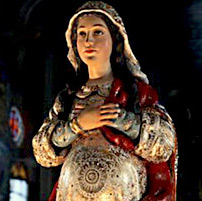
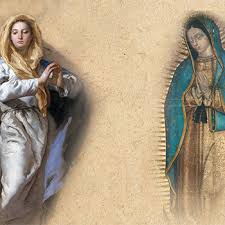
On December 18, in the waning days of Advent,  a feast was dedicated to Our Lady’s expectation of her son’s birth. Because an ancient law of the Church prohibited the celebration of feasts during Lent, the Tenth Council of Toledo in 656 A.D. transferred the feast of the Annunciation from March 23 to December 18. Eventually, Annunciation regained its former day. So December 18 later came to be known as the Feast of the Expectation of the Blessed Virgin Mary,  commonly called Santa Maria de la O, even in the liturgical books. Though seemingly related to the O Antiphons (of which O Come, O Come Emmanuel has become the most well-known) the 1909 Catholic Encyclopedia states that name “Our Lady of O” stems from the custom of the clerics in the choir after Vespers on that day to utter a loud and protracted “O,” expressing the longing of the universe for the coming of the Redeemer. The statue above, presenting the roundness of the pregnant Virgin,  naturally represents Our Lady of O, although its provenance is unknown. Our Lady of O was chosen for honorable mention in the Catholic Literary Arts Advent Sacred Poetry Contest in 2020.

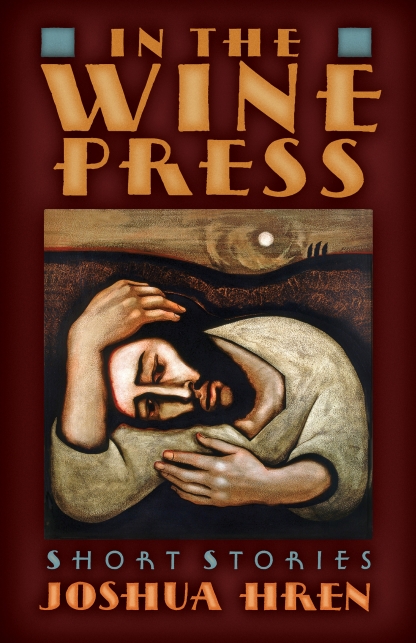
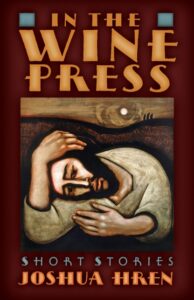
Joshua Hren’s In The Wine Press: ‘Not for Radical Autonomy But For Communion and Transcendence’

In a recent essay Joseph Bottum pins the novel’s decline less on screens and social media than on metaphysical flatness. Much contemporary fiction either inhabits a character at close range or—in a more recent trend—zooms out to offer 30,000-foot omniscience. But at its best the art of fiction is both subjective and objective, getting into the characters’ heads and hearts while detaching us enough to confer a superior understanding. To achieve this depth, however, requires both a sense of the distortions of our age and a clear vision of the good life.

Few writers have either; fewer still possess both. Joshua Hren (editor of Wiseblood Books which is about to publish my novel Minor Indignities) is one of those who both sees clearly and is equipped to interpret what he sees.  His new collection takes us to the heart of dysfunctions—familial, clerical, intellectual—that plague our world while offering a revivifying sanity.

“Horseradish,” the opening story, is just shy of twenty pages. It presents a nighttime conversation between a father and his son on the rickety porch they built together. They’ve gone out to watch a comet, but as they stand physically “closer than they had been in years” they have the sort of serious, awkward exchange that most of us in the same position would do our best to flee. The son goes on the attack, forcing his dad to confront past abdications, but while their oversharing dredges up memories, some fond (the father grew up in what he recalls with pride as the “Slovenian ghetto”), others troubling, what eventually emerges is a more recent trauma: the son is there because he decamped after losing his temper with his wife and hurling a salt shaker through a window.

With this revelation, the see-saw tilts. The father takes control, admonishing and firm, but also paternally tender:

“I maybe never gave you enough. Affection,” he said.

“Dad, “ I said. “Oče.”

“Don’t,” he commanded me, cuffing my wrist with his hand. “Listen. Maybe I never did. But listen. I don’t want to hear how you never touched your wife like that. How you never laid your hands on her. I’m not interested too much in what you didn’t do. But I’ve been wondering one thing for a long time. Do you ever? Touch her. Why am I going to die without ever having held a grandchild? Are you two…”

My arms stuck out like a poorly-clad scarecrow, and I swear I saw him look up, a terse search of the sky, as though he hoped a bird would blind me with dung for failing to give him descendants.

There may be nothing so tricky to represent without mawkishness as the fall of barriers between two people so close as to make intimacy unbearable. By story’s end Hren has given us reconciliation without sentimentality, and symbols—the porch as unstable artifact of the father-son bond, the once-in-a-lifetime comet mirroring a brief window for genuine connection—that work on every level.

Another story, “Old Blood,” reaches toward reconciliation with similar tact: a school shooter’s almost-but-not-quite-girlfriend phones her Vietnam vet uncle in a nursing home to invite him to move in with her. She is spurred to this act of charity by loneliness, yes, but above all by reflecting on what could have driven her former online paramour to such evil. If in his previous collection Hren trod ground more familiar to partisans of Catholic fiction—the spiritual physics of self-mortification—here he telegraphs his intentions less, and shows more restraint. The action of grace is there, but not so much in the parting of the sea within the story’s frame as in the reader’s awareness that blocked exits in the here-and-now point to liberations that fiction most successfully represents discreetly, or even a contrario.

In “Work of Human Hands,” a widow seeks healing for her twelve-year-old son, Rudy, sexually abused by their parish priest, whose predations are described with excruciating but muted realism. We are then privy to Rudy’s encounter with the virtuous but decrepit Father Sun, a wheelchair-bound traditionalist (he has Mosebach’s Heresy of Formlessness by his bedside) who nods off in mid-conversation before snapping awake again to lay hands on the boy in a very different sense, adding another layer to the story’s title:

Balancing his body with his good arm, Father searched the bureau somewhat frantically until, nodding, he heaved out an old black book whose edges were light red like the priest’s face. Father Sun’s eyes flitted fiercely across the pages. His shoulders scrunched up and his neck shot out as he searched. Peering into a prayer at the very end, he nodded again and mouthed the words, ignoring the absence of sound, and in the naked room his rasps came out loud. He pressed his hands against the boy’s head, rubbing in the water he had sprinkled there, holding his hands against Rudy’s temples until the trembling in his hands ceased, then until the boy stopped shaking.

Finally, we eavesdrop on the offending priest’s own fantasies of doing penance through bloody, self-inflicted violence—followed by his realization that a first, faint stirring of justice could be achieved only by expressing contrition directly to his victims. The story’s use of multiple viewpoints offers a sense of orchestration and design.

There is maturity in the idea running through In the Wine Press that unspectacular words and gestures contain still greater spiritual power than needed but secondary acts of physical penance. The collection’s title suggests that providence will in the course of our everyday lives devise mortifications more effective than any we invent for ourselves. And it is under the pressure they place on us that drops of precious mercy are squeezed out of our otherwise hardened hearts.

Two of Hren’s stories—“Some Other Exit” and “Their Fire is Not Quenched”—feature adolescents in rebellion. One rages against a world of spreadsheets, self-help mantras, and pyramid schemes, doctoring his Harvard t-shirt to read “Hatred” and fronting a rock band called CORIOLANUS; the other dreams of cold political mastery and a plum job with a Washington think tank but lives with his parents, whose piety he despises. Other stories address the cover-up of clerical misdeeds, the innocence tarnished by pornography, and the damage casually inflicted by political ambition. Such are the subjects—at once weighty and ticklish—Hren has taken on. We’d rather look away, but his ethic as a writer is to cut through discomfort and depression with brutal honesty. As St. Thomas knew, contemplating the truth is among the best remedies for sadness.

Set in a corner store, the collection’s last story, “Proof of the Immortality of the Soul, with Reference to Beeswax Soap,” is a high-degree-of-difficulty piece that blurs the lines between prose and poetry:

Look a broomstick-thin man with two packs of cigars bulging out of his chest, pockets fatter than his frame, man he’s chewing on his sleeves, stepping up to the clerk who’ll be here until close, squinting under the beams that illumine the things that his ma clicked her tongue at as he flicked up his finger. But he still can’t quite shake that sharp tsk when he sees unclad ladies on the covers of shellacked magazines and the color-code condoms claiming pleasures and ease and he clings, cleaves condemned, to the counter’s cliff-edge like a cold-blood-caught criminal on apocalypse eve, feeling heat if you will like a fried nervous chicken with five bona fide furies biting after his heels.

As the scene shifts to a smelly church bathroom,  physical grime is likened to the buildup of sin on the soul, and you feel genuinely elated when “you” (the story is told in the second person) ends up joining a confession line. As for Hren’s method of delivering impressions in a relentless staccato, with plentiful alliteration—is it over the top? Yes. Does it work? Yes, at least for this story.

Most of the book, however, relies on more familiar narrative techniques and requires only as much investment from the reader as the author can pay back, with interest, in the currency of storytelling pleasure. This, I think, is the route forward for Catholic writers: mastery of craft united with a vision informed by faith, but never the latter without the former—and the former above all.

The Czech writer Josef Skvorecky once said that all great novels are thesis novels—and they all have the same thesis. As liberalism’s success breeds its own failure, we need works that lead our society to reexamine its basic anthropological premises, reminding us that we are wired not for radical autonomy but for communion and transcendence. Of course, such works make their point not through abstract statements but by artfully selecting details, characters, actions. Any attempt at paraphrase falls short—their intellectual meaning is accessible only by experiencing them in their entirety. While some recent novels published by mainstream houses meet this description (Christopher Beha’s Index of Self-Destructive Acts comes to mind), in the end we may have to rebuild our literary culture from the ground up.

It is with fiction like Joshua Hren’s that we can undertake this essential task.

Trevor Cribben Merrill’s reviews and essays have appeared in The University Bookman, Dappled Things, and The American Conservative, among others.

The Wounded Surgeon: Suffering the Little Children in Dana Gioia’s “Special Treatments Ward”

But Jesus said to them: “Suffer the little children, and forbid them not to come to me: for the kingdom of heaven is for such.”

—Matthew 19:14

“Evil,” wrote Flannery O’Connor, “is not a problem to be solved but a mystery to be endured.” Pains can either be borne in emulation of Christ crucified or they can be borne bitterly, like arbitrary afflictions lacking meaning and mystery.

Dana Gioia, the poet and public intellectual who has done more than any other living figure to galvanize the Catholic literary tradition, prompts this either / or in a number of his poems, not a few of which unveil him as no stranger to suffering. Gioia, once a business executive and former Chairman of the National Endowment for the Arts, acquired a keen knowledge of loss when in December of 1987 his four-month-old son Michael Jasper died of sudden infant death syndrome.

As he said after the death, “I saw poetry differently. Writing took on a spiritual urgency I had never experienced before.” Often this urgency leads us through hellish landscapes, lairs of despair. And yet, as Janet McCann observes, if Gioia’s poetry can be dark, it “isn’t nihilistic, nor is it unforgiving.” “Special Treatments Ward”  is one striking example.  In this poem, the narrator’s reduced state leaves the reader rattled; the suffering of innocents has left him lost. Taken as a whole, however, the poem elevates us above this world’s ceiling, ameliorating our losses through the dead children’s healing.

So this is where the children come to die,
hidden on the hospital’s highest floor.
They wear their bandages like uniforms
and pull their IV rigs along the hall
with slow and careful steps. Or bald and pale,
they lie in bright pajamas on their beds,
watching another world on a screen.

Read More about The Wounded Surgeon: Suffering the Little Children in Dana Gioia’s “Special Treatments Ward”

“Hasten to Aid Thy Fallen People”

“Hasten to Aid Thy Fallen People”

How does one make a song of holiness?
  Or speak of music without spoiling it?
They both seem more than our tongues can confess
  And, born above, in our world do not fit.
    What’s more, those who ascend with them
    Are closed in on themselves, struck dumb,
And all in ecstasy that they have heard
Seems flailing, foolish in a fallen word.


But every rising strain must strain indeed
  To lend a form to what in truth is light,
And manifest peace as if it’s a deed
  And give transcendence some arc of a flight.
    The purity of every saint
    Will be daubed on with sloppy paint,
And what no thought may comprehend or say
Must be taught in the staging of a play.


The gift of form, because so fascinating,
  As we bend down to work with knife or ruler,
Reminds us that beyond it’s always waiting
  Some piercing light. Consider how the jeweler
    Makes every cut upon a stone
    For its sake but not that alone,
His patient labor wasted if a line
Does not refract and multiply and shine.


And, any humble implement may serve
  To figure-forth and yet conceal that light,
So that high thought is felt upon each nerve
  And mystery is given to our sight.
    Just this way, things are lifted up:
    A chalice wrought from wooden cup;
A little dust and water, mixed to clay,
Are molded into birds that fly away.


The Mass is first His earthen sacrifice,
  But also taste of peace and heaven’s throne,
The gift that leaves behind all thought of price
  Yet where, no less, we raise a plangent groan,
    For at its finish we are sent
    Into the world both dark and bent
That bearing out the Virgin’s hastening aid
From ruined choirs some good may be remade.


This is the seventh and final poem from James Matthew Wilson’s new book of poems, The River of the Immaculate Conception (Wiseblood Books, 2019), commemorating the Mass of the Americas and rooted in his childhood vision of America as a Catholic Country. “Hasten to Aid Thy Fallen People” is a line from the Marian antiphon for the Advent season, the Alma Redemptoris Mater, which begins:
O loving Mother of our Redeemer, gate of heaven, star of the sea,
Hasten to aid thy fallen people who strive to rise once more.

The Song of Elizabeth Seton

THE SONG OF ELIZABETH SETON

Elizabeth was just a girl,
    And watched as her young mother died.
Her father, in his Yankee way,
    Went out and fetched another bride.
And so it was, that all her life,
    Loss and renewal were close allied.


Years on, her William’s father passed
    And left five children fatherless,
She who had young cares of her own
    Took them still in her tenderness.
And she became a second mother
    To raise and love and school and dress.


The seas, a storm of piracy,
    Beheadings in the squares of France;
The fevers breaking in New York
    Amid a silken formal dance;
Their houses strong-built on good streets
    But crumbling by each hour’s mischance.


Napoleon, at Vienna’s gates,
    Lays waste to all that Europe’s been;
Her father steps from bed to bed
    Among immigrants in quarantine;
The crowd of coarse and stricken Irish
   Bow down in prayer upon the green.


While she looks up at spangled stars
    Spread over the city in the fall,
Brief letters coming from abroad
    Call William’s debts in desperate scrawl.
And when her father dies, all she
    Can do is sit to mend a shawl.


But even as they lose their things,
    Trade sensibility for sense,
She, like her father, tends the sick,
    Gives struggling widows her few cents,
And claims the family pew to hear
    The Reverend Hobart’s eloquence.


“We pay a debt for every pleasure,”
    She writes, “for beauty and for joy,”
“And every suffering we may bear,
    If we the strength of God employ,”
“Our merciful Conductor veils
    Those evils time cannot destroy.”


At last, their fortunes sinking still
    And William growing weak within,
Leaving all children, save their Anne,
    With those they once had taken in,
They crossed to Italy in hopes
    Some resurrection might begin.


But thoughts of showing Anne those churches
    Of worship “sumptuous and splendid”
Were, in the harbor, by armed guards
    With threatening bayonets, upended.
Not to Livorno’s wharf, but to
    The Lazzaretto they descended.


Confined by bare walls and barred windows
    She learned to contemplate her God,
And though her body rest imprisoned,
    Her soul was raised by love to laud.
When Anna says, “Death frees us for Him,”
    Such words from child lips leave her awed.


And death was coming. Through the walls,
    December winds course, sharp with brine,
While they draw deeper in, in prayer,
    Commune on “slips of bread and wine,”
And, helpless, watch as William lies
    And coughs blood in his last decline.


Yes, perfect prayer and happiness
    Resemble, in their stillness, death;
The soul may be drawn into God
    Though captive in the narrowest breadth;
All three knew heaven with their grief
    And left this world with Will’s last breath.


Elizabeth passed from that prison
    Into a Florentine chapel’s dark,
Within whose depths the altar gold
    Glistered with every taper’s spark;
And, seeing the rich and poor at prayer,
    She knew this was God’s holy ark.


And, all her life she gave to it,
    Sent forth from stillness into deed,
To mother those who had no mother,
    And teach the poor to pray and read;
Sent out as Mother Seton now
    To plant her country with faith’s seed.


This is the sixth poem from James Matthew Wilson’s song cycle The River of the Immaculate Conception (Wiseblood Books, 2019). This new book of poems commemorates Frank La Rocca’s Mass of the Americas and was inspired in part by James Matthew Wilson’s childhood sense of America as a Catholic country.

“Gloriosa Dicta Sunt De Te”

“Gloriosa Dicta Sunt De Te”

When we think of our land, we often think
Of those bare wilds waiting to be claimed,
As if it were a force of will alone
That made it ours, and mixing sweat with dust,
Its matter with our labor, what was nothing
Becomes somehow a thing that might be loved,
Be built upon and put to use, defended.
I have been one of those who stand in awe
Of pioneers and makers of great things,
Of those who slice a sharp spade through thick roots.


How much less often do we think of land
Not as the stuff lain idle to be grabbed,
But as a stage, a platform where we stand.
Not empty, for upon it we depend;
Not arbitrary, for it’s all been formed
So long before our dawning that we sense
A hundred histories have gone to dust
Deepening the hillsides, carving out its rivers.
How rarely do we think of it as place,
As scene where destinies are shaped by grace.


So, in my childhood, the lakeside chapel,
Modest and plain, shaped like a wooden boat,
Where I heard Mass in summertime, was named
For St. de Porres, and he prayed for us,
Though all I knew about him was his name.
And so, in Maryland and San Francisco,
The place is named not for what we have done there,
But for what we hope we might still receive:
The walls of city, home, and church designed
Just to contain what grace will fill them with.


So, sitting in my classroom, as a boy,
The school named for Saint Thomas of Aquino,
I heard my teacher speak of Michigan,
Of Joliet, Doblan, and Père Marquette.
And, telling us their stories, she unfolded
Another history than the one we’re used to.
One in which, by the Holy Spirit’s grace,
Men slipped along the wilderness’s veins,
Bearing such names as, hitherto unspoken,
Might be, to consecrate a land of saints.


For, naming is a kind of grace not deed.
It clarifies what was not understood,
Such that, what outwardly remains the same
Becomes itself more fully and more truly,
Transformed within by the articulate light.
To lay above a saint’s bones on the shore;
To pray the words that saints have prayed before;
To name and know what comes forth from the darkness;
These are the occupations of a place,
Its purpose and its glory and its grace.


Editor’s Note: This is part 5 from James Matthew Wilson’s new song cycle, The River of the Immaculate Conception which may be purchased from Wiseblood Books. The title translates as “Glorious Things Have Been Said of You.” This is first a quotation from Psalm 87, where it refers to “The City of God.” But it is also a quotation from a Gregorian chant celebrating the Immaculate Conception: “Glorious things have been proclaimed concerning you, O Mary; for the Almighty has
done marvelous things on your behalf.”

The Agnus Dei of Jacques Marquette

The Agnus Dei of Jacques Marquette

    Before the thousands, Père Marquette stood up to preach,
That through the Blessed Virgin none escape his reach;
That though he suffer all, he’d bear the sacred story
Down the great river he’d entitled to her glory.
And now, before him, knelt the warriors and their chiefs
To whom, a year ago, he’d promised her reliefs
From sin and solitude, from shadowed ignorance,
And, in that wounded wilderness, her peace advance.
    Behind him, four great images of her were raised
On Chinese taffeta that left the fires amazed;
They heard of Jesus Christ, who on that day had died
For them upon the cross, his mother there beside,
And John, who loved and honored her with filial love.
The mysteries of the faith seemed hovering just above.
    But even as he spoke and offered all as gift,
Marquette felt deep within his side the aching rift
That would, a few days hence, force him to leave again
This mission he had credited the virgin’s gain.
And leaving thus, he knew already, he would meet
Her robed and crowned with stars, and treading with bare feet.
Those feet, he told them now, would trample Satan’s head,
Restoring life and light to this world dark and dead.
    For years, he’d served the mission of the northern lake,
Learned the Algonquin tongues and said Mass for the sake
Of those who had been baptized by priests come before him.
But it was not for this so many waters bore him
To that new world, where Jogue and Jean Brébeuf had died;
And not for this that in his private prayers he cried,
Begging Our Lady send him where all were deprived
Of knowledge of her son. Then, Joliet arrived.
    “This day of the Immaculate Conception, he
Comes bearing news we are to solve the mystery
Of the Great Water our Illini say runs west
Beyond those lands claimed by a French or Spanish crest,”
Marquette wrote, but by then the lakeshore sank in ice;
They waited, stomachs hungry, fur coats plagued with lice.
He waited, making the Ignatian long retreat,
His prayer, cold breath, and penance, his cold ache of feet.
They waited, till the sun returned with biting flies,
Then seven men, with corn and smoked meats for supplies,
Launched birch canoes, at last, that they might go explore
What other miracles Our Lady had in store.
    How beautiful, descending the Meskousing stream,
To slip along soft waters, marshy with the cream
Of wild rice. As they passed, the birds rose in a cloud
And flapped one great arc through the sky until it bowed
Back to the water and hid once again in reeds,
Whose stalks brushed the canoe and filled its floor with seeds.
Marquette knew it a place through which a man may pass
As unremembered guest, as breath upon cold glass,
And spoke into that emptiness a further vow:
To dedicate to Mary all that she’d allow.
    As deer roused from their drink upon the iron shore,
Then fled beneath the towering oaks, he heard the roar,
Dim at first, loudening, as the idle current sped
And spat them forth upon the Mississippi’s bed.
“I felt,” Marquette would write, “a joy I can’t express,
To name for her that river which flows like a tress
Down the vast, rolling back of that great land we bring
To Christ, and trust to the protection of our king.”
    The river was so wide and gentle, deep and brown,
They drew their oars in, let its silence take them down.
But then, a giant fish struck, shaking the canoe,
And in the grass, a great wildcat came into view,
Straight-whiskered, tiger-faced, with pelt of gray and black;
A bone-nosed sturgeon leaped and splashed upon its back.
But, more than these, and stranger, prairies to the West
Seemed shadowed with dark masses: horned, in shaggy vest,
Broad-headed and thick-maned, hump-shouldered buffalo
Whose skin and meat they had already come to know,
But whose horns they had yet to see impale a man
Then hoof him in the dust, within a moment’s span.
    “For days, I saw such creatures, but no human being.
We kept our fires small, for fear of what they’d bring,
And bedded through the dark hours in our anchored boats
Where I stared up at stars and murmured over my notes,
Knowing that all we carried with us could be lost
And that I’d pay with pleasure a still greater cost,
So long as I may bring to such a wild part
The mysteries Our Lady pondered in her heart.”
    But then, Marquette would write, one afternoon they found
Faint tracks imprinted in the shoreline’s muddy ground.
Marquette and Joliet alone pursued the trail
And, silent, came unseen within a village pale.
Then, loud they raised their voices, and the priest stood tall
In long black robe, as braves came answering their call.
    The Indians wore French cloth and bore a calumet
Dangled with greeny feathers, as they came and met
The strangers. They were called the Illinois, one said.
An old man spoke: “How beautiful the sun that’s led
You Frenchmen to us, and we welcome you in peace.”
Then women crowded, children stared up without cease.
    As all these gathered, the young priest stood forth to speak:
“O people, you like us the Father made, and weak
Like us, you are the children of his sacred pity;
He wishes you to join him in his holy city,
And so he’s sent me down this river as his priest,
That all who live upon it may share in his feast.
Let crosses be upraised and idols downward hurled
That all shall see his peace restored into the world.”
    Their chief replied, “The sun grows bright, the river smooth,
The corn more sweet, tobacco in its power to soothe,
Because you come among us. But, I beg of you,
Proceed no farther or a beast downstream will chew
Your boats to splinters, and the Arkansas are fierce,
Return all greeting with a wail, and gladly pierce
The stranger with their arrows and their Spanish guns.
There is no further good where this great water runs.”
    But when he paused, the priest replied that he’d no fear
To lose that life God gave him, not to be held dear,
Then promised to those people he would come again
To live with them, if that was what the Lord should deign.
    And though the harsh Missouri caught them in its flood,
Great demons stalked the cliffs, and Indians cried for blood;
Though even Marquette would feel an axe blade graze his head,
And fever and mosquitos weakened his soft tread;
Within a year, though pale and worn, he did return.
And there, he preaches, till his guts begin to burn
And names one last place after the Immaculate,
For even now, he knows the hour has grown late.
    He takes his leave again to trace the northern shore,
Where, in the Easter twilight, he can row no more.
His two companions urge him on with words and tears;
But he has prayed for this, and silences their fears:
“My brother Xavier died in wretchedness afar,
And brothers Issac, Jean, and Gabriel died in war.”
They lay him by the water, build a hut of bark,
And see his eyes are brightening as the sky grows dark.
“Mother of God, remember me,” they hear him call;
And then, Marquette lay back his head, and that was all.

Subscribe to Our Emails