“Mary is a mother figure and the mother of God’s Son.
She is ‘the highest honor of our race,’ as the Book of Judith states.
She is the perfection of the human person kept free of sin.
That motherly love touches the heart of anyone who loves her Son.
So many central mysteries of our faith and salvation came through her.”
Archbishop Salvatore Cordileone of San Francisco
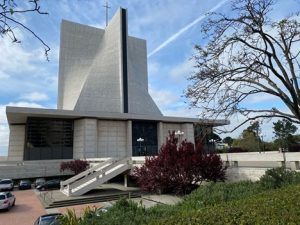
Already when one first approaches, St. Mary’s Cathedral surprises.
In densely-packed San Francisco — so tightly constrained by the belt of the Pacific Ocean in the west, the Golden Gate Straits to the north, the Bay in the east, and other cities to the south — in such a city of tight neighborhoods, the vast open expanse around the cathedral catches one by surprise.
Majestic and iconic and one of the most famous landmarks of San Francisco, the Cathedral of St. Mary of the Assumption sits on the edge of a steep hill.
The horizon behind the cathedral is therefore not cluttered by other buildings but instead shows only the open sky. Especially on evenings, or when the fog drifts in from the west, the cathedral seems to float between earth and sky — an appropriate image for Our Lady rising upwards, assumed from Earth into Heaven.
Since the open air parking lot that brackets the cathedral is sunk below ground level, as one approaches the cathedral from the street, or having walked up the wide stairs from the parking to the street level, one finds oneself on a broad plaza that functions as a wide bridge leading to the cathedral. The sunken parking lot functions almost like a moat and gives the cathedral the appearance of an island. This physical separation from its surroundings, plus the brilliant white marble exterior and the soaring, unusually sinuous roof, crowned by a 55 foot cross, clearly indicate that one is approaching a holy place. Traditionally, cathedrals have often been described as a “Gateway to Heaven” or as a “Bridge to Heaven” — but very few cathedrals have incorporated this image to such a visual degree as St. Mary’s Cathedral.
St. Mary’s is the third cathedral built in San Francisco. The first cathedral was commissioned by the first Archbishop of San Francisco, Joseph Alemany.
Opened on Christmas Eve 1854 as the Cathedral of St. Mary of the Immaculate Conception, it was the first church to be so dedicated — the doctrine having been officially promulgated just three weeks earlier. The cathedral was the tallest and largest building in Gold Rush San Francisco, and it ministered not only to the spiritual needs and challenges of “the wickedest city in the West”, it also served as a major educational center and cultural center, hosting sacred music programs with full orchestra and featuring some of the greatest singers in the world as they passed through this roaring, gold-drenched city.
As San Francisco’s explosive growth continued, so did the size of its Catholic population. Although contemplating retirement after 31 years, Archbishop Alemany organized plans for a larger cathedral in one of the newer western districts of the city. His successor, Archbishop Patrick Riordan, completed and dedicated the new cathedral, St. Mary of the Assumption, on January 11, 1891. The original cathedral, meanwhile, became known as “Old St Mary’s”, was given to the recently formed Paulist Fathers, and still stands today in the district now known as Chinatown.
The new cathedral, a grand Victorian edifice, with its large (and exhausting) sweep of stairs to the main portal and its powerful Neo-Romanesque features, survived the massive earthquake of 1906 with minimal damage, and also escaped the resulting catastrophic fires which annihilated much of San Francisco, including the entire downtown areas.
St. Mary’s then witnessed the swift reconstruction of the city, a succession of four archbishops, and the economic booms which the First and Second World Wars brought to San Francisco. But on September 7, 1962, St. Mary’s was severely gutted by a fire, when a stand of votive candles was knocked over accidentally. Although much of the core structure was still intact, the roof was gone and most of the interior was a shambles. Rather than repair this cathedral, the new Archbishop, Joseph T. McGucken, who had been in office a mere six months, chose to build a new and even larger cathedral a little further west on the crest of that same hill.
Archbishop McGucken hired three local San Francisco architects: Angus McSweeney, Paul A. Ryan, and John Michael Lee. The Archbishop expected the following for the new cathedral’s design:
“It should not be built to look like a tent (tabernacle), nor a crown, nor a fortress, nor an arena. It should look like what it is — a temple of divine worship whose walls enshrine a Holy of Holies and embrace a congregation of worshippers. The external appearance of its various parts should indicate the sacredness and importance of their interior function.”
But the early sketches, ranging in styles from Neo-Romanesque to California mission ignited a storm of protest. The response of Allan Temko, the architecture critic (and later Pulitzer Prize winner) for the San Francisco Chronicle, may have been the important turning point: “The Cathedral should, and can be a great building in every sense of greatness, if only the church and the city together make the best of this tremendous opportunity … the Cathedral must belong to its own people and place, but also to the world. It must express the oneness of things, as well as their ineffable mystery.” Furthermore, Temko called for a bold new cathedral that would reveal the soul of the city and, most especially, would underscore San Francisco’s greatness as an international city of world renown.
Archbishop McGucken and his three local architects then turned to an Italian architect, Pietro Belluschi, who had worked for many years in Portland, Oregon, designed several churches in the Pacific Northwest, and who was now Dean of the School of Architecture at the Massachusetts Institute of Technology (MIT) in Cambridge, MA.
Belluschi was originally hesitant. He wrote:
“From the beginning we were aware that this is not an age of cathedral building … Yet the yearning for spiritual goals is still a powerful force seeking expression.” Architects find such a task difficult, he explained, because “they have for too long been engaged in building symbols of commerce.” But Belluschi was intrigued. “After much thought we concluded that the most promising result would lie in extracting architectural significance from the most advanced construction techniques of the day” — meaning, “our recently acquired knowledge of reinforced concrete.” Structure would be emphasized because it was the basis for all “large scale architecture,” as it had been for the great Gothic cathedrals. Therefore “we sought advice and help from the best engineers and the use of the most advanced testing laboratories in the world.”
To this end Belluschi brought in Pier-Luigi Nervi, also from northern Italy, who was considered one of the great pioneers in structural concrete architecture. Nervi and Belluschi envisioned a stunning hyperbolic paraboloid design, which was especially challenging given the nature of earthquake-prone San Francisco.
The planning and design of the new cathedral also coincided with the Second Vatican Council, which Archbishop McGucken attended and which was led by Pope John XXIII. Among the many proposals for reform, the Council suggested major innovations in church design informed by a “noble simplicity”.
The second President of the Vatican Council, Pope Paul VI, described his vision of a new cathedral: “in the majesty of the building, it is a symbol of the spiritual temple that is built up in souls and is resplendent in the glory of divine grace … the cathedral, furthermore, should be regarded as the express image of Christ’s visible Church, praying, singing, and worshipping on earth.” The Council thus made very specific changes to the interior layout of a church. McGucken, Nervi and Belluschi were inspired.
Archbishop McGucken advised his architects that he wanted: “a cathedral that would accommodate large numbers of people; one that would enable even large crowds to surround the altar; and a structure that would be a statement that God is present in beauty in the earthly city.” San Francisco now had the opportunity to build the first cathedral in the United States “that was inspired by the liturgical vision of the Council.” Pier-Luigi Nervi called the new cathedral they were designing, “the first cathedral truly of our time and in harmony with the liturgical reforms of the Council.”
Preparations for construction at 1111 Gough Street began in August 1965. The cornerstone was blessed on December 13, 1967, the new cathedral opened its doors in October 1970, and was formally blessed on May 5, 1971. It had cost $9 million to complete. The new cathedral complex also included conference rooms for banquets and meetings (today the Event Center), a residence for the Archbishop, and a new high school building (today Sacred Heart Cathedral Preparatory), located on what is now called Cathedral Hill.
The modernity of this cathedral was startling for its time, especially given the far more traditional designs of its predecessors. And that modernity is startling still today.
Yet despite its abstract forms, St. Mary’s is rich with traditional, or, perhaps more accurately, with timeless Catholic symbolism and Christian mysticism.
Stretching broadly in front of the cathedral is a wide plaza that consists of white stone designs that outline a procession of red brick crosses — together the stark white and warm red patterns are meant to reflect the Spanish mission heritage of California.
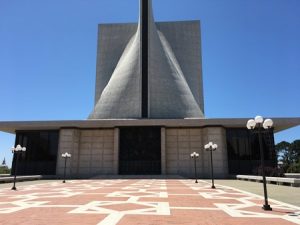
As visitors approach the cathedral across this plaza, one’s attention is caught by the striking, curving roof that crowns the cathedral, the exterior covered by white Italian travertine marble. The later Archbishop of San Francisco, William Levada, interpreted the design as follows:
“The distinctive shape of St Mary’s Cathedral is meant to evoke the image of the meeting tent which housed the Ark of the Covenant during Israel’s 40-year desert journey from slavery into freedom. That tent was a reminder for the people of Israel as well as a sign to the nations that God had definitely “pitched his tent” with his people, traveling with them on their pilgrim journey and sharing with them their joys and hopes, their sorrows and tribulations. That revelation of God’s presence with his people was but a foreshadowing of the marvelous fulfillment of the Incarnation of the Son of God, when Jesus Christ took our flesh from the womb of the Virgin Mary and dwelt among us.”
The monumental bronze and glass entrance to the cathedral is dominated by an enormous overpanel above the doors. This entrance was created by the northern Italian sculptor Enrico Manfrini (1917 – 2004), called the “sculptor of the Popes” — having known and portrayed all popes from Pius XII to John Paul II. A friend of Pope Paul VI, and recommended by him, Manfrini had already acquired fame for his sculpted cathedral doors in Siena, Rome and Damascus, and he also later crafted the ring of the fisherman worn by Pope Francis.
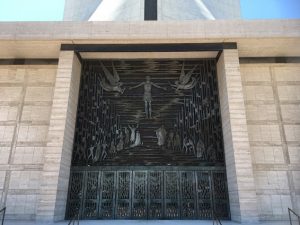
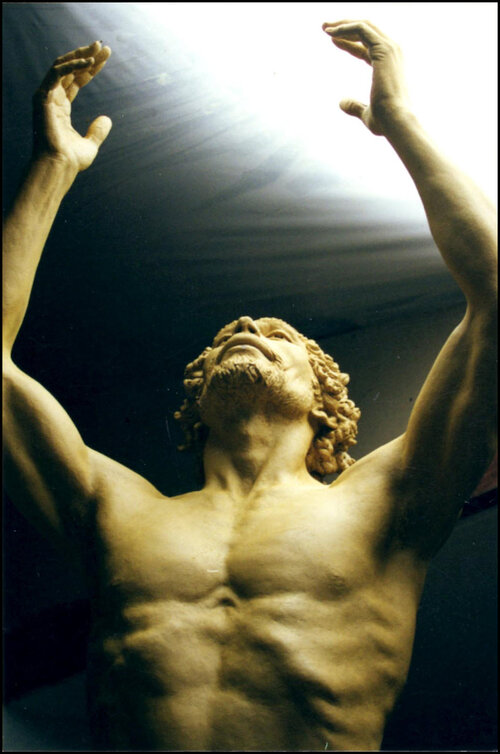
The entrance overpanel of St. Mary’s is dominated by the risen Christ, whose arms are stretched out — not only as a reminder of the Cross, but also stretched out as a gesture of welcome to all who approach. On either side, two angels rush in. Beneath Christ, people gather along the contours of a hill, left and right. On the lower far left, two men are fighting bitterly, another man near them points up towards Christ, suggesting He is the only source that will end conflict. Other men and women, some with children, ascend. Manfrini, working in Italy, had wanted to include local elements, and therefore at the top of the hill on the left, one finds St. Francis of Assisi (the patron of the city of San Francisco) and to his left, kneeling in adoration, St. Clare of Assisi (the patron saint of the nearby Santa Clara Valley, today better known by its nickname “Silicon Valley”). Also kneeling below Christ is Pope Paul VI (pope at the time of the completion of the cathedral), his papal triple crown set aside in a gesture of humility.
At the lower right of the overpanel, three pairs of men represent compassion, reconciliation, and cooperation. Above them, a family stands before the Virgin Mary, who gathers the Christian family together and leads them to Christ.
The current Archbishop, the Most Rev. Salvatore Cordileone, elaborates on this role of Mary: Just as Mary had a special role in mothering God’s son, she has a special role in mothering each of us into the life of her son — we don’t need Mary to point us to Jesus. Archbishop Cordileone continues: “We know where He is. He’s in the tabernacle, in the sacraments, in His word. He is present in the church. Rather, what we need is someone to pick us up and carry us to Him, because we are too weak to get there on our own. In her maternal presence, Mary is there to advocate for us.”
Here in the entrance overpanel, Mary does indeed carry out the role of advocate for those who turn to her.
Below the overpanel are the row of five double-doors, sculpted in the form of thorny, jagged, almost impenetrable branches — a “tanglewood”, Docent Maryanne Murray explains, that “represent’s life’s difficulties.” Generally, one or two of the doors are always open. But if all the doors are closed, their appearance is most effective. As one reaches for a door handle, one realizes that the door handles are in the forms of serpents and dragons and similar reptilian monsters — and instinctively, one hesitates.
These “serpent doors”, the docent explains, “signify the evil that confronts us as we pass through life.”
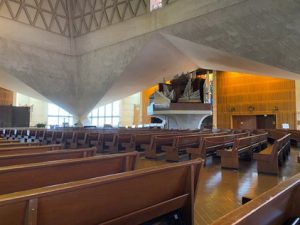
As one steps through the entrance doors into the great interior of the cathedral, nothing prepares visitors for what they now see — an immense space that soars almost 20 stories high — considered to be one of the most extraordinary interior spaces in all of modern architecture.
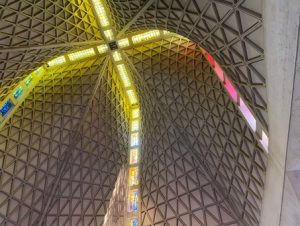
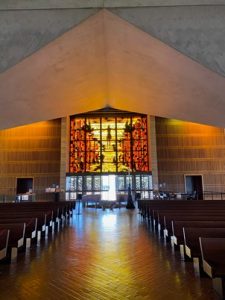
A massive, triangle-coffered roof, which begins almost at floor level, curves upward, rising ever higher. At the top, where one would ordinarily expect supporting girders and trusses to hold the steeply climbing roof in place, there are instead glass openings, not supports. The soaring roof ends at the top in 4 banks of bright yellow stained glass skylight windows which together create an enormous light-streaming cross.
Each of the four arms of the cross extends down as four thin vertical shafts of stained-glass windows, “extending to the four points of the compass”. Each shaft of stained glass is dominated by a different prominent color to represent the four basic elements: red for fire, blue for water, green for earth, and gold for air.
The stained glass windows were designed by Prof. György Kepes, called a master of the mystery of light. Initially a Hungarian photographer, he eventually joined MIT as a professor of visual design, “the first artist at MIT”, and established at MIT the Center for Advanced Visual Arts.
What makes this massive coffered dome all the more remarkable is that the dome ends near the floor in four pylon piers — pylons which seem remarkably small for the gigantic concrete dome which they support. The pylons slope up and become ever thinner, culminating at their smallest point in a circumference of only 24 feet, making the connection between these pylon piers and the dome they support look remarkably thin and fragile. The pylons, upon which the dome rests, nevertheless extend, unseen, almost 100 feet deep into the ground to reach bedrock, and each pylon supports nearly 10 million pounds of pressure.
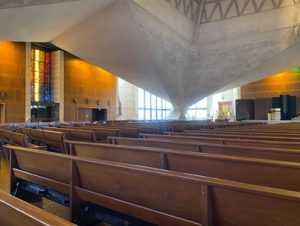
From an architectural and engineering point of view, the sinuous dome of this cathedral is a masterpiece, one of the greatest accomplishments for both Belluschi and Nervi. Many an expert, and many a layperson, has commented on how unnerving it is to see such a massive interior concrete dome resting on such proportionately small pylons and the even thinner connection between them. Architect Brad Dunning writes: “Nervi pushed the limits of reinforced concrete to the extreme; maybe when visiting here we all should believe in God for safety reasons alone, given the extreme, logic-defying cantilevers and load-bearing abstractions on display.”
Behind each of the pylons there are immense corner glass windows, and with the light that streams in here at each corner, the pylons look even more delicate. Again, because the pylons slope up, making the connection between these pylon piers and the dome look remarkably thin and fragile, it looks as if the pylons are being stretched upwards, as if their concrete is stretching ever thinner, giving the impression that the entire structure of the dome is rising upwards. Similarly, the shafts of the stained-glass windows create the impression that the dome is pulling apart : just as the dome of an astronomical observatory parts to reveal the night sky, the dome of St. Mary’s seems to pull apart to reveal the first glimpses of the mysteries of Heaven.
The concrete structure of the soaring roof, free of internal supports, allows for completely unobstructed views of the altar from almost anywhere in the nave. One of the innovations of Vatican II was to turn the altar so that the priest, the celebrant, would face the worshippers. Furthermore, a division between the sanctuary and the nave, between the altar and the parishioners, was also to be removed in order to emphasize “the unity of the Whole People of God in worship.”
Archbishop McGucken explained, “Essentially, all artistic and architectural elements should unite the worshippers, drawing them toward the altar to be participants in the sacrament, rather than seated passively in the congregation watching the clergy.” Thus, the pews radiate outwards from the sanctuary on three sides in such as way, that no worshipper is more than 75 feet away from the altar. Over 2400 worshippers can be seated and there is standing room for 1500 more.
At the four corners of the cathedral, the immense corner windows allow expansive views outside, giving the nave an even greater sense of space. Thus, one never entirely loses view of the city beyond the cathedral — a reminder that the church has an obligation to interact with the modern world. The former rector of St. Mary’s, Monsignor John Talesfore, writes: “Ancient faith and modern technology combine to create a monument to the praise of God that draws our eyes both upward to heaven in the graceful sweep of the cupola and outward to the four corners of our beloved city and the world to which we are sent in eager service.”
To retain a sense of its sacredness, the sanctuary itself is raised up 6 steps, which also makes it easier for the worshippers to see the altar, the ambo, and the unfolding of the liturgy. The sanctuary exhibits the “noble simplicity” that the Vatican II reforms had advocated.
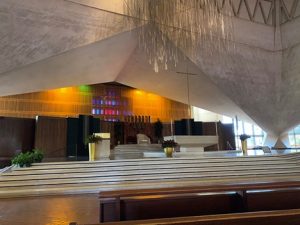
The altar is a single 20-ton block of cream white Botticino marble from northern Italy, the same marble also used for the nearby ambo, as well as the baptismal font at the entrance to the cathedral. Sister Michaela O’Conner, archivist for the Sisters of the Holy Family, recalls, “I learned that the white marble of the ambo, font and the altar were taken from the same part of the quarry in Italy so that their grain, color and attributes would be the same, reflecting the unity of baptism, Eucharist, and the Word of the Lord.” As in any traditional cathedral, here, too, beneath the altar are relics, including relics from St. Francis and a piece of the casket of St. Damian of Molokai.
The cathedra, too, the throne of the Archbishop, is made of the same white, gently carved stone. At the cathedra’s base, two bronze candelabra stand with seven angels total, each with a scroll bearing a popular title for the Virgin Mary. Behind the cathedra rises a rosewood reredos, a screen with very little ornamentation except for a bronze coat of arms of the Archbishop. Originally the coat of arms belonged to that of Archbishop McGucken; today the coat of arms displayed are those of the current Archbishop Cordileone. The left part of the heraldic shield shows the insignia of the office of the Archbishop of San Francisco itself: the crossed arms and hands with the stigmata, representing Jesus Christ but also St. Francis of Assisi, the patron of the city. The right part of the shield shows a lion holding a heart, the translation of the Archbishop’s family name, Cordileone (cor di leone — heart of a lion); below the lion, a California crab represents the line of fisherman of the Cordileone family. The banner below the shield displays the motto In Verbo Tuo — “At Your Word” — referring to the Gospel story in which Jesus tells Simon Peter and his companions to cast their nets again. Simon Peter responds, “Master, we have toiled all night and took nothing. But at your word I will let down the nets.” Behind the coat of arms and the reredos, wooden stave paneling creates the sense of a fragile wall through which shines an ethereal cross of colored light.
When one first enters the cathedral, one sees not only the soaring dome. Movement also captures one’s attention: glistening high above the altar, what seems at first glance to be like rays of shimmering light descend downwards over the altar.
This baldacchino is a collection of several thousand thin metal rods, catching the light, then disappearing, then reappearing once more.
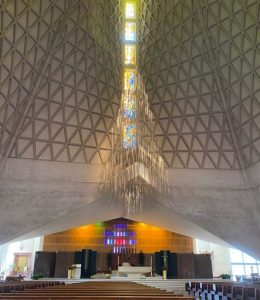
This sculpture was designed by Richard Lippold, who believed, like many artists, that art should “deepen the mystery”. The evanescent baldacchino and the long golden cross that floats below it, directly above the altar, reinforce the sacredness of the sanctuary. “At once still and yet moving, answering light to light in its silence.” This towering sculpture, Lippold explains, may be “perceived as an angel” or the “luminous robe of the Virgin”, or “a Divine presence above the most holy space in the church.”
Monsignor Talesfore again: “Light bathes the interior space through the immense overhead cross of golden glass that continues down the four sides in green, white, red and blue to represent the four elements of earth, air, fire and water – and all that God has made new in the death and resurrection of Christ. Surely no other space could provide us a better opportunity to contemplate the mystery of God’s presence and action in our lives, captured in perhaps the most evocative piece of American religious art of the 20th century, Richard Lippold’s 150-foot baldacchino sculpture, 4,000 concave aluminum rods that appear to shower light down upon the altar, leaving the visitor no doubt where our faith sees heaven meeting earth.”
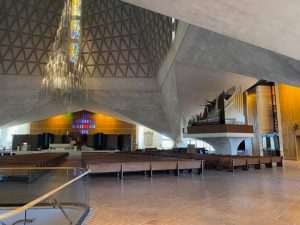
To the right of the sanctuary, one can see the spectacular Ruffatti organ It sits on a large pedestal that curves up and outwards — giving the impression that the organ itself has just risen up through the floor. Made in Padua, Italy, it was built especially for St. Mary’s by Famiglia Artigiana Fratelli Ruffatti, a family firm established in 1940 and carrying on the centuries-old superior Venetian traditions of organ building. With 4 manuals, 72 registers, 89 ranks, and a total of 4,842 pipes, and with a 70 stop electro-pneumatic system of solid-state circuity providing instant and noiseless operation, it is considered to be one of the finest organs in the world.
On the cathedral wall behind the organ are the first set of 7 simple sculpted reliefs for the Stations of the Cross by Delph Ell — again a noble simplicity. “The fourteen sculptures by Delph Ell offer an opportunity for modern-day pilgrims to reflect on the depths of Christ’s suffering out of love for us.” Appropriately, these seven Stations are located above the confessionals, flanking the side entrance. The other set of 7 Stations are found on the opposing wall around the second side entrance.
Traditionally, a cathedral has a series of side altars, and St. Mary’s, too, has a series of large bronzes, patronal shrines, set in the 8 niches around the body of the cathedral, which serve as an example of the teaching function of the cathedral. Like the great bronze entrance, six of the bronze niche sculptures were also made by Enrico Manfrini, and completed by his student, Mario Rudelli.
The overarching theme of the six bronze patronal shrines is the Virgin Mary as the first disciple of Christ and as a model of Christian discipleship for all who follow Him. Each bronze is accompanied by plaques which highlight Mary’s role in these significant events and how her role deepens an understanding of the nature of discipleship.
Each of these bronze sculptures weighs approximately two tons but is suspended above the ground by unseen steel bars, so that the bronzes appear to be floating, giving the scenes depicted an even greater transcendent quality. The scene of each bronze and an example of the accompanying teaching follows:
THE VISITATION — “The Disciple Serves Christ in Others”
“After Mary says ‘yes’ to God’s plan for her to be the mother of Christ, she immediately journeys to the home of her cousin Elizabeth and stays with her until the birth of Elizabeth’s child, John the Baptist. Our Lady is portrayed here waiting on her elderly relatives, for discipleship finds expression in the works of charity, even — or especially — in the tasks of daily life.”
THE FLIGHT INTO EGYPT — “The Disciple Shares in Christ’s Rejection”
“No sooner is Christ born than the shadow of the Cross falls: Herod seeks to kill the child, and the Holy Family must flee to Egypt. The newborn Christ shares the fate of those who come to our shores from many countries to escape violence, repression and poverty.”
WEDDING FEAST AT CANA — “The Disciple Turns to Christ in Faith”
“In St. John’s Gospel, Mary appears only twice: at the beginning and the end of Jesus’ public life. Here, at the Wedding Feast at Cana, Jesus performs his first miracle.”
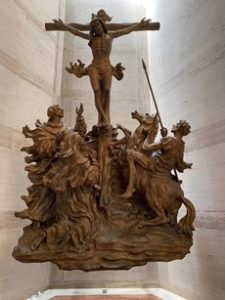
THE CRUCIFIXION — “The Disciple Draws Life from the Pierced Heart of Christ”
“In St. John’s Gospel, this is also the hour of his victory, for from death will come resurrection and the birth of the Church. At the foot of the Cross stand Mary and the Beloved Disciple. The dying Jesus brings into existence a new family: “Woman, behold your son; son, behold your mother.” The centurion is poised to pierce the side of Christ with a lance. With this act, he will reveal the heart of Christ, from which flows blood and water — the sacramental life of the Church.”
PENTECOST — “The Disciple Receives the Spirit in the Community of the Church”
“After Our Lord’s Ascension, the disciples gather in prayer with Mary to await the outpouring of the Holy Spirit. On Pentecost, the Spirit descends on them as tongues of flame.”
Below the bronze, two angels hold up the shrine of the Holy Oils “used in sacramental anointings…visible signs of the strengthening, healing and sanctifying power of the Holy Spirit.”
THE ASSUMPTION OF OUR LADY INTO HEAVEN — “The Disciple Inherits the Gift of Eternal Life”
“Since Mary has shared so intimately in the mission of her Son, it is fitting that she should be the first to experience the fullness of his victory over death. Here we see the reward of discipleship, as angels carry her bodily into the glory of heaven. We believe that by taking up our cross and following Jesus, we too will receive from him the crown of eternal life. Mary’s Assumption offers a sign of hope to the pilgrim Church on earth as we await Christ’s return in glory.”
Finally, the last niche is located to the right of the sanctuary and holds a mosaic of Our Lady of Guadalupe from Mexico.
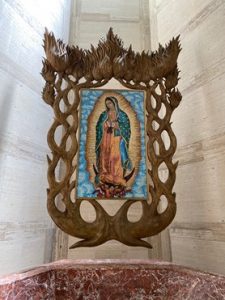
Msgr. Thomas Bowe, the first rector of the cathedral (1962-1981) outbid screen actress and legend Dolores del Rio for this mosaic. A new frame was then fashioned for it by Manfrini as well.
THE SHRINE OF OUR LADY OF GUADALUPE
Our Lady of Guadalupe is one of the most beloved pictures of the Mother of Christ in the Americas. In 1531 a young man, Juan Diego, “had a vision of the Mother of God, and the image of the woman he saw miraculously appeared on his cloak. That image, reproduced here, melds the European and Aztec cultures, uniting them in a common faith. The bronze frame portrays the Burning Bush encountered by Moses, the event which marked the beginning of God’s deliverance of his People.”
Opposite, to the left of the sanctuary, one finds the Blessed Sacrament Shrine, identified with the symbols of bread loaves and fishes, and the words of St John the Baptist: “Ecce Agnus Dei !” — Behold the Lamb of God.
These bronze patronal shrines by Enrico Manfrini and Mario Rudelli were completed over a period of approximately 25 years. The first arrived under Archbishop McGucken (1962 -1977), who oversaw the construction and completion of the new cathedral. Nearly all remaining bronzes gradually arrived under his successor, Archbishop John R. Quinn (1977-1995).
Like his predecessor, Archbishop Quinn received many distinguished visitors at St. Mary’s Cathedral. In June 1982, for example, while on a nationwide speaking tour, Mother Teresa attended the celebrations in San Francisco for the 800th anniversary of the birth of St. Francis of Assisi. Speaking to over 4,000 people inside St. Mary’s Cathedral, she encouraged her listeners not to shun but to get to know the poor and to learn how to love them and to help them.
Five years later, in 1987, Pope John Paul II celebrated the first papal mass in this cathedral. One nun who attended, Sister Pat Hunter, recalled that when Pope John Paul arrived, the normally so restrained sisters stood on the pews and cheered. During his San Francisco visit, Pope John Paul shocked the press and the public, when he held in his arms a 4-year-old child, Brendan O’Rourke, who was dying of AIDS. In a time in which there was great fear and much ignorance about how one could contract the disease, Archbishop Quinn explained, “Pope John Paul II was one of the first world leaders to breach the barrier and embrace a person with AIDS. Holding Brendan, John Paul was a living embodiment of the compassion of Christ.”
Two years later and less than 20 years after its completion, St. Mary’s faced its most dangerous physical challenge: a powerful, 6.9 magnitude earthquake rocked the Bay Area. The Loma Prieta earthquake of Oct 17, 1989 inflicted considerable damage to the region; over 60 people were killed and almost 4000 injured. But like its predecessor in 1906, the new St. Mary’s survived this earthquake virtually unscathed. Pier-Luigi Neri’s structural engineering genius was proven in a most spectacular fashion.
Archbishop Quinn served in San Francisco until 1995. Pope John Paul II then appointed William Levada to be the new Archbishop (1995-2005). Asked whether he expected to be made a cardinal, Levada replied: “There is only one cardinal in California. He is in Los Angeles. Being a cardinal is the consolation prize for not being the archbishop of San Francisco.” (Nevertheless, Archbishop Levada did in fact become Cardinal later.)
Under Archbishop Levada, the last of the bronze patronal shrines was installed, and he therefore presided over the formal dedication of the cathedral to St. Mary of the Assumption on October 5, 1996, along with retired Archbishop John Quinn.
Upon Archbishop Levada’s departure, Pope Benedict XVI appointed George Hugh Niederauer as Archbishop of San Francisco on December 15, 2005. Six years later, the Archbishop underwent major heart surgery, and he retired the following year.
The current and 9th archbishop, Salvatore Cordileone, also appointed by Pope Benedict XVI, was installed on the feast day of St Francis of Assisi on Oct. 4, 2012.
In his inaugural homily, Archbishop Cordileone stressed the power of the rosary: “Let us not underestimate the power of this prayer, which has brought about true miracles at other turning points in the history of the Church. The daily rosary, prayed individually and, especially, together in the family, is a time-tested means of acquiring spiritual stamina in the face of temptations to settle for mediocrity in the life of faith and even the abandonment of faith altogether.” The Archbishop also reminded those attending of the “joy of believing”: “Joy is the hallmark of the authentic Christian life” — a joy that is not “the passing happiness of pleasurable experiences” but a joy “that is, deep, abiding, lasting.”
Since its opening, the Cathedral of St. Mary of the Assumption, like its predecessors, is a great center of liturgy and worship, of culture and education. Hundreds of schoolchildren are conducted through the church each year by well-trained docents to “share with them the history and beauty of this magnificent spiritual space,” writes Mary Hehir, the first director of docents. And thousands of students celebrate their graduation from high school and from college here. The cathedral has hosted countless cultural and civic events, and it remains one of the main tourist attractions of San Francisco.
And St. Mary’s, again like its predecessors, has also been a major center of music, especially under Archbishop Cordileone, who has re-affirmed the Church’s role in sponsoring great works of art. Recently, as a tribute to Our Lady of Guadalupe, the patroness of Mexico and all the Americas, Archbishop Cordileone commissioned Frank la Rocca, composer-in-residence at the Benedict XVI Institute for Sacred Music and Divine Worship, to create a “Mass of the Americas” in the great sacred music tradition of the Church. Archbishop Cordileone explained his motivation as follows:
“Every year in the Archdiocese of San Francisco, we have a big celebration of Our Lady of Guadalupe, patroness of both Mexico and all the Americas, on the Saturday before her feast day, with a procession and a Mass at St. Mary’s Cathedral. Last year, I realized that Saturday, Dec. 8, was also the Solemnity of the Immaculate Conception, patron saint of the United States. Our Lady is the mother of all God’s children, and I thought that in the midst of so much division and contention in our society, she can unite us. I asked Frank La Rocca … to compose music for a Mass for Our Lady that incorporated sacred music and the melodies of songs Mexican people sing to celebrate Our Lady, so they would connect with it. I told him that my idea for this composition was inspired by the way the Franciscans had built their mission churches. They were traditional Catholic churches, but local materials were employed, like adobe. That artistic style reflects the creation of sacred art in the Catholic Tradition.
This Mass includes music in Latin, English, and Spanish. There is a ‘Hail Mary’ in Nahuatl, the same Aztec language that Our Lady used to speak to St. Juan Diego.”
The Mass of the Americas was first celebrated on Dec 8, 2018, in St. Mary’s Cathedral.
For all of its fame and its prominence on the San Francisco skyline, St. Mary’s has not been without its critics. From the moment its creation was first announced and throughout its construction, opponents complained about the design, but most especially about the cost. Vocal demonstrators protested during the opening festivities. Dorothy Day, the co-founder of the Catholic Worker Movement, who served the poor for over 40 years, visited St Mary’s in San Francisco shortly after its completion. As one of the greatest advocates of Christian social justice of her time, she attended a meeting in which once again the most long-standing and bitter grievance against the construction of the cathedral was articulated: that the money used to build this monumental church could have been better allocated to help the poor. Naturally, these critics expected Dorothy Day to agree. But unexpectedly, she did not. Instead, she replied:
“The church has an obligation to feed the poor, and we cannot spend all our money on buildings. However, there are many kinds of hunger. There is a hunger for bread, and we must give people food. But there is also a hunger for beauty — and there are very few beautiful places that the poor can get into. Here is a place of transcendent beauty, and it is as accessible to the homeless as it is to the mayor of San Francisco. The Cathedral in San Francisco is one of the few places where the poor can go and sit down and be with God in beauty …”
Fifty years later, Archbishop Cordileone, too, reaffirmed the human need for beauty.
“Perhaps what the poor most lack in their lives is beauty: being dignified by that beauty which ennobles and elevates the soul, assuring them of their equal dignity as a fellow child of God whom God created in His image and likeness.”
The aesthetic, cultural, and spiritual value of the cathedral was also underscored by Monsignor John Talesfore. “No human endeavor matches the building of a cathedral.”
A cathedral is “the very pinnacle of what we recognize to be noble, beautiful and outstanding in all of human activity and accomplishment.”
In 2017, St. Mary’s was designated by Architecture Digest as one of the 10 most beautiful churches in the United States.
Pope Benedict XVI, for whom the role of beauty was an important part of his teachings, wrote that an emphasis on beauty is an “important part of the Catholic vision”, and that there is a vital connection “between beauty and the Christian vocation.”
“Beauty is a path to God, who is the source of all beauty.” Pope Benedict called for “new ‘epiphanies’ of beauty”, and this magnificent cathedral, St. Mary of the Assumption, has often been described as precisely this — a new epiphany of Beauty.
“When Archbishop McGucken stood in the ruins of this cathedral,” suggested Archbishop George Niederauer, “even he could not imagine what beauty would arise from those ashes.” And Archbishop John Quinn concluded, “St. Mary’s Cathedral is a window on the infinite, lifting the human spirit to the …. eternal beauty which is God.”
The Cathedral of St. Mary of the Assumption celebrates its 50th Anniversary Jubilee Year from May 5, 2020 to May 5, 2021.
For 50 years, worshippers and visitors have been inspired upon entering St. Mary’s Cathedral and have been astonished by the immense soaring beauty of this space.
And when worshippers and visitors leave, they are again inspired as they depart.
For as they finally turn to leave, the overpanel above the entrance, seen now from inside, reveals something unexpected: as the light streams yellow through the glass, the side figures are no longer men and women climbing a hill. Instead one now clearly sees instead a golden chalice, the embodiment of the Eucharist.
And in the cup of the chalice, there appears the ascended Christ.
_____
Almighty God,
You gave a humble Virgin the privilege of being mother of your Son,
and crowned her with the glory of heaven.
May the prayers of the Virgin Mary bring us to the salvation of Christ
and raise us up to eternal life.
We ask this through our Lord Jesus Christ your Son
who lives and reigns with you
and the Holy Spirit,
one God, forever and ever.
Amen.
Nikolaus Hohmann is the Chairman of the Humanities Department at the San Francisco Conservatory of Music.