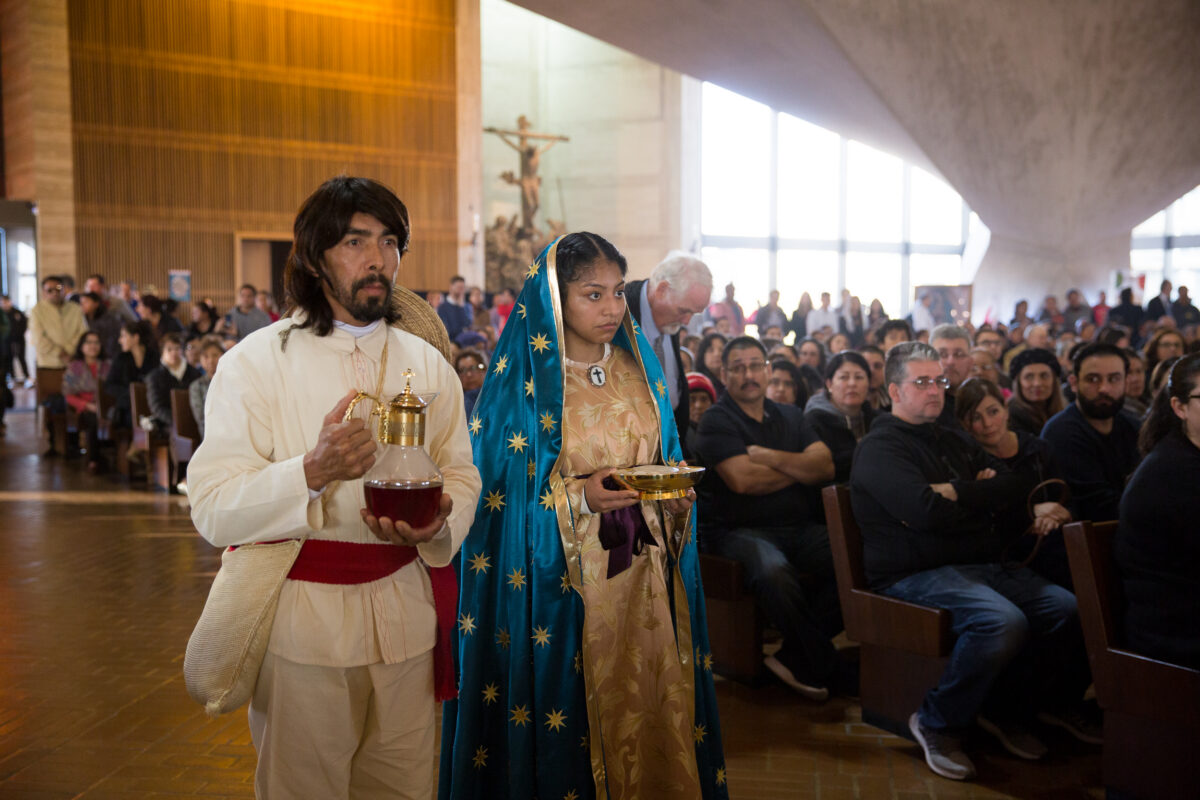
Defending St. Junípero Serra, with Holy Water, the Rosary—and the Arts

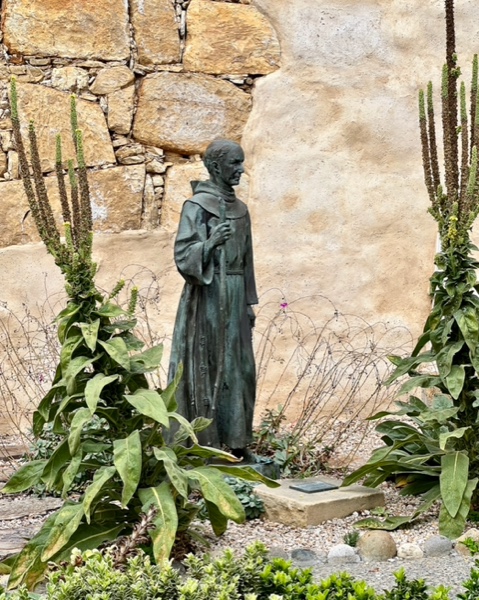
St. Junipero Serra, a holy man dedicated to the earthly and heavenly well being of Native Americans has been denounced as a racist, a genocidal monster. One CBS news report even libeled the saint as a slave owner.

On Juneteenth 2020, haters brought their ire against the founding father of California to San Francisco. Hundreds of protesters, many of them dressed in black, toppled and defaced statues in Golden Gate Park. Many figures whose statues were attacked had no apparent connection to racism or slavery. For example, the mob graffitied a monument to Cervantes and his characters, Don Quixote and Sancho Panza.

Prominent among the statues attacked that day was St. Junípero Serra’s. His statue was overturned. Both the statue and its pedestal were defaced with red spray paint. “Stolen Land” was scrawled on the pedestal.

Dismayed by the vandalism, I was happy to see Archbishop Cordileone take an unusual and gutsy step. Not stopping with issuing an eloquent statement of protest—which would likely be ignored even in the unlikely event it was read by Serra’s detractors, the archbishop also used powerful spiritual weapons at his disposal.

Park workers had cleaned the graffiti from the statue and taken it away to storage when the archbishop went with about two hundred of the faithful to the site of the empty pedestal. On that drizzly day, wearing an amaranth purple skull cap, and the amaranth cassock proper to his role as a bishop under a lace-trimmed alb, with a deep purple stole around his shoulders, Archbishop Cordileone blessed the area with holy water and performed a minor exorcism. He then led a rosary of reparation.

In a clip now posted at the archdiocesan website, the archbishop said, “An act of sacrilege occurred here that is an act of the evil one. Evil has made itself present here.”

Archbishop Cordileone went on to say he grew up in San Diego, near the first mission Serra founded in Alta California when it was under Spanish rule, the area which now makes up the state of California. So, he said, he has a heartfelt connection to the saint. “I’ve been feeling great distress and sort of a deep wound in my soul when I see these horrendous acts of blasphemy and disparaging of the memory of Serra —who was such a hero, such a great defender of the indigenous people of this land.”

Remarkably, the archbishop has also defended St. Junípero Serra in many other unique and creative ways—using the arts.
Through the Benedict XVI Institute for Sacred Music and Divine Worship that he founded, with the savvy assistance of Maggie Gallagher, the institute’s Executive Director, Archbishop Cordileone commissioned a new Mass setting, a painting, and a poem in honor of the saint. During a Zoom event, “The Making of Missa Sancti Juniperi Serra,” Gallagher said that following the Renaissance model of commissioning great works of art from within the heart of the Church, all of these works were funded by a generous patron, Mr. Terry Castor of San Diego, in honor of his deceased wife, Barbara. Anyone who celebrates the Missa Santi Juniperi Serra is asked to remember Barbara Castor in prayer.

Missa Sancti Juniperi Serra

During the ZOOM event on April 30, 2022, Archbishop Cordileone spoke about how the idea to commission a Mass in honor of St. Junípero Serra was formed.

The archdiocese would be hosting a Sacra Liturgia Conference at the end of June, an international event which, as the archbishop said, “brings together great minds and hearts of people who are working to promote and renew sacred liturgy in the Church and regain the beauty that the liturgy deserves. I thought that since the last day of the conference is July 1, the feast day of St. Junípero Serra, a perfect way to bring this to a conclusion would be to celebrate a Solemn High Pontifical Mass —in the extraordinary form because that’s the form of the Mass that St. Junípero Serra himself celebrated.”

The Mass would be celebrated in Mission Dolores Basilica, which was built in 1876 adjacent to the original Church of Mission San Francisco de Asis to accommodate larger congregations. Mission San Francisco was founded by Padre Francisco Palóu under the direction of St. Junípero Serra in 1776, and the adobe mission church built in 1791 is the oldest surviving structure in the city. (EWTN recorded the Mass, and you can view it at Cathedrals Across America—Solemn Mass for the Feast of St. Junípero Serra.)

Archbishop Cordileone continued, “I asked Frank to compose a Mass in honor of St. Junípero Serra that would be reflective of the mission era here in California.” This is the third Mass setting composed at the archbishop’s request by Frank La Rocca (franklarocca.com) , who is the Benedict XVI Institute’s composer in residence.

La Rocca then spoke about how he went about making his composition evoke the experience of what a Mass from that time would have been, “One important way is through the choice of the instruments accompanying the singers. It would be a small ensemble just like the ones they had in the missions of maybe a string quartet, a couple of flutes, perhaps a small portable organ.”

At the premiere, La Rocca’s music was performed on baroque-style string instruments and flutes to contribute to the authenticity, but modern instruments will be able to perform the music as well.
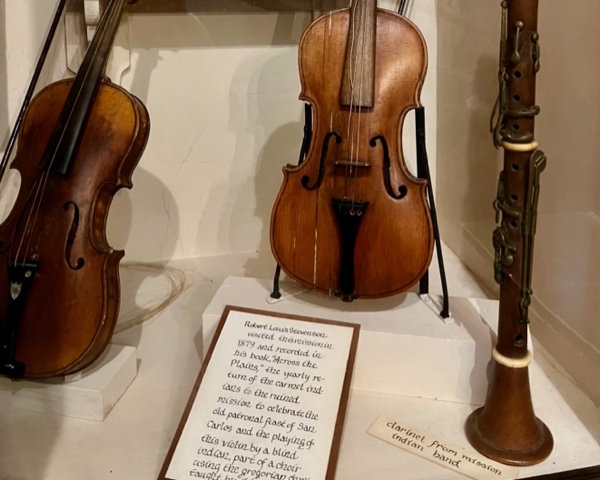
Musical instruments played to accompany Masses with Gregorian chants by the Indians in the Mission bands.

In addition, Frank La Rocca said he wove throughout his Mass setting the tune of one of St. Junípero Serra’s favorite hymns, “Salve Virgen Pura,”—”Hail Pure Virgin.”

“In addition to the hymn I wanted to make allusions to Gregorian chants from Missa Orbis Factor, which certainly would have been one of the most commonly heard Mass ordinaries in those days.”

La Rocca used the Salve as a Prelude, and worked it in as a thematic element of the music for the Mass, using the melody and derivatives of it in the music accompanying the ordinary the texts of the Mass. He wrote me later in an email that this technique is known as a “Parody”—a term that has nothing to do with mockery.

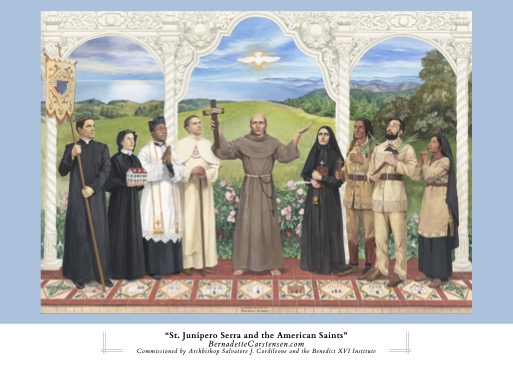
St. Junípero Serra and the American Saints Painting

Figurative artist, Bernadette Carstensen (bernadettecarstensen.com) is Benedict XVI Institute’s painter in residence. During the Zoom event, she unveiled her commissioned painting “St. Junípero Serra and the American Saints.”

As Carstensen pointed out, the saints are standing in the painting against a classic California landscape on Mount Tamalpais with roses and columbine that grow there. Columbine also represents the Holy Spirit. The roses look to be Roses of Castile, of the kind St. Juan Diego found growing in winter and gathered into his tilma after the apparition of Our Lady of Guadalupe in Mexico.

The figure of St. Junípero Serra in the middle stands with arms upraised similar to the pose of his statue that was toppled in Golden Gate Park. From left to right on either side of Serra are Blessed Michael McGiveny; St. Elizabeth Ann Seton; Servant of God Father Augustus Tolton; Saint Damian of Molokai; Saint Mother Cabrini; a Native American representing the Huron Christian martyrs; St. René Goupil, representing the Jesuit martyrs, and St. Kateri Tekakwitha. At the saints’ feet are Spanish tiles depicting the nine missions founded by St. Serra. Below is a dedication to Barbara Castor.

The Liturgy of the Hours of Saint Junípero Serra

Benedict XVI Institute poet-in-residence James Matthew Wilson spoke about and read his poem, “The Liturgy of the Hours of Saint Junípero Serra.”

“I wanted to write the poem as a prayer . . . so we could read the poem and pray the poem.” Wilson said he used the rhyme royal scheme to honor St. Serra’s long and painful walk along El Camino Real—which in English means the royal road. Each stanza of seven lines, in iambic pentameter with a rhyme scheme of ABABBCC is about a different object from a different stage of Fr. Serra’s life starting from his youth in Mallorca, intended for us to ponder the object and think about what it can teach us about his spiritual life.
Eloquence beyond Words

Using the eloquence of the beauty of music and art, poetry, and architecture to defeat lies and ugliness is a profound idea. Research has shown that repeating the lies of opponents even when we have strong arguments against the lies may paradoxically strengthen belief in the lie among those who have believed it already. Besides, some people will not have heard the lie before, and it doesn’t help to spread it even further.

The arts are so convincing because they captivate people and grab people’s emotions, and even when they don’t completely bypass the intellect, they enrich the understanding.

A More Truthful Image

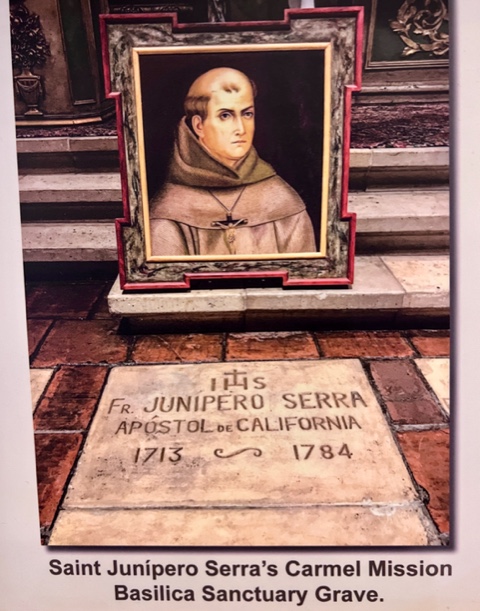
Recently I came across this review at website of the restored Carmel Mission where St. Junípero died and was buried, which portrays a more truthful image of the saint, “Walking through the primitive furnishings and reviewing the very basic library housed in the place, with tools and instruments available a couple of centuries ago illustrates the very primitive conditions in which the inhabitants lived and worked and the sacrifices made by the man that brought European culture and civilization to this part of America.”
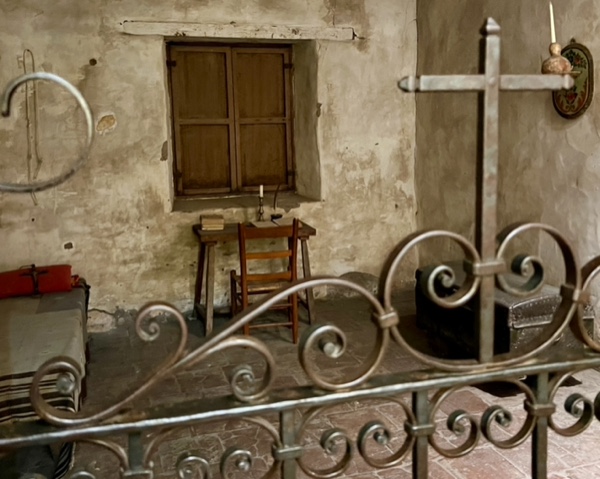
St. Junipero Serra’s ascetic cell at Mission Carmel, where he died and was buried.

This article is adapted from an essay that first appeared in the Fall 2022 Edition of Latin Mass Magazine. Republished with a few modifications, with permission.

St. Kateri’s Gaze and the Iconography of John B. Giuliani

St. Kateri Tekakwitha “the Lily of the Mohawks” was born in the village of Ossernenon in present-day New York State, to Mohawk Chief Kenneronkwa and a woman raided from the Algonquin people.  Before her mother was taken captive  and adopted into the Mohawk tribe, French Catholic missionaries near Montreal had baptized and educated her, converting her to the Church.

At the frail age of four years, Tekakwitha lost her parents and younger brother to a smallpox outbreak that spared her life, but terribly scarred her skin and impaired her eyesight.  She followed in the moccasin steps of her mother and on Easter Sunday, April 18, 1676 at the age of 19, Tekakwitha assumed the baptismal name, “Catherine,” in honor of St. Catherine of Siena.  She disavowed marriage, instead vowing perpetual virginity, and eventually moved to the Jesuit mission village of Kahnake.  According to Father Pierre Cholonec, Tekakwitha said:

“I have deliberated enough. For a long time, my decision on what I will do has been made. I have consecrated myself entirely to Jesus, son of Mary, I have chosen Him for husband, and He alone will take me for wife.

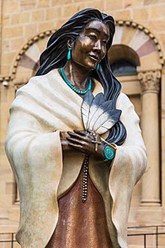
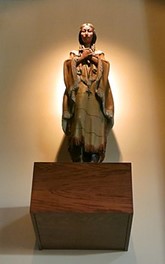
Statue of Saint Kateri Tekakwitha at the Cathedral Basilica of St. Francis of Assisi, Santa Fe, New Mexico

The Jesuits characterized Kateri as reserved, averse to social gatherings and given to blanketing her scarred face. She slept on thorns, offering her suffering up for her family’s conversion, a Christian practice that for her recalled the traditional Iroquois ritual of drawing blood. She wanted to found a convent with a devout fellow convert, Anastasia (a friend of Tekawitha’s late mother) but the Jesuits told her she was “too young in faith.”

Hagiographers attested that on her death at age 24, witnesses watched her scars vanish, to leave her skin resplendently beautiful.  As early as 1684, her gravesite had become a place for pilgrimages.  

In 1885, American Catholics initiated the process for Kateri Tekakwitha’s canonization, followed by Canadian Catholics. As described on Wikipedia: “On January 3, 1943, Pope Pius XII declared her venerable. She was beatified as Catherine Tekakwitha on June 22, 1980, by Pope John Paul II.”

In his canonization homily, Pope Benedict XVI honored St. Kateri:

“There she worked, faithful to the traditions of her people, although renouncing their religious convictions until her death at the age of twenty-four. Leading a simple life, Kateri remained faithful to her love for Jesus, to prayer and to daily Mass. Her greatest wish was to know and to do what pleased God. She lived a life radiant with faith and purity.

Kateri impresses us by the action of grace in her life in spite of the absence of external help and by the courage of her vocation, so unusual in her culture. In her, faith and culture enrich each other! May her example help us to live where we are, loving Jesus without denying who we are. Saint Kateri, Protectress of Canada and the first Native American saint, we entrust to you the renewal of the faith in the first nations and in all of North America! May God bless the First Nations!”

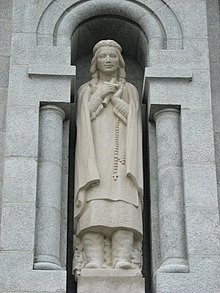
Statue of Saint Kateri Tekakwitha by Joseph-Émile Brunet at the Basilica of Sainte-Anne-de-Beaupré, near Quebec City

This first American Indian saint resonates powerfully, for me and for many other Indigenous people, “loving Jesus without denying who we are.”

Walk the galleries of the Prairie Edge & Sioux Trading Post on the Dakota plains, and you will see some extraordinary works by the late John B. Giuliani, priest and painter, such as his Crow Trinity, his Cheyenne Virgin and Child and Sundancer Christ. Beneath the liberal, loquacious light from those floor-to-ceiling windows, the perfectly-mixed American Indian red ochre, corn-yellow, and gold maize of his icons flow in complete harmony and complement to the authentic Indigenous art surrounding them. There at that leisurely outland in Rapid City, the good Father stands beside Jim Little Wounded and Kevin Fast Horse, holding his own with no fear, beside Joanne Bird and Del Iron Cloud with confidence, despite Giuliani’s Byzantine style.

Perhaps against all odds, the predominant religion today among American Indians is Christianity, and in fact, given the intense and unrelenting spirituality which has always been characteristic of the culture, evidence of Christ is often the first one will encounter – as when entering, for instance, the Qualla Boundary, the Cherokee reservation inhabited by the Eastern Band of Cherokee Indians in North Carolina, where the most noticeable, immediately-recognizable structure is a church. Therefore, it should go without saying that our contemporary art scene must accept this reality, and then reflect its truth. As arts journalist, Grace Glueck, wrote in The New York Times, “Although Western art was raised on religion, 20th-century modernism more or less tuned it out. Yet in the last few decades artists, if not curators, have become more open to the subject…”²

Unfortunately, the onset of that “tuning-out” occurred precisely as North American Indians began coming into their own, in terms of conversion, and thus they were abandoned by the sophisticated art world as far as representation. Now more than ever, artists of faith in every discipline are justified in addressing this neglect of what is arguably the most difficult feat accomplished across the continent – the spiritual coercion of an entire race. Moreover, that representation should not relegate Native American Indians to mere conquests of elite and superior missionaries, but in accordance with the Scriptures which say of Christ: “…you ransomed people for God from every tribe and language and people and nation, and you have made them a kingdom and priests to our God, and they shall reign on the earth.” Wholly apart from any issue of “social justice,” spiritual justice demands their equal representation as sovereigns and savants – and saints.

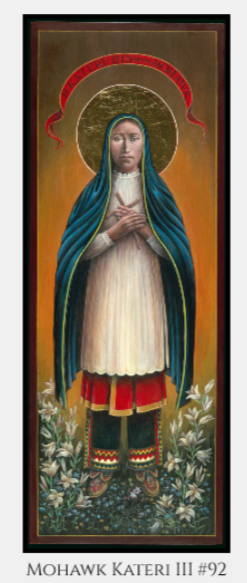
Indigenous believers will find themselves well-represented at Giuliani’s sacramental “table.”  There is only one, not very impressive, painting of St. Kateri drawn by one who knew her.  So it is with more than a bit of wonder and consternation that, looking into his Mohawk Kateri III #92, it is as though I am gazing into the face of my own late mother, who was a direct descendant of an Algonquin born in the same generation as Saint Kateri, an Algonquin orphaned by the same smallpox which took Kateri’s likewise-Algonquin mother and Mohawk father. My amazement is not merely towards the actual features themselves, but the very attitude with which Father Giuliani has infused them. He has captured the soul of the Native American Indian with startling skill.

Saint Kateri’s expression is itself an embodiment of that stoic, borderline-suffering countenance which was my mother’s “thousand-yard-long stare.” Kateri is beatified by the beauty of a glinting bronze nimbus, full as a Beaver Moon, which was that calendar date of the “last call” for ancient Native American Indians to prepare for winter. It will appeal to the truly Indigenous, if only at an intuitive, vestigial level, signifying security amid worldly instability, recalling the ancestral memory of the beaver, symbol of that being who will provide warmth, our last and only hope and salvation by its sacrifice, keeping our hearts soft before the coming cold – a Christ figure from the Animal Kingdom, of sorts.

In the mythology of the Omaha people, we have in “Ictinike and the Four Creators,” a hero who visits a beaver which sacrifices its own son to provide him with food. Following this meal, the father beaver plunges the bones underwater, and the son is resurrected. Too, the Cherokee held a belief called “Cover the blood,” that an animal slain in hunting might be resurrected from its blood spilt by drops on the ground. A similar doctrine runs through the religion of many other tribes. ³

A statue of Saint Kateri Tekakwitha in Saint John Neumann Catholic Church, Sunbury, Ohio

Could it be that, just as early Indigenous missionaries employed the touchstones of the “old religion” to woo their people to the Good News, Father Giuliani unwittingly or knowingly reconnoitered the Beaver Moon, for her halo? Saint Kateri is the patroness of Native American Indians and First Nations peoples, of integral ecology and traditional ecological knowledge, so whether by divine inspiration or his own carnal understanding, this would seem perfectly decided – almost, in fact, an environmental “election.” As Saint Paul wrote, “…to all men, I have become all things, that by all means I may save some,” such an artistic interpretation of Kateri’s nimbus has the power to draw and unite all Nations, from the Southeastern Cherokee who called the Beaver Moon “nu-da-de-qua,” to the Northwestern peoples’ “alangitapi.”

Rather than emphasizing a voluminous veil at her crown, Giuliani downplays the fabric around the saint’s face, focusing on copious, blue folds less suggestive of a cotton mantle than of “Long Man River,” who washed away the despair and impure thoughts of Native ancestors. The sheer weight and width of this massive, dramatic headdress seem to invite viewers not to the mystery fringe of a mortal woman’s hair, but to the currents of living waters. But whereas the veil and white sheath she wears reflect the traditional iconography of the “White Man,” at their lower edge is seen the familiar attire of Native American culture, where a multi-colored, zigzag pantaloon border grazes the tops of Saint Kateri’s dainty feet in moccasins. Her feet are firmly planted at a modest space, in a field of wildflowers where stands of lilies arise on either side, giving testimony to her designation as the “Lily of the Mohawks.”

But the covering of Saint Kateri’s hair proves a much more profound and powerful outward sign of devotion to the Native American Indian viewer, than it does to the non-Native. The covering of the hair conveys a submission to the Christian faith as well as a cultural “assimilation” in a manner that white European Christians could never fully experience, for hair is sacred in Native American Indian culture, a source of ornamental service especially in worship at ceremonial events. An Amerindian’s long hair represents strong self-identity, even clan affiliation (as in the Cherokee “Long Hair Clan”). To throw away our hair is to practice self-mortification, even mourning akin to the Old Testament practice of rending one’s garments, an utter disregard of the ego which goes far beyond the customary cutting of a nun’s hair (symbolizing an end to feminine vanity). Thus Saint Kateri gains profound universal reactions of renunciation through this imagery, humility which contemplative American Indians both male and female will feel in a visceral way.

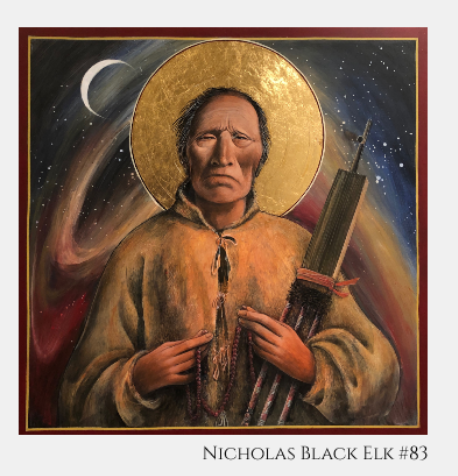
Also noteworthy in Giuliani’s “sacred Indian menagerie” is his iconography of the Lakota Holy Man, mystic and Catholic missionary, Nicholas Black Elk. While Black Elk is not officially a canonized saint, the Jesuits appointed him to the position of catechist after his baptism in 1904. Thereafter, Black Elk is credited with bringing hundreds of fellow Native American Indians into the faith. Devotions including the rosary and Sacred Heart were a vital part of his practices, thus it is perfect that Giuliani, in “Nicholas Black Elk #83,” has portrayed him with a strand of rustic and somewhat-crudely mismatched beads of natural wooden hue. While Giuliani’s use of lunar imagery might be debatable in the depiction of Kateri, here it is undeniable.

Behind Black Elk’s aureole, reminiscent of a hammered brass cymbal, a crescent moon hangs against the backdrop of a starry night sky. Punctuating the heavens, a celestial supernova swirls around his shoulders in orbits of streaked red and gold, giving the impression of enormous, interstellar wings. His face is un-romanticized and unerring in likeness to the mien of the one after whom it was modeled. There is no question that this is Black Elk as he appeared in the last years of his life. The illusion would be complete, except for the icon’s ragged monastic robe with its lowered hood, hidden behind the rough-hewn cloth of a garment whose yellow hues harmonize with the gold of the supernova “wings” on either side. This effect being so seamless, the viewer feels all the more that they are appendages, “feathered” outgrowths of the man himself. Again, here it seems there is more subtle symbolism at work, a hint at the antediluvian Birdman regalia of Native American Indians which elevated priests to their stature, conveying instant recognition at mere sight to every domestic clan and outside tribe.

Vestiges of this ancient diaconate are still visible today in the falcon dancer “vestments” seen at powwows for formal stomps and ceremonies. In the Southeastern Ceremonial Complex, the Birdman represented the Upper World, where its genesis was accompanied by sun, moon, and stars – the latter two which also appear in Giuliani’s icon. “The life of an Indian,” said Black Elk, “is like the wings of the air… That is why the Indian is always feathered up, he is a relative to the wings of the air.”

 If ancestral memory does indeed remain, passing down along with the “generational trauma” a hunger for and appreciation of unction both heavenly and carnal, then the Native American Indian viewer should find ample spiritual inspiration – and if not, Giuliani’s sublime suggestion of the ritual feathers is sufficient, imparting at least a dose of tangibility, reinforced through use of the red ochre and sunflower/corn silk yellow paints which were so common to the culture. The combination is found equally in authentic Buffalo Dreamer hand-painted rawhide shields and genuine turtle amulets on display nearby in the galleries of that Prairie Edge & Sioux Trading Post, authentic art by the Ute Nation and Oglala Lakota – Nicholas Black Elk’s own blood people.

Consequently, this priest’s art is art which has undoubtedly found its place. In a pastoral letter, Reverend Nicholas Black Elk wrote of the American Indians, “We all suffer in this land. But let me tell you, God has a special place for us when our time has come.” Surely if we read the signs and have ears to hear, that time has now come, with one of those special places living in the lasting works of John Giuliani.

Jennifer Reeser is a bi-racial writer of European American and Native American descent, the author of “Indigenous,” and “Strong Feather.” Her reviews have appeared in First Things, LIGHT, Able Muse, and elsewhere.

¹Despair Over The Pope https://www.nybooks.com/articles/2010/06/10/despair-over-pope/

2 Art Review: Creative Souls Who Keep the Faith of Challenge Its Influence https://www.nytimes.com/2000/04/21/arts/art-review-creative-souls-who-keep-the-faith-or-challenge-its-influence.htm

³History, Myths, and Sacred Formulas of the Cherokee, ©1900 by James Mooney, reprinted by Bright Mountain Books, 1992, p. 474

Winter’s Still Song

(after hearing Morten Lauridsen’s Magnum Mysterium at a friend’s Wedding)

The hush falls

like soft-feathered snow,

as light takes its leave.


Clamoring thoughts,

like tired children

spent from running

in delirious circles,

take a final spin,

then collapse,

asleep in a pile.


Our Mother, full of stars,

reaches up her gentle

hand to switch on

the crescent moon.

Its sparse light

trails to earth

like a bridal train

and lays like lace upon

the snow-covered ground.


Now, finally,

cloaked in quiet

there is a clearing

not already occupied

by thought

where we are stilled by song

and become

the sweet capture

of two delicate voices

entwined like dancers

turning in the air,

light-footed,

arching heavenward.


Here,

hanging in the air,

like crystals on a

snow-laden tree:

what rough straw

would have whispered

from the manger.

Tamara Nicholl-Smith’s poetry has been featured on two Albuquerque city bus panels, one parking meter, numerous radio shows, a spoken-word classical piano fusion CD, and in several publications, including the Mutablis Press anthology Enchantment of the Ordinary, Kyoto Journal Issue 95, The Examined Life Journal Issue 8, and Catholic Arts Today. She is currently pursuing an MFA in Creative Writing at the University of Saint Thomas in Houston. She enjoys puns and likes her bourbon neat.

Passable Prayer: Witness

Lord, you have searched me and have known
my madness, a wilderness of visions and song.
 

I welter in birthright riddles, my mother
deranged, my father the fool. They claim
I prophesied in wordless gurgles grown
to wails—lament bled with ecstasy.
 

Now I rove, a cockeyed home
for maggots and mutters. Rumors river
and surge through this untamed soul,
ebbing beliefs I still cry without end.
 

When you next pass through, whisper me
from ruins. Say among the rants was a shrapnel
of truth. Name me what you wish
and plunge these tremors beneath your current.
 

And if you insist I risk wrecking the call
—fanatic caressing the unlikely God—
if passion must tightrope peril, I pray
you salt my tongue with light and dove.
 

Whitney Rio-Ross is the author of the poetry chapbook Birthmarks (Wipf & Stock) and poetry editor for Fare Forward. Her poetry has appeared or is forthcoming in The Windhover, Rock & Sling, America Magazine, Psaltery & Lyre, Relief Journal, and elsewhere. She lives in Nashville, Tennessee.

Editor’s Note: We are proud to publish the winning poem of Catholic Literary Arts’s sacred poetry contest, judged by the noted poet Jane Greer, one of the founders of the New Formalist poetry movement.  She commented:

“Whatever formal poetic tools a poem does or doesn’t use, if it doesn’t use evocative imagery, it’s something less than a poem. The language in this work is gorgeous and does the job it is meant to do. ‘I welter in birthright riddles;’ ‘Now I rove, a cockeyed home / for maggots and mutters;’ ‘whisper me / from ruins. Say among the rants was a shrapnel / of truth. Name me what you wish / and plunge these tremors beneath your current.’ The language does not tell us about but leads us to experience the Baptist’s inner and outer turmoil, his suffering, his love. This is poetry.”

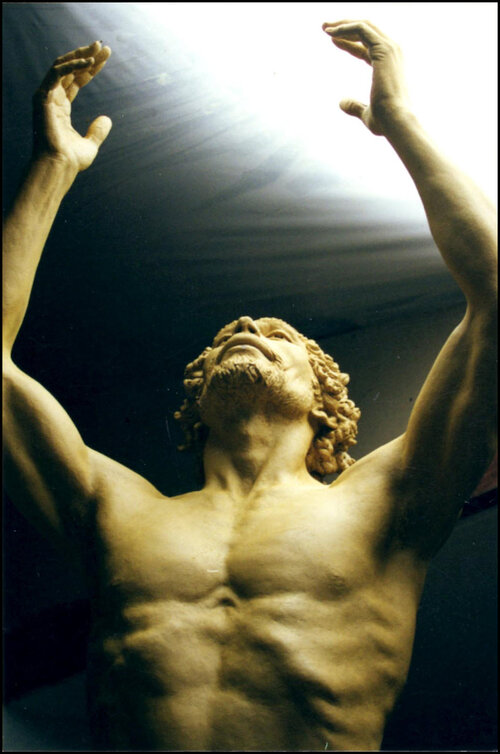
The Catholic Literary Arts contest asks poets to write in response to works of art by living Catholic artists.  In this case, the poet Whitney Rio-Ross chose as her inspiration the above sculpture of St. John the Baptist by Thomas Marsh. His work may be found at: http://thomasmarshsculptor.net/
 

The Hymn of San Juan Diego

[Editors note: This is the second poem in the song cycle by James Matthew Wilson inspired by the Mass of the Americas, called “The River of the Immaculate Conception.” The book may be purchased from WisebloodBooks.com.]

The Hymn of Juan Diego

Thus it is said that Juan Diego
Saw first the Aztec girl,
Her shoulders cloaked in starry mantle
Her hair dark as the merle.


The hill whereon she stood had been
An ancient mother’s home,
Laid low with all Tenochtitlan
When stout Cortez had come.


Light sprang from dull rocks at her feet
And birdsong filled the place,
While she herself eclipsed the sun,
Its blaze about her face.


And every color of the stones
For which the Spaniards killed
Became the turquoise and the gold
With which the sky was filled.


“All those who seek me, Little One,
Will have me for their mother;
And those by pride or greed estranged
Will someday call you brother.”


Juan begged the bishop build a church,
Received a doubtful smile;
And felt his own unworthy bones
As ignorant and vile.


The bishop’s jeweled servants scorned him,
Said he was telling lies.
A second time the bishop’s asked,
A second time denies.


Some thought to beat Juan for his words;
He found his uncle ill,
So every claim upon him led
Him to avoid her will.


But she met him upon the way:
“Why do you run from me?
My mantle covers you already,
And sets your uncle free.”


“Gather these roses in your cloak
As your land’s never seen,
Then, lay them at the holy feet,
And he’ll know what they mean.”


The brute crowd at the bishop’s door
Stood in his way and sneered.
They saw his breast of flowers and snatched;
The petals disappeared.


So, Juan Diego was let in
To stand before the throne,
To show his harvest of the rose
Where rose had never grown.


“I’ve done as she, the mother of God
Told me to do,” he said,
And poured out at the bishop’s feet
The bright abundant red.


But, as these fell, the bishop saw
Juan’s rough-stitched cloak unfold
The image of that placid queen
Ablaze with teal and gold.


He fell upon his knees in praise
And wept for love of her
Who on that land of rock and thorn
Her great care should confer.


Beneath her mantle and her banner
All those vast lands are warmed,
But what we seek in them must be
First by her love transformed.


And so, Diego’s cloak poured forth
Not conquest but sweet flowers
And Mary chose a tattered cloth
To first unveil her powers.


This is the second poem from James Matthew Wilson’s new book of poems, The River of the Immaculate Conception (Wiseblood Books, 2019).

Subscribe to Our Emails