Congratulations Graduates! Seek Beauty
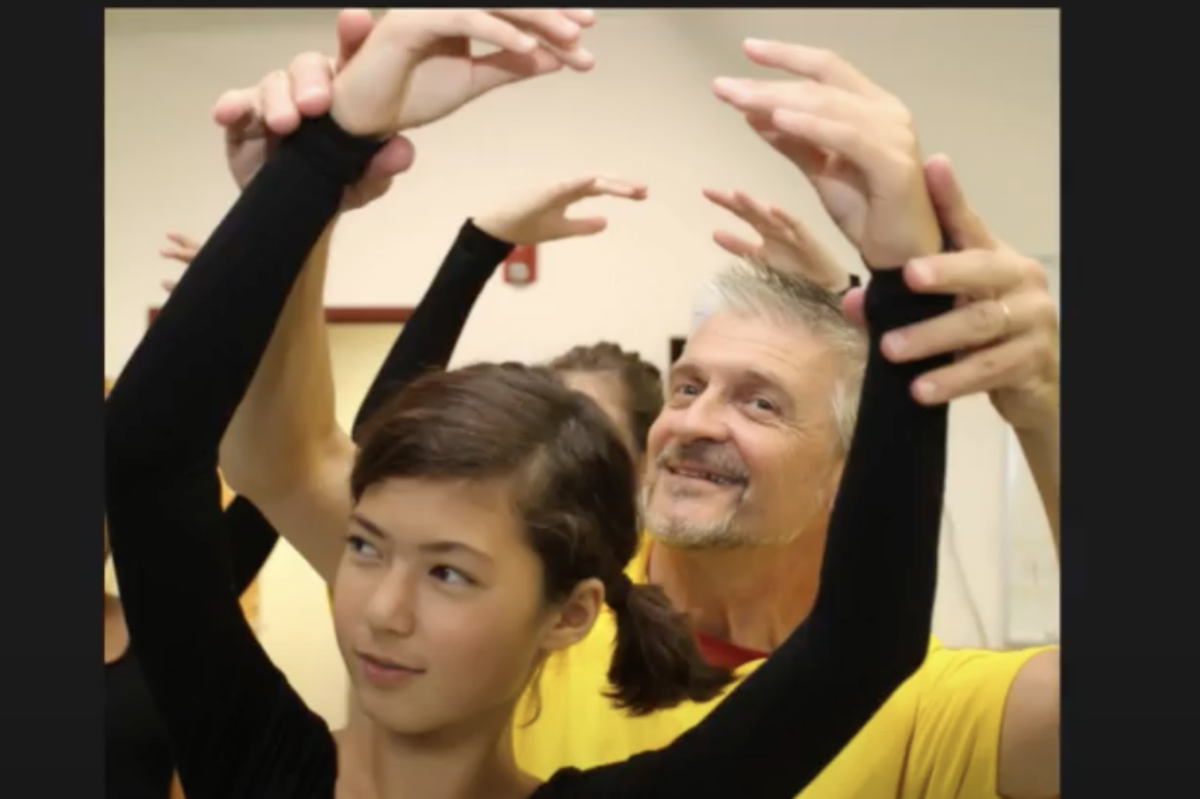
Salesian Spirituality has had a tremendous impact on my life. I credit the Sisters, and the teachings of St. Francis de Sales and St. Jane de Chantal with inspiring me to devote over half of my life to the mission of the Visitation School.

I’ve decided to share some details from my first quarter here, and my initial encounter with Salesian Spirituality.  At the beginning of this 36-year journey here at Visitation, the students had not yet been as immersed in the study and practice of the counsels of St. Francis and St. Jane as they are today. I had one class that was extremely noisy and disrespectful. I tried changing the atmosphere and engaging the students in learning the beauty and the value of ballet and ballet training. I tried this in innumerable ways.

But –– while I was envisioning a program modeled after the great ballet academies in Europe, the students were disappointed that they didn’t have jazz, tap, ballet, and baton in my class. They had expected a program like most American neighborhood dance schools were offering in the Eighties, and they let their disenchantment be known.

I had hoped that Visitation, with its highly respected academic level, would be the perfect setting for actual classical ballet training. That was also the reason why Visitation had chosen to hire the Andahazy Ballet, known for its commitment specifically to the classical traditions.

Well, I’m sure you have heard the expression, “If you want to make God laugh, tell Him your plans!” I was about to experience this first-hand –– there was a crushing gap between my vision and reality. I really suffered over this. I went to the chapel to pray several times. I wanted to do the best I could for the students.

One time, passing by the stained-glass window in the foyer of the Fine Arts Center, its words jumped out at me: “All things with love, nothing by constraint.”

The words made me really angry –– like a case of false advertising –– ineffective in real life.  It felt like mockery. It caused me to roll my eyes, thinking it was a pious platitude. It felt totally unrelated to my actual situation. How could “no constraint” ever solve my current conflict with the students? My first reaction, then, was irritation.

But I suddenly found myself challenged: challenged that, if it was true, I needed to actually apply the words and put “all through love, nothing by constraint” into action.

So, I asked myself, “How do I live this in my situation?”

I had already doled-out detentions to all the students in the class. Their response had been fury. Some of the students felt I was unfair. They said they had not been part of those who were disruptive. Some said they didn’t want to be treated like “a bunch of kids”.

My effort to live out the words of our founders made me hear their complaints. The next time I met that class, I announced that each of them were to assign themselves detention, or no detention, depending on whether or not they had contributed to the mayhem. Except for one student, everyone ultimately assigned themselves a “detention”.From that day onward, there was peace in our relationship. By applying, “All through love, nothing by constraint”, to my teaching, I learned that one has to put into action the virtues taught by the Visitation Sisters’ two great foundings saints: humility and gentleness. Then, and only then, will they become powerfully effective in our lives.

Allow me to share another Salesian quote from the Letters of Spiritual Direction (page 109) that is especially meaningful to me: “Try to carry out your tasks cheerfully; but if you cannot do it cheerfully, at least do it courageously.”

This has been very helpful to me. Maybe we are not always able to successfully accomplish the tasks set before us in the way we had envisioned, and which we feel would bring us joy. So we become discouraged. It’s normal. It’s something we cannot change. But, what we can do, is to go on, courageously.

The last quote I’d like to share with you is the motto of the Sisters of the Visitation Monastery of Minneapolis: “A gentle presence in a violent world.”

As followers of Visitation spirtuality we are asked to say the Direction of Intention every morning: “My God, I give you this day. I offer you, now, all of the good that I shall do and I promise to accept, for love of you, all of the difficulty that I shall meet. Help me to conduct myself during this day in a manner pleasing to you. Amen.”

We do this in order ultimately to bring about God’s Kingdom on earth. Envisioning something, and then carrying it out with intentionality has great power; however, the essential is how we carry out our intentions. Throughout each day we have to strive to be generous, hospitable, and loving in how we treat those we encounter –– and whom God has placed in our paths. We are called –– and must be compelled to follow the motto: “A gentle presence in a violent world”.

Here is my personal motto, to share with you: The best antidote to violence is beauty.

St. John Paul II and Pope Benedict XVI repeatedly have affirmed that beauty is the indispensable ingredient to counteract evil. The famous speech of Leonard Bernstein after the assassination of President John F. Kennedy, stressed the importance of beauty through the arts for conquering violence in the world.

The striving for beauty in ballet training is very challenging to the individual, because it involves our bodies. The need to change our physical body requires a supreme effort since our perception of our own self is so intimately bound to our body.

To choose a higher esteem than our own self esteem is a herculean task. I don’t even believe that this is possible without real spiritual help. But with God’s grace –– God’s actual intervention –– a person can develop a self-image in God’s image –– when we are humbly aware of our limitations –– and ask.

Dear Graduates, the Sisters of Visitation have always embodied these virtues –– practicing these counsels daily –– as a commitment to their religious vows. This is the most precious and lasting gift from Visitation to you.

Is that not why we are here today –– the one-hundred forty-eighth graduation of our school? To celebrate that something of inestimable value has been bequeathed by the Sisters to us: the tradition of practicing the Salesian virtues daily, especially their crowning motto –– “LIVE + JESUS!”

Marius Andaházy, formerly of Stockholm’s Royal Swedish Ballet, is Artistic Director of the Andaházy Ballet Company (www.andahazyballet.com) and the Andaházy School of Classical Ballet of St. Paul / Minneapolis, Minnesota. He has directed a ballet program from 1984 through the present for Visitation School in Mendota Heights, Minnesota. Marius Andaházy can be contacted via email: >ballet@andahazy.com

Visitation School in Mendota Heights, Minnesota, is an independent Catholic school founded in 1873 by the Sisters of the Visitation of Holy Mary. It educates boys and girls from Montessori Pre-K through grade five and all-girls in grades six to twelve. A Visitation education is more than just academic achievement; it’s about growth and wholeness in mind, body and spirit. Visitation provides an education that is not for school, but for life (Non Scholae, Sed Vitae). (www.visitation.net)

Copyright Marius Andahazy 2020.

Photo credit: Andy Clayton-King of King Studios

The Wounded Surgeon: Suffering the Little Children in Dana Gioia’s “Special Treatments Ward”

But Jesus said to them: “Suffer the little children, and forbid them not to come to me: for the kingdom of heaven is for such.”

—Matthew 19:14

“Evil,” wrote Flannery O’Connor, “is not a problem to be solved but a mystery to be endured.” Pains can either be borne in emulation of Christ crucified or they can be borne bitterly, like arbitrary afflictions lacking meaning and mystery.

Dana Gioia, the poet and public intellectual who has done more than any other living figure to galvanize the Catholic literary tradition, prompts this either / or in a number of his poems, not a few of which unveil him as no stranger to suffering. Gioia, once a business executive and former Chairman of the National Endowment for the Arts, acquired a keen knowledge of loss when in December of 1987 his four-month-old son Michael Jasper died of sudden infant death syndrome.

As he said after the death, “I saw poetry differently. Writing took on a spiritual urgency I had never experienced before.” Often this urgency leads us through hellish landscapes, lairs of despair. And yet, as Janet McCann observes, if Gioia’s poetry can be dark, it “isn’t nihilistic, nor is it unforgiving.” “Special Treatments Ward”  is one striking example.  In this poem, the narrator’s reduced state leaves the reader rattled; the suffering of innocents has left him lost. Taken as a whole, however, the poem elevates us above this world’s ceiling, ameliorating our losses through the dead children’s healing.

So this is where the children come to die,
hidden on the hospital’s highest floor.
They wear their bandages like uniforms
and pull their IV rigs along the hall
with slow and careful steps. Or bald and pale,
they lie in bright pajamas on their beds,
watching another world on a screen.

Read More about The Wounded Surgeon: Suffering the Little Children in Dana Gioia’s “Special Treatments Ward”

“Hasten to Aid Thy Fallen People”

“Hasten to Aid Thy Fallen People”

How does one make a song of holiness?
  Or speak of music without spoiling it?
They both seem more than our tongues can confess
  And, born above, in our world do not fit.
    What’s more, those who ascend with them
    Are closed in on themselves, struck dumb,
And all in ecstasy that they have heard
Seems flailing, foolish in a fallen word.


But every rising strain must strain indeed
  To lend a form to what in truth is light,
And manifest peace as if it’s a deed
  And give transcendence some arc of a flight.
    The purity of every saint
    Will be daubed on with sloppy paint,
And what no thought may comprehend or say
Must be taught in the staging of a play.


The gift of form, because so fascinating,
  As we bend down to work with knife or ruler,
Reminds us that beyond it’s always waiting
  Some piercing light. Consider how the jeweler
    Makes every cut upon a stone
    For its sake but not that alone,
His patient labor wasted if a line
Does not refract and multiply and shine.


And, any humble implement may serve
  To figure-forth and yet conceal that light,
So that high thought is felt upon each nerve
  And mystery is given to our sight.
    Just this way, things are lifted up:
    A chalice wrought from wooden cup;
A little dust and water, mixed to clay,
Are molded into birds that fly away.


The Mass is first His earthen sacrifice,
  But also taste of peace and heaven’s throne,
The gift that leaves behind all thought of price
  Yet where, no less, we raise a plangent groan,
    For at its finish we are sent
    Into the world both dark and bent
That bearing out the Virgin’s hastening aid
From ruined choirs some good may be remade.


This is the seventh and final poem from James Matthew Wilson’s new book of poems, The River of the Immaculate Conception (Wiseblood Books, 2019), commemorating the Mass of the Americas and rooted in his childhood vision of America as a Catholic Country. “Hasten to Aid Thy Fallen People” is a line from the Marian antiphon for the Advent season, the Alma Redemptoris Mater, which begins:
O loving Mother of our Redeemer, gate of heaven, star of the sea,
Hasten to aid thy fallen people who strive to rise once more.

“Gloriosa Dicta Sunt De Te”

“Gloriosa Dicta Sunt De Te”

When we think of our land, we often think
Of those bare wilds waiting to be claimed,
As if it were a force of will alone
That made it ours, and mixing sweat with dust,
Its matter with our labor, what was nothing
Becomes somehow a thing that might be loved,
Be built upon and put to use, defended.
I have been one of those who stand in awe
Of pioneers and makers of great things,
Of those who slice a sharp spade through thick roots.


How much less often do we think of land
Not as the stuff lain idle to be grabbed,
But as a stage, a platform where we stand.
Not empty, for upon it we depend;
Not arbitrary, for it’s all been formed
So long before our dawning that we sense
A hundred histories have gone to dust
Deepening the hillsides, carving out its rivers.
How rarely do we think of it as place,
As scene where destinies are shaped by grace.


So, in my childhood, the lakeside chapel,
Modest and plain, shaped like a wooden boat,
Where I heard Mass in summertime, was named
For St. de Porres, and he prayed for us,
Though all I knew about him was his name.
And so, in Maryland and San Francisco,
The place is named not for what we have done there,
But for what we hope we might still receive:
The walls of city, home, and church designed
Just to contain what grace will fill them with.


So, sitting in my classroom, as a boy,
The school named for Saint Thomas of Aquino,
I heard my teacher speak of Michigan,
Of Joliet, Doblan, and Père Marquette.
And, telling us their stories, she unfolded
Another history than the one we’re used to.
One in which, by the Holy Spirit’s grace,
Men slipped along the wilderness’s veins,
Bearing such names as, hitherto unspoken,
Might be, to consecrate a land of saints.


For, naming is a kind of grace not deed.
It clarifies what was not understood,
Such that, what outwardly remains the same
Becomes itself more fully and more truly,
Transformed within by the articulate light.
To lay above a saint’s bones on the shore;
To pray the words that saints have prayed before;
To name and know what comes forth from the darkness;
These are the occupations of a place,
Its purpose and its glory and its grace.


Editor’s Note: This is part 5 from James Matthew Wilson’s new song cycle, The River of the Immaculate Conception which may be purchased from Wiseblood Books. The title translates as “Glorious Things Have Been Said of You.” This is first a quotation from Psalm 87, where it refers to “The City of God.” But it is also a quotation from a Gregorian chant celebrating the Immaculate Conception: “Glorious things have been proclaimed concerning you, O Mary; for the Almighty has
done marvelous things on your behalf.”

The Agnus Dei of Jacques Marquette

The Agnus Dei of Jacques Marquette

    Before the thousands, Père Marquette stood up to preach,
That through the Blessed Virgin none escape his reach;
That though he suffer all, he’d bear the sacred story
Down the great river he’d entitled to her glory.
And now, before him, knelt the warriors and their chiefs
To whom, a year ago, he’d promised her reliefs
From sin and solitude, from shadowed ignorance,
And, in that wounded wilderness, her peace advance.
    Behind him, four great images of her were raised
On Chinese taffeta that left the fires amazed;
They heard of Jesus Christ, who on that day had died
For them upon the cross, his mother there beside,
And John, who loved and honored her with filial love.
The mysteries of the faith seemed hovering just above.
    But even as he spoke and offered all as gift,
Marquette felt deep within his side the aching rift
That would, a few days hence, force him to leave again
This mission he had credited the virgin’s gain.
And leaving thus, he knew already, he would meet
Her robed and crowned with stars, and treading with bare feet.
Those feet, he told them now, would trample Satan’s head,
Restoring life and light to this world dark and dead.
    For years, he’d served the mission of the northern lake,
Learned the Algonquin tongues and said Mass for the sake
Of those who had been baptized by priests come before him.
But it was not for this so many waters bore him
To that new world, where Jogue and Jean Brébeuf had died;
And not for this that in his private prayers he cried,
Begging Our Lady send him where all were deprived
Of knowledge of her son. Then, Joliet arrived.
    “This day of the Immaculate Conception, he
Comes bearing news we are to solve the mystery
Of the Great Water our Illini say runs west
Beyond those lands claimed by a French or Spanish crest,”
Marquette wrote, but by then the lakeshore sank in ice;
They waited, stomachs hungry, fur coats plagued with lice.
He waited, making the Ignatian long retreat,
His prayer, cold breath, and penance, his cold ache of feet.
They waited, till the sun returned with biting flies,
Then seven men, with corn and smoked meats for supplies,
Launched birch canoes, at last, that they might go explore
What other miracles Our Lady had in store.
    How beautiful, descending the Meskousing stream,
To slip along soft waters, marshy with the cream
Of wild rice. As they passed, the birds rose in a cloud
And flapped one great arc through the sky until it bowed
Back to the water and hid once again in reeds,
Whose stalks brushed the canoe and filled its floor with seeds.
Marquette knew it a place through which a man may pass
As unremembered guest, as breath upon cold glass,
And spoke into that emptiness a further vow:
To dedicate to Mary all that she’d allow.
    As deer roused from their drink upon the iron shore,
Then fled beneath the towering oaks, he heard the roar,
Dim at first, loudening, as the idle current sped
And spat them forth upon the Mississippi’s bed.
“I felt,” Marquette would write, “a joy I can’t express,
To name for her that river which flows like a tress
Down the vast, rolling back of that great land we bring
To Christ, and trust to the protection of our king.”
    The river was so wide and gentle, deep and brown,
They drew their oars in, let its silence take them down.
But then, a giant fish struck, shaking the canoe,
And in the grass, a great wildcat came into view,
Straight-whiskered, tiger-faced, with pelt of gray and black;
A bone-nosed sturgeon leaped and splashed upon its back.
But, more than these, and stranger, prairies to the West
Seemed shadowed with dark masses: horned, in shaggy vest,
Broad-headed and thick-maned, hump-shouldered buffalo
Whose skin and meat they had already come to know,
But whose horns they had yet to see impale a man
Then hoof him in the dust, within a moment’s span.
    “For days, I saw such creatures, but no human being.
We kept our fires small, for fear of what they’d bring,
And bedded through the dark hours in our anchored boats
Where I stared up at stars and murmured over my notes,
Knowing that all we carried with us could be lost
And that I’d pay with pleasure a still greater cost,
So long as I may bring to such a wild part
The mysteries Our Lady pondered in her heart.”
    But then, Marquette would write, one afternoon they found
Faint tracks imprinted in the shoreline’s muddy ground.
Marquette and Joliet alone pursued the trail
And, silent, came unseen within a village pale.
Then, loud they raised their voices, and the priest stood tall
In long black robe, as braves came answering their call.
    The Indians wore French cloth and bore a calumet
Dangled with greeny feathers, as they came and met
The strangers. They were called the Illinois, one said.
An old man spoke: “How beautiful the sun that’s led
You Frenchmen to us, and we welcome you in peace.”
Then women crowded, children stared up without cease.
    As all these gathered, the young priest stood forth to speak:
“O people, you like us the Father made, and weak
Like us, you are the children of his sacred pity;
He wishes you to join him in his holy city,
And so he’s sent me down this river as his priest,
That all who live upon it may share in his feast.
Let crosses be upraised and idols downward hurled
That all shall see his peace restored into the world.”
    Their chief replied, “The sun grows bright, the river smooth,
The corn more sweet, tobacco in its power to soothe,
Because you come among us. But, I beg of you,
Proceed no farther or a beast downstream will chew
Your boats to splinters, and the Arkansas are fierce,
Return all greeting with a wail, and gladly pierce
The stranger with their arrows and their Spanish guns.
There is no further good where this great water runs.”
    But when he paused, the priest replied that he’d no fear
To lose that life God gave him, not to be held dear,
Then promised to those people he would come again
To live with them, if that was what the Lord should deign.
    And though the harsh Missouri caught them in its flood,
Great demons stalked the cliffs, and Indians cried for blood;
Though even Marquette would feel an axe blade graze his head,
And fever and mosquitos weakened his soft tread;
Within a year, though pale and worn, he did return.
And there, he preaches, till his guts begin to burn
And names one last place after the Immaculate,
For even now, he knows the hour has grown late.
    He takes his leave again to trace the northern shore,
Where, in the Easter twilight, he can row no more.
His two companions urge him on with words and tears;
But he has prayed for this, and silences their fears:
“My brother Xavier died in wretchedness afar,
And brothers Issac, Jean, and Gabriel died in war.”
They lay him by the water, build a hut of bark,
And see his eyes are brightening as the sky grows dark.
“Mother of God, remember me,” they hear him call;
And then, Marquette lay back his head, and that was all.

The Hymn of San Juan Diego

[Editors note: This is the second poem in the song cycle by James Matthew Wilson inspired by the Mass of the Americas, called “The River of the Immaculate Conception.” The book may be purchased from WisebloodBooks.com.]

The Hymn of Juan Diego

Thus it is said that Juan Diego
Saw first the Aztec girl,
Her shoulders cloaked in starry mantle
Her hair dark as the merle.


The hill whereon she stood had been
An ancient mother’s home,
Laid low with all Tenochtitlan
When stout Cortez had come.


Light sprang from dull rocks at her feet
And birdsong filled the place,
While she herself eclipsed the sun,
Its blaze about her face.


And every color of the stones
For which the Spaniards killed
Became the turquoise and the gold
With which the sky was filled.


“All those who seek me, Little One,
Will have me for their mother;
And those by pride or greed estranged
Will someday call you brother.”


Juan begged the bishop build a church,
Received a doubtful smile;
And felt his own unworthy bones
As ignorant and vile.


The bishop’s jeweled servants scorned him,
Said he was telling lies.
A second time the bishop’s asked,
A second time denies.


Some thought to beat Juan for his words;
He found his uncle ill,
So every claim upon him led
Him to avoid her will.


But she met him upon the way:
“Why do you run from me?
My mantle covers you already,
And sets your uncle free.”


“Gather these roses in your cloak
As your land’s never seen,
Then, lay them at the holy feet,
And he’ll know what they mean.”


The brute crowd at the bishop’s door
Stood in his way and sneered.
They saw his breast of flowers and snatched;
The petals disappeared.


So, Juan Diego was let in
To stand before the throne,
To show his harvest of the rose
Where rose had never grown.


“I’ve done as she, the mother of God
Told me to do,” he said,
And poured out at the bishop’s feet
The bright abundant red.


But, as these fell, the bishop saw
Juan’s rough-stitched cloak unfold
The image of that placid queen
Ablaze with teal and gold.


He fell upon his knees in praise
And wept for love of her
Who on that land of rock and thorn
Her great care should confer.


Beneath her mantle and her banner
All those vast lands are warmed,
But what we seek in them must be
First by her love transformed.


And so, Diego’s cloak poured forth
Not conquest but sweet flowers
And Mary chose a tattered cloth
To first unveil her powers.


This is the second poem from James Matthew Wilson’s new book of poems, The River of the Immaculate Conception (Wiseblood Books, 2019).

Who is James Matthew Wilson? Dana Gioia Speaks

From the editors:

Our present to you this Lent is to publish a series of poems by James Matthew Wilson. They commemorate The Mass of the Americas and are inspired, as James wrote in First Things, by his childhood sense of America as a Catholic country.  He doesn’t mean, of course, that America is only a Catholic country.  But the Catholic roots of this country run very deep and include many underappreciated heroes.  He calls this song cycle “The River of the Immaculate Conception.”  That river is known by its official name: The Mississippi River. Yet early on, Jesuit missionaries consecrated it to Our Lady.  Purchase the book of poems at WisebloodBooks.com.

We are very proud and excited to give you this gift. James Matthew Wilson is not just a good poet. He is one of our finest rising Catholic artists and intellectuals. 

You don’t have to believe us.  Believe Dana Gioia on the video below:

“James Matthew Wilson is the most conspicuously talented young poet-critic in American Catholic letters…When you hear James’s work, you’re hearing the kind of tradition that’s in Anthony Hecht, Robert lowerll, William Butler Yeats. Certainly this new poem, it’s as if James has set down in this new work with a great organ keyboard and he’s decided he’s going to play every key, he’s going to pull out every stop in the course of creating this new poem each of the sections of which is in a different form, a different line length, a different rhyme scheme, a different perspective; and it’s an incredibly difficult act to bring off because at every moment you’re taking risks. But I think that it is a successful and exciting work. You know there is, at the moment, an exciting rebirth of Catholic poetry in the United States and it’s full of talented young writers but even in this interesting cohort James Matthew Wilson, I think, is one of the leading people that you are really going to watch in the future.”  Dana Gioia


The Great Renaissance Artist You’ve Never Seen Before

The National Gallery of Art has put on an extraordinary exhibit of a great Renaissance artist who is almost unknown outside his native land: Alonso Berruguete (ca. 1486-1561) was the first and greatest sculptor of the Spanish Renaissance.

He is little-known outside of his native country, however, because much of his artwork is embedded in the massive gilded wooden retablos that he built as towering backdrops for the main altars in cathedrals and monastery churches in and around his native Valladolid in central Spain. The retablos, multi-leveled and crammed with multiple images, carved and painted, of Christ and the saints, some of enormous size so they could be seen by worshipers far below, cannot be transported. And the cities of Valladolid and Toledo, where Berruguete did most of his work, are slightly off the tourist trail, so few Americans are familiar with his sculpture.

For me and for many, that just changed as a result of this exhibition:

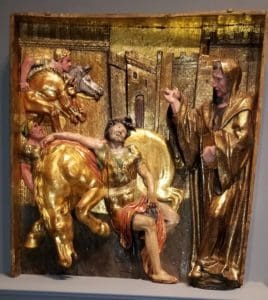
St. Benedict converting the Goth Zalla (monastery of San Benito el Real, Valladolid)

Fortunately for American lovers of art and especially sacred art, during one of its periodic anticlerical phases during the 1830s, the  Spanish government xpropriated and forcibly secularized the site of one of Berruguete’s most impressive altarpieces: the Benedictine monastery church of San Benito el Real in Valladolid.

Berruguete’s 40-foot-high retablo was mostly destroyed in this burst of iconoclasm and many of its sculptures ended up in a municipal museum. That made it possible for them to travel outside of Spain, and their portability has enabled the National Gallery of Art in Washington, D.C., to assemble the first major U.S. exhibition of Berruguete’s work.

The exhibition includes some of his most impressive sculptures from San Benito and nearby churches, together with paintings, drawings, and pieces by other Spanish artists who were contemporaries of his that give his output an artistic context. The exhibition, scheduled to run through February 17, is a small one: just 40 artworks in two rooms. It is complicated by the fact that Berruguete, like many successful artists of his time (and Andy Warhol in our own day), employed a workshop of apprentices to help fill his numerous commissions, so it is difficult to ascertain how much of any particular sculpture is actually the work of his own hand.

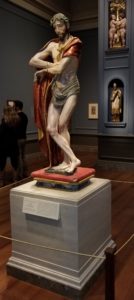
Ecce Homo (monastery of San Benito el Real, Valladolid)

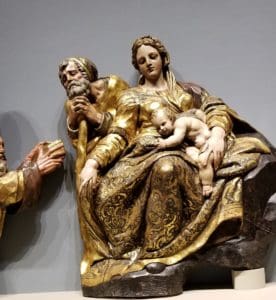
Yet all of them—figures of the crucified Christ and his mother, saints, and Old Testament prophets–bear the mark of Berruguete’s unquestioned ability to meld wood, gilding, classical technique learned from Italian Renaissance masters, and a flair for emotional expressiveness into sculptures of astonishing religious intensity.

Valladolid, about 120 miles north of Madrid, was the capital of the kingdom of Castille during Berruguete’s lifetime and thus, effectively, the capital of Spain itself. Ferdinand of Aragon and Isabella of Castille were married in Valladolid in 1469, and their most famous protégé, Christopher Columbus, died there in 1506. Miguel de Cervantes, author of Don Quixote, lived and worked in Valladolid. Berruguete’s father, Pedro Berruguete (ca. 1450-1504), was also an artist, even more talented as a painter than his son, if a Madonna and Child of his on exhibit at the National Gallery is any indication.

Pedro had brought the Renaissance to Spain in a different fashion, introducing a Flemish “Northern Renaissance” style of painting that influenced many Spanish artists besides himself. After Pedro’s death, his son Alonso, then age 18, took off for Italy, where he lived in Florence and Rome for thirteen years and developed his talent for sculpture, befriending and assisting Michelangelo, Andrea del Sarto, and Filippino Lippi, among others. He also became one of the early promulgators of Mannerism, the 16th-century artistic style that emphasized extreme emotive expression—often via elongated figures in contorted positions–over classical harmony in composition.

When Berruguete returned to Spain and transformed his Italian training into an alabaster relief titled The Resurrection for the cathedral in Valencia, his work suddenly became in high demand. The Holy Roman Emperor Charles V, grandson of Ferdinand and Isabella and heir to the Spanish throne, made him court painter and sculptor in 1520. He turned from stone sculpture to wood, the traditional material of the medieval Spanish retablo, and his workshop in Valladolid, together with other patronage from Charles, made him a wealthy man. He continued to work in wood, marble, and bronze until his death at nearly age 80.

Adoration of the Magi (Chapel of the Epiphany, church of Santiago Apostol, Valladolid)

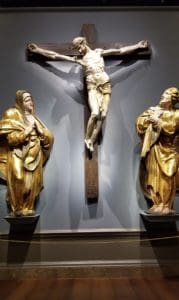
Crucifixion (monastery of San Benito el Real, Valladolid)

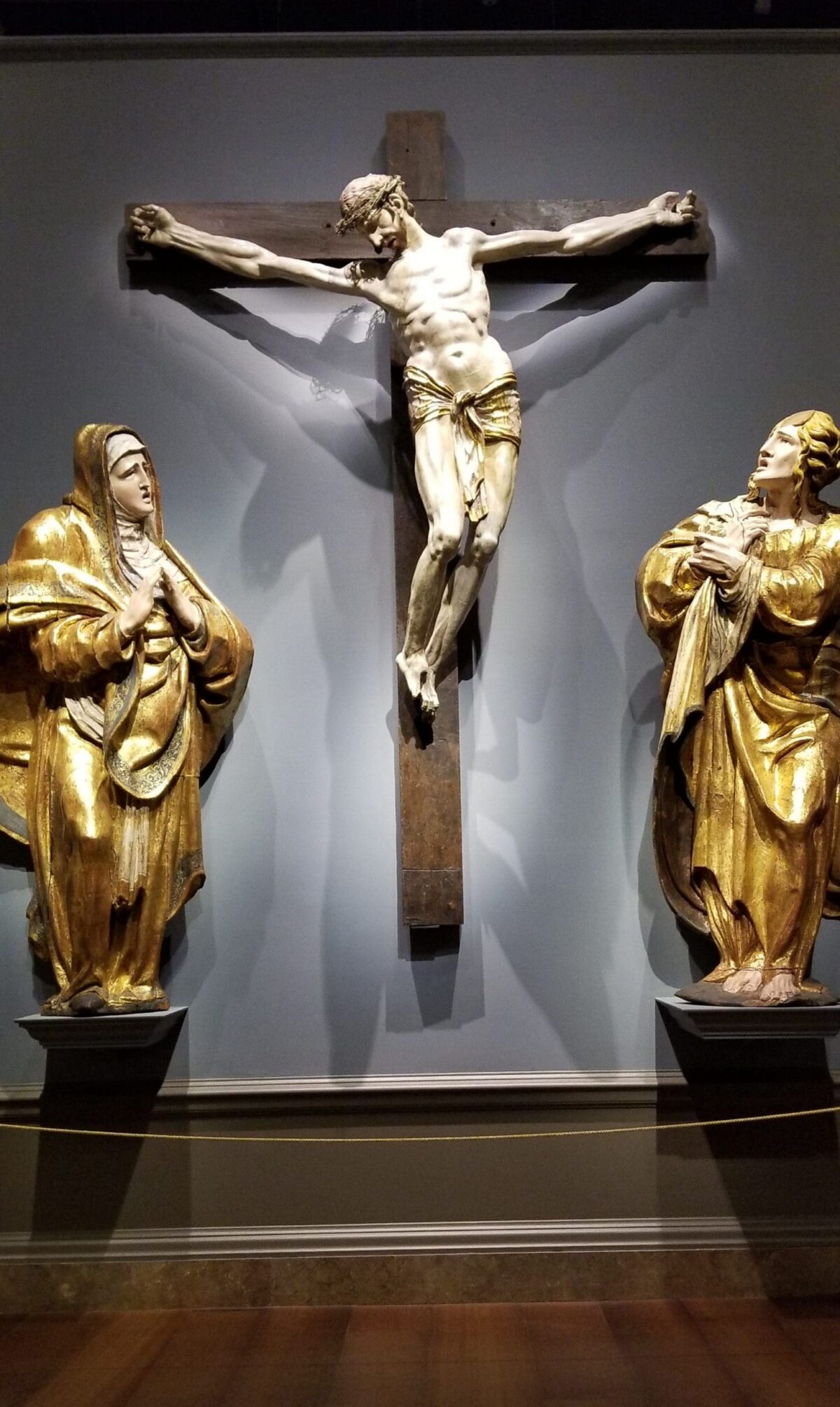
The retablo sculptures of Berruguete on display at the National Gallery, lavishly gold-painted and brilliant with color, are nearly always twisted figures caught in moments of emotional agony or religious ecstasy. A sculpture from the San Benito church depicting Abraham about to sacrifice Isaac displays a crouching, open-mouthed, nearly nude Isaac, his hands bound behind him and his body bowed over with terror (his figure resembles one of Michelangelo’s male nudes on the Sistine Chapel’s ceiling), while the gray-bearded Abraham gazes at the viewer in as much torment as his son. Two wooden prophets writhe in the divine power that inspires them. The most thrilling of Berruguete’s statues in this exhibition are his crucified Christ flanked by his mother, Mary, and the apostle John; their enormous figures once crowned the pinnacle of the San Benito retablo. Mary and John, both wrapped in swirling, voluminous gilded garments, grieve for the dead Christ, but more calmly, as seems fitting, than the emotion-charged figures from below. As for Berruguete’s Christ, his body, gray in death and looking as though it were carved from stone, seems utterly at rest, the bloody work of redemption complete.

For Americans—and others of the New World—Berruguete’s sculptures will resonate in an additional way. The Spanish colonizers of the Americas brought their retablo tradition with them to the churches they built there. Artistic styles changed over the centuries, but anyone who has visited the California missions or the cathedrals in, say Mexico City or Cusco, will find Berruguete’s lavishly decorated wooden edifices startlingly familiar. We have one of Spain’s greatest sculptors to thank in part for one of our own architectural traditions.

Charlotte Allen is a D.C. based arts reporter for Catholic Arts Today and the author of The Human Christ: The Search for the Historical Jesus.

Sarah Cortez: Cop, Poet, Catholic

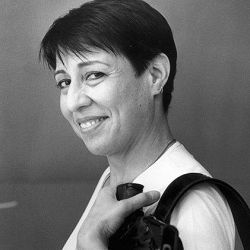
Sarah Cortez is known as “the cop poet.” One of her favorite photos of herself features a mischievously smiling Cortez showing off her gun in its shoulder holster.

Her work includes short stories, essays, and a memoir as well as poetry, and much of it centers around her later-life career as a police officer in her native Houston. (She graduated from that city’s police academy in 1993.) Her first collection of poetry, How to Undress a Cop (2000), published by Arte Público Press, was described by Publisher’s Weekly as “[b]y turns erotic, tender, and gritty” and “powerfully direct.” The poems, some of which had such titles as “Rosie Working Plain Clothes” and “Christmas With the Vice Squad,” bore witness to another of her literary strengths: a sly and observant sense of humor.

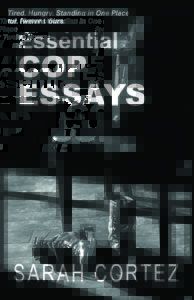
Her latest collection, Tired, Hungry, Standing in One Spot for Twelve Hours: Essential Cop Essays (2018) won a 2019 award from the National Federation of Press Women. In that book Cortez wrote of “the endless boredoms and dirt” and the “tiny, stark terrors” of police work, but also the “hidden rewards of intense camaraderie, sense of mission, and the fulfillments of justice and duty.” Her 2013 collection of poems about policing, Cold Blue Steel, was praised by Booklist for displaying “a frank language in sharp lyrics charged with weary passion.”

Cortez’s literary—and above all, religious—roots run deep. After graduating from Rice University with honors (majoring in psychology and religion) in 1972, she taught herself ancient Greek and obtained a master’s degree in classics from the University of Texas-Austin, and then another master’s degree, in accounting, from the University of Houston, which launched a corporate career that paid well but never satisfied her.

After four years as a full-time officer on the Houston police force specializing in sexual-assault investigations, she moved to reserve-officer status in order to devote herself to a literary career: writing, editing, and teaching creative writing courses as well as promoting the experiences of the Latino-Americans of Texas.

Not long after taking up police work, she returned to the practice of the childhood Catholic faith in which she was raised.

Sarah Cortez is currently the founder and president of Catholic Literary Arts a Houston-based nonprofit that offers workshops in spiritual journaling, poetry and fiction writing and hosts an annual Fearless Catholic Writers Camp for high school students. Find out more about these and other Cortez adventures at CatholicLiteraryArts.org.

Charlotte Allen: Did you start out just writing at night, sort of like Joseph Wambaugh on his first novel?

Sarah Cortez: I started writing before I became a police officer. I was first published as a fiction writer, in the short story. A few years into that, as my first marriage started failing, when I sat down to write, instead of prose, poetry came out.

I only wrote poetry for maybe the next ten to twelve years, so it was during that period that I finished the police academy and became a full-time police officer.

Charlotte Allen: How long did this go on before you decided to try to get published—or did you just decide right away and start sending your stuff off?

Sarah Cortez: Well, I had already been published in fiction. It took several years of doing full-time police work before I started writing about it, because I was then writing about my family, my large, crazy Latino family. I hesitated to write about police work. The majority of police work is dirty and boring. It’s not dramatic and certainly not sexy. That’s a Hollywood myth. But there aren’t too many police officer-poets, so once people started seeing the work, I got a great deal of interest.

Once I started writing the poems and once I won my first award in 1999, many were interested because the poems were written from a street cop’s perspective.  I suppose they had an innate veracity and realism that people were attracted to; also, because they were about calls for service, about getting shot at, what is it like wearing a ballistic vest, and so forth.  So, people knew from the subject matter of some of these poems what I did.

Charlotte Allen: One might think that no one really cares about poets, but in fact that seemed not to be the case in your case.

Sarah Cortez: In fact, I got my first offer for a book without even asking for it. I just got it in the mail from a very wonderful publisher.

It was one of the most gorgeous meetings, ordained by the Holy Spirit. I was standing in the University of Houston Parking lot, doing extra  duty as a full-time police officer, when  who should come out of the building next to the lot but Nicolás Kanellos, award-winning professor of Hispanic Studies at the University of Houston and director of Arte Público Press?

I recognized him. I knew his face. I introduced myself and said, “I just want to tell you: I admire you work and I’ve followed your achievements, and I want to congratulate you.” First, he says “Thank you.” And then he asks that magical question every writer is waiting for the publisher to ask: “And do you write?”

I could have melted into a little puddle on the asphalt. And I said, “Yes, sir.” And he said, “What do you write?” And I said, “Poetry.” And he said, “Well, send me some.”

That began a year and a half of correspondence with this fine scholar and man. I would get home from evening shift at 11 p.m. or 10 p.m. and I would write for 20 minutes or 30 minutes almost every night. I would finish, revise and revise, and I’d send him a group of poems and a snailmail letter, and he would send me a letter back, e.g.: “Well this one is great. I like this one, but I didn’t like the last stanza. It’s too elegiac,”

And then after a while, he wrote me a letter and said, “Well, I think you have enough poems for a book. Do you want a book with us?”

He’s an amazing scholar, an amazing publisher, and I think it shows his character. I was just an unknown cop in a parking lot. He didn’t know about me. I hadn’t won my first big award yet.

And just out of the goodness of his heart, he took the time to have this year-and-a-half correspondence with me.

Charlotte Allen: What has made you a Catholic writer?

Sarah Cortez: Well, after 35 years of being gone from the Catholic Church, I came back about ten years ago. I love being Catholic. There’s so much joy and so much meaning for me in the sacramental life of the Church, in trying to live up to the call of the Gospel. I would never claim to do a very good job at it. I’m always trying to get better at doing that. But I want to share that joy through my writing. I want to appreciate the writing of others. And at this point in my literary career I want to be known as a Catholic writer. It’s very important to me.

Charlotte Allen: Were you baptized Catholic?

Sarah Cortez: Yes. My mother was Catholic. My dad was baptized early on, but his mother died when he was five, and his father remarried a non-Catholic.

My dad was born in 1917. Both my mother’s and my father’s families came to rural south Texas from Spain in the 19th century, farmers and fishermen.  Both families were just struggling. They were struggling to eat and to stay alive. My dad’s mom died in one of the great influenza epidemics of the early 20th century. So, my dad really didn’t have much of a childhood, and he didn’t have any faith instruction in his childhood. He never opposed my mother going to church, and eventually he started going to church with us. After I left to go to college, he actually started fully participating in the Catholic faith.

Charlotte Allen: And what about you? It sounds to me as though just as your father was reentering the faith, you were leaving it.

Sarah Cortez: Yes, I went to college, and like most college kids decided to worship in the chapel of convenience. And then I had my corporate career. And then I left corporate America to go into police work.

Charlotte Allen: Why police work as opposed to anything else?

Sarah Cortez: I fell in love it like you fall in love with a man. Being faced with unmitigated insanity—because the streets are insane. These TV shows don’t even begin to get it right. The insanity doesn’t even have to be dangerous, although it oftentimes is. It’s just a different world. It’s not the world of plush couches in offices. A crazy person knifes you, and you have a knife wound. Or a sane person knifes you, and you still have a knife wound.

But I also fell in love with the mission, which is public safety, the public good, the common good. It’s no longer fashionable to believe in the common good or what’s good for society as a whole among certain people, but to be an effective public servant you must completely identify with the mission, which is being willing to die for people that you don’t even know.

That’s true whether you’re a firefighter, EMS, a police officer, or military. My husband is a retired fireman. There are very few people in policing or firefighting whom I have ever met in 25 years who haven’t come from a Christian background. Even if they’re not “practicing.”  They still come from that core set of assumptions about humanity that you find in the Christian and especially Catholic worldview.

Charlotte Allen: Are there police officers who just haven’t come to terms with death and find themselves unable to continue? They think that they will never die, or people on their watch aren’t going to die?

Sarah Cortez: I’ll put it the way a good friend of mine in my department put it: These young kids who want to become a cop—they don’t really think about it, but they want to be a Care Bear. They get in, and they go through the academy, and they do fine, and they qualify with a firearm and they get a job. And then they find out that a lot of people in the world, especially now, regrettably in America, hate them! You wear a blue shirt? Hey, we hate you! You wear a blue shirt—you’re a racist! With no data, no evidence, no nothing, people just hate them. And it freaks them out, because they want to be a Care Bear.

I went into police work at an older age with my eyes open: OK, some people are going to hate me, some people are going to like me, most people are not going to care about me. I’m hired to do a job, so I’m going to do my job. That person likes me, that person hates me. I don’t know if the younger ones, just because our society has changed so much, understand that.

Charlotte Allen: They hope to be heroes and find out that most of it isn’t very heroic on a day-to-day basis.

Sarah Cortez: It’s dirty. You may lose your life to save somebody else’s life—and they hate cops. But that’s part of the sacramental nature about it.

Charlotte Allen: Is that something that led you back to the church, back to practicing your faith?

Sarah Cortez: Well, it led me to a much stronger faith, because you really must come to some sort of peace with the idea of death before you go to the police academy. If you don’t. you’re really stupid. I was older than the traditional candidate. I was around 40 when I went to the police academy. Most people are in their twenties. But you must know: OK, I’m willing to die. I know what death is, and it’s OK. For most people, that requires belief in God. Not everybody, obviously.

So, it got me closer to my initial belief, but at that point I still wasn’t willing to mitigate belief by action. It was, I believe in God, yeah, but I’m not willing to do the right thing.

But I did have strongly in my mind that if I ever married a second time, that second marriage had to be a sacramental marriage in the Catholic Church. So, when my husband asked me to marry him, I had to get my act in order.

The priest recommended that both my husband and I go through RCIA. And that was actually pretty cool, because when I left the church, I was all of 18 or 19, so I had a pretty simplistic understanding of the Catholic faith. After going through RCIA one of my favorite things to read now is moral theology.  I love trying to extend my intellectual grasp of the religion, although religion is undoubtedly lived out in human interactions, not lived out in reading books. My husband asked me to get married, we went through RCIA, I did my confession, and boom! Here I am today!

I love St. John Paul II. I remember reading his answer to the question: What’s the basis of hope in today’s world? That’s something a cop has to think about: how do we believe in the best, even after seeing the worst?

I have seen things, or read them in reports, or seen crime-scene photographs that are some of the worst things that a human can do. Yet I am constantly called upon by the requirements of my job and my calling to believe the best I can believe in everybody.  If I’m here to save your life as a police officer, I have to believe that your life is worth saving. But I also know that someone who looks exactly like you maybe she tortured her dog.

Police work for me becomes an extremely fascinating crucible to hold all of society’s burning ashes of sheer evil and meanness without it burning me up and still believe in the best in everybody.

Charlotte Allen: How do you avoid cynicism?

Sarah Cortez: The key is realizing that when you know the difference between good and evil then you know that that capacity to do good and evil is inside of everybody: Some people live it out more to the sheep or more to the goats. That is human nature since the Fall. Faith shores you up despite knowledge, so knowledge doesn’t destroy you.

You become that crucible. The crucible cannot break. The crucible has got to hold everything, it’s got to hold it until it gets molten enough to mix together so you can get what the dross turns into, which is the gold, the treasure. So, you’ve got to be able to hold all of this inside of you without breaking.

Charlotte Allen: When you returned to the faith, was this a kind of gradual process, or did it all just happen overnight?

Sarah Cortez: It was gradual, but it was clear. What I had to make it through was the fear. And I think probably for myself as a human being and for many other human beings as well, you’ve to make it through the fear to get to clarity.

Charlotte Allen: What were you afraid of?

Sarah Cortez: Can you imagine going to confession after 35 years? That right there was probably the biggest stumbling-block.

As a child, I confessed things like lying to my mom, being smart-off to my mom. Even so, back then I was always very scared to go to confessional. After 35 years of adult life, I was terrified. But I just regret having waited so long, because there have been so many times that I could have been dead. I woke up twice after falling asleep driving—I opened my eyes and I found I was headed straight to a cement wall. So, if my guardian angel or the Holy Spirit or whatever it was hadn’t awakened me, I would have just driven into the cement wall.

Charlotte Allen: How does your Catholicism works its way into your writing?

Sarah Cortez: Sometimes it works its way into my writing as prayers. I like to write prayers. One poem is the prayer of a sexual-assault investigator, and it came from a case of mine. That was one of my police specialties: sexual assault. I have another prayer that actually came from one of my husband’s cases. He was an arson investigator, so: Prayer of an Arson Investigator.

I love writing prayers. I also love writing about the Mysteries of the Rosary, the great sacred mysteries of the Truth: the Incarnation, transubstantiation, the Immaculate Conception, great mysteries like this. I used to think, again with that simplistic, childlike viewpoint, that the mysteries of the church related to things I would never understand. What I’ve found out, since I’ve come back as an adult to Faith, that the mysteries of the faith really mean that no matter how deep I go into them either intellectually, emotionally, mentally, on any level, I will never get to the bottom. The source will never cease flowing.

Charlotte Allen is a D.C. based arts reporter for Catholic Arts Today and the author of The Human Christ: The Search for the Historical Jesus. This is the second of a series of Catholic Arts Today interviews with Catholic writers who attended the 2019 Catholic Imagination Conference at Loyola University’s Hank Center for the Catholic Intellectual Heritage.

New Poem: Nativity

Nativity

Forget your Christmas cards and little creche
the cutesy donkey, sheep and shepherd boys.
Put away the twinkle lights and all that trash;
the candy, carols, cards and tacky toys.


For there in your safe familiar manger
lies something that should shock and terrify—
a mewling, interstellar stranger,
an undercover agent—infant spy.


He promises to turn every table
and become an unrelenting master.
making the satisfied world unstable
and lashing the complacent with disaster.


Here shivers something unpredictable—
divine but defined, swaddled yet wild.
Here is something tender and terrible—
a feisty girl and her dangerous child.


Fr Dwight Longenecker is a parish priest, blogger, author, playwright and poet. Follow him at dwightlongenecker.com

Subscribe to Our Emails