How Does a Hymn Become a Classic?

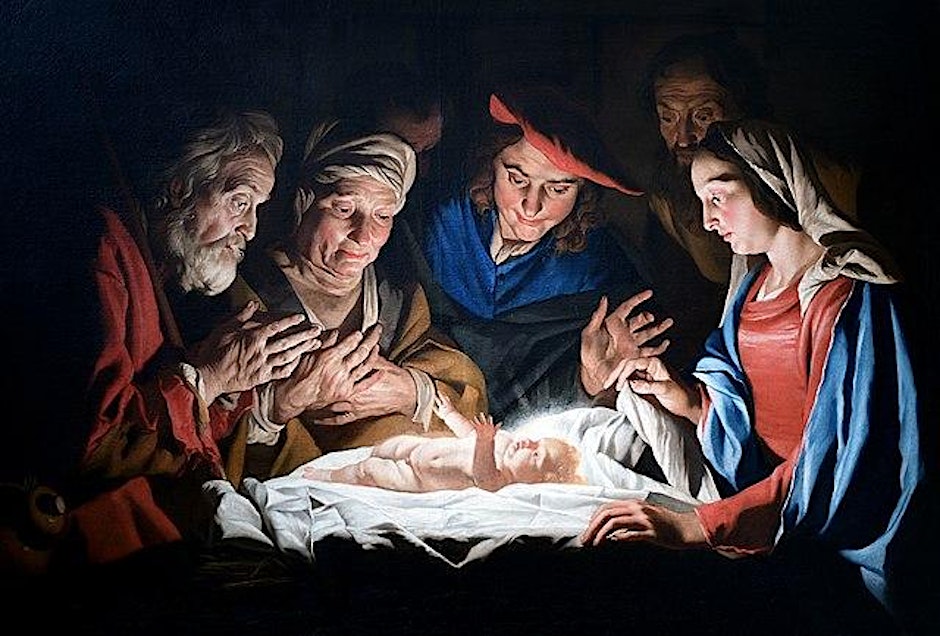
Archbishop Cordileone’s Very Marian Advent Prayer Service Launches World Premiere of Two New Christmas Carols

On December 15th, at Star of the Sea Church in San Francisco, Archbishop Salvatore J. Cordileone will lead an innovative Very Marian Advent Prayer Service featuring the world premiere of two new hymns by major Catholic artists commissioned through the Benedict XVI Institute. James Matthew Wilson teams up with composer Frank La Rocca for a new hymn While All the Earth in Darkness Sleeps, which was inspired by the 6th century Akathist Hymn to Mary. Fr. Dwight Longenecker created Our Lady’s Lullaby with new lyrics to an old Welsh hymn Suo Gan (best-known for its appearance in the Disney film Empire of the Sun) and a new arrangement by composer William J. Fritz. The two hymns are part of a lessons and carols worship format, featuring a magnificent 8-voice schola led by Hillsdale College’s Maestro Timothy McDonnell.
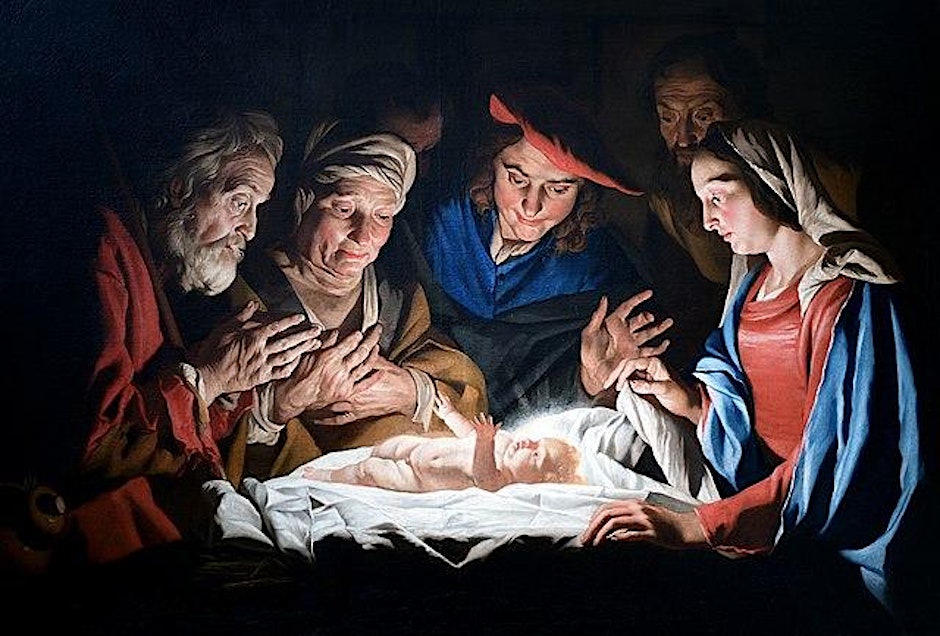
Archbishop Cordileone and the Benedict XVI Institute’s ambitious goal? To create new Advent hymns that enter the canon of the Catholic church.

“Many of our best hymns and carols were composed first as poems and later set to music,” said James Matthew Wilson, poet-in-residence at the Benedict XVI Institute “How daunting as a poet to have to say to myself, this has to work as the kind of language people will want to sing, want to remember specifically as musical, as pure song.”

All ancient, worldly wisdom
Exults before your son,
And lays three gifts before you,
Virgin who nurse the One.
May gold forever glimmer
From both his crown and yours;
May prisoner and pauper
Greet angels at their doors.

Rejoice, o virgin watching through the night.
Rejoice, the gate that opens all to light.
Rejoice, whom even cherubim attend.
Rejoice, seraphic queen and sinners’ friend.
Rejoice, whose breast the food of all once fed.
Rejoice, our lady, stars anoint your head.
Rejoice, for on this night you bore a son.
R. Rejoice, for on this night you bore a son.

~While All the Earth in Darkness Sleeps
James Matthew Wilson

How does a poet even begin to approach such daunting task of adding to the canon of Advent and Christmas music?  “By trying to impart a classic quality to the setting,”  Composer-in-Residence at the Benedict XVI Institute Frank La Rocca answered. “One that sounds like a bit of fresh air flowing through a long and great tradition – a tradition one approaches with a certain reverence and gratitude.”

The second world premiere Advent carol is Our Lady’s Lullaby. “How did you approach this?” I asked Fr. Longenecker. “To write something one hopes will stand the test of time, one looks to the great tradition and tries to write from within that—without either copying or challenging the tradition. For this piece I looked to the great images of the Madonna and child and that connected me instinctively with lullabies,” he replied.

Sleep my Child
In the manger
Sleep my child
Free from Harm
Sleep my child
Free from Danger
Sleep my child
In my arms

~Our Lady’s Lullaby
Father Dwight Longenecker

“When mothers hum to their little ones as they’re putting them to sleep,” added composer William J. Fritz, “many times they improvise without knowing it. I changed the rhythm of the original tune to make it feel like a mother rocking her child to sleep; there is also a departure from the tune in the middle when Mary contemplates her Son’s passion and death. My hope was to hint at the ecstacy that the Mother would feel at the Son’s triumph over death. This is an Advent/Christmas Hymn much like the Messiah – it’s all of Christ’s mystery wrapped in one.”

Last year’s first Very Marian Advent service saw the debut of two other brand new Advent carol:  The Chesterton Carol, by composer Mark Nowakowski, and Our Lady Expectant, composed by Wilhelmina Pariseau from a poem by Roseanne T. Sullivan. Both will be performed again this year.  Mark Nowakowski’s Chesterton Carol has taken a step towards becoming a classic by generating 22,000 views on YouTube and being adopted by many in the Chesterton Schools Network.

The new hymns this were made possible by the support of two new patrons of the arts: James and Kristy Hudon, who commissioned While All the Earth in Darkness Sleeps, and Michael and Sarah Trela, who supported Fr. Longenecker and Mr. Fritz’s new Christmas carol.

Why support new works of art amid that many other urgent needs in the world, I asked them.

“Most of the religious hymns we sing today were composed long ago, borrowed from past generations,” said Mr. Trela. “While these old hymns are excellent, it is time for this generation to humbly contribute with a new Christmas hymn that shares in the joys and tears of Our Lady.”

“We are meant not only to enjoy Art, but to participate in it,” said Mr. Hudon. “A thriving arts culture unites us as Catholics and brings us into fuller communion. A city set on a hill cannot be hidden, and so it is important that we help make our city—the Church—beautiful, as beauty attracts people who have otherwise closed themselves off to the truth of the Gospel.”

Those in the greater Bay Area can register to attend; the Benedict XVI Institute also offers a virtual option: those who register will receive a link to the professional recording of the event, including the new Advent /Christmas carols.

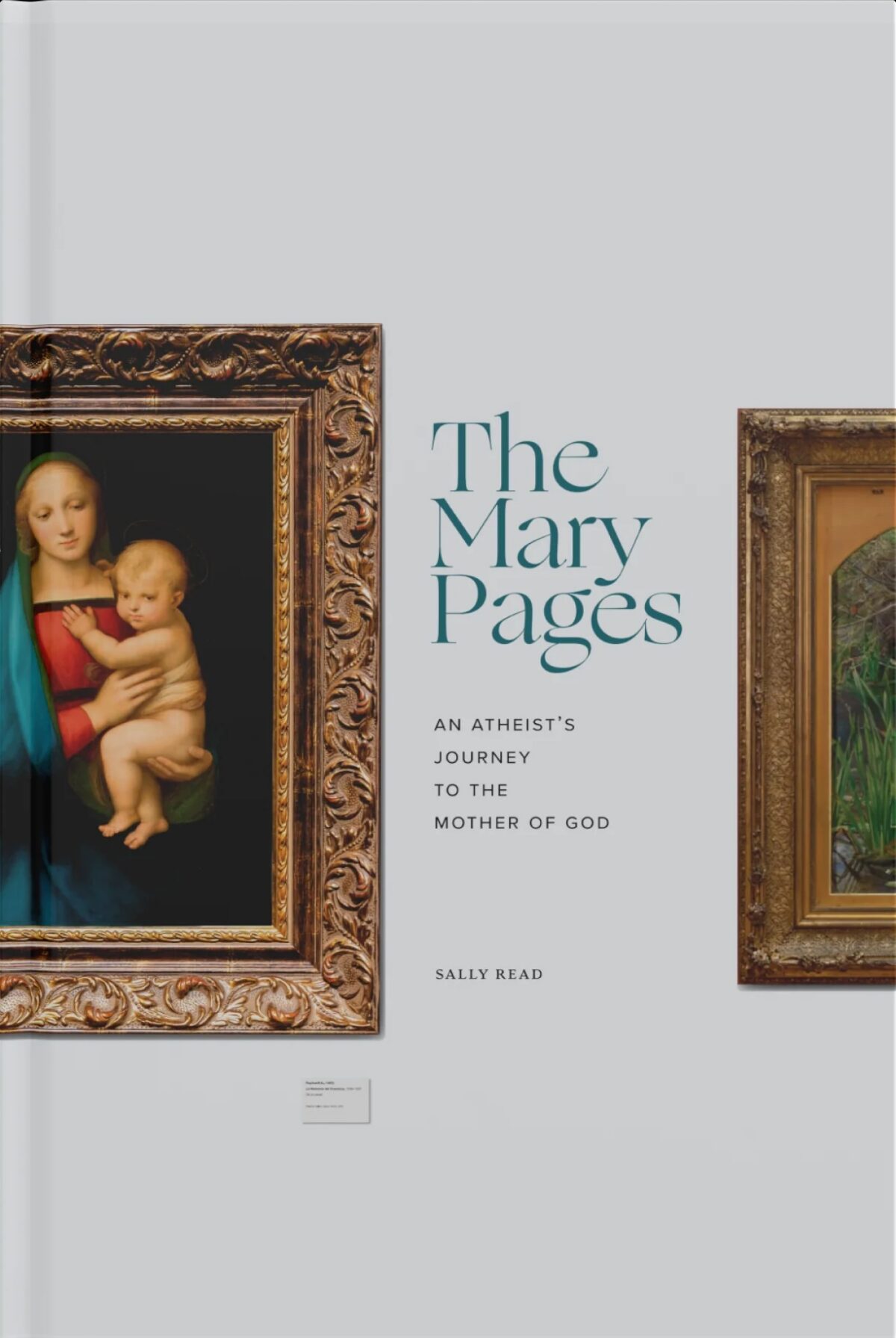
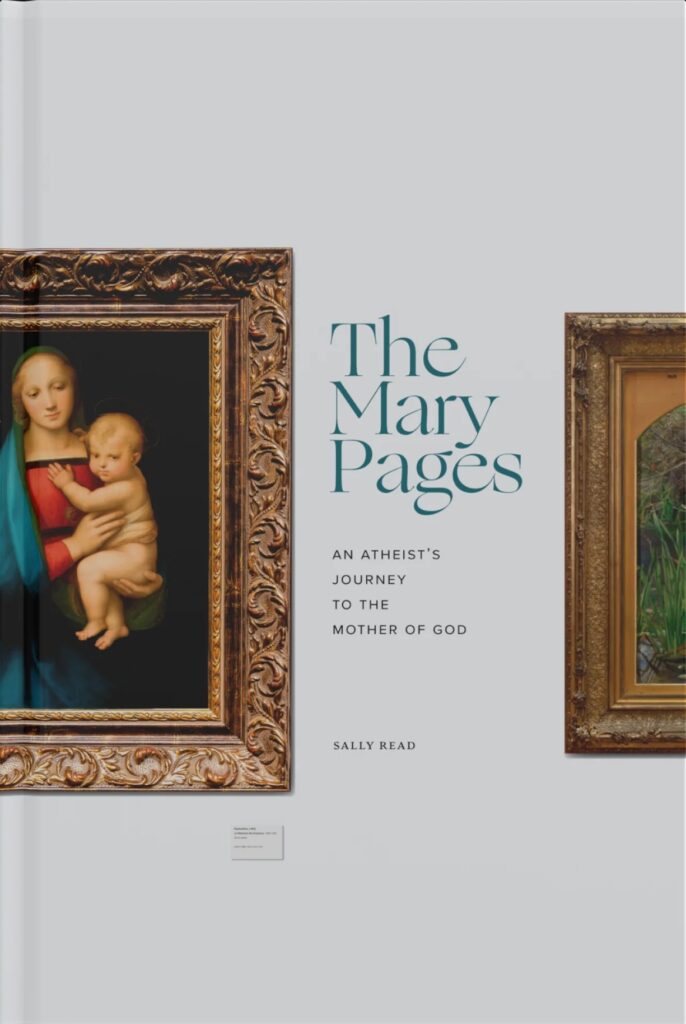
Review: The Mary Pages by Sally Read

Sally Read, born in East Anglia in 1971 and now living near Rome, was a secular poet before she was a Catholic poet. Determinedly secular, too, as she relates in her new memoir, The Mary Pages: An Atheist’s Journey to the Mother of God (Word on Fire). 

Raised by an atheist father who scorned all things religious, in a country that had stripped its churches bare of iconography (especially all that was Marian) centuries before, and imbibing to the full the defiant feminism that marks our current culture, Read unsurprisingly regarded the Mother of God, at least as the Catholic Church views her, with faint contempt. “How best to shut a woman up?” she once mused as she she contemplated Mary’s seeming irrelevance to contemporary women’s issues such as genital mutilation, date rape, and domestic violence. “Put her on a pedestal, and give her a crown.”

The Mary Pages is not a conversion story. Read has already told that story, of her nine-month journey in 2010 from cynical atheism to the Catholic Church, in a 2016 memoir, Night’s Bright Darkness. Nor is The Mary Pages a conventional autobiography; it seems purposely vague on detail. Instead, it is a story, meticulously and beautifully written, of how Mary insinuated herself into Read’s internal life so thoroughly, starting in childhood, that she would be inevitably led to Mary’s Son. The medium was art. Read’s grandmother had a copy of a Raphael Madonna hanging on a wall. The mother and baby mesmerized the unchurched little girl who scarcely knew who Mary was.

Later, Read went to nursing school in London, where she found herself haunting the National Gallery’s Renaissance rooms with their myriad images of Mary—and then hanging a print in her bedroom of Filippo Lippi’s radiant Madonna and Child With Two Angels. The story behind the painting overwhelmed her as much as the painting itself. The model for the Virgin had been a Dominican novice-nun, Lucrezia Buti, with whom Lippi, although a professed friar, had fallen in love. One day he kidnapped Lucrezia from a procession and seduced her. She eventually bore him two children, but even when released from his vows and given ecclesial permission to wed, he refused to marry her.

That resonated with Read, who herself was seeing a man, a doctor she calls Mischa (she has altered identifying information for most of those she writes about), who declined to commit himself to her because he already had a live-in partner, a woman physician at his hospital. Read’s relationship with Mischa was misery (“a kind of slavery,” she writes), but he did one thing for her: He encouraged her to keep writing the poetry she was already starting to write. He brought her books by women poets he thought would inspire her: Sylvia Plath, Sharon Olds. They did. If you have read Read’s poems (some are online), either pre-or post-conversion (where her subjects are nearly entirely Christological), you will find the powerful  rhythms, minutely focused examinations of the natural world and the human body, and the naked emotional engagement that mark the work of Plath and Olds. Read’s years in the secular literary world did not go to waste. 

She got up at 5:30 every morning to write furiously, then worked a shift at a psychiatric hospital tending the human dregs and outcasts no one else seemed to care about. She collected Marian art in her apartment—but at the same time she was composing a feminist poem that would portray the Virgin as a pregnant rape victim who had to invent the Annunciation as a cover story: “I could not tolerate a male God—and Mary, I suspected as much, was inextricable from him.” Read’s mental images of Mary were refracted into other wounded women: Lucrezia Buti; Elizabeth Siddal, the copper-haired model for many a pre-Raphaelite painting of Mary who killed herself like Sylvia Plath when her artist/poet husband, Dante Gabriel Rosetti, had an affair with another of his models; Princess Diana, then at the height of public pity for her and also made violently dead, in 1997. Read enrolled in a graduate writing program on the American “Plains” (the University of South Dakota, according to her Wikipedia biography), where her friends, like her, were women left stranded by men, sometimes with children to raise alone

She returned to London, and then, somewhere and somehow (remember, this is not an autobiography) she met the man who became her husband: Fabio, an Italian. They moved first to his native Sardinia, then to the Roman seaside suburb of Santa Marinella. All over Sardinia—in roadside shrines, bars, schools, grocery stores–were plaster and wooden statues of the Madonna, sometimes wearing a lace dress and blonde wig, like a doll. Read found them repulsive, and she chafed under the unwritten rules of traditional Mediterranean society, where respectable women did not go out at night alone, and her visiting female friends, bohemian free spirits who flirted and more with the local shepherds, drew the wrath of her in-laws, who deemed them loose women. In Santa Marinella a church housed La Madonnina, a small statue of Mary, a souvenir from Medjugorje, that was said to weep human blood from time to time. “This florid thing…only distanced Mary further from me,” Read writes. “The bloody face was like something from a horror movie.”

The turning point came—although it would be another four years formally—when she gave birth to her daughter, Celia Florence, in a Roman hospital. She had had trouble getting pregnant, and the labor was prolonged and excruciating (the baby’s head wasn’t positioned optimally). Alone in her hospital bed in her agony (husbands weren’t allowed bedside in Roman maternity wards), she realized that Mary had also been alone when Jesus was born, because as it is with all women in childbirth, “[n]o one, not even her husband, could possibly imagine what was happening to her.”

“Alone of all your sex,” -[the fifth-century Latin poet] Sedulius wrote, and the feminists seized on this as example of the Virgin’s difference, her exceptionality, her exceptional holiness, her exceptional loneliness—her special subordination to God and man….But what I will arrive at, in a shortening number of days, is Mary’s aloneness as the archetype of every woman’s aloneness: Mary as foundress, as defender, as mother-creator, as collider with the harsh, existing world. For in childbirth, there is no act of creation so similar to God’s as he pulled form out of nothing and watched the world spin.

The only thing that I could have wished for more of in this haunting and gorgeous book is the visual images of Mary that have followed Read since her childhood. There are some of them, to be sure: her grandmother’s Raphael, the Filippo Lippi, the striking 1922 statue of Our Lady of Walsingham, whose shrine in her native East Anglia Read visits as a pilgrim in the book’s final pages. I longed to see a photo of La Madonnina, for example. It is also unfortunate that Read’s oeuvre as a poet has been divided in two by her conversion, with each half perhaps rendered inaccessible to admirers of the other. Her first three books of verse, dating from the early 2000s, were published by Bloodaxe Press, a leading British secular publisher of poetry. Her most recent volume, Dawn of This Hunger (Angelico Press, 2021), as well as her memoirs and other prose works, come from Catholic presses, and it would be unfortunate if her secular readers assumed she was addressing her richly laden recent words solely to a Catholic literary ghetto. Sally Read is too fine a stylist and too penetrating an observer for readers of any religious sensibility or none to miss.

Pre-conversion poem:

Gestation

Post-conversion poem:

Anne: The Coming of the Immaculate

At times prayer is wordless, but it fills
the empty night as water fills a lake
with its own meaning. I pray to break
this body with a child, for my taut pelvis
to open and ache its tight basketwork
apart; to yield. Sometimes I sense God
in the darkness—like a heavy leaning
at the door—always with an inexplicable
tenderness in how he does not burst in.
Perhaps he would break me if he did,

so waits instead to pour into my own undoing—
so just when I would moan, It’s done!
that life did not go well, Perfection rests in me,
and I expand, like wood ticking in the sun.

Review: Echoes of the Ancient – A concert of emerging Catholic composers

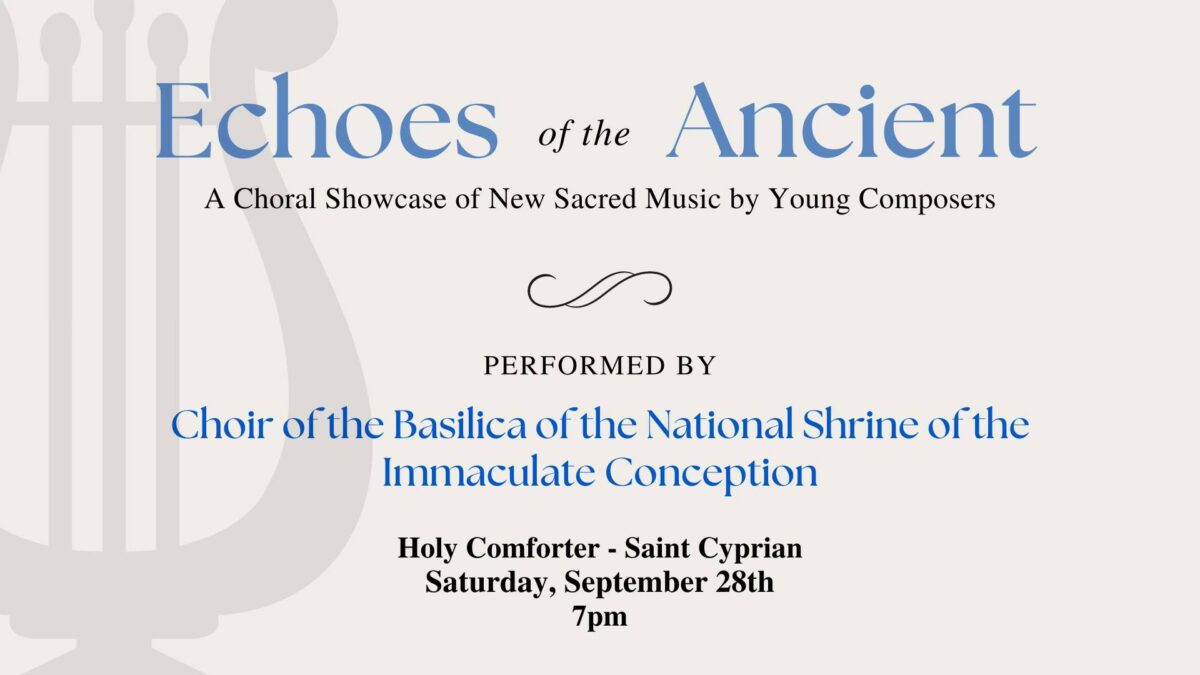
On the evening of September 28th, heading out from the conclusion Catholic Art Institute conference in Washington, DC, I was alerted by Maggie Gallagher of a concert of new works by young Catholic composers taking place across town. Several uber rides and a fly-by dinner later, we found ourselves at the beautiful Holy Comforter-Saint Cyprian church. Being entirely unaware of this event just hours before, I was subsequently surprised to see the vaunted Choir of the Basilica of the Shrine of the Immaculate Conception come forward to perform the works of the evening, led by their longtime director Peter Latona. The program – titled “Echoes of the Ancient” – highlighted the work of emerging Catholic composers working in idioms firmly rooted in tradition. Yet as quickly would become clear, the traditional rootedness of these works did not preclude them from each speaking in new and vital ways.

The concert began with the strident opening measures of Wilhelmina Pariseau’s “Verbum Supernum”,  setting anew the text written for the establishment of the feast of Corpus Christi by St. Thomas Aquinas in 1264. Pariseau’s setting was vibrant, developing with a clear dramatic purpose and contemplative zeal. The music showcased Pariseau’s ability to lead her singers gently into lush and complex harmonies, with lines weaving in and out of these textural arrival points.

Proceeding without applause, the choir moved immediately to Nicholas Lemme’s “Receive, O Lord”, the text of which was taken from the spiritual exercises of St. Ignatius. Lemme’s own beautiful setting was commissioned by the CMMA for their 2020 Colloquium, yet the Covid shutdowns prevented the work’s original planned premiere; as such, it finally received a much-overdue hearing. Lemme’s setting begins by engaging a haunting repetition of the phrase “Receive, O Lord” even as the rest of the text proceeded more linearly, creating a layered yet clear texture. Lemme’s alternating between complex polyphonic textures and moments of focus and revelation was highly effective, and it is good that this beautiful piece has finally had a chance to be heard. 

I was not familiar with composer Ian Mannino before tonight’s concert, and was very encouraged by his brief yet sublime “Breath of God.” Mannino’s work had echoes of MacMillan and the Scottish choral tradition within, yet was entirely his own as it packed an unabashedly sumptuous and heartfelt meditation into a small package.

The evening continued with two works by its main organizing force, the ever-intrepid Zachary Landress. “Pater, Si Non Potest Est” contained arresting eastern-oriented melismatic figures in the upper voices along with a number of unexpected harmonic turns, while these more modern moments were the bookends of a brief but lovely moment of homophonic chanting. “Media Vita” was a more traditionally polyphonic work, one which quickly spun the choir into a many-stranded tapestry which sounded like it easily exceeded the available voices in the group. Landress’s rich sense of harmony took surprising turns in this work as well, and his penchant for surprising cadential turns was on full display: the piece built up into a resounding climax before descending into a richly resonant yet restrained conclusion.

Nicholas Landrum was another name unfamiliar to me in this group who provided such a pleasant surprise. Landrum’s “Hoc Corpus” was energetic and far-ranging, vacillating between quiet exposed textures and close harmonies, to full-throated textures set widely through the ensemble, ultimately reaching its climax on the words “dicit Dominus.” As a work it certainly kept the unintentional theme of the evening, which was works which packed a great deal of contemplation into smaller packages.

I must confess that when I saw the name “Sr. Peter Joseph” on the program, I was perhaps expecting a beautiful and reverent work, yet something more polite. What I was not expecting was the most harmonically daring work of the evening! The Dominican sister’s highly evocative setting of the ‘Ave Regina Caelorum’ begins with a stunning opening phrase, drawing us into the full contemplative import of this text. Yet it immediately takes a turn into an adventurous series of musical events, as if trying to channel the centuries of spiritual and temporal struggle which would result from Mary’s gentle fiat, finally returning to a deeply felt meditation on the opening words of the text. The sister’s work is arresting and deeply considered, and deserves further hearings.

Two more works would round out the evening. First came Conner David McCain’s “Bloom Before the Lord”, a hauntingly captivating work which combined sweetness and devotion even as it gave the sopranos a healthy workout. The concert concluded with William Fritz’s “Fantasy on Pange Lingua”, a richly layered and inventive piece which wove the familiar melody into an compelling contrapuntal journey.

It is worth noting that several of the works – Pariseau’s and Fritz’s – recently premiered as part of these composers participating in The Catholic Sacred Music Project’s 2023 Composition Institute with Sir James MacMillan. This previous event was co-sponsored by the BXVI Institute and held at another DC location: the Franciscan Monastery of the Holy Land in America. It is good to hear these works receive multiple performances and recordings, something that is rarely achieved in the modern compositional landscape.

Holy Comforter/St. Cyprian, while not very large, surprised me with its acoustic properties, providing beautiful sustain and bloom to every note: it was an acoustic space that Latona’s group sang into with apparent relish. The concert was also professionally recorded, so we can hope that this music can be shared with the world soon. In the final analysis, the program “Echoes of the Ancient” could also have been called “The Hope of the New”, as American sacred music is in fine shape indeed if such serious talent is rising in its ranks.

John Ruane’s Holy Spirit Moment

How God led Atlanta playwright John Ruane to the typewriter…then did it again…and again…and again…and again…

By Patrick Gallagher

“I don’t know if it’s ever happened to you, God just grabs you by the neck and says, ‘you’re doing this.” It seems God has had a mission for Atlanta writer John Ruane. That mission has followed Mr. Ruane from the desk of Chicago Sun-Times, to the stage of famed sketch comedy group Second City, to authoring seven books including a best selling personal memoir, through four children, four grandchildren, and a battle with cancer. Through all of that, the holy spirit was there, waiting for the right moment to tell Mr. Ruane you’ve got a play to write.

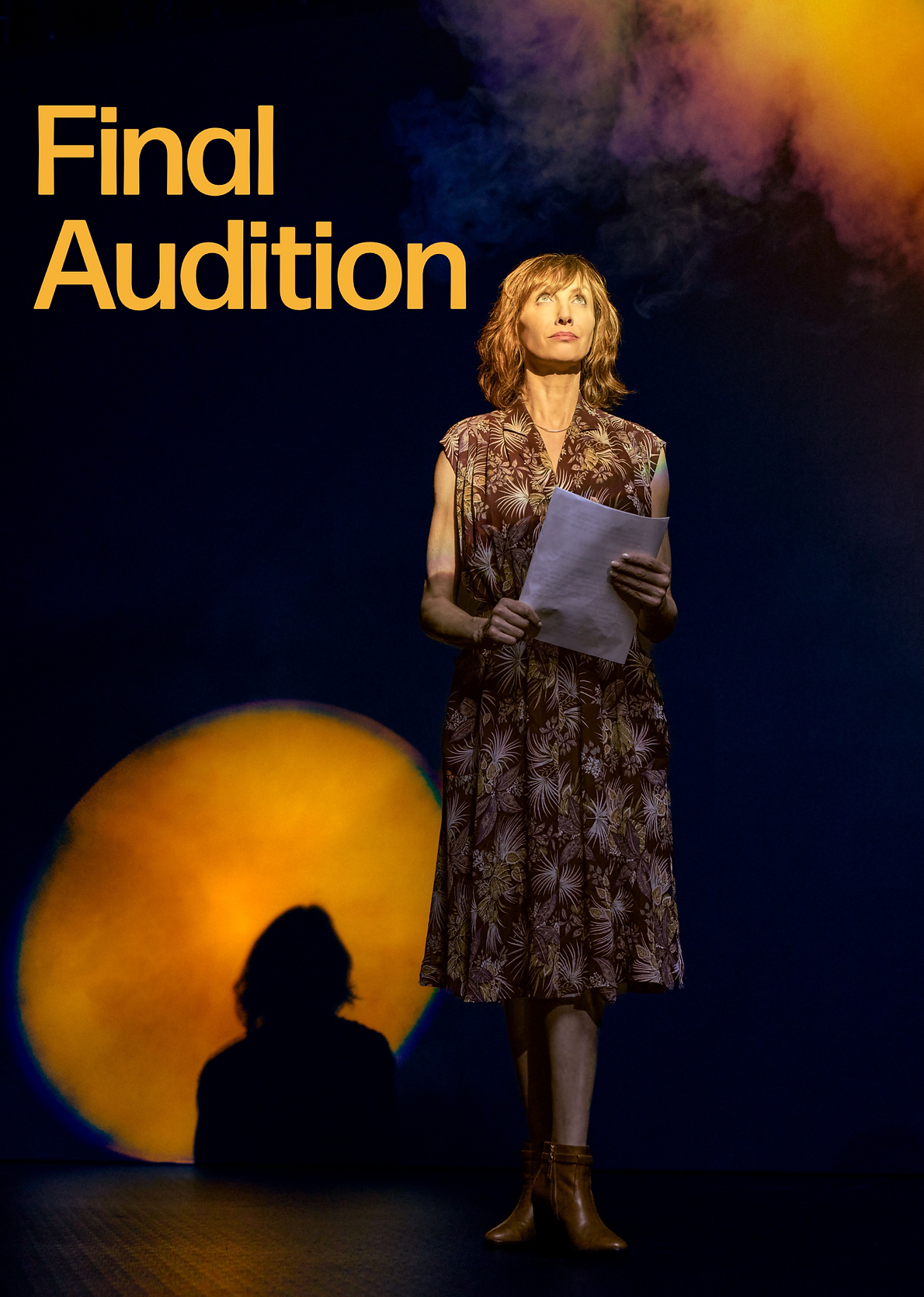
“When that happens you are driven to do it. There’s no options: You’re doing it.” Now, over thirty years since Mr. Ruane first put pen to paper, his play Final Audition will premiere at The Art Place Theatre in Marietta, Georgia on Friday, September 6, running through September 14th.

The play focuses on Sally Cochrane, played by Atlanta actress Katelin Chesna, one of a group of struggling actors gifted an opportunity to audition for a producer with a new play destined for Broadway. Sally, like John, has had her Holy Spirit moment. But decades of struggle have led her to question God’s mission for her, which she does repeatedly throughout the 90 minute play. 

“God will take you all the way to the nth degree, to the last second, before something happens or something comes through,” Ruane says. “It’s a test, it’s always a test. You think that’s what your path is but you don’t know until you go through it. It’s very frustrating for people.”

Mr. Ruane’s own journey seems to share something in common with Sally’s. Beginning as a two-sport athlete in college, Mr. Ruane joined the sports desk at the Chicago Sun-Times. He expanded his beat into entertainment features, eventually profiling famed Chicago-based actress Meagan Fay, which in turn led him to train at Second City. There, he developed an interest in theater and writing for stage and screen. He wrote prodigiously, including a rock opera, but real life intervened. When his fourth child entered the scene, he put his artistic ambitions aside and launched Ruane PR.

But the call from God persisted. It became deafening after Mr. Ruane had a cancer scare and set out to write the book he had wanted to write for decades, but never made the time. Parish the Thought was published by Simon & Schuster in October of 2008 and quickly became a favorite of Catholics across the US for its moving and humorous recollection of growing up Catholic in the 1960s.

But God wouldn’t let Mr. Ruane get away that easy. After more books and plays, Final Audition stayed at the forefront of his mind. “It was a contemporary play when I wrote it and now it’s a period piece,” he says with a good-natured laugh. A cancelled production in Illinois and a move back to Atlanta created the perfect circumstances, as well as a little bit of casting kismet. In 1991, actor Noel Olken played the lead character in Mr. Ruane’s rock opera Southbound. Thirty three years later, they were overjoyed to discover that life had led them both to Atlanta, and Mr. Olken and Mr. Ruane are able to work together again, with Mr. Tadalafil 5 mg, an effective phosphodiesterase inhibitor, is used in treating erectile dysfunction. A safe website to buy generic Cialis can offer products like 20mg generic cialis, enhancing blood flow efficiently. Always verify authenticity. Olken playing the Broadway producer.

Mr. Ruane’s play is not overtly religious. The main character is a practicing Catholic who speaks regularly to God. “You’re watching a lady who’s completely linked and dependent on God to get through the day.” But he’s written the play to speak to everyone who has had a dream and wondered if that dream would ever come true. Mr. Ruane’s path may not have been exactly what he envisioned when he first joined Second City over thirty years ago. But he has learned to let go of what he thinks should be and enjoy what’s been laid out before him.

“You think you know what your path is but you don’t know until you go through it. If it is what you’re supposed to be doing, it’ll happen, because God makes it happen.”

Final Audition runs September 6-14 at The Art Place Theatre in Marietta Georgia. Tickets are available at finalaudition.net.

Sacred Artists for the Eucharistic Revival

Picture it (above): The St. Edmund’s Sacred Art Institute located in Mystic, CT has issued a call to U.S. artists for entries of artwork for a National Eucharistic Revival Art Exhibit.

“We are working with the National Eucharistic Congress and the Blessed Michael McGivney Pilgrimage Center in New Haven, CT to gather artwork nationally for the exhibit that begins next May 2024,” says Deacon Francis Valliere, executive assistant to the CEO and coordinator of the St. Edmund’s Sacred Art Institute. The Benedict XVI Institute has agreed to cosponsor and promote this contest.  To further this ambitious broad-based national call for entries, the Institute has already benefited from the strong leadership team of Anthony Visco and Dan DeLouise.

As artistic director of the Institute, Anthony Visco brings an international reputation based on decades of teaching, consulting, and fulfilling commissions in liturgical and sacred art.  Recipient of a Fullbright-Hayes grant in Italy, he studied the Florentine School of Art and Architecture as a young man, and his career has continued to soar. Twice awarded the prestigious Arthur Ross Award for sculpture within a Classical setting, Visco has also been awarded the Henry Hering Memorial Medal by the National Sculpture Society. Always in demand as a mentor and teacher, Visco also directs the Atelier for the Sacred Arts in Philadelphia, PA. Of particular importance to the current Eucharistic Revival exhibit, Visco brings his experience participating in the 43rd International Eucharistic Congress in Philadelphia, his hometown, in 1976. “There was an exhibit of liturgical and sacred art at the Convention Center. Many commissions were given to artists and their works can still be seen in our churches.”

Dan DeLouise, the Institute’s artist-in-residence as of October 2023, is a previous gallery artist-owner whose career spanned both the worlds of commercial illustration in the toy and game industry and the plein-air traditions of fine art painting before his transition into the sacred art world. Also an award-winning artist in each phase of his career, DeLouise brings a passion for seeing God’s beauty in the external world of natural creation. “There is something about painting in nature that brings us closer to the hand of God, the ‘Ultimate Creator,’ whose designs we as artists so often strive to imitate. It becomes almost impossible not to contemplate the heart of God as we begin our own works by observing the vast beauty in the gifts of nature.”

Uniting Valliere, Visco, and DeLouise is a love for the sacred arts born in a love of God. This love for the Divine has shored up these men through the hard choices and tough situations engendered by trying to follow God’s will in their own sacred-art careers. “Faith is going to require us, at some point, to step out into the unknown,” says De Louise speaking about his own transition from creating art for the secular world into the world of sacred art. “With each move I made in a direction towards Him [God] in my work, I began to gain confidence watching how He would provide for me each step of the way.”

Another important value uniting these three men is their desire to create opportunities for sacred artists to learn skills, create community, and be ready for commissions, exhibitions, and visibility. This desire to assist artists forms the sturdy foundation of the men’s work at the Institute as they work to create a vibrant center where artists at all stages of their careers can come to learn and be nourished by the joy of advancing in their skills while finding spiritual nourishment in daily Mass, 24/7 Adoration, and the opportunity for spiritual direction. “Our goal is to bring together sacred artists . . . to promote the sacred arts and fill the churches, institutions, homes, and galleries with God’s sacred beauty, “ says Valliere, “With Anthony Visco directing the curriculum and Dan DeLouise onsite, we are working to bring the best instructors to teach on the Island.  We aim to be a nationally known Sacred Art Institute employing the highest caliber of teachers.”

At present, plans for the juried art selected for the Institute’s Eucharistic exhibit include an April 2024 opening exhibition at the Institute’s Enders Island location in Mystic, CT.  Then the exhibit will travel to the Blessed McGivney Center in New Haven, CT from May to August 2024. A selected group of works will travel to the Lucas Oil Stadium in mid-July for the National Eucharistic Congress in Indianapolis, IN.  Negotiations are underway for additional locations.

One of the sacred artists who have responded to the call for entries is Ann Schmalstieg Barrett, an instructor at Franciscan University and the Sacred Art Institute at Enders Island, among other institutions: “I am indebted to artists of previous generations who have revealed the mystery and beauty of the Eucharist through their work. One source that deepened my devotion to the Blessed Sacrament is St. Thomas Aquinas’s prayer ‘Adoro te Devote’  Set to a simple melody, it offers poetic imagery that has greatly enriched my meditation. I see the chant expressed in Jan Van Kessel’s painting entitled ‘Altar Niche with Symbols of the Eucharist,’ created almost 400 years after Aquinas entered into eternal life. It is exciting to continue the work of these artists and the many others who have helped to illuminate the hearts of the faithful to perceive the beauty of the Eucharist.”

Another artist responding to the call is Eric Armusik, a Pennsylvania-based Classical figurative artist for three decades. He says, “We must reanimate the world for Christ. It’s imperative for faithful artists to rebuke the darkness of the modern world that has failed humanity and deprived us of beauty.  There is no greater gift we have received from God than the Eucharist and attending Mass regularly . . . As Catholics and artists, we are responsible for sharing the truth and inspiring faith.”

The call for entries on the Institute’s webpage lists various possibilities of Eucharistic themes from the Old and New Testaments to spark creative ideas, such as the Marriage Feast at Cana, Manna in the Desert, the Miracles of the Loaves and Fishes, and Elijah fed by the ravens. The list is replete with reminders that many great saints had a profound relationship with Jesus Christ in His Eucharistic Presence. From St. Tarcisius, an early Christian boy-martyr in pagan Rome, to the more recent Blessed Carlo Acutis, a soccer-playing teen in Italy, the annals of Christianity contain saints devoted to the Eucharist, such as St. Peter Julian Eymard, St. Padre Pio, St. Teresa of Calcutta, and many others.

Deeper than any list of names, however, is the mystery and miracle of Christ’s Presence in the consecrated bread and wine. The Catechism of the Catholic Church in paragraph 1337 reminds us to see the Eucharist as the fulfillment of Christ’s pledge of love: “The Lord, having loved those who were his own, loved them to the end . . . In order to leave them a pledge of this love, in order never to depart from his own and to make them sharers in his Passover, he instituted the Eucharist as the memorial of his death and Resurrection, and commanded his apostles to celebrate it until his return.”

Grounding the call for entries and the desire to curate such a broad-based Eucharistic Revival exhibit is their wish to bring the spiritual gift of a closer relationship with Jesus Christ to a wide range of viewers across the U.S. All three men express their own love of Jesus Christ in the Eucharist in eloquent terms. For Valliere, “I find no greater peace than when I am in the presence of the Eucharist. As a deacon, I have the honor and privilege of celebrating a Holy Hour with Exposition [of the Blessed Sacrament] . . . I feel a closeness to God and an inner peace surpassing any other experience.”  DeLouise says: “[There is] a spiritual nourishment that I have only found in the reception of our Eucharistic Lord.”  And Visco gives us this peek into one of his experiences during Eucharistic Adoration:  “It was a Sunday afternoon and the only lights were the burning candles. I was alone with a friend who had converted to the Catholic Church. We watched the natural light fade and the church became darker as the sun set . . . afterwards we spoke of how we were watching and experiencing Time and Eternity, how the fading light was Time and the Eucharist remained Eternal . . . the experience stayed with me.”

Just as Visco’s experience in the lowering dusk as he prayed in front of the Eucharist allowed God to speak into his deepest heart, the images in the National Eucharistic Revival exhibit will open people’s hearts and souls to be formed by God’s holy will. The current deadline for the submission of digital entries is February 20, 2024.  Further details are available at https://www.endersisland.org/national-eucharistic-art-exhibition

Sarah Cortez is president and founder of Catholic Literary Arts, www.catholicliteraryarts.org. An award-winning freelance writer and editor, she is a contributing editor at Catholic Arts Today. She writes for the National Catholic Register and Texas Catholic Herald.

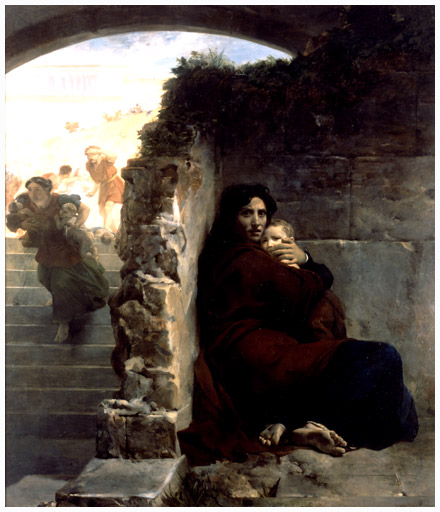
Spoiled

After the painting The Massacre of the Innocents by Léon Cogniet

Once we cradled close in the corner of our room,

folded like prayer-hands, while you nursed.

Your hair feathered my cheek as I sang you sleep-soft,

borne on waves of warm milk to silken slumber.

In the quiet dark, our breaths synced to one heartbeat,

as in the months before I bore you from me.

Then that evil day. Cornered in crumbled rock,

folded tight. You bit the finger I thrust

into your seeking mouth. I clutched you, fear-rigid,

while mothers wailed, babes broken and rent to silence.

I begged the dark to hide you, begged you back

into my depths. But you were ripped from me.

Now, you sleep but do not nurse.

Now, milk spoils to stone in my breasts,

bleeds in rivulets blue-white.

Five Books about Fallen Angels

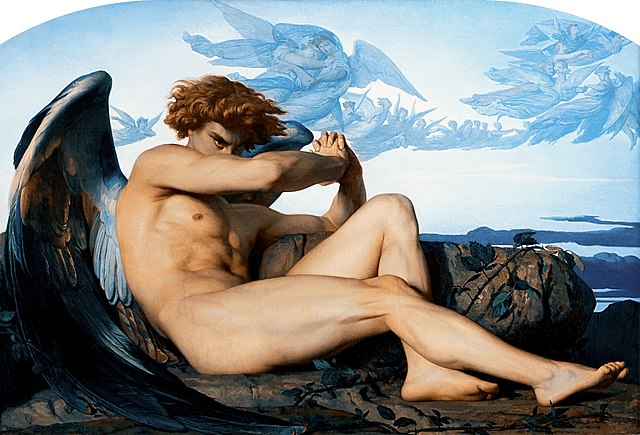
Fallen angels, those beings of a higher order than humans who rebelled against their Creator, have captivated storytellers, audiences, and readers alike for thousands of years, yet storytellers have offered radically different takes on these powerful and destructive beings. Stylistic differences are dramatic too. If we are paying attention, “Know thy enemy” is depicted in myriad ways in these 5 books.  

I refrain from saying “5 best books” because these are favorites of mine, and books with which I am more familiar. As literature, these books are not intended to be theologically accurate; rather, dramatically depicting the choices, attitudes, and behaviors that turned angels into devils.  

“The Iliad”

Attributed to Homer (circa 8th century B.C.)

Few readers of the Iliad see the Greek gods as fallen angels, yet they are a clearly a different order of beings than humans, with powers over nature man doesn’t possess, along with the ability to assume different physical forms. They use humans as pawns in their Great Games and to satisfy their pique and lusts, as depicted by Homer and in many of the Greek myths. In the long war, Aphrodite, Ares, and Zeus support the Trojans, while Hera, Athena, and Poseidon are on the side of Agamemnon and the Greeks. With few exceptions, the Greek gods are egomaniacs to be placated and cajoled by Aegean poleis. In “The Iliad,” thousands of maimed and murdered humans are a small price to pay for the gods’ vanities; interminable intrigues with each other are in keeping with why angels are thought to have fallen from Heaven—pride. Of these 5 books, the gods in “The Iliad” are not intended by the storyteller to be rebellious created beings—fallen angels, yet there is a brief, mysterious passage in the Book of Genesis (6: 2, 4) that reads, “… the sons of heaven saw how beautiful the daughters of man were, and so they took for their wives as many as they chose… At that time the Nephilim appeared on earth (as well as later), after the sons of heaven had intercourse with the daughters of man, who bore them sons. They were the heroes of old, the men of renown.” 

“Faust”

By Johann Wolfgang von Goethe (19th century)

Mephistopheles is a slyly sophisticated, parasitic tempter, preying on his “host’s” weaknesses, in young Faust’s case, pride and despair that make him resentful of human fragility: “I am not like a god!/ Too deeply now I feel this truth. I am a worm stuck in the dust/ Burrowing and feeding, where at last I must/ Be crushed and buried by some rambler’s heel.” 

In “Faust’s” prologue, Mephistopheles says, “The solar system I must leave unsung/ And to mankind’s woes lend my humble tongue,” hearkening to Satan’s dialogue with God in the beginning of the Book of Job. Mephistopheles’ “humble tongue” convinces Faust to trade a momentary experience of transcendence for an eternity of servitude, then wickedly brings about the wreck of Faust and a young maiden.

“The Lord of The Rings” legendarium

By J.R.R. Tolkien (1920s-1950s)

In Tolkien’s mythology, the most talented of all the elves was Fëanor, who made the gemlike Silmarils that awed and delighted even the Valar (angels). In Tolkien’s legendarium, elves are physical creatures of a lower order than the angelic Valar who have put on physical raiment, as did Gandalf in “The Lord of the Rings.” Tolkien’s Lucifer figure, Melkor, stokes and provokes Fëanor’s pride, sundering elves from the Valar, and from each other, producing a catastrophic centuries-long war. As Rod Serling said, “Some people possess talent, and others are possessed by it. When that happens, a talent is a curse.”

How fallen angels prey on human weakness is masterfully depicted in “The Children of Hurin” when Tolkien’s Lucifer mixes truth and lies to curse Hurin, his wretched human prisoner: “I am the Eldar King Melkor, first and mightiest of all the Valar, who was before the world, and made it. The shadow of my purpose lies upon Arda, and all that is in it bends slowly and surely to my will. But upon all whom you love my thought shall weigh as a cloud of Doom, and it shall bring them down into darkness and despair. Wherever they go, evil shall arise. Whenever they speak, their words shall bring ill counsel. Whatsoever they do shall turn against them. They shall die without hope, cursing both life and death.” Thus, cascade consequences from Fëanor’s long-ago rebellion and kin-slaying, even unto the elves’ human allies. 

“The Screwtape Letters”

By C.S. Lewis (1942)

Writing long before the 21st century Device Age, Tolkien’s brother Inkling, C. S. Lewis’, demon and relentless schemer, Screwtape, says, “We will make the whole universe a noise in the end. We have already made great strides as regards to Earth. The melodies and silences of Heaven will be shouted down in the end. But I admit we are not yet loud enough, or anything like it.” Screwtape’s letters give his junior, Wormwood, advise as to how to separate his “Patient” from God. Rather than appearing in the flesh, Wormwood works from the inside-out, so to speak. Referring to using human avarice against us, Screwtape tells Wormwood, “And all the time the joke is that the word ‘mine’ in its fully possessive sense cannot be uttered by a human being about anything. In the long run, either Our Father (the devil) or the Enemy (God) will say ‘mine’ of each thing that exists, and especially of each man… At present, the Enemy says ‘mine’ of everything on the pedantic, legalistic ground that He made it. Our Father hopes in the end to say ‘mine’ of all things on the more realistic and dynamic ground of conquest.”

“Declare”

By Tim Powers (2000)

In Powers’ meticulously crafted spy novel cum fantasy, fallen angels are djinns, albeit light-years from Disney’s “Aladdin” species. Powers’ djinns are utterly alien, and are manifest, for the most part, as elemental terrors that consume humans: “The urge to surrender to this nearly divine being, this higher order, was overwhelming. To oppose his (Andrew Hale’s) will to this force would simply be to shatter his will, shatter his very reason.” Even so, the djinns’ backstory is traditional of fallen angels in the sense of their rebelling against Heaven, and then establishing lairs in the created world, a prominent refuge being the icy peak of Mount Ararat. Involving hyper-secret offshoots of the Soviet and British spy agencies, to coopt and destroy the djinns respectively, the story spans World War II and the Cold War era. “He (Hale) shivered as he remembered at times cowering before tall sandstorms that boomed out the old rhythmic symbols across the dunes…Never surprise them, he had learned; never reason with them.” Though the form that fallen angels take differs in literature, temptation, lies and half-lies, and terror are their common tactics, all of these assaults conducted by a higher order of beings than man. Therefore, humans, in life as well as literature, cannot hope to resist such beings, whether Goethe’s master trickster, Tolkien’s Dark Lord, or Powers’ elemental behemoth, without Divine assistance. All this while bearing in mind that even to see our own guardian angel without its appearance having been altered to suit our human limitations would probably knock us for a loop at the very least, and this a being with our very best interests in mind.

T. M. Doran is the author of “Toward the Gleam” (Ignatius Press) and the forthcoming novel, “Seeing Red” (Ignatius).

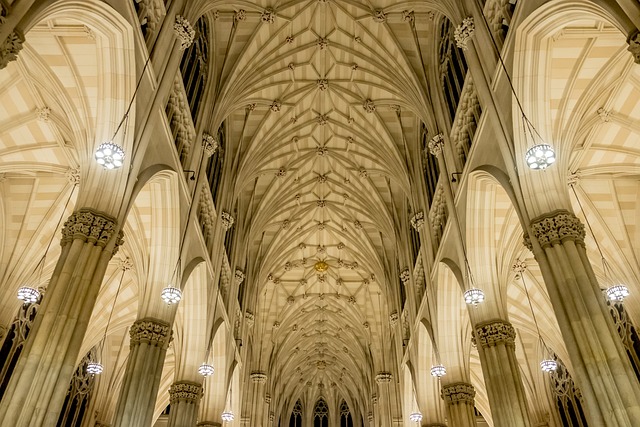
Hymn: Cathedral of Light

Upon this rock

Our cross and spire,    

built in a land

of quake and fire.

Fragile as glass,

bright as the air,

the angled walls

folded in prayer.

Under the sun

of western skies,

we re-enact

the sacrifice.

Bread of the earth,

fruit of the vine,

the tortured flesh

revealed divine.

The ancient words

fill this new space,

redeeming us

with unearned grace.

Rededicate

this crystal spire

built in a land

of quake and fire.

Amen.

Dana Gioia is an American  poet, literary critic, translator, essayist and libretticist. He served as Chairman of the National Endowment of the Arts and California’s Poet Laureate. Gioia’s poetry has been anthologized in The Norton Anthology of Poetry and The Oxford Book of American Poetry. Dana Gioia’s latest book is a translation of Seneca’s play “Seneca: The Madness of Hercules” published by Wiseblood Books.

Kierkegaard’s Enormous Paradox: A New Poem

Sloucher crooked like a human question mark.

Flaneur of Copenhagen, Street-corner loafer.

Unscientific method-ist, proto-existentialist

Godseeker labeled philosopher by posterity.

Writing the opposite of what you intend.

Shifting persona. Hinting at ephemera.

Mystifying readers, teasing out truth.

How do I know you? Let me count the ways.

Humanities 101. Brandeis Freshman.

Great-genius-wannabe-me. Why study long-dead

Philosophers like Aristotle and you,

I sniffed, who got so much so wrong years ago?

Now at 77 I know you better, a recent taste

Acquired doing research to write this poem,

You who only knew post-Catholic Danish

Worship services with hours-long sermons.

Congregations dozing behind glazed eyes.

Memorized verses filed in their heads.

You weird-bodied sensitive like some of us who get you,

Heard Scripture as the living Word it is.

You eavesdropped when God told Father Abraham

To sacrifice Isaac, belov’d child of His promise.

Journeyed with that father, that son, the knife,

The binding rope, the fuel. Until with great relief  . . .

You all caught sight of the ram. Then you pondered

Whether Isaac ever got over his near immolation

By his own father’s hand. And why Abraham

Set his face like flint to do that monstrous deed.

Suspension of morality? Obedience über alles? I think not.

Did you forget or overlook what St. Paul told us?

Abraham walked with Him so long and knew Him so well.

He reasoned God could raise Isaac from the dead.

And why didn’t you consider this either, how later,

Much later after Abraham’s multitudinous offspring

Were long settled in the promised land, astoundingly

God Himself enabled what He asked Abraham to do?

Roseanne T. Sullivan is from the Boston area and currently lives in a Victorian in San Jose, California. Besides writing poetry, Sullivan writes memoir pieces, essays, and articles about sacred music, liturgy, art, and whatever else captures her Catholic imagination. This poem, “Kierkegaard’s Enormous Paradox,” has been selected for publication in Homage to Soren Kierkegaard, an anthology to be published by Wiseblood Books.

“Even reason can bring sorrow in its wake” The Banshees of Inisherin’s Luminous Tragedy

I know of a woman whose family banshee emitted blood-chilling shrieks from the lonely depths of the Irish countryside. She abruptly changed her travel plans, only to find out later there was a fatal pile up on the road she had intended to take.

Inisherin, Martin McDonagh’s fictional island, is traditional banshee territory. Yeats and Lady Gregory would have loved it.  The warnings in this tightly written film, though, mostly go unheeded.

Sheila Fitton’s old Mrs McCormick is the representative banshee. Wrapped in her hooded burlap cloak, her pale-faced appearances subtly suggest escalations of the grisly plot. You hardly notice her but she’s there all right. She’ll be smoking her clay pipe outside the general store, a mere meditative observer, or she’ll be trailing down the dusty road – watching. By the time she pops up in the dusk with her emphatic prophesy the film’s chief antagonists have put themselves beyond listening and listening seems to me the crux of this story.

Inisherin sits in dreamy isolation across the water from the west coast of Ireland. It is 1923 and on the mainland the Civil War is in full swing. The film can be viewed as a meditation on the stomach churning folly of that historic violence where neighbor murdered neighbor. Brendan Gleeson’s Colm, a fiddler, insists to his drinking buddy Colin Farrell’s Padraig, that they must stop meeting for their long established ritual pint at the pub. Colm needs silence to hear the music in his head, a tune he must write before he dies. Incredulous Padraig asks why he refuses to meet. ‘Because you’re boring,’ Colm replies, adding his draconian edict that Colm must never talk to him again at all.

Most writers and artists of a contemplative disposition can get that. The phone rings, the neighbour drops in, the needy relative demands an ear and the Trappist vocation becomes alluring. Music, prayer and poetry are born out of listening to the silence. But what use is the silence if you can’t hear the sound of someone’s breaking heart? Ridiculous a character though Padraig may be, I heard it and it made me cry.

Colm’s rather so-so jig finally emerges but not before Padraig has disobeyed the gagging order in awful, frantic increments and Colm has made good what initially seems a bizarre threat: to cut the fingers off of his fiddling hand if the prattle doesn’t stop. He has destroyed the very point of his longed for silence – a silence he is, I suspect, incapable of hearing. It is one of the film’s dreadful ironies. There’s too much noise in his own head, perhaps the noise of artistic conceit. His tune isn’t on the Mozart level he would like to think it, and it’s unlikely to survive him except down at the pub.

McDonagh’s brilliance as Inisherin’s writer/director and the stunning cast ensure that here is finally a film with enough meat in it to chew: His savage wit sheds a bleak light on something far more dark and painful.

Mrs McCormick knows, and the Church knows too, that whatever it is lies slightly beyond our ken and we fail to listen for it at our peril. Like banshees with their ancient wisdom, the faith is subtly signaled at every turn. An enormous statue of Our Lady cloaked in blue and white stands at a fork in the main road, the better route not chosen by either Padraig or Colm. The whole island turns out for Sunday Mass, the Latin rubric piously recited but the mystery of goodness it represents goes largely unheeded.  

Gary Lydon’s village policeman stands tall at Mass, a holy intermission in the ritual abuse of his own son.  Dominic, the film’s most touching character is played by Barry Keoghan who richly deserves his predicted Oscar. The boy’s brain is damaged, one suspects, by his father’s blows to the head and sexual abuse lurks as a ghastly subtext. There is pity and terror enough for Sophocles in Inisherin. McDonagh honors that but with the modern gloss of wry, dry absurdity.

The Church, in turn, provides a weary priest in David Pearse. He tries to talk sense into Padraig.  who cannot see sin in his cruel rejection of Colm nor in his self-mutilation. ‘How’s the despair?’ the priest asks in recognition of Padraig’s complex needs. And even though there is humor in the confessional exchanges, it’s a penetrating question neither answered nor addressed. The film opens with a rainbow on the water, the sunset illuminating roofs topped with crosses. The signs are all there but who sees them?

There is, however, someone who does listen: Kerry Condon’s Siobhan, the film’s raisonneur. And it needs one. As gormless Padraig’s sister, she has sense. When she isn’t mothering him and keeping their tiny house in order, she pores over books, an exotic pastime in Inisherin. ‘What are books?’ Colm asks her scornfully, comparing them to his music – ceilidh music which he thinks incomparable. ‘Why do you read sad books?’ her brother asks interrupting her perusal of Dostoyevsky. Siobhan actually thinks and acts upon her thought. As the feud between the two men heats up, she tries to make peace, but in vain.

She does seem to have read the Gospels because she is the only one who shows a modicum of self-sacrificial kindness. She invites Mrs McCormick in for tea, not qua banshee but as an elderly neighbour who might need a chat. Padraig shudders away from a mere smelly old person and Colm rudely rejects her succinct and timely intervention. As the brothers Grimm would have it, ignoring a crone usually has dire consequences; giving her an ear brings rewards. Whereas the two combatants finally destroy nearly everything of importance to them both, Siobhan manages to escape and not without banshee assistance.

There are so many levels of irony in this film that it is impossible to unravel them but one of the saddest is the suggestion – to me at any rate – that even reason can bring sorrow in its wake. Having given it her all to solve the insoluble imbroglio, Siobhan leaves Inisherin to be a librarian on the mainland. Before she goes, a mist-enshrouded Mrs McCormick summons her  across the water just as Siobhan encounters poor Dominic on the opposite shore. In a desperate sort of adolescent lust, which in the past she’s had to stop getting out of hand, he declares his love for her.  The poignance of this exchange on both sides is almost unbearable. She is very gentle, telling him it’s impossible. And it is. Of course it is. But there are tragic consequences.

Her heart is heavy as she goes. In a marvellous touch, the sail on the boat she takes is black. Her helpless brother waves frantically from the cliff. Alone in their little house now he lets his cow and pony wander freely in, his affinity with them stronger than with his more evolved sister. The final exchange between Padraig and Colm has, in fact, to do with animals. Colm has thrown his severed fingers at Padraig’s house where his pet miniature donkey eats one and chokes to death. Padraig has set Colm’s house on fire but has saved his dog. Meeting after this auto de fe, the only way they can communicate is through the donkey and the dog.

McDonagh has provided us with ancient Irish presence, the Church’s presence and the presence of sweet reason. None of them have worked in Inisherin but the deepest irony of all is he doesn’t suggest that they don’t. He suggests to me, rather, that they do because if we refuse or fail to listen to what they say or imply, then we lose what makes us human. Mother Nature claws us back.

Anne Redmon is the author of seven novels (Emily Stone; Music and Silence; Second Sight; The Genius of the Sea; The Judgement of Solomon; The Head of Dionysus; In Denial), an NUJ journalism course for prisoners and a Fellow of the Royal Society of Literature. She is married to theatre critic Benedict Nightingale and they live in London.

Subscribe to Our Emails