Lazarus Box

Here, from my box of precious things:
a handful of rose petals dry and wither-burnt;
a smooth stick in the shape of a perfect “y;”
a tarnished ring, once gold;
a small keepsake vial filled with ash.

[Paltry offerings from a has-been box.]

You can see it, can’t you:
the rose when it sang with its sisters
before it was cradled in a hand, and deeply inhaled;
the twig when it branched and bloomed buds,
the small trumpet of Spring;
the ring in its days of luster; and
my father when he stood strong-boned,
skin flush with the flow of blood.

I am told; with time
these things will rise again
and blush full-bloom,
that the thin song of memory
will thicken into harmony,

and that for You,
everything is at once
ash and becoming.

Tamara Nicholl-Smith is currently pursuing an MFA in Creative Writing at the University of Saint Thomas in Houston. Her poetry has appeared on two Albuquerque city bus panels, one parking meter, numerous radio shows, a spoken-word classical piano fusion CD, and in several publications, including the Mutablis Press anthologies Enchantment of the Ordinary and Chaos, Dive, Reunion (forthcoming), Kyoto Journal, The Examined Life Journal, Catholic Arts Today and America. 

+Cordileone on his new Mass for Life: “Gratitude for the immense gift of being loved by our Creator. Also, prayers for the souls of all those whose lives have been cut short.”

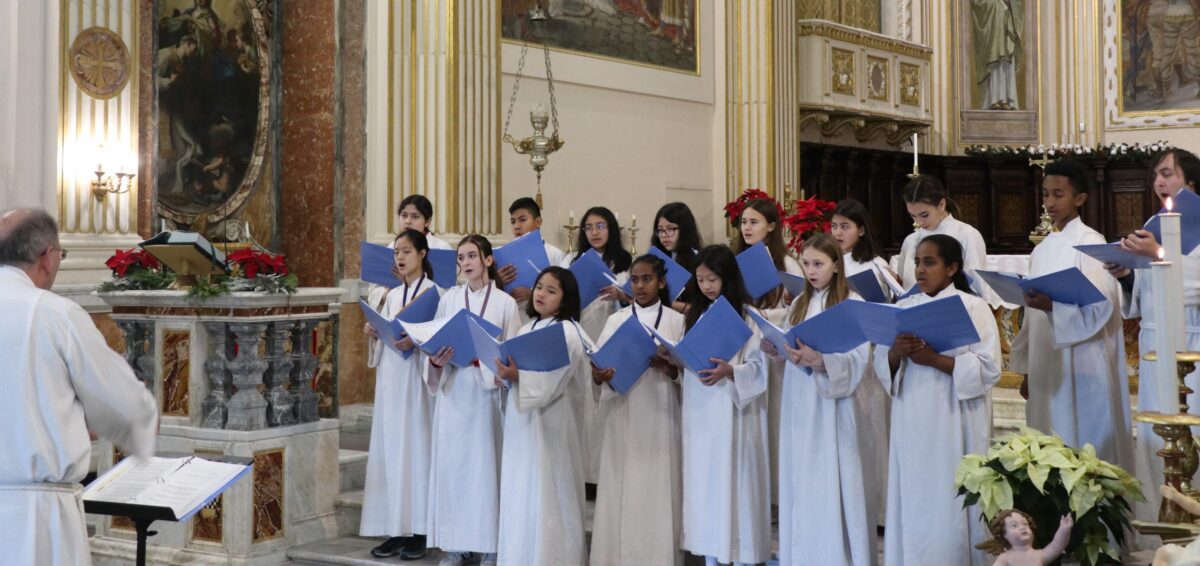
On January 21, 2023, the clear, sweet voices of the Chamber Choir of St. Brigid’s School will rise in a new choral Mass commissioned by Archbishop Salvatore J. Cordileone to begin the West Coast Walk for Life in San Francisco. This Holy Mass will launch the day’s walk in celebration of the human gift for life and the urgent, ongoing need for the protection of the most vulnerable in society—the unborn.

“Quite some time ago I foresaw that the Mass preceding the annual Walk for Life—which always falls on the Saturday closest to January 11—in the year 2023 would be the perfect occasion for commissioning a new Mass of sacred music, as it would be the 50th anniversary of the tragic Roe decision,” said the Archbishop. “The massive killing of the unborn for over fifty years cries out to heaven for a special Mass honoring the sacredness of all human life, from conception to natural death.”

The new Mass’s complete title is the Mass of St. Agnes in Thanksgiving for Human Life. The memorial of St. Agnes, virgin martyr, is the day of the debut of the music at the Cathedral of St. Mary of the Assumption.  In the Archbishop’s words, the theme of the Mass is: “Gratitude for the gift of life, no matter how challenging the circumstances: gratitude for the gift of being in the world and for the immense gift of being loved by our Creator. Also, prayers for the souls of all those whose lives have been cut short.”

The commissioning of this Mass is part of the tradition that the Archbishop, largely through the work of the Benedict XVI Institute for Sacred Music and Divine Worship, is revivifying by commissioning new Masses. He explains, “The idea is to identify major contemporary themes, and use the beauty of sacred music to highlight the issues and unite people around them. Because Frank La Rocca, our composer in residence, was already occupied composing the ‘Messe des Malades honoring Our Lady of Lourdes’ that will be celebrated at Oakland’s Cathedral of Christ the Light on February 11, the Mass of St. Agnes in Thanksgiving for Human Life is not a Benedict XVI Institute project.”

This Mass for Life was composed by Christopher Mueller, a decades-long musician and choirmaster, with unique elements chosen by the Archbishop to highlight thanksgiving for the gift of life.

Foremost among the Mass’s unique attributes was the Archbishop’s request that the Mass showcase the children’s voices at St. Brigid’s Choir School. The 20 children who will sing this Mass are the elite Chamber Choir consisting of 5th-8th graders, “who learn more advanced repertoire and who have demonstrated superior musical skills, as well as a sense of responsibility and commitment,” said Chris Tietze, cathedral music director. “The children are very receptive and enthusiastic about this new work and are excited to be a part of the premiere.”

Given the time constraints of learning new music, the children will be accompanied by adult singers, thus continuing a sacred music tradition of mingled adult and child voices begun prior to the Renaissance. 

The ten movements of the Mass are sung principally in Latin with the post-Communion oratory sung in Latin, Spanish, and English. Mueller composed both the Ordinary sections (Kyrie, Gloria, Sanctus, Agnus Dei) and the Propers, those texts that define the specificity of a liturgy and interweave themes from a feast day throughout the Mass (Introit, Gradual, Alleluia, Offertory, Communion, and post-Communion).

Responding to the Archbishop’s request, Mueller composed the post-Communion meditation based on text taken from the first five verses of the book of Jeremiah when God commissions the youthful Jeremiah as a prophet. Adult tenors and basses sing God’s words, fittingly in Latin, and the children’s soprano and alto voices answer in English and Spanish, then combine with the adult voices in Latin as Jeremiah accepts God’s will by stepping into his role as a prophet.

The text of the post-Communion meditation begins with God’s words to the young Jeremiah: “Before I formed you in the womb, I knew you.” The Archbishop chose this same text to begin his May 2021 pastoral letter on Abortion, Communion and Catholics in Public Life.  These words harken to one of the great mysteries of God’s relationship with man—God’s intimate and loving knowledge of and unique plan for each person before conception.

“Even before birth, our introduction to human society, we are known and loved, and God has a vocation for each one of us, some special purpose for which He has brought us into the world. We matter,” said Archbishop Cordileone.

This post-Communion meditation will allow the listeners a time of silent meditation on the horrific and willful killing of the innocent in the womb. Archbishop Cordileone’s words affirm that “the innocence of children is a cry for all of us to do more, sacrifice more, and think more about how to support babies in the womb—and their mothers.  We love our children; let that love inspire us to face down the horror of abortion and choose life.”

Mueller anticipates this post-Communion movement to be the most emotionally charged section for listeners due to the particular innocence conveyed musically by children’s voices.  “When people hear beautiful children’s voices, they don’t have an intellectual construct about the level of vocal training. This allows a well-trained youthful voice to reach deeper into a listener’s heart. Children’s voices can have a more direct effect. A children’s choir is the perfect sonic realm for this Mass.”

As the director of the Foundation for Polyphony and Chant, Mueller has long composed and championed both Gregorian chant and Renaissance polyphony. In this Mass, he also used rhythms from the 19th century American hymnal, “The Sacred Harp.” Bringing elements of these traditions into this new music enabled him to utilize sacred music traditions while also responding to the themes of life, thanksgiving for God’s gifts, and hope.

Mueller’s Mass compositions feature inter-related chants based on Gregorian chant in the Gradual and Alleluia. The Introit, Offertory, and Communion contain some imitative counterpoint and select modern harmonies. The post-Communion meditation does not incorporate chant, but rather is focused through melodies and accompaniment reflecting a more modern style.

At the Archbishop’s request, Mueller composed the Ordinary parts of the Mass to allow the congregation’s participation. The first decision was to use the chants from the Missa de Angelus, the most widely used and known Latin Ordinary Mass, for the Kyrie, Gloria, Sanctus, and Agnus Dei. The second decision was to animate the congregation’s involvement in the three-fold process by beginning with the children’s voices and soft organ, then moving to parishioners’ and children’s voices with a fuller organ, then adding the adult choir’s participation with imitative counterpoint or polyphony.

The liturgical realities reflected in this process reflect a decades-long acknowledgement by Holy Mother Church that active participation by the people in the pews is crucial. Even prior to the Vatican II Council, Pope St. Pius X introduced this concept in his motu proprio Tra le sollecitudini in 1903 by advocating for the instruction of the faithful in standard Gregorian chants in Latin. The Council itself recognized a place for choral music in Sacrosanctum concilium, which gives the example of sacred polyphony as a type of music that is not strictly Gregorian chant but is suited to liturgical action.

“So there is room for both: congregational singing and choral singing that is beyond the capacity of a typical congregation.  Chris Mueller’s newly composed Mass reflects this proper balance,” said Archbishop Cordileone.

 “Children singing on their own, then with people in the pews—adults, adolescents and children—and then with adult professional voices.  All make a contribution in their own unique and equally valuable way. It is a brilliant way to use music to point to this fundamentally important reality of our God-given human dignity,” said the Archbishop.

“The Walk for Life Mass is always the proper way to start such an important day,” said Eva Muntean, founder of the West Coast Walk for Life. “When we go to Mass everything we do is put into the proper perspective, which means God comes first. The Walk for Life Mass is one of the most well attended Masses of the year at the Cathedral. To see so many Catholics worshipping God together and standing for his littlest children gives such a feeling of fellowship and unity.  It is unforgettable. This Mass, which I’m sure will be breathtaking, will be a hymn to the beauty of human life. I expect that beauty to energize our people.”

Sacred liturgy seeks to give form to and elevate the human longing for God and also, in some partial way, to satisfy it.  Sacred music has the power to both glorify God and give back to God, the Author of all beauty, something of human construction that is beautiful.  In the words of composer Christophe Mueller, “If the music helps you pray, then it does its job. The Mass isn’t a concert; the music has to support and serve liturgical action.”

The commissioning of a uniquely suited, new choral Mass on the theme of gratitude for human life serves as a reminder of how important it is to find the path God intends for the use of the particular gifts He has given us.

As Archbishop Cordileone puts it: “God has given us all the same basic human vocation: to be happy with Him now in this life, and perfectly so forever in the life of heaven. We do this by stewarding wisely and generously the gifts He has given us. Some of those gifts we share in common. But many are specific to the individual, particular talents unique to each one, that we are called to use for God’s purposes, for spreading and sharing His love. It’s not how talented that one is that really matters, but developing the talents God has given us and using them to do His will.”

“It gives me great joy to recognize this call, and to help and animate others in responding to it, especially in a way that brings people together and ennobles us, and opens us up to God’s grace through the experience of His beauty. This is what I find most rewarding in commissioning new Masses of sacred music, such as the Mass of St. Agnes in Thanksgiving for Human Life.”

As thousands of people gather to pray this new Mass to begin the West Coast Walk for Life and the voices rise to heaven in song, may we all become stronger in taking a stand against the holocaust of abortion.

Sarah Cortez is president and founder of Catholic Literary Arts, www.catholicliteraryarts.org. A freelance writer and editor with fourteen books, she resides in Houston, TX. She is a fellow of the Dallas Institute of Humanities and Culture, a Scanlan fellow at the University of St. Thomas, and a fellow of the Virginia Center for the Creative Arts. www.poetacortez.com

“Can we break out of this prison of self?” The CAT interview with Phil Klay

Phil Klay is a novelist and a Marine Corps veteran. His short story collection Redeployment won numerous important prizes: the 2014 National Book Award for Fiction, the National Book Critics’ Circle John Leonard Prize for best debut work in any genre, and one of the 10 Best Books of 2014 by The New York Times. His novel Missionaries was named to the Wall Street Journal’s best 10 books of 2020 list. His writing has appeared in The New York Times, The Washington Post, The Wall Street Journal, The Atlantic, The New Yorker, and the Brookings Institution’s Brookings Essay series. He currently teaches fiction at Fairfield University. His latest work, the essay collection Uncertain Ground was released in May of 2022 with Penguin Press.

Catholic Arts Today’s contributing editor, Sarah Cortez, interviewed Klay about his vision as an artist and as a Catholic artist in Dallas during the 2022 Catholic Imagination Conference.

Sarah Cortez: In the story “Prayer in the Furnace” a line written by an older priest to a younger priest, an Army chaplain, caught my attention. It says: “Sin is a lonely thing.” I wondered if this is the appropriate lens through which to read all the stories in Redeployment, through the lens of the spiritual detachments that your characters endure: meaningful sex, memories of home, security of training, security of location, faith in God, faith in fellow humans. Are you consciously stripping away a man’s spiritual struts?

Phil Klay: It’s not that all these things must fail. Some props are more false than others. Sex with a prostitute is not going to do it in terms of connection or meaning. But the isolation, the alienation people experience was important to me. A central drama of the book is that the characters are trying to make contact. Are we isolated atomized creatures only experiencing things that are only ours? Is there a way to break out of this prison of self?  Are there points of contact?

It is important that the old priest (though he has never been to war) is not impressed with the horrors of war; not because war is not horrific but because horrible things are what humans often do: This is sin and its consequences. It is not fundamentally different than what he’s dealt with back at home, maybe more extreme, but the question remains the same: Can we escape from the prison of the self? Can contact can be made?

So in the longer story “Psychological Operations,” there are intertwined narratives of a character telling stories to a woman that he’s attracted to and a story of his relationship with his father along with multiple stories about insurgents. I did that not because I was interested in playing a metaphysical game of nesting Russian-doll narratives, but because of the way that language is being used in each of those iterations of the story while the character moves closer and closer to a space of genuine vulnerability.

Sarah Cortez:  One thing I enjoyed in your stories was the male humor: the visceral roughness and crudity. The fact that the characters are often facing death or dealing with its aftermath seems to ratchet up the humor?

Phil Klay: Rough humor is one way of bonding, a way of bluntly acknowledging a difference, then agreeing to laugh about it.  On the other hand, humor can also be used as a way to make distinctions and create barriers. Sexist humor often functions like that in male groups: You tell the joke that is inherently demeaning in front of the one woman who is present. That woman is then put in a bind: Either she laughs loudly and accepts the underlying premise of the joke, which is demeaning to women. Or she pushes back against it, in which case, she’s not a team player.

You can also see humor as positive. The amount of racial humor that went around among a very diverse Marine population was, and is, enormous. But humor was also a way of bluntly acknowledging differences and then making a conscious decision, like “we’re going to laugh about this rather than make an issue of it.”  I don’t want to overly idealize it, because it’s not like there wasn’t a double-edged sword to it, but humor could be a method for dealing with this distance and difference that results in bonding. If somebody says something that sort of bothers you or offends you, turning it into a joke is one way of acknowledging it without insisting on it being your way. The humor then is another way of saying, “Let’s just get past these things, together.”

Sarah Cortez: One of the moments that hit me the hardest in Redeployment was in “Bodies” when the young soldier at home on leave lies down on top of the covers of his ex-girlfriend’s bed with her. He knows she’s a pacifist and no longer loves him. When he held her hands a few moments earlier, her only response was to say, “I didn’t shave my legs today.” The way that she reacts is so far from what he needs.

Phil Klay:  But it’s also related to what he needs. It’s that hairline moment. It’s Frank O’Hara’s line: “I want to be at least as alive as the vulgar.” It’s not supposed to be where you stop. But it is being alive.

There’s something about sex for a lot of these characters who want connection. Sex often feels to people like it is the epitome of intimacy. That’s why sex can also be the most alienating thing, as it is in some of the stories, because the thing that is supposed to be most intimate is actually the moment when you feel most alone.

At a visceral level, the opaqueness of the other body in front of you makes the failure that much greater. And yet the characters come back to sex because it does have that aura that it will be a portal to connection. When it’s working, sex is about vulnerability, it’s about connection and intimacy. It’s about love. Sex can be about family and community, and so it can be about building a family, making sexual intimacy not just a moment of connection, but about your future, and your past as well. Sex is this thing, and, of course, sex is often this kind of substitute for experience, right? It’s often a substitute for God. But there’s a reason for that, right? Sex is sort of like a key to the self, a key to understanding. What matters most about sex is that it’s not like other human acts.

Sarah Cortez: You’ve said you consider yourself a Catholic writer. Tell us more about this.

Phil Klay:  Readers are free to take what they can from my work; if somebody who’s not interested in the religious themes isn’t necessarily missing everything about the book, they’re just focusing on something different. There are reviews of my novel Missionaries that were all about it being Catholic, and then there were reviews that were all about American military policy.  You’d almost think there were two different books, and to me that is fine. In some ways, I like that, I like the readers coming with different things that they’re interested in and taking different things away.

In fiction, it’s not like there’s a correct answer that everybody is supposed to come to. That’s not the point. Fiction is something that you come with your own world view and understanding, then you enter into this other world that has been created for you, and then you make something out of it. You have a creative response to it, so not everybody’s supposed to have the same response. Hopefully, a writer is able to hit different people at different levels.

But I do want people to be aware that the Catholicism is important to me, and not just because a priest shows up in the book, which is the most obvious thing. When you read a novel like Andre Dubus’ The Lieutenant, (which is being re-issued and is a wonderful novel), you can read it without any idea that he’s a Catholic author, or that religion is extremely important to him because there’s not a whisper of it in the book. It’s a military novel full of ritual and purpose and an institution that provides those things within a collective setting—and it’s about a character who is trying to find himself and his identity and a source of meaning in life through that purely secular institution. If you understand more of Dubus’ worldview and what matters to him, you understand that he’s writing about a world that his interest in is deeply related to his faith. He’s also showing skepticism about the depth and the extent to which a purely secular world can satisfy someone in those regards. It’s also deeply related to his faith, and so it adds a different layer and a different way of reading the book, and a different way of understanding what matters to the author. So, yes, of course, I want be known as that kind of author; I want to write in that way.

Sarah Cortez: You’ve said that stories that engage with the world and engage with the faith can be tools for the faithful to use. Could you tell us how you might see this happening?

Phil Klay: I wouldn’t still be a Catholic except for Flannery O’Connor’s “Parker’s Back.” In this story you find characters really grappling with the difficulties that people encounter. What drew me back to the faith was not a set of intellectual propositions, but rather more of a sense that a world view that is informed by Catholic sensibility is richer and truer to the beauty of reality and to real evil. The Catholic sensibility is attuned to the characters’ struggles.  You can have a character that is no longer Catholic that is struggling with the same crises.

Stories are deeply important to our faith. What we have are traditions, rituals, communal practices…and stories, stories. The Bible is a cacophony of stories that must be appreciated through literature. The stories about the saints. We are story-telling animals. For each age we must find stories that grapple with the world as we find it.

Sarah Cortez: Why do you teach creative writing?

Phil Klay: I like it. What’s not to like when you take your favorite thing in the world, and you share with students who are trying to express things that are important to them now? Storytelling is the best way for us to express that which is most vital to us. You can become utterly vulnerable on the page in fiction in a way that you can’t in any other form—and that is a glorious thing. It’s a thing that keeps us human.

Sarah Cortez is president and founder of Catholic Literary Arts, www.catholicliteraryarts.org. A Houston writer and editor with fourteen award-winning books to her credit, she is a fellow of the Dallas Institute of Humanities and Culture, a Scanlan fellow at the University of St. Thomas, and a former fellow of the Virginia Center for the Creative Arts. www.poetacortez.com

In Memory of the North American Martyrs 

               I
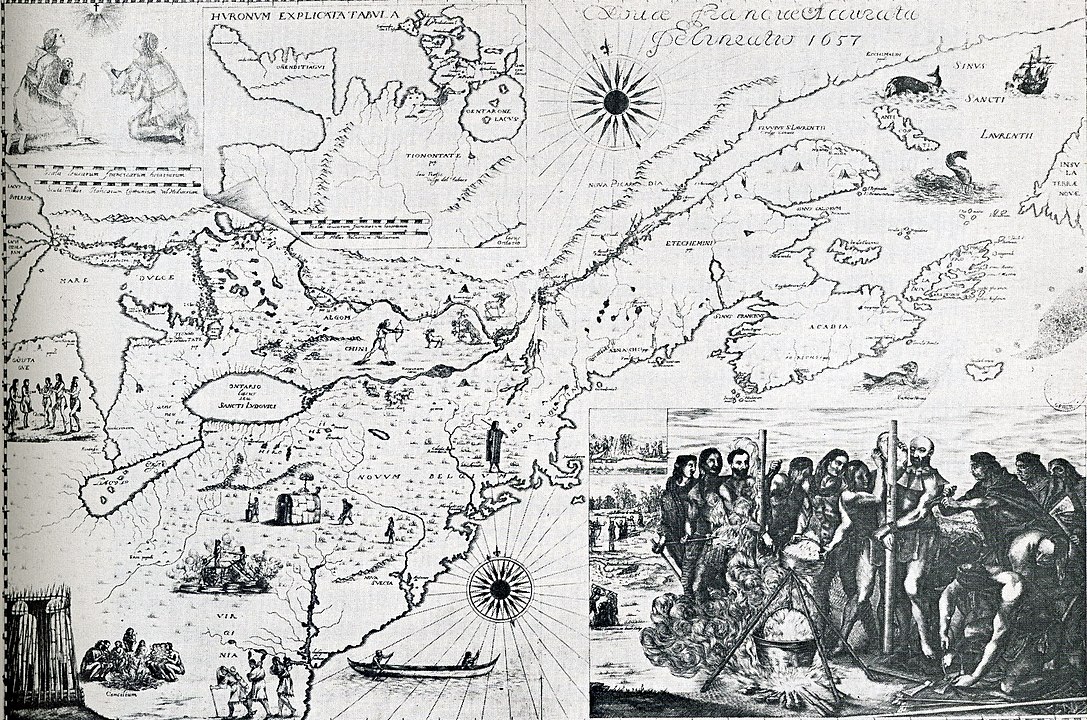
Twelve years before his death, Père Jean Brébeuf
Wrote out instructions to his fellow priests
And missionaries for their life among
   The Huron people:

Have true affection for them, first, he said,
For they, as you, are ransomed by the blood
Of Christ; accept without complaint their cornmeal
     However tasteless;

Keep in your pockets beads, jambettes, and fishhooks
For barter with the other tribes you’ll meet;
And, during portage, carry what you can,
     If just a kettle;

And yet, the best equipment you can bear
Is silence. Seat yourself in the canoe,
And speak no word, but churn your oar in silence
     As they will do.

How else address the great sky’s opened vault
Above the river gliding its swift current?
How else to greet the banks obscure with shadows
     Of fir and spruce?

How else perceive the plies of ice on ice
Extending brightness on dark water? How
Else to receive the snow whose soundless fall
     Will transform all?

There is a silence to that wilderness
That needs no word of ours; an emptiness
That does not ask for gift of tongue or lip
     But our whole lives,

And waits with frigid clarity upon
The naked boughs, much like the Saturday
Between the hour of Christ’s death and that
     In which he rose.

But, Hurons have as well another reason
For quiet, as their eyes survey the shoreline
For prints in mud, their ears strain for the sounds
     Of cracking branches.

They know what force could lie around each bend.
They feel the forest as it holds its breath
Before the rage of musket ball, the cry
     Of bow and axe.


               II
And so, the brethren listened, Jogue, Goupil,
Daniel and L’Alemont; they took their posts
In birch canoes with feet bare, cassocks tucked,
   And prayers turned inward.

They waited for the hour to break the silence
If only with their halting Huron speech,
To tell these people of the woods there was
   A God who loved them.

They knew before their craft slipped from the shore,
Their lives would pass away in that great silence.
That some, invited to a feast, would have
   Their skulls split wide.

That, captured, Jogue would feel his nails pulled out,
His fingers chewed to stubs by Iroquois teeth;
That those who beat and stripped him would be those
   He’d vowed to love.

And that Brébeuf would feel the Iroquois cudgel
Upon his head, their lashes on his back,
A traitorous Huron raise a boiling kettle
   To baptize him.

As he leaned heavy on the post that held him,
And watched the flames consume the mission church,
He never ceased to fill the wilderness
   With praise to God.

And even as they took his tongue and lips,
And cooked his skin before his eyes, he called
Out to the ones who tortured him the glory
   Of their salvation.


               III
For my part, when I think of Jogue’s torn hands,
Brébeuf kept wakeful through his mutilation,
And praising—praising—though even some he baptized
   Now ate his flesh,

I long to feel the blaze of righteous gunfire,
To hear a sudden clamor of French arms
Descend to save those priests and punish those who
   Took such cruel pleasures.

I want the wilderness itself to speak,
The rivers to rise up and swallow all,
The trees to bend and break their bonds, and sunlight
   To crown their heads.

But that’s not what Brébeuf or Jogue desired,
Who came to walk along the Huron paths
And dwell within their villages, and join
   Them in their suffering.

And though the Iroquois soon scattered all,
The priests remained to carry their own weight
To speak of Christ and love them as Christ did
   These brethren.

For, Jogue heard, even in his silent heart,
You go not to return: the wilderness
An altar where he made himself, to God,
   Burnt offering. 

Defending St. Junípero Serra, with Holy Water, the Rosary—and the Arts

St. Junipero Serra, a holy man dedicated to the earthly and heavenly well being of Native Americans has been denounced as a racist, a genocidal monster. One CBS news report even libeled the saint as a slave owner.

On Juneteenth 2020, haters brought their ire against the founding father of California to San Francisco. Hundreds of protesters, many of them dressed in black, toppled and defaced statues in Golden Gate Park. Many figures whose statues were attacked had no apparent connection to racism or slavery. For example, the mob graffitied a monument to Cervantes and his characters, Don Quixote and Sancho Panza.

Prominent among the statues attacked that day was St. Junípero Serra’s. His statue was overturned. Both the statue and its pedestal were defaced with red spray paint. “Stolen Land” was scrawled on the pedestal.

Dismayed by the vandalism, I was happy to see Archbishop Cordileone take an unusual and gutsy step. Not stopping with issuing an eloquent statement of protest—which would likely be ignored even in the unlikely event it was read by Serra’s detractors, the archbishop also used powerful spiritual weapons at his disposal.

Park workers had cleaned the graffiti from the statue and taken it away to storage when the archbishop went with about two hundred of the faithful to the site of the empty pedestal. On that drizzly day, wearing an amaranth purple skull cap, and the amaranth cassock proper to his role as a bishop under a lace-trimmed alb, with a deep purple stole around his shoulders, Archbishop Cordileone blessed the area with holy water and performed a minor exorcism. He then led a rosary of reparation.

In a clip now posted at the archdiocesan website, the archbishop said, “An act of sacrilege occurred here that is an act of the evil one. Evil has made itself present here.”

Archbishop Cordileone went on to say he grew up in San Diego, near the first mission Serra founded in Alta California when it was under Spanish rule, the area which now makes up the state of California. So, he said, he has a heartfelt connection to the saint. “I’ve been feeling great distress and sort of a deep wound in my soul when I see these horrendous acts of blasphemy and disparaging of the memory of Serra —who was such a hero, such a great defender of the indigenous people of this land.”

Remarkably, the archbishop has also defended St. Junípero Serra in many other unique and creative ways—using the arts.

Through the Benedict XVI Institute for Sacred Music and Divine Worship that he founded, with the savvy assistance of Maggie Gallagher, the institute’s Executive Director, Archbishop Cordileone commissioned a new Mass setting, a painting, and a poem in honor of the saint. During a Zoom event, “The Making of Missa Sancti Juniperi Serra,” Gallagher said that following the Renaissance model of commissioning great works of art from within the heart of the Church, all of these works were funded by a generous patron, Mr. Terry Castor of San Diego, in honor of his deceased wife, Barbara. Anyone who celebrates the Missa Santi Juniperi Serra is asked to remember Barbara Castor in prayer.

Missa Sancti Juniperi Serra

During the ZOOM event on April 30, 2022, Archbishop Cordileone spoke about how the idea to commission a Mass in honor of St. Junípero Serra was formed.

The archdiocese would be hosting a Sacra Liturgia Conference at the end of June, an international event which, as the archbishop said, “brings together great minds and hearts of people who are working to promote and renew sacred liturgy in the Church and regain the beauty that the liturgy deserves. I thought that since the last day of the conference is July 1, the feast day of St. Junípero Serra, a perfect way to bring this to a conclusion would be to celebrate a Solemn High Pontifical Mass —in the extraordinary form because that’s the form of the Mass that St. Junípero Serra himself celebrated.”

The Mass would be celebrated in Mission Dolores Basilica, which was built in 1876 adjacent to the original Church of Mission San Francisco de Asis to accommodate larger congregations. Mission San Francisco was founded by Padre Francisco Palóu under the direction of St. Junípero Serra in 1776, and the adobe mission church built in 1791 is the oldest surviving structure in the city. (EWTN recorded the Mass, and you can view it at Cathedrals Across America—Solemn Mass for the Feast of St. Junípero Serra.)

Archbishop Cordileone continued, “I asked Frank to compose a Mass in honor of St. Junípero Serra that would be reflective of the mission era here in California.” This is the third Mass setting composed at the archbishop’s request by Frank La Rocca (franklarocca.com) , who is the Benedict XVI Institute’s composer in residence.

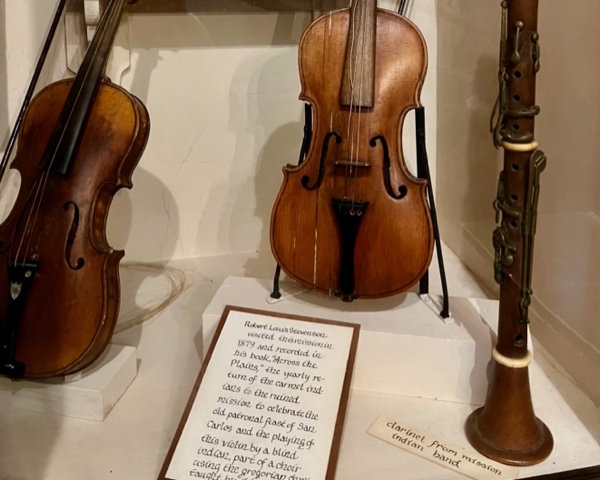
La Rocca then spoke about how he went about making his composition evoke the experience of what a Mass from that time would have been, “One important way is through the choice of the instruments accompanying the singers. It would be a small ensemble just like the ones they had in the missions of maybe a string quartet, a couple of flutes, perhaps a small portable organ.”

At the premiere, La Rocca’s music was performed on baroque-style string instruments and flutes to contribute to the authenticity, but modern instruments will be able to perform the music as well.

Musical instruments played to accompany Masses with Gregorian chants by the Indians in the Mission bands.

In addition, Frank La Rocca said he wove throughout his Mass setting the tune of one of St. Junípero Serra’s favorite hymns, “Salve Virgen Pura,”—”Hail Pure Virgin.”

“In addition to the hymn I wanted to make allusions to Gregorian chants from Missa Orbis Factor, which certainly would have been one of the most commonly heard Mass ordinaries in those days.”

La Rocca used the Salve as a Prelude, and worked it in as a thematic element of the music for the Mass, using the melody and derivatives of it in the music accompanying the ordinary the texts of the Mass. He wrote me later in an email that this technique is known as a “Parody”—a term that has nothing to do with mockery.

St. Junípero Serra and the American Saints Painting

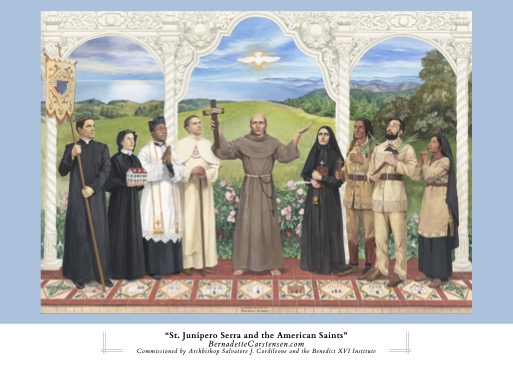
Figurative artist, Bernadette Carstensen (bernadettecarstensen.com) is Benedict XVI Institute’s painter in residence. During the Zoom event, she unveiled her commissioned painting “St. Junípero Serra and the American Saints.”

As Carstensen pointed out, the saints are standing in the painting against a classic California landscape on Mount Tamalpais with roses and columbine that grow there. Columbine also represents the Holy Spirit. The roses look to be Roses of Castile, of the kind St. Juan Diego found growing in winter and gathered into his tilma after the apparition of Our Lady of Guadalupe in Mexico.

The figure of St. Junípero Serra in the middle stands with arms upraised similar to the pose of his statue that was toppled in Golden Gate Park. From left to right on either side of Serra are Blessed Michael McGiveny; St. Elizabeth Ann Seton; Servant of God Father Augustus Tolton; Saint Damian of Molokai; Saint Mother Cabrini; a Native American representing the Huron Christian martyrs; St. René Goupil, representing the Jesuit martyrs, and St. Kateri Tekakwitha. At the saints’ feet are Spanish tiles depicting the nine missions founded by St. Serra. Below is a dedication to Barbara Castor.

The Liturgy of the Hours of Saint Junípero Serra

Benedict XVI Institute poet-in-residence James Matthew Wilson spoke about and read his poem, “The Liturgy of the Hours of Saint Junípero Serra.”

“I wanted to write the poem as a prayer . . . so we could read the poem and pray the poem.” Wilson said he used the rhyme royal scheme to honor St. Serra’s long and painful walk along El Camino Real—which in English means the royal road. Each stanza of seven lines, in iambic pentameter with a rhyme scheme of ABABBCC is about a different object from a different stage of Fr. Serra’s life starting from his youth in Mallorca, intended for us to ponder the object and think about what it can teach us about his spiritual life.

Eloquence beyond Words

Using the eloquence of the beauty of music and art, poetry, and architecture to defeat lies and ugliness is a profound idea. Research has shown that repeating the lies of opponents even when we have strong arguments against the lies may paradoxically strengthen belief in the lie among those who have believed it already. Besides, some people will not have heard the lie before, and it doesn’t help to spread it even further.

The arts are so convincing because they captivate people and grab people’s emotions, and even when they don’t completely bypass the intellect, they enrich the understanding.

A More Truthful Image

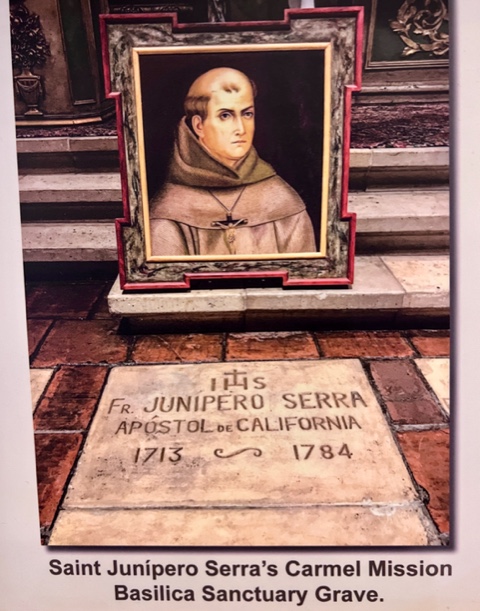
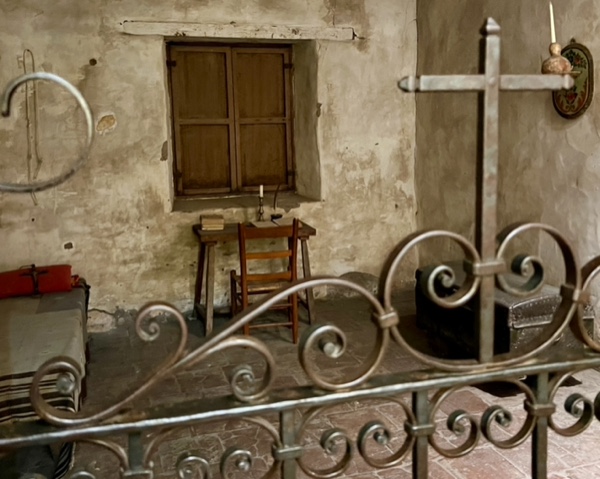
Recently I came across this review at website of the restored Carmel Mission where St. Junípero died and was buried, which portrays a more truthful image of the saint, “Walking through the primitive furnishings and reviewing the very basic library housed in the place, with tools and instruments available a couple of centuries ago illustrates the very primitive conditions in which the inhabitants lived and worked and the sacrifices made by the man that brought European culture and civilization to this part of America.”

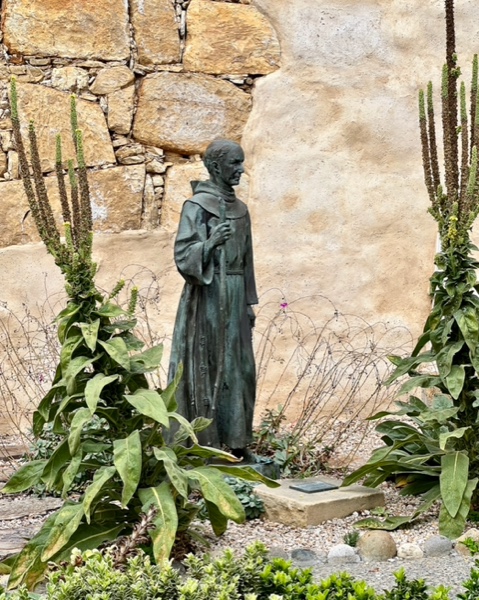
St. Junipero Serra’s ascetic cell at Mission Carmel, where he died and was buried.

This article is adapted from an essay that first appeared in the Fall 2022 Edition of Latin Mass Magazine. Republished with a few modifications, with permission.

Willa Cather and St. John Paul II: The Missionary Way

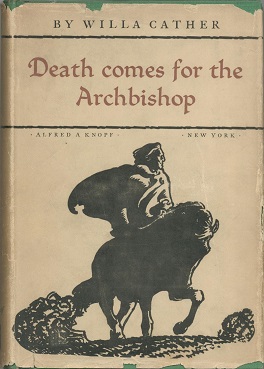
In spite of great differences, novelist Willa Cather and St. John Paul II show uncanny agreement as to the nature and validity of the Roman Catholic Church’s particular way of spreading the Faith to non-believers. Cather’s most successful novel, Death Comes for the Archbishop, reveals a vision of saintliness later codified in what JP2’s encyclical Redemptoris Missio calls “missionary spirituality.”

Cather was Episcopalian, not Catholic; Cather’s early success was in journalism, while St. Pope John Paul II excelled as a playwright, poet, and actor before choosing the priesthood; Cather was American, he was Polish; Cather’s birth in 1873 placed her in a century prior to both World Wars, and before John Paul II’s birth in 1920.  However, the missionary spirituality which Cather demonstrated through her fictional skill in Death Comes for the Archbishop and which John Paul II articulated in Redemptoris Missio are the same.

Willa Cather’s novel, Death Comes for the Archbishop, originally published in 1927, was her ninth novel and one of her most enduring titles. In it, she presents the story of two French missionary priests, Bishop Latour and Father Vaillant, in the primitive and often dangerous nineteenth-century American southwest. They have made the difficult decision to travel across an ocean to bring Jesus Christ and His Church to unbelievers.  The two friends encounter a range of desperate spiritual conditions in the people living in cultures acclimated to sin and violence.  The list is long: apostate priests, murderers, pagan beliefs and rites, a “Catholic” culture that has largely withered and died for complicated reasons or has simply never been introduced.

Cather’s later comments reveal that she chose to write this novel with an emphasis on the eternal rather than the temporal. In an open letter to Commonweal about Archbishop, Cather wrote: “I had all my life wanted to do something in the style of legend, which is absolutely the reverse of dramatic treatment.”  She continues by saying that since she viewed the Purvis de Chavannes frescoes of St. Geneviève as a schoolgirl she had wanted to write a piece “without accent”—a piece that would touch upon an incident, then pass on to others.  Such writing would only be successful and integrated if there was a powerful narrative grander in scope that the quotidian urgencies of plot.  Cather found her powerful narrative in the battle of Good against Evil.

Cather’s choice of missionary Catholic priests for the main characters of this novel is startling when viewed again the backdrop of her lived experience as a non-Catholic.  Yet she had been visiting the Southwestern rural countryside and Indian villages for at least 15 years before writing the novel.  Her typically terse conclusion was: “The story of the Catholic Church in that country was the most interesting of all its stories.”  Cather chose not to write the dramatic story of missionary priests martyred in North America—a long list containing some deaths that were well-documented in journals and letters, such as the torture and death of 35 year-old Fray Luis Jayme, one of St. Junipero Serra’s fellow Franciscan priests, who was stripped, shot with 18 arrows, then beat about the head and face with stones and cudgels until he died. Instead, Cather wrote the daily stories comprising the decades of missionary service in a way that allows the reader to settle into the slow, plodding road to saintliness where the eternal significance of the characters’ actions and choices is what matters.

A close reading of St. John Paul II’s encyclical Redemptoris Misso, published on December 7, 1990, elevates Cather’s novel from a brilliant study in saintliness to a thorough and luminous study in missionary spirituality. With firm clarity, the document begins its chapter on “Missionary Spirituality” by stating: “Missionary activity demands a specific spirituality.” Next, the four main components of missionary spirituality are listed: a life of complete docility to the Spirit, intimate communion with Christ, apostolic charity, and the call to holiness.

The foundational characteristic of mission spirituality is defined as “. . . being molded from within by the Spirit, so that we may become ever more like Christ.” Upon this basis, the missionary builds his or her life to enable the work of bringing the Gospel to non-believers. The essential characteristics which flow from the life of docility to the Spirit are the gifts of fortitude and discernment. From intimate communion with Christ comes the two characteristics of a person’s total self-emptying and the overcoming of attachment to people and things. Apostolic charity brings both a love of people and a love of the Church.  And, lastly, the call to holiness necessitates that a missionary be a contemplative in action as well as a person of the Beatitudes.

Cather’s novel gives numerous examples of the main characters displaying each of the four components of mission spirituality by letting the reader see Latour’s and Vaillant’s reactions to people and circumstances.  Since the call to holiness is such a distinguishing feature of the two men’s lives, let’s see how Cather conveys it.

In the first scene of the book, Bishop Latour wanders lost and thirsty in a parched land with almost no hope of finding water. Latour doesn’t fear death, but relies on his faith that the Holy Spirit is leading him.  The configuration of branches on a tree reminds Latour of the cross of Jesus Christ and without hesitation he falls to his knees to pray in meditation on Christ’s words from the cross: “I thirst.”

Cather allows the cruciform tree branches to bring allegorical significance and spiritual focus to Latour’s self-sacrifice and suffering.  Latour’s reaction of abiding faith in God establishes the reader’s expectation that Latour will find the spiritual in the temporal events he encounters throughout the book, and he does.  Even after the two later instances of spiritual doubt or dryness in the book, Latour returns to prayer and to God. In the aftermath of Latour’s close brush with death through dehydration and exposure, and in his miraculous discovery of water and food at a hidden oasis with good and humble people, we glimpse Vaillant’s own spirituality from his friend-since-childhood Latour’s perspective: “. . . his dear Joseph [Vaillant] must always have the miracle direct and very spectacular, not with Nature but against it. He would almost be able to tell the colour of the mantle Our Lady wore when She took the mare by the bridle back yonder among the junipers . . .”.  The conclusion of both priests that a miracle occurred is steadfast, but their individual reactions illustrate their very different personalities: Vaillant is impetuous and unassuming, Latour is reserved and careful, and quiet, if not slightly pedantic.

Cather builds upon the unique personalities of each man to illustrate the other components of mission spirituality. In showing Latour and Vaillant as possessing both fortitude and discernment, Cather reaches into her writer’s toolbox to draw lively scenes and personalities of people with whom the priests must interact.

For instance, Latour’s quiet sense of when and how to act, or not act is one of his most intriguing qualities. How does he know, when viewing the rebellious Fr. Martinez whose “mouth was the very assertion of violent, uncurbed passions and tyrannical self-will” that “the day of [Martinez’s] lawless personal power was almost over”? How indeed?  In a little over one year later, Martinez will formally resign his parish, and Latour will replace him with a Spanish priest that Latour recruited with the exact combination of skills and qualities to be accepted by the parish so they can be shepherded back to a correct understanding of the Faith. Fr. Vaillant possesses his own kind of discernment, which, due to his naturally impulsive personality often manifests in sharp bursts of friendship and goodwill.  Cather records numerous successes where Fr. Vaillant makes friends and fosters thriving parishes even in areas previously under the magnetic sway of a rebellious priest banished by Latour.

Both priests possess the particular strength of character defined as fortitude by the Catechism of the Catholic Church: “the moral virtue that ensures firmness in difficulties and constancy in the pursuit of the good.” Fortitude encompasses bravery but goes further with its emphasis on an interior moral compass defined by God.

It is easy to find examples of both priests’ bravery in uneasy and hostile circumstances throughout the saga of their decades in America.  But personal bravery alone cannot explain their calmness during all the threatening circumstances. Cather great literary triumph is to make the reader understand that there is a spiritual depth underpinning their preparation and bravery. They expect God’s will to unfold and are solid in their adherence to it. Their assured serenity in the face of danger and hardships reflects a commitment to accomplishing the moral good and their belief that God will use them for that end.

The total self-emptying in order to identify with Jesus Christ that is required by missionary spirituality refers to Phil. 2:5-9 where St. Paul refers to Christ’s self-emptying in order to effect both the Incarnation and man’s Redemption. Redemptoris Missio quotes the Second Vatican Ecumenical Council’s Ad Gentes which states: “the missionary is required to ‘renounce himself and everything up to this point he considered as his own, and to make himself everything to everyone.’” 

While examples of the simple normal pleasures the two men have had to give up are spread throughout the novel (French pears, lettuce, beautiful vestments, Gothic cathedrals, green vegetables in winter, lamb cooked rare, sheets or beds, the emotional consolations of family), there are other deeper sacrifices. 

Fr. Vaillant gives up his longing for a settled life of devotion to the Blessed Mother in a quiet monastery with no further travel to tax his frail physique; Fr. Latour, those intellectual pursuits where he experienced great success as a younger priest and their accompanying aesthetic rewards. Both men consciously choose to deny themselves what would best suit their natures in order to live out their missionary role under rough and unpredictable circumstances on a foreign continent. Neither of them grumbles nor questions the sacrifices. This patient endurance and embracing of hardship to save souls is testified to by North American missionaries, such as St. Junipero Serra writing after years of hardship upon finding out that supply ships were disastrously late in arriving to the bay of Monterey in 1772: “All the missionaries grieve—we all grieve—over the vexations, labours, and reverses we have to put up with. No one, however, desires to leave his mission.  The fact is, labours or no labours, there are several souls in heaven from Monterey, San Antonio, and San Diego.”

Missionary spirituality demands two types of self-renunciation which are themselves components of asceticism defined by the Church as “the disciplining of the will.” The first is self-renunciation against all temptation to “self-seeking, self-promotion and self-indulgence.” The second is asceticism related to the ministry to others, such as the inconveniences of missionary travel, disappointment, opposition, and the misunderstanding of co-workers.

All of the priests in Cather’s novel could be evaluated according to these standards, with some living up to these standards and some not.  But it is Vaillant and Latour whose tireless work to save souls is foregrounded. The extrovert Vaillant has single-minded, boundless energy and enthusiasm for each new assignment in spite of his broken body and numerous injuries and brushes with death. Latour’s “self-renunciation” related to his ministry is best seen in his miles of arduous horseback and mule-back travels to learn about the various types of people in his diocese so he can appoint priests who will be most effective in the widely different locations. More than once, Latour and Vaillant are observed to be working as hard as parish priests despite the fact that they are respectively, bishop and vicar.  These scenes in the novel remind the reader of the hard-working and apparently tireless St. Junipero Serra who routinely walked up to 35 miles/day with a painful, ulcerated leg to reach more souls who hadn’t heard the saving word of God.  This same zeal to minister to souls for their salvation is articulated in the writing of St. Serra about the reasons for establishing the Franciscan missions: “Above all, let those who are to come here as missionaries not imagine that they are coming for any other purpose but to endure hardships for the love of God and the salvation of souls.”

The ability for self-renunciation illustrated by these examples both in the novel and in historical letters and journals of actual North American missionaries is complemented and completed by a quality the encyclical calls “apostolic charity.”  The encyclical continues: “The missionary is urged on by ‘zeal for souls,’ a zeal inspired by Christ’s own charity, which takes the form of concern, tenderness, compassion, openness, availability and interest in peoples’ problems”. This apostolic charity is rooted in Christ and his love for both men and his Church. The encyclical continues with foregrounding the missionary’s necessary love for Christ’s Church.

Throughout the novel, Cather shows both priests responding to the needs of complete strangers with a complete disregard for their own comfort or safety. Without hesitation, Vaillant journeys through a storm and negotiates the dangers of washed-out roads and darkness to give Last Rites to Padre Lucero, an apostate priest who previously undermined Latour’s authority as bishop. Once he arrives at the deathbed location, Vaillant stays true to his “zeal for souls” by focusing himself, the dying man, and everyone else in the house on Padre Lucero’s salvation and the proper disposition of a dying man’s soul.

Religious novelists have often discussed the “face of God” problem, the difficulty of showing through the natural world the supernatural realities. The extraordinary gifts of Willa Cather have offered this alternative: a realistic and profound glimpse into the face of a saint.  At the novel’s conclusion, the reader is left with an appreciation of two men whose lives have been depleted totally by the hardships of their missionary work. Yet both men are presented as content despite the pain of old injuries and the deprivations of their existence in America. This is the peace of God which passeth all understanding.

These two priests have wholeheartedly fulfilled their role as missionaries, so beautifully drawn in Cather’s prose and summarized by another saint—St. John Paul II—in Redemptoris Missio.

Sarah Cortez is president and founder of Catholic Literary Arts, www.catholicliteraryarts.org. A freelance writer and editor with fourteen award-winning books, spanning poetry, fiction, essay, and spiritual memoir to her credit, she resides in Houston, TX. www.poetacortez.com

My Burden Light: Poem

after François Mauriac

If you wish to resist the cross of Christ

Don’t you dare dream up a casual affair.

Follow Rimbaud. Pulled hair, soul sunken,  

Swear your friends fiends, rival Satan’s refusal,

Gutturally given out of season and drunken,

Scorning the Jesus who slept through the storm,

Spitting at nuns who tend your sad corps.

But deathbed, foul breath, you’ll mouth off bad faith:

Prepare everything in my room just so,

Arrange the candles and needle-worked lace.

Now let the chaplain confess my coarse soul.

White linen must pall every inch of this place.

The priest appears and makes ready the bread.

Consummatum est pax crosses over the dead.


Joshua Hren is founder of Wiseblood Books and co-founder of the MFA at the University of St. Thomas. He regularly publishes essays and poems in such journals as First Things and America, National Review and Commonweal, Public Discourse and LOGOS, Evangelization & Culture and The Lamp. Joshua’s books include: the novel Infinite Regress; the short story collections This Our Exile and In the Wine Press; the book of poems Last Things, First Things, & Other Lost Causes; Middle-earth and the Return of the Common Good: J.R.R. Tolkien and Political Philosophy; How to Read (and Write) Like a Catholic; and Contemplative Realism: A Theological-Aesthetical Manifesto.

Daniel Knaggs Composes Music as an Icon for the Sacred

American composer Daniel Knaggs premiered his Two Streams, a cantata based on Jesus Christ’s message of Divine Mercy for mankind, last fall in Houston, Texas.  The concert celebrated the historic Church of the Annunciation’s 150-year anniversary in a gala evening event with almost 400 in attendance. The interior of the Romanesque-Gothic Church, a virtual jewel-box of carved marble, serene statues, and the original 19th-century stained glass, showcased the sacred music within vibrant architectural beauty.

            Two Streams is Knaggs’ most substantial project in an award-winning career that includes commissions, prizes, and awards for composition from around the globe.  The initial impetus for the piece arose from Knaggs’ desire to compose music in response to his experiences in the Polish cities of Kracow, Warsaw, and Gdansk, the city now famous for the Solidarity movement’s founding and contribution to the downfall of Soviet Communism. Knaggs’ strong attraction to the Diary of St. Maria Faustina Kowalska, which revealed God’s message of Divine Mercy, provided the touchstone for the piece’s ultimate grounding and spiritual context. He says, “The idea of a God who is merciful to a fault disarms me. This is our God whose greatest attribute is His unending mercy for us and which He wants us to spread throughout the world.”  The sudden and premature death of Knaggs’ father just after the commissioning of the piece brought a deeply felt personal dimension to the spiritual reassurance of Christ’s Divine Mercy. The title of the piece, Two Streams, evokes the two rays emanating from the image Christ asked St. Faustina to have painted of His Divine Mercy: a white stream of life-giving grace and the red stream of purifying grace flowing from His heart.

            For Knaggs, the composition of music is a painstaking process.  He says, “You have to be in it for the long haul—to be able to work with a piece until every feature is right.”  Both spiritual and practical aspects influence a composer, like Knaggs, whose goal is participation in conveying metaphysical or spiritual aspects beyond daily reality.  He says, “In composing, we are indebted to what has come before us, for example, chant, polyphony. When you write music, you have the ability to bring in the register and range of voices, dynamics of soft and loud, keys and tonality to add to the meaning. One movement of Two Streams has no words, but I believe things are being conveyed. If someone tried to write music without a belief in the spiritual truths, the audience would know.”

            Two Streams has 14 movements based on texts from three sources: the Diary of St. Faustina, Scripture, and liturgical texts. The movements are arranged symmetrically with the first and last movements related, the second and the 13th, and so on.  Four hymns (songs) of Mercy are interspersed between the movements to ground the listener in both trust and joy. Each song  features a hymnic stanza sung in English with a subsequent hymn of Mercy sung in Latin. The intention is to depict a timeless scriptural echo of the content in each hymn’s stanza which then ripples eternally throughout the past, present, and future. An example of this structure is the Song of Mercy II sung by the mezzo-soprano soloist. While it is joyous, the hymn spills over into the contemplative Latin section with the words: “Show us your mercy, O Lord, and grant us your salvation.”

                        You gush forth from the Divine Trinity,

                        But from one single womb filled with love.

                        The mercy of the Lord will be revealed in the soul

                        In all its fullness when the veils falls.

                        Ostende nobis Domine misericordiam tuam. Et

                        salutare tuum da nobis.

While Knaggs, who has studied six languages, simultaneously composed versions of the entire cantata in English and Polish, the liturgical texts of both are in Latin and Greek with the Scriptural texts in Latin. The simple yet powerful words within the composition were chosen by Knaggs. He says, “[The words] speak to the fragility of the human experience. And they speak to the transcendent hope that God offers us.” The music forms a seamless and rich tapestry weaving together threads from many eras including Medieval, Renaissance, Baroque, Classical, Romantic, and contemporary to explore the much needed message of Divine Mercy. The beauty of the music during the premiere is already an argument in favor of its continued appeal to audiences, whether believers or non-believers in the Christian-Catholic faith. 

            The location of the Church of the Annunciation in the heart of Houston’s frenetic downtown entertainment district provided yet another way for Two Streams to reach out with its message of Divine Mercy to the surrounding community. The pastor of Annunciation, Rev. Fr. Paul Felix, says, “Our parish can feel the heartbeat of our community.  We want to facilitate and promote the positive interaction of faith and culture. We want to bring the culture into a regard of the deeper issues of faith and a consideration of substantive issues. I heard that even the singers during rehearsals were deeply touched by the message of Divine Mercy. This message was heard by the audience which included parishioners, benefactors, many new visitors, seminarians, priests, and faculty members from several universities.”  

            The Two Streams premiere included the Houston Chamber Choir with director Robert Simpson, the 16-piece Kinetic string ensemble, the Annunciation Schola, and soloists Sasha Cooke, Chris Bozeka, Mark Diamond, and Caitlin Aloia. For Rev. Fr. Paul Felix, the experience of hearing the music for the first time was “very powerful and moving” with its harkening back to the eternal theme of Divine Mercy which informs so much of the daily work of a parish priest’s spiritual and corporal works of mercy, such as hearing Confessions, providing spiritual direction, visiting the sick, etc.  Rev. Fr. Felix says, “The Lord intervened to make St. Faustina the apostle of Divine Mercy.  It is so important for our time to listen.  God gave this message so people could find their way out of sin and evil through the redeeming love of Jesus.”

Knaggs’ most ardent wish for sacred music is that “the music conveys its own eloquence.” The mysterious resides inside music; the experience of hearing the metaphysical or spiritual content allows what Knaggs refers to as “music as an icon.  It is a window that points to a great reality. When people experience music that is not just about itself, they can experience realities beyond the music itself.  Maybe that person then sees there is more to life that just what’s here.  Music is a shared experience. It has a unique ability to reach inside the human heart.”

Sarah Cortez is president and founder of Catholic Literary Arts, www.catholicliteraryarts.org. A freelance writer and editor with fourteen award-winning books to her credit, she resides in Houston, TX. www.poetacortez.com

St. Kateri’s Gaze and the Iconography of John B. Giuliani

St. Kateri Tekakwitha “the Lily of the Mohawks” was born in the village of Ossernenon in present-day New York State, to Mohawk Chief Kenneronkwa and a woman raided from the Algonquin people.  Before her mother was taken captive  and adopted into the Mohawk tribe, French Catholic missionaries near Montreal had baptized and educated her, converting her to the Church.

At the frail age of four years, Tekakwitha lost her parents and younger brother to a smallpox outbreak that spared her life, but terribly scarred her skin and impaired her eyesight.  She followed in the moccasin steps of her mother and on Easter Sunday, April 18, 1676 at the age of 19, Tekakwitha assumed the baptismal name, “Catherine,” in honor of St. Catherine of Siena.  She disavowed marriage, instead vowing perpetual virginity, and eventually moved to the Jesuit mission village of Kahnake.  According to Father Pierre Cholonec, Tekakwitha said:

“I have deliberated enough. For a long time, my decision on what I will do has been made. I have consecrated myself entirely to Jesus, son of Mary, I have chosen Him for husband, and He alone will take me for wife.

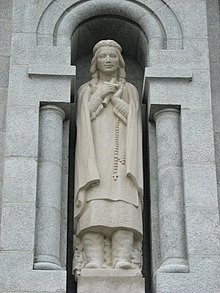
Statue of Saint Kateri Tekakwitha at the Cathedral Basilica of St. Francis of Assisi, Santa Fe, New Mexico

The Jesuits characterized Kateri as reserved, averse to social gatherings and given to blanketing her scarred face. She slept on thorns, offering her suffering up for her family’s conversion, a Christian practice that for her recalled the traditional Iroquois ritual of drawing blood. She wanted to found a convent with a devout fellow convert, Anastasia (a friend of Tekawitha’s late mother) but the Jesuits told her she was “too young in faith.”

Hagiographers attested that on her death at age 24, witnesses watched her scars vanish, to leave her skin resplendently beautiful.  As early as 1684, her gravesite had become a place for pilgrimages.  

In 1885, American Catholics initiated the process for Kateri Tekakwitha’s canonization, followed by Canadian Catholics. As described on Wikipedia: “On January 3, 1943, Pope Pius XII declared her venerable. She was beatified as Catherine Tekakwitha on June 22, 1980, by Pope John Paul II.”

In his canonization homily, Pope Benedict XVI honored St. Kateri:

“There she worked, faithful to the traditions of her people, although renouncing their religious convictions until her death at the age of twenty-four. Leading a simple life, Kateri remained faithful to her love for Jesus, to prayer and to daily Mass. Her greatest wish was to know and to do what pleased God. She lived a life radiant with faith and purity.

Kateri impresses us by the action of grace in her life in spite of the absence of external help and by the courage of her vocation, so unusual in her culture. In her, faith and culture enrich each other! May her example help us to live where we are, loving Jesus without denying who we are. Saint Kateri, Protectress of Canada and the first Native American saint, we entrust to you the renewal of the faith in the first nations and in all of North America! May God bless the First Nations!”

Statue of Saint Kateri Tekakwitha by Joseph-Émile Brunet at the Basilica of Sainte-Anne-de-Beaupré, near Quebec City

This first American Indian saint resonates powerfully, for me and for many other Indigenous people, “loving Jesus without denying who we are.”

Walk the galleries of the Prairie Edge & Sioux Trading Post on the Dakota plains, and you will see some extraordinary works by the late John B. Giuliani, priest and painter, such as his Crow Trinity, his Cheyenne Virgin and Child and Sundancer Christ. Beneath the liberal, loquacious light from those floor-to-ceiling windows, the perfectly-mixed American Indian red ochre, corn-yellow, and gold maize of his icons flow in complete harmony and complement to the authentic Indigenous art surrounding them. There at that leisurely outland in Rapid City, the good Father stands beside Jim Little Wounded and Kevin Fast Horse, holding his own with no fear, beside Joanne Bird and Del Iron Cloud with confidence, despite Giuliani’s Byzantine style.

Perhaps against all odds, the predominant religion today among American Indians is Christianity, and in fact, given the intense and unrelenting spirituality which has always been characteristic of the culture, evidence of Christ is often the first one will encounter – as when entering, for instance, the Qualla Boundary, the Cherokee reservation inhabited by the Eastern Band of Cherokee Indians in North Carolina, where the most noticeable, immediately-recognizable structure is a church. Therefore, it should go without saying that our contemporary art scene must accept this reality, and then reflect its truth. As arts journalist, Grace Glueck, wrote in The New York Times, “Although Western art was raised on religion, 20th-century modernism more or less tuned it out. Yet in the last few decades artists, if not curators, have become more open to the subject…”²

Unfortunately, the onset of that “tuning-out” occurred precisely as North American Indians began coming into their own, in terms of conversion, and thus they were abandoned by the sophisticated art world as far as representation. Now more than ever, artists of faith in every discipline are justified in addressing this neglect of what is arguably the most difficult feat accomplished across the continent – the spiritual coercion of an entire race. Moreover, that representation should not relegate Native American Indians to mere conquests of elite and superior missionaries, but in accordance with the Scriptures which say of Christ: “…you ransomed people for God from every tribe and language and people and nation, and you have made them a kingdom and priests to our God, and they shall reign on the earth.” Wholly apart from any issue of “social justice,” spiritual justice demands their equal representation as sovereigns and savants – and saints.

Indigenous believers will find themselves well-represented at Giuliani’s sacramental “table.”  There is only one, not very impressive, painting of St. Kateri drawn by one who knew her.  So it is with more than a bit of wonder and consternation that, looking into his Mohawk Kateri III #92, it is as though I am gazing into the face of my own late mother, who was a direct descendant of an Algonquin born in the same generation as Saint Kateri, an Algonquin orphaned by the same smallpox which took Kateri’s likewise-Algonquin mother and Mohawk father. My amazement is not merely towards the actual features themselves, but the very attitude with which Father Giuliani has infused them. He has captured the soul of the Native American Indian with startling skill.

Saint Kateri’s expression is itself an embodiment of that stoic, borderline-suffering countenance which was my mother’s “thousand-yard-long stare.” Kateri is beatified by the beauty of a glinting bronze nimbus, full as a Beaver Moon, which was that calendar date of the “last call” for ancient Native American Indians to prepare for winter. It will appeal to the truly Indigenous, if only at an intuitive, vestigial level, signifying security amid worldly instability, recalling the ancestral memory of the beaver, symbol of that being who will provide warmth, our last and only hope and salvation by its sacrifice, keeping our hearts soft before the coming cold – a Christ figure from the Animal Kingdom, of sorts.

In the mythology of the Omaha people, we have in “Ictinike and the Four Creators,” a hero who visits a beaver which sacrifices its own son to provide him with food. Following this meal, the father beaver plunges the bones underwater, and the son is resurrected. Too, the Cherokee held a belief called “Cover the blood,” that an animal slain in hunting might be resurrected from its blood spilt by drops on the ground. A similar doctrine runs through the religion of many other tribes. ³

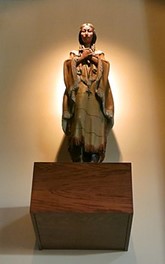
A statue of Saint Kateri Tekakwitha in Saint John Neumann Catholic Church, Sunbury, Ohio

Could it be that, just as early Indigenous missionaries employed the touchstones of the “old religion” to woo their people to the Good News, Father Giuliani unwittingly or knowingly reconnoitered the Beaver Moon, for her halo? Saint Kateri is the patroness of Native American Indians and First Nations peoples, of integral ecology and traditional ecological knowledge, so whether by divine inspiration or his own carnal understanding, this would seem perfectly decided – almost, in fact, an environmental “election.” As Saint Paul wrote, “…to all men, I have become all things, that by all means I may save some,” such an artistic interpretation of Kateri’s nimbus has the power to draw and unite all Nations, from the Southeastern Cherokee who called the Beaver Moon “nu-da-de-qua,” to the Northwestern peoples’ “alangitapi.”

Rather than emphasizing a voluminous veil at her crown, Giuliani downplays the fabric around the saint’s face, focusing on copious, blue folds less suggestive of a cotton mantle than of “Long Man River,” who washed away the despair and impure thoughts of Native ancestors. The sheer weight and width of this massive, dramatic headdress seem to invite viewers not to the mystery fringe of a mortal woman’s hair, but to the currents of living waters. But whereas the veil and white sheath she wears reflect the traditional iconography of the “White Man,” at their lower edge is seen the familiar attire of Native American culture, where a multi-colored, zigzag pantaloon border grazes the tops of Saint Kateri’s dainty feet in moccasins. Her feet are firmly planted at a modest space, in a field of wildflowers where stands of lilies arise on either side, giving testimony to her designation as the “Lily of the Mohawks.”

But the covering of Saint Kateri’s hair proves a much more profound and powerful outward sign of devotion to the Native American Indian viewer, than it does to the non-Native. The covering of the hair conveys a submission to the Christian faith as well as a cultural “assimilation” in a manner that white European Christians could never fully experience, for hair is sacred in Native American Indian culture, a source of ornamental service especially in worship at ceremonial events. An Amerindian’s long hair represents strong self-identity, even clan affiliation (as in the Cherokee “Long Hair Clan”). To throw away our hair is to practice self-mortification, even mourning akin to the Old Testament practice of rending one’s garments, an utter disregard of the ego which goes far beyond the customary cutting of a nun’s hair (symbolizing an end to feminine vanity). Thus Saint Kateri gains profound universal reactions of renunciation through this imagery, humility which contemplative American Indians both male and female will feel in a visceral way.

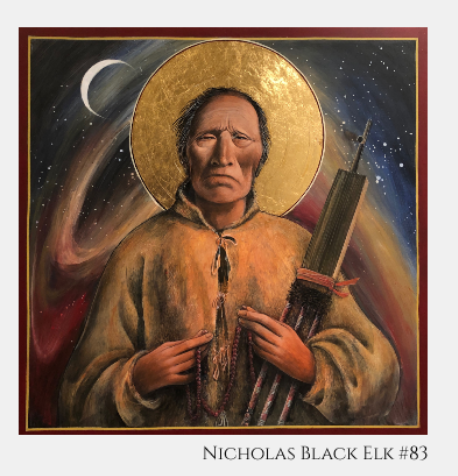
Also noteworthy in Giuliani’s “sacred Indian menagerie” is his iconography of the Lakota Holy Man, mystic and Catholic missionary, Nicholas Black Elk. While Black Elk is not officially a canonized saint, the Jesuits appointed him to the position of catechist after his baptism in 1904. Thereafter, Black Elk is credited with bringing hundreds of fellow Native American Indians into the faith. Devotions including the rosary and Sacred Heart were a vital part of his practices, thus it is perfect that Giuliani, in “Nicholas Black Elk #83,” has portrayed him with a strand of rustic and somewhat-crudely mismatched beads of natural wooden hue. While Giuliani’s use of lunar imagery might be debatable in the depiction of Kateri, here it is undeniable.

Behind Black Elk’s aureole, reminiscent of a hammered brass cymbal, a crescent moon hangs against the backdrop of a starry night sky. Punctuating the heavens, a celestial supernova swirls around his shoulders in orbits of streaked red and gold, giving the impression of enormous, interstellar wings. His face is un-romanticized and unerring in likeness to the mien of the one after whom it was modeled. There is no question that this is Black Elk as he appeared in the last years of his life. The illusion would be complete, except for the icon’s ragged monastic robe with its lowered hood, hidden behind the rough-hewn cloth of a garment whose yellow hues harmonize with the gold of the supernova “wings” on either side. This effect being so seamless, the viewer feels all the more that they are appendages, “feathered” outgrowths of the man himself. Again, here it seems there is more subtle symbolism at work, a hint at the antediluvian Birdman regalia of Native American Indians which elevated priests to their stature, conveying instant recognition at mere sight to every domestic clan and outside tribe.

Vestiges of this ancient diaconate are still visible today in the falcon dancer “vestments” seen at powwows for formal stomps and ceremonies. In the Southeastern Ceremonial Complex, the Birdman represented the Upper World, where its genesis was accompanied by sun, moon, and stars – the latter two which also appear in Giuliani’s icon. “The life of an Indian,” said Black Elk, “is like the wings of the air… That is why the Indian is always feathered up, he is a relative to the wings of the air.”

 If ancestral memory does indeed remain, passing down along with the “generational trauma” a hunger for and appreciation of unction both heavenly and carnal, then the Native American Indian viewer should find ample spiritual inspiration – and if not, Giuliani’s sublime suggestion of the ritual feathers is sufficient, imparting at least a dose of tangibility, reinforced through use of the red ochre and sunflower/corn silk yellow paints which were so common to the culture. The combination is found equally in authentic Buffalo Dreamer hand-painted rawhide shields and genuine turtle amulets on display nearby in the galleries of that Prairie Edge & Sioux Trading Post, authentic art by the Ute Nation and Oglala Lakota – Nicholas Black Elk’s own blood people.

Consequently, this priest’s art is art which has undoubtedly found its place. In a pastoral letter, Reverend Nicholas Black Elk wrote of the American Indians, “We all suffer in this land. But let me tell you, God has a special place for us when our time has come.” Surely if we read the signs and have ears to hear, that time has now come, with one of those special places living in the lasting works of John Giuliani.

Jennifer Reeser is a bi-racial writer of European American and Native American descent, the author of “Indigenous,” and “Strong Feather.” Her reviews have appeared in First Things, LIGHT, Able Muse, and elsewhere.

¹Despair Over The Pope https://www.nybooks.com/articles/2010/06/10/despair-over-pope/

2 Art Review: Creative Souls Who Keep the Faith of Challenge Its Influence https://www.nytimes.com/2000/04/21/arts/art-review-creative-souls-who-keep-the-faith-or-challenge-its-influence.htm

³History, Myths, and Sacred Formulas of the Cherokee, ©1900 by James Mooney, reprinted by Bright Mountain Books, 1992, p. 474

“Are We Not Interested in the Cosmos Anymore?” James Matthew Wilson, Katy Carl, Glenn Arbery and More: A Contemplative Realism Symposium

            In February 2022 the Benedict XVI Institute published Joshua Hren’s Contemplative Realism: A Theological-Aesthetical Manifesto, by Joshua Hren, founder of Wiseblood Books, co-founder of the Master of Fine Arts in Creative Writing program at the University of St. Thomas in Houston, and prolific novelist, poet, and essayist. His essays and poems have appeared frequently in such periodicals as First Things, America, Commonweal, National Review, Catholic World Report, and Law & Liberty. His books include two collections of short stories, This Our Exile (2017) and In the Wine Press (2020); the book of poems Last Things, First Things, and Other Lost Causes (forthcoming, 2022); Middle-Earth and the Return of the Common Good: J.R.R. Tolkien and Political Philosophy (2018); How to Read (and Write) Like a Catholic (2021); and the novel Infinite Regress (2022).

A recent article in Mere Orthodoxy explains Contemplative Realism’s germinal yearning. John-Paul Heil reviews the report in The University Bookman, Only the Lover Writes,” and, a review of both Contemplative Realism and Benjamin Myers’ book appeared over at Voegelin View: Literature for the Recovery of Reality: Joshua Hren and Benjamin Myers’ Christian Vision for Literature.”

            Contemplative Realism is Hren’s response to Pope Benedict XVI’s summons to writers to “ask rather more carefully what ‘the real’ actually is.” “Are we not interested in the cosmos anymore?” Benedict asks. “[T]he man who puts to one side the reality of God is a realist only in appearance.”

            Hren takes up this challenge. Since its origins in the eighteenth century, Western fiction has for the most part eschewed the metaphysical—the presence of the divine behind the scrim of the visible world—to present a “reality” limited to the surface conditions of day-to-day modern life and thus often, although not always, infused with bleakness, black humor, cynicism, and despair. Any sense that some other reality might exist is reserved for the genre of fantasy. Contemplative Realism aims to define the response that a Christian writer of fiction might have to this self-imposed limitation: crafting a distinctive literature that includes ultimate as well as surface reality. The models already exist: Dostoevsky, Flannery O’Connor, Marilynne Robinson. Hren writes:

The underbellies of our civilizations and the cesspools rank in the pockets of our souls are real. They rightly make us reel. Sometimes the vestiges of God in the world can seem scarce or scattered relative to the apparent success of raw evil. At this juncture the contemplative realist seeks to stoke reverence for the reality of the Paschal mystery—a passion, death and Resurrection that is more real than an infinite tally of the sins and the frightening fissures, the apparently irreversible cracks in existence. But, countenancing the same absurdities that unnerved Camus and the existentialists, the contemplative realist will prevent his story’s perspective from relishing the farcical or capitulating to the       cruel to the point of souring cynical even as (fiction being largely a record of man in rebellion), a large part of his work consists of drawing out the spiritual intensities of man’s refusal to serve.

 and:

The contemplative realist, considering the actual existence of things, at once sees them as we were meant to see them and also shows the rest of us how to see them. Sometimes he shows us the same thing several times, in several ways, leading us up the ladder of perception to a fuller share in the beauty of being: superficially first, operating in the mode of “how things are” in their apparent blasé “nothing to see here” state, or scattered in apparent disorder; then, as St. Bonaventure puts it, “he considers things in themselves,” namely, in their matter and substance, power and activity, measure and motion, and from here “the observer can rise, as from a vestige, to the knowledge of the immense power, wisdom, and goodness of the Creator.” The contemplative, as         contemplative, can achieve this ascent without needing to communicate it at all. No one, says Bonaventure, “arrives at contemplation except through penetrating meditation, holy living, and devout prayer.” The contemplative realist surely needs these things and more. Wedded to the word and world in a different manner, the contemplative realist must     manifest this perception in his prose. 

Hren’s Manifesto, besides being a beautifully written and passionately argued 64-page book, is an actual manifesto. Hren has garnered the signatures of a number of Catholic writers who endorse his theory of a distinctively Christian approach to literature.

            Catholic Arts Today has decided to engage Hren’s intriguing and challenging theories. To that end, we have posed some questions his manifesto raises to its signatories. What follows is a kind of symposium, a conversation we have cobbled together from our questions and the responses of five of the signatories.

Besides Joshua Hren himself, the signers of the Manifesto participating in the conversation include:

–Glen Arbery, president of Wyoming Catholic College and author of Why Literature Matters (2001) and the novels Bearings and Distances (2015) and Boundaries of Eden (2020).

–Katy Carl, editor-in-chief of Dappled Things and author of the novel As Earth Without Water (2021) and Praying the Great O Antiphons: My Soul Magnifies the Lord (2021).

–Sarah Cortez, author or editor of 14 collections of poems and essays, including Tired, Hungry, Standing in Spot for Twelve Hours: Essential Cop Essays (2019), third-place winner of the National Federation of Press Women’s nonfiction award.

–Benjamin Myers, professor of literature at Oklahoma Baptist University, author of three books of poetry, and 2015-2016 Poet Laureate of the state of Oklahoma.

–James Matthew Wilson, poet-in-residence at the Benedict XVI Institute, director of the Master of Fine Arts program at the University of St. Thomas in Houston, and author of eleven books, including six books and chapbooks of poetry.

 Catholic Arts Today: How would you distinguish contemplative realism as a fictional mode from realistic fiction that happens to have been written by a Catholic writer? For example, there’s Flannery O’Connor’s wonderful story “Everything That Rises Must Converge,” about the black and white mothers who meet on a newly integrated Southern bus and have no ability to understand or even perceive each other (not to mention the white mother’s oh-so-sophisticated but comically obtuse son). We know that O’Connor was a Catholic writer who took seriously the mysterious workings of grace in the human heart–so we might classify this story as a work of contemplative realism. But a secular admirer of O’Connor–and there are many–might see the story as a strictly secular story of the tragedy of the human condition–something that all good secular writers as well as Christian writers recognize. Why is this story an example of contemplative realism–in contrast to just plain realism as explicated by a talented and observant writer?

James Matthew Wilson: In my view, Contemplative Realism is not a manifesto positing a new or specialized literary practice or poetics, though it may have touches of that. It is rather an insistence that contemporary literature recover the fullness of breadth and depth proper to the great literature of every age. Odysseus descends to the underworld. Aeneas descends to the underworld. Since Dante, our knowledge of the real comprehends the descent into mystery and the ascent to the divine essence. Not all art can have such a cosmic scope; the minute, particular, and immanent is also a worthy theme for literature. But once we have seen those grand or awesome vistas, art is itself transformed. The weakness to which Joshua is responding is that, with full knowledge of how revelation and grace have transformed what we know about nature, so much contemporary art proceeds as if nothing had changed. It shies away from grandeur, it fumbles in knowing ignorance, and settles for a foreshortened horizon that even the unbeliever knows is not the full range of the spirit. Art does not tolerate special pleading, but it becomes a lie when it pretends to be utterly unaware of things just because its authors do not like them or believe in them or feel capable of speaking of them.

Katy Carl: This question helps to clarify that contemplative realism is not being presented as though it were the one and only “right” way to be a “Catholic writer” (that fraught, much-contested term) or even a spiritual writer. Rather, it serves to articulate one aesthetic approach to literature that is deeply consonant with the best of the Catholic intellectual and spiritual tradition. We can locate it among a multiplicity of “Christian realisms” whose emphases may vary. O’Connor, who considered herself a “Christian realist” and as such also a “prophet of distances,” has a voice so sui generis that any imitation must pale beside the original. The secret of her genius was not “violence” or even “hillbilly Thomism” but the gift to see things as only she could see them.

As you rightly notice, this is the work of any writer worth her salt, regardless of that writer’s other beliefs. But for a writer who starts from a position not of habitual doubt or materialist skepticism but of enthusiastic assent that what the Church proposes and believes in the Creeds is essentially true, what is seen and how it is seen will shift. This is what O’Connor meant when she said doctrine was an instrument of vision, not an obstacle to vision. Jacques Maritain is also on to this when he speaks of the altitude from which an artist is able to see. To my mind, a contemplative realist seeks to dramatize the point of intersection between the vertical axis of human experience, the aspiration toward God, and the horizontal axis of the observable world.

Catholic Arts Today:  Conversely, what’s to distinguish a work by a secular writer who happens to “show the rest of us how to see…the actual existence of things” and a work by a contemplative realist? Take Hemingway’s 1927 story “Hills Like White Elephants,” about a young woman being pressured by her boyfriend into having an abortion. This story is an extraordinary narrative of “the actual existence of things”: the girl’s horrifying realization of the ultimate sterility–and shallowness–of the pair’s months-long relationship that is in fact like the dry, barren condition of the hills in the Ebro Valley. Was Hemingway a writer of contemplative realism manqué? Or just a secular writer who could see inconvenient truths? How would a Catholic writer have handled the story any differently?

Katy Carl: The virtue and the liability of Hemingway’s pared-down style both dwell in the power of suggestion by omission. Speaking just for myself as a reader, I find this power can be brilliantly used or pursued to a fault, depending on the context, and in “Hills Like White Elephants” the brilliance all comes across in the felt absence of love. This absence is only too realistic in the story’s context, but if it were all we could expect from reality on or off the page, we’d be right to despair. It’s much harder to write unsentimentally, truthfully, about the presence of love than about its frequent absences and failures in human behavior. This is especially true when you’re dealing with characters who have numbed themselves beyond the reach of feeling or connecting with any love that may be present in the situation. The contemplative realist is always on the search for a suggestion of the “Love that moves the sun and other stars,” whether or not a particular story’s characters are similarly inclined.

To return to O’Connor, think of her Haze Motes in Wise Blood, charging through the streets of Taulkinham, as hellbent on sustaining his own misery as either of Hemingway’s lovers here—but O’Connor calls our attention beyond and above the misery in a way Hemingway might have considered cheating because it reaches beyond the senses, though you couldn’t with any justice call it distanced from the senses either. Again, O’Connor makes that attempt to discover the sensorially rendered intersection of the vertical and horizontal planes, which Hemingway might have seen as a pointless exercise but which, to a contemplative realist, is almost the whole point.

Benjamin Myers: I think it is important to note that the signs of the transcendent are in the reality depicted by the fiction not just in the words of the story. Two photographers might capture two images of the same bright light, one calling it a trick of the lens and one calling it an angel, but it cannot be both. If it is an angel, then they have both taken a photograph of an angel, regardless of one photographer’s ignorance of that truth. In other words, the more talented and observant a writer is, the more difficult it would be for that writer to be merely a “plain realist,” regardless of the writer’s awareness of what true reality he or she may be capturing in fiction. (Of course, the artist who knows what he or she is depicting has an advantage). Nihilism and materialism require scant attention to the nature of things, but many great writers have been of God’s party without knowing it.

Sarah Cortez: Especially within the Catholic (Christian) worldview, intentionality is paramount because sin requires intentionality, just as not sinning does.  Therefore, I would say that great or even good writers who undercover layers of meaning in their work, even metaphysical meaning, may not necessarily have the contemplative realist goal in mind due to lack of intentionality.

Catholic Arts Today: Joshua has pointed to a cynicism, nihilism, and despair that he suggests is a cornerstone of the realistic tradition. He cites the novels of Balzac, Flaubert, Camus, and Jonathan Franzen as some of his examples. But is this dichotomy the only way to contrast the realistic tradition with contemplative realism? What about novelists and story-writers of manners, such as Trollope, George Eliot, Chekhov, Nabokov, A.S. Byatt, and others who simply aren’t interested in metaphysical reality? Where do they stand in the realism vs. contemplative realism dichotomy?

Benjamin Myers: The signs of the transcendent are not always spectacular. The bread and the cup are household things. When a writer is observant of what is, even in the “mundane,” the transcendent can come through, though a writer such as Trollope or Chekhov will certainly often, whether consciously or unconsciously, attempt to stifle that transcendence. That is one kind of materialist realism, a blessedly failing kind at times– or blessed to the extent that it fails. In Nabokov I sense a greater awareness of what is missing, a yearning for transcendence that the writer feels as near but refuses to believe in. In such cases the frustrated yearning itself can become a kind of sign of the transcendent, when the writer is sharp enough.

James Matthew Wilson: Hans Urs von Balthasar says that the Christian must be the guardian of metaphysics in the present age. So is it with the Catholic or contemplative-realist writer. Some authors have little or no metaphysical scope to their work and the work suffers for it, even if the work can still — and with ease — be affirmed as good, or even very good. Literature always faces the temptation to become secular, whether in an imitation of classical humanism or a vulgar politicization of aesthetic form or in a mere playful romanticism. One does not need to deny the value that may be found in each of these secular visions to observe that they do not tell the whole story. It’s my hope that my work celebrates the discipline and reason of the human spirit in keeping with the best aspects of classicism, while it also keeps the work open to the transcendent. A vision of the secular, and of the merely human, always implies by its own internal essence and existence, the presence of that which transcends it. Paul Claudel wrote of this often in his poetry: to study the nature of things is to study causality, and, for Claudel, the only cause was that of the God who created all things and held them in relation to one another.

Catholic Arts Today: Can you be a Catholic novelist (or poet or screenwriter) without being a contemplative realist? What about such Catholic novelists as Robert Stone, Alice McDermott, Phil Klay, and Kirsten Valdez Quade, who have brought their Catholicism to their writing and dealt with serious questions of faith, salvation, and morality in their fiction. What might separate them from contemplative realists?

Joshua Hren: Many contemporary Catholic writers operating in different veins contain considerable goods. As I note in a piece for University Bookman, Phil Klay’s Missionaries contains a stunning intrusion of Christ onto the scene. I also appreciate much that is happening in the realism of Christopher Beha–both in What Happened to Sophie Wilder and The Index of Self-Destructive Acts. And then there’s Randy Boyagoda’s comic contributions to contemporary Catholic letters, Dante’s Indiana, which I’ve reviewed at Law & Liberty.

In How to Read (and Write) Like a Catholic, I outline three main ways that we can approach the goods of literature:

1. The study of literature as the study of human nature, which is to say the study of ancient texts in order to obtain a greater understanding of human passions and ends, possibilities and limits, to witness man’s innate social nature, to hear the whispers of natural law as it chastens man in rebellion, and to consider how the human story unfolds outside of a direct encounter with Christian revelation. (This does not exclude reading the deep meanings of these works according to the light of Christ.)

2. The study of literature that is intrinsically Catholic. This can be undertaken through an examination of the presence of metanoia (conversion) in great literary texts; through a consideration of the way in which writers dramatize the workings of grace upon nature; and through a sacramental approach that sees the ways in which seen images point to unseen realities–a cultivation of the capacity to, in Flannery O’Connor’s words, see evil as “a mystery to be endured” and “not a problem to be solved.”  

3. The study of “Christ-haunted” fictions–the persistence, often in traces or in veiled form, of Catholic ideas, images, and tradition in purportedly secular or postmodern poetry and stories, as well as literature grappling with faith within an increasingly secularized literary canon.

Catholic Arts Today: Is there a temptation for the contemplative realist to be complacent, to write simple dichotomies of faith versus its lack, to elide over despair and doubt? How can a contemplative realist avoid that trap?

Glenn Arbery: Chaucer makes fun of such complacency and such “dichotomies of faith versus its lack” in “The Prioress’s Tale,” the horrifically pious story of a sweet Catholic boy killed by demonic Jews. He mercilessly satirizes the Prioress herself in the General Prologue of The Canterbury Tales, but he is just as satirical about the Miller, whose tale of sexual antics remains both hilarious and outrageous.

Contemplative realism means taking the world as we actually experience it. When Joshua coined the term, I don’t think he meant to suggest a new approach but rather to emphasize that the Catholic writer has never needed to be afraid to face the whole truth of things, which necessarily includes spiritual levels. I get the impression that some Catholics are horrified by depictions of eros or bad language or violence–I think of Flannery O’Connor’s Wise Blood or her stories “Good Country People” or “Greenleaf” (not to mention most of Walker Percy)–as though the faith could not stand up to them. But, even more than when O’Connor or Percy were writing, the culture we inhabit promotes “expressive individualism,” which negates the very idea of transgression, and one thing we need is to see sin as sin.

The imaginations of children might need to be protected (even from some passages in the Bible), but the mature imagination needs the real world of beauty and transgression, misery and grace. It’s important to present people in their self-consciousness and the allure of sin without glamorizing evil, and also to present them in their prayer, their doubt, their suffering, because these are realities that must be worked through with fear and trembling. 

 I would argue that the Catholic writer has this advantage: he or she does not have to invent the whole meaning. The world is given and given with intention — it already has meaning. If fiction is any good, it is patterned upon real observation, which means that it is the interpretive discovery of what is already there. Instead of having to force layers of meaning into the fiction, the Catholic open to givenness and divine intention can trust that in pursuing the beauty of the work, he or she does not have to intend every meaning consciously. As Jesus says, “a good measure, packed together, shaken down, and overflowing, will be poured into your lap.”

Sarah Cortez: Simplicity of both worldview and of artistic expression can always be a wily seducer. Within the context of this manifesto, however, the only “simplicities” stated are spiritual truths which because of their inherent nature defy their apparent simplicity due to their origin in the Divine nature of God. Thus, the writer, in particular, is left with the task of bringing to the page truths grounded in the many mysteries God has placed within human nature, and each person’s torments and joys as his individual salvation is worked out within a luminous but crazy world.

Joshua Hren: My manifesto on behalf of a “contemplative realism” makes no claims to create, ex nihilo,a new aesthetical species. Nor does it advance this rough school of literary fish as some preeminent or sole “way forward” for fiction in our time. It makes the case for an aesthetic that does not negate so much as it develops the goods of realism. It makes the case for an aesthetic that is consciously committed to unflinchingly gazing at the brokenness and terrifying aspects of nature, resisting the notion that what is “most real” is most evil or difficult to countenance, and yet representing the innumerable crosses in nature and the startling fissures in nature, even as it also gives witness to what St. Bonaventure calls the “vestiges of God” found in the creative world, and the heroic sanctity that can be cultivated even in unpropitious environs.

My manifesto seeks to articulate a literary approach that exists already in diffuse books and also in the potencies of living artists. It seeks to gather and galvanize those souls. It is a soul cry to break through restrictive bonds of the culture we inherited, and yet to be in conversation with our fellow artists who are not believers but who have tremendous natural insights into the state of contemporary fiction or the prospects of the novel in an age of diminishing readers. Amidst this conversation, we necessarily critique the deficiencies of those realisms that reduce what is most real to the seen. 

Subscribe to Our Emails