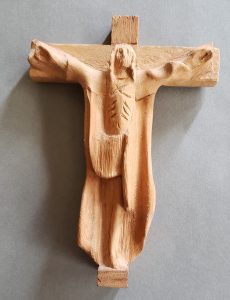
A Conversion

Editor’s note: In his last months dying of cancer, Timothy Murphy, a gay man who preceeded his partner in converting to Catholicism, poured out poetry. Some of them he gave to me to publish.  This poem captures his partner’s conversion as he was dying and the poet’s faith that therefore they will meet and love again in Heaven, where sin cannot mar or muck our loves.   MG

A Conversion

I.
Deeply suspicious: my return to faith
troubled him, but he asked for David’s Psalms,
heard them again.  Those poems were blessed alms
to a man starved, told he would be a wraith,
his shade wandering Hades in three years.
Leukemia poisoning his blood and bone
would bear him off, leaving his love alone
to drown grief in his whiskey and his tears.
Each of the Books of Wisdom planted seeds.
To texts I read he brought his wit, his reason,
knowing to everything there is a season
(his last!), the King James verses grasped-at reeds,
elpis, for one condemned by carcinoma.
Leukemia would morph into lymphoma.

II.
He ground the oxycodone with his pestle,
thinking to swill it in a glass of rum,
believing that he had no Kingdom Come.
The pain too great, he was too sick to wrestle
with a dark angel whose face he did not know,
but a Voice told him “You are not alone.”
That Sunday evening, he picked up the phone
to summon me from my December snow.
Clearing his head he drove down to the beach
to glass the Gulf Stream for its sails and hulls,
for converse with his friends, the terns and gulls.
There “You are not alone,” seabirds would screech.
A wise old Irish priest quelled Alan’s terror
as he confessed a life of sin and error.
III.
That year I stayed with him through Eastertide,
his first Triduum when he heard me say
The Long Gospel of John, Christ’s dying day.
I watched my love taken, our Savior’s bride.
When Easter dawned he swore his solemn vow
to translate David into divers measures,
his four score psalms, all of them precious treasures,
a “near and present comfort” to me now.
A year of suffering, a year of pride
in lines well turned that catch me by the throat,
it doesn’t seem six years ago I wrote
“Offered a choice, he took the angels’ side.”
His ashes scattered by a buoy’s bell,
I’ve never known a man to die so well.

IV.
Rejoice in the Lord, you righteous;
the praise of the just is fitting.
Adore the Lord with the harp;
strum on the ten-stringed lyre.
Sing a new song to the Lord.
Play it with skill and verve,
for the word of the Lord is pure,
and all that he does will endure.


So do I now commence my morning prayer.
Some nights I dream, climbing a winding stair
where I shuck off all trace of mortal sorrow,
certain I shall embrace my love tomorrow.

Archbishop Cordileone’s New Renaissance in Sacred Music

As my mother was dying this past October—and at age 100 and fading, she was obviously not going to be with us much longer—my greatest fear was: Would we really have to sing “Blest Are They” at her funeral Mass?

I didn’t realize at the time that this upbeat funeral favorite in “contemporary” Catholic parish music had recently been banned in many dioceses after dozens of women in 2020 accused its composer, David Haas, of sexual misconduct at a summer music program for teens that he had overseen. But that hardly mattered. There were plenty of other faux-folk post-Vatican II hymns that seem to be the standard repertoire at the Catholic funerals I’ve attended: “Be Not Afraid,” “On Eagle’s Wings,” “Here I Am, Lord.”

I dreaded all of this, but what I dreaded most was the prospect that my mother’s parish church in California wouldn’t have a choir or a music director able to handle anything else.

Many parish music directors are part-timers who love music but have little formal training. Their main familiarity with Mass music seems to come from Oregon Catholic Press (OCP), which, along with its Chicago-based competitor, GIA Publications, seems to have a lock on the distribution of the disposable paperback missalettes. The OCP has its own stable of affiliated composers, whose easy-listening religious “songs,” attuned to three-chord guitar accompaniment, typically focus on friendly feeling or social justice rather than transcendent mystery. Many Catholic Mass-goers know only the OCP offerings, and music directors in turn tend to cater to those expectations. It is a seemingly endless feedback loop that can make attending Sunday Mass in many parishes a banal and dispiriting experience: the plodding monotony of the “four hymns” mumbled by the congregation.

So as my mother’s end drew near, I sent a diplomatically worded email to Steven Ottományi, the music director at St. Andrew’s. In it I wondered politely if there could be some sung arrangements for her of, say, In paradisum, which is supposed to be the recessional hymn of the Mass of Christian Burial but is often bypassed. I love the traditional “Tridentine” Latin Mass but I decided to stick with the Novus Ordo for my mother. For one thing, Pope Francis had just issued his apostolic letter Traditionis custodes restricting celebration of the old rite, and I didn’t want to stir up political wasp’s nests in a parish 3,000 miles from my East Coast home. So my best hope, at a meeting I set up with Steven during what was to be my last visit to my mother, had been to adorn the Novus Ordo with as many traditional elements as pragmatically possible.

And what a surprise that meeting turned out to be! Right off, Steven, a Ph.D. candidate in medieval music at the Claremont Graduate University, informed me that there is actually a complete sung Gregorian-chant Missa pro defunctis in Latin, including an optional Dies irae Sequence (thought by most Catholics to have been abandoned after the Second Vatican Council), right in the Novus Ordo itself.

There was? I had never heard of such a thing in all my years of attending post-Vatican II funerals. But there it was, Steven showed me, its chant-notation buried in plain sight. I ordered it up, along with Maurice Duruflé’s Ubi caritas as a Communion hymn.

My mother died five weeks later, and she had, I am proud to say, the most beautiful funeral Mass I have ever attended in any rite. Attendees who had scarcely set foot inside a Catholic church in their lives commented on the beauty.

My point is that there are transformative things that can be done musically and liturgically with the Novus Ordo Mass—and that at least in some parishes they are already being done. Furthermore, there is also a small but growing body of parish music directors eager to incorporate serious and beautiful traditional sacred music into Sunday Masses, as well as a small but growing body of Catholic composers writing new sacred music that is also serious and beautiful, including entire sung Masses.

On Saturday, Nov. 6, 2021, the Benedict XVI Institute and the Archdiocese of San Francisco sponsored a “Requiem Mass for the Homeless,” a Mass mourning and reminding attendees of the human dignity of the lost and often mentally ill and drug-addicted who live and die on the San Francisco streets, especially in thes crime-beset Tenderloin District not far from the archdiocese’s Cathedral of St. Mary of the Assumption. San Francisco’s Archbishop Salvatore Cordileone was the celebrant, as he had been at two previous Masses for the homeless in 2018 and 2019. The rite was Novus Ordo. The music had been specially commissioned from Frank La Rocca, the Benedict XVI Institute’s composer-in-residence. A brand-new shrine at the rear of the cathedral, Patron Saints of the Homeless, painted by artist Bernadette Carstensen in a style reminiscent of the Renaissance yet unmistakably contemporary, depicted Our Lady of Sorrows with her Child surrounded by saints new and old: Francis of Assisi, Mother Teresa, Maximilian Kolbe, St. Josephine Bakhita…all patron saints of the causes of homelessness from drug addiction, poverty, human trafficking.

The hundreds who attended the Mass included San Francisco civic officials, many of them non-Catholics, and a large contingent from the Church’s social-justice wing, which isn’t known for its interest in musical or liturgical conservatism. But there they were, under the spell of La Rocca’s music and the dignity and reverence of Archbishop Cordileone’s celebration of the Mass—all for the sake and the souls of lost and despised human beings.

The most moving moment aesthetically and emotionally was the post-Communion interlude, La Rocca’s haunting arrangement, nearly 7 minutes long, of the Latin antiphon O vos omnes: “O all you who walk by on the road, pay attention, and see if there is any sorrow like my sorrow.” The antiphon, its scriptural text from the Lamentations of Jeremiah, is most often associated with Good Friday—but here the association was with the misery of the homeless, shunned and ignored by passers-by on the sidewalks; their sufferings joined the sufferings of Christ on the cross. La Rocca’s composition recalled the famous setting of Jeremiah’s words by the sixteenth-century composer Tomás Luis de Victoria—but it was also strikingly original. Among the hundreds listening to it that Saturday morning, “there was absolute silence,” veteran Stanford music professor William Mahrt recalled afterwards at a Mass-related panel at the archdiocese’s St. Patrick’s Seminary in Menlo Park. “You could hear a pin drop,” Mahrt said. Everyone there was completely taken out of themselves.”

The palpable awe in a congregation of people who had probably never experienced anything in their churches like La Rocca’s O vos omnes was a lesson in liturgical supply-side economics: If you build it, they will come. Of course, a professional-level production with a full, classically trained chorus and orchestra like the Benedict XIV Institute’s Requiem Mass for the Homeless is out of the question for the average tightly budgeted parish and its underpaid music director—so how do you bring musical beauty to the grassroots—the 98 percent of Catholics who have never seen a traditional Catholic liturgy and probably don’t even know who Palestrina was–in any practical way?

Providing possible answers to that question was the theme of a composers’ and musical directors’ strategy session at St. Patrick’s on Sunday, Nov. 7, that was perhaps even more important in its pastoral implications than the Mass for the Homeless itself. Attendees included La Rocca; prolific sacred-music composer Jeffrey Quick, who directs a schola cantorum singing Gregorian chant at St. Sebastian Church in Akron, Ohio; Kent State University music professor Mark Nowakowski, who scored Cameron O’Hearn’s Mass of the Ages, the documentary that celebrates the traditional Latin Mass; and Massimo Scapin, the new director of liturgical music at St. John Cantius Church in Chicago.

But Breaking Bread, as several participants pointed out, is typically the only musical resource many parishes offer, and “It’s not in the hymnal” is the frequent response of music directors when it’s suggested to them that they might introduce their choirs and congregations to, say, Gregorian chant. The average choir director “isn’t paid enough to research alternative sources,” Jennifer Donelson-Nowicka, associate professor and director of sacred music at St. Joseph’s seminary in New Yorkpointed out, even if the sources are as readily available as the Choral Public Domain Library and the Church Music Association of America’s free Musica Sacra website on the internet. The solution might be as simple as providing better hymnals to the pews: There was much praise for the St. Michael’s Hymnal, a handsome hardback with generous chant sections in Latin and English produced by a small nonprofit publisher in Lafayette, Ind., and now in its fifth edition. Some parishes have compiled and published their own hymnals. Others foster Gregorian chant by teaching it to children in parish schools and summer chant camps.

Or simply persuade Catholic composers (and make it monetarily feasible for them, which isn’t easy—that, too was a topic of discussion) to write music for parish choirs that may be thinly stocked with trained talent and lack the range of voices needed to produce complex Renaissance-style polyphony.

“I’m a working parish musician, and I’m here to make a plea to the composers in this group,” said Kevin Faulkner, music director at St. Luke’s Church in West Palm Beach, Fla, and conductor of boys’ and girls’ choirs at the parish school.  “The greatest corpus of music that lacks any contemporary expression are the Latin Offertories. There are plenty of Palestrina Offertories that are often for six voices or more, and I can do that on Sundays if I’m feeling good, but not always, and the need is out there for something simpler.”

“If you can compose for two voices, male and female, and put chant in the middle, that would work,” said Rebecca Ostermann, who teaches choral conducting at the Catholic University of America. “People are interested in chant, but they’re afraid of it.”

The need is out there—and so, as my mother’s funeral Mass and Archbishop Cordileone’s Requiem Mass for the Homeless, is the potential for heartfelt response by congregations when they are introduced to the tradition and liturgical beauty that the Catholic Church offers the world. One of the composers at the St. Patrick’s workshop reminded his fellows that every piece of music composed in the West for the last millennium uses a system of “do re mi” staff notation invented by a Benedictine monk named Guido who taught music to singers at the cathedral in Arezzo, Tuscany, during the tenth century: “I’m using the tools developed by the Catholic Church every single day. I always tell my fellow film composers that they should have a shrine to Guido of Arezzo.”

Quietly, a renaissance of American Catholic sacred music appears to be building. “We need to create a better pipeline between parishes and living Catholic composers” said Maggie Gallagher, executive director of the BenedictInstitute.org. “Our great Catholic high sacred music tradition is not closed and dead. It has deep roots and new flowers. Bringing together music directors and composers at St. Patrick’s Seminary was a pivotal step.”

The next step?  Bringing the Sacra Liturgia conference to San Francisco June 28-July 1. Cardinal Sarah and Cardinal Pell will join Bishop Lopes and Archbishop Cordileone celebrating beautiful liturgies.  The final Mass will be a newly commissioned Frank La Rocca Mass honoring St. Junipero Serra at Mission Dolores (which he founded in 1776) (by the Benedict Sixteen Choir and Orchestra (Richard Sparks, conducting) which is fresh off a triumph in New York City’s St. Patrick’s Old Cathedral of The Mass of the Americas. (For more information visit BenedictInstitute.org)

Speaking at the same post-Mass conference Archbishop Cordileone summed it up: “In the times we’re living in now there’s such a need for timeless beauty. This is what sacred music needs to do—to take a classical tradition and continue it, a living tradition of timeless beauty.” He added: “When people see and experience something beautiful, maybe they’ll do something similar in their parishes. Historically the Church has suffered brutal attacks, but it has always been able to offer the truth and to offer beauty. It’s a strategy for evangelization that the Church has used from the very beginning.”

Charlotte Allen is executive editor of Catholic Arts Today.

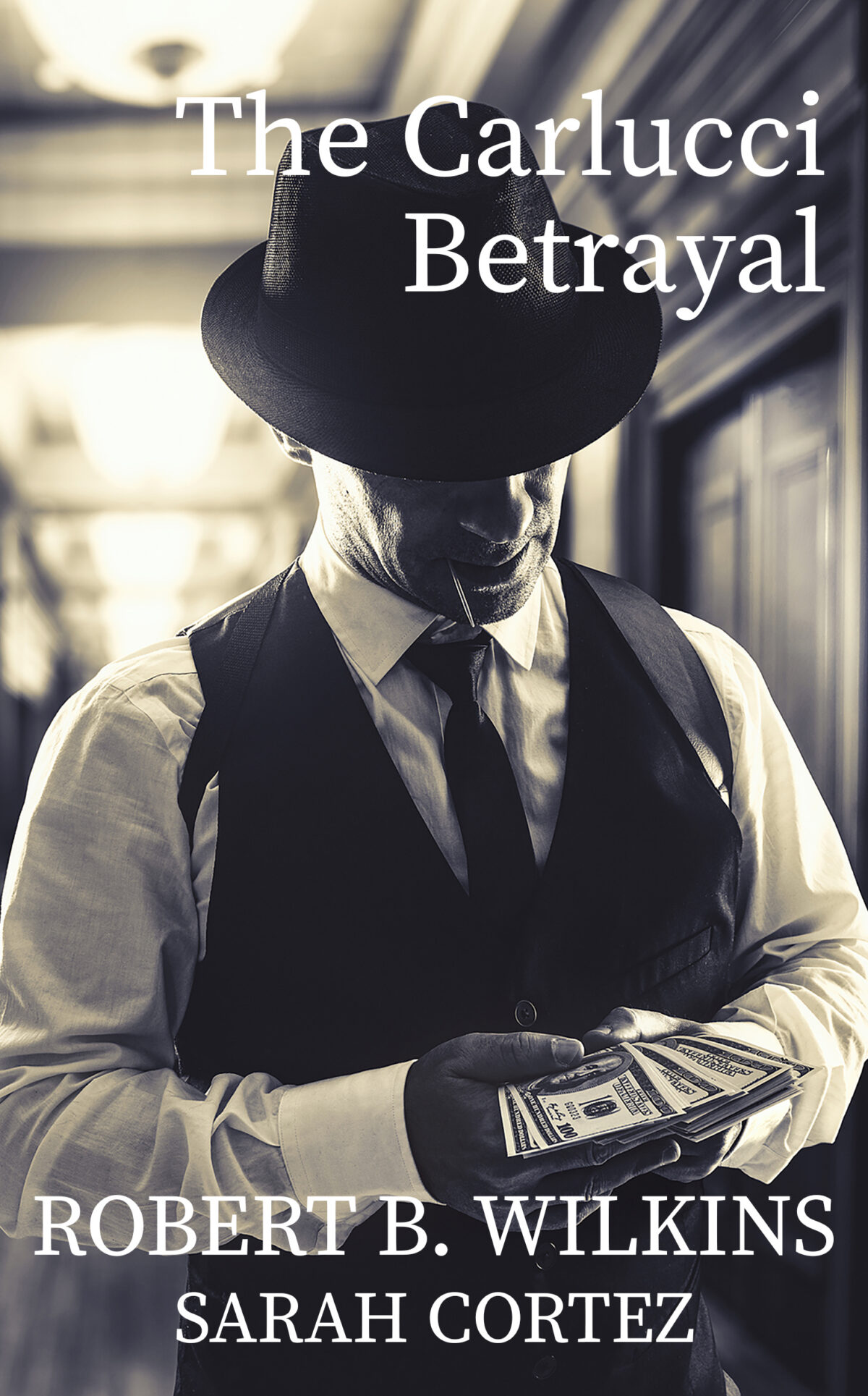
The Carlucci Betrayal: The Latest American Gangster Breaking Good

A Review of Robert B. Wilkins and Sarah Cortez’s The Carlucci Betrayal (Texas, White Bird Publications, 2021)

On January 10, 1999, The Sopranos aired on HBO. Before the days of Nextflix and Amazon Prime streamed on laptops, phones and tables, The Sopranos was broadcast on the soon to be eliminated cable television.

The Sopranos narrates the story of Tony Soprano (played by the late James Gandolfino), an Italian American mobster who, like The Godfather’s Michael Corleone, is a loving father as well as a vicious mobster. However, unlike Michael Corleone, Tony has a fragile weakness: he suffers from panic attacks, which he treats with the aid of his psychiatrist Jennifer Melfi, who eventually proscribes him Prozac.

Gandolfino’s Tony Soprano was a thoroughly postmodern man, haunted by his childhood and weakened by his anxiety, he was a deeply “existentialist” figure. Like Homer Simpson, Tony was also the American everyman balding and overweight with a taste for classic rock, sports, and World War II history.

However, more than his flaws or quotidian all American “dad-ness,” Tony was a man’s man, an intelligent and educated tough guy who was able to navigate labyrinthian wilderness of mirrors in the criminal world while managing the terrors and tedium of the postmillennial American cultural landscape.

This manliness and intellectual toughness matched with a fatal flaw would inaugurate what some critics have called the Third Golden Age of Television (ca 2000-present) (some critics have even gone so far as to call our era The Golden Age of Television).

With brilliantly crafted series such as Mad Men (2007-2015), Breaking Bad (2008-2014), and Season 1 of True Detective (2014), the Third Golden Age of TV has been marked by The Sopranos’ exploration of wounded masculinity attempting to navigate a world in which men are, in the words of NY Times columnist Maureen Down, no longer “necessary.”

While these TV series are, in many ways, “conservative” or “right wing” in as much as they, at times, present masculinity as well as various “natural” virtues such as courage and self-sacrifice as positive goods, most of the best of post-Sopranos TV is so filled with impurity, violence, and such dark and scandalous ideas as to make watching such series difficult if not impossible (as with True Detective) for most Catholics.

In their recent work, The Carlucci Affair, Robert Wilkins, a medical doctor turned author from Galveston, TX, and Sarah Cortez, a former active-duty police officer and current reserve officer  turned artist and fellow for the Dallas Institute of Humanities and Culture, skillfully craft a gangster novel that dramatizes the rise of two brothers from gangster wannabe barbers to heads of a major mob business on the fictional island of Zapata, Mississippi.

The Carlucci Betrayal tells the story of Frank and Vince Carlucci, two ambitious Italian-American  brothers, attempting to make it during the Prohibition era in the Deep South. Allying themselves with a more powerful gangster named Tony DeLuca, the Carlucci brothers battle against Cajun bootleggers, the powerful Chicago mob, hypocritical preachers, the WASP establishment, and their own demons in order to build a “boardwalk empire” before Prohibition threatens to upset their illegal liquor trade.

While built around the life of organized crime, The Carlucci Betrayal is also a tormented love story about the battle between Frank and Vince for Lisa, a runaway turned (almost) prostitute turned owner of a half way house for reformed women of the night. Vince overpowers Frank (and Lisa) and makes Lisa “his girl,” but Frank and Lisa undertake an affair that produces a child, Randall, who must be left with relatives in Oklahoma.

What makes The Carlucci Betrayal so distinct is the honest love that Frank has for Lisa; he finally admits this love to his brother in the final scenes of the novel, stating: “True love, Vince. Lisa is my true love.”

However, like The Godfather trilogy before it, The Carlucci Betrayal is also a story about the consequences of sin and the effect of a life of violence that claims the lives of those caught up in the orbit of crime and ambition.

From the very first page of the novel, we learn that Vince “was always ready” for a fight; however, this violence in him, like the impurity of Oscar Wilde’s Dorian Gray, grows into a monster as Vince is consumed with the violence that he perpetuates in order to build the Carlucci criminal empire (there are a few passages that readers with a “chaster muse” may want to skip over).

Vince and Frank are brothers but almost doppelgangers or two sides of every man: the beast and the king, the strong man and the lover.

With their strength and pathos, Vince and Frank are much stronger and more powerful than Tony Soprano or even Mad Man’s Don Draper; they are members of a stronger and earlier time in American history before men were finally broken and tamed by post-industrial bourgeois life.

The Carlucci Betrayal is additionally the story of redemption and the possibility for God’s grace to transform the lives of those who are receptive to it as well as God’s ability to “heal the broken hearted” and bring a happy ending from a tragedy.

Indeed, God’s presence radiates throughout the novel in a manner atypical to most gangster films, which (with the exception of Martin Scorsese’s recent Christ-haunted Irishman) usually dismiss Christian faith with an ironic postmodern shrug.

In a scene deeply redolent of the bittersweet “dinner scene” ending of The Godfather 2, Lisa has the entire Carlucci (literal) gang over at her place and prays with genuine sincerity:

My dear God, bless my dearest friends and protect Vince on his journey. May you see fit to allow us to celebrate again like this—together—in the future. Bless us all as we go with you on each of our individual journeys in life. Bless this food, we ask.

By the end of the novel, many of the characters at the dinner are dead, and, in another work with out a theological center, would only convey a jagged bitterness and irony.

However, in The Carlucci Betrayal. God is a hidden but nonetheless present force guiding the lives of the main characters.

Frank, the brother who keeps his hands (relatively) clean from the violence that ultimately consumes Vince, himself prays in St. Catherine’s Church, humbling beseeching God: “Please, God, I have no right to talk to you, but I know you are up there watching over me. Please guide me through this maze I have created with my life. Please don’t let me lose Lisa, dear God.”

Both Lisa and Frank’s prayers are answered, but not quite in the ways that they anticipated and not without the suffering that is endemic in this “valley of tears” into which humans are thrown.

The book can be purchased here.

Assistant Professor of English at Georgia Southwestern State University, Jesse Russell has published in  academic journals such as Literature and TheologyNew Blackfriars, and Texas Studies in Literature and Language. His books Irony, Liberalism and Fantasy and The Redemption of Geoffrey Hill are both forthcoming from Lexington Books.

Dan DeLouise: On Painting Christ Crucified

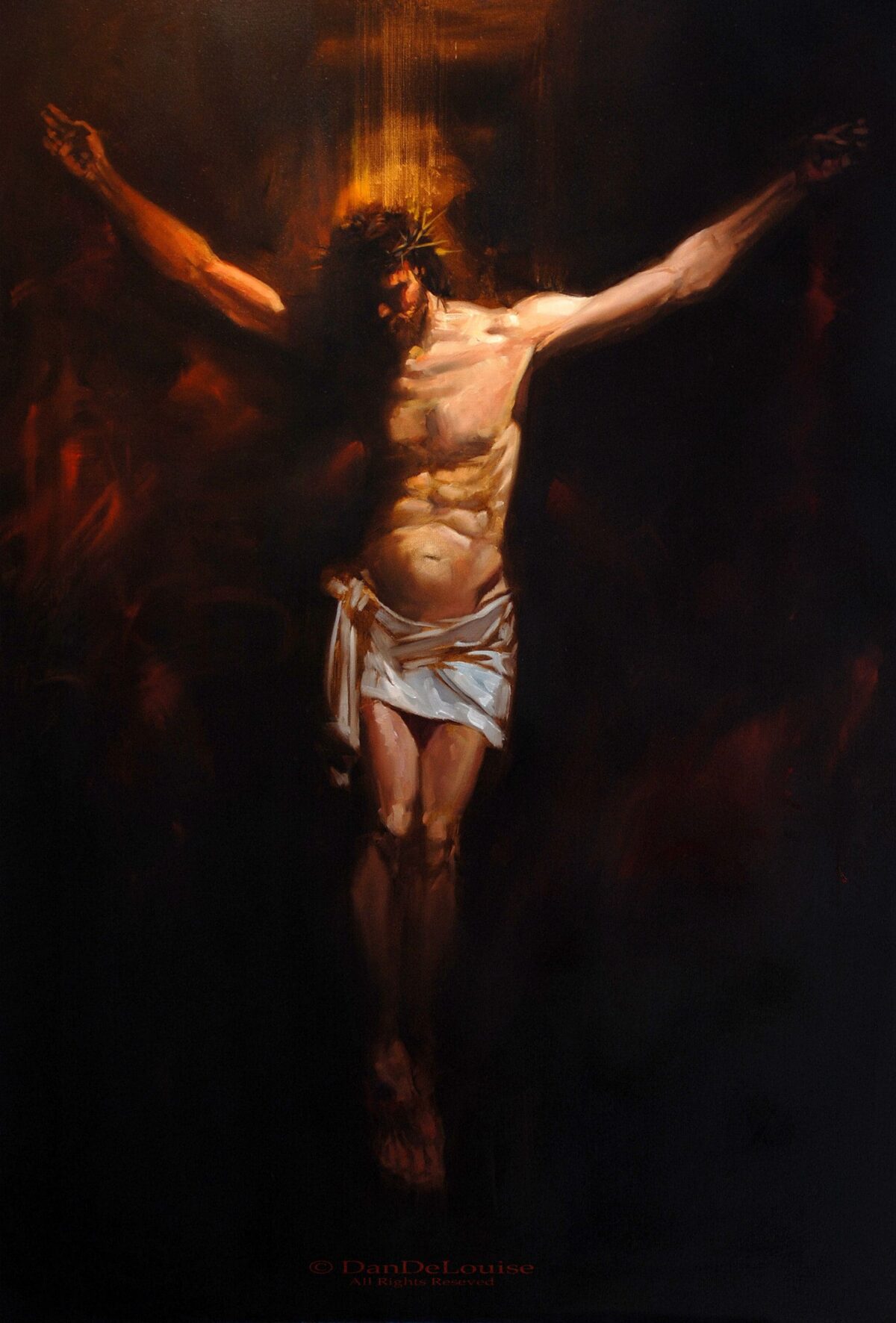
Stroll the wide sidewalks of downtown’s Main Street in seaside Rockport, Massachusetts, home of one of the U.S.’s oldest artist colonies.  You’ll see a striking oil painting of the Crucifixion in a front window of a gallery: Christ’s body hangs, a whitened cipher painted in the unabashed agony of redemptive sacrifice.

Dan DeLouise is the Crucifixion’s painter and the gallery that displays it is his own. The path that has brought this artist known for his secular work to this moment in his career has been winding, unpredictable, and deeply spiritual.

Like the Wyeths, he began his career as an illustrator.  A Long Island native, DeLouise graduated from Syracuse University with a major in commercial illustration after a two-year stint at a junior college. Five years of pounding the pavement in Manhattan’s mean streets brought him commercial art assignments, and eventually a specialization in the toy and game industry.  Recruited by Hasbro for a rare in-house position as an illustrator, DeLouise focused on the digital techniques required for commercial fantasy art.

With time, the physical art-making skills that he had previously trained in and utilized in mediums such as oil, gouache, and watercolor seemed to him to deteriorate.  As Dan DeLouise puts it “my skills as an artist were in jeopardy” despite (or perhaps because of) his commercial success.

In addition to this troublesome erosion of certain of his technical skills, DeLouise missed “the interaction of the artist and the paint,” he told me. This crucial incarnational aspect of art-making had become too distant. Another missing piece, he said was the internal dimension inside the artist illumined by St. John Paul II’s words in his “Letter to Artists” (1999): “In producing a work, artists express themselves to the point where this work becomes a unique disclosure of their own being, of what they are and how they are what they are.”

Certain new moral challenges arose for DeLouise in the corporate arena, such as an assignment to work on Ouija boards.  He settled that particular conflict out to the satisfaction of his conscience, but on the horizon more conflicts clearly loomed. DeLouise decided to quit his job and instead devote himself to a freelance painting career, principally working in oils.

Soon afterwards, as he walked through Rockport’s commercial center in 2013, Dan DeLouise found himself face-to-face with a “For Lease” sign on the front of 53 Main Street, a three-story, shake-cedar shingled building with several street-front arches, only feet away from a men’s retailer selling a wide array of woolen plaid shirts and waterproof footwear. He only meant to inquire about the cost of a lease, but instead moved by impulse or the Holy Spirit, he signed a contract for the space now called DeLouise Studio.  He began painting nonstop.

The demand for his plein-air landscapes provided income (and still does), but DeLouise’s invigorated commitment to painting outdoors brought something else—a deepening relationship to God.  “There is a certain closeness to God when you are painting in nature,” DeLouise mused to me, “There is something about seeing God’s creation and trying to emulate it.  Many artists have spoken about it—such as, contemporary painters David Curtis, Mitch Baird, Jonathan Stasko.”  Other personal matters pushed DeLouise to seek the solace of daily Mass and a deeper prayer life, both of which sustained him and his burgeoning artistic outpouring.

But within a few years DeLouise experienced a deep yearning to paint another kind of art: sacred art.

The first image that called to DeLouise to paint it was the Crucifixion.  It is this painting of the Crucifixion that can still be seen today through a large front window, only a short walk from the ice-cream parlor and near the Pendleton shirts next door.

DeLouise’s Christ hangs suspended on a muddied background, arms outstretched without even a cross.  Clearly, He is nailed and, just as clearly, racked by the physical and mental torture required to attain the redemption of mankind.  A light illuminates Christ from above and brings his blood-drained, whitened flesh into focus in the shoulder and torso area on one side of the corpus.

Much of the painting’s power derives from the omission of standard attributes: no cross, no halo, no crowd of holy mourners, no INRI placard above Christ’s head. Gone are the other figures typically portrayed in attendance at the Crucifixion: the crucified robbers flanking Jesus’ cross, the Roman soldiers. In fact, Christ’s legs and feet below the knees barely appear. One nailed hand recedes into darkness, while the thorns on Christ’s head assume cruel prominence.  The painting becomes a crucible for all the elements of Christ’s self-sacrifice and functions like an alchemical crucible to concentrate them into their purest form: Jesus Christ Himself.

Christ’s head inclines downward (toward the viewer’s left), so there is no accusatory gaze or tender eyes of merciful acceptance. Perhaps, this Christ is already dead; perhaps He is overcome with exhaustion and pain, hanging limp until His final moment. Only the viewer can supply his/her own relationship toward the Christ Crucified, toward the already (or almost) completed gift of redemption purchased by Christ’s obedience to His Father’s will.

This extraordinary reach into the viewer’s soul to complete the painting accounts for part of this image’s power. Sometimes people stop in front of this Crucifixion and kneel in the street; sometimes people stand and openly weep. Some people keep walking and ignore the 36” x 24” canvas. There have been no negative reactions and a wealth of compliments.

DeLouise had thought about painting the Crucifixion for five years before he summoned the courage to begin. He fretted about the difficulty of painting such a complex religious image and worried over whether the appropriate references in the historical tradition could be correctly honored. A visit to the Louvre and its acres of sacred art ignited his passion to paint Christ Crucified: “When I returned from the Louvre, I painted it—which wasn’t what I had planned to paint or thought of doing.  What came out from the brush wasn’t mine, almost.  It typically would take me two weeks to paint a canvas of this size, but this painting took me two days.  I’ve never experienced anything like this at all.”

DeLouise offered the painting as meditative art to his parish where it was displayed on the altar from Holy Thursday to Holy Saturday. Immediately after, the Covid-19 shutdown began and he brought the painting to his gallery where it provided solace to all viewers through one of the large front windows with a light illuminating it throughout the entire night.

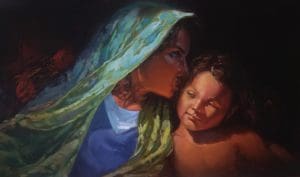
To his surprise, he has found a burgeoning market for his works of sacred art. One of his sacred paintings is entitled “Under Watchful Eyes” showing a calm, but alert, Blessed Mother with a drowsy Child Jesus.

Foremost in DeLouise’s mind is a desire to paint spiritual truths as they should be painted, grounded in tradition and truth. “I want to gain more knowledge so that I am honoring God as He should be portrayed, that I am portraying Truth so that I don’t confuse people. Sacred art reveals the spiritual understanding of the artist,” says DeLouise, “This is a responsibility we have as artists of sacred art.”

Daily Mass and frequent reception of the sacraments of Confession and the Eucharist sustain DeLouise: “We forget how transforming the Eucharist is. It is the one thing that has changed me the most.”

If you stroll down Main Street in Rockport, Massachusetts, pause in front of DeLouise’s gallery.  Peer beyond the white window sills. Allow the deep mystery of Christ’s sacrifice to transfix you. The interior movement of your heart will complete the Crucifixion painting’s meaning revealed through Dan DeLouise’s artistry. Stand and weep, or kneel and pray. Do not keep walking.  Allow yourself to be both wounded and healed.

Sarah Cortez is president and founder of Catholic Literary Arts. http://www.catholicliteraryarts.org

Dan DeLouise can be contacted at http://www.delouisestudios.com

Winter’s Still Song

(after hearing Morten Lauridsen’s Magnum Mysterium at a friend’s Wedding)

The hush falls

like soft-feathered snow,

as light takes its leave.


Clamoring thoughts,

like tired children

spent from running

in delirious circles,

take a final spin,

then collapse,

asleep in a pile.


Our Mother, full of stars,

reaches up her gentle

hand to switch on

the crescent moon.

Its sparse light

trails to earth

like a bridal train

and lays like lace upon

the snow-covered ground.


Now, finally,

cloaked in quiet

there is a clearing

not already occupied

by thought

where we are stilled by song

and become

the sweet capture

of two delicate voices

entwined like dancers

turning in the air,

light-footed,

arching heavenward.


Here,

hanging in the air,

like crystals on a

snow-laden tree:

what rough straw

would have whispered

from the manger.

Tamara Nicholl-Smith’s poetry has been featured on two Albuquerque city bus panels, one parking meter, numerous radio shows, a spoken-word classical piano fusion CD, and in several publications, including the Mutablis Press anthology Enchantment of the Ordinary, Kyoto Journal Issue 95, The Examined Life Journal Issue 8, and Catholic Arts Today. She is currently pursuing an MFA in Creative Writing at the University of Saint Thomas in Houston. She enjoys puns and likes her bourbon neat.

Scoring Mass of the Ages: An Interview with Mark Nowakowski

Mass of the Ages, Catholic filmmaker Cameron O’Hearn’s documentary about the astonishing revival of the traditional Latin Mass among Catholics of all ages, has already attracted more than 550,000 YouTube views after its livestreaming debut on August 15. O’Hearn managed to make the 47-minute movie—actually the first part of a trilogy—mostly on a budget of only $170,000 crowdfunded on Kickstarter.

The film centers around Kristine Mauss of Tacoma, Washington, whose husband, Michael, died of a rare and virulent form of brain cancer in August 2020, leaving her with four young children. In a series of interviews Kristine, working through her grief and trying to be strong for her children, tells of the faith and meaning that the Latin Mass and other traditional Catholic practices infuse as the center of her family’s religious life. “I just need the solid foundation,” she says. “That’s what tradition is.” In other interviews theologians explore the long history and development of the traditional Mass, and priests describe their experiences saying it for the first time after decades of experience solely with the vernacular Novus Ordo that is standard in most Catholic churches.

Mass of the Ages makes its persuasive case through aesthetic appeal, displaying the exceptionally beautiful churches and exceptionally reverent liturgies that the traditional Latin Mass supports. But it is the film’s music that is its aesthetic and emotional center. The original score is by the Polish-American composer Mark Nowakowski, an assistant professor of music at Kent State University in Ohio. His concert music, commissioned and performed by such groups as the Kronos Quartet and the Cleveland Chamber Symphony, has been described as “a merger of bold expressionism and mystical contemplation.”

In Mass of the Ages Nowakowski’s haunting interplay of tradtional and nontraditional instruments heightens the grief and courage of Kristine and her children, while a composition for full orchestra that Nowakowski has titled “Birthright” marks a musical theme that will reappear throughout the trilogy. The film also uses the Kyrie from Palestrina’s Missa Papae Marcelli as recorded by the Tallis Scholars and other stock music interwoven with Nowakowski’s own.

Catholic Arts Today’s executive editor, Charlotte Allen, interviewed Nowakowski on September 9. There Nowakowski talked about his experiences composing a film score in contrast to a concert piece, the complex interplay of egos and goals between a film’s director and its composer, the musical effects that Nowakowski was trying to achieve, and the compelling nature of the Mass of the Ages project that inspired him to give to the film far more than most composers give to more ordinary projects.

Charlotte Allen: How do you write a movie a movie score, in contrast to the kind of concert music that you’ve written in the past and also the sacred music? What’s the difference in approach?

Mark Nowakowski: It’s very, very different. When you’re writing a concert piece, unless you’re dealing with some kind of egomaniacal conductor, it’s understood that the composer has a vision, that the vision is realized in the piece, and the vision is shared–and that it’s the ensemble’s job to realize that vision in a performance. I write the piece, you agree on a contract to perform it, or to record it, and you can’t come back at me and say, “I just don’t like the way you ended the second movement. Can you tweak it?” Unless I’ve done something that’s a mistake, or it’s impossible to perform, what I give you is what you must perform.

Now in a film you have to subjugate your creative impulse to the director’s vision. So you’re dealing very much with a service industry. It’s a back-and-forth process. With this film, for instance, I saw some clips, and then I read a script, and I composed about almost an hour’s worth of music based on that script and those clips. And then they changed the edit completely, so out of the fifteen or so things I sent him, he ended up keeping about three.

And then we did it again–and then we did this elongated process two more times, so there’s about three or four times as much music as was written that has made the film. Now some composers put in clauses saying, “I will rewrite each scene up to one or two times.” My decision with this film, because I thought it was so crucially important, was to give Cameron every change, every suggestion, everything that he could possibly want. My thinking was that the film was so historically important, much more important than me or my time. So anything I could give him, I did. The relationship between composer and director is always a maze to navigate, and as we were first getting to know each other personally, it became an interpersonal thing to figure out, because I was to pick the music that speaks to his film, and he has to communicate his musical desires to me despite not speaking that artistic language. In the end, each time we agreed on an aesthetic effect, I think our sense of communication increased and the pace of scoring got faster and more efficient.

So then, as you get to know each other, it becomes easier for the composer to anticipate what the director is actually looking for. And that’s all part of that service-industry aspect as well. You are facilitating your talent to the director’s ultimate vision. He’s making the call of what works for him and what doesn’t. And there are places where we agreed very much, and there are places where we disagreed, and I realized it in the end he was absolutely right. And those tracks where we disagree I just save for something else. Those become mine. That’s how it works.

Charlotte Allen: Were there certain specific moods that you were trying to evoke? And how did you do it? I noticed that there’s a lot of piano and a lot of strings. I wondered why you picked those in particular, and what you were trying to do. Part of the movie, a great part of it, is Kristine Mauss’s story and the sadness of her losing her husband and trying to put her life together via her faith. So how did you approach that as a composer?

Now, in terms of strings and piano, those are kind of obvious choices. We first thought we would do the film with lots of vocal pieces, and we did. But one of the reasons you don’t see a lot of them in the final version of the movie is because in a documentary there’s a lot of speaking. Speaking will take up a similar frequency as singing, and they could actually interfere with each other. So in the end I don’t have a lot of singing going on. Strings and piano are standard in films. A string ensemble covers, probably, the full range of human hearing, has great dynamic capability, can do many things holistically, and can basically create support for any mood you’re working on. That’s why it is the industry standard to write every score with strings.

As for piano, for some reason, and perhaps it’s cultural or psychological, it seems to represent the individual. And so, when we talk about Kristine’s personal struggle in mourning, as a composer I’m seeking the authentic musical vehicle to immanentize this grief in sound. And in the end I think everything turned out remarkably well.

Charlotte Allen: I found it extraordinary, the scenes of her husband’s death. I watched Mass of the Ages twice, and I cried both times, so your music had a powerful effect on me.

Mark Nowakowski: I cried multiple times while working on it. And I thought I was done with it, and then a few weeks later Cameron comes back and says, “We’ve extended it.” Can you make it a little bit longer? And I’m like, “That’s traumatizing. I don’t want to go back to that one.” Which I’m almost ashamed to say, because it was not my tragedy. It was very emotionally affecting to work on, and it was the hardest part of the entire job, but I think also maybe it was the one that turned out most honestly the best. At the end I told him, “We have to be done with this. This is enough of the story.”

Charlotte Allen: Do you think that the movie successfully incorporates Kristine’s story and the Mass itself? It’s almost as if there were two disparate elements there. And, of course, the priests and theologians interviewed were all talking about the Mass itself. And so I’m wondering: Was it a musical challenge for you to try to integrate those two things, a very different kind of documentary and a personal story?

Mark Nowakowski:  I was one of the few people who saw the original–“here’s all the footage we got, almost three hours longer”–before they decided to make it a trilogy. And I believe it was Cameron’s wife who first pointed out to him that he actually had three stories and three films to make, instead of one extraordinarily long documentary. Two personal stories and three angles at which he was approaching the subject. And that it might be better off in smaller bites, as a trilogy.

And when he expressed this to me and showed me that first cut, I thought it was much, much better. I think it makes great sense to show the individual’s life struggle and how it relates to the decision to attend the Latin Mass, especially at a time where you hear people disparaging the people who attend the old rite as people who are aesthetic fetishists or cultural supremacists or whatever it may be. So here’s somebody presented in a very sympathetic way saying, “No, this is what it is for me.” And I think it’s very helpful to see the macro and the micro level of this issue and present that real human story. Musically it became much simpler to underscore individuals and individual journeys as opposed to just ideas.

The second thing that we decided would be a permanent part of all three films was the music track that you hear a little bit of at the end of Kristine’s story, in which she talks about what the Church and Latin Mass have meant for her. There’s a theme that comes in that we call “Birthright,” and it’s going to appear in several different guises and forms. And you hear it in its full first guise in that long, extended piece which accompanies the credits.

That was my going from the micro of Kristine’s story to the macro of what she is talking about: that there’s a sacred birthright in the Latin Mass. She and I share a similar story. We’re looking for our spiritual heritage, we’re looking for the more. We’ve seen the modern version, and we find it lacking. We’re looking for a way to sink our teeth into something spiritually, something much more substantive.

Charlotte Allen: From the intimation that Cameron gave at the end of the movie, it appears that the second part of the trilogy is going to be about Archbishop Annibale Bugnini [1912-1982], the Vatican official who basically pushed the Novus Ordo through. That sounds like a more polemical topic, and I’m wondering if the next part is going to be entirely polemical, or will there be a personal story as well?

And so I think Cameron is going to talk about what occurred, who were the players and what were the goals, what were some of the things they said and wrote which explain what occurred. And of course the subtext is: We don’t think what occurred was perhaps an optimal state of things, whether you’re talking about people who question the very authenticity of Vatican II or people who say, “If we’d only implemented Sacrosanctum Concilium [the Vatican II document that called for greater lay involvement with the liturgy] the way it was written, if we implemented it carefully and graciously, we would not be dealing with this liturgical war that we’re dealing with right now.” And I think that part of the story was that perhaps the intent all along was not to create a gentle reform as opposed to a revolutionary reform.

Charlotte Allen: Is this the first movie score that you’ve ever done?

Mark Nowakowski: No, I’ve done a couple over the years. When I was younger, I had some teachers telling me to go to L.A. and actually do it for a living. I decided not to pursue that path, after discernment, for a number of reasons. Part of it was that in the early 2000s I saw where the culture in Hollywood was going, and I didn’t want to have to sell myself for that for so many years just for the chance to do one or two projects that I cared about.

And also I thought that the Lord was really calling me to do more traditional compositions. So I said: “If you want me to do a film score, Lord, you’re going to have to find another way to do it.” And over the years some opportunities came. I did a couple of full scores, and then two or so years ago I did a soundtrack for the documentary Discovering Tolkien [2017], which showed on EWTN. It was fun, and it was kind of a reentry into the industry for me. I had so much fun doing it that I began to actively seek such projects.

Charlotte Allen: Speaking of Palestrina, did you feel that you were up against a master? Did you feel intimidated by having to work Palestrina into your own music?

Mark Nowakowski: Well, it depends. Obviously, when you set yourself up against any master, you’re going to feel intimidated. No one will write in our time anything equal to Palestrina, or [William] Byrd, or [Thomas] Tallis. And I don’t think I normally would have ever accepted the challenge to weave some Palestrina into the score if it were anything more than a trailer. I would say no, because Palestrina shouldn’t be touched. I shouldn’t add or take anything away from it. It’d be like adding a scene to Shakespeare.

Charlotte Allen: Is there choral music by you in the film?

Mark Nowakowski: There’s a short one. When they’re talking about the musical legacy of the church, there’s a Kyrie by me that’s playing.

Charlotte Allen: And that’s not Palestrina, right?

Mark Nowakowski: No, that’s me.

Charlotte Allen: I remember listening to it and, because I knew there would be portions of a Palestrina Mass, thinking, “Now is this the Palestrina?” But then the real Palestrina came on and it was completely different. That was very flattering to you, but it probably shows how little I know about music. I was sort of disoriented thinking perhaps it was from another Palestrina Mass that I didn’t know.

Mark Nowakowski: No, that was a scene that was put together very late, and Cameron sends me a text saying, “Can you write me a Kyrie by tomorrow or some kind of choral music to go with it?” So I just wrote the Kyrie, and I did it in a couple of hours. For some reason, the idea just kind of dropped from the sky and I said, “Okay, that’s simple but it does the job.”

And we set it, and we couldn’t get singers at the time to perform it, so all the vocals are computer-generated for that particular track. If you listen very closely, you can probably tell, but it was actually done using virtual instruments. There’s an instrument where, if you play the notes, what you hear are the recordings of real singers singing those notes. The software can be manipulated to sing words as well. If you just type it in and you play, it’s going to sound very clunky and fake. So, it becomes sort of a side craft to manipulate that piece of software and the resulting audio file to make it sound as realistic as possible.

Charlotte Allen: That’s something that I was completely unaware of. I guess it’s easier than hiring a chorus and working it up with rehearsals and so forth.

Mark Nowakowski: With most documentaries the budget for that’s not going to be there. You’re talking about tens and tens and tens of thousands of dollars for performers. So for a while, composers actually stopped being willing to write big scores for documentaries. But with the advent of virtual instruments and then being able to produce all these things from small studios, we’re able to once again get big sounds and big ideas put together without having to have a half-million-dollar studio budget.

Charlotte Allen: I probably should have watched Mass of the Ages a third time because I hadn’t even realized until the credits at the end that you had actually incorporated some other music besides the Palestrina.

Mark Nowakowski: There were three tracks that Cameron included which were not mine. One was the Palestrina. The other [the electropop group Nono’s “The Fifth Season”] was at that part where they’re explaining the differences between the two forms of the Mass. The other one [composer Jordan Critz’s “Edge of the Light”] was the very last one—it’s a very beautiful track. It was with the climatic interview with Kristine and the beautiful fadeout at the end: the altar servers walking down the street to the church.

This was simply a project that was much bigger than any of us.

Charlotte Allen is executive editor of Catholic Arts Today.

Passable Prayer: Witness

Lord, you have searched me and have known
my madness, a wilderness of visions and song.
 

I welter in birthright riddles, my mother
deranged, my father the fool. They claim
I prophesied in wordless gurgles grown
to wails—lament bled with ecstasy.
 

Now I rove, a cockeyed home
for maggots and mutters. Rumors river
and surge through this untamed soul,
ebbing beliefs I still cry without end.
 

When you next pass through, whisper me
from ruins. Say among the rants was a shrapnel
of truth. Name me what you wish
and plunge these tremors beneath your current.
 

And if you insist I risk wrecking the call
—fanatic caressing the unlikely God—
if passion must tightrope peril, I pray
you salt my tongue with light and dove.
 

Whitney Rio-Ross is the author of the poetry chapbook Birthmarks (Wipf & Stock) and poetry editor for Fare Forward. Her poetry has appeared or is forthcoming in The Windhover, Rock & Sling, America Magazine, Psaltery & Lyre, Relief Journal, and elsewhere. She lives in Nashville, Tennessee.

Editor’s Note: We are proud to publish the winning poem of Catholic Literary Arts’s sacred poetry contest, judged by the noted poet Jane Greer, one of the founders of the New Formalist poetry movement.  She commented:

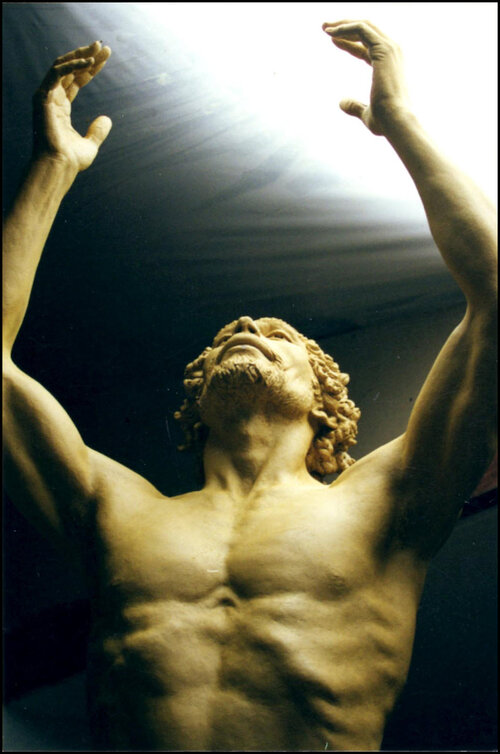
“Whatever formal poetic tools a poem does or doesn’t use, if it doesn’t use evocative imagery, it’s something less than a poem. The language in this work is gorgeous and does the job it is meant to do. ‘I welter in birthright riddles;’ ‘Now I rove, a cockeyed home / for maggots and mutters;’ ‘whisper me / from ruins. Say among the rants was a shrapnel / of truth. Name me what you wish / and plunge these tremors beneath your current.’ The language does not tell us about but leads us to experience the Baptist’s inner and outer turmoil, his suffering, his love. This is poetry.”

The Catholic Literary Arts contest asks poets to write in response to works of art by living Catholic artists.  In this case, the poet Whitney Rio-Ross chose as her inspiration the above sculpture of St. John the Baptist by Thomas Marsh. His work may be found at: http://thomasmarshsculptor.net/
 

Little Li: The Child Martyr of the Eucharist in China


She was a little Chinese Catholic girl, in a country where Catholics were and are only a demographic drop in the most populous country in the world, a country where Christians have been regarded for more than 100 years as dupes at best, agents at worst, of imperialistic Western powers. Their churches were marked for obliteration.

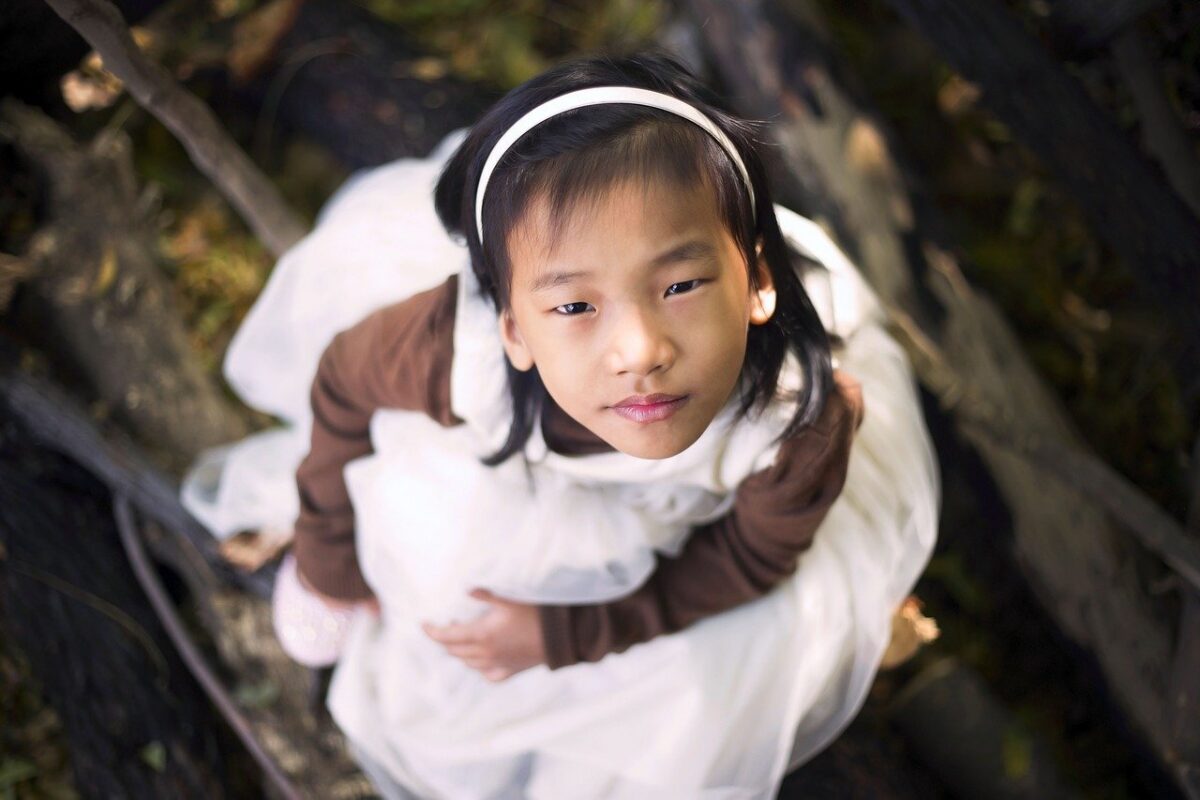
The little Catholic girl has been given a name—Li—but we don’t know if that was really her name. In several versions of the story she has no name at all. We don’t know exactly where in China she lived, either, perhaps the rural setting near Shanghai that is sometimes mentioned. Her age is usually given as 10 or 11, but we don’t really know about that, either. We know she lived in the twentieth century, and there is a strong likelihood that it was the mid-twentieth century, right after Mao Zedong completed his communist takeover of China.

Little Li never made it to adolescence; she was killed for her faith right in her village parish church. She has become a legend. Like so many of the early martyrs of the Church, she was a real soul whose story was taken up by other real souls looking for reasons to believe. Her story has been told, retold, and embellished by many tellers in an age hungry for faith, in a culture where terror and poverty have often reigned together, in a world riven by world wars, holocausts, and new weapons of mass destruction.

Many of the facts are uncertain except the most important one: Little Li—let’s call her that—was a martyr of the Eucharist. She gave her life in an act of Christian heroism and devotion to the Eucharist that has inspired multitudes.

What would you do if you were a Catholic and government troops invaded your parish church, imprisoning your parish priest? What would you do if the soldiers broke into the tabernacle, took the ciborium, and scattered the Hosts on the floor in an act of desecration designed to both terrorize you and demoralize you, to threaten everything and everyone you knew and loved?

What would you do? Many people under such pressure buckled and joined the secularizing majority.

Here is what Li did: After nightfall, she slipped back into the church and observed a Holy Hour in front of the Hosts scattered on the church floor. After she finished the devotion, she carefully bent down and consumed just a single one of the Hosts with her tongue.

As a layperson in those pre-Vatican II days, little Li had been taught it was wrong to touch the Host with her hands. And she knew that in ordinary circumstances lay people were not supposed to consume more than one Host in a day. (She didn’t know of the exception granted to prevent the desecration of the Eucharist.)

So, at great risk each time, Li patiently returned to the church night after night to observe her Holy Hour and consume another precious piece of the Body of Christ. There were 32 Hosts on the floor, so her nightly visits took just over a month. On the very last night, she was caught by a soldier guarding the church and killed.

The story of little Li became associated with Archbishop Fulton J. Sheen, the Catholic media personality whose television show, “Life Is Worth Living,” drew as many as thirty million weekly viewers during the 1950s. Sheen was a tireless promoter of the Holy Hour as a Catholic devotion.

In his autobiography, Treasure in Clay, completed shortly before his death in 1979 at age 84 but not published until 1982, Sheen wrote about the sufferings of Chinese Catholics in the wake of Mao’s revolution that established a Communist regime in China that has lasted to this day. Sheen wrote this:

“Elsewhere in China, a priest had just begun Mass when Communists entered and arrested him and made him a prisoner in a house adjoining the little church. From a window in that house he could see the tabernacle. Shortly after his imprisonment, the Communists opened the tabernacle, threw the Hosts on the floor, and stole the Sacred Vessels. The priest then decided ­­ to make adoration to Our Lord in the Blessed Sacrament as much as he could day and night. About three o’clock one morning, he saw a child who had been at the morning Mass open a window, climb in, come to the sanctuary floor, get down on both knees, press her tongue to the Host to give herself Holy Communion. The priest told me there were about thirty Hosts in the ciborium. Every single night she came at the same time until there was only one Host left.  As she pressed her tongue to receive the Body of Christ, a shot rang out. A Communist soldier had seen her. It proved to be her Viaticum.”

According to people who knew Sheen or knew his work, this was an incident that Sheen had repeated in talks and interviews during his long priestly and media ministry. In particular, they say, Sheen had revealed in a 1979 television interview that little Li’s fervent devotion to the Eucharist had been the inspiration for his preaching. It was her story as well, according to accounts, that had led Sheen to promise that he, personally, would observe a Holy Hour of prayer and adoration before the Blessed Sacrament every day of his priestly life, a promise that he kept.

But there are inconsistencies: the tale of little Li has acquired a number of variants and likely grown in its many retellings.

For example, many—including Sheen himself in his autobiographyassume that Li was one of the first victims of Communism in China. There is a version of her story on the website of the Cardinal Kung Foundation, established to honor Ignatius Kung Pin-Mei (1901-2000), the long-imprisoned bishop of Shanghai, and to call attention to the persecuted Catholics of China’s underground Church.

The Cardinal Kung version, which refers to Li only as “a little girl” age 11, places her martyrdom as occurring “when the communists took over China,” that is, it would seem, in 1948 or 1949. The Kung Foundation version jibes fairly closely to the version in Sheen’s autobiography, although it is more detailed. For example, it states that the little girl consumed exactly 32 Hosts (not “about thirty”) before being killed, and offers a different version of the manner of her death.

According to the Kung foundation, just after she had consumed the thirty-second and last Host, she accidentally made a noise that awakened the sleeping guard, who didn’t shoot her, but, rather, beat her to death with his rifle butt. Yet as in Sheen’s autobiography, the parish priest, who had been imprisoned inside his rectory by the Communists, watched the crime helplessly from his window.

In 1988 a German priest and prolific author of devotional works, Karl M. Harrer, crafted his own version of Li’s story in a book, Die schönsten eucharistischen Wunder (“The Most Beautiful Eucharistic Miracles”). In this telling of the story, which also occurs during the Communist takeover of 1949, four soldiers and their commander barge into the parish priest’s schoolhouse and force the children to take down the classroom’s crucifix, statues, and holy pictures, and dump them into the toilet. One little girl, unnamed, refuses. The commander orders the girl’s father to be summoned and the villagers herded into the parish church where they watch the Hosts (their exact number is not given) not only thrown onto the church floor by the soldiers who use their rifles to pry open the tabernacle, but stomped on by them while their commander mocks the Real Presence.

The priest is imprisoned, not in his rectory as in the Cardinal Kung version, but in a coal bin inside the church that has a small opening through which he can see the unfolding events. He watches the little girl’s visits to the church—at dawn in this version, not at night–to pray and consume the Hosts on the floor. On the final day, as the girl is praying but before she has consumed the Host, the door of the church bursts open, and a soldier fires a single shot that mortally wounds her. With her last breaths the girl crawls to the Host, receives it, and then dies.

The soldier, shocked at his deed, frees the priest from the coal bin. He tells the priest, “Sir, if in every town there was such a little girl, no soldier would ever fight for the Communists!”

Harrer, who died in 1996, added to the story an apparent appearance of the Blessed Virgin—a “lovely young woman clad in beautiful garments” who enters the church and comforts the little girl after the soldiers’ commander abuses her, lending a miraculous element to the Little Li story.

The most elaborate version of the story appeared in a 2007 book by Sister Emmanuel Maillard, a consecrated lay member of the Community of the Beatitudes, a French charismatic organization, and a champion of alleged apparitions of the Blessed Virgin in Medjugorje. Sister Emmanuel’s retelling of the story in The Hidden Child of Medjugorje generally tracks Harrer’s, except that it is even more detailed. She gives a specific month and year for the martyrdom—July 1953, two months after the girl’s First Communion—and she is the first to attach the name “Li” to the little girl, whose age is 10 in her version. The parish priest also has a name: Father Luke from the “Missions Étrangères,” apparently a reference to a Paris-based missionary organization. There is also a nun, Sister Euphrasia, who teaches catechism to the village children at the parish school.

The indignities Li suffers are more drawn-out and detailed in this than in other versions. When she tries to hide a picture of the Good Shepherd from the soldiers confiscating the school’s holy images, their captain slaps her on the cheek and sends her crashing to the floor. The soldiers don’t break into the tabernacle with their rifles; they fire at it. The priest is neither imprisoned in the rectory as in Sheen’s autobiography and the Cardinal Kung version, nor locked in the coal bin as in Harrer’s. Rather, the parishioners hide him in a recess in the choir of the church, where, as in the other versions, he can see little Li praying and receiving the Host at daybreak for each of the 32 nights (Father Luke knows exactly how many Hosts he had placed in the ciborium).

The single gunshot that mortally wounds Li just before she consumes the last Host appears in Sister Emmanuel’s version, but she does not mention the mysterious lovely young woman who comforts Li in Harrer’s version.

The association of the story of little Li with the Communist takeover of China under Mao Zedong makes sense. Those years, especially after the Korean War broke out in 1950, were marked by brutal persecution of Christians as agents of foreign powers. Bishops and priests were arrested, imprisoned, tortured, and killed. Foreign missionaries were expelled, and Mao’s government launched a massive effort to break the independence of China’s Christian churches, including the Catholic Church, and bring them under direct government control.

One of the resisters was Ignatius Kung, arrested in 1955 and imprisoned for more than 30 years. He was secretly named a Cardinal in pectore by Pope St. John Paul II, his elevation revealed only in 1991. The story of Li’s heroism resonated in part because it exemplified that of Kung and many others.

But there is a chronological problem: the connection to Fulton J. Sheen. The late Father Andrew Apostoli, a Franciscan priest who was one of the postulators for Sheen’s canonization, offered a version of the story of little Li whose time frame actually contradicted that in Sheen’s own autobiography. Apostoli maintained that Sheen had heard the story of little Li while he was a student in seminary prior to his ordination in 1919. That would place Li’s martyrdom several decades earlier than Mao’s takeover, Apostoli concluded, perhaps during the 1911 Revolution that ended imperial rule in China, or during the Boxer Rebellion of around 1900. Both events were marked by extreme violence toward Christians both foreign and Chinese. “[I]t may not have been the communists who perpetrated this horrible crime,” Apostoli wrote in a foreword to St. Thérèse: A Treasured Love Story (2007), a collection of sermons preached by Sheen about the French Carmelite nun who had also inspired him.

Apostoli’s narrative about Sheen, however, has its own problems. Like others who have touched on the Li-Sheen connection, he does not provide a specific date for, much less a citation to a transcript of Sheen’s alleged televised statement in 1979, making it challenging to track down. As for Sheen’s having heard the story while he was studying for the priesthood from 1917-1919, Apostoli attributes that detail to a bishop (unnamed in his foreword) with whom he had spoken at an EWTN event: “The bishop told him that he had spoken with a seminary classmate of Sheen’s at St. Paul Seminary, who said he, Sheen, and another classmate heard the story while they were students there.”

This double hearsay is difficult to verify because of the anonymity of the sources, and it is likely that all the informants are dead, including, now, Apostoli himself, who died in December 2020. So in the absence of records or long memories in China, where the persecution of Christians continues, it seems impossible to know for certain exactly what the circumstances and timing of Li’s death were. Communist revolution or Boxer Rebellion? She remains shrouded in what appears to be impenetrable mystery.

Did Sheen, close to his death, misremember when he had heard the story of little Li—or did he conflate it with a similar story of Chinese Catholic heroism that had occurred earlier or later? On the other hand, perhaps Apostoli’s sources were mistaken.

This is something that the latest reteller of Li’s story, Ellen Lucey Prozell, a writer for Catholic magazines, candidly recognized. In 2016 she turned the story into a children’s book, 32 Days: A Story of Faith and Courage (Pauline Kids). Using some of the material on which Sister Emmanuel elaborated, Prozell added frankly fictional details, naming the little Chinese girl “Pei” and creating family members, friends, and a close-knit peasant village whose parish school is taken over by Mao’s revolutionaries, with the children forced to regurgitate Marxist doctrine after all the religious objects in their church and classrooms are destroyed. She builds in suspense: Pei is almost caught several times while sneaking into the church—and then caught for real in the book’s sad but inspiring ending.

The spare details that are known are what give the story of this child-martyr the feel of concrete truth: Thirty-two Hosts. What storyteller would make up such a seemingly arbitrary number? The desecrated church, the repeated acts of heroism based upon her child’s faith and devotion, a violent death in a country whose twentieth century (as well as its twenty-first) has been marked by brutal efforts to eradicate Christianity.

We don’t know Li’s actual name or exactly when she lived and died, but we can know the persecution she and millions endured and the faith that allowed Little Li to die a martyr for the Eucharist are both most assuredly real.

Author’s Update:

After this piece was posted I heard by email from Sister Connie Derby, R.S.M., archivist for the Archdiocese of Rochester, New York, where Fulton J. Sheen served as archbishop from 1966 to October 1969, when he resigned at age 74, ten years before his death on December 9, 1979. (I had also contacted archivists at the Diocese of Peoria, Illinois, where Sheen had been ordained in 1919, and St. Bernard’s School of Theology and Ministry in Rochester, which houses a large collection of Sheen’s papers.)

The Rochester archdiocesan archives contain extensive documentation, in print and on video, of Sheen’s career as bishop and media personality. I had asked Sister Connie whether the archives included any documentation of Sheen’s alleged statement in an interview shortly before his death that a little Chinese girl’s devotion and martyrdom had inspired his own devotion to the Holy Hour. Sister Connie sent me a copy of an interview given by Sheen to Long Island Catholic published on April 26, 1979, as well as a YouTube link to Sheen’s very last television interview, in October 1979. Neither contains any reference to little Li. Sister Connie told me that the YouTube video was “probably edited,” and so it is possible that Sheen could have mentioned Li elsewhere in the interview. “In the end, I can neither confirm nor deny that he mentioned this story in an interview,” Sister Connie emailed me. “I simply find no evidence for or against it in our files.”

Charlotte Allen is executive editor of Catholic Arts Today.
Roberto Estopiñán: Sculptor of God and Modernity


Editor’s Note: This is one of a series  that might be called “Forgotten Catholics”: Great artists, novelists, and poets who are not known as Catholics. In this essay you will meet one of the great 20th-century Latin American sculptors, a refugee from Communist Cuba, who in times of crisis turned to St. Ignatius’ examen exercise to ground himself in the presence of God. Surely a re-valuation of this man’s work in light of his faith is long overdue.

Roberto Gabriel Estopiñán (1921-2015), a Cuban sculptor who emigrated to exile in the United States not long after Fidel Castro’s revolution in 1959, is considered one of Latin America’s most important 20th-century artists.

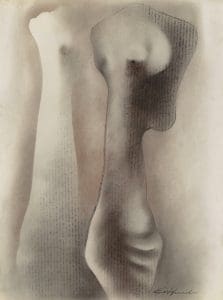
His work, which includes drawings and prints as well as sculptures in wood and bronze, is in the collections of New York’s Museum of Modern Art, the Smithsonian’s American Art Museum, the Art Institute of Chicago, and the Detroit Institute of Art, among many locations. He is best known for his stark, disturbing renderings of political prisoners, the fruit of his own experiences as a dissident under both Castro and his predecessor, the dictator Fulgencio Batista, and for his representations of the female torso that can remind viewers of both classical statuary and the high-modern, abstractly elongated work of Henry Moore.

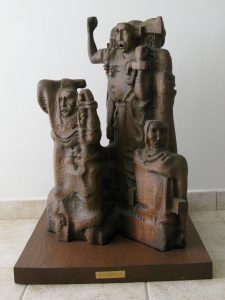
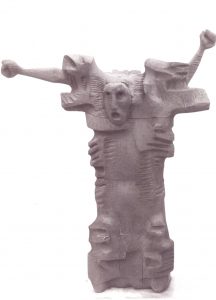
Estopiñán, Prisoners, c. 1964-1965

What is little known about Estopiñán is the centrality of his Catholic faith in both his life and his work.

He was born in Havana to a father from Asturias in northwest Spain and a mother of African descent. His father died when Roberto was seven years old; he and his younger brother were raised by their mother, a maternal uncle, and a grandmother. He attended the local public school but went to a Jesuit church near his home for catechism classes. His youthful exposure to the Jesuits would affect him for the rest of his life. In moments of political crisis he would turn to the examen, a five-step prayer technique that is part of St. Ignatius Loyola’s Spiritual Exercises and focuses on the laying out of the day’s events in the awareness of the presence of God. Besides being a means of discerning one’s relationship to God, the examen has a visual component—seeing in one’s mind how God is working in one’s life—and it informed Estopiñán’s sense of visual aesthetics and would serve as a compass in his art.

Estopiñán, Crucifixion, 1964

Estopiñán was something of a prodigy. At the age of fourteen, he won the first prize in drawing at the Centro Asturiano, a regional association for Cubans of Asturian descent. Shortly afterward he received special permission to enter the San Alejandro Academy of Fine Arts in Havana, which usually did not accept minors. At the school he was mentored first by its director, the painter Armando Menocal (1863-1941), then by the landscape artist Antonio Rodríguez Morey (1872-1967), and finally by Juan José Sicre (1898-1974), regarded as one of Cuba’s greatest sculptors. Sicre, a professor of sculpture at the Academy, had helped introduce European modernist art to Cuba, and from the 1930s through the 1950s had sculpted monumental figures in Havana of José Martí and other Cuban national heroes that stand to this day.  Estopiñán was first Sicre’s student, then his assistant, and, finally, his colleague for the next fifty years.

After graduating from San Alejandro in 1942, Estopiñán began simultaneously teaching art at the Ceiba del Agua School for young men, assisting Sicre in public art projects and developing his own artistic vision. He also traveled widely, to Mexico, New York, France, and Italy. From the late 1940s through the 1950s his sculpture evolved from an early neoclassical phase under the influence of Maillol to what he defined as “formalist humanism”: emphasizing the abstract beauty of the shapes he sculpted while not abandoning the human figure as the basis of his work. As the 1950s progressed he chose to carve in native Cuban woods as well as weld scraps of various metals. Although he was obviously influenced by Henry Moore and Julio González (1876-1942), a Spanish modernist sculptor whose iron weldings prefigured Estopiñán’s weldings in bronze, he had already created his own visual language.

Estopiñán, an avid reader, was preoccupied by the tensions of the Cold War, the aftereffects of the Nazi concentration camps, and the nuclear detonations that marked that era. There seemed to have been a historical breakdown—and this affected his ideas about people’s inner lives, as well as about what representing the human figure meant for artists after such historical breakdowns. He also felt a call to civic duty, especially after Batista’s coup of March 1952 established a military dictatorship that suspended Cuba’s constitution and most civil liberties in what had been a fragile democracy. Estopiñán joined the Directorio Revolucionario Estudiantil, an anticommunist, pro-democracy student-based organization that opposed the Batista regime.

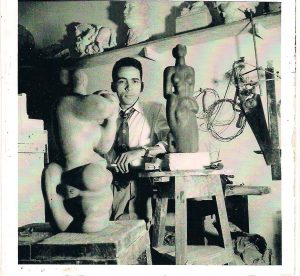
Estopiñán in Havana, 1952

During those years he read voraciously, from anti-communist writers on the left such as George Orwell, Ignazio Silone, and Arthur Koestler to Catholic philosophers such as Jacques Maritain and Étienne Gilson, as well as the poetry of Dante and Valéry.

He was deeply affected by Gilson’s 1955 Mellon lectures at the National Gallery that later became a book, Painting and Reality. Gilson argued that modern painting and sculpture did not aim to represent or imitate the natural world, but rather to add to it. For this reason, Gilson argued, modern art must be distinguished from mere “picturing”—producing images of actual or possible beings. The modern artist, according to Gilson, dismantles the unnecessarily descriptive, the overly decorative, and the merely illustrative, proposing instead an expressive language of the essential that is ultimately more spiritual than conventional depiction. Estopiñán decided to ground his aesthetic practice in Gilson’s theory of the “pure plastic elements” that characterized modern art, as well as Valéry’s definition of a classic: “a work that is measured by three standards: quantity, quality and variety.”

Throughout the 1950s Estopiñán simultaneously experimented formally with his sculpture and engaged in revolutionary acts against the Batista dictatorship. He participated in strikes, printed and delivered leaflets, and hid other revolutionaries on the run. He also began his arresting sculptures of political prisoners, winning prizes in national exhibitions. After the triumph of Castro’s revolution, the new regime rewarded his activism with diplomatic postings as a cultural attaché in Egypt, Czechoslovakia, and China. His experience in China while Mao Zedong carried out his program of forced collectivization of agriculture, suppression of Christian churches, and disastrous Great Leap Forward that resulted in tens of millions of deaths by famine, confirmed misgivings that he had already been experiencing about Cuba just a few weeks after Castro’s triumph.

“My intuition told me that instead of democracy, it was populism manipulated by a demagogue, that rule of law was not restored but replaced by the mob, and that the new regime was turning against the very Catholic church that had supported it,” Estopiñán told me an interview in 2014. “Communist China was simply the nightmare confirmed. I had seen the future and it was hell.”

Estopiñán, Rebel Prisoner, 1965

Back in Cuba in early 1961, he encountered a brutally sectarian society where opposition was not tolerated. He saw only four choices for him: adapt and lose your soul; be imprisoned; be executed; or save your soul and your life by going into exile. He chose the latter.

On his way to a new diplomatic assignment in Honduras, he got off the plane in Tegulcigapa, went straight to the U.S. embassy, and requested asylum. In exile first in Miami, then in New York City, he was overcome by a profound existential crisis: How could he have been fooled? Why and how did a revolution meant to be democratic sour so quickly into totalitarianism? He tortured himself looking for an answer, but the Jesuit examen came to his rescue, as did Maritain and Camus.

He also made new discoveries among 20th-century writers who had found meaning in Christian faith: Simone Weil and Thomas Merton. A fellow Cuban exile, the Catholic poet Israel Rodríguez (1925-2008), lent him two books by contemporary Catholic theologians that trace the roots of the atheism and nihilism that undergird many modern ideologies: The Drama of Atheist Humanism by Henri de Lubac and The God Question and Modern Man by Hans Urs von Balthasar. Both were Jesuits, and both were energized by the Second Vatican Council and its efforts to revitalize the Catholic Church as a bulwark against modernity’s aggressive secularism while at the same time speaking a language that modernity would understand.

After arriving in exile in the midst of this crisis of faith and ideology, Estopiñán slowly started to draw and sculpt again. But he found his earlier formalism hollow and lacking. He began to study the Romanesque sculpture of twelfth-century Western Europe, in which the elongated stone figures of Christ and other biblical personages dramatized religious meaning, as well as the work of the German Expressionist sculptor Ernst Barlach (1870-1938), whose realistic but stylized woodcarvings and bronzes that recalled the sculptures of saints on the façades of Gothic cathedrals displayed intense spiritual yearnings. Estopiñán needed to return to the human figure in a less abstract manner, more directly, more emotionally, in the best tradition of religious art.

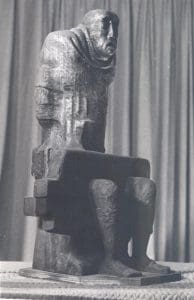
Estopiñán, Seated Prisoner, 1966

And he did.

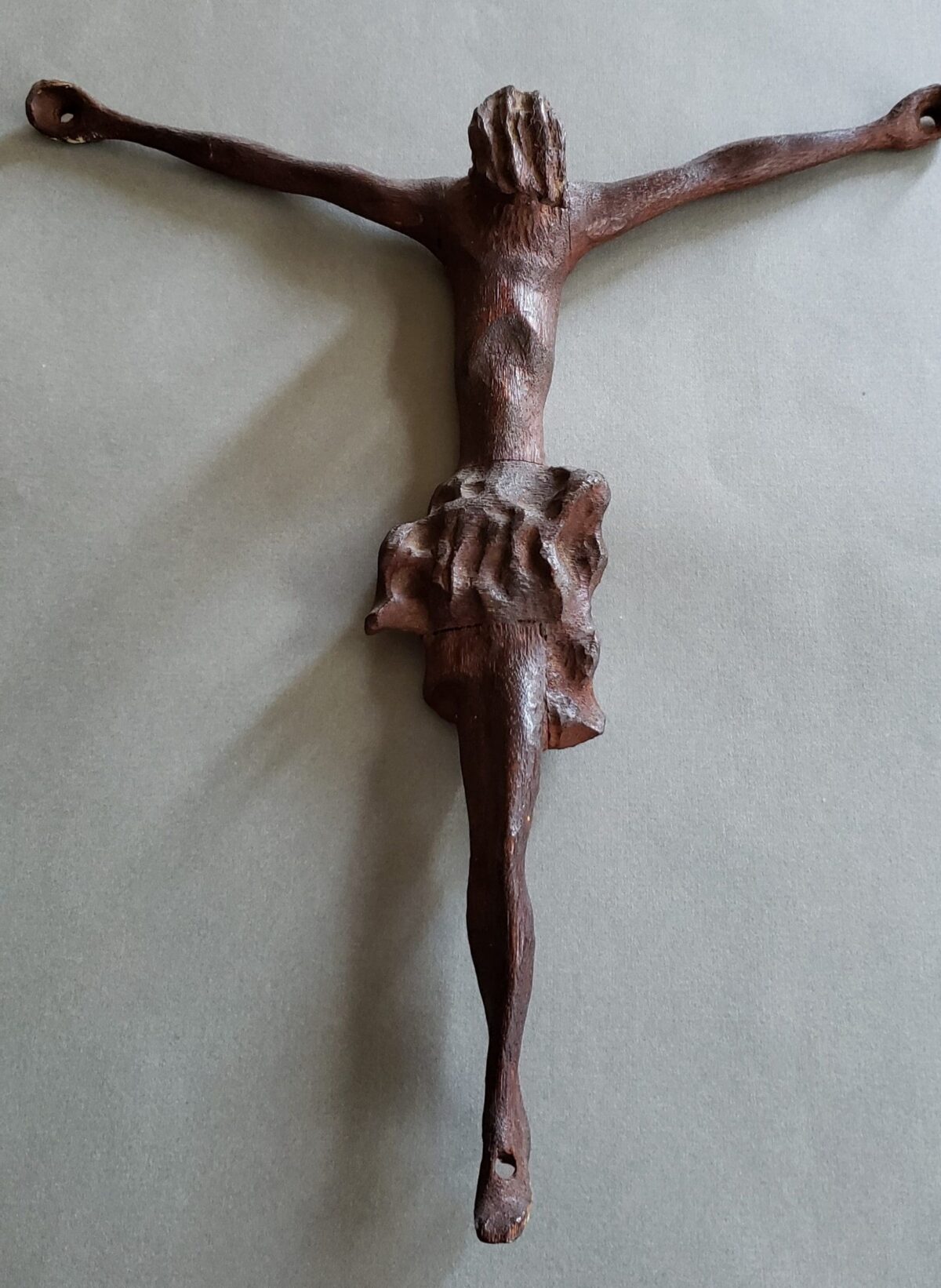
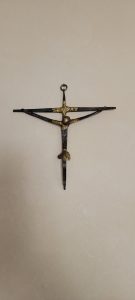
Throughout the 1960s the human figure returned to Estopiñán’s art, often in specifically religious images. During this decade drawings and sculptures of crucifixes, crucifixions and Calvaries appeared by the dozens, together with his continuing representations of political prisoners along with warriors and exiles. Ranging from minimalistic simplicity to dramatic expressionism, these works communicate depth of feeling and religious intensity. Estopiñán viewed his challenge as translating his inner life, his faith, into these works. I believe he succeeded; those works are grounded in profound Christian belief.

Estopiñán, Crucifix, 1962

Years later Estopiñán recalled: “I wanted to be true to myself, which meant being a modern artist and a believer. [Georges] Rouault and Barlach could do it, as well as abstractionists like [Alfred] Manessier and [Jean René] Bazaine. But so could artists who were not traditional believers, like Matisse in the chapel at Vence, like Germaine Richier’s crucifix in the church at Assy. I am not talking of grotesqueries like Le Corbusier’s church [an asymmetric concrete chapel with tiny windows erected in 1955 in Ronchamp, France], but something deep and clear and balanced.”

During the 1970s Estopiñán’s style shifted toward a more organic figuration, reflecting his desire to convey a synthesis between the human body and plant life. By the 1980s he had arrived at a new classicism, austere and simplified, in which the female torso whose renderings he became famous for and the political prisoners who continued to haunt him were his most constant themes, right through the end of his life.

Estopiñán, Untitled (Double Female Torso), 1985

In 2002 Estopiñán and his wife, Carmina Benguría, a performance artist and fellow exile, moved from New York to Miami. There he produced two etchings with crucifixion themes, carved a study for what he called a “resurrection crucifix,” which he hoped to make life-size for a chapel, and made drawings for a sculpture of a Madonna and Child (now in the collection of the chapel at Xavier University in New Orleans) that he was not able to execute.

Shortly before his death at age 93 I interviewed him for the last time. I asked, “Tell me in one sentence what your work is about.” He responded, “It’s about opening up matter–stone, wood, metal–and allowing the Spirit to dwell. In the end, I am merely a tool of God.”

Estopiñán, Study for a Resurrection Crucifix, 2002

Roberto Estopiñán pursued an authentic modern art that was also reflective of his intense Catholic faith. Hans Urs von Balthasar had raised “the God question and modern man” as an expression of the difficulty of maintaining Christian belief in a radically secularized and nihilistic age. Estopiñán provided an answer.

Editor: We asked Alejandro Anreus, a professor of art at William Paterson University, for his biography. He replied: “I came into exile with my mother, grandmother, and two aunts in 1970 in the ‘Freedom Flights’ set up by the LBJ administration. I was short of being ten years old by less than a month. Through anti-Castro human rights activism, I met Estopinan when I was 16 years old, and he became a father figure for the rest of my life. He introduced me to Orwell, Silone, Weil, Merton, also anti-Leninist Marxists like Rosa Luxemburg and Victor Serge, since he was a strong believer that to counterattack Marxism, you need to read it and know it. I organized two major exhibitions of his work; an important three-person show in 1992 at the Montclair Art Museum, and a retrospective of his prints at the Jersey City Museum in 1996. In 2019 I edited a book of interviews ‘Roberto Estopinan. In His Own Words’ published by ARS Atelier Press in Guttenberg, NJ. I have a Ph.D. in art history from the Graduate Center, CUNY, and I am the author of 6 books on Latin American art, and over 60 catalog essays, articles, and reviews, which have appeared in Art Nexus, Commonweal, Third Text, Art Journal and the Madrid-based digital periodical Diario de Cuba.”

I Point My Tan-Topped Hands To Him, (a God poem)


wind myself up the way my buddy,
Dave, taught me when I was fifteen,
kick my leg toward high heaven
land on it, pivot,
and throw him everything I’ve got,
circuitously wrapped in the hardest,
throwable sphere I can find.
In his perfect swing
(didn’t realize he knew baseball),
he smashes me a line drive
in such a non-elapse of time
that the morsel becomes juicy,
pierces my chest cavity
to lodge in my heart.
I gasp in delight that he takes
so much attention with me.
I throw up my glove –
can’t use it on him.
Everyone * laughs.

*Hebrews 12:1

Fr. Phil Flott is a semi-retired Catholic priest from Omaha. NE. He has written most of his life and been published hundreds of times in journals such as, Pensive Journal, Sangam, and Vita Poetica. He is a member of Catholic Literary Arts.


Subscribe to Our Emails