Gwyneth Thompson-Briggs: The Catholic Arts Today Interview

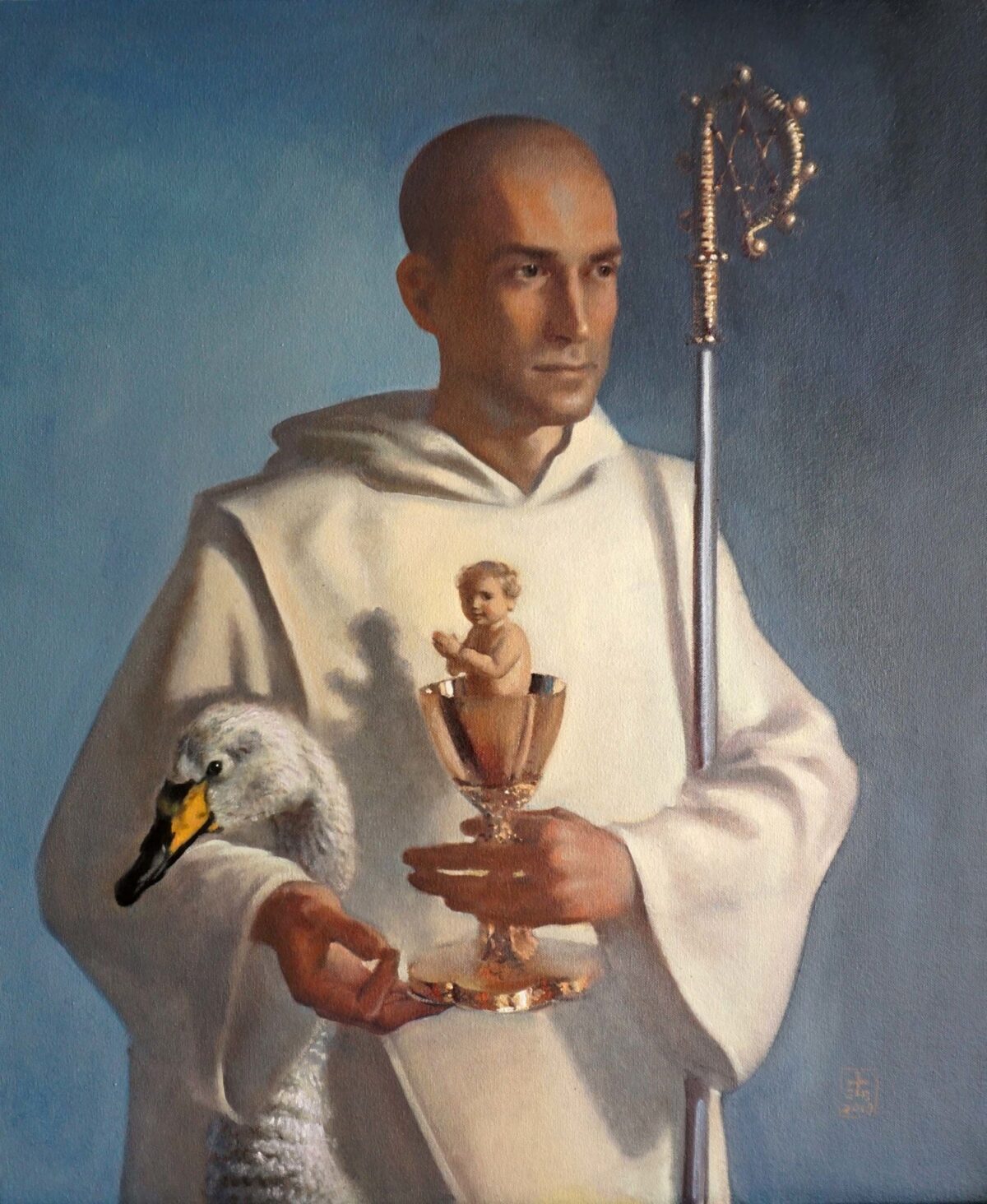
Editors Note: We have here Catholic Arts Today at its finest: a conversation between a significant young Catholic composer of sacred music and a significant young Catholic painter of sacred art. A feast for the mind and an inspiration (we hope) to the next generation of Catholic artists.  The painting by Gwyneth Thompson-Briggs above, St. Hugh of Lincoln, has never been published before.

Gwyneth Thompson-Briggs is a painter with a rising profile in the world of sacred art. But not content to promote only her own work, Gwyneth recently launched a new Catholic Artists Directory, featuring a carefully curated selection of Catholic creatives in the sacred music and visual arts world.  This new Catholic Artists Directory has two big purposes: First, pastors, church committees, Catholic schools and institutions, and private patrons of the arts now have a one-stop forum to find artists of the highest caliber to adorn their churches, chapels and homes. Second, the Catholic Artists Directors provides an online home for artists and art-lovers to network and discover and learn from each other’s work.

Sacred Music Composer and Kent State Professor Mark Nowakowski recently sat down with the artist Gwyneth Thompson-Briggs, founder of the Catholics Artists Directory, to discuss her new initiative and her work.

Mark Nowakowski: Why did you start this new Catholic artist directory?

Gwyneth Thompson-Briggs: When I began doing sacred art full-time this year I realized that there was a need for both patrons and sacred artists. Patrons needed a single place where they could find a curated selection of professional sacred artists and many talented artists needed exposure. I’d like artists to exert their time and talent making art rather than planning marketing strategies. It has been a pleasure to be able to help raise the profile of Catholic artists today who are reviving traditional techniques.

Mark Nowakowski: So your own experience seems to mirror my own as a composer: One must become a businessman and entrepreneur and voracious networker to find way to even start to get one’s art out into the general public. I can’t help but feel that God has called and equipped a veritable small army of talent, and that this army of Beauty is just waiting for fertile soil (and appropriate support) to start a new Renaissance. What is your experience surveying and now representing the broader field of Catholic art, music, architecture, and related disciplines?

Gwyneth Thompson-Briggs: Yes! There is a small army of talent that is standing at the ready. It is really exciting to get to know my other comrades-at-arms and the patrons who are helping us. I used to think that patrons were, for the most part, older, affluent, and part of a disappearing population of individuals with good taste. It has been a happy surprise that new patrons are coming forward who are in their thirties. They are not particularly affluent, but are willing to sacrifice in the name of beauty.
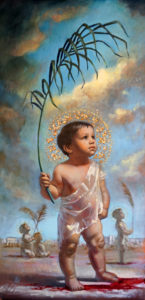
Gwyneth Thompson-Briggs, Holy Innocents, oil on canvas, 24 x 48 in, 2019

Mark Nowakowski: I think your own art is truly wonderful. What were the most beneficial as well as challenging aspects to developing your craft and establishing your professional career?

Gwyneth Thompson-Briggs: For me the great key was experiencing sublime works of art in person: Michelangelo’s Medici Tombs in Florence, the Van der Weyden diptych at the Philadelphia Museum of Art, and the portrait of Luis de Gongora by Velazquez at the Boston Museum of Fine Arts, among others. My skill also underwent extraordinary transformation each time I was able to see a master artist demonstrate the execution of a particular technique.

When I was five, a local watercolor artist taught me to “let the water do the work” when painting flowers; when I was a teenager, a life-drawing instructor took the charcoal from my hand and merged all the different shadow regions of my fragmented sketch into one unified form; as an adult, Paul Ingbretson solved a problem I had struggled with for a decade by observing that I needed to mix a bit more linseed oil into my whites “until the mixture was like a heavy cream.”

The most challenging part of growing as an artist has been gaining access to masterpieces and master artists. Sensors and over-zealous guards in museums tend to keep visitors too far back from the canvas to truly observe strokes and paint quality. While there are some masters working today, I haven’t found anyone truly conversant in Baroque technique. So, one must cobble together what one can learn from old paintings with what one can learn from contemporary masters.

Another challenge is the sense of inadequacy. As a mid-career artist, one always feels that there is more to learn before one is really qualified to accept commissions, but I now realize that it is by accepting commission that I am able to grow most quickly. Each commission is just a bit out of my comfort zone. Each commission requires me to study art history, to learn more about a particular technique or the archival nature of the materials involved, and to perform technically better than the time before.
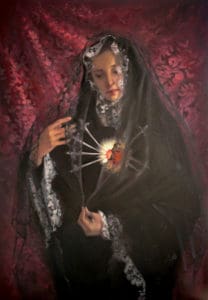
Gwyneth Thompson-Briggs, Our Lady of Sorrows, oil on canvas, 24 x 34 in, 2019

Mark Nowakowski:  In a society where there is endemic poverty, where there is suffering, where there are major social issues such as abortion and the defense of marriage to tackle, how do we justify taking money for the arts? How do we convince others of the importance of patronage? I have my own answer, but I’d love to hear your own perspective.

Gwyneth Thompson-Briggs: I live in St. Louis, a city with profound economic problems. I often meditate on the poor children that grow up in run-down neighborhoods, crumbling school buildings, and are culturally nourished exclusively by online treacle.

If only they knew that in the center of one particularly depressed area, the beautiful church of St. Francis de Sales run by the Institute of Christ the King welcomes both rich and poor and provides a respite from the oppression of daily life. As long as we are in this world, we are going to suffer from economic, physical, or emotional problems. A beautiful church or a moving work of art allows us to perceive our sufferings in the light of eternity and gives us the strength to go on.

Beautiful art is a gift especially for the poor but it is the responsibility of the rich to fund the art and to demand the highest standards from the artist.

Mark Nowakowski: What is leading to this new potential renaissance in Catholic art?

Gwyneth Thompson-Briggs: Perhaps one of the paradoxes of our times is that the darker the crisis in the Church and the world, the more brightly the beauty of Tradition shines and attracts. This paradox was strikingly illustrated on the final weekend of October this year, when the conclusion of the Amazon Synod coincided with the 8th annual Populus Summorum Pontificum pilgrimage. More and more people, especially young people, realize that the only way out of the dead-end of modern life is Tradition, including the traditional arts that are fostered by and at the service of divine worship.

I think that the very severity of the crisis–what several commentators have called the Passion of the Mystical Body–is helping people to distinguish orthodoxy from heterodoxy, holiness from worldliness, beauty from ugliness, and excellence from dross.

After sixty years of detente with the world, a renewed polarization is emerging. There is a renewed militancy in the Church Militant, even if only among a fragment of the baptized. These souls know that they can’t trust the bishops or the pope to teach them the Faith or to fund genuine sacred art; they must learn the Faith from old books and from the small but growing ranks of traditional priests, and they must themselves become discriminating patrons–because the worship of God demands the greatest artistic treasures we can offer to His majesty.

Similarly, young people know that they can’t expect a real formation in the arts in the conventional art schools or university art departments, including the nominally Catholic ones; they know that the mainstream art world, the mainstream media, and mainstream academia are ideologically perverse and technically ignorant. So, they are seeking out genuine artistic formation outside of the old structures.

In the midst of what Dietrich von Hildebrand called “the devastated vineyard,” even as those who should be tending the vineyard continue to devastate her, there are new shoots on the old grapevines.

To see more of Gwyneth Thompson-Briggs work, visit https://gwyneththompsonbriggs.com/. To explore the emerging generation of Catholic painters and other sacred artists visit CatholicArtistsDirectory.com.

Dr. Mark Nowakowski is a composer and scholar whose musical works have been premiered globally by the Kronos Quartet, the Cleveland Chamber Symphony, the Silesian Quartet, and other luminaries, while his 2017 Naxos debut album “Blood, Forgotten” earned critical praise in Gramophone magazine. His writings are regularly published in CatholicArtsToday, Sound on Sound, CDN, and OnePeterFive.

Alice McDermott: The CAT Interview

Who is Alice McDermott?


She is or has been: a professor at Johns Hopkins University; a wife, the mother of three children; one of America’s most distinguished novelists; the author of 8 novels, New York Times best-sellers and multiple award-winners among them. There is a story, possibly apocryphal, of the time Alice McDermott’s students went wild with excitement upon learning she had won the National Book Award for her 1998 novel Charming Billy. “I’ll give $100 to anyone who can name last year’s National Book Award winner,” she is supposed to have said. No-one collected. For McDermott, the consummate artist, it’s the work that counts, not the awards.

Following Flannery O’Connor’s lead, McDermott doesn’t particularly like to think of herself as either a “Catholic artist” or as an “Irish-American artist” even though Irish-Catholic characters have played such a prominent role in her work. When Medium interviewer asked her in 2018 about her faith, Alice McDermott responded: “In my life as a writer, Catholicism certainly has shaped how I use language…and metaphor…I’m a practicing Catholic myself — though I probably don’t practice enough to be really good at it. I love the gifts of the Church, and I’m constantly dismayed by its failings. Kind of the same way I feel about people.”

Her latest novel, The Ninth Hour, is about “Nuns,” she told Medium, “And laundry. Other things, too, of course — notions of sacrifice and selflessness and how the past reverberates, or doesn’t.” She went on: “I’ve always balked a little at being labelled a Catholic novelist — much as I balk at being labelled an Irish-American novelist (sorry) — but there were times when I thought about this one, ‘You want a Catholic novel? I’ll give you a Catholic novel!’”

A portion of The Ninth Hour appeared in 2015 as an extraordinary story in the New Yorker, “These Short, Dark Days.” So at the Catholic Imagination Conference at Loyola’s Hank Center for the Catholic Intellectual Heritage this September,  I asked her about that:

Charlotte Allen: I read it twice, and I remember how you made each word in that story count. It was really a remarkable achievement that story, about this nun who had a lot of guts. She was up against people who were not so great. But she knew her own sins and she basically tried to sneak the suicide into the grave but it didn’t work. I hated the suicide, I felt no sympathy for him, but I hated even more the New York Times guy who blew the story.

Alice McDermott: So, I got to write: ‘The New York Times has a big mouth.’ Very seldom do I get to enjoy my own language, but I loved it when she said that. I really loved it.

Charlotte Allen: Did you do a lot of research—archives, old newspapers–to write The Ninth Hour?

Alice McDermott: That was so much fun. The initial impulse for the story was really that a friend of mine told me that he had a childhood memory. He lived way upstate New York. His family had been there forever. And he had a childhood memory of a very old man who lived with a great aunt, or a great-great aunt in the house of theirs. This very old man was not a relative. He had served as a “substitute” [for a draftee] in the Civil War for one of this aunt’s brothers. And when he came back from the war, the family took him in, and he lived with the family until he died. And I loved that.

So that’s really the first research that I did, and that led me to a lot of newspapers from the early part of the 20th century because a lot of men who had served in the Civil War as substitutes as young men had survived. They would be mentioned, mostly in New York, Philadelphia, Boston papers. The Brooklyn Eagle is so much fun to read. I was seeing also at the same time lots of little articles about suicides, and turning on the gas. Thinking about it, it makes sense. Most of these people didn’t have guns, and they wouldn’t have access to drugs. I guess they could hang themselves, but turning on the gas seemed to be the suicide means of choice in that era.

So those two things—the whole idea of a substitute, someone who puts himself in harm’s way so that someone else can live and stay safe, or someone who takes his own life and doesn’t think about who is this going to damage—metaphorically, because we understand now that suicide is not a selfish act, that it’s mental illness, despair and all that. So that’s where the research kind of brought me to the story.

The other thing I did see, especially in the New York papers and some of the Boston papers, was how many little articles there were about nuns taking care of people, raising money, having a raffle for the orphans, all in this era. There were so many nuns in the United States.

Charlotte Allen: There were. And so many of them were selfless people.

Alice McDermott: Nuns were the social safety net for a lot of these immigrant communities, these immigrant ghettos.

Charlotte Allen: And one of the great things in the story was the personalities of the nuns. I went to Catholic school as a kid, and some of the nuns I liked and some I hated. One of them I just loved.

Alice McDermott: Sure, we’re all human. It wouldn’t make any sense if they were all good or all bad.

Charlotte Allen: But I never thought much about the personalities behind them and what it must have been like to have lived their lives, especially in a convent where you’re in close quarters with a bunch of other women with whom you might have nothing in common or not much.

Alice McDermott: Except your vocation.  If you think about it in the context of time and place, a lot of the women who went into religious life with some ambition—to be teachers or to be nurses or to alleviate suffering—were ambitious women who did not have many options for their ambition. Intelligent, ambitious women who did not want to get married and have a pack of kids and maybe die young as they saw their own mothers had done or as they saw their sisters.

Take Catherine of Siena, for example. She had her first visions after she saw her sister die in childbirth. And there was that handsome guy who was waiting to marry her. Like this is my future, or I can be a saint, I can live alone. I don’t have to have some hairy guy coming in and bothering me.

Entering the convent was a way for intelligent, aware, ambitious—and I say ambitious in all the best ways—women at a time when there weren’t too many other options. Even nurses were looked down on. Nursing was not considered a noble profession in that time and place. But then along with ambitions, there is the idea that you’re one of the holy sisters, and the rest of your life will be taken care of, that you’ll have a place to live that’s not provided by your husband or your father.

Most of the congregations that either came to the United States or were founded here were women-led and women-run, like the order founded by Elizabeth Seton. There weren’t many opportunities for women to run that kind of hospital or school, except through religious life. So, yes, Vatican II shook up a lot of things, but also the culture changed. Women who wanted to get a degree in theology didn’t have to sign up to be nuns and be celibate for the rest of their lives in order to take the classes or do the work that they wanted to do.

That’s what made me think: How much more complex these women are than the culture has ever allowed them to be. Ambition and a kind of fearlessness and a tremendous selflessness. But I think you can be selfless and still have ego and still say: I’m good at this. I’m better than most people, and I really should be in charge, and these people—they’re not so good at it.

So that’s what made me fascinated by it: Why are we thinking all these women are alike, and why are we relegating their work to something that’s easy and simple when they took on the hardest tasks?

Charlotte Allen: And you certainly make that clear in that story.

Alice McDermott: It’s suffering. It’s taking a daily stand to alleviate something they know they can never alleviate. So that was the other part of the research, reading about religious orders, and how hidden that history still is. This is something in my patchy education that I did not know. The Mayo Clinic was started by Catholic nuns. The Catholic Church should have been teaching us that. We should know the names of these women.

Charlotte Allen: And then I read a second interview with you about The Ninth Hour, which turned it into more of a feminist parable. I saw it as a story about human weakness. How much feminism was there in the story, or are all these things mixed together in a bag?

Alice McDermott: I don’t know if you can separate it out. If I get a writing assignment about feminism and the Church, I’ll write an essay about that, or an op-ed. But in fiction,  it’s the insistence on the individual humanity of every single character. That is sometimes surprising to readers these days: In fiction, people who are being stereotyped, who are being defined by gender or religious habit, become individuals. I think that’s the obligation of fiction. I know it’s why I go to fiction.

In The Ninth Hour, for example here is a nun in the traditional habit doing the humble work of the “Little Nursing Sisters of the Sick Poor.” She has just been sitting and begging and comes upon this situation of a young man who’s just committed suicide. This nun understands that this poor widow in front of her needs her Church at this moment; she needs to have her spouse buried. She needs the ritual of the Church. This nun knows that her compassionate Church should be there for this widow.  This particular nun, who’s not like any other nun who’s ever existed, because she’s not like any other human being who’s ever existed before except inside this story, feels: I’m going to do the right thing for her.

This nun is a woman who’s seen suffering, who’s given her life to the Church. I don’t see that as a feminist thing because she’s a woman and a nun who’s standing up against a patriarchal institution. I see that as a remarkable woman’s life experience compressed into a single moment: She is doing what she must do. She’s doing the right thing.

Charlotte Allen: That’s the story that I read when I read the story. But your other stories don’t quite have that focus. They’ve been about Catholics, Catholics in New York, so I’ve never thought of you, in fact, as a Catholic writer but as a writer about people who are Catholics.

Alice McDermott: Thank you. I appreciate that. But The Ninth Hour is a novel about redemption. And faith.

Charlotte Allen: So why are you so pleased to have not been regarded as a Catholic writer?

Alice McDermott: It seems that those kind of labels speak to…the wallpaper. They speak to the subjects of the writer. These people are Catholics, yes. They’re New York Irish Catholics. I think more and more we forget to talk about what a novel means rather than what is it about. What the novel is about is just the surface of things. But we’re looking underneath the surface. That’s what fiction is supposed to do. So being labeled a Catholic writer—number one, most people think that you’re out to convince.

Charlotte Allen: That you’re just going to turn out some pious fiction.

Alice McDermott: Right. But also to me, it’s limiting the role of fiction to what it’s about, so that you’re a guy who writes war stories, say.  Tim O’Brien, he’s the war-story guy. But the value of a story is not what the story is about. The subject is just the surface of things. The meaning is how the words work, how the images work, what you do with the subject. More and more I feel like in popular culture we don’t talk about books, because it’s harder.

The other aspect I do not like, is the label implies also that you’re writing for Catholics. If you’re a black writer, you’re just writing about black people for black people. I became a reader at a time when nobody said you should read only about people whom you recognize. Nobody ever said that. The whole point of reading fiction for me is: Become somebody else. Don’t go looking for yourself. Become somebody else.

Part of it is the way literature has been taught in recent decades. If an adolescent goes to the English teacher and says, ‘My parents are getting a divorce, and I think my brother is taking drugs,’ teachers tend to say: ‘Well, here’s a novel about a girl just like you whose parents are getting divorced. Read this, and it will make you feel better.’ Instead of saying, for example: ‘Read Jane Eyre.’ Live that life a little bit. Nothing is going to heal what is happening to you, but that’s not what literature is for. Read Moby Dick, for heaven’s sake, and live somewhere else for a while.

I kind of feel sorry for teachers. I don’t want to come down on them or on any other kind of academic. They have to justify ‘why read’.  Our culture doesn’t seem to understand that art is not just a means to a utilitarian end.

Charlotte Allen: I think that so much literature has become boxed in. There’s black literature for and by blacks, Latino literature, or feminist literature.

Alice McDermott: It’s this whole sort of revival of the Victorian note of reading novels for edification. In the 21st century—I don’t know how we ended up here, but that seems to be…

Charlotte Allen (interrupting): Read something uplifting.

Alice McDermott: That may happen, sure. But if that’s the only point, it diminishes the value, the miracle of entering into someone else’s life through story in a way that we can never know each other in the real world. Through the miracle of the story, you get to hear someone else’s interior voice in your own head, to see through their eyes, just to experience that. Never mind if it makes you a better person after you’ve finished it, or never mind that now I know what it’s like to live in the Deep South. Thinking of literature in this way implies that reading is all about you.

You don’t have to think about yourself. You are going to live this experience. When you’re reading this novel, or you’re looking at this work of art, or you’re listening to this symphony, you’re experiencing the best of life. You’re experiencing this gift of life in whatever we give each other in whatever time it takes. When you leave, it doesn’t mean art is necessarily going to change you. It doesn’t mean it’s going to make you a better boss or student or help you get a job.

I say: Leave yourself alone, forget yourself for a while, and enter into the art of storytelling that will allow you, for whatever time you’re steeped in this novel, never to be yourself.

Charlotte Allen is a D.C. based arts reporter for Catholic Arts Today and the author of The Human Christ: The Search for the Historical Jesus. This is the first of a series of Catholic Arts Today interviews with Catholic writers who attended the 2019 Catholic Imagination Conference at Loyola University’s Hank Center for the Catholic Intellectual Heritage.


Subscribe to Our Emails