How Does a Hymn Become a Classic?

Archbishop Cordileone’s Very Marian Advent Prayer Service Launches World Premiere of Two New Christmas Carols

On December 15th, at Star of the Sea Church in San Francisco, Archbishop Salvatore J. Cordileone will lead an innovative Very Marian Advent Prayer Service featuring the world premiere of two new hymns by major Catholic artists commissioned through the Benedict XVI Institute. James Matthew Wilson teams up with composer Frank La Rocca for a new hymn While All the Earth in Darkness Sleeps, which was inspired by the 6th century Akathist Hymn to Mary. Fr. Dwight Longenecker created Our Lady’s Lullaby with new lyrics to an old Welsh hymn Suo Gan (best-known for its appearance in the Disney film Empire of the Sun) and a new arrangement by composer William J. Fritz. The two hymns are part of a lessons and carols worship format, featuring a magnificent 8-voice schola led by Hillsdale College’s Maestro Timothy McDonnell.

Archbishop Cordileone and the Benedict XVI Institute’s ambitious goal? To create new Advent hymns that enter the canon of the Catholic church.

“Many of our best hymns and carols were composed first as poems and later set to music,” said James Matthew Wilson, poet-in-residence at the Benedict XVI Institute “How daunting as a poet to have to say to myself, this has to work as the kind of language people will want to sing, want to remember specifically as musical, as pure song.”

All ancient, worldly wisdom
Exults before your son,
And lays three gifts before you,
Virgin who nurse the One.
May gold forever glimmer
From both his crown and yours;
May prisoner and pauper
Greet angels at their doors.

Rejoice, o virgin watching through the night.
Rejoice, the gate that opens all to light.
Rejoice, whom even cherubim attend.
Rejoice, seraphic queen and sinners’ friend.
Rejoice, whose breast the food of all once fed.
Rejoice, our lady, stars anoint your head.
Rejoice, for on this night you bore a son.
R. Rejoice, for on this night you bore a son.

~While All the Earth in Darkness Sleeps
James Matthew Wilson

How does a poet even begin to approach such daunting task of adding to the canon of Advent and Christmas music?  “By trying to impart a classic quality to the setting,”  Composer-in-Residence at the Benedict XVI Institute Frank La Rocca answered. “One that sounds like a bit of fresh air flowing through a long and great tradition – a tradition one approaches with a certain reverence and gratitude.”

The second world premiere Advent carol is Our Lady’s Lullaby. “How did you approach this?” I asked Fr. Longenecker. “To write something one hopes will stand the test of time, one looks to the great tradition and tries to write from within that—without either copying or challenging the tradition. For this piece I looked to the great images of the Madonna and child and that connected me instinctively with lullabies,” he replied.

Sleep my Child
In the manger
Sleep my child
Free from Harm
Sleep my child
Free from Danger
Sleep my child
In my arms

~Our Lady’s Lullaby
Father Dwight Longenecker

“When mothers hum to their little ones as they’re putting them to sleep,” added composer William J. Fritz, “many times they improvise without knowing it. I changed the rhythm of the original tune to make it feel like a mother rocking her child to sleep; there is also a departure from the tune in the middle when Mary contemplates her Son’s passion and death. My hope was to hint at the ecstacy that the Mother would feel at the Son’s triumph over death. This is an Advent/Christmas Hymn much like the Messiah – it’s all of Christ’s mystery wrapped in one.”

Last year’s first Very Marian Advent service saw the debut of two other brand new Advent carol:  The Chesterton Carol, by composer Mark Nowakowski, and Our Lady Expectant, composed by Wilhelmina Pariseau from a poem by Roseanne T. Sullivan. Both will be performed again this year.  Mark Nowakowski’s Chesterton Carol has taken a step towards becoming a classic by generating 22,000 views on YouTube and being adopted by many in the Chesterton Schools Network.

The new hymns this were made possible by the support of two new patrons of the arts: James and Kristy Hudon, who commissioned While All the Earth in Darkness Sleeps, and Michael and Sarah Trela, who supported Fr. Longenecker and Mr. Fritz’s new Christmas carol.

Why support new works of art amid that many other urgent needs in the world, I asked them.

“Most of the religious hymns we sing today were composed long ago, borrowed from past generations,” said Mr. Trela. “While these old hymns are excellent, it is time for this generation to humbly contribute with a new Christmas hymn that shares in the joys and tears of Our Lady.”

“We are meant not only to enjoy Art, but to participate in it,” said Mr. Hudon. “A thriving arts culture unites us as Catholics and brings us into fuller communion. A city set on a hill cannot be hidden, and so it is important that we help make our city—the Church—beautiful, as beauty attracts people who have otherwise closed themselves off to the truth of the Gospel.”

Those in the greater Bay Area can register to attend; the Benedict XVI Institute also offers a virtual option: those who register will receive a link to the professional recording of the event, including the new Advent /Christmas carols.

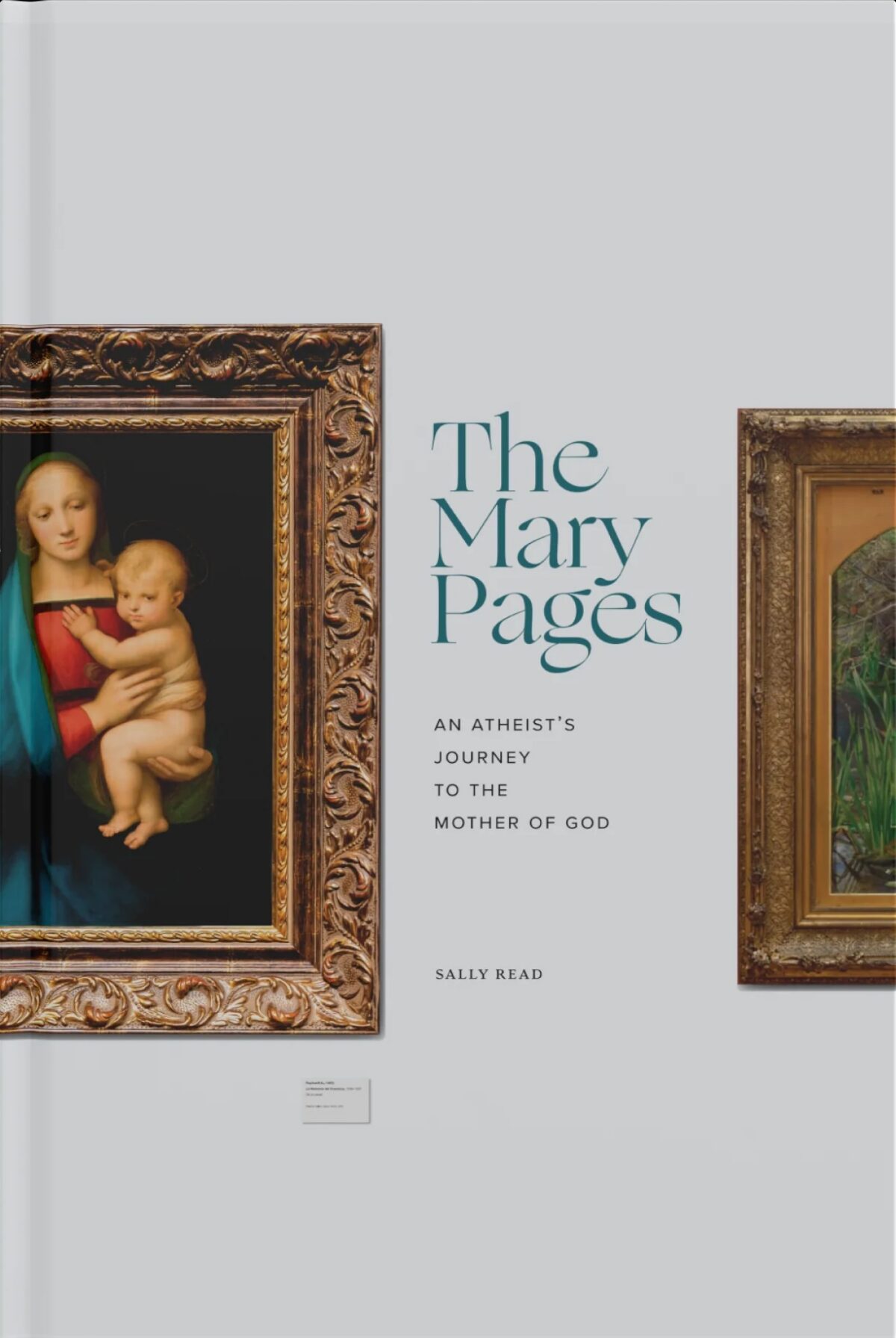
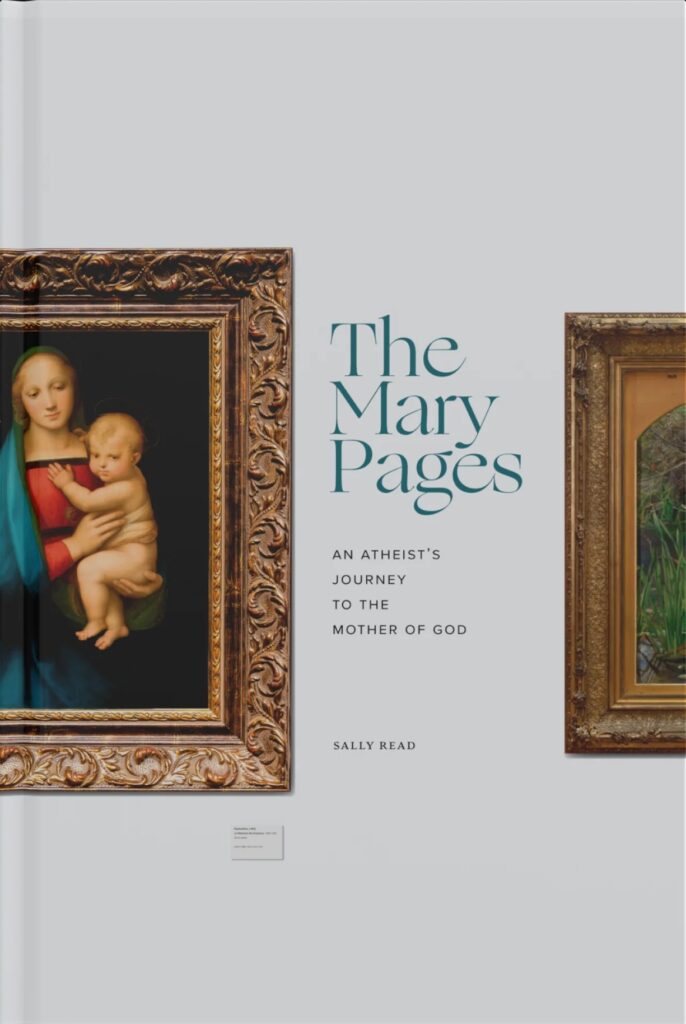
Review: The Mary Pages by Sally Read

Sally Read, born in East Anglia in 1971 and now living near Rome, was a secular poet before she was a Catholic poet. Determinedly secular, too, as she relates in her new memoir, The Mary Pages: An Atheist’s Journey to the Mother of God (Word on Fire). 

Raised by an atheist father who scorned all things religious, in a country that had stripped its churches bare of iconography (especially all that was Marian) centuries before, and imbibing to the full the defiant feminism that marks our current culture, Read unsurprisingly regarded the Mother of God, at least as the Catholic Church views her, with faint contempt. “How best to shut a woman up?” she once mused as she she contemplated Mary’s seeming irrelevance to contemporary women’s issues such as genital mutilation, date rape, and domestic violence. “Put her on a pedestal, and give her a crown.”

The Mary Pages is not a conversion story. Read has already told that story, of her nine-month journey in 2010 from cynical atheism to the Catholic Church, in a 2016 memoir, Night’s Bright Darkness. Nor is The Mary Pages a conventional autobiography; it seems purposely vague on detail. Instead, it is a story, meticulously and beautifully written, of how Mary insinuated herself into Read’s internal life so thoroughly, starting in childhood, that she would be inevitably led to Mary’s Son. The medium was art. Read’s grandmother had a copy of a Raphael Madonna hanging on a wall. The mother and baby mesmerized the unchurched little girl who scarcely knew who Mary was.

Later, Read went to nursing school in London, where she found herself haunting the National Gallery’s Renaissance rooms with their myriad images of Mary—and then hanging a print in her bedroom of Filippo Lippi’s radiant Madonna and Child With Two Angels. The story behind the painting overwhelmed her as much as the painting itself. The model for the Virgin had been a Dominican novice-nun, Lucrezia Buti, with whom Lippi, although a professed friar, had fallen in love. One day he kidnapped Lucrezia from a procession and seduced her. She eventually bore him two children, but even when released from his vows and given ecclesial permission to wed, he refused to marry her.

That resonated with Read, who herself was seeing a man, a doctor she calls Mischa (she has altered identifying information for most of those she writes about), who declined to commit himself to her because he already had a live-in partner, a woman physician at his hospital. Read’s relationship with Mischa was misery (“a kind of slavery,” she writes), but he did one thing for her: He encouraged her to keep writing the poetry she was already starting to write. He brought her books by women poets he thought would inspire her: Sylvia Plath, Sharon Olds. They did. If you have read Read’s poems (some are online), either pre-or post-conversion (where her subjects are nearly entirely Christological), you will find the powerful  rhythms, minutely focused examinations of the natural world and the human body, and the naked emotional engagement that mark the work of Plath and Olds. Read’s years in the secular literary world did not go to waste. 

She got up at 5:30 every morning to write furiously, then worked a shift at a psychiatric hospital tending the human dregs and outcasts no one else seemed to care about. She collected Marian art in her apartment—but at the same time she was composing a feminist poem that would portray the Virgin as a pregnant rape victim who had to invent the Annunciation as a cover story: “I could not tolerate a male God—and Mary, I suspected as much, was inextricable from him.” Read’s mental images of Mary were refracted into other wounded women: Lucrezia Buti; Elizabeth Siddal, the copper-haired model for many a pre-Raphaelite painting of Mary who killed herself like Sylvia Plath when her artist/poet husband, Dante Gabriel Rosetti, had an affair with another of his models; Princess Diana, then at the height of public pity for her and also made violently dead, in 1997. Read enrolled in a graduate writing program on the American “Plains” (the University of South Dakota, according to her Wikipedia biography), where her friends, like her, were women left stranded by men, sometimes with children to raise alone

She returned to London, and then, somewhere and somehow (remember, this is not an autobiography) she met the man who became her husband: Fabio, an Italian. They moved first to his native Sardinia, then to the Roman seaside suburb of Santa Marinella. All over Sardinia—in roadside shrines, bars, schools, grocery stores–were plaster and wooden statues of the Madonna, sometimes wearing a lace dress and blonde wig, like a doll. Read found them repulsive, and she chafed under the unwritten rules of traditional Mediterranean society, where respectable women did not go out at night alone, and her visiting female friends, bohemian free spirits who flirted and more with the local shepherds, drew the wrath of her in-laws, who deemed them loose women. In Santa Marinella a church housed La Madonnina, a small statue of Mary, a souvenir from Medjugorje, that was said to weep human blood from time to time. “This florid thing…only distanced Mary further from me,” Read writes. “The bloody face was like something from a horror movie.”

The turning point came—although it would be another four years formally—when she gave birth to her daughter, Celia Florence, in a Roman hospital. She had had trouble getting pregnant, and the labor was prolonged and excruciating (the baby’s head wasn’t positioned optimally). Alone in her hospital bed in her agony (husbands weren’t allowed bedside in Roman maternity wards), she realized that Mary had also been alone when Jesus was born, because as it is with all women in childbirth, “[n]o one, not even her husband, could possibly imagine what was happening to her.”

“Alone of all your sex,” -[the fifth-century Latin poet] Sedulius wrote, and the feminists seized on this as example of the Virgin’s difference, her exceptionality, her exceptional holiness, her exceptional loneliness—her special subordination to God and man….But what I will arrive at, in a shortening number of days, is Mary’s aloneness as the archetype of every woman’s aloneness: Mary as foundress, as defender, as mother-creator, as collider with the harsh, existing world. For in childbirth, there is no act of creation so similar to God’s as he pulled form out of nothing and watched the world spin.

The only thing that I could have wished for more of in this haunting and gorgeous book is the visual images of Mary that have followed Read since her childhood. There are some of them, to be sure: her grandmother’s Raphael, the Filippo Lippi, the striking 1922 statue of Our Lady of Walsingham, whose shrine in her native East Anglia Read visits as a pilgrim in the book’s final pages. I longed to see a photo of La Madonnina, for example. It is also unfortunate that Read’s oeuvre as a poet has been divided in two by her conversion, with each half perhaps rendered inaccessible to admirers of the other. Her first three books of verse, dating from the early 2000s, were published by Bloodaxe Press, a leading British secular publisher of poetry. Her most recent volume, Dawn of This Hunger (Angelico Press, 2021), as well as her memoirs and other prose works, come from Catholic presses, and it would be unfortunate if her secular readers assumed she was addressing her richly laden recent words solely to a Catholic literary ghetto. Sally Read is too fine a stylist and too penetrating an observer for readers of any religious sensibility or none to miss.

Pre-conversion poem:

Gestation

Post-conversion poem:

Anne: The Coming of the Immaculate

At times prayer is wordless, but it fills
the empty night as water fills a lake
with its own meaning. I pray to break
this body with a child, for my taut pelvis
to open and ache its tight basketwork
apart; to yield. Sometimes I sense God
in the darkness—like a heavy leaning
at the door—always with an inexplicable
tenderness in how he does not burst in.
Perhaps he would break me if he did,

so waits instead to pour into my own undoing—
so just when I would moan, It’s done!
that life did not go well, Perfection rests in me,
and I expand, like wood ticking in the sun.

Spoiled

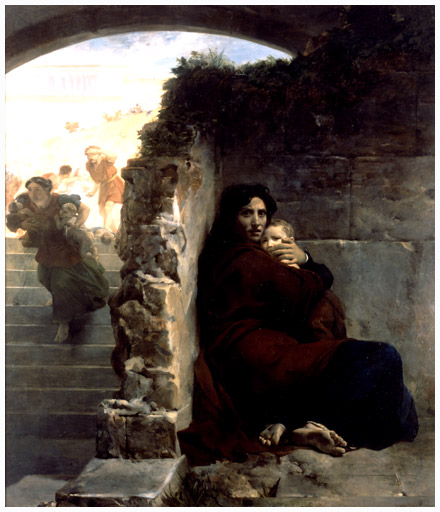
After the painting The Massacre of the Innocents by Léon Cogniet

Once we cradled close in the corner of our room,

folded like prayer-hands, while you nursed.

Your hair feathered my cheek as I sang you sleep-soft,

borne on waves of warm milk to silken slumber.

In the quiet dark, our breaths synced to one heartbeat,

as in the months before I bore you from me.

Then that evil day. Cornered in crumbled rock,

folded tight. You bit the finger I thrust

into your seeking mouth. I clutched you, fear-rigid,

while mothers wailed, babes broken and rent to silence.

I begged the dark to hide you, begged you back

into my depths. But you were ripped from me.

Now, you sleep but do not nurse.

Now, milk spoils to stone in my breasts,

bleeds in rivulets blue-white.

Metanoia: One Composer’s Catholic Journey

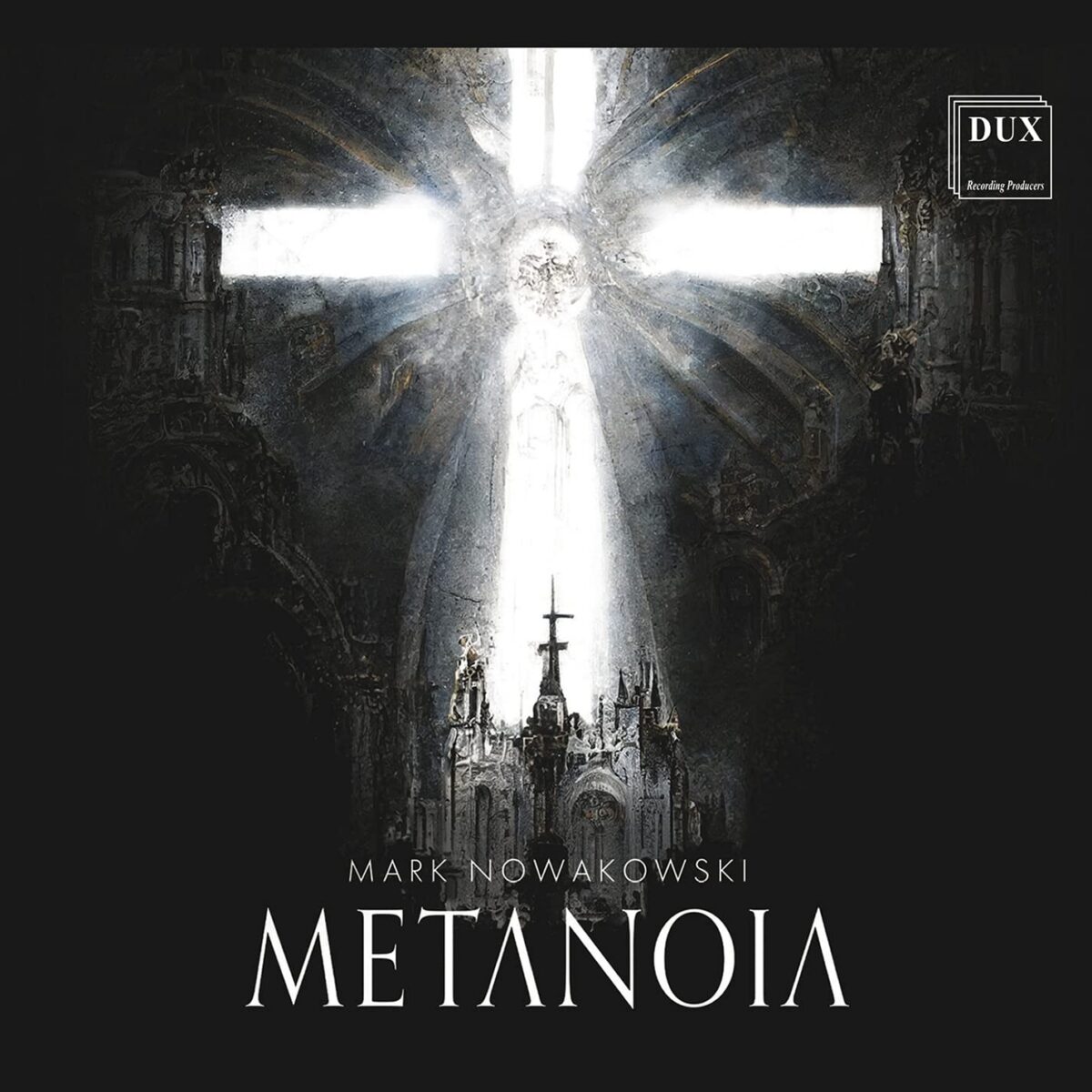
On May 19th I’ll be releasing my second album, Metanoia, published by the Polish label “DUX” and distributed internationally via Naxos. This is the story of a composer’s journey in creating new sacred music that brings people closer to God.

What is sacred music? This is the first question I wrestle with, for while the line between liturgical and non-liturgical music is at least somewhat clear, the question of what makes music “sacred” drifts into more fraught philosophical territory. Music itself points towards transcendent striving and the music most fully realized is one which engages our contemplative nature. Sacred music is that which makes us stop and contemplate what lies beyond the noise and distraction of the world: It points us toward God.

Even during a time of growing hostility to faith in general and Catholicism in particular within the concert hall, it is the works of Catholic and Orthodox composers which have continued to play a major part in our classical music.

The 20th century’s greatest composition pedagogue, Nadia Boulanger (1887-1979), was a deeply faithful Catholic and daily communicant, and most of her famous students (even those not implicitly Christian) retain a distinctly spiritual approach to their work.

One of her many contemporaries was Olivier Messiaen (1907-1992), a French composer whose compositions are marked by his Catholic faith and fascination with theology. Some secularists love his fascination with birdsong (which I suspect for Messiaen pointed to the universal harmonies of the Creator anyway). I rather prefer his Poèmes pour Mi, which strikes me as a historical musical prelude (and musical counterpart) to the deep theological meditations of John Paul II’s Theology of the Body.

Francis Poulenc’s (1899-1963) many sacred works, including his Gloria and Stabat Mater, reflect his deep spirituality and commitment to the Catholic Church. In midlife, when a dear friend died in a traffic accident, Poulenc made a pilgrimage to the Sanctuary of the Black Virgin in Rocamadour, triggering a profound spiritual revelation. His resulting Litanies for the Black Virgin for women’s chorus and organ was premiered by Nadia Boulanger during a London BBC concert.

Henyrk Górecki (1933-2010) was another Catholic whose works include luminous choral works and the best-selling Third Symphony, yes, but also a grouping of more challenging chamber works which invite deeper contemplation. (I’ve written about them here.)

Giya Kancheli (1935-2019) was a devout Orthodox Christian born in Soviet Georgia whose striking works, including his Liturgy for Viola and Symphony No. 6, are characterized by their meditative quality and evocative use of soundscapes. John Tavener (1944-2013) was an English convert to Orthodox Christianity. His masterworks include the record-setting The Protecting Veil and haunting Funeral Ikos.

Today the heirs of this line of composers include Arvo Pärt (Orthodox, but setting almost exclusively Catholic texts), and Sir James MacMillan. MacMillan’s compositions reflect his Catholic faith and Scottish identity, with works such as his St. John Passion and Symphony No. 5 receiving critical acclaim, though it is his Confession of Isobel Gowdie and his Sing a New Song which move me most profoundly. Pärt’s minimalist style is infused with religious motifs, evident in works such as his Magnificat and Tabula Rasa.

In Poland, Pawel Lukaszewski holds a dominant role among composers, and I think succeeded in his astounding Via Crucis in writing the first sacred masterwork of the 20th century. Lukaszewski in turn has inspired composers like Sebastian Szymanski, who writes truly gorgeous music.  Finally in North America we have our own Frank LaRocca, who is leading a new generation of Catholic composers in various stages of their career including Jeffrey Quick, Daniel Knaggs, Bobby Chastain, Xanthe Kraft, and others.

The next generation of Catholic composers should take heart: despite the hostility we encounter, both the origins of our craft and its modern manifestation are distinctly Catholic by nature, and I would go as far as to claim that a Catholic art needs a Catholic perspective to be most fully realized.

As to my own part, In my 2017 release for Naxos, Blood Forgotten, the string quartets featured within were deeply personal statements (as many string quartets are) and represented some of my most heady and complex music (as many string quartets do). There are rich statements of culture and philosophy here, yes, but also distinct moments that reach for the sacred in music. While the album was successful, a number of other diverse projects were already brewing, from chamber to choral to even electronic music. Over a period of eight years I collected the best recordings from these various collaborations, intent on assembling them into a distinctly Catholic vision of non-liturgical sacred music. I hope to craft and share music which challenges the listener and takes them on a journey, or perhaps provides contemplative fodder for their own spiritual journey. From this my second album, Metanoia, has been born.

The title track, “Metanoia,” was a collaboration with the Italian-based Monteverdi Cello Octet, with whom I developed an immediate connection despite the geographical distance between us. The piece explores the Gospel meaning of the Greek word “Metanoia,” which is often translated as “repent,” but in reality carries the deeper command to “change one’s manner of thinking.” There is difficulty of changing ingrained thoughts and habits, yes, but even more profoundly there is great struggle to change spiritual habits and enliven dead hearts; music for its part is the ideal vehicle with which to explore and express these often indescribable spiritual struggles.

Metanoia begins with strained and uncertain textures and builds into a rich melodic landscape before arriving at a place of fierce conflict. Eventually, the conflicting lines settle into an aggressive percussive repetition, while a new pleading melody emerges, threatening to explode into ecstasy before descending into a more uncertain ending: the journey goes on, as we have “put into the deep,” but Christ is with us, and our fundamental transformation continues.

It’s the most challenging work on the album and intentionally put first on the disc: This is contemplation, not easy listening.

We travel from Italy to Poland next with “Tu autem, Domine?” which is a gentler work, a meditation for mixed chorus that repeats and refashions its short text into a series of varied spiritual questions, which seem as much a plea as an impassioned demand. The questioning ultimately settles into a dramatic “Amen,” vacillating between uncomprehending resignation and peaceful acceptance. I explored the particular way that Poles approach God in our personal and historical difficulties in this work, which was beautifully brought out by Szymon Wyrzykowski and his wonderful “Chaps” choir in a recording session in Szczecin, Poland.

The album proceeds to “Before I formed you…,” a work for voices and baroque stringed instruments, arising from my frequent collaborations with Three Notch’d Road and violinist Fiona Hughes and bass-baritone Peter Walker. As a father of four, the meaning of this work is far from ambiguous for me, and our premieres with Three Notch’d Road featured Catholics pensively approaching me to see “if I really meant what I think you meant.” Indeed, I did. After all, I’ve had the privilege of witnessing beautiful little humans – full of personality and complexity – manifest into our universe, challenging and enlivening us with their precious presence.

To think of what this means, and how God cooperates with mere humans in the begetting of eternal beings, is a shattering reality that I wished to contemplate in this new work. The piece takes its text from Psalm 139:13-15, announcing “For thou didst form my inward parts,” and slowly growing in intensity as they declaim: “thou didst knit me together in my mother’s womb. My frame was not hidden from thee…”. The music takes a fragile and introspective turn with the singers stating: “when I was being made in secret, intricately wrought in the depths of the earth.” If the preceding words can be understood as an individual’s praise for their own creation, the reply from Jeremiah 1:5 is perhaps God’s answer. The strings transition into a modern and sparse sustaining texture as the singers state in unison “Before I formed you in the womb, I knew you,” at which point the sustain buzzes and grows with the words “and before you were born I consecrated you.” The piece is bookended by a variation of the opening string duo, a musical ellipsis implying the continuation of life’s drama beyond the musical expression itself.

All sacred music, properly understood, is prolife, but this hymn happens to use the same Biblical quote Archbishop Cordileone used to title his letter on the Eucharist, abortion and Communion.

Listen here:

"Before I formed you..."

The piano trio Reaching moves from mysterious textures to rampaging exchanges, pushing the University of Memphis Trio to their limits. Metaphorically, the piece is about “crabs in a bucket,” or a story that fishermen tell. When one of the crabs closer to the top sees the light and tries to escape, the other crabs reach up and pull their intrepid colleague back down. The moral of the story, of course, is that “people are like crabs in a bucket.” Anyone who strives to break the mundane will struggle through such things in their own life, and often we are dragged back down despite our best efforts. In such moments a repose is necessary, a re-gathering of strength, a prayer, and a renewed ascent begins.

Quo Vadis, Domine? is a 20-minute sacred drama set on the famous story from the early days of the Church, as famously dramatized towards the end of Henryk Sienkiewicz’s novel Quo Vadis. As a libretto, I set the very words of the scene from Sienkiewicz’s novel into a dialogue form, after which they were translated into Latin by a priest-scholar from the Confraternity of St. Peter (FSSP). Individual singers represent the characters in the story: Peter sung by countertenor, his boy traveling companion by soprano, and the words of Christ by Peter Walker’s resonant bass-baritone. When singing as a trio, the ensemble represents the narrator. This ancient economy of means allows for expansive storytelling, and if a poem can bring deeper spiritual insight and focused intensity into a minute event or observation, then music has the added advantage of also stretching out the emotional and contemplative material of such an encounter into temporal time.

The album concludes with Bogurodzica: Medytacja (“Mother of God: Meditation”) a work for cello duo and electronics which takes as its source material the famous Polish hymn of the same name. The initial low antiphonal exchanges between the cellists allow the electronically generated accompaniment to subtly enter, ushering in a rich tapestry of sounds almost entirely drawn from digitally manipulated recordings of the cello. It is, in many ways, a companion work to Blood, Forgotten, for solo violin, video and electronics, the title track of my debut 2017 Naxos release. I know that some listeners will see the words “cello and electronics” and flee, but it was my intent to go against the grain of so much pointillistic and unapproachable electronic music, and instead write something moving and beautiful where the cello – not the computer – takes the lead. There is a challenging contemplative arc to the piece, but my hope is at the end of this album, Bogurodzica will leave the listener in a timeless and expansive place.

As a Catholic composer, I hope that this work will inspire others to seek transformation and to embrace the challenges and opportunities of the spiritual life.

Composer Mark Nowakowski’s latest work Metanoia is available here: https://naxos.lnk.to/DUX1916

Kierkegaard’s Enormous Paradox: A New Poem

Sloucher crooked like a human question mark.

Flaneur of Copenhagen, Street-corner loafer.

Unscientific method-ist, proto-existentialist

Godseeker labeled philosopher by posterity.

Writing the opposite of what you intend.

Shifting persona. Hinting at ephemera.

Mystifying readers, teasing out truth.

How do I know you? Let me count the ways.

Humanities 101. Brandeis Freshman.

Great-genius-wannabe-me. Why study long-dead

Philosophers like Aristotle and you,

I sniffed, who got so much so wrong years ago?

Now at 77 I know you better, a recent taste

Acquired doing research to write this poem,

You who only knew post-Catholic Danish

Worship services with hours-long sermons.

Congregations dozing behind glazed eyes.

Memorized verses filed in their heads.

You weird-bodied sensitive like some of us who get you,

Heard Scripture as the living Word it is.

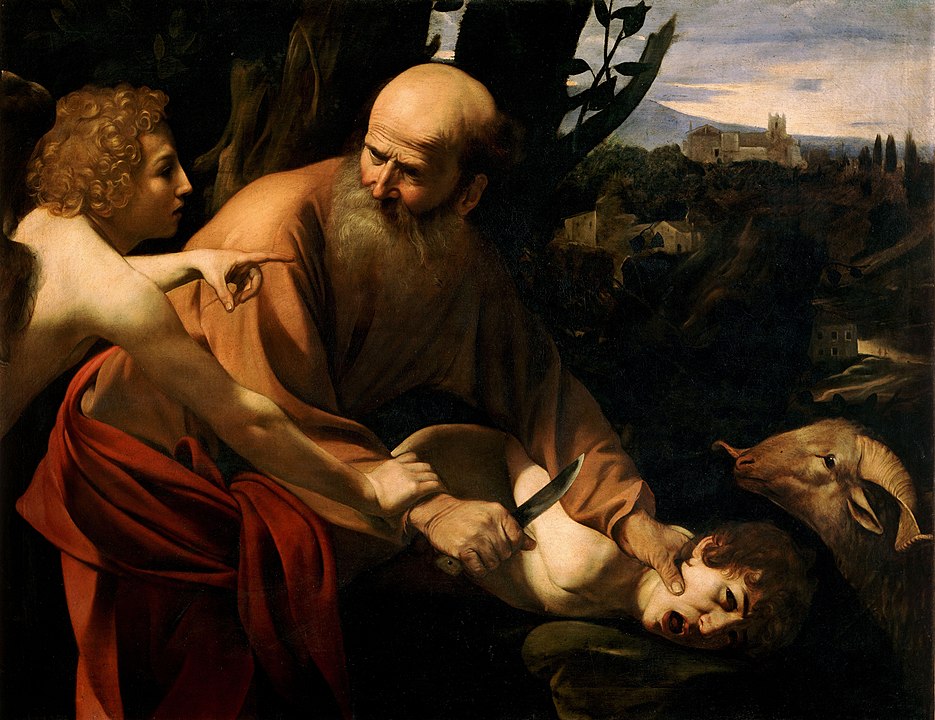
You eavesdropped when God told Father Abraham

To sacrifice Isaac, belov’d child of His promise.

Journeyed with that father, that son, the knife,

The binding rope, the fuel. Until with great relief  . . .

You all caught sight of the ram. Then you pondered

Whether Isaac ever got over his near immolation

By his own father’s hand. And why Abraham

Set his face like flint to do that monstrous deed.

Suspension of morality? Obedience über alles? I think not.

Did you forget or overlook what St. Paul told us?

Abraham walked with Him so long and knew Him so well.

He reasoned God could raise Isaac from the dead.

And why didn’t you consider this either, how later,

Much later after Abraham’s multitudinous offspring

Were long settled in the promised land, astoundingly

God Himself enabled what He asked Abraham to do?

Roseanne T. Sullivan is from the Boston area and currently lives in a Victorian in San Jose, California. Besides writing poetry, Sullivan writes memoir pieces, essays, and articles about sacred music, liturgy, art, and whatever else captures her Catholic imagination. This poem, “Kierkegaard’s Enormous Paradox,” has been selected for publication in Homage to Soren Kierkegaard, an anthology to be published by Wiseblood Books.

“Even reason can bring sorrow in its wake” The Banshees of Inisherin’s Luminous Tragedy

I know of a woman whose family banshee emitted blood-chilling shrieks from the lonely depths of the Irish countryside. She abruptly changed her travel plans, only to find out later there was a fatal pile up on the road she had intended to take.

Inisherin, Martin McDonagh’s fictional island, is traditional banshee territory. Yeats and Lady Gregory would have loved it.  The warnings in this tightly written film, though, mostly go unheeded.

Sheila Fitton’s old Mrs McCormick is the representative banshee. Wrapped in her hooded burlap cloak, her pale-faced appearances subtly suggest escalations of the grisly plot. You hardly notice her but she’s there all right. She’ll be smoking her clay pipe outside the general store, a mere meditative observer, or she’ll be trailing down the dusty road – watching. By the time she pops up in the dusk with her emphatic prophesy the film’s chief antagonists have put themselves beyond listening and listening seems to me the crux of this story.

Inisherin sits in dreamy isolation across the water from the west coast of Ireland. It is 1923 and on the mainland the Civil War is in full swing. The film can be viewed as a meditation on the stomach churning folly of that historic violence where neighbor murdered neighbor. Brendan Gleeson’s Colm, a fiddler, insists to his drinking buddy Colin Farrell’s Padraig, that they must stop meeting for their long established ritual pint at the pub. Colm needs silence to hear the music in his head, a tune he must write before he dies. Incredulous Padraig asks why he refuses to meet. ‘Because you’re boring,’ Colm replies, adding his draconian edict that Colm must never talk to him again at all.

Most writers and artists of a contemplative disposition can get that. The phone rings, the neighbour drops in, the needy relative demands an ear and the Trappist vocation becomes alluring. Music, prayer and poetry are born out of listening to the silence. But what use is the silence if you can’t hear the sound of someone’s breaking heart? Ridiculous a character though Padraig may be, I heard it and it made me cry.

Colm’s rather so-so jig finally emerges but not before Padraig has disobeyed the gagging order in awful, frantic increments and Colm has made good what initially seems a bizarre threat: to cut the fingers off of his fiddling hand if the prattle doesn’t stop. He has destroyed the very point of his longed for silence – a silence he is, I suspect, incapable of hearing. It is one of the film’s dreadful ironies. There’s too much noise in his own head, perhaps the noise of artistic conceit. His tune isn’t on the Mozart level he would like to think it, and it’s unlikely to survive him except down at the pub.

McDonagh’s brilliance as Inisherin’s writer/director and the stunning cast ensure that here is finally a film with enough meat in it to chew: His savage wit sheds a bleak light on something far more dark and painful.

Mrs McCormick knows, and the Church knows too, that whatever it is lies slightly beyond our ken and we fail to listen for it at our peril. Like banshees with their ancient wisdom, the faith is subtly signaled at every turn. An enormous statue of Our Lady cloaked in blue and white stands at a fork in the main road, the better route not chosen by either Padraig or Colm. The whole island turns out for Sunday Mass, the Latin rubric piously recited but the mystery of goodness it represents goes largely unheeded.  

Gary Lydon’s village policeman stands tall at Mass, a holy intermission in the ritual abuse of his own son.  Dominic, the film’s most touching character is played by Barry Keoghan who richly deserves his predicted Oscar. The boy’s brain is damaged, one suspects, by his father’s blows to the head and sexual abuse lurks as a ghastly subtext. There is pity and terror enough for Sophocles in Inisherin. McDonagh honors that but with the modern gloss of wry, dry absurdity.

The Church, in turn, provides a weary priest in David Pearse. He tries to talk sense into Padraig.  who cannot see sin in his cruel rejection of Colm nor in his self-mutilation. ‘How’s the despair?’ the priest asks in recognition of Padraig’s complex needs. And even though there is humor in the confessional exchanges, it’s a penetrating question neither answered nor addressed. The film opens with a rainbow on the water, the sunset illuminating roofs topped with crosses. The signs are all there but who sees them?

There is, however, someone who does listen: Kerry Condon’s Siobhan, the film’s raisonneur. And it needs one. As gormless Padraig’s sister, she has sense. When she isn’t mothering him and keeping their tiny house in order, she pores over books, an exotic pastime in Inisherin. ‘What are books?’ Colm asks her scornfully, comparing them to his music – ceilidh music which he thinks incomparable. ‘Why do you read sad books?’ her brother asks interrupting her perusal of Dostoyevsky. Siobhan actually thinks and acts upon her thought. As the feud between the two men heats up, she tries to make peace, but in vain.

She does seem to have read the Gospels because she is the only one who shows a modicum of self-sacrificial kindness. She invites Mrs McCormick in for tea, not qua banshee but as an elderly neighbour who might need a chat. Padraig shudders away from a mere smelly old person and Colm rudely rejects her succinct and timely intervention. As the brothers Grimm would have it, ignoring a crone usually has dire consequences; giving her an ear brings rewards. Whereas the two combatants finally destroy nearly everything of importance to them both, Siobhan manages to escape and not without banshee assistance.

There are so many levels of irony in this film that it is impossible to unravel them but one of the saddest is the suggestion – to me at any rate – that even reason can bring sorrow in its wake. Having given it her all to solve the insoluble imbroglio, Siobhan leaves Inisherin to be a librarian on the mainland. Before she goes, a mist-enshrouded Mrs McCormick summons her  across the water just as Siobhan encounters poor Dominic on the opposite shore. In a desperate sort of adolescent lust, which in the past she’s had to stop getting out of hand, he declares his love for her.  The poignance of this exchange on both sides is almost unbearable. She is very gentle, telling him it’s impossible. And it is. Of course it is. But there are tragic consequences.

Her heart is heavy as she goes. In a marvellous touch, the sail on the boat she takes is black. Her helpless brother waves frantically from the cliff. Alone in their little house now he lets his cow and pony wander freely in, his affinity with them stronger than with his more evolved sister. The final exchange between Padraig and Colm has, in fact, to do with animals. Colm has thrown his severed fingers at Padraig’s house where his pet miniature donkey eats one and chokes to death. Padraig has set Colm’s house on fire but has saved his dog. Meeting after this auto de fe, the only way they can communicate is through the donkey and the dog.

McDonagh has provided us with ancient Irish presence, the Church’s presence and the presence of sweet reason. None of them have worked in Inisherin but the deepest irony of all is he doesn’t suggest that they don’t. He suggests to me, rather, that they do because if we refuse or fail to listen to what they say or imply, then we lose what makes us human. Mother Nature claws us back.

Anne Redmon is the author of seven novels (Emily Stone; Music and Silence; Second Sight; The Genius of the Sea; The Judgement of Solomon; The Head of Dionysus; In Denial), an NUJ journalism course for prisoners and a Fellow of the Royal Society of Literature. She is married to theatre critic Benedict Nightingale and they live in London.

“Can we break out of this prison of self?” The CAT interview with Phil Klay

Phil Klay is a novelist and a Marine Corps veteran. His short story collection Redeployment won numerous important prizes: the 2014 National Book Award for Fiction, the National Book Critics’ Circle John Leonard Prize for best debut work in any genre, and one of the 10 Best Books of 2014 by The New York Times. His novel Missionaries was named to the Wall Street Journal’s best 10 books of 2020 list. His writing has appeared in The New York Times, The Washington Post, The Wall Street Journal, The Atlantic, The New Yorker, and the Brookings Institution’s Brookings Essay series. He currently teaches fiction at Fairfield University. His latest work, the essay collection Uncertain Ground was released in May of 2022 with Penguin Press.

Catholic Arts Today’s contributing editor, Sarah Cortez, interviewed Klay about his vision as an artist and as a Catholic artist in Dallas during the 2022 Catholic Imagination Conference.

Sarah Cortez: In the story “Prayer in the Furnace” a line written by an older priest to a younger priest, an Army chaplain, caught my attention. It says: “Sin is a lonely thing.” I wondered if this is the appropriate lens through which to read all the stories in Redeployment, through the lens of the spiritual detachments that your characters endure: meaningful sex, memories of home, security of training, security of location, faith in God, faith in fellow humans. Are you consciously stripping away a man’s spiritual struts?

Phil Klay: It’s not that all these things must fail. Some props are more false than others. Sex with a prostitute is not going to do it in terms of connection or meaning. But the isolation, the alienation people experience was important to me. A central drama of the book is that the characters are trying to make contact. Are we isolated atomized creatures only experiencing things that are only ours? Is there a way to break out of this prison of self?  Are there points of contact?

It is important that the old priest (though he has never been to war) is not impressed with the horrors of war; not because war is not horrific but because horrible things are what humans often do: This is sin and its consequences. It is not fundamentally different than what he’s dealt with back at home, maybe more extreme, but the question remains the same: Can we escape from the prison of the self? Can contact can be made?

So in the longer story “Psychological Operations,” there are intertwined narratives of a character telling stories to a woman that he’s attracted to and a story of his relationship with his father along with multiple stories about insurgents. I did that not because I was interested in playing a metaphysical game of nesting Russian-doll narratives, but because of the way that language is being used in each of those iterations of the story while the character moves closer and closer to a space of genuine vulnerability.

Sarah Cortez:  One thing I enjoyed in your stories was the male humor: the visceral roughness and crudity. The fact that the characters are often facing death or dealing with its aftermath seems to ratchet up the humor?

Phil Klay: Rough humor is one way of bonding, a way of bluntly acknowledging a difference, then agreeing to laugh about it.  On the other hand, humor can also be used as a way to make distinctions and create barriers. Sexist humor often functions like that in male groups: You tell the joke that is inherently demeaning in front of the one woman who is present. That woman is then put in a bind: Either she laughs loudly and accepts the underlying premise of the joke, which is demeaning to women. Or she pushes back against it, in which case, she’s not a team player.

You can also see humor as positive. The amount of racial humor that went around among a very diverse Marine population was, and is, enormous. But humor was also a way of bluntly acknowledging differences and then making a conscious decision, like “we’re going to laugh about this rather than make an issue of it.”  I don’t want to overly idealize it, because it’s not like there wasn’t a double-edged sword to it, but humor could be a method for dealing with this distance and difference that results in bonding. If somebody says something that sort of bothers you or offends you, turning it into a joke is one way of acknowledging it without insisting on it being your way. The humor then is another way of saying, “Let’s just get past these things, together.”

Sarah Cortez: One of the moments that hit me the hardest in Redeployment was in “Bodies” when the young soldier at home on leave lies down on top of the covers of his ex-girlfriend’s bed with her. He knows she’s a pacifist and no longer loves him. When he held her hands a few moments earlier, her only response was to say, “I didn’t shave my legs today.” The way that she reacts is so far from what he needs.

Phil Klay:  But it’s also related to what he needs. It’s that hairline moment. It’s Frank O’Hara’s line: “I want to be at least as alive as the vulgar.” It’s not supposed to be where you stop. But it is being alive.

There’s something about sex for a lot of these characters who want connection. Sex often feels to people like it is the epitome of intimacy. That’s why sex can also be the most alienating thing, as it is in some of the stories, because the thing that is supposed to be most intimate is actually the moment when you feel most alone.

At a visceral level, the opaqueness of the other body in front of you makes the failure that much greater. And yet the characters come back to sex because it does have that aura that it will be a portal to connection. When it’s working, sex is about vulnerability, it’s about connection and intimacy. It’s about love. Sex can be about family and community, and so it can be about building a family, making sexual intimacy not just a moment of connection, but about your future, and your past as well. Sex is this thing, and, of course, sex is often this kind of substitute for experience, right? It’s often a substitute for God. But there’s a reason for that, right? Sex is sort of like a key to the self, a key to understanding. What matters most about sex is that it’s not like other human acts.

Sarah Cortez: You’ve said you consider yourself a Catholic writer. Tell us more about this.

Phil Klay:  Readers are free to take what they can from my work; if somebody who’s not interested in the religious themes isn’t necessarily missing everything about the book, they’re just focusing on something different. There are reviews of my novel Missionaries that were all about it being Catholic, and then there were reviews that were all about American military policy.  You’d almost think there were two different books, and to me that is fine. In some ways, I like that, I like the readers coming with different things that they’re interested in and taking different things away.

In fiction, it’s not like there’s a correct answer that everybody is supposed to come to. That’s not the point. Fiction is something that you come with your own world view and understanding, then you enter into this other world that has been created for you, and then you make something out of it. You have a creative response to it, so not everybody’s supposed to have the same response. Hopefully, a writer is able to hit different people at different levels.

But I do want people to be aware that the Catholicism is important to me, and not just because a priest shows up in the book, which is the most obvious thing. When you read a novel like Andre Dubus’ The Lieutenant, (which is being re-issued and is a wonderful novel), you can read it without any idea that he’s a Catholic author, or that religion is extremely important to him because there’s not a whisper of it in the book. It’s a military novel full of ritual and purpose and an institution that provides those things within a collective setting—and it’s about a character who is trying to find himself and his identity and a source of meaning in life through that purely secular institution. If you understand more of Dubus’ worldview and what matters to him, you understand that he’s writing about a world that his interest in is deeply related to his faith. He’s also showing skepticism about the depth and the extent to which a purely secular world can satisfy someone in those regards. It’s also deeply related to his faith, and so it adds a different layer and a different way of reading the book, and a different way of understanding what matters to the author. So, yes, of course, I want be known as that kind of author; I want to write in that way.

Sarah Cortez: You’ve said that stories that engage with the world and engage with the faith can be tools for the faithful to use. Could you tell us how you might see this happening?

Phil Klay: I wouldn’t still be a Catholic except for Flannery O’Connor’s “Parker’s Back.” In this story you find characters really grappling with the difficulties that people encounter. What drew me back to the faith was not a set of intellectual propositions, but rather more of a sense that a world view that is informed by Catholic sensibility is richer and truer to the beauty of reality and to real evil. The Catholic sensibility is attuned to the characters’ struggles.  You can have a character that is no longer Catholic that is struggling with the same crises.

Stories are deeply important to our faith. What we have are traditions, rituals, communal practices…and stories, stories. The Bible is a cacophony of stories that must be appreciated through literature. The stories about the saints. We are story-telling animals. For each age we must find stories that grapple with the world as we find it.

Sarah Cortez: Why do you teach creative writing?

Phil Klay: I like it. What’s not to like when you take your favorite thing in the world, and you share with students who are trying to express things that are important to them now? Storytelling is the best way for us to express that which is most vital to us. You can become utterly vulnerable on the page in fiction in a way that you can’t in any other form—and that is a glorious thing. It’s a thing that keeps us human.

Sarah Cortez is president and founder of Catholic Literary Arts, www.catholicliteraryarts.org. A Houston writer and editor with fourteen award-winning books to her credit, she is a fellow of the Dallas Institute of Humanities and Culture, a Scanlan fellow at the University of St. Thomas, and a former fellow of the Virginia Center for the Creative Arts. www.poetacortez.com

In Memory of the North American Martyrs 

               I
Twelve years before his death, Père Jean Brébeuf
Wrote out instructions to his fellow priests
And missionaries for their life among
   The Huron people:

Have true affection for them, first, he said,
For they, as you, are ransomed by the blood
Of Christ; accept without complaint their cornmeal
     However tasteless;

Keep in your pockets beads, jambettes, and fishhooks
For barter with the other tribes you’ll meet;
And, during portage, carry what you can,
     If just a kettle;

And yet, the best equipment you can bear
Is silence. Seat yourself in the canoe,
And speak no word, but churn your oar in silence
     As they will do.

How else address the great sky’s opened vault
Above the river gliding its swift current?
How else to greet the banks obscure with shadows
     Of fir and spruce?

How else perceive the plies of ice on ice
Extending brightness on dark water? How
Else to receive the snow whose soundless fall
     Will transform all?

There is a silence to that wilderness
That needs no word of ours; an emptiness
That does not ask for gift of tongue or lip
     But our whole lives,

And waits with frigid clarity upon
The naked boughs, much like the Saturday
Between the hour of Christ’s death and that
     In which he rose.

But, Hurons have as well another reason
For quiet, as their eyes survey the shoreline
For prints in mud, their ears strain for the sounds
     Of cracking branches.

They know what force could lie around each bend.
They feel the forest as it holds its breath
Before the rage of musket ball, the cry
     Of bow and axe.


               II
And so, the brethren listened, Jogue, Goupil,
Daniel and L’Alemont; they took their posts
In birch canoes with feet bare, cassocks tucked,
   And prayers turned inward.

They waited for the hour to break the silence
If only with their halting Huron speech,
To tell these people of the woods there was
   A God who loved them.

They knew before their craft slipped from the shore,
Their lives would pass away in that great silence.
That some, invited to a feast, would have
   Their skulls split wide.

That, captured, Jogue would feel his nails pulled out,
His fingers chewed to stubs by Iroquois teeth;
That those who beat and stripped him would be those
   He’d vowed to love.

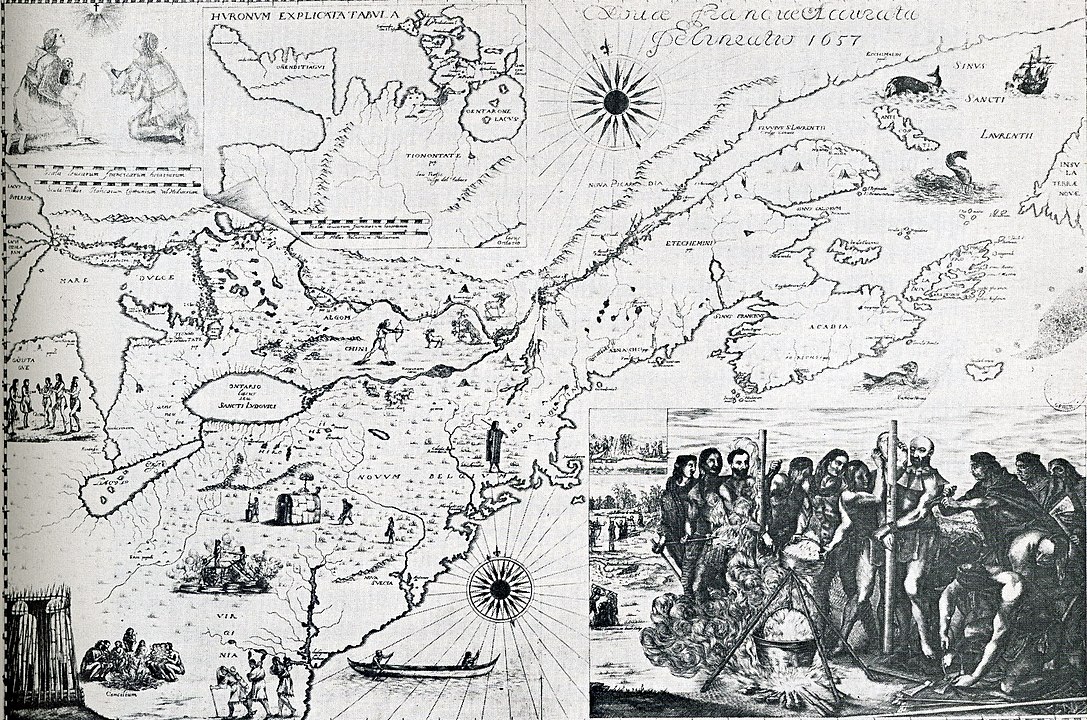
And that Brébeuf would feel the Iroquois cudgel
Upon his head, their lashes on his back,
A traitorous Huron raise a boiling kettle
   To baptize him.

As he leaned heavy on the post that held him,
And watched the flames consume the mission church,
He never ceased to fill the wilderness
   With praise to God.

And even as they took his tongue and lips,
And cooked his skin before his eyes, he called
Out to the ones who tortured him the glory
   Of their salvation.


               III
For my part, when I think of Jogue’s torn hands,
Brébeuf kept wakeful through his mutilation,
And praising—praising—though even some he baptized
   Now ate his flesh,

I long to feel the blaze of righteous gunfire,
To hear a sudden clamor of French arms
Descend to save those priests and punish those who
   Took such cruel pleasures.

I want the wilderness itself to speak,
The rivers to rise up and swallow all,
The trees to bend and break their bonds, and sunlight
   To crown their heads.

But that’s not what Brébeuf or Jogue desired,
Who came to walk along the Huron paths
And dwell within their villages, and join
   Them in their suffering.

And though the Iroquois soon scattered all,
The priests remained to carry their own weight
To speak of Christ and love them as Christ did
   These brethren.

For, Jogue heard, even in his silent heart,
You go not to return: the wilderness
An altar where he made himself, to God,
   Burnt offering. 

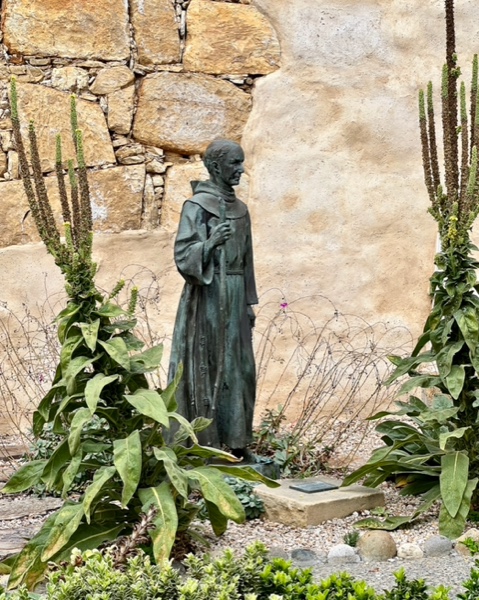
Defending St. Junípero Serra, with Holy Water, the Rosary—and the Arts

St. Junipero Serra, a holy man dedicated to the earthly and heavenly well being of Native Americans has been denounced as a racist, a genocidal monster. One CBS news report even libeled the saint as a slave owner.

On Juneteenth 2020, haters brought their ire against the founding father of California to San Francisco. Hundreds of protesters, many of them dressed in black, toppled and defaced statues in Golden Gate Park. Many figures whose statues were attacked had no apparent connection to racism or slavery. For example, the mob graffitied a monument to Cervantes and his characters, Don Quixote and Sancho Panza.

Prominent among the statues attacked that day was St. Junípero Serra’s. His statue was overturned. Both the statue and its pedestal were defaced with red spray paint. “Stolen Land” was scrawled on the pedestal.

Dismayed by the vandalism, I was happy to see Archbishop Cordileone take an unusual and gutsy step. Not stopping with issuing an eloquent statement of protest—which would likely be ignored even in the unlikely event it was read by Serra’s detractors, the archbishop also used powerful spiritual weapons at his disposal.

Park workers had cleaned the graffiti from the statue and taken it away to storage when the archbishop went with about two hundred of the faithful to the site of the empty pedestal. On that drizzly day, wearing an amaranth purple skull cap, and the amaranth cassock proper to his role as a bishop under a lace-trimmed alb, with a deep purple stole around his shoulders, Archbishop Cordileone blessed the area with holy water and performed a minor exorcism. He then led a rosary of reparation.

In a clip now posted at the archdiocesan website, the archbishop said, “An act of sacrilege occurred here that is an act of the evil one. Evil has made itself present here.”

Archbishop Cordileone went on to say he grew up in San Diego, near the first mission Serra founded in Alta California when it was under Spanish rule, the area which now makes up the state of California. So, he said, he has a heartfelt connection to the saint. “I’ve been feeling great distress and sort of a deep wound in my soul when I see these horrendous acts of blasphemy and disparaging of the memory of Serra —who was such a hero, such a great defender of the indigenous people of this land.”

Remarkably, the archbishop has also defended St. Junípero Serra in many other unique and creative ways—using the arts.

Through the Benedict XVI Institute for Sacred Music and Divine Worship that he founded, with the savvy assistance of Maggie Gallagher, the institute’s Executive Director, Archbishop Cordileone commissioned a new Mass setting, a painting, and a poem in honor of the saint. During a Zoom event, “The Making of Missa Sancti Juniperi Serra,” Gallagher said that following the Renaissance model of commissioning great works of art from within the heart of the Church, all of these works were funded by a generous patron, Mr. Terry Castor of San Diego, in honor of his deceased wife, Barbara. Anyone who celebrates the Missa Santi Juniperi Serra is asked to remember Barbara Castor in prayer.

Missa Sancti Juniperi Serra

During the ZOOM event on April 30, 2022, Archbishop Cordileone spoke about how the idea to commission a Mass in honor of St. Junípero Serra was formed.

The archdiocese would be hosting a Sacra Liturgia Conference at the end of June, an international event which, as the archbishop said, “brings together great minds and hearts of people who are working to promote and renew sacred liturgy in the Church and regain the beauty that the liturgy deserves. I thought that since the last day of the conference is July 1, the feast day of St. Junípero Serra, a perfect way to bring this to a conclusion would be to celebrate a Solemn High Pontifical Mass —in the extraordinary form because that’s the form of the Mass that St. Junípero Serra himself celebrated.”

The Mass would be celebrated in Mission Dolores Basilica, which was built in 1876 adjacent to the original Church of Mission San Francisco de Asis to accommodate larger congregations. Mission San Francisco was founded by Padre Francisco Palóu under the direction of St. Junípero Serra in 1776, and the adobe mission church built in 1791 is the oldest surviving structure in the city. (EWTN recorded the Mass, and you can view it at Cathedrals Across America—Solemn Mass for the Feast of St. Junípero Serra.)

Archbishop Cordileone continued, “I asked Frank to compose a Mass in honor of St. Junípero Serra that would be reflective of the mission era here in California.” This is the third Mass setting composed at the archbishop’s request by Frank La Rocca (franklarocca.com) , who is the Benedict XVI Institute’s composer in residence.

La Rocca then spoke about how he went about making his composition evoke the experience of what a Mass from that time would have been, “One important way is through the choice of the instruments accompanying the singers. It would be a small ensemble just like the ones they had in the missions of maybe a string quartet, a couple of flutes, perhaps a small portable organ.”

At the premiere, La Rocca’s music was performed on baroque-style string instruments and flutes to contribute to the authenticity, but modern instruments will be able to perform the music as well.

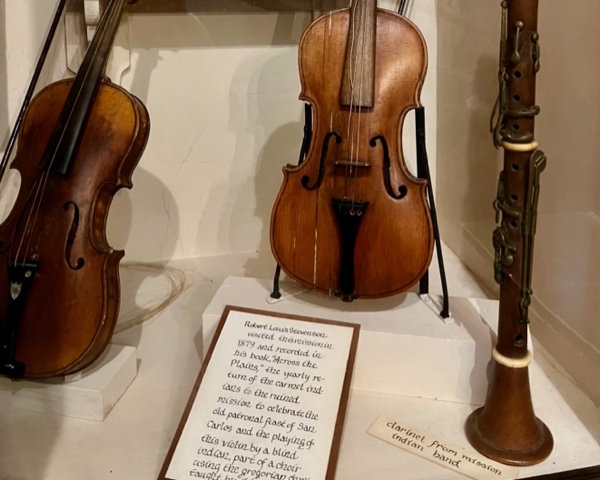
Musical instruments played to accompany Masses with Gregorian chants by the Indians in the Mission bands.

In addition, Frank La Rocca said he wove throughout his Mass setting the tune of one of St. Junípero Serra’s favorite hymns, “Salve Virgen Pura,”—”Hail Pure Virgin.”

“In addition to the hymn I wanted to make allusions to Gregorian chants from Missa Orbis Factor, which certainly would have been one of the most commonly heard Mass ordinaries in those days.”

La Rocca used the Salve as a Prelude, and worked it in as a thematic element of the music for the Mass, using the melody and derivatives of it in the music accompanying the ordinary the texts of the Mass. He wrote me later in an email that this technique is known as a “Parody”—a term that has nothing to do with mockery.

St. Junípero Serra and the American Saints Painting

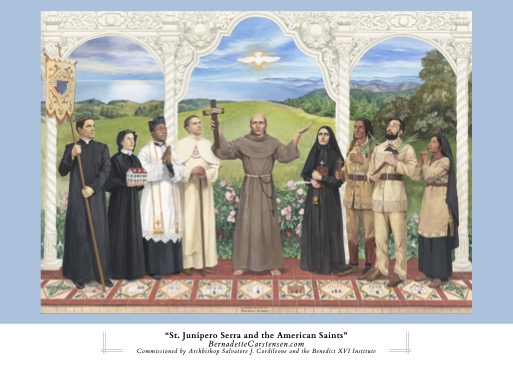
Figurative artist, Bernadette Carstensen (bernadettecarstensen.com) is Benedict XVI Institute’s painter in residence. During the Zoom event, she unveiled her commissioned painting “St. Junípero Serra and the American Saints.”

As Carstensen pointed out, the saints are standing in the painting against a classic California landscape on Mount Tamalpais with roses and columbine that grow there. Columbine also represents the Holy Spirit. The roses look to be Roses of Castile, of the kind St. Juan Diego found growing in winter and gathered into his tilma after the apparition of Our Lady of Guadalupe in Mexico.

The figure of St. Junípero Serra in the middle stands with arms upraised similar to the pose of his statue that was toppled in Golden Gate Park. From left to right on either side of Serra are Blessed Michael McGiveny; St. Elizabeth Ann Seton; Servant of God Father Augustus Tolton; Saint Damian of Molokai; Saint Mother Cabrini; a Native American representing the Huron Christian martyrs; St. René Goupil, representing the Jesuit martyrs, and St. Kateri Tekakwitha. At the saints’ feet are Spanish tiles depicting the nine missions founded by St. Serra. Below is a dedication to Barbara Castor.

The Liturgy of the Hours of Saint Junípero Serra

Benedict XVI Institute poet-in-residence James Matthew Wilson spoke about and read his poem, “The Liturgy of the Hours of Saint Junípero Serra.”

“I wanted to write the poem as a prayer . . . so we could read the poem and pray the poem.” Wilson said he used the rhyme royal scheme to honor St. Serra’s long and painful walk along El Camino Real—which in English means the royal road. Each stanza of seven lines, in iambic pentameter with a rhyme scheme of ABABBCC is about a different object from a different stage of Fr. Serra’s life starting from his youth in Mallorca, intended for us to ponder the object and think about what it can teach us about his spiritual life.

Eloquence beyond Words

Using the eloquence of the beauty of music and art, poetry, and architecture to defeat lies and ugliness is a profound idea. Research has shown that repeating the lies of opponents even when we have strong arguments against the lies may paradoxically strengthen belief in the lie among those who have believed it already. Besides, some people will not have heard the lie before, and it doesn’t help to spread it even further.

The arts are so convincing because they captivate people and grab people’s emotions, and even when they don’t completely bypass the intellect, they enrich the understanding.

A More Truthful Image

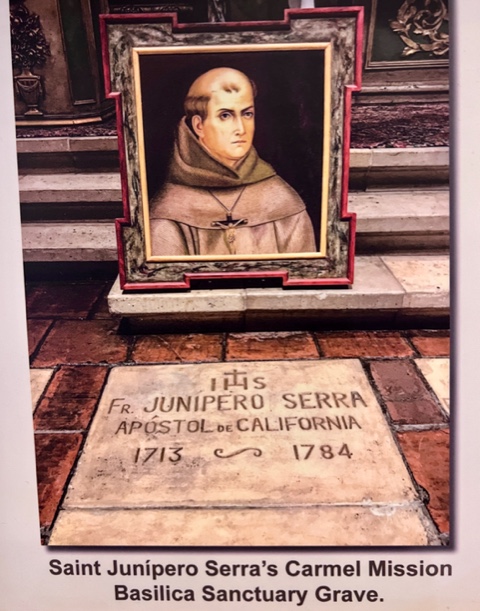
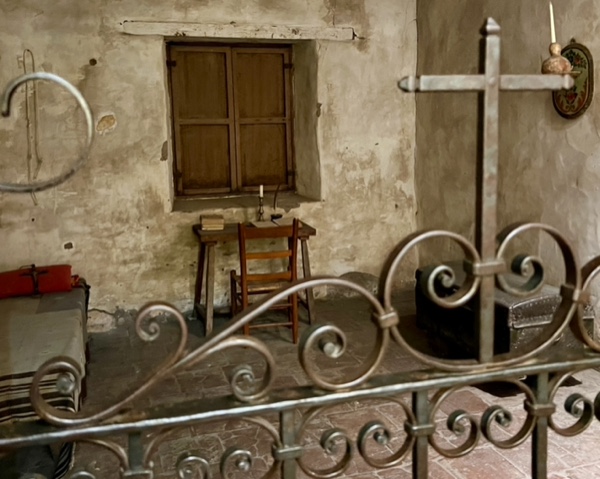
Recently I came across this review at website of the restored Carmel Mission where St. Junípero died and was buried, which portrays a more truthful image of the saint, “Walking through the primitive furnishings and reviewing the very basic library housed in the place, with tools and instruments available a couple of centuries ago illustrates the very primitive conditions in which the inhabitants lived and worked and the sacrifices made by the man that brought European culture and civilization to this part of America.”

St. Junipero Serra’s ascetic cell at Mission Carmel, where he died and was buried.

This article is adapted from an essay that first appeared in the Fall 2022 Edition of Latin Mass Magazine. Republished with a few modifications, with permission.

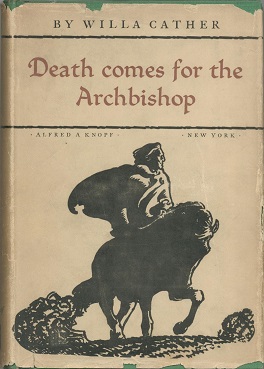
Willa Cather and St. John Paul II: The Missionary Way

In spite of great differences, novelist Willa Cather and St. John Paul II show uncanny agreement as to the nature and validity of the Roman Catholic Church’s particular way of spreading the Faith to non-believers. Cather’s most successful novel, Death Comes for the Archbishop, reveals a vision of saintliness later codified in what JP2’s encyclical Redemptoris Missio calls “missionary spirituality.”

Cather was Episcopalian, not Catholic; Cather’s early success was in journalism, while St. Pope John Paul II excelled as a playwright, poet, and actor before choosing the priesthood; Cather was American, he was Polish; Cather’s birth in 1873 placed her in a century prior to both World Wars, and before John Paul II’s birth in 1920.  However, the missionary spirituality which Cather demonstrated through her fictional skill in Death Comes for the Archbishop and which John Paul II articulated in Redemptoris Missio are the same.

Willa Cather’s novel, Death Comes for the Archbishop, originally published in 1927, was her ninth novel and one of her most enduring titles. In it, she presents the story of two French missionary priests, Bishop Latour and Father Vaillant, in the primitive and often dangerous nineteenth-century American southwest. They have made the difficult decision to travel across an ocean to bring Jesus Christ and His Church to unbelievers.  The two friends encounter a range of desperate spiritual conditions in the people living in cultures acclimated to sin and violence.  The list is long: apostate priests, murderers, pagan beliefs and rites, a “Catholic” culture that has largely withered and died for complicated reasons or has simply never been introduced.

Cather’s later comments reveal that she chose to write this novel with an emphasis on the eternal rather than the temporal. In an open letter to Commonweal about Archbishop, Cather wrote: “I had all my life wanted to do something in the style of legend, which is absolutely the reverse of dramatic treatment.”  She continues by saying that since she viewed the Purvis de Chavannes frescoes of St. Geneviève as a schoolgirl she had wanted to write a piece “without accent”—a piece that would touch upon an incident, then pass on to others.  Such writing would only be successful and integrated if there was a powerful narrative grander in scope that the quotidian urgencies of plot.  Cather found her powerful narrative in the battle of Good against Evil.

Cather’s choice of missionary Catholic priests for the main characters of this novel is startling when viewed again the backdrop of her lived experience as a non-Catholic.  Yet she had been visiting the Southwestern rural countryside and Indian villages for at least 15 years before writing the novel.  Her typically terse conclusion was: “The story of the Catholic Church in that country was the most interesting of all its stories.”  Cather chose not to write the dramatic story of missionary priests martyred in North America—a long list containing some deaths that were well-documented in journals and letters, such as the torture and death of 35 year-old Fray Luis Jayme, one of St. Junipero Serra’s fellow Franciscan priests, who was stripped, shot with 18 arrows, then beat about the head and face with stones and cudgels until he died. Instead, Cather wrote the daily stories comprising the decades of missionary service in a way that allows the reader to settle into the slow, plodding road to saintliness where the eternal significance of the characters’ actions and choices is what matters.

A close reading of St. John Paul II’s encyclical Redemptoris Misso, published on December 7, 1990, elevates Cather’s novel from a brilliant study in saintliness to a thorough and luminous study in missionary spirituality. With firm clarity, the document begins its chapter on “Missionary Spirituality” by stating: “Missionary activity demands a specific spirituality.” Next, the four main components of missionary spirituality are listed: a life of complete docility to the Spirit, intimate communion with Christ, apostolic charity, and the call to holiness.

The foundational characteristic of mission spirituality is defined as “. . . being molded from within by the Spirit, so that we may become ever more like Christ.” Upon this basis, the missionary builds his or her life to enable the work of bringing the Gospel to non-believers. The essential characteristics which flow from the life of docility to the Spirit are the gifts of fortitude and discernment. From intimate communion with Christ comes the two characteristics of a person’s total self-emptying and the overcoming of attachment to people and things. Apostolic charity brings both a love of people and a love of the Church.  And, lastly, the call to holiness necessitates that a missionary be a contemplative in action as well as a person of the Beatitudes.

Cather’s novel gives numerous examples of the main characters displaying each of the four components of mission spirituality by letting the reader see Latour’s and Vaillant’s reactions to people and circumstances.  Since the call to holiness is such a distinguishing feature of the two men’s lives, let’s see how Cather conveys it.

In the first scene of the book, Bishop Latour wanders lost and thirsty in a parched land with almost no hope of finding water. Latour doesn’t fear death, but relies on his faith that the Holy Spirit is leading him.  The configuration of branches on a tree reminds Latour of the cross of Jesus Christ and without hesitation he falls to his knees to pray in meditation on Christ’s words from the cross: “I thirst.”

Cather allows the cruciform tree branches to bring allegorical significance and spiritual focus to Latour’s self-sacrifice and suffering.  Latour’s reaction of abiding faith in God establishes the reader’s expectation that Latour will find the spiritual in the temporal events he encounters throughout the book, and he does.  Even after the two later instances of spiritual doubt or dryness in the book, Latour returns to prayer and to God. In the aftermath of Latour’s close brush with death through dehydration and exposure, and in his miraculous discovery of water and food at a hidden oasis with good and humble people, we glimpse Vaillant’s own spirituality from his friend-since-childhood Latour’s perspective: “. . . his dear Joseph [Vaillant] must always have the miracle direct and very spectacular, not with Nature but against it. He would almost be able to tell the colour of the mantle Our Lady wore when She took the mare by the bridle back yonder among the junipers . . .”.  The conclusion of both priests that a miracle occurred is steadfast, but their individual reactions illustrate their very different personalities: Vaillant is impetuous and unassuming, Latour is reserved and careful, and quiet, if not slightly pedantic.

Cather builds upon the unique personalities of each man to illustrate the other components of mission spirituality. In showing Latour and Vaillant as possessing both fortitude and discernment, Cather reaches into her writer’s toolbox to draw lively scenes and personalities of people with whom the priests must interact.

For instance, Latour’s quiet sense of when and how to act, or not act is one of his most intriguing qualities. How does he know, when viewing the rebellious Fr. Martinez whose “mouth was the very assertion of violent, uncurbed passions and tyrannical self-will” that “the day of [Martinez’s] lawless personal power was almost over”? How indeed?  In a little over one year later, Martinez will formally resign his parish, and Latour will replace him with a Spanish priest that Latour recruited with the exact combination of skills and qualities to be accepted by the parish so they can be shepherded back to a correct understanding of the Faith. Fr. Vaillant possesses his own kind of discernment, which, due to his naturally impulsive personality often manifests in sharp bursts of friendship and goodwill.  Cather records numerous successes where Fr. Vaillant makes friends and fosters thriving parishes even in areas previously under the magnetic sway of a rebellious priest banished by Latour.

Both priests possess the particular strength of character defined as fortitude by the Catechism of the Catholic Church: “the moral virtue that ensures firmness in difficulties and constancy in the pursuit of the good.” Fortitude encompasses bravery but goes further with its emphasis on an interior moral compass defined by God.

It is easy to find examples of both priests’ bravery in uneasy and hostile circumstances throughout the saga of their decades in America.  But personal bravery alone cannot explain their calmness during all the threatening circumstances. Cather great literary triumph is to make the reader understand that there is a spiritual depth underpinning their preparation and bravery. They expect God’s will to unfold and are solid in their adherence to it. Their assured serenity in the face of danger and hardships reflects a commitment to accomplishing the moral good and their belief that God will use them for that end.

The total self-emptying in order to identify with Jesus Christ that is required by missionary spirituality refers to Phil. 2:5-9 where St. Paul refers to Christ’s self-emptying in order to effect both the Incarnation and man’s Redemption. Redemptoris Missio quotes the Second Vatican Ecumenical Council’s Ad Gentes which states: “the missionary is required to ‘renounce himself and everything up to this point he considered as his own, and to make himself everything to everyone.’” 

While examples of the simple normal pleasures the two men have had to give up are spread throughout the novel (French pears, lettuce, beautiful vestments, Gothic cathedrals, green vegetables in winter, lamb cooked rare, sheets or beds, the emotional consolations of family), there are other deeper sacrifices. 

Fr. Vaillant gives up his longing for a settled life of devotion to the Blessed Mother in a quiet monastery with no further travel to tax his frail physique; Fr. Latour, those intellectual pursuits where he experienced great success as a younger priest and their accompanying aesthetic rewards. Both men consciously choose to deny themselves what would best suit their natures in order to live out their missionary role under rough and unpredictable circumstances on a foreign continent. Neither of them grumbles nor questions the sacrifices. This patient endurance and embracing of hardship to save souls is testified to by North American missionaries, such as St. Junipero Serra writing after years of hardship upon finding out that supply ships were disastrously late in arriving to the bay of Monterey in 1772: “All the missionaries grieve—we all grieve—over the vexations, labours, and reverses we have to put up with. No one, however, desires to leave his mission.  The fact is, labours or no labours, there are several souls in heaven from Monterey, San Antonio, and San Diego.”

Missionary spirituality demands two types of self-renunciation which are themselves components of asceticism defined by the Church as “the disciplining of the will.” The first is self-renunciation against all temptation to “self-seeking, self-promotion and self-indulgence.” The second is asceticism related to the ministry to others, such as the inconveniences of missionary travel, disappointment, opposition, and the misunderstanding of co-workers.

All of the priests in Cather’s novel could be evaluated according to these standards, with some living up to these standards and some not.  But it is Vaillant and Latour whose tireless work to save souls is foregrounded. The extrovert Vaillant has single-minded, boundless energy and enthusiasm for each new assignment in spite of his broken body and numerous injuries and brushes with death. Latour’s “self-renunciation” related to his ministry is best seen in his miles of arduous horseback and mule-back travels to learn about the various types of people in his diocese so he can appoint priests who will be most effective in the widely different locations. More than once, Latour and Vaillant are observed to be working as hard as parish priests despite the fact that they are respectively, bishop and vicar.  These scenes in the novel remind the reader of the hard-working and apparently tireless St. Junipero Serra who routinely walked up to 35 miles/day with a painful, ulcerated leg to reach more souls who hadn’t heard the saving word of God.  This same zeal to minister to souls for their salvation is articulated in the writing of St. Serra about the reasons for establishing the Franciscan missions: “Above all, let those who are to come here as missionaries not imagine that they are coming for any other purpose but to endure hardships for the love of God and the salvation of souls.”

The ability for self-renunciation illustrated by these examples both in the novel and in historical letters and journals of actual North American missionaries is complemented and completed by a quality the encyclical calls “apostolic charity.”  The encyclical continues: “The missionary is urged on by ‘zeal for souls,’ a zeal inspired by Christ’s own charity, which takes the form of concern, tenderness, compassion, openness, availability and interest in peoples’ problems”. This apostolic charity is rooted in Christ and his love for both men and his Church. The encyclical continues with foregrounding the missionary’s necessary love for Christ’s Church.

Throughout the novel, Cather shows both priests responding to the needs of complete strangers with a complete disregard for their own comfort or safety. Without hesitation, Vaillant journeys through a storm and negotiates the dangers of washed-out roads and darkness to give Last Rites to Padre Lucero, an apostate priest who previously undermined Latour’s authority as bishop. Once he arrives at the deathbed location, Vaillant stays true to his “zeal for souls” by focusing himself, the dying man, and everyone else in the house on Padre Lucero’s salvation and the proper disposition of a dying man’s soul.

Religious novelists have often discussed the “face of God” problem, the difficulty of showing through the natural world the supernatural realities. The extraordinary gifts of Willa Cather have offered this alternative: a realistic and profound glimpse into the face of a saint.  At the novel’s conclusion, the reader is left with an appreciation of two men whose lives have been depleted totally by the hardships of their missionary work. Yet both men are presented as content despite the pain of old injuries and the deprivations of their existence in America. This is the peace of God which passeth all understanding.

These two priests have wholeheartedly fulfilled their role as missionaries, so beautifully drawn in Cather’s prose and summarized by another saint—St. John Paul II—in Redemptoris Missio.

Sarah Cortez is president and founder of Catholic Literary Arts, www.catholicliteraryarts.org. A freelance writer and editor with fourteen award-winning books, spanning poetry, fiction, essay, and spiritual memoir to her credit, she resides in Houston, TX. www.poetacortez.com

Subscribe to Our Emails