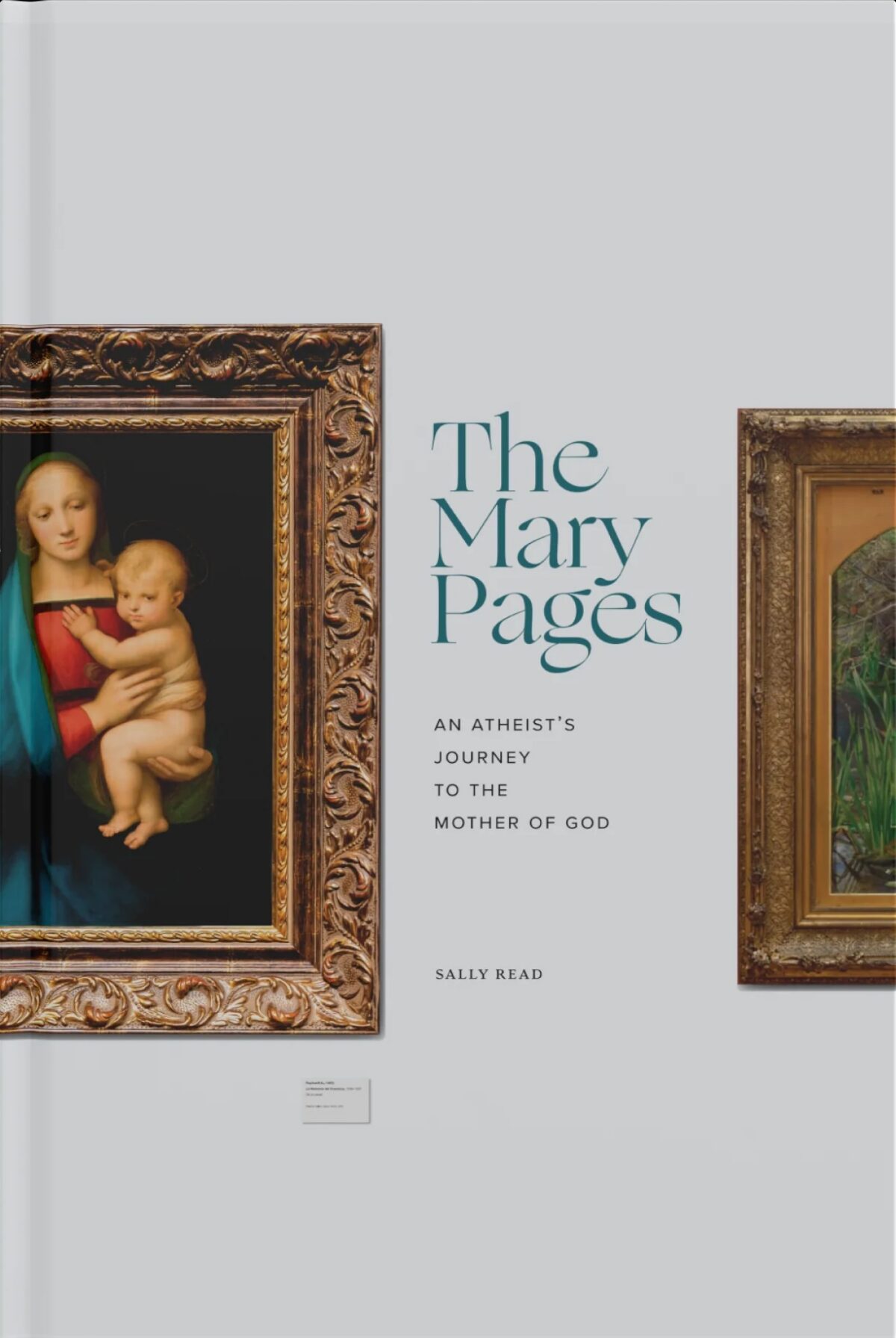
Review: The Mary Pages by Sally Read

Sally Read, born in East Anglia in 1971 and now living near Rome, was a secular poet before she was a Catholic poet. Determinedly secular, too, as she relates in her new memoir, The Mary Pages: An Atheist’s Journey to the Mother of God (Word on Fire). 

Raised by an atheist father who scorned all things religious, in a country that had stripped its churches bare of iconography (especially all that was Marian) centuries before, and imbibing to the full the defiant feminism that marks our current culture, Read unsurprisingly regarded the Mother of God, at least as the Catholic Church views her, with faint contempt. “How best to shut a woman up?” she once mused as she she contemplated Mary’s seeming irrelevance to contemporary women’s issues such as genital mutilation, date rape, and domestic violence. “Put her on a pedestal, and give her a crown.”

The Mary Pages is not a conversion story. Read has already told that story, of her nine-month journey in 2010 from cynical atheism to the Catholic Church, in a 2016 memoir, Night’s Bright Darkness. Nor is The Mary Pages a conventional autobiography; it seems purposely vague on detail. Instead, it is a story, meticulously and beautifully written, of how Mary insinuated herself into Read’s internal life so thoroughly, starting in childhood, that she would be inevitably led to Mary’s Son. The medium was art. Read’s grandmother had a copy of a Raphael Madonna hanging on a wall. The mother and baby mesmerized the unchurched little girl who scarcely knew who Mary was.

Later, Read went to nursing school in London, where she found herself haunting the National Gallery’s Renaissance rooms with their myriad images of Mary—and then hanging a print in her bedroom of Filippo Lippi’s radiant Madonna and Child With Two Angels. The story behind the painting overwhelmed her as much as the painting itself. The model for the Virgin had been a Dominican novice-nun, Lucrezia Buti, with whom Lippi, although a professed friar, had fallen in love. One day he kidnapped Lucrezia from a procession and seduced her. She eventually bore him two children, but even when released from his vows and given ecclesial permission to wed, he refused to marry her.

That resonated with Read, who herself was seeing a man, a doctor she calls Mischa (she has altered identifying information for most of those she writes about), who declined to commit himself to her because he already had a live-in partner, a woman physician at his hospital. Read’s relationship with Mischa was misery (“a kind of slavery,” she writes), but he did one thing for her: He encouraged her to keep writing the poetry she was already starting to write. He brought her books by women poets he thought would inspire her: Sylvia Plath, Sharon Olds. They did. If you have read Read’s poems (some are online), either pre-or post-conversion (where her subjects are nearly entirely Christological), you will find the powerful  rhythms, minutely focused examinations of the natural world and the human body, and the naked emotional engagement that mark the work of Plath and Olds. Read’s years in the secular literary world did not go to waste. 

She got up at 5:30 every morning to write furiously, then worked a shift at a psychiatric hospital tending the human dregs and outcasts no one else seemed to care about. She collected Marian art in her apartment—but at the same time she was composing a feminist poem that would portray the Virgin as a pregnant rape victim who had to invent the Annunciation as a cover story: “I could not tolerate a male God—and Mary, I suspected as much, was inextricable from him.” Read’s mental images of Mary were refracted into other wounded women: Lucrezia Buti; Elizabeth Siddal, the copper-haired model for many a pre-Raphaelite painting of Mary who killed herself like Sylvia Plath when her artist/poet husband, Dante Gabriel Rosetti, had an affair with another of his models; Princess Diana, then at the height of public pity for her and also made violently dead, in 1997. Read enrolled in a graduate writing program on the American “Plains” (the University of South Dakota, according to her Wikipedia biography), where her friends, like her, were women left stranded by men, sometimes with children to raise alone

She returned to London, and then, somewhere and somehow (remember, this is not an autobiography) she met the man who became her husband: Fabio, an Italian. They moved first to his native Sardinia, then to the Roman seaside suburb of Santa Marinella. All over Sardinia—in roadside shrines, bars, schools, grocery stores–were plaster and wooden statues of the Madonna, sometimes wearing a lace dress and blonde wig, like a doll. Read found them repulsive, and she chafed under the unwritten rules of traditional Mediterranean society, where respectable women did not go out at night alone, and her visiting female friends, bohemian free spirits who flirted and more with the local shepherds, drew the wrath of her in-laws, who deemed them loose women. In Santa Marinella a church housed La Madonnina, a small statue of Mary, a souvenir from Medjugorje, that was said to weep human blood from time to time. “This florid thing…only distanced Mary further from me,” Read writes. “The bloody face was like something from a horror movie.”

The turning point came—although it would be another four years formally—when she gave birth to her daughter, Celia Florence, in a Roman hospital. She had had trouble getting pregnant, and the labor was prolonged and excruciating (the baby’s head wasn’t positioned optimally). Alone in her hospital bed in her agony (husbands weren’t allowed bedside in Roman maternity wards), she realized that Mary had also been alone when Jesus was born, because as it is with all women in childbirth, “[n]o one, not even her husband, could possibly imagine what was happening to her.”

“Alone of all your sex,” -[the fifth-century Latin poet] Sedulius wrote, and the feminists seized on this as example of the Virgin’s difference, her exceptionality, her exceptional holiness, her exceptional loneliness—her special subordination to God and man….But what I will arrive at, in a shortening number of days, is Mary’s aloneness as the archetype of every woman’s aloneness: Mary as foundress, as defender, as mother-creator, as collider with the harsh, existing world. For in childbirth, there is no act of creation so similar to God’s as he pulled form out of nothing and watched the world spin.

The only thing that I could have wished for more of in this haunting and gorgeous book is the visual images of Mary that have followed Read since her childhood. There are some of them, to be sure: her grandmother’s Raphael, the Filippo Lippi, the striking 1922 statue of Our Lady of Walsingham, whose shrine in her native East Anglia Read visits as a pilgrim in the book’s final pages. I longed to see a photo of La Madonnina, for example. It is also unfortunate that Read’s oeuvre as a poet has been divided in two by her conversion, with each half perhaps rendered inaccessible to admirers of the other. Her first three books of verse, dating from the early 2000s, were published by Bloodaxe Press, a leading British secular publisher of poetry. Her most recent volume, Dawn of This Hunger (Angelico Press, 2021), as well as her memoirs and other prose works, come from Catholic presses, and it would be unfortunate if her secular readers assumed she was addressing her richly laden recent words solely to a Catholic literary ghetto. Sally Read is too fine a stylist and too penetrating an observer for readers of any religious sensibility or none to miss.

Pre-conversion poem:

Gestation

Post-conversion poem:

Anne: The Coming of the Immaculate

At times prayer is wordless, but it fills
the empty night as water fills a lake
with its own meaning. I pray to break
this body with a child, for my taut pelvis
to open and ache its tight basketwork
apart; to yield. Sometimes I sense God
in the darkness—like a heavy leaning
at the door—always with an inexplicable
tenderness in how he does not burst in.
Perhaps he would break me if he did,

so waits instead to pour into my own undoing—
so just when I would moan, It’s done!
that life did not go well, Perfection rests in me,
and I expand, like wood ticking in the sun.

The Mind of the Maker and the Art of Liturgy: A Poet’s Eye View

…the mind of the maker and the Mind of the Maker

are formed on the same pattern, and all their works are made in their own image.

—Dorothy Sayers, The Mind of the Maker

Hope always draws the soul from the beauty which is seen to what is beyond,

always kindles the desire for the hidden through what is constantly perceived.

—Gregory of Nyssa, The Life of Moses

PROLOGUE

           Asked to write on “liturgy and the artistic imagination,” I find myself rocking on a restless sea. So young in Orthodoxy that I am not even a toddler, I wonder what I can say about liturgy that will be worth a reader’s while; though I have no interest in adding to the liturgy I experience—itself already a work of participative art—I am interested in how liturgy and a maker’s imagination might dance together.

           Yet since many shiploads of words have been written about imagination, what cargo shall I add to these? More, what is meant by artistic imagination? How does it fit into the braid of the human, a winding together of nous—often defined as “the eye of the heart” or “eye of the soul”—sense perceptions, and reason? What happens when we marry liturgy and the urge to make?

1.

THE WISH FOR INFANT SIGHT

The flame of fire, the living spring

              Not long ago, I found myself at a Sunday parlor church deep in the Carolina mountains, sitting between my mother in her wheelchair—she having been felled from walking by a long bout with covid—and an elderly man named Jerry, who had introduced himself to me a few days before by saying that he was lost, and who had kissed me on the cheek when I walked him to his room. We were twelve in that parlor, with a rural Baptist preacher accompanied by his wife and two daughters in mightily spangled red-and-gold dresses. Around me sat the halt and lame, and I remembered the Centuries of Mediation by lovely-minded 17th-Century Anglican poet, priest, and philosoph Thomas Traherne, conveying in a great flow of words the enchantment and beauty of his infant sight, and his adoration of an Edenic realm radiant with signs of divine making:

The corn was orient and immortal wheat, which never should be reaped, nor was ever sown. I thought it had stood from everlasting to everlasting. The dust and stones of the street were as precious as gold: the gates were at first the end of the world. The green trees when I saw them first through one of the gates transported and ravished me, their sweetness and unusual beauty made my heart to leap, and almost mad with ecstasy, they were such strange and wonderful things: The Men! O what venerable and reverend creatures did the aged seem! Immortal Cherubims! And young men glittering and sparkling Angels, and maids strange seraphic pieces of life and beauty! Boys and girls tumbling in the street, and playing, were moving jewels. I knew not that they were born or should die; But all things abided eternally as they were in their proper places. Eternity was manifest in the Light of the Day, and something infinite behind everything appeared which talked with my expectation and moved my desire. The city seemed to stand in Eden, or to be built in Heaven. The streets were mine, the temple was mine, the people were mine, their clothes and gold and silver were mine, as much as their sparkling eyes, fair skins and ruddy faces. The skies were mine, and so were the sun and moon and stars, and all the World was mine; and I the only spectator and enjoyer of it (701.)

           As the rural Baptist pastor sang the old songs praising the solid rock and the flying-away of the soul, as he preached on Christ walking the waves and calling for Peter to come to him on the sea, through the boisterous air, I was surprised to find myself stirred to tears, with a strange, uncanny sense of the parlor being encircled by a great wheel of figures, dim and pale. It seemed that the saints came even to the Carolina coves and hollers, even to those who do not call to their names, and even to those who are losing the powers of speech. We did not need the liturgy to feel the nous stirring. For long moments, I shared Traherne’s intense sweetness and joyful infant sight and could—compassing the world—say with him, “The streets were mine, the temple was mine, the people were mine….”

           What happens at such moments? Is this part of the infant sight, to love and feel our heart go out to others, living and dead, and to be called to walk the uncanny waters of what lies beyond us? In For the Life of the World, Alexander Schmemann – the 20th century Orthodox theologian whose most famous work on liturgy, “For the Life of the World,” was distributed by samizdat in the old Soviet Union – says quite plainly that the church is “the joy of recovered childhood, tithe free, unconditioned, and disinterested joy which alone is capable of transforming the world” (39.) He quotes Romano Guardini on liturgy to say that “It is in the highest sense the life of a child, in which everything is picture, melody, and song…it unites act and reality in a supernatural childhood before God” (40.) I look to the magical vision of little Thomas Traherne, future poet and writer. For some happy period of time in the seventeenth century, he lives at the Edenic mountain peak where a child of time touches eternity, and where the soul streams forth and kisses Creation and its creatures. His Blakean “doors of perception” are bright and clean, and so reveal the infinite. Like Christ in the Eucharist, he is broken into pieces for love of every part of the world, and yet he is not divided: he remains young Thomas, already the poet who has eyes to see.

2.

CHILLING AT THE PALAZ OF HOON

Illuminate our intellect, / Pour forth thy love

           One view of the early church fathers is that imagination is a risk, that it can endanger the soul. This danger appears particularly in the region of contemplative prayer, where stillness and rejection of images is desired. According to the fathers, images may become part of what separates the human from the divine; the contemplative should never image God or find pleasure in imaginary scenes during prayer, lest he fall prey to pride and self-deception and passions. In the seventh-century Ladder of Divine Ascent, Saint John Climacus writes that the very first step in prayer is to shoo away thoughts. Silence of mind is desired. (Note: This idea remains strong in the Orthodox tradition and, yes, is clearly opposed by the mode of Ignatius of Loyola.)

           In our age, when attention spans are fragmented by a quick, frenetic TikTok pace and where no subject is taboo, wildness may be far more appealing than silence of mind. Chaotic seas of our culture may carry us very far from stillness, into ports of our own invention—each creating the self as a proud Wallace Stevens figure, as in “Tea at the Palaz of Hoon”: “Out of my mind the golden ointment rained, /And my ears made the blowing hymns they heard. / I was myself the compass of that sea: / I was the world in which I walked, and what I saw / Or heard or felt came not but from myself”. (Stevens 65.) I am fond of many Wallace Stevens poems, yet I would say that Hoon’s self-born sight is not Traherne’s child sight, easily perceiving and indeed knowing that the world is more than what our senses tell us and catching hold of a divine radiance.

           Instead, Wallace Stevens’ Hoon is a Modernist questioner and answerer who is his own god and his own creation, self-anointed and self-sung: a kind of solipsist-ruler who has yielded utterly to the powers of the imagination. Like his artificer, Stevens, Hoon finds redemption in poetry. He may seem at first glance to be congruent with Maritain’s affirmation that “The mind rejoices in the beautiful because in the beautiful it finds itself again: recognizes itself, and comes into contact with its very own life,” but Hoon has neither sense of himself as creature rejoicing in being a part of Creation, nor sense of Traherne’s the infinite-behind-beauty—God as author of beauty (26.) Gazed at through a Modernist lens, the figure of Hoon recalls Salvador Dali’s prophetic remark that the time appeared to be drawing near when confusion might be systematized and so lead to a complete discrediting of the world of reality.

           So yes, there is a curious danger. The possibility of replacing God with imagination and making is an idea that appears to be passed down by the Romantics, who turned the artist into a secular priest of art.

3.

MADE AND MAKING

Oh, creator Spirit, appear

           What is this element I am asked to discuss, this artistic imagination?

           Made in the image of the Maker, we’re all makers, whether we’re baking or roofing or turning a pot on the wheel. We have the urge to make, to use some Ars, some art, skill, or craft: this is the inner call to imagination, to bodying forth some new thing, some sub-creation. Those of us who want to paint or sculpt or compose or dance or make stories and poems have often—perhaps not so much lately, and certainly not among the institutionalized “avant-garde”—been the wandering pursuers of the great transcendentals inherited from the classical world. Beauty, truth, and goodness would probably be regarded as excessive demands for most making, but perhaps not for, say, a poet pouring his energies into the uncompromising shape of a traditional sonnet. The poet is not thinking about beauty or truth, though he is attempting to capture something—to catch it in a net of words, or as Yeats would say, “a mouthful of air.”

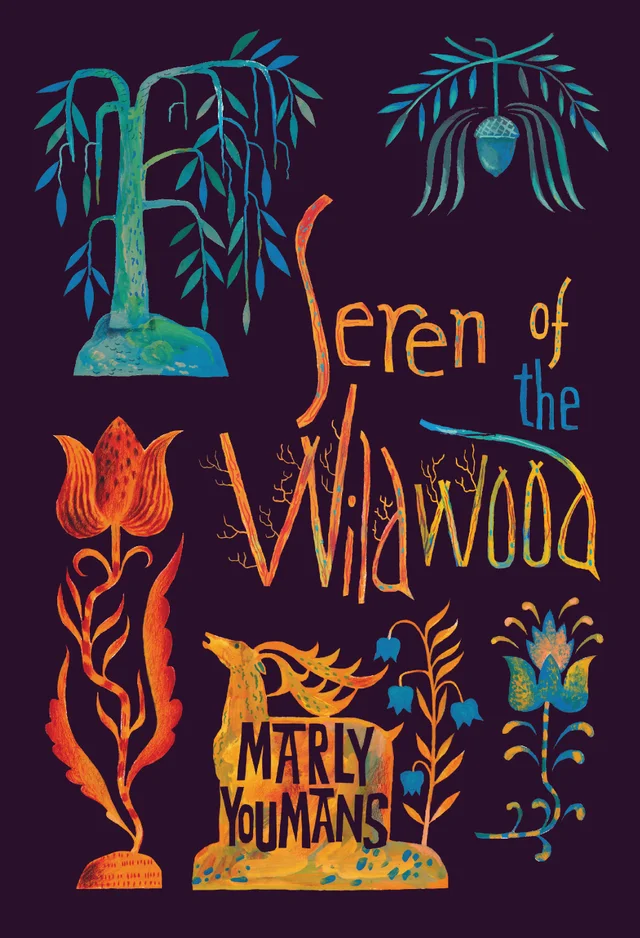
           Ideally, the maker who chases the transcendentals would possess the “wise-heartedness” attributed to the artists of the tabernacle in Exodus, and so use the plait of reason, nous, and bodily senses to create good things that add to the sum of beauty and truth in the world. In my recent book, Seren of the Wildwood, the eponymous heroine achieves something of wise-heartedness after seven years of journeys, peril, and sorrows in Wildwood. Transformation leads to a place where she looks back and retrieves out from raw, tumultuous years a desire to make that streams with soulfulness, yet is grounded in earthly things. She thinks

                                                     . . . how in secrecy

                     She might become a golden bowl of flame

                     In an enchanted world—this one, a place

                     Of paradise and hell and mundane hours,

                     Where she could learn to make, to sing her tale

                                                     Around

                                A hearth and wildwood blaze

                                On nights in winter crowned

                                By the strange, striking lays

                                That hold mortals spellbound (72.)

A wise-hearted pursuit of the transcendentals: yes, I think we might call it artistic. Making, in this view, can be regarded as part of the fulfilling of human nature as formed in the image and likeness of God.

           Wielding the imagination—making—in order to bring something worthy out of the generous profusion and welter of Creation is a simple though profound idea. Making does not need the complication of the Romantic vision of a suffering, unstable creator, nor does it need to proclaim Aestheticism’s “l’art pour l’art,” nor does it need to reject skill and embrace ugliness and transgression. It must not want to hammer out a message, for that is a work’s ruination. It must not try to cram everything the maker knows into the work. Making will fail if a maker does not honor the makers of the past and refuses to learn their craft and technique. Making will fail if a maker lets the unfairness of the present times and particularly in the world of the arts sap his spirit.

           People with the eyes to see the naked emperors of our world—the Repha’im kings of our day—already know that making can miss its mark entirely in execution (as in weak mimesis, ungainly form, axe-grinding, obsession with originality, domination by politics, kitsch, determination to shock or repulse, inappropriate feeling)  or in loveless purpose. We discern that missed mark in Genesis when Adam and Eve believe they can hide the shame of an act by stitching together leaves to make coverings for themselves. We see missed marks all around us, as in graffitied and decaying Brutalist architecture, in new Duchampian works influenced by his “readymades,” in lyrics of political hate, or in slatternly poems of worn-out transgression and shapelessness.

           Such creations are reductive; they diminish beauty and truth, rather than reaching for “the rendering strange of reality in order to make it clearer” (Mosley 23.) When a visionary Traherne sees children as “moving jewels,” he grasps at the strangeness of a paradox, joining together the stillness of gems to the liveliness of children at play, and in doing so reveals the human form as precious, alive with precious, sparkling light and color, a part of the wider Creation that bathes him in glory. This is revelation, “the rendering strange” that summons up beauty and truth.

           A maker should remember that we who make do not only make works that may be labeled as art. We also are co-making ourselves because whatever spirit that flows through a work as it is coming to fruition is also changing us for good or for ill. This, too, is part of what we may call the work of the imagination. Just as all humans ought to have a sound diet in order to thrive, we peculiar humans who have the desire to reach toward a higher making are best fed by strong, fine materials and purposes. And when we are done with a work, we are to yield to others what we have made out of the abundant stuff of Creation, which is our given, our great donnée.

           What does that mean for us as viewers, listeners, readers, receivers of what is made? We cannot experience the essence of a maker through what he or she has made, but we can experience the energies of the person and the beauties of a work. Such an encounter can be, to some greater or lesser degree, an immersion in the flowing energies that birth art, and a kind of renewing of the thing made. (This way of looking is a small reflection of the large Orthodox idea that we cannot know God’s essence but can experience his energies or attributes, for that grace radiates from his essence and is revealed to the soul.) For, “the beautiful does not exist for the artist and poet alone—though these can find in it more poignant depths of meaning than other men—so the world of Reality exists for all; and all may participate in it, unite with it, according to their measure and to the strength and purity of their desire” (Underhill 13.)

           And if the thing made by a poet or painter or choreographer or composer has captured enough of a sense of life, enough of the maker’s vital energies, it may continue to burn brightly and share its light with all for many years. It may even inspire and be generative for other makers, later in our linear time.   

4.

MAKERS AND LITURGY

As we enter now the timeless mystery

           The liturgy is a work of symbolic, participative art—it is a vessel, a form filled with adoration, spirit, and oblations meant to join human beings with the Trinity and the Divine Council, to feed men and women through “the holy and immortal mystery” of “our most essential bread,” filling them with divine, uncreated grace (Liturgy 40, 37.) Like a graft on an apple tree, a communicant is incorporated into the very body of Christ through the mystery of mysteries. In the Cherubic Hymn, those called to the Eucharist mystically “represent the Cherubim,” a reminder that they are one with the Divine Counsel. The liturgy lifts a fragment of Creation toward God, and sees that bread and wine transfigured. What is mortal touches the immortal; time and eternity greet each other. As then-Cardinal Joseph Ratzinger asserts in The Spirit of the Liturgy, “Christ himself is the bridge between time and eternity” (92.) Liturgy is a kind of procession over that bridge, into the strange light of the kingdom beyond.

           So too, in a far more modest way, human making can result in a shape, a vessel that spills over with mortal mystery—the inspired blending of attention, spirit, and human energies. The influx of power that inspires the poet and embodies itself in words has long been compared to the Holy Spirit, and no writer knows where her muse comes from, or where it goes. A writer can fiddle and make something out of words, or she can be borne on the flood of spirit that clothes itself in her very thoughts and words. Such imaging forth is mystery, and a faint, fractal likeness to the God who speaks the world into being. To repeatedly participate in works of art as maker or enjoyer is, like that crossing of a holy bridge into another kingdom, a way to see more clearly. And like the liturgy, words and musical notes and dance can be seen as procession; they move through time toward their right closure.

           Both religion and any art devoted to transcendental qualities are intensely countercultural for us, in a time when the world has been flattened, and all that exists for many has been reduced to material desires. Simultaneously, others have reached a Silicon-Valley hope-for-transcendence where some plot and hope that we can abandon the messiness of life and upload our minds into some technocratic cloud, where we may have faux material pleasures forevermore, or until the plug on the matrix is pulled. Others plan to have their frozen heads revived in some utopian and even more technology-mad age. Surely, we are already veering into that era; iPhones are glued to hands, AI-generated articles appear on Buzzfeed, bad ChatGPT poems pop up online, and we pause to glance at faux retro photographs from Midjourney. Whether pleasing or fleeing the flesh, life is dwindled down to material pleasures bodily felt, or to what can be known without the body, through some fabulous-seeming technology. As Ivan Ilyin warns in his 1937 Foundations of Christian Culture, “a people can stand on the absolute high point of technology and civilization, while in the arrest of spiritual culture (morality, science, art politics, and economy) they can be undergoing a period of degradation (19.)

           Christianity and transcendentally-inclined art resist all reductionism and show by their very presence that this world is more than what it appears to be, that the symbolic landscape around us is constantly speaking to us: that it may be broken but is good, beautiful. For a Christian, every tree rooted in earth and pointed toward heaven can recall the cross, and all water the baptism of Christ. Our home planet is alive with energies and mystery.

           We may look again to literature to find a more-than-seems world; the Gawain poet shows us how the strange and uncanny may crash into a gathering and drop its weird challenge. Rejoicing in human making, Keats gives to us the lovely “still unravish’d bride of quietness”: an urn. Dickinson joys in a route of evanescence, a wheel of emerald and cochineal: the hummingbird, bright spark of Creation. Vaughan recalls the time of his “Angel-infancy” when he felt “bright shoots of everlastingness.”

           Lovely, revelatory images take us back to Traherne’s “Eternity was manifest in the Light of the Day, and something infinite behind everything appeared which talked with my expectation and moved my desire.” In a question that may serve as a response to Traherne’s outpouring of beauty and his sense of a subsequent fall into a “dirty world,” theologian Timothy Patitsas speaks of the necessity of beginning with beauty and pure feeling, and asks whether faith might not be “the memory of theophany, the continuing to launch towards that divine supernova when it seems to have gone dark” (96.)

           The slow, powerful procession of the liturgy leads us to the light of Traherne’s “something infinite,” God the maker and giver, the sacrificer, the server, the one who loves his Creation. It teaches, hands down the apostolic faith, joins the human and divine together into one assembly, and allows what is mortal to brush against the infinite. For centuries, human makers mirrored those actions, serving the good of the thing made, passing down tradition and technique, seeking to learn and surpass their own previous work. The maker’s role began to show distinct signs of change during the Renaissance, a transition especially clear in painting, where artists moved from a focus on holiness to the fleshy and erotic in classical and even biblical subjects. The artist became a special, sensitive figure with a role set apart in the Romantic era, when poets and painters grasped after the sublime in nature. By the time we reach Surrealism, with its writers and painters who fulminate against societal structures of many sorts, “nothing is to be regarded as sacrosanct except the random destructive/creative will of the artist, who as a prime principle and presence eclipses God” (Jeffrey 300-301.)

           Today we often find that tradition, skill and craft, beauty, and the good of the made thing are rejected—tendencies that may be most vividly exposed in our out-of-control art market for “avant-garde” painting and sculpture but are present in other branches of the arts. What can liturgy say to this?

           A unified work of art proclaiming truth and beauty, liturgy upholds and offers the larger life that can be lived in Christ—a corrective to the trivialization, confusion, and technological chaos of the times. Liturgy simultaneously enlarges the maker’s conception of what life is and, thereby, the possibilities of art, while gifting us all with something our rebellious era heartily resists, a kind of modesty: knowledge of our own limits. That is, the liturgy shows useful ways of belonging: our place in family; our place in a community, past, present, and future; and our human limits, our place in the universe as creatures, part of the wider Creation, sharing in its fragility and its need to be stewarded. The journey of liturgy takes us to a place where we know our own modest place, yet can see Traherne’s “Eternity…manifest in the Light of the Day.”

A maker might yet find transformation in the presence of the Maker, and might come to honor not nature, an element outside of us, but Creation, of which she is a part.

O send out thy light and thy truth

___________

Marly Youman’s latest narrative poem Seren of the Wildwood may be purchased at Wiseblood Books: https://www.wisebloodbooks.com/store/p129/seren-of-the-wildwood-by-marly-youmans.html

Bibliography

Ilyin, Ivan. Foundations of christian culture. Translated by Nicholas Kotar, Waystone Press, 2019.

Jeffrey, David Lyle. In the Beauty of Holiness: Art and the Bible in Western Culture. William B. Eerdmans, 2017.

The Divine Liturgy of Saint Gregory the Great according to the usage of Cloud-Bearing Mountain Christian Retreat & Training Center and St. Herman of Alaska Church in the Catskills. 2023.

Maritain, Jacques. 1947. Art and scholasticism. Cluny Press, 2016.

Mosley, David Russell Being deified: poetry and fantasy on the path to god. Fortress Press, 2016.

Ratzinger, Joseph Cardinal. The spirit of the liturgy. Translated by John Saward, Ignatius Press, 2000.

Schmemann, Alexander. 1970. For the life of the world: sacraments and orthodoxy. St. Vladimir’s Seminary Press, 2018.

Stevens, Wallace. 1923. The collected poems of wallace stevens. Alfred A. Knopf, 1954.

Traherne, Thomas. “Centuries of meditation.” Seventeenth-century prose and poetry (4th ed), edited by Witherspoon, Alexander M. and Warnke, Frank J. Harcourt, Brace & World, 1963, 693-704.

Underhill, Evelyn. 1915. Practical Mysticism. Digireads.com Publishing, 2010.

Youmans, Marly. Seren of the wildwood. Wiseblood Books, 2023.
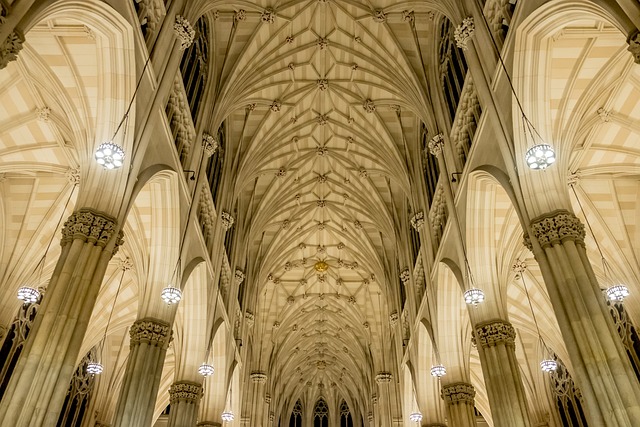
Hymn: Cathedral of Light

Upon this rock

Our cross and spire,    

built in a land

of quake and fire.

Fragile as glass,

bright as the air,

the angled walls

folded in prayer.

Under the sun

of western skies,

we re-enact

the sacrifice.

Bread of the earth,

fruit of the vine,

the tortured flesh

revealed divine.

The ancient words

fill this new space,

redeeming us

with unearned grace.

Rededicate

this crystal spire

built in a land

of quake and fire.

Amen.

Dana Gioia is an American  poet, literary critic, translator, essayist and libretticist. He served as Chairman of the National Endowment of the Arts and California’s Poet Laureate. Gioia’s poetry has been anthologized in The Norton Anthology of Poetry and The Oxford Book of American Poetry. Dana Gioia’s latest book is a translation of Seneca’s play “Seneca: The Madness of Hercules” published by Wiseblood Books.

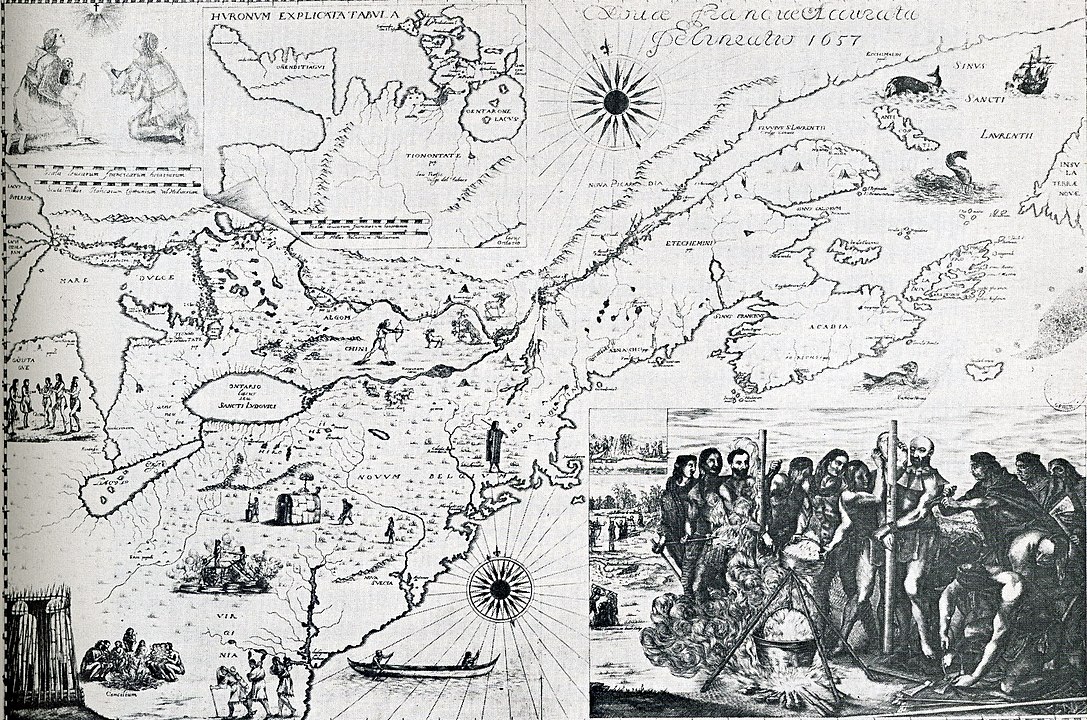
In Memory of the North American Martyrs 

               I
Twelve years before his death, Père Jean Brébeuf
Wrote out instructions to his fellow priests
And missionaries for their life among
   The Huron people:

Have true affection for them, first, he said,
For they, as you, are ransomed by the blood
Of Christ; accept without complaint their cornmeal
     However tasteless;

Keep in your pockets beads, jambettes, and fishhooks
For barter with the other tribes you’ll meet;
And, during portage, carry what you can,
     If just a kettle;

And yet, the best equipment you can bear
Is silence. Seat yourself in the canoe,
And speak no word, but churn your oar in silence
     As they will do.

How else address the great sky’s opened vault
Above the river gliding its swift current?
How else to greet the banks obscure with shadows
     Of fir and spruce?

How else perceive the plies of ice on ice
Extending brightness on dark water? How
Else to receive the snow whose soundless fall
     Will transform all?

There is a silence to that wilderness
That needs no word of ours; an emptiness
That does not ask for gift of tongue or lip
     But our whole lives,

And waits with frigid clarity upon
The naked boughs, much like the Saturday
Between the hour of Christ’s death and that
     In which he rose.

But, Hurons have as well another reason
For quiet, as their eyes survey the shoreline
For prints in mud, their ears strain for the sounds
     Of cracking branches.

They know what force could lie around each bend.
They feel the forest as it holds its breath
Before the rage of musket ball, the cry
     Of bow and axe.


               II
And so, the brethren listened, Jogue, Goupil,
Daniel and L’Alemont; they took their posts
In birch canoes with feet bare, cassocks tucked,
   And prayers turned inward.

They waited for the hour to break the silence
If only with their halting Huron speech,
To tell these people of the woods there was
   A God who loved them.

They knew before their craft slipped from the shore,
Their lives would pass away in that great silence.
That some, invited to a feast, would have
   Their skulls split wide.

That, captured, Jogue would feel his nails pulled out,
His fingers chewed to stubs by Iroquois teeth;
That those who beat and stripped him would be those
   He’d vowed to love.

And that Brébeuf would feel the Iroquois cudgel
Upon his head, their lashes on his back,
A traitorous Huron raise a boiling kettle
   To baptize him.

As he leaned heavy on the post that held him,
And watched the flames consume the mission church,
He never ceased to fill the wilderness
   With praise to God.

And even as they took his tongue and lips,
And cooked his skin before his eyes, he called
Out to the ones who tortured him the glory
   Of their salvation.


               III
For my part, when I think of Jogue’s torn hands,
Brébeuf kept wakeful through his mutilation,
And praising—praising—though even some he baptized
   Now ate his flesh,

I long to feel the blaze of righteous gunfire,
To hear a sudden clamor of French arms
Descend to save those priests and punish those who
   Took such cruel pleasures.

I want the wilderness itself to speak,
The rivers to rise up and swallow all,
The trees to bend and break their bonds, and sunlight
   To crown their heads.

But that’s not what Brébeuf or Jogue desired,
Who came to walk along the Huron paths
And dwell within their villages, and join
   Them in their suffering.

And though the Iroquois soon scattered all,
The priests remained to carry their own weight
To speak of Christ and love them as Christ did
   These brethren.

For, Jogue heard, even in his silent heart,
You go not to return: the wilderness
An altar where he made himself, to God,
   Burnt offering. 

Defending St. Junípero Serra, with Holy Water, the Rosary—and the Arts

St. Junipero Serra, a holy man dedicated to the earthly and heavenly well being of Native Americans has been denounced as a racist, a genocidal monster. One CBS news report even libeled the saint as a slave owner.

On Juneteenth 2020, haters brought their ire against the founding father of California to San Francisco. Hundreds of protesters, many of them dressed in black, toppled and defaced statues in Golden Gate Park. Many figures whose statues were attacked had no apparent connection to racism or slavery. For example, the mob graffitied a monument to Cervantes and his characters, Don Quixote and Sancho Panza.

Prominent among the statues attacked that day was St. Junípero Serra’s. His statue was overturned. Both the statue and its pedestal were defaced with red spray paint. “Stolen Land” was scrawled on the pedestal.

Dismayed by the vandalism, I was happy to see Archbishop Cordileone take an unusual and gutsy step. Not stopping with issuing an eloquent statement of protest—which would likely be ignored even in the unlikely event it was read by Serra’s detractors, the archbishop also used powerful spiritual weapons at his disposal.

Park workers had cleaned the graffiti from the statue and taken it away to storage when the archbishop went with about two hundred of the faithful to the site of the empty pedestal. On that drizzly day, wearing an amaranth purple skull cap, and the amaranth cassock proper to his role as a bishop under a lace-trimmed alb, with a deep purple stole around his shoulders, Archbishop Cordileone blessed the area with holy water and performed a minor exorcism. He then led a rosary of reparation.

In a clip now posted at the archdiocesan website, the archbishop said, “An act of sacrilege occurred here that is an act of the evil one. Evil has made itself present here.”

Archbishop Cordileone went on to say he grew up in San Diego, near the first mission Serra founded in Alta California when it was under Spanish rule, the area which now makes up the state of California. So, he said, he has a heartfelt connection to the saint. “I’ve been feeling great distress and sort of a deep wound in my soul when I see these horrendous acts of blasphemy and disparaging of the memory of Serra —who was such a hero, such a great defender of the indigenous people of this land.”

Remarkably, the archbishop has also defended St. Junípero Serra in many other unique and creative ways—using the arts.

Through the Benedict XVI Institute for Sacred Music and Divine Worship that he founded, with the savvy assistance of Maggie Gallagher, the institute’s Executive Director, Archbishop Cordileone commissioned a new Mass setting, a painting, and a poem in honor of the saint. During a Zoom event, “The Making of Missa Sancti Juniperi Serra,” Gallagher said that following the Renaissance model of commissioning great works of art from within the heart of the Church, all of these works were funded by a generous patron, Mr. Terry Castor of San Diego, in honor of his deceased wife, Barbara. Anyone who celebrates the Missa Santi Juniperi Serra is asked to remember Barbara Castor in prayer.

Missa Sancti Juniperi Serra

During the ZOOM event on April 30, 2022, Archbishop Cordileone spoke about how the idea to commission a Mass in honor of St. Junípero Serra was formed.

The archdiocese would be hosting a Sacra Liturgia Conference at the end of June, an international event which, as the archbishop said, “brings together great minds and hearts of people who are working to promote and renew sacred liturgy in the Church and regain the beauty that the liturgy deserves. I thought that since the last day of the conference is July 1, the feast day of St. Junípero Serra, a perfect way to bring this to a conclusion would be to celebrate a Solemn High Pontifical Mass —in the extraordinary form because that’s the form of the Mass that St. Junípero Serra himself celebrated.”

The Mass would be celebrated in Mission Dolores Basilica, which was built in 1876 adjacent to the original Church of Mission San Francisco de Asis to accommodate larger congregations. Mission San Francisco was founded by Padre Francisco Palóu under the direction of St. Junípero Serra in 1776, and the adobe mission church built in 1791 is the oldest surviving structure in the city. (EWTN recorded the Mass, and you can view it at Cathedrals Across America—Solemn Mass for the Feast of St. Junípero Serra.)

Archbishop Cordileone continued, “I asked Frank to compose a Mass in honor of St. Junípero Serra that would be reflective of the mission era here in California.” This is the third Mass setting composed at the archbishop’s request by Frank La Rocca (franklarocca.com) , who is the Benedict XVI Institute’s composer in residence.

La Rocca then spoke about how he went about making his composition evoke the experience of what a Mass from that time would have been, “One important way is through the choice of the instruments accompanying the singers. It would be a small ensemble just like the ones they had in the missions of maybe a string quartet, a couple of flutes, perhaps a small portable organ.”

At the premiere, La Rocca’s music was performed on baroque-style string instruments and flutes to contribute to the authenticity, but modern instruments will be able to perform the music as well.

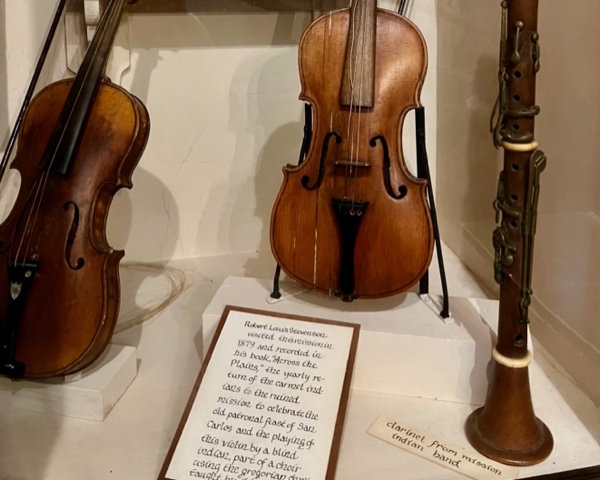
Musical instruments played to accompany Masses with Gregorian chants by the Indians in the Mission bands.

In addition, Frank La Rocca said he wove throughout his Mass setting the tune of one of St. Junípero Serra’s favorite hymns, “Salve Virgen Pura,”—”Hail Pure Virgin.”

“In addition to the hymn I wanted to make allusions to Gregorian chants from Missa Orbis Factor, which certainly would have been one of the most commonly heard Mass ordinaries in those days.”

La Rocca used the Salve as a Prelude, and worked it in as a thematic element of the music for the Mass, using the melody and derivatives of it in the music accompanying the ordinary the texts of the Mass. He wrote me later in an email that this technique is known as a “Parody”—a term that has nothing to do with mockery.

St. Junípero Serra and the American Saints Painting

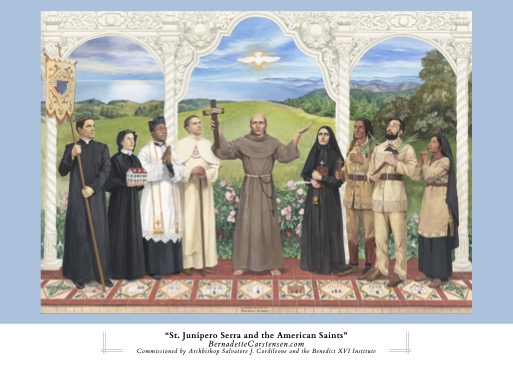
Figurative artist, Bernadette Carstensen (bernadettecarstensen.com) is Benedict XVI Institute’s painter in residence. During the Zoom event, she unveiled her commissioned painting “St. Junípero Serra and the American Saints.”

As Carstensen pointed out, the saints are standing in the painting against a classic California landscape on Mount Tamalpais with roses and columbine that grow there. Columbine also represents the Holy Spirit. The roses look to be Roses of Castile, of the kind St. Juan Diego found growing in winter and gathered into his tilma after the apparition of Our Lady of Guadalupe in Mexico.

The figure of St. Junípero Serra in the middle stands with arms upraised similar to the pose of his statue that was toppled in Golden Gate Park. From left to right on either side of Serra are Blessed Michael McGiveny; St. Elizabeth Ann Seton; Servant of God Father Augustus Tolton; Saint Damian of Molokai; Saint Mother Cabrini; a Native American representing the Huron Christian martyrs; St. René Goupil, representing the Jesuit martyrs, and St. Kateri Tekakwitha. At the saints’ feet are Spanish tiles depicting the nine missions founded by St. Serra. Below is a dedication to Barbara Castor.

The Liturgy of the Hours of Saint Junípero Serra

Benedict XVI Institute poet-in-residence James Matthew Wilson spoke about and read his poem, “The Liturgy of the Hours of Saint Junípero Serra.”

“I wanted to write the poem as a prayer . . . so we could read the poem and pray the poem.” Wilson said he used the rhyme royal scheme to honor St. Serra’s long and painful walk along El Camino Real—which in English means the royal road. Each stanza of seven lines, in iambic pentameter with a rhyme scheme of ABABBCC is about a different object from a different stage of Fr. Serra’s life starting from his youth in Mallorca, intended for us to ponder the object and think about what it can teach us about his spiritual life.

Eloquence beyond Words

Using the eloquence of the beauty of music and art, poetry, and architecture to defeat lies and ugliness is a profound idea. Research has shown that repeating the lies of opponents even when we have strong arguments against the lies may paradoxically strengthen belief in the lie among those who have believed it already. Besides, some people will not have heard the lie before, and it doesn’t help to spread it even further.

The arts are so convincing because they captivate people and grab people’s emotions, and even when they don’t completely bypass the intellect, they enrich the understanding.

A More Truthful Image

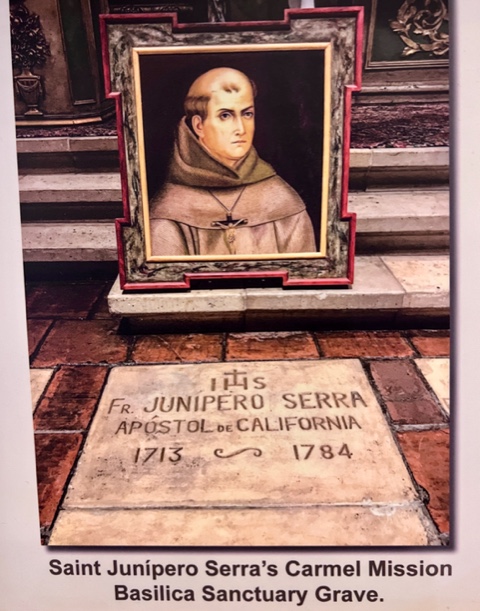
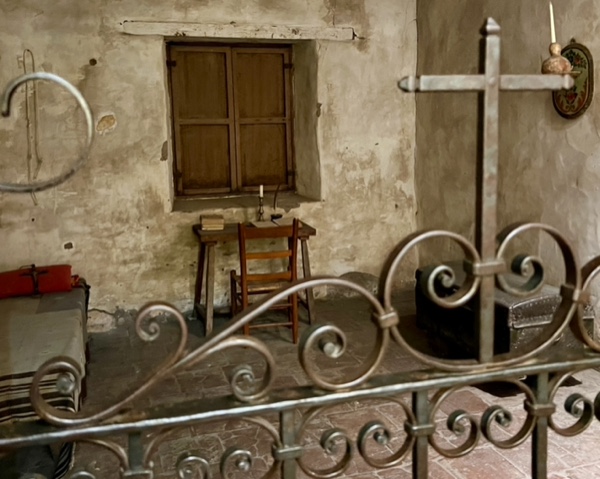
Recently I came across this review at website of the restored Carmel Mission where St. Junípero died and was buried, which portrays a more truthful image of the saint, “Walking through the primitive furnishings and reviewing the very basic library housed in the place, with tools and instruments available a couple of centuries ago illustrates the very primitive conditions in which the inhabitants lived and worked and the sacrifices made by the man that brought European culture and civilization to this part of America.”

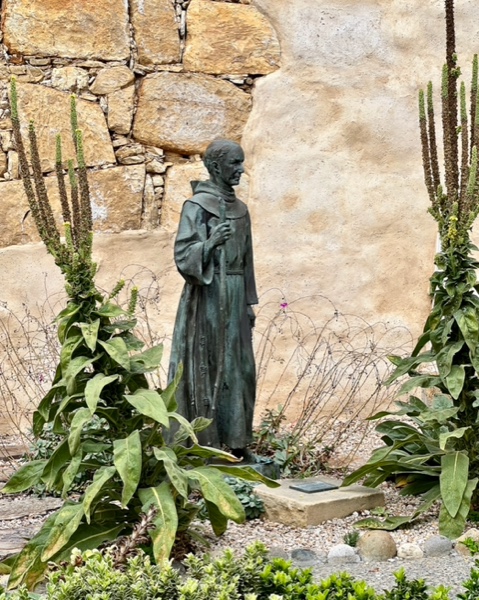
St. Junipero Serra’s ascetic cell at Mission Carmel, where he died and was buried.

This article is adapted from an essay that first appeared in the Fall 2022 Edition of Latin Mass Magazine. Republished with a few modifications, with permission.

Daniel Knaggs Composes Music as an Icon for the Sacred

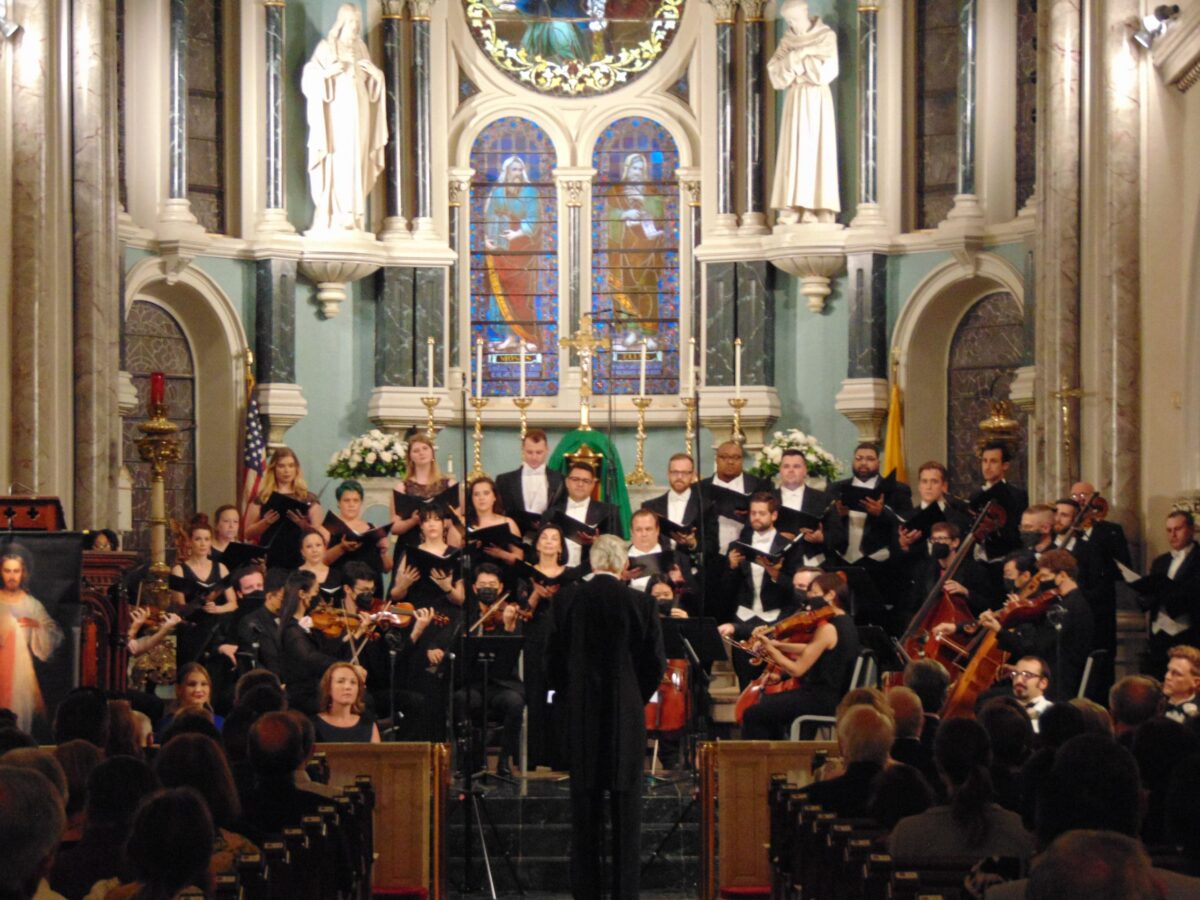
American composer Daniel Knaggs premiered his Two Streams, a cantata based on Jesus Christ’s message of Divine Mercy for mankind, last fall in Houston, Texas.  The concert celebrated the historic Church of the Annunciation’s 150-year anniversary in a gala evening event with almost 400 in attendance. The interior of the Romanesque-Gothic Church, a virtual jewel-box of carved marble, serene statues, and the original 19th-century stained glass, showcased the sacred music within vibrant architectural beauty.

            Two Streams is Knaggs’ most substantial project in an award-winning career that includes commissions, prizes, and awards for composition from around the globe.  The initial impetus for the piece arose from Knaggs’ desire to compose music in response to his experiences in the Polish cities of Kracow, Warsaw, and Gdansk, the city now famous for the Solidarity movement’s founding and contribution to the downfall of Soviet Communism. Knaggs’ strong attraction to the Diary of St. Maria Faustina Kowalska, which revealed God’s message of Divine Mercy, provided the touchstone for the piece’s ultimate grounding and spiritual context. He says, “The idea of a God who is merciful to a fault disarms me. This is our God whose greatest attribute is His unending mercy for us and which He wants us to spread throughout the world.”  The sudden and premature death of Knaggs’ father just after the commissioning of the piece brought a deeply felt personal dimension to the spiritual reassurance of Christ’s Divine Mercy. The title of the piece, Two Streams, evokes the two rays emanating from the image Christ asked St. Faustina to have painted of His Divine Mercy: a white stream of life-giving grace and the red stream of purifying grace flowing from His heart.

            For Knaggs, the composition of music is a painstaking process.  He says, “You have to be in it for the long haul—to be able to work with a piece until every feature is right.”  Both spiritual and practical aspects influence a composer, like Knaggs, whose goal is participation in conveying metaphysical or spiritual aspects beyond daily reality.  He says, “In composing, we are indebted to what has come before us, for example, chant, polyphony. When you write music, you have the ability to bring in the register and range of voices, dynamics of soft and loud, keys and tonality to add to the meaning. One movement of Two Streams has no words, but I believe things are being conveyed. If someone tried to write music without a belief in the spiritual truths, the audience would know.”

            Two Streams has 14 movements based on texts from three sources: the Diary of St. Faustina, Scripture, and liturgical texts. The movements are arranged symmetrically with the first and last movements related, the second and the 13th, and so on.  Four hymns (songs) of Mercy are interspersed between the movements to ground the listener in both trust and joy. Each song  features a hymnic stanza sung in English with a subsequent hymn of Mercy sung in Latin. The intention is to depict a timeless scriptural echo of the content in each hymn’s stanza which then ripples eternally throughout the past, present, and future. An example of this structure is the Song of Mercy II sung by the mezzo-soprano soloist. While it is joyous, the hymn spills over into the contemplative Latin section with the words: “Show us your mercy, O Lord, and grant us your salvation.”

                        You gush forth from the Divine Trinity,

                        But from one single womb filled with love.

                        The mercy of the Lord will be revealed in the soul

                        In all its fullness when the veils falls.

                        Ostende nobis Domine misericordiam tuam. Et

                        salutare tuum da nobis.

While Knaggs, who has studied six languages, simultaneously composed versions of the entire cantata in English and Polish, the liturgical texts of both are in Latin and Greek with the Scriptural texts in Latin. The simple yet powerful words within the composition were chosen by Knaggs. He says, “[The words] speak to the fragility of the human experience. And they speak to the transcendent hope that God offers us.” The music forms a seamless and rich tapestry weaving together threads from many eras including Medieval, Renaissance, Baroque, Classical, Romantic, and contemporary to explore the much needed message of Divine Mercy. The beauty of the music during the premiere is already an argument in favor of its continued appeal to audiences, whether believers or non-believers in the Christian-Catholic faith. 

            The location of the Church of the Annunciation in the heart of Houston’s frenetic downtown entertainment district provided yet another way for Two Streams to reach out with its message of Divine Mercy to the surrounding community. The pastor of Annunciation, Rev. Fr. Paul Felix, says, “Our parish can feel the heartbeat of our community.  We want to facilitate and promote the positive interaction of faith and culture. We want to bring the culture into a regard of the deeper issues of faith and a consideration of substantive issues. I heard that even the singers during rehearsals were deeply touched by the message of Divine Mercy. This message was heard by the audience which included parishioners, benefactors, many new visitors, seminarians, priests, and faculty members from several universities.”  

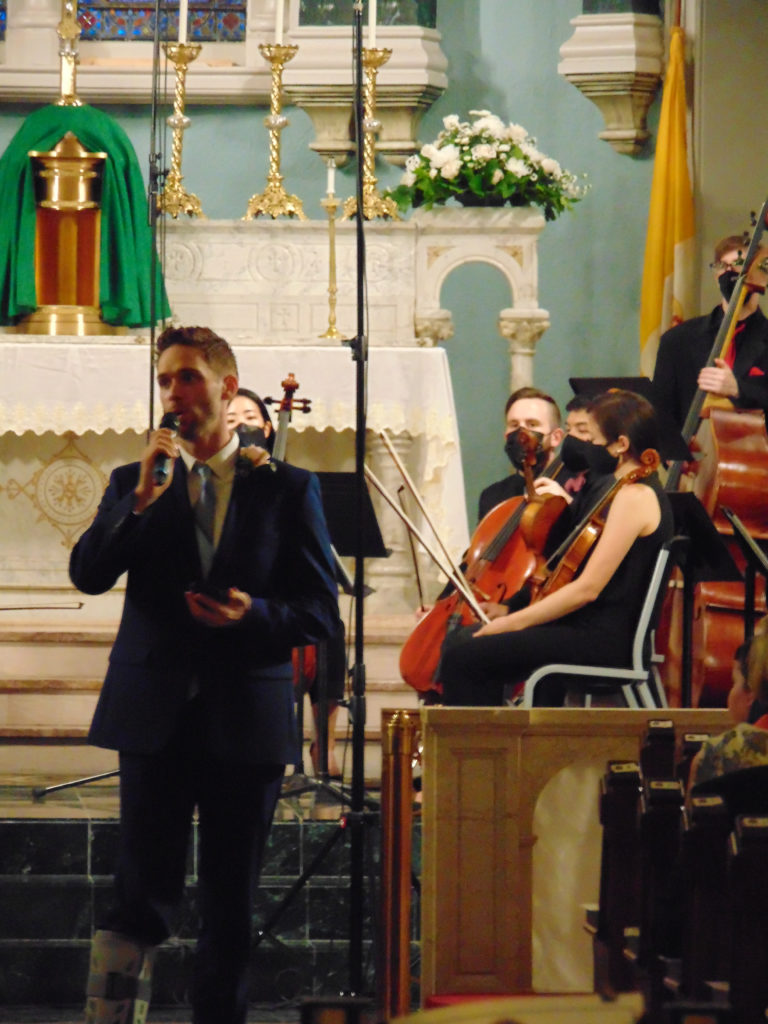
            The Two Streams premiere included the Houston Chamber Choir with director Robert Simpson, the 16-piece Kinetic string ensemble, the Annunciation Schola, and soloists Sasha Cooke, Chris Bozeka, Mark Diamond, and Caitlin Aloia. For Rev. Fr. Paul Felix, the experience of hearing the music for the first time was “very powerful and moving” with its harkening back to the eternal theme of Divine Mercy which informs so much of the daily work of a parish priest’s spiritual and corporal works of mercy, such as hearing Confessions, providing spiritual direction, visiting the sick, etc.  Rev. Fr. Felix says, “The Lord intervened to make St. Faustina the apostle of Divine Mercy.  It is so important for our time to listen.  God gave this message so people could find their way out of sin and evil through the redeeming love of Jesus.”

Knaggs’ most ardent wish for sacred music is that “the music conveys its own eloquence.” The mysterious resides inside music; the experience of hearing the metaphysical or spiritual content allows what Knaggs refers to as “music as an icon.  It is a window that points to a great reality. When people experience music that is not just about itself, they can experience realities beyond the music itself.  Maybe that person then sees there is more to life that just what’s here.  Music is a shared experience. It has a unique ability to reach inside the human heart.”

Sarah Cortez is president and founder of Catholic Literary Arts, www.catholicliteraryarts.org. A freelance writer and editor with fourteen award-winning books to her credit, she resides in Houston, TX. www.poetacortez.com

Winter’s Still Song

(after hearing Morten Lauridsen’s Magnum Mysterium at a friend’s Wedding)

The hush falls

like soft-feathered snow,

as light takes its leave.


Clamoring thoughts,

like tired children

spent from running

in delirious circles,

take a final spin,

then collapse,

asleep in a pile.


Our Mother, full of stars,

reaches up her gentle

hand to switch on

the crescent moon.

Its sparse light

trails to earth

like a bridal train

and lays like lace upon

the snow-covered ground.


Now, finally,

cloaked in quiet

there is a clearing

not already occupied

by thought

where we are stilled by song

and become

the sweet capture

of two delicate voices

entwined like dancers

turning in the air,

light-footed,

arching heavenward.


Here,

hanging in the air,

like crystals on a

snow-laden tree:

what rough straw

would have whispered

from the manger.

Tamara Nicholl-Smith’s poetry has been featured on two Albuquerque city bus panels, one parking meter, numerous radio shows, a spoken-word classical piano fusion CD, and in several publications, including the Mutablis Press anthology Enchantment of the Ordinary, Kyoto Journal Issue 95, The Examined Life Journal Issue 8, and Catholic Arts Today. She is currently pursuing an MFA in Creative Writing at the University of Saint Thomas in Houston. She enjoys puns and likes her bourbon neat.

Passable Prayer: Witness

Lord, you have searched me and have known
my madness, a wilderness of visions and song.
 

I welter in birthright riddles, my mother
deranged, my father the fool. They claim
I prophesied in wordless gurgles grown
to wails—lament bled with ecstasy.
 

Now I rove, a cockeyed home
for maggots and mutters. Rumors river
and surge through this untamed soul,
ebbing beliefs I still cry without end.
 

When you next pass through, whisper me
from ruins. Say among the rants was a shrapnel
of truth. Name me what you wish
and plunge these tremors beneath your current.
 

And if you insist I risk wrecking the call
—fanatic caressing the unlikely God—
if passion must tightrope peril, I pray
you salt my tongue with light and dove.
 

Whitney Rio-Ross is the author of the poetry chapbook Birthmarks (Wipf & Stock) and poetry editor for Fare Forward. Her poetry has appeared or is forthcoming in The Windhover, Rock & Sling, America Magazine, Psaltery & Lyre, Relief Journal, and elsewhere. She lives in Nashville, Tennessee.

Editor’s Note: We are proud to publish the winning poem of Catholic Literary Arts’s sacred poetry contest, judged by the noted poet Jane Greer, one of the founders of the New Formalist poetry movement.  She commented:

“Whatever formal poetic tools a poem does or doesn’t use, if it doesn’t use evocative imagery, it’s something less than a poem. The language in this work is gorgeous and does the job it is meant to do. ‘I welter in birthright riddles;’ ‘Now I rove, a cockeyed home / for maggots and mutters;’ ‘whisper me / from ruins. Say among the rants was a shrapnel / of truth. Name me what you wish / and plunge these tremors beneath your current.’ The language does not tell us about but leads us to experience the Baptist’s inner and outer turmoil, his suffering, his love. This is poetry.”

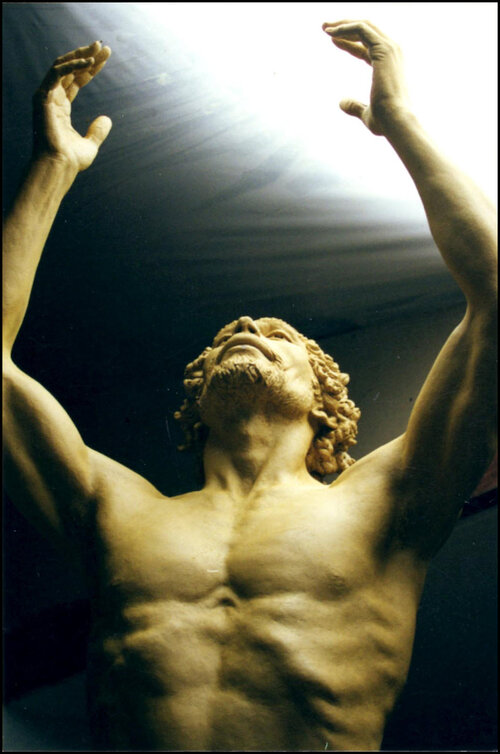
The Catholic Literary Arts contest asks poets to write in response to works of art by living Catholic artists.  In this case, the poet Whitney Rio-Ross chose as her inspiration the above sculpture of St. John the Baptist by Thomas Marsh. His work may be found at: http://thomasmarshsculptor.net/
 

Roberto Estopiñán: Sculptor of God and Modernity


Editor’s Note: This is one of a series  that might be called “Forgotten Catholics”: Great artists, novelists, and poets who are not known as Catholics. In this essay you will meet one of the great 20th-century Latin American sculptors, a refugee from Communist Cuba, who in times of crisis turned to St. Ignatius’ examen exercise to ground himself in the presence of God. Surely a re-valuation of this man’s work in light of his faith is long overdue.

Roberto Gabriel Estopiñán (1921-2015), a Cuban sculptor who emigrated to exile in the United States not long after Fidel Castro’s revolution in 1959, is considered one of Latin America’s most important 20th-century artists.

His work, which includes drawings and prints as well as sculptures in wood and bronze, is in the collections of New York’s Museum of Modern Art, the Smithsonian’s American Art Museum, the Art Institute of Chicago, and the Detroit Institute of Art, among many locations. He is best known for his stark, disturbing renderings of political prisoners, the fruit of his own experiences as a dissident under both Castro and his predecessor, the dictator Fulgencio Batista, and for his representations of the female torso that can remind viewers of both classical statuary and the high-modern, abstractly elongated work of Henry Moore.

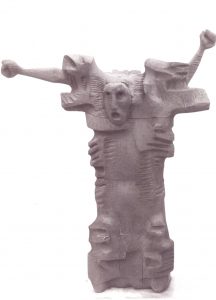
Estopiñán, Prisoners, c. 1964-1965

What is little known about Estopiñán is the centrality of his Catholic faith in both his life and his work.

He was born in Havana to a father from Asturias in northwest Spain and a mother of African descent. His father died when Roberto was seven years old; he and his younger brother were raised by their mother, a maternal uncle, and a grandmother. He attended the local public school but went to a Jesuit church near his home for catechism classes. His youthful exposure to the Jesuits would affect him for the rest of his life. In moments of political crisis he would turn to the examen, a five-step prayer technique that is part of St. Ignatius Loyola’s Spiritual Exercises and focuses on the laying out of the day’s events in the awareness of the presence of God. Besides being a means of discerning one’s relationship to God, the examen has a visual component—seeing in one’s mind how God is working in one’s life—and it informed Estopiñán’s sense of visual aesthetics and would serve as a compass in his art.

Estopiñán, Crucifixion, 1964

Estopiñán was something of a prodigy. At the age of fourteen, he won the first prize in drawing at the Centro Asturiano, a regional association for Cubans of Asturian descent. Shortly afterward he received special permission to enter the San Alejandro Academy of Fine Arts in Havana, which usually did not accept minors. At the school he was mentored first by its director, the painter Armando Menocal (1863-1941), then by the landscape artist Antonio Rodríguez Morey (1872-1967), and finally by Juan José Sicre (1898-1974), regarded as one of Cuba’s greatest sculptors. Sicre, a professor of sculpture at the Academy, had helped introduce European modernist art to Cuba, and from the 1930s through the 1950s had sculpted monumental figures in Havana of José Martí and other Cuban national heroes that stand to this day.  Estopiñán was first Sicre’s student, then his assistant, and, finally, his colleague for the next fifty years.

After graduating from San Alejandro in 1942, Estopiñán began simultaneously teaching art at the Ceiba del Agua School for young men, assisting Sicre in public art projects and developing his own artistic vision. He also traveled widely, to Mexico, New York, France, and Italy. From the late 1940s through the 1950s his sculpture evolved from an early neoclassical phase under the influence of Maillol to what he defined as “formalist humanism”: emphasizing the abstract beauty of the shapes he sculpted while not abandoning the human figure as the basis of his work. As the 1950s progressed he chose to carve in native Cuban woods as well as weld scraps of various metals. Although he was obviously influenced by Henry Moore and Julio González (1876-1942), a Spanish modernist sculptor whose iron weldings prefigured Estopiñán’s weldings in bronze, he had already created his own visual language.

Estopiñán, an avid reader, was preoccupied by the tensions of the Cold War, the aftereffects of the Nazi concentration camps, and the nuclear detonations that marked that era. There seemed to have been a historical breakdown—and this affected his ideas about people’s inner lives, as well as about what representing the human figure meant for artists after such historical breakdowns. He also felt a call to civic duty, especially after Batista’s coup of March 1952 established a military dictatorship that suspended Cuba’s constitution and most civil liberties in what had been a fragile democracy. Estopiñán joined the Directorio Revolucionario Estudiantil, an anticommunist, pro-democracy student-based organization that opposed the Batista regime.

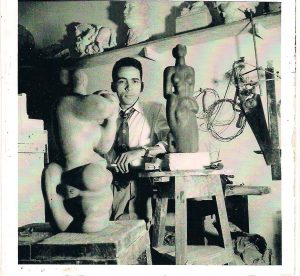
Estopiñán in Havana, 1952

During those years he read voraciously, from anti-communist writers on the left such as George Orwell, Ignazio Silone, and Arthur Koestler to Catholic philosophers such as Jacques Maritain and Étienne Gilson, as well as the poetry of Dante and Valéry.

He was deeply affected by Gilson’s 1955 Mellon lectures at the National Gallery that later became a book, Painting and Reality. Gilson argued that modern painting and sculpture did not aim to represent or imitate the natural world, but rather to add to it. For this reason, Gilson argued, modern art must be distinguished from mere “picturing”—producing images of actual or possible beings. The modern artist, according to Gilson, dismantles the unnecessarily descriptive, the overly decorative, and the merely illustrative, proposing instead an expressive language of the essential that is ultimately more spiritual than conventional depiction. Estopiñán decided to ground his aesthetic practice in Gilson’s theory of the “pure plastic elements” that characterized modern art, as well as Valéry’s definition of a classic: “a work that is measured by three standards: quantity, quality and variety.”

Throughout the 1950s Estopiñán simultaneously experimented formally with his sculpture and engaged in revolutionary acts against the Batista dictatorship. He participated in strikes, printed and delivered leaflets, and hid other revolutionaries on the run. He also began his arresting sculptures of political prisoners, winning prizes in national exhibitions. After the triumph of Castro’s revolution, the new regime rewarded his activism with diplomatic postings as a cultural attaché in Egypt, Czechoslovakia, and China. His experience in China while Mao Zedong carried out his program of forced collectivization of agriculture, suppression of Christian churches, and disastrous Great Leap Forward that resulted in tens of millions of deaths by famine, confirmed misgivings that he had already been experiencing about Cuba just a few weeks after Castro’s triumph.

“My intuition told me that instead of democracy, it was populism manipulated by a demagogue, that rule of law was not restored but replaced by the mob, and that the new regime was turning against the very Catholic church that had supported it,” Estopiñán told me an interview in 2014. “Communist China was simply the nightmare confirmed. I had seen the future and it was hell.”

Estopiñán, Rebel Prisoner, 1965

Back in Cuba in early 1961, he encountered a brutally sectarian society where opposition was not tolerated. He saw only four choices for him: adapt and lose your soul; be imprisoned; be executed; or save your soul and your life by going into exile. He chose the latter.

On his way to a new diplomatic assignment in Honduras, he got off the plane in Tegulcigapa, went straight to the U.S. embassy, and requested asylum. In exile first in Miami, then in New York City, he was overcome by a profound existential crisis: How could he have been fooled? Why and how did a revolution meant to be democratic sour so quickly into totalitarianism? He tortured himself looking for an answer, but the Jesuit examen came to his rescue, as did Maritain and Camus.

He also made new discoveries among 20th-century writers who had found meaning in Christian faith: Simone Weil and Thomas Merton. A fellow Cuban exile, the Catholic poet Israel Rodríguez (1925-2008), lent him two books by contemporary Catholic theologians that trace the roots of the atheism and nihilism that undergird many modern ideologies: The Drama of Atheist Humanism by Henri de Lubac and The God Question and Modern Man by Hans Urs von Balthasar. Both were Jesuits, and both were energized by the Second Vatican Council and its efforts to revitalize the Catholic Church as a bulwark against modernity’s aggressive secularism while at the same time speaking a language that modernity would understand.

After arriving in exile in the midst of this crisis of faith and ideology, Estopiñán slowly started to draw and sculpt again. But he found his earlier formalism hollow and lacking. He began to study the Romanesque sculpture of twelfth-century Western Europe, in which the elongated stone figures of Christ and other biblical personages dramatized religious meaning, as well as the work of the German Expressionist sculptor Ernst Barlach (1870-1938), whose realistic but stylized woodcarvings and bronzes that recalled the sculptures of saints on the façades of Gothic cathedrals displayed intense spiritual yearnings. Estopiñán needed to return to the human figure in a less abstract manner, more directly, more emotionally, in the best tradition of religious art.

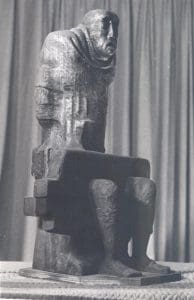
Estopiñán, Seated Prisoner, 1966

And he did.

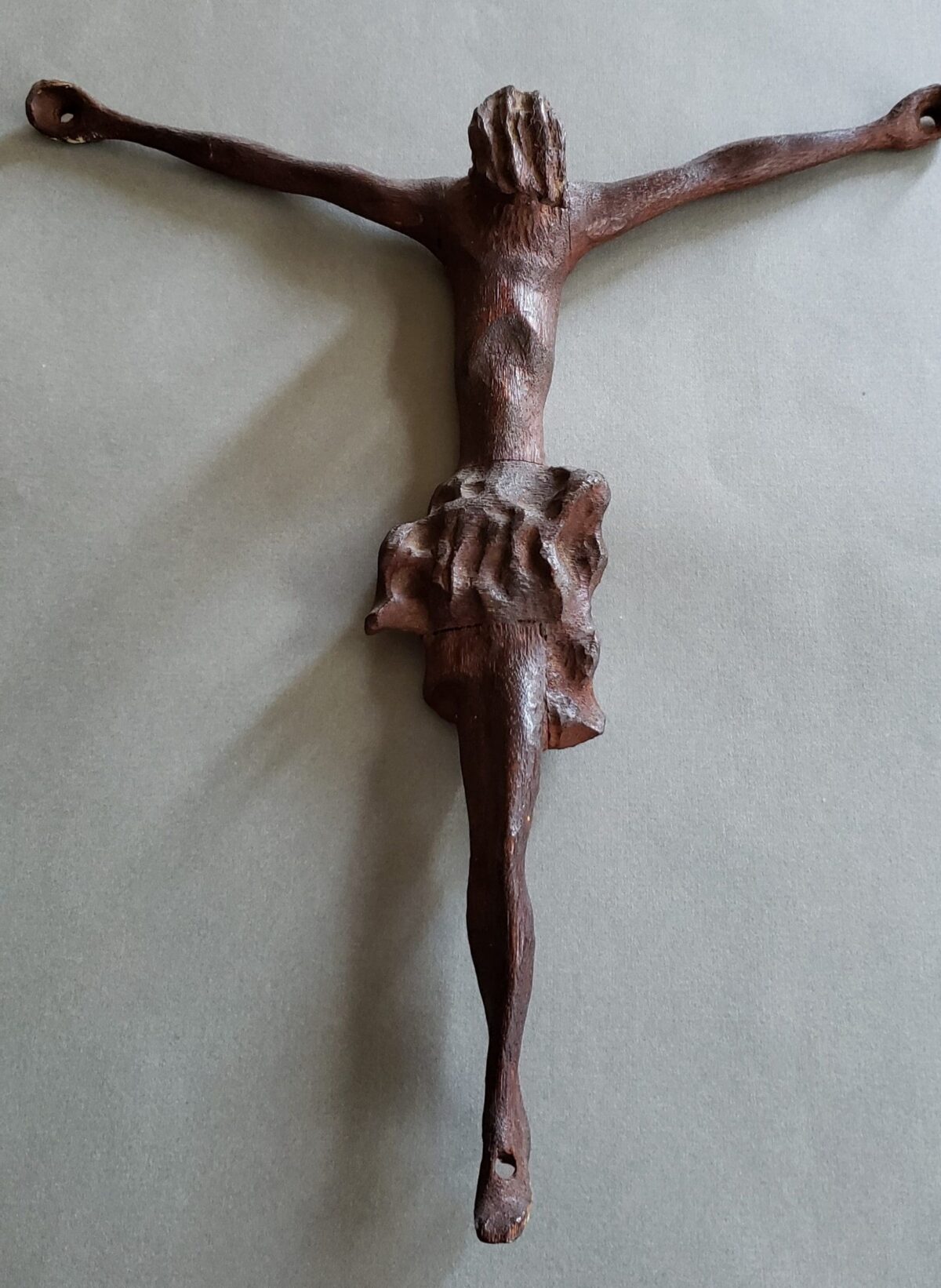
Throughout the 1960s the human figure returned to Estopiñán’s art, often in specifically religious images. During this decade drawings and sculptures of crucifixes, crucifixions and Calvaries appeared by the dozens, together with his continuing representations of political prisoners along with warriors and exiles. Ranging from minimalistic simplicity to dramatic expressionism, these works communicate depth of feeling and religious intensity. Estopiñán viewed his challenge as translating his inner life, his faith, into these works. I believe he succeeded; those works are grounded in profound Christian belief.

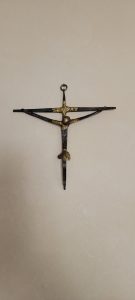
Estopiñán, Crucifix, 1962

Years later Estopiñán recalled: “I wanted to be true to myself, which meant being a modern artist and a believer. [Georges] Rouault and Barlach could do it, as well as abstractionists like [Alfred] Manessier and [Jean René] Bazaine. But so could artists who were not traditional believers, like Matisse in the chapel at Vence, like Germaine Richier’s crucifix in the church at Assy. I am not talking of grotesqueries like Le Corbusier’s church [an asymmetric concrete chapel with tiny windows erected in 1955 in Ronchamp, France], but something deep and clear and balanced.”

During the 1970s Estopiñán’s style shifted toward a more organic figuration, reflecting his desire to convey a synthesis between the human body and plant life. By the 1980s he had arrived at a new classicism, austere and simplified, in which the female torso whose renderings he became famous for and the political prisoners who continued to haunt him were his most constant themes, right through the end of his life.

Estopiñán, Untitled (Double Female Torso), 1985

In 2002 Estopiñán and his wife, Carmina Benguría, a performance artist and fellow exile, moved from New York to Miami. There he produced two etchings with crucifixion themes, carved a study for what he called a “resurrection crucifix,” which he hoped to make life-size for a chapel, and made drawings for a sculpture of a Madonna and Child (now in the collection of the chapel at Xavier University in New Orleans) that he was not able to execute.

Shortly before his death at age 93 I interviewed him for the last time. I asked, “Tell me in one sentence what your work is about.” He responded, “It’s about opening up matter–stone, wood, metal–and allowing the Spirit to dwell. In the end, I am merely a tool of God.”

Estopiñán, Study for a Resurrection Crucifix, 2002

Roberto Estopiñán pursued an authentic modern art that was also reflective of his intense Catholic faith. Hans Urs von Balthasar had raised “the God question and modern man” as an expression of the difficulty of maintaining Christian belief in a radically secularized and nihilistic age. Estopiñán provided an answer.

Editor: We asked Alejandro Anreus, a professor of art at William Paterson University, for his biography. He replied: “I came into exile with my mother, grandmother, and two aunts in 1970 in the ‘Freedom Flights’ set up by the LBJ administration. I was short of being ten years old by less than a month. Through anti-Castro human rights activism, I met Estopinan when I was 16 years old, and he became a father figure for the rest of my life. He introduced me to Orwell, Silone, Weil, Merton, also anti-Leninist Marxists like Rosa Luxemburg and Victor Serge, since he was a strong believer that to counterattack Marxism, you need to read it and know it. I organized two major exhibitions of his work; an important three-person show in 1992 at the Montclair Art Museum, and a retrospective of his prints at the Jersey City Museum in 1996. In 2019 I edited a book of interviews ‘Roberto Estopinan. In His Own Words’ published by ARS Atelier Press in Guttenberg, NJ. I have a Ph.D. in art history from the Graduate Center, CUNY, and I am the author of 6 books on Latin American art, and over 60 catalog essays, articles, and reviews, which have appeared in Art Nexus, Commonweal, Third Text, Art Journal and the Madrid-based digital periodical Diario de Cuba.”

I Point My Tan-Topped Hands To Him, (a God poem)


wind myself up the way my buddy,
Dave, taught me when I was fifteen,
kick my leg toward high heaven
land on it, pivot,
and throw him everything I’ve got,
circuitously wrapped in the hardest,
throwable sphere I can find.
In his perfect swing
(didn’t realize he knew baseball),
he smashes me a line drive
in such a non-elapse of time
that the morsel becomes juicy,
pierces my chest cavity
to lodge in my heart.
I gasp in delight that he takes
so much attention with me.
I throw up my glove –
can’t use it on him.
Everyone * laughs.

*Hebrews 12:1

Fr. Phil Flott is a semi-retired Catholic priest from Omaha. NE. He has written most of his life and been published hundreds of times in journals such as, Pensive Journal, Sangam, and Vita Poetica. He is a member of Catholic Literary Arts.


Subscribe to Our Emails