The First Cathedral in the World Built After Vatican II Turns 50


“Mary is a mother figure and the mother of God’s Son. 
She is ‘the highest honor of our race,’ as the Book of Judith states. 
She is the perfection of the human person kept free of sin. 
That motherly love touches the heart of anyone who loves her Son. 
So many central mysteries of our faith and salvation came through her.”

Archbishop Salvatore Cordileone of San Francisco
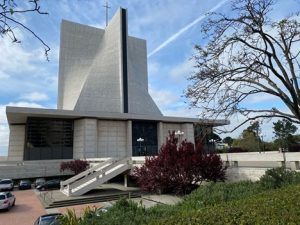
Already when one first approaches, St. Mary’s Cathedral surprises.

In densely-packed San Francisco — so tightly constrained by the belt of the Pacific Ocean in the west, the Golden Gate Straits to the north, the Bay in the east, and other cities to the south — in such a city of tight neighborhoods, the vast open expanse around the cathedral catches one by surprise.

Majestic and iconic and one of the most famous landmarks of San Francisco, the Cathedral of St. Mary of the Assumption sits on the edge of a steep hill.  

The horizon behind the cathedral is therefore not cluttered by other buildings but instead shows only the open sky. Especially on evenings, or when the fog drifts in from the west, the cathedral seems to float between earth and sky — an appropriate image for Our Lady rising upwards, assumed from Earth into Heaven. 

Since the open air parking lot that brackets the cathedral is sunk below ground level, as one approaches the cathedral from the street, or having walked up the wide stairs from the parking to the street level, one finds oneself on a broad plaza that functions as a wide bridge leading to the cathedral.  The sunken parking lot functions almost like a moat and gives the cathedral the appearance of an island.  This physical separation from its surroundings, plus the brilliant white marble exterior and the soaring, unusually sinuous roof, crowned by a 55 foot cross, clearly indicate that one is approaching a holy place.  Traditionally, cathedrals have often been described as a “Gateway to Heaven”  or as a “Bridge to Heaven” — but very few cathedrals have incorporated this image to such a visual degree as St. Mary’s Cathedral.  

St. Mary’s is the third cathedral built in San Francisco.  The first cathedral was commissioned by the first Archbishop of San Francisco, Joseph Alemany. 

Opened on Christmas Eve 1854 as the Cathedral of St. Mary of the Immaculate Conception, it was the first church to be so dedicated — the doctrine having been officially promulgated just three weeks earlier.  The cathedral was the tallest and largest building in Gold Rush San Francisco, and it ministered not only to the spiritual needs and challenges of “the wickedest city in the West”, it also served as a major educational center and cultural center, hosting sacred music programs with full orchestra and featuring some of the greatest singers in the world as they passed through this roaring, gold-drenched city.

As San Francisco’s explosive growth continued, so did the size of its Catholic population.  Although contemplating retirement after 31 years, Archbishop Alemany organized plans for a larger cathedral in one of the newer western districts of the city. His successor, Archbishop Patrick Riordan, completed and dedicated the new cathedral, St. Mary of the Assumption, on January 11, 1891.  The original cathedral, meanwhile, became known as “Old St Mary’s”, was given to the recently formed Paulist Fathers, and still stands today in the district now known as Chinatown.

The new cathedral, a grand Victorian edifice, with its large (and exhausting) sweep of stairs to the main portal and its powerful Neo-Romanesque features, survived the massive earthquake of 1906 with minimal damage, and also escaped the resulting catastrophic fires which annihilated much of San Francisco, including the entire downtown areas.  

St. Mary’s then witnessed the swift reconstruction of the city, a succession of four archbishops, and the economic booms which the First and Second World Wars brought to San Francisco.  But on September 7, 1962, St. Mary’s was severely gutted by a fire, when a stand of votive candles was knocked over accidentally.  Although much of the core structure was still intact, the roof was gone and most of the interior was a  shambles.  Rather than repair this cathedral, the new Archbishop, Joseph T. McGucken, who had been in office a mere six months, chose to build a new and even larger cathedral a little further west on the crest of that same hill.

Archbishop McGucken hired three local San Francisco architects:  Angus McSweeney, Paul A. Ryan, and John Michael Lee.  The Archbishop expected the following for the new cathedral’s design:

“It should not be built to look like a tent (tabernacle), nor a crown, nor a fortress, nor an arena. It should look like what it is — a temple of divine worship whose walls enshrine a Holy of Holies and embrace a congregation of worshippers.  The external appearance of its various parts should indicate the sacredness and importance of their interior function.”

But the early sketches, ranging in styles from Neo-Romanesque to California mission ignited a storm of protest.  The response of Allan Temko, the architecture critic (and later Pulitzer Prize winner) for the San Francisco Chronicle, may have been the important turning point: “The Cathedral should, and can be a great building in every sense of greatness, if only the church and the city together make the best of this tremendous opportunity … the Cathedral must belong to its own people and place, but also to the world. It must express the oneness of things, as well as their ineffable mystery.”   Furthermore, Temko called for a bold new cathedral that would reveal the soul of the city and, most especially, would underscore San Francisco’s greatness as an international city of world renown.

Archbishop McGucken and his three local architects then turned to an Italian architect, Pietro Belluschi, who had worked for many years in Portland, Oregon, designed several churches in the Pacific Northwest, and who was now Dean of the School of Architecture at the Massachusetts Institute of Technology (MIT) in Cambridge, MA.  

Belluschi was originally hesitant. He wrote:

“From the beginning we were aware that this is not an age of cathedral building … Yet the yearning for spiritual goals is still a powerful force seeking expression.”  Architects find such a task difficult, he explained, because “they have for too long been engaged in building symbols of commerce.”  But Belluschi was intrigued.   “After much thought we concluded that the most promising result would lie in extracting architectural significance from the most advanced construction techniques of the day” — meaning, “our recently acquired knowledge of reinforced concrete.”   Structure would be emphasized because it was the basis for all “large scale architecture,” as it had been for the great Gothic cathedrals.  Therefore “we sought advice and help from the best engineers and the use of the most advanced testing laboratories in the world.”

To this end Belluschi brought in Pier-Luigi Nervi, also from northern Italy, who was considered one of the great pioneers in structural concrete architecture. Nervi and Belluschi envisioned a stunning hyperbolic paraboloid design, which was especially challenging given the nature of earthquake-prone San Francisco.

The planning and design of the new cathedral also coincided with the Second Vatican Council, which Archbishop McGucken attended and which was led by Pope John XXIII.  Among the many proposals for reform, the Council suggested major innovations in church design informed by a “noble simplicity”.

The second President of the Vatican Council, Pope Paul VI, described his vision of a new cathedral: “in the majesty of the building, it is a symbol of the spiritual temple that is built up in souls and is resplendent in the glory of divine grace … the cathedral, furthermore, should be regarded as the express image of Christ’s visible Church, praying, singing, and worshipping on earth.” The Council thus made very specific changes to the interior layout of a church. McGucken, Nervi and Belluschi were inspired.  

Archbishop McGucken advised his architects that he wanted: “a cathedral that would accommodate large numbers of people; one that would enable even large crowds to surround the altar; and a structure that would be a statement that God is present in beauty in the earthly city.” San Francisco now had the opportunity to build the first cathedral in the United States “that was inspired by the liturgical vision of the Council.” Pier-Luigi Nervi called the new cathedral they were designing, “the first cathedral truly of our time and in harmony with the liturgical reforms of the Council.”

Preparations for construction at 1111 Gough Street began in August 1965.  The cornerstone was blessed on December 13, 1967,  the new cathedral opened its doors in October 1970,  and was formally blessed on May 5, 1971.  It had cost $9 million to complete. The new cathedral complex also included conference rooms for banquets and meetings  (today the Event Center), a residence for the Archbishop, and a new high school building (today Sacred Heart Cathedral Preparatory), located on what is now called Cathedral Hill.   

The modernity of this cathedral was startling for its time, especially given the far more traditional designs of its predecessors. And that modernity is startling still today.

Yet despite its abstract forms, St. Mary’s is rich with traditional, or, perhaps more accurately, with timeless Catholic symbolism and Christian mysticism. 

Stretching broadly in front of the cathedral is a wide plaza that consists of white stone designs that outline a procession of red brick crosses — together the stark white and warm red patterns are meant to reflect the Spanish mission heritage of California.
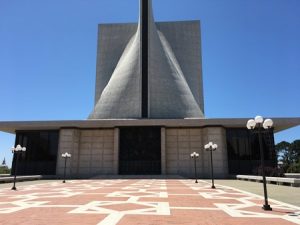
As visitors approach the cathedral across this plaza, one’s attention is caught by the striking, curving roof that crowns the cathedral, the exterior covered by white Italian travertine marble. The later Archbishop of San Francisco, William Levada, interpreted the design as follows:

“The distinctive shape of St Mary’s Cathedral is meant to evoke the image of the meeting tent which housed the Ark of the Covenant during Israel’s 40-year desert journey from slavery into freedom.  That tent was a reminder for the people of Israel as well as a sign to the nations that God had definitely  “pitched his tent”  with his people, traveling with them on their pilgrim journey and sharing with them their joys and hopes, their sorrows and tribulations.  That revelation of God’s presence with his people was but a foreshadowing of the marvelous fulfillment of the Incarnation of the Son of God, when Jesus Christ took our flesh from the womb of the Virgin Mary and dwelt among us.”

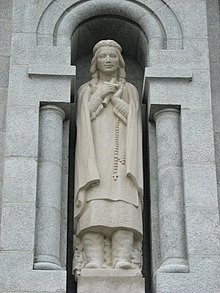
The monumental bronze and glass entrance to the cathedral is dominated by an enormous overpanel above the doors. This entrance was created by the northern Italian sculptor Enrico Manfrini (1917 – 2004), called the “sculptor of the Popes” — having known and portrayed all popes from Pius XII to John Paul II.  A friend of Pope Paul VI, and recommended by him, Manfrini had already acquired fame for his sculpted cathedral doors in Siena, Rome and Damascus, and he also later crafted the ring of the fisherman worn by Pope Francis.
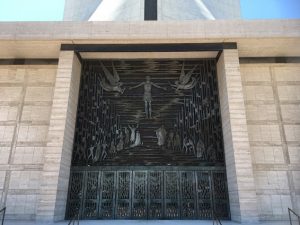
The entrance overpanel of St. Mary’s is dominated by the risen Christ, whose arms are stretched out — not only as a reminder of the Cross, but also stretched out as a gesture of welcome to all who approach.  On either side, two angels rush in.  Beneath Christ, people gather along the contours of a hill, left and right.  On the lower far left, two men are fighting bitterly, another man near them points up towards Christ, suggesting He is the only source that will end conflict.  Other men and women, some with children, ascend. Manfrini, working in Italy, had wanted to include local elements, and therefore at the top of the hill on the left, one finds St. Francis of Assisi  (the patron of the city of San Francisco) and to his left, kneeling in adoration, St. Clare of Assisi (the patron saint of the nearby Santa Clara Valley, today better known by its nickname “Silicon Valley”). Also kneeling below Christ is Pope Paul VI (pope at the time of the completion of the cathedral), his papal triple crown set aside in a gesture of humility.  

At the lower right of the overpanel, three pairs of men represent compassion, reconciliation, and cooperation.  Above them, a family stands before the Virgin Mary, who gathers the Christian family together and leads them to Christ. 

The current Archbishop, the Most Rev. Salvatore Cordileone, elaborates on this role of Mary: Just as Mary had a special role in mothering God’s son, she has a special role in mothering each of us into the life of her son — we don’t need Mary to point us to Jesus.  Archbishop Cordileone continues:  “We know where He is.  He’s in the tabernacle, in the sacraments, in His word.  He is present in the church.  Rather, what we need is someone to pick us up and carry us to Him, because we are too weak to get there on our own.  In her maternal presence, Mary is there to advocate for us.”

Here in the entrance overpanel, Mary does indeed carry out the role of advocate for those who turn to her.

Below the overpanel are the row of five double-doors, sculpted in the form of thorny, jagged, almost impenetrable branches — a “tanglewood”, Docent Maryanne Murray explains, that “represent’s life’s difficulties.”  Generally, one or two of the doors are always open.  But if all the doors are closed, their appearance is most effective. As one reaches for a door handle, one realizes that the door handles are in the forms of serpents and dragons and similar reptilian monsters — and instinctively, one hesitates. 

These “serpent doors”, the docent explains, “signify the evil that confronts us as we pass through life.”

As one steps through the entrance doors into the great interior of the cathedral, nothing prepares visitors for what they now see — an immense space that soars almost 20 stories high — considered to be one of the most extraordinary interior spaces in all of modern architecture.
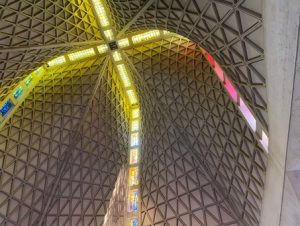
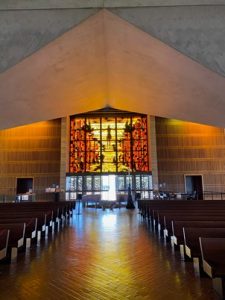
A massive, triangle-coffered roof, which begins almost at floor level, curves upward, rising ever higher. At the top, where one would ordinarily expect supporting girders and trusses to hold the steeply climbing roof in place, there are instead glass openings, not supports.  The soaring roof ends at the top in 4 banks of bright yellow stained glass skylight windows which together create an enormous light-streaming cross.

Each of the four arms of the cross extends down as four thin vertical shafts of stained-glass windows, “extending to the four points of the compass”.  Each shaft of stained glass is dominated by a different prominent color to represent the four basic elements: red for fire, blue for water, green for earth, and gold for air. 

The stained glass windows were designed by Prof. György Kepes, called a master of the mystery of light.  Initially a Hungarian photographer, he eventually joined MIT as a professor of visual design, “the first artist at MIT”, and established at MIT the Center for Advanced Visual Arts. 

What makes this massive coffered dome all the more remarkable is that the dome ends near the floor in four pylon piers — pylons which seem remarkably small for the gigantic concrete dome which they support.  The pylons slope up and become ever thinner, culminating at their smallest point in a circumference of only 24 feet, making the connection between these pylon piers and the dome they support look remarkably thin and fragile. The pylons, upon which the dome rests, nevertheless extend, unseen, almost 100 feet deep into the ground to reach bedrock, and each pylon supports nearly 10 million pounds of pressure.
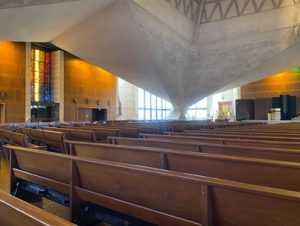
From an architectural and engineering point of view, the sinuous dome of this cathedral is a masterpiece, one of the greatest accomplishments for both Belluschi and Nervi.  Many an expert, and many a layperson, has commented on how unnerving it is to see such a massive interior concrete dome resting on such proportionately small pylons and the even thinner connection between them. Architect Brad Dunning writes:  “Nervi pushed the limits of reinforced concrete to the extreme; maybe when visiting here we all should believe in God for safety reasons alone, given the extreme, logic-defying cantilevers and load-bearing abstractions on display.”

Behind each of the pylons there are immense corner glass windows, and with the light that streams in here at each corner, the pylons look even more delicate.  Again, because the pylons slope up, making the connection between these pylon piers and the dome look remarkably thin and fragile, it looks as if the pylons are being stretched upwards, as if their concrete is stretching ever thinner, giving the impression that the entire structure of the dome is rising upwards.  Similarly, the shafts of the stained-glass windows create the impression that the dome is pulling apart :  just as the dome of an astronomical observatory parts to reveal the night sky, the dome of St. Mary’s seems to pull apart to reveal the first glimpses of the mysteries of Heaven.

The concrete structure of the soaring roof, free of internal supports, allows for completely unobstructed views of the altar from almost anywhere in the nave.  One of the innovations of Vatican II was to turn the altar so that the priest, the celebrant, would face the worshippers. Furthermore, a division between the sanctuary and the nave, between the altar and the parishioners, was also to be removed in order to emphasize “the unity of the Whole People of God in worship.”

Archbishop McGucken explained, “Essentially, all artistic and architectural elements should unite the worshippers, drawing them toward the altar to be participants in the sacrament, rather than seated passively in the congregation watching the clergy.” Thus, the pews radiate outwards from the sanctuary on three sides in such as way, that no worshipper is more than 75 feet away from the altar. Over 2400 worshippers can be seated and there is standing room for 1500 more.

At the four corners of the cathedral, the immense corner windows allow expansive views outside, giving the nave an even greater sense of space.  Thus, one never entirely loses view of the city beyond the cathedral — a reminder that the church has an obligation to interact with the modern world. The former rector of St. Mary’s, Monsignor John Talesfore, writes: “Ancient faith and modern technology combine to create a monument to the praise of God that draws our eyes both upward to heaven in the graceful sweep of the cupola and outward to the four corners of our beloved city and the world to which we are sent in eager service.”

To retain a sense of its sacredness, the sanctuary itself is raised up 6 steps, which also makes it easier for the worshippers to see the altar, the ambo, and the unfolding of the liturgy. The sanctuary exhibits the “noble simplicity” that the Vatican II reforms had advocated.
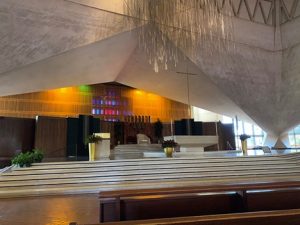
The altar is a single 20-ton block of cream white Botticino marble from northern Italy, the same marble also used for the nearby ambo, as well as the baptismal font at the entrance to the cathedral. Sister Michaela O’Conner, archivist for the Sisters of the Holy Family, recalls, “I learned that the white marble of the ambo, font and the altar were taken from the same part of the quarry in Italy so that their grain, color and attributes would be the same, reflecting the unity of baptism, Eucharist, and the Word of the Lord.” As in any traditional cathedral, here, too, beneath the altar are relics, including relics from St. Francis and a piece of the casket of St. Damian of Molokai. 

The cathedra, too, the throne of the Archbishop, is made of the same white, gently carved stone.  At the cathedra’s base, two bronze candelabra stand with seven angels total, each with a scroll bearing a popular title for the Virgin Mary. Behind the cathedra rises a rosewood reredos, a screen with very little ornamentation except for a bronze coat of arms of the Archbishop. Originally the coat of arms belonged to that of Archbishop McGucken;  today the coat of arms displayed are those of the current Archbishop Cordileone.  The left part of the heraldic shield shows the insignia of the office of the Archbishop of San Francisco itself:  the crossed arms and hands with the stigmata, representing Jesus Christ but also St. Francis of Assisi, the patron of the city.  The right part of the shield shows a lion holding a heart, the translation of the Archbishop’s family name, Cordileone (cor di leone — heart of a lion); below the lion, a California crab represents the line of fisherman of the Cordileone family.  The banner below the shield displays the motto In Verbo Tuo — “At Your Word” — referring to the Gospel story in which Jesus tells Simon Peter and his companions to cast their nets again.  Simon Peter responds,  “Master, we have toiled all night and took nothing.  But at your word I will let down the nets.” Behind the coat of arms and the reredos, wooden stave paneling creates the sense of a fragile wall through which shines an ethereal cross of colored light.

When one first enters the cathedral, one sees not only the soaring dome.  Movement also captures one’s attention: glistening high above the altar, what seems at first glance to be like rays of shimmering light descend downwards over the altar.

This baldacchino is a collection of several thousand thin metal rods, catching the light, then disappearing, then reappearing once more.
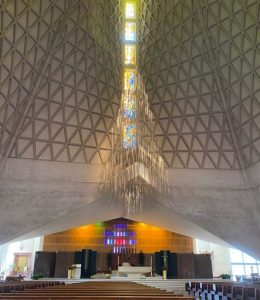
This sculpture was designed by Richard Lippold, who believed, like many artists, that art should “deepen the mystery”. The evanescent baldacchino and the long golden cross that floats below it, directly above the altar, reinforce the sacredness of the sanctuary.   “At once still and yet moving, answering light to light in its silence.” This towering sculpture, Lippold explains, may be “perceived as an angel” or the “luminous robe of the Virgin”, or “a Divine presence above the most holy space in the church.”

Monsignor Talesfore again: “Light bathes the interior space through the immense overhead cross of golden glass that continues down the four sides in green, white, red and blue to represent the four elements of earth, air, fire and water – and all that God has made new in the death and resurrection of Christ. Surely no other space could provide us a better opportunity to contemplate the mystery of God’s presence and action in our lives, captured in perhaps the most evocative piece of American religious art of the 20th century, Richard Lippold’s 150-foot baldacchino sculpture, 4,000 concave aluminum rods that appear to shower light down upon the altar, leaving the visitor no doubt where our faith sees heaven meeting earth.”
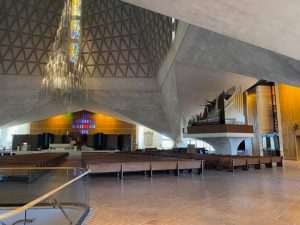
To the right of the sanctuary, one can see the spectacular Ruffatti organ  It sits on a large pedestal that curves up and outwards — giving the impression that the organ itself has just risen up through the floor.  Made in Padua, Italy, it was built especially for St. Mary’s by Famiglia Artigiana Fratelli Ruffatti, a family firm established in 1940 and carrying on the centuries-old superior Venetian traditions of organ building.  With 4 manuals, 72 registers, 89 ranks, and a total of 4,842 pipes, and with a 70 stop electro-pneumatic system of solid-state circuity providing instant and noiseless operation, it is considered to be one of the finest organs in the world.
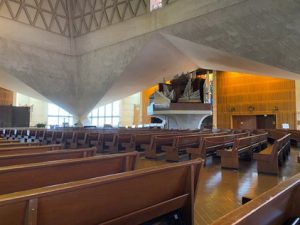
On the cathedral wall behind the organ are the first set of 7 simple sculpted reliefs for the Stations of the Cross by Delph Ell — again a noble simplicity.  “The fourteen sculptures by Delph Ell offer an opportunity for modern-day pilgrims to reflect on the depths of Christ’s suffering out of love for us.”    Appropriately, these seven Stations are located above the confessionals, flanking the side entrance.  The other set of 7 Stations are found on the opposing wall around the second side entrance.

Traditionally, a cathedral has a series of side altars, and St. Mary’s, too, has a series of large bronzes, patronal shrines, set in the 8 niches around the body of the cathedral, which serve as an example of the teaching function of the cathedral.  Like the great bronze entrance, six of the bronze niche sculptures were also made by Enrico Manfrini, and completed by his student, Mario Rudelli.

The overarching theme of the six bronze patronal shrines is the Virgin Mary as the first disciple of Christ and as a model of Christian discipleship for all who follow Him.  Each bronze is accompanied by plaques which highlight Mary’s role in these significant events and how her role deepens an understanding of the nature of discipleship. 

Each of these bronze sculptures weighs approximately two tons but is suspended above the ground by unseen steel bars, so that the bronzes appear to be floating, giving the scenes depicted an even greater transcendent quality.  The scene of each bronze and an example of the accompanying teaching follows:

THE VISITATION  — “The Disciple Serves Christ in Others”

After Mary says ‘yes’ to God’s plan for her to be the mother of Christ, she immediately journeys to the home of her cousin Elizabeth and stays with her until the birth of Elizabeth’s child, John the Baptist.  Our Lady is portrayed here waiting on her elderly relatives, for discipleship finds expression in the works of charity, even — or especially — in the tasks of daily life.”

THE FLIGHT INTO EGYPT — “The Disciple Shares in Christ’s Rejection”

No sooner is Christ born than the shadow of the Cross falls: Herod seeks to kill the child, and the Holy Family must flee to Egypt.  The newborn Christ shares the fate of those who come to our shores from many countries to escape violence, repression and poverty.”

WEDDING FEAST AT CANA  — “The Disciple Turns to Christ in Faith”

In St. John’s Gospel, Mary appears only twice: at the beginning and the end of Jesus’ public life. Here, at the Wedding Feast at Cana, Jesus performs his first miracle.

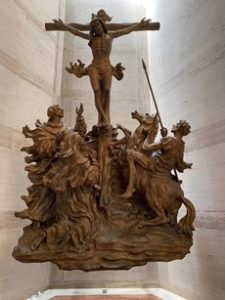
THE CRUCIFIXION — “The Disciple Draws Life from the Pierced Heart of Christ”

In St. John’s Gospel, this is also the hour of his victory, for from death will come resurrection and the birth of the Church.  At the foot of the Cross stand Mary and the Beloved Disciple. The dying Jesus brings into existence a new family:  “Woman, behold your son; son, behold your mother.”  The centurion is poised to pierce the side of Christ with a lance.  With this act, he will reveal the heart of Christ, from which flows blood and water — the sacramental life of the Church.

PENTECOST — “The Disciple Receives the Spirit in the Community of the Church”

After Our Lord’s Ascension, the disciples gather in prayer with Mary to await the outpouring of the Holy Spirit.  On Pentecost, the Spirit descends on them as tongues of flame.

Below the bronze, two angels hold up the shrine of the Holy Oils  “used in sacramental anointings…visible signs of the strengthening, healing and sanctifying power of the Holy Spirit.”

THE ASSUMPTION OF OUR LADY INTO HEAVEN  — “The Disciple Inherits the Gift of Eternal Life”

Since Mary has shared so intimately in the mission of her Son, it is fitting that she should be the first to experience the fullness of his victory over death. Here we see the reward of discipleship, as angels carry her bodily into the glory of heaven.  We believe that by taking up our cross and following Jesus, we too will receive from him the crown of eternal life. Mary’s Assumption offers a sign of hope to the pilgrim Church on earth as we await Christ’s return in glory.”

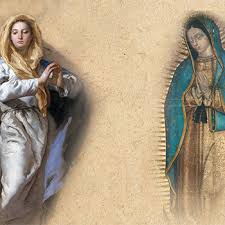
Finally, the last niche is located to the right of the sanctuary and holds a mosaic of Our Lady of Guadalupe from Mexico. 
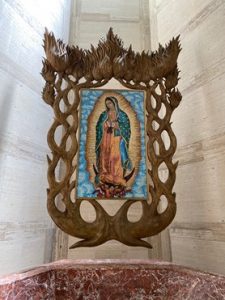
Msgr. Thomas Bowe, the first rector of the cathedral (1962-1981) outbid screen actress and legend Dolores del Rio for this mosaic. A new frame was then fashioned for it by Manfrini as well.

THE SHRINE OF OUR LADY OF GUADALUPE 

Our Lady of Guadalupe is one of the most beloved pictures of the Mother of Christ in the Americas.  In 1531 a young man, Juan Diego, “had a vision of the Mother of God, and the image of the woman he saw miraculously appeared on his cloak. That image, reproduced here, melds the European and Aztec cultures, uniting them in a common faith. The bronze frame portrays the Burning Bush encountered by Moses, the event which marked the beginning of God’s deliverance of his People.”

Opposite, to the left of the sanctuary, one finds the Blessed Sacrament Shrine, identified with the symbols of bread loaves and fishes, and the words of St John the Baptist:  “Ecce Agnus Dei !” — Behold the Lamb of God.

These bronze patronal shrines by Enrico Manfrini and Mario Rudelli were completed over a period of approximately 25 years.  The first arrived under Archbishop McGucken (1962 -1977), who oversaw the construction and completion of the new cathedral.  Nearly all remaining bronzes gradually arrived under his successor, Archbishop John R. Quinn (1977-1995).

Like his predecessor, Archbishop Quinn received many distinguished visitors at St. Mary’s Cathedral.  In June 1982, for example, while on a nationwide speaking tour, Mother Teresa attended the celebrations in San Francisco for the 800th anniversary of the birth of St. Francis of Assisi.  Speaking to over 4,000 people inside St. Mary’s Cathedral, she encouraged her listeners not to shun but to get to know the poor and to learn how to love them and to help them. 

Five years later, in 1987,  Pope John Paul II celebrated the first papal mass in this cathedral. One nun who attended, Sister Pat Hunter, recalled that when Pope John Paul arrived, the normally so restrained sisters stood on the pews and cheered. During his San Francisco visit, Pope John Paul shocked the press and the public, when he held in his arms a 4-year-old child, Brendan O’Rourke, who was dying of AIDS. In a time in which there was great fear and much ignorance about how one could contract the disease, Archbishop Quinn explained, “Pope John Paul II was one of the first world leaders to breach the barrier and embrace a person with AIDS.  Holding Brendan, John Paul was a living embodiment of the compassion of Christ.”

Two years later and less than 20 years after its completion, St. Mary’s faced its most dangerous physical challenge: a powerful, 6.9 magnitude earthquake rocked the Bay Area.  The Loma Prieta earthquake of Oct 17, 1989 inflicted considerable damage to the region; over 60 people were killed and almost 4000 injured. But like its predecessor in 1906, the new St. Mary’s survived this earthquake virtually unscathed.  Pier-Luigi Neri’s structural engineering genius was proven in a most spectacular fashion.

Archbishop Quinn served in San Francisco until 1995.  Pope John Paul II then appointed William Levada to be the new Archbishop (1995-2005).  Asked whether he expected to be made a cardinal, Levada replied: “There is only one cardinal in California. He is in Los Angeles. Being a cardinal is the consolation prize for not being the archbishop of San Francisco.”  (Nevertheless, Archbishop Levada did in fact become Cardinal later.)

Under Archbishop Levada, the last of the bronze patronal shrines was installed, and he therefore presided over the formal dedication of the cathedral to St. Mary of the Assumption on October 5, 1996, along with retired Archbishop John Quinn.

Upon Archbishop Levada’s departure, Pope Benedict XVI appointed George Hugh Niederauer as Archbishop of San Francisco on December 15, 2005.   Six years later, the Archbishop underwent major heart surgery, and he retired the following year.

The current and 9th archbishop, Salvatore Cordileone, also appointed by Pope Benedict XVI, was installed on the feast day of St Francis of Assisi on Oct. 4, 2012.

In his inaugural homily, Archbishop Cordileone stressed the power of the rosary:  “Let us not underestimate the power of this prayer, which has brought about true miracles at other turning points in the history of the Church. The daily rosary, prayed individually and, especially, together in the family, is a time-tested means of acquiring spiritual stamina in the face of temptations to settle for mediocrity in the life of faith and even the abandonment of faith altogether.”   The Archbishop also reminded those attending of the “joy of believing”:  “Joy is the hallmark of the authentic Christian life” — a joy that is not “the passing happiness of pleasurable experiences” but a joy “that is, deep, abiding, lasting.” 

Since its opening, the Cathedral of St. Mary of the Assumption, like its predecessors, is a great center of liturgy and worship, of culture and education.   Hundreds of schoolchildren are conducted through the church each year by well-trained docents to “share with them the history and beauty of this magnificent spiritual space,”  writes Mary Hehir, the first director of docents.  And thousands of students celebrate their graduation from high school and from college here.  The cathedral has hosted countless cultural and civic events, and it remains one of the main tourist attractions of San Francisco.

And St. Mary’s, again like its predecessors, has also been a major center of music, especially under Archbishop Cordileone, who has re-affirmed the Church’s role in sponsoring great works of art.  Recently, as a tribute to Our Lady of Guadalupe, the patroness of Mexico and all the Americas, Archbishop Cordileone commissioned Frank la Rocca, composer-in-residence at the Benedict XVI Institute for Sacred Music and Divine Worship, to create a “Mass of the Americas” in the great sacred music tradition of the Church. Archbishop Cordileone explained his motivation as follows:

Every year in the Archdiocese of San Francisco, we have a big celebration of Our Lady of Guadalupe, patroness of both Mexico and all the Americas, on the Saturday before her feast day, with a procession and a Mass at St. Mary’s Cathedral. Last year, I realized that Saturday, Dec. 8, was also the Solemnity of the Immaculate Conception, patron saint of the United States. Our Lady is the mother of all God’s children, and I thought that in the midst of so much division and contention in our society, she can unite us. I asked Frank La Rocca …  to compose music for a Mass for Our Lady that incorporated sacred music and the melodies of songs Mexican people sing to celebrate Our Lady, so they would connect with it.  I told him that my idea for this composition was inspired by the way the Franciscans had built their mission churches. They were traditional Catholic churches, but local materials were employed, like adobe. That artistic style reflects the creation of sacred art in the Catholic Tradition.

This Mass includes music in Latin, English, and Spanish. There is a ‘Hail Mary’ in Nahuatl, the same Aztec language that Our Lady used to speak to St. Juan Diego.”

The Mass of the Americas was first celebrated on Dec 8, 2018, in St. Mary’s Cathedral.

For all of its fame and its prominence on the San Francisco skyline, St. Mary’s has not been without its critics. From the moment its creation was first announced and throughout its construction, opponents complained about the design, but most especially about the cost. Vocal demonstrators protested during the opening festivities.  Dorothy Day, the co-founder of the Catholic Worker Movement, who served the poor for over 40 years, visited St Mary’s in San Francisco shortly after its completion. As one of the greatest advocates of Christian social justice of her time, she attended a meeting in which once again the most long-standing and bitter grievance against the construction of the cathedral was articulated: that the money used to build this monumental church could have been better allocated to help the poor. Naturally, these critics expected Dorothy Day to agree. But unexpectedly, she did not. Instead, she replied:

“The church has an obligation to feed the poor, and we cannot spend all our money on buildings.  However, there are many kinds of hunger.  There is a hunger for bread, and we must give people food. But there is also a hunger for beauty — and there are very few beautiful places that the poor can get into. Here is a place of transcendent beauty, and it is as accessible to the homeless as it is to the mayor of San Francisco. The  Cathedral in San Francisco is one of the few places where the poor can go and sit down and be with God in beauty …”

Fifty years later, Archbishop Cordileone, too, reaffirmed the human need for beauty.

“Perhaps what the poor most lack in their lives is beauty:  being dignified by that beauty which ennobles and elevates the soul, assuring them of their equal dignity as a fellow child of God whom God created in His image and likeness.”

The aesthetic, cultural, and spiritual value of the cathedral was also underscored by Monsignor John Talesfore. “No human endeavor matches the building of a cathedral.” 

A cathedral is “the very pinnacle of what we recognize to be noble, beautiful and outstanding in all of human activity and accomplishment.”

In 2017, St. Mary’s was designated by Architecture Digest as one of the 10 most beautiful churches in the United States.

Pope Benedict XVI, for whom the role of beauty was an important part of his teachings, wrote that an emphasis on beauty is an “important part of the Catholic vision”, and that there is a vital connection “between beauty and the Christian vocation.”  

“Beauty is a path to God, who is the source of all beauty.”  Pope Benedict called for “new ‘epiphanies’ of beauty”,  and this magnificent cathedral, St. Mary of the Assumption, has often been described as precisely this — a new epiphany of Beauty.

“When Archbishop McGucken stood in the ruins of this cathedral,” suggested Archbishop George Niederauer, “even he could not imagine what beauty would arise from those ashes.”   And Archbishop John Quinn concluded,   “St. Mary’s Cathedral is a window on the infinite, lifting the human spirit to the …. eternal beauty which is God.” 

The Cathedral of St. Mary of the Assumption celebrates its 50th Anniversary Jubilee Year from May 5, 2020 to May 5, 2021.

For 50 years, worshippers and visitors have been inspired upon entering St. Mary’s Cathedral and have been astonished by the immense soaring beauty of this space.

And when worshippers and visitors leave, they are again inspired as they depart.  

For as they finally turn to leave, the overpanel above the entrance, seen now from inside, reveals something unexpected: as the light streams yellow through the glass, the side figures are no longer men and women climbing a hill. Instead one now clearly sees instead a golden chalice, the embodiment of the Eucharist.  

And in the cup of the chalice, there appears the ascended Christ.
_____

Almighty God,
You gave a humble Virgin the privilege of being mother of your Son,
and crowned her with the glory of heaven.
May the prayers of the Virgin Mary bring us to the salvation of Christ
and raise us up to eternal life.
We ask this through our Lord Jesus Christ your Son
who lives and reigns with you
and the Holy Spirit,
one God, forever and ever.
Amen.
Nikolaus Hohmann is the Chairman of the Humanities Department at the San Francisco Conservatory of Music.


The Last Vermeer: Is There in Truth no Beauty?


The Oscars just tanked. Beautiful small but barely-watched movies, combined with boring woke politics, produced an epic collapse in ratings.

But the significance of a work of art does not ultimately lie in its ability to reach a mass market.  Now, seems as good a time as any to visit another small, beautiful film released last year about two Dutch Catholic painters. The one, Johannes Vermeer (1632-1675), is one of the greatest artists of all time. The other Henricus Antonius “Han” Van Meegeren (1889-1947) became perhaps the greatest art forger of all time.

What does it tell us about the integrity of art when the value of a painting depends on the name attached to it? This is not a new question. Another Catholic painter, Andy Warhol, played and replayed on this theme in his work. But The Last Vermeer takes exploring this question to a different level by setting up a dramatic confrontation between a Nazi hunter who cares more about truth than revenge, and an artist who ultimately chose revenge over truth.

Revenge against whom?  Against the tyranny of the modern critic over the creative artist, of course. The sneers of the critics in response to Van Meegeren’s first exhibit of paintings in Amsterdam left him humiliated and his career in tatters, but with his taste for alcohol, women, and lavish living intact.  His response was to unleash on the art market a series of exquisitely painted fake Vermeers along with a new finishing process that would foil the experts’ chemical tests used to authenticate the age of the painting.

Van Meegeren’s new Vermeers burst onto the international art scene; they were praised and pronounced authentic by the most distinguished critics and hung in major museums (including the National Gallery in the United States).

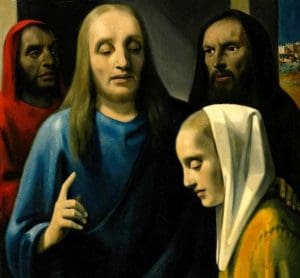
During the Nazi occupation, Van Meegeren even sold the widely lauded Christ with the Adulteress to future Nazi war criminal Hermann Goering.

Han Van Meegeren, Christ with the Woman Taken in Adultery

After the liberation of the Netherlands, Van Meegeren was charged with collaborating with the enemy, a capital crime under Dutch laws.  Van Meegeren’s spectacular defense was to declare himself an art forger who had patriotically tricked the Nazis into trading priceless looted Dutch masterpieces for fake Vermeers. To prove it, he painted a brand-new Vermeer, Jesus Among the Doctors, right in the courtroom as the two-year legal proceeding progressed (in the movie, which telescopes the action, he completes the painting while in prison awaiting trial).

It was sweet revenge for Van Meegren: the critics were publicly humiliated, and he became an instant national hero for hoodwinking the Nazis into trading genuine Dutch masterpieces for fakes.

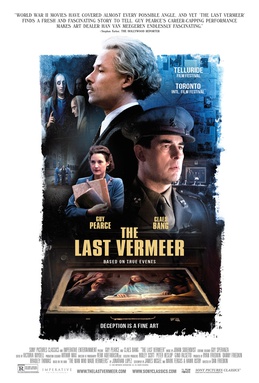
To explore its themes of integrity, the film The Last Vermeer chooses for its protagonist not Van Meegeren himself but a Captain Joseph Piller (Claes Bang), a Jewish Resistance fighter in the Netherlands who is charged with investigating Van Meegeren for the Allied Forces. While investigating the sale of Christ with the Adulteress to Goering, Piller discovers a lascivious photo of his wife, Johana (Susannah Doyle), attending one of Van Meegeren’s debauched parties with a Nazi official. The discovery severs his marriage and separates Piller from his beloved little son. Piller has every motive for pursuing Van Meegeren: doing so would satisfy a deep desire for revenge for the desecration of his wife, his people, his country.  And yet, he chooses to defend Van Meegeren in the Dutch courts. “It’s not the man, really” he explains, “it’s that he’s innocent.”

Piller’s emotional plight is tangible but nonetheless upstaged by the virtuoso performance of Guy Pearce as the suave, cultivated, and endlessly fascinating artistic genius Van Meegeren, with his elegant Amsterdam home and his extensive collection of cut-glass liquor decanters, to the point the viewer might briefly wonder why Piller’s story is in the film at all. But both performances are upstaged, at least in the courtroom scenes, by the looming presence of Van Meegeren’s fake Vermeers themselves.

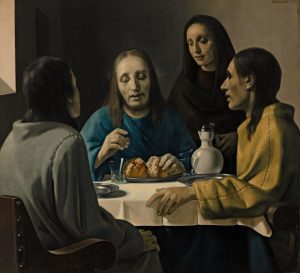
The Van Meegeren trial attracted such international attention that newsreel footage of it survives to this day, and the settings of the courtroom in The Last Vermeer faithfully replicate history.  Over the judges’ heads hang the enormous religious paintings hauled in for the trial: Christ With the Adulteress, a Last Supper, and The Supper at Emmaus, a 1937 painting that had persuaded Abraham Bredius, the leading Dutch expert on Vermeer, to pronounce the work “the masterpiece” of Vermeer’s career and thus help launch Van Meegeren’s lucrative business churning out similar paintings for museums and private collectors.

Han Van Meegeren, Supper at Emmaus

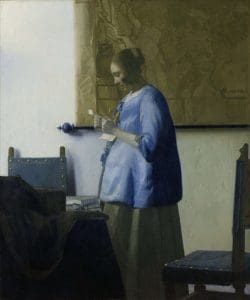
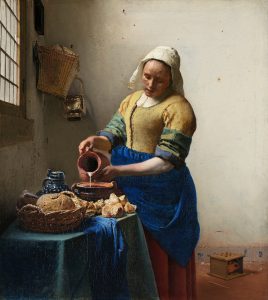
To a twenty-first-century eye, these paintings look nothing like the smaller genre paintings of seventeenth-century Dutch domestic life—The Milkmaid (1658) or Woman Reading a Letter (1664)—that we typically associate with Vermeer, but they are haunting.

Johannes Vermeer, Woman Reading a Letter

Johannes Vermeer, The Milkmaid

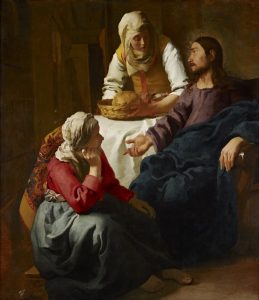
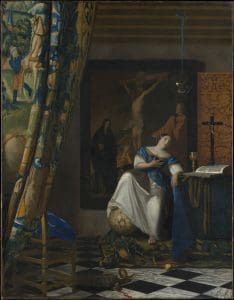
Vermeer converted to Catholicism only on his marriage to Catharina Bolnes in 1653. The sincerity of Vermeer’s Catholic faith has been the subject of long-running debate. Of the 34 paintings now universally attributed to Vermeer only two, Christ in the House of Martha and Mary (1654-1656) and Allegory of the Catholic Faith (1670-74), have religious themes, and only the latter is overtly Catholic in subject matter, depicting an altar crucifix that would have been unthinkable in a Calvinist church of Vermeer’s youth.

Johannes Vermeer, Christ in the House of Martha and Mary

Johannes Vermeer, Allegory of the Catholic Faith

But that was the nature of Vermeer’s economic and social milieu. The long, war-torn struggle of the Low Countries starting in the sixteenth century to free themselves from rule by Habsburg Spain had left the Dutch Republic an overwhelmingly Protestant country by the time Vermeer was born. Catholics, associated with Habsburg rule, were tolerated, even accepted in the social fabric, but forbidden to hold public office or worship in public. They met for Mass in warehouses and private homes, likely including that of Maria Thins, Vermeer’s wealthy mother-in-law, where the Vermeers, who never had much money, lived. Reformed doctrine forbade religious images inside churches, so there were no commissions for the huge religious paintings that were features of Counter-Reformation church decoration in the Catholic countries of the seventeenth century. Art production during the Dutch Golden Age was strictly for the private market, and market forces and fashions determined its content. While some prosperous citizens of Delft and elsewhere hung paintings with Biblical themes in their homes (which the Reformed Church allowed), most preferred smaller works with secular themes: portraits, landscapes, still-lifes, and the genre paintings at which Vermeer became a virtuoso.

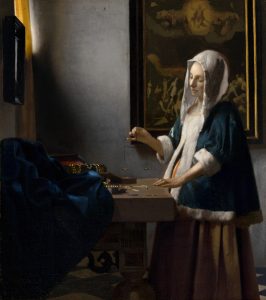
But some art historians have discerned subtle Catholic imagery even in some of Vermeer’s secular paintings. The University of Montana’s Valerie Hedquist argues, for example, that the veiled, clearly pregnant young woman in his Woman Holding a Balance (1662-1665) is an image of the Virgin Mary, and that Vermeer included in the painting such traditional Marian symbols as the pearl and the mirror. In any event, Vermeer named one of his sons Ignatius after St. Ignatius Loyola, the Jesuits’ founder and another son became a priest.

Johannes Vermeer, Woman Holding a Balance

Van Meegeren, by contrast, was born into a middle-class Catholic family in Deventer, in the eastern Netherlands. He seemed to have abandoned the practice of his faith early on, probably in rebellion against his father, a schoolteacher, who ridiculed and tried to stifle his son’s artistic talent. In one respect, however, he retained a Catholic sensibility: He revered and practiced traditional representational art, refusing to participate in the Expressionist and Cubist movements that critics of the early twentieth century baptized as the only serious art. Van Meegeren deemed them decadent. He won prizes and praise for meticulous draftsmanship and made a fair living traveling around Europe painting portraits. Then, in 1923, critics derided an exhibition of his paintings as derivative and lacking in psychological depth. He maintained that the trauma of that damning criticism was what drove him to forgery: He would play the critics for fools and prove his artistic genius by turning out counterfeit masterpieces that they would dub masterpieces.

Soon enough, working through layers of art dealers so as to protect his anonymity, Van Meegeren was flooding the art world with “newly discovered” paintings by the masters of the Dutch Golden Age: Franz Hals, Gerard ter Borch, Pieter de Hooch, Dirck Van Barburen, and, of course, Vermeer—all finely executed and plausibly resembling known works by those painters. He used seventeenth-century canvases from which he scraped the existing paint and mixed pigments from materials that the seventeenth-century masters had used themselves.

Wealthy collectors snapped up the paintings, and some ended up in museums. (Indeed, to this day it is unclear whether certain museum Vermeers are actually Van Meegerens—and a supposed Van Barburen owned by the Courtauld Institute in London was found to be a likely Van Meegeren as recently as 2011.) These were all smaller works, and by the early 1930s Van Meegeren was plotting to execute a Vermeer on a grander scale—The Supper at Emmaus–that would finance his expensively debauched lifestyle.

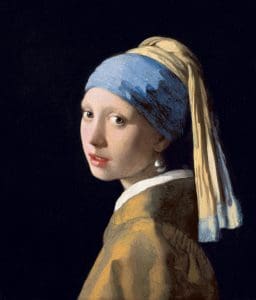
Vermeer was an ideal choice. His work fell into obscurity after his death and had few collectors. Not until the 1860s did art historians focus on his luminous genius and begin to rank him as one of the greatest of the Dutch Masters. Lost Vermeers and imagined Vermeers regularly surfaced after that, and it was not hard to believe that still more of them hung undiscovered in musty European corners. Van Meegeren spent several years perfecting a Vermeer-like brushstroke and teaching himself how to recreate the colors of Vermeer’s limited palette. He spent a small fortune on tubes of expensive genuine ultramarine, made from pulverized lapis lazuli, a semi-precious stone that makes a brilliant blue paint. Vermeer lavished ultramarine on his paintings (his famous Girl With a Pearl Earring, painted around 1665, uses ultramarine for its subject’s bright blue cap.) To achieve craquelure, the hardened, time-cracked surface of centuries-old oil paintings, Van Meegeren mixed liquid bakelite, the stuff of old telephones, into the paint.

Johannes Vermeer, Girl with a Pearl Earring

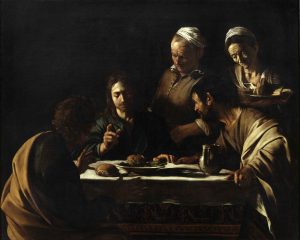
The real measure of Van Meegeren’s brilliance as a forger, however, was his fabrication of an entirely new artistic style for Vermeer. His model was not Vermeer himself, but Caravaggio. The style of that Italian Baroque painter (1571-1610) had influenced a generation of Northern European Catholic artists, especially in Utrecht, a Dutch city that remained predominantly Catholic throughout the Reformation and whose churches continued to commission art. They created their own striking versions of Caravaggio’s large-scale religious paintings: naturalism, chiaroscuro effects, and simple, dramatic compositions in which the painted figures looked as though they had been photographed at a moment of high emotion. Art historians of the 1930s wondered whether Vermeer, too, had imitated Caravaggio, especially during his early career when he made at least one known painting with New Testament subject matter (Christ in the House of Mary and Martha looks somewhat Caravaggio-esque and very unlike Vermeer’s later work). The Supper at Emmaus, modeled on a 1610 painting by Caravaggio dealing with this post-Resurrection appearance of Jesus, responded directly to the historians’ speculation. It was the missing link.

Caravaggio, Supper at Emmaus

Once Bredius enthusiastically endorsed it as a genuine Vermeer, a wealthy shipowner bought the painting for $5.5 million in today’s dollars and donated it to the Boijmans Van Beuningen Museum in Rotterdam. That opened the reputational and financial floodgates for Van Meegeren to generate and launder through his dealer network even more counterfeit Vermeers in the same style with similar New Testament themes, including the Christ With the Adulteress that he sold to Goering. Overall he earned about $50 million in today’s dollars from his ventures into art forgery.

After Van Meegeren’s conviction and death, the value of his fraudulent Vermeers collapsed. With the passage of time, they look more obviously like concoctions of the 1930s and 1940s—perhaps Van Meegeren’s version of the Expressionism he found so aesthetically deficient. It has been easy for many of today’s critics to deride Van Meegeren as a mediocre painter and the experts such as Bredius who swallowed his bait as vain, self-aggrandizing fools.

But as Friedkin’s movie The Last Vermeer suggests, the Van Meegeren affair raises genuine and complex questions about the meaning and value of art.

While watching the courtroom scenes in the film, I found myself unable to take my eyes off The Supper at Emmaus and Christ With the Adulteress. They were compelling in their stark geometric composition and their focus on the liminal and unknowable presence of Jesus as a figure who sets astonishing revelations in motion. None of those paintings was a knockoff; they were genuine originals, just not by Vermeer. What if tastes in art change again over, say, the next 70 years, and we regard the avant-garde twentieth-century art that was the reigning style when Van Meegeren painted as childish rather than cutting-edge? In a 2010 documentary Fiso Lammertse, a curator at the Van Beuningen Museum, pointed out that people loved The Supper at Emmaus during the 1930s. “They thought it was beautiful. And it is beautiful. That wasn’t wrong.”

The climactic scene of the film is about the nature of integrity to one’s calling. Piller and Van Meegeren meet up after Van Meegeren is acquitted of treason and basking in his glory as a national hero. Piller confronts Van Meegeren with another truth: great artists in every age become great because they persist through the rancor of critics, through the ignorance of audiences, through public failure, in remaining true to their own artistic vision. What instead did Van Meegeren do with all his talent? The art forger has no answer.

In The Last Vermeer Captain Piller discovers—and this is true to history—that Van Meegeren had, during wartime, sent an autographed copy of a book of his drawings to Hitler with a fawning dedication. In the end of the movie, Piller throws the book into the trash and goes to reconcile with his wife. She is flawed like Van Meegeren, flawed like himself. She is the woman taken in adultery, to whom Jesus said in John’s Gospel, “Neither will I condemn thee. Go, and now sin no more.”

It could be said that at least in this fictional story Van Meegeren did not paint his fake Vermeers in vain.

Charlotte Allen is a culture and arts reporter for Catholic Arts Today

Gleaming Brightly: T.M. Doran’s Catholic Imagination (INTERVIEW)

Editor’s Note:

T.M. Doran is a professor of engineering at Lawrence Technological University, but in recent years he has also managed to become one of the most exciting voices in Catholic literature. His novels Circling the Turtle, Terrapin, and Iota represent a bold breadth of thematic storytelling, while his novel Toward the Gleam has launched an entirely new series of Tolkien-related literature which teams with life and originality. Mark Nowakowski is a rising young Catholic composer of sacred music and a professor of music technology at Kent State.  Listening to these two Catholic creators converse is fascinating and revealing.

Mark Nowakowski: Thanks, Mr. Doran, for your valuable time today! What are significant things about Mr. Doran which animate him as a person and an author?

T.M. Doran: I’ve been married to my beautiful wife for over 40 years. She’s too good for me, and I’m not the only one who says that. My areas of specialty are the environment and infrastructure, having worked on hundreds of such projects over the years, and these subjects sometimes seep into my stories. I’m keenly interested in history/archaeology, astrophysics, and the natural sciences, and always have a book on one of these subjects at hand.

Mark Nowakowski: When and why did you start writing fiction?

T.M Doran: I began composing short stories before I was ten. As a boy, I loved to read, and I suppose that inspired me to try my hand. Many of these early stories had surprise endings.

Mark Nowakowski: How do you think about the relationship of your faith (Catholicism) to your art?

T.M. Doran: I strive to compose rousing, provocative, mysterious stories that people want to read. A common subtext in my stories is that moral choices have transcendent meaning, and consequences that migrate like cracks on an ice-covered pond.

Modernist literature may go so far as to admit that choices produce physical or psychological consequences, but can’t admit that such choices are inherently good or bad, right or wrong. So modern literature often depicts human beings as intelligent animals programmed by natural processes to respond in predictable, albeit dramatic, ways.

Authors with religious faith have to be careful not to fall into a similar trap where good choices are always rewarded in this life and bad choices are always punished in the here and now. Another thing I love to explore in my stories is the arc of human growth, often in fits and starts, and never complete in this life: “The road goes ever on and on.”

Mark Nowakowski: I myself am not an author of fiction, but fiction for me was an introduction to creative thought. As a creative kid, I for instance drew incredible solace and inspiration from the idea that an old English professor like JRR Tolkien felt free to spend incredible amounts of time contemplating an imaginary world. Even today, when I compose music, having good fiction at my side is often a wellspring from which inspiration rises (your books too!). Did you experience anything like this as well, given that you were writing at such a young age? And given the importance of Tolkien to some of your published work, when did you discover this pivotal Catholic author?

T.M. Doran: I first read The Lord of the Rings in my early twenties as a fantasy/adventure story. Subsequently, I’ve read The Lord of the Rings and Tolkien’s connected stories as dense, interwoven sagas and songs of a mythological world, as a caution about the lure of pride and power, and more recently, as a stark depiction of human frailty and our utter dependence on grace.

The hero of Middle Earth, Frodo Baggins is the person best suited to take on that terrifying and daunting mission. But he could not have fulfilled his mission without the “assistance” of Gollum, and only mercy made it possible for Gollum to be present at that moment. As for Frodo, there is no peace for him in victory over the Enemy. Will a boat come for me at the end? is a deeply spiritual question many of us ask in times of trial.

Mark Nowakowski: One can often sense the (often hidden) Catholicity of a writer or filmmaker based on how they approach the idea of the consequence of our actions. It’s really a different way of seeing the world. Could you perhaps speak more to the question of moral choice in fiction?

TD: I perceive this Catholic perspective in many creative people: Vivaldi, Michelangelo, Eliot, O’Connor, Capra, Hitchcock, Brubeck, and Graham Greene among them.

I’ve read many reviews of Greene’s “The Quiet American” but none of these mark this essential last-page reflection of the atheistic journalist who contributed to the death of the American in the story: “I thought of the first day and Pyle sitting beside me at the Continental…Everything had gone right with me since he had died, but how I wished there existed someone to whom I could say that I was sorry.”

Greene’s journalist has a sense of honor and contrition, but without God honor falls prey to desires and fears: Where does one go to confess and receive forgiveness when there is no God?

Mark Nowakowski: Speaking of Tolkien: Toward the Gleam is so successful because you a create a plausible prehistory of Tolkien’s created world which seems like it must have actually happened. Then you spin another tale around it which, while imagined, adds another layer of “this could easily be real” to the formula. Was this your intent?

T.M. Doran: Yes, this is what I intended with Toward the Gleam, though I’m not sure I’d have the courage to compose and submit such a story today. Someone once said that I took the easy path by choosing a Tolkien-like character for Toward the Gleam, not realizing how difficult John Hill was to write.

Even though John Hill was a fictional character, I felt severely constrained by what I could do with him. Jan Skala in Iota and Lyle Stuart in The Lucifer Ego were much easier to write because of the creative freedom I enjoyed with these characters; I could let them go in directions I hadn’t expected when I embarked on these stories.

For Toward the Gleam, I spent countless days researching and matching the era of the world of the manuscript with known biology (flora and fauna), geography, climate, even anthropology, thus John Hill’s meetings with Pepin Hermann (who features again in The Lucifer Ego) and Greta Erickson (who features again in book three). As the prehistoric civilization continues to affect characters in Toward the Gleam, so characters in Toward the Gleam continue to affect characters and events in The Lucifer Ego and Kataklusmós.

“This could easily be real” plays out in book three, something I had intended even as I began composing Toward the Gleam fifteen years ago.

Mark Nowakowski: Music has taught me that great art has some manner of pre-existence, and that the great works feel “necessary” in their own existence. When I think of the poetic, I think of a stream of something objectively real and yet entirely beyond our capacity to describe, one into which artists are allowed to dip despite not understanding. Considering the way in which the palpable realism of Toward the Gleam built upon the palpable history of the Lord of the Rings, can you perhaps speak to something like this? Have you had such a sense or experience?

T.M. Doran: I love how you describe the creative experience. In my writing, I’ve experienced this powerful sense of Truth and Beauty beyond understanding, and I’ve also sensed it in music and visual art: An invitation to a larger life, you might say, a life one is permitted to glimpse/hear for brief periods of time, and something that remains with us as a deep yearning.

When I’m writing, I often listen to classical music or instrumental jazz, as music inspires and invigorates me. Without faith, these glimpses of an “unattainable” larger life can lead to despair, as has often occurred in the lives of artists.

Mark Nowakowski: You speak so lovingly of your wife. Was your own marriage perhaps a model for how you depicted the main character’s marriage in Toward the Gleam, especially the closing chapters when they are old?

T.M. Doran: For John Hill and E.M., I did indeed draw on what I had learned about the Tolkien marriage and on my own marriage, as both marriages involve strong-minded people who are deeply in love. When someone spends “incredible amounts of time contemplating an imaginary world (art that transcends the physical world)” it is bound to affect those close to them, even if not a matter of mortal danger as it was for John and E.M.

Mark Nowakowski: Earlier on you mention Iota. As somebody who visited Communist Poland and heard many stories of this world and subsequently later studied it as an adult, I was beyond struck by the accuracy of the “feeling” you achieved in this novel, set in a Soviet prison shortly after World War II. What lead you down the path to pick this setting for a story? And how did you pursue the particular tone and tenor of the Soviet ideological atmosphere?

T.M. Doran: I embarked with the thought of contrasting heroic mercy, which doesn’t come naturally to man, with man’s unspeakable brutality when he rejects the true God. Doing so in the cauldron of a detention camp with men representing many ways of looking at life, and a world with so much chaos, seemed an appropriate setting for these ideas to play out.

There were so many influences on this story. I read a great deal on the Soviet and Nazi ideologies and regimes: Shirer, Churchill, Gilbert, Weigel’s biography of St. John Paul II among them. I have a friend who escaped from Communist Czechoslovakia via North Africa. Solzhenitsyn’s and Pasternak’s writings. The character of Father Petrenko was influenced by the priest depicted in the German film, “The Ninth Day” who was released from Dachau for nine days with the expectation that if he cooperated with the Nazis he wouldn’t be returned to the camp.

Heroic mercy is the central thread in the story: Fr. Petrenko, the guard Piotr, and finally Drewniak. Then, there is the Major, who is full of schemes, illusions, petty aspirations, and yet so empty of life. And yes, I write about the diabolical influence that accompanies extreme depravity. These were my themes.

Mark Nowakowski: How far do you think we are from an Iota setting in America and the West?

T.M. Doran: The totalitarian inclination has persisted throughout history, and particularly in eras where religious faith has waned or is under attack. Soon after the American Revolution, many actually wanted to emulate the brutal radicalism that triumphed in France. They were unsuccessful but came closer to prevailing than many now realize.

For myself, I’m dumbfounded that, so soon after witnessing the viciousness of 20th-century totalitarian ideologies in action, there is so much ignorance (including the so-called highly educated) of where this path inevitably leads.

Sometimes, I feel like George Orwell must have felt in the 1940s. There’s an irreverent story told about Robert Conquest who unmasked Stalin’s brutality in his book, “The Great Terror” (1968) and was roundly criticized/ridiculed for it at the time. Years later, after the fall of the Soviet Union, when the book was reissued, Conquest was reported to have suggested the title: “I Told You So, You ###### Fools”. Irreverent but to the point.

Mark Nowakowski: What (if any) has been your experience with secular publishers?

T.M. Doran:  I’ve reached out to secular publishers/agents without success. I think it’s harder today to sell a story that goes against the strong secular/materialist spirit of today’s world. On the other hand, I don’t consider myself a strong enough writer (certainly not a Greene or O’Connor or Waugh) to be a good test. Furthermore, I don’t have the traditional education/experience of most authors, a significant shortcoming to many in the publishing world. I’m at peace with this today.

Mark Nowakowski: What can the world expect from T.M. Doran next?

T.M. Doran: I’m in the production phase for Kataklusmós, a story that completes the Toward the Gleam saga. A demanding story to write, 3-4 years composing, a dozen versions, lots of research, and challenging themes. I’m always working on several longer or shorter stories, but after Kataklusmós I may step back from publishing.

Mark Nowakowski: We wish you luck on that, sir, and hope that your step back from publishing may not be too long a hiatus. Thank you for your time today!

The Beha Option

Flannery O’Connor; Walker Percy; J.F. Powers: young Catholic novelists may dream of joining the pantheon of 20th century greats, openly Catholic, yet acknowledged by the literary world. But is that even possible any more?

In 2015 Piers Paul Read, a bestselling novelist published by international giant Bloomsbury, suggested that in the UK the answer was “no”:

A novel with an overtly Catholic theme now finds it difficult to find a British publisher: the fine English Catholic novelist Lucy Beckett, having failed to find a publisher in the UK, has her work published by Ignatius Press in San Francisco. My own novel, The Death of a Pope, was published in the U.S. by Ignatius after I was advised by my agent that it was too Catholic in content to be submitted for publication in the UK.

And so a parallel literary world, a “Catholic ghetto,” has emerged in recent years to cope with this new reality. In the US, journals like Dappled Things and Image and publishing houses like Ignatius, Wiseblood, Angelico, and Slant offer Catholic authors a forum, and, perhaps even more crucially, a sense of community. Inspired by Dana Gioia, Catholic scholars, novelists, and poets now gather biannually in cities across the US to celebrate and discuss the “Catholic Literary Imagination.”

This mini-Catholic literary revival is a wonderful thing, and I am one of its many grateful beneficiaries. But for many of us, some nagging doubts remain: shouldn’t we be trying to escape the Catholic ghetto? Shouldn’t we write novels of the human condition that appeal to all kinds of readers, and not just to fellow churchgoers?

I don’t know whether Christopher Beha’s new novel, The Index of Self-Destructive Acts, deliberately sets out to be such a Catholic novel for all seasons, but the results speak for themselves.

Set among the New York media and financial elite after the 2008 financial crisis, The Index is one of those ambitious, era-capturing sagas that recalls Tom Wolfe and Jonathan Franzen. But Beha’s new novel is also concerned with faith in a thoroughgoing way that’s increasingly rare.

Beha, a cradle Catholic who, after falling away, recently reverted, is the author of two previous novels and a 2010 memoir, The Whole Five Feet: What the Great Books Taught Me About Life, Death, and Pretty Much Everything Else, about the year he took off to read the Harvard Classics. In 2019 Beha was appointed the editor at Harper’s, which The New York Times, in reporting on his elevation, called “a hot seat in the world of highbrow journalism.”

Thus, he is a rare believer in the midst of the literary scene, bringing a Catholic perspective to a disenchanted world.

What that entails, exactly, is worth teasing out. The Index is not about what Beha has elsewhere termed “the Catholic experience.” True, the Doyle family at the heart of the book is Catholic. But they are hardly devout.

Kit, the mother, conceives of prayer as a form of relaxing meditation and doubts its power to act in the world. She goes to Mass every few months at best, and avoids the confessional.

By and large, Catholic practice doesn’t play a major role in the book, except when its patterns resurface under other guises in the behavior of former believers whose longing for meaning has outlived the lapse of their faith.

Instead of hagiography, Beha holds up a mirror in which readers full of ambitious dreams and little faith can see themselves flailing in self-deception, addiction, and sickness.

Walker Percy observed that the pleasure that a novel gives is equal to the recognition it inspires: the more the truth of our condition is revealed in the characters, the more we are elated to find our sins exposed and transcended. Beha puts his finger on the human tendency to tragicomic dysfunction, our compulsion to behave in ways no data-driven model would predict, often at great cost to ourselves and others.

This idea, a close cousin to the doctrine of original sin, is expressed in the titular “index,” a baseball stat that refers to hit batsmen, balks, and other pitching miscues. When Frank and “the kid” attend a ballgame, they argue about whether numbers capture the sport’s essence:

“Unbelievable,” Frank said. “We’re going to lose this game on a balk. How many of your computer simulations would you have to run before that happened?”

“Quite a few,” the kid admitted.

Like that hapless losing team, almost everyone in Beha’s novel meets with self-inflicted disgrace: Frank Doyle, a pundit and baseball writer, torpedoes his career by making offensive jokes on live television (the jokes are objectively offensive, rather than just perceived as such by an indignant mob, which anchors this episode firmly in 2009 rather than 2020). Journalist Sam Waxworth, despite his self-declared coolly rational worldview, embarks on an affair that puts his marriage and new job in jeopardy. Other characters get involved in shady schemes, hit “reply all” when they know they shouldn’t, or suffer illness or addiction without recognizing how weakened and enslaved they have become.

“Something in us wanted to be irrational,” Waxworth thinks at one point. “Something wanted, perhaps, to be wrong.”

Beha suggests these unforced errors are symptoms, the sort of glitch that happens when we don’t face up to our longing for eternity. “Nothing would be returned to us in the fullness of time, because time had no fullness,” Frank thinks despairingly on his deathbed. “It was a constant emptying.” He yearns for “a recording angel” to preserve the instants slipping away, the memories and unrealized projects that will die with him.

When a self-styled prophet named Herman Nash predicts the end of the world, Frank’s daughter Margo reflects that his “great mistake was not to believe that the world would come to an end, but to think that it wasn’t ending every day.” Camus once wrote something similar: “Do not wait for the Last Judgment. It takes place every day.”

Christianity, in Beha’s novel, is less an objective truth that breaks into our lives, compelling assent, than the answer to a subjective, existential predicament. Repeated self-sabotage breaks down trust in the sovereign individual self, leading to a quest—“the search,” as Walker Percy put it—for a transcendent lifeline. Similarly, Frank’s desire to have his life omnisciently transcribed is a sign that we are, inescapably, religious beings, straining toward the infinite.

Nash, the streetcorner preacher with an internet following, is a touchstone for these longings. When a benefactor launches a full-fledged PR campaign to push Nash’s forecast of doom, billboards and even a television spot during the World Series ask a portentous question: “What would you change if you knew it was all going to end? November 1, 2009, 10 o’clock?

Is Nash a lunatic or a con artist? He could be either. Yet his call to repentance resonates, both in our world and in Beha’s fictional one. We live in a culture which distracts us from—and lures us to—death, but the great questions nag at our hearts.

Frank Doyle’s son, Eddie, an Iraq War vet, is one of those touched by Nash’s message. Eddie first sees the preacher performing ad hoc baptisms in the fountain in Washington Square and ends up following him home. There Eddie makes an impromptu confession (“God’s power is greater than any sin,” Nash assures him) and is dunked in a bathtub:

Eddie had anticipated a sense of peace coming over him, but he felt instead exhilaration, as though he’d been walking around with weights on, and now that they had been removed he had a great store of energy and strength. Nash handed Eddie a towel from the rack by the sink, and he retreated discreetly from the room while Eddie dried off his face and hair. When he’d finished, Eddie didn’t go straight outside. He stayed by himself, seated on the edge of the bath, trying to catch his breath.

Eddie grew up Catholic. He has not so much repudiated the faith as found his parents’ lukewarm way of living it out unpersuasive. When eventually he moves in with Nash, the man’s preaching has “a kind of familiarity. So much of it was already somewhere inside of Eddie. He’d thought he’d left the church behind when he went off to college, but thirteen years of Catholic school had left more traces than he’d imagined. He felt as though he were coming home, rather than embarking on an entirely new practice.”

A true seeker, Eddie is humble enough to admit his desire for God, and willing to give of himself. He simply never encountered models of holiness who could make the Christian message vibrant and plausible. His scripture-quoting roommate turns out to be less reliable than anticipated, but through him Eddie rediscovers the power of the sacraments, if only in ersatz form.

Suffering from both crippling jealousy and a strange physical ailment, Waxworth’s wife Lucy also turns to a healer. Someone presses a flyer into her hand on the street: “Ms. Clara Luna says: DON’T GIVE UP!! […] SHE […] can bring the SPIRIT OF RELEASE and CONTROL […] There is a Doctor of all doctors. WHEN YOUR CASE SEEMS HOPELESS THERE IS A REMEDY FOR YOU.

Lit by candles and fragrant with incense, Lucy’s awkward, comical visit with Clara Luna isn’t as satirical as it sounds. Rather than mocking alternative liturgies, Beha seems to be asking what their existence says about our craving for sacramental absolution.

Nash ends up being wrong, of course—the world does not end. But his prophecy comes true individually for Frank, Kit, Eddie, and the rest.

At first, these minor apocalypses produce a rosy foretaste of resolution. Disaster thickens family bonds. Margo and Sam experience moments of clarity—they seem to have come through a decisive ordeal. Yet just when the story seems poised to leave at least some characters sitting pretty, Beha resists the temptation to tidiness. Fortunes are lost; redemptive arcs unravel; couples split up, in spite of rectified intentions and sincere apologies.

While this life offers many good things, ultimate happiness is not among them.

Beha’s ability to reveal upward yearnings and sacramental patterns, as well as his refusal of what Joshua Hren has called “easy exits,” bespeaks a Catholic sensibility no less palpable for being largely implicit. What is missing here, perhaps, is confidence in what lies beyond the secular, a sense that not only do we long for the infinite, but that the infinite also longs for us.

In our days of diversity quotas and cancel culture, we need a “Benedict Option,” wherein Catholic talent can stretch its limbs freely. But to ensure the work is not only well-intentioned but also really good, we shouldn’t shy from the standard of the “Beha Option,” which wins readers who don’t necessarily share the author’s faith. No work can succeed, commercially but also aesthetically, unless it touches what all of us share: the inescapable human condition.

For today’s believing writer, Beha’s achievement in The Index of Self-Destructive Acts strikes me as an unavoidable reference point.

Trevor Cribben Merrill is the author of a novel, Minor Indignities (Wiseblood Books, 2020). His writing has appeared in The University Bookman, Dappled Things, and The American Conservative, among others.

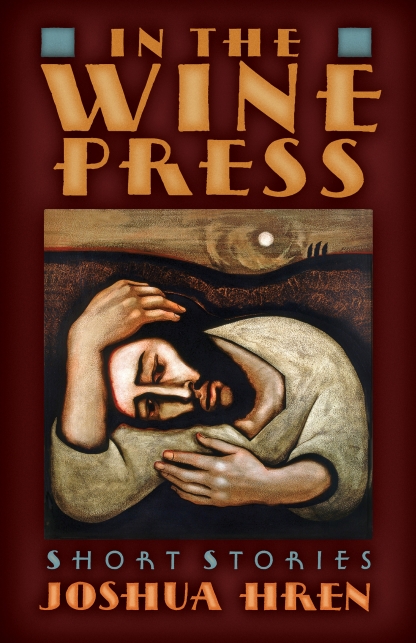
Joshua Hren’s In The Wine Press: ‘Not for Radical Autonomy But For Communion and Transcendence’

In a recent essay Joseph Bottum pins the novel’s decline less on screens and social media than on metaphysical flatness. Much contemporary fiction either inhabits a character at close range or—in a more recent trend—zooms out to offer 30,000-foot omniscience. But at its best the art of fiction is both subjective and objective, getting into the characters’ heads and hearts while detaching us enough to confer a superior understanding. To achieve this depth, however, requires both a sense of the distortions of our age and a clear vision of the good life.

Few writers have either; fewer still possess both. Joshua Hren (editor of Wiseblood Books which is about to publish my novel Minor Indignities) is one of those who both sees clearly and is equipped to interpret what he sees.  His new collection takes us to the heart of dysfunctions—familial, clerical, intellectual—that plague our world while offering a revivifying sanity.

“Horseradish,” the opening story, is just shy of twenty pages. It presents a nighttime conversation between a father and his son on the rickety porch they built together. They’ve gone out to watch a comet, but as they stand physically “closer than they had been in years” they have the sort of serious, awkward exchange that most of us in the same position would do our best to flee. The son goes on the attack, forcing his dad to confront past abdications, but while their oversharing dredges up memories, some fond (the father grew up in what he recalls with pride as the “Slovenian ghetto”), others troubling, what eventually emerges is a more recent trauma: the son is there because he decamped after losing his temper with his wife and hurling a salt shaker through a window.

With this revelation, the see-saw tilts. The father takes control, admonishing and firm, but also paternally tender:

“I maybe never gave you enough. Affection,” he said.

“Dad, “ I said. “Oče.”

“Don’t,” he commanded me, cuffing my wrist with his hand. “Listen. Maybe I never did. But listen. I don’t want to hear how you never touched your wife like that. How you never laid your hands on her. I’m not interested too much in what you didn’t do. But I’ve been wondering one thing for a long time. Do you ever? Touch her. Why am I going to die without ever having held a grandchild? Are you two…”

My arms stuck out like a poorly-clad scarecrow, and I swear I saw him look up, a terse search of the sky, as though he hoped a bird would blind me with dung for failing to give him descendants.

There may be nothing so tricky to represent without mawkishness as the fall of barriers between two people so close as to make intimacy unbearable. By story’s end Hren has given us reconciliation without sentimentality, and symbols—the porch as unstable artifact of the father-son bond, the once-in-a-lifetime comet mirroring a brief window for genuine connection—that work on every level.

Another story, “Old Blood,” reaches toward reconciliation with similar tact: a school shooter’s almost-but-not-quite-girlfriend phones her Vietnam vet uncle in a nursing home to invite him to move in with her. She is spurred to this act of charity by loneliness, yes, but above all by reflecting on what could have driven her former online paramour to such evil. If in his previous collection Hren trod ground more familiar to partisans of Catholic fiction—the spiritual physics of self-mortification—here he telegraphs his intentions less, and shows more restraint. The action of grace is there, but not so much in the parting of the sea within the story’s frame as in the reader’s awareness that blocked exits in the here-and-now point to liberations that fiction most successfully represents discreetly, or even a contrario.

In “Work of Human Hands,” a widow seeks healing for her twelve-year-old son, Rudy, sexually abused by their parish priest, whose predations are described with excruciating but muted realism. We are then privy to Rudy’s encounter with the virtuous but decrepit Father Sun, a wheelchair-bound traditionalist (he has Mosebach’s Heresy of Formlessness by his bedside) who nods off in mid-conversation before snapping awake again to lay hands on the boy in a very different sense, adding another layer to the story’s title:

Balancing his body with his good arm, Father searched the bureau somewhat frantically until, nodding, he heaved out an old black book whose edges were light red like the priest’s face. Father Sun’s eyes flitted fiercely across the pages. His shoulders scrunched up and his neck shot out as he searched. Peering into a prayer at the very end, he nodded again and mouthed the words, ignoring the absence of sound, and in the naked room his rasps came out loud. He pressed his hands against the boy’s head, rubbing in the water he had sprinkled there, holding his hands against Rudy’s temples until the trembling in his hands ceased, then until the boy stopped shaking.

Finally, we eavesdrop on the offending priest’s own fantasies of doing penance through bloody, self-inflicted violence—followed by his realization that a first, faint stirring of justice could be achieved only by expressing contrition directly to his victims. The story’s use of multiple viewpoints offers a sense of orchestration and design.

There is maturity in the idea running through In the Wine Press that unspectacular words and gestures contain still greater spiritual power than needed but secondary acts of physical penance. The collection’s title suggests that providence will in the course of our everyday lives devise mortifications more effective than any we invent for ourselves. And it is under the pressure they place on us that drops of precious mercy are squeezed out of our otherwise hardened hearts.

Two of Hren’s stories—“Some Other Exit” and “Their Fire is Not Quenched”—feature adolescents in rebellion. One rages against a world of spreadsheets, self-help mantras, and pyramid schemes, doctoring his Harvard t-shirt to read “Hatred” and fronting a rock band called CORIOLANUS; the other dreams of cold political mastery and a plum job with a Washington think tank but lives with his parents, whose piety he despises. Other stories address the cover-up of clerical misdeeds, the innocence tarnished by pornography, and the damage casually inflicted by political ambition. Such are the subjects—at once weighty and ticklish—Hren has taken on. We’d rather look away, but his ethic as a writer is to cut through discomfort and depression with brutal honesty. As St. Thomas knew, contemplating the truth is among the best remedies for sadness.

Set in a corner store, the collection’s last story, “Proof of the Immortality of the Soul, with Reference to Beeswax Soap,” is a high-degree-of-difficulty piece that blurs the lines between prose and poetry:

Look a broomstick-thin man with two packs of cigars bulging out of his chest, pockets fatter than his frame, man he’s chewing on his sleeves, stepping up to the clerk who’ll be here until close, squinting under the beams that illumine the things that his ma clicked her tongue at as he flicked up his finger. But he still can’t quite shake that sharp tsk when he sees unclad ladies on the covers of shellacked magazines and the color-code condoms claiming pleasures and ease and he clings, cleaves condemned, to the counter’s cliff-edge like a cold-blood-caught criminal on apocalypse eve, feeling heat if you will like a fried nervous chicken with five bona fide furies biting after his heels.

As the scene shifts to a smelly church bathroom,  physical grime is likened to the buildup of sin on the soul, and you feel genuinely elated when “you” (the story is told in the second person) ends up joining a confession line. As for Hren’s method of delivering impressions in a relentless staccato, with plentiful alliteration—is it over the top? Yes. Does it work? Yes, at least for this story.

Most of the book, however, relies on more familiar narrative techniques and requires only as much investment from the reader as the author can pay back, with interest, in the currency of storytelling pleasure. This, I think, is the route forward for Catholic writers: mastery of craft united with a vision informed by faith, but never the latter without the former—and the former above all.

The Czech writer Josef Skvorecky once said that all great novels are thesis novels—and they all have the same thesis. As liberalism’s success breeds its own failure, we need works that lead our society to reexamine its basic anthropological premises, reminding us that we are wired not for radical autonomy but for communion and transcendence. Of course, such works make their point not through abstract statements but by artfully selecting details, characters, actions. Any attempt at paraphrase falls short—their intellectual meaning is accessible only by experiencing them in their entirety. While some recent novels published by mainstream houses meet this description (Christopher Beha’s Index of Self-Destructive Acts comes to mind), in the end we may have to rebuild our literary culture from the ground up.

It is with fiction like Joshua Hren’s that we can undertake this essential task.

Trevor Cribben Merrill’s reviews and essays have appeared in The University Bookman, Dappled Things, and The American Conservative, among others.

The Wounded Surgeon: Suffering the Little Children in Dana Gioia’s “Special Treatments Ward”

But Jesus said to them: “Suffer the little children, and forbid them not to come to me: for the kingdom of heaven is for such.”

—Matthew 19:14

“Evil,” wrote Flannery O’Connor, “is not a problem to be solved but a mystery to be endured.” Pains can either be borne in emulation of Christ crucified or they can be borne bitterly, like arbitrary afflictions lacking meaning and mystery.

Dana Gioia, the poet and public intellectual who has done more than any other living figure to galvanize the Catholic literary tradition, prompts this either / or in a number of his poems, not a few of which unveil him as no stranger to suffering. Gioia, once a business executive and former Chairman of the National Endowment for the Arts, acquired a keen knowledge of loss when in December of 1987 his four-month-old son Michael Jasper died of sudden infant death syndrome.

As he said after the death, “I saw poetry differently. Writing took on a spiritual urgency I had never experienced before.” Often this urgency leads us through hellish landscapes, lairs of despair. And yet, as Janet McCann observes, if Gioia’s poetry can be dark, it “isn’t nihilistic, nor is it unforgiving.” “Special Treatments Ward”  is one striking example.  In this poem, the narrator’s reduced state leaves the reader rattled; the suffering of innocents has left him lost. Taken as a whole, however, the poem elevates us above this world’s ceiling, ameliorating our losses through the dead children’s healing.

So this is where the children come to die,
hidden on the hospital’s highest floor.
They wear their bandages like uniforms
and pull their IV rigs along the hall
with slow and careful steps. Or bald and pale,
they lie in bright pajamas on their beds,
watching another world on a screen.

Read More about The Wounded Surgeon: Suffering the Little Children in Dana Gioia’s “Special Treatments Ward”

“Hasten to Aid Thy Fallen People”

“Hasten to Aid Thy Fallen People”

How does one make a song of holiness?
  Or speak of music without spoiling it?
They both seem more than our tongues can confess
  And, born above, in our world do not fit.
    What’s more, those who ascend with them
    Are closed in on themselves, struck dumb,
And all in ecstasy that they have heard
Seems flailing, foolish in a fallen word.


But every rising strain must strain indeed
  To lend a form to what in truth is light,
And manifest peace as if it’s a deed
  And give transcendence some arc of a flight.
    The purity of every saint
    Will be daubed on with sloppy paint,
And what no thought may comprehend or say
Must be taught in the staging of a play.


The gift of form, because so fascinating,
  As we bend down to work with knife or ruler,
Reminds us that beyond it’s always waiting
  Some piercing light. Consider how the jeweler
    Makes every cut upon a stone
    For its sake but not that alone,
His patient labor wasted if a line
Does not refract and multiply and shine.


And, any humble implement may serve
  To figure-forth and yet conceal that light,
So that high thought is felt upon each nerve
  And mystery is given to our sight.
    Just this way, things are lifted up:
    A chalice wrought from wooden cup;
A little dust and water, mixed to clay,
Are molded into birds that fly away.


The Mass is first His earthen sacrifice,
  But also taste of peace and heaven’s throne,
The gift that leaves behind all thought of price
  Yet where, no less, we raise a plangent groan,
    For at its finish we are sent
    Into the world both dark and bent
That bearing out the Virgin’s hastening aid
From ruined choirs some good may be remade.


This is the seventh and final poem from James Matthew Wilson’s new book of poems, The River of the Immaculate Conception (Wiseblood Books, 2019), commemorating the Mass of the Americas and rooted in his childhood vision of America as a Catholic Country. “Hasten to Aid Thy Fallen People” is a line from the Marian antiphon for the Advent season, the Alma Redemptoris Mater, which begins:
O loving Mother of our Redeemer, gate of heaven, star of the sea,
Hasten to aid thy fallen people who strive to rise once more.

Who is James Matthew Wilson? Dana Gioia Speaks

From the editors:

Our present to you this Lent is to publish a series of poems by James Matthew Wilson. They commemorate The Mass of the Americas and are inspired, as James wrote in First Things, by his childhood sense of America as a Catholic country.  He doesn’t mean, of course, that America is only a Catholic country.  But the Catholic roots of this country run very deep and include many underappreciated heroes.  He calls this song cycle “The River of the Immaculate Conception.”  That river is known by its official name: The Mississippi River. Yet early on, Jesuit missionaries consecrated it to Our Lady.  Purchase the book of poems at WisebloodBooks.com.

We are very proud and excited to give you this gift. James Matthew Wilson is not just a good poet. He is one of our finest rising Catholic artists and intellectuals. 

You don’t have to believe us.  Believe Dana Gioia on the video below:

“James Matthew Wilson is the most conspicuously talented young poet-critic in American Catholic letters…When you hear James’s work, you’re hearing the kind of tradition that’s in Anthony Hecht, Robert lowerll, William Butler Yeats. Certainly this new poem, it’s as if James has set down in this new work with a great organ keyboard and he’s decided he’s going to play every key, he’s going to pull out every stop in the course of creating this new poem each of the sections of which is in a different form, a different line length, a different rhyme scheme, a different perspective; and it’s an incredibly difficult act to bring off because at every moment you’re taking risks. But I think that it is a successful and exciting work. You know there is, at the moment, an exciting rebirth of Catholic poetry in the United States and it’s full of talented young writers but even in this interesting cohort James Matthew Wilson, I think, is one of the leading people that you are really going to watch in the future.”  Dana Gioia


The Great Renaissance Artist You’ve Never Seen Before

The National Gallery of Art has put on an extraordinary exhibit of a great Renaissance artist who is almost unknown outside his native land: Alonso Berruguete (ca. 1486-1561) was the first and greatest sculptor of the Spanish Renaissance.

He is little-known outside of his native country, however, because much of his artwork is embedded in the massive gilded wooden retablos that he built as towering backdrops for the main altars in cathedrals and monastery churches in and around his native Valladolid in central Spain. The retablos, multi-leveled and crammed with multiple images, carved and painted, of Christ and the saints, some of enormous size so they could be seen by worshipers far below, cannot be transported. And the cities of Valladolid and Toledo, where Berruguete did most of his work, are slightly off the tourist trail, so few Americans are familiar with his sculpture.

For me and for many, that just changed as a result of this exhibition:

St. Benedict converting the Goth Zalla (monastery of San Benito el Real, Valladolid)

Fortunately for American lovers of art and especially sacred art, during one of its periodic anticlerical phases during the 1830s, the  Spanish government xpropriated and forcibly secularized the site of one of Berruguete’s most impressive altarpieces: the Benedictine monastery church of San Benito el Real in Valladolid.

Berruguete’s 40-foot-high retablo was mostly destroyed in this burst of iconoclasm and many of its sculptures ended up in a municipal museum. That made it possible for them to travel outside of Spain, and their portability has enabled the National Gallery of Art in Washington, D.C., to assemble the first major U.S. exhibition of Berruguete’s work.

The exhibition includes some of his most impressive sculptures from San Benito and nearby churches, together with paintings, drawings, and pieces by other Spanish artists who were contemporaries of his that give his output an artistic context. The exhibition, scheduled to run through February 17, is a small one: just 40 artworks in two rooms. It is complicated by the fact that Berruguete, like many successful artists of his time (and Andy Warhol in our own day), employed a workshop of apprentices to help fill his numerous commissions, so it is difficult to ascertain how much of any particular sculpture is actually the work of his own hand.

Ecce Homo (monastery of San Benito el Real, Valladolid)

Yet all of them—figures of the crucified Christ and his mother, saints, and Old Testament prophets–bear the mark of Berruguete’s unquestioned ability to meld wood, gilding, classical technique learned from Italian Renaissance masters, and a flair for emotional expressiveness into sculptures of astonishing religious intensity.

Valladolid, about 120 miles north of Madrid, was the capital of the kingdom of Castille during Berruguete’s lifetime and thus, effectively, the capital of Spain itself. Ferdinand of Aragon and Isabella of Castille were married in Valladolid in 1469, and their most famous protégé, Christopher Columbus, died there in 1506. Miguel de Cervantes, author of Don Quixote, lived and worked in Valladolid. Berruguete’s father, Pedro Berruguete (ca. 1450-1504), was also an artist, even more talented as a painter than his son, if a Madonna and Child of his on exhibit at the National Gallery is any indication.

Pedro had brought the Renaissance to Spain in a different fashion, introducing a Flemish “Northern Renaissance” style of painting that influenced many Spanish artists besides himself. After Pedro’s death, his son Alonso, then age 18, took off for Italy, where he lived in Florence and Rome for thirteen years and developed his talent for sculpture, befriending and assisting Michelangelo, Andrea del Sarto, and Filippino Lippi, among others. He also became one of the early promulgators of Mannerism, the 16th-century artistic style that emphasized extreme emotive expression—often via elongated figures in contorted positions–over classical harmony in composition.

When Berruguete returned to Spain and transformed his Italian training into an alabaster relief titled The Resurrection for the cathedral in Valencia, his work suddenly became in high demand. The Holy Roman Emperor Charles V, grandson of Ferdinand and Isabella and heir to the Spanish throne, made him court painter and sculptor in 1520. He turned from stone sculpture to wood, the traditional material of the medieval Spanish retablo, and his workshop in Valladolid, together with other patronage from Charles, made him a wealthy man. He continued to work in wood, marble, and bronze until his death at nearly age 80.

Adoration of the Magi (Chapel of the Epiphany, church of Santiago Apostol, Valladolid)

Crucifixion (monastery of San Benito el Real, Valladolid)

The retablo sculptures of Berruguete on display at the National Gallery, lavishly gold-painted and brilliant with color, are nearly always twisted figures caught in moments of emotional agony or religious ecstasy. A sculpture from the San Benito church depicting Abraham about to sacrifice Isaac displays a crouching, open-mouthed, nearly nude Isaac, his hands bound behind him and his body bowed over with terror (his figure resembles one of Michelangelo’s male nudes on the Sistine Chapel’s ceiling), while the gray-bearded Abraham gazes at the viewer in as much torment as his son. Two wooden prophets writhe in the divine power that inspires them. The most thrilling of Berruguete’s statues in this exhibition are his crucified Christ flanked by his mother, Mary, and the apostle John; their enormous figures once crowned the pinnacle of the San Benito retablo. Mary and John, both wrapped in swirling, voluminous gilded garments, grieve for the dead Christ, but more calmly, as seems fitting, than the emotion-charged figures from below. As for Berruguete’s Christ, his body, gray in death and looking as though it were carved from stone, seems utterly at rest, the bloody work of redemption complete.

For Americans—and others of the New World—Berruguete’s sculptures will resonate in an additional way. The Spanish colonizers of the Americas brought their retablo tradition with them to the churches they built there. Artistic styles changed over the centuries, but anyone who has visited the California missions or the cathedrals in, say Mexico City or Cusco, will find Berruguete’s lavishly decorated wooden edifices startlingly familiar. We have one of Spain’s greatest sculptors to thank in part for one of our own architectural traditions.

Charlotte Allen is a D.C. based arts reporter for Catholic Arts Today and the author of The Human Christ: The Search for the Historical Jesus.

Sarah Cortez: Cop, Poet, Catholic

Sarah Cortez is known as “the cop poet.” One of her favorite photos of herself features a mischievously smiling Cortez showing off her gun in its shoulder holster.

Her work includes short stories, essays, and a memoir as well as poetry, and much of it centers around her later-life career as a police officer in her native Houston. (She graduated from that city’s police academy in 1993.) Her first collection of poetry, How to Undress a Cop (2000), published by Arte Público Press, was described by Publisher’s Weekly as “[b]y turns erotic, tender, and gritty” and “powerfully direct.” The poems, some of which had such titles as “Rosie Working Plain Clothes” and “Christmas With the Vice Squad,” bore witness to another of her literary strengths: a sly and observant sense of humor.

Her latest collection, Tired, Hungry, Standing in One Spot for Twelve Hours: Essential Cop Essays (2018) won a 2019 award from the National Federation of Press Women. In that book Cortez wrote of “the endless boredoms and dirt” and the “tiny, stark terrors” of police work, but also the “hidden rewards of intense camaraderie, sense of mission, and the fulfillments of justice and duty.” Her 2013 collection of poems about policing, Cold Blue Steel, was praised by Booklist for displaying “a frank language in sharp lyrics charged with weary passion.”

Cortez’s literary—and above all, religious—roots run deep. After graduating from Rice University with honors (majoring in psychology and religion) in 1972, she taught herself ancient Greek and obtained a master’s degree in classics from the University of Texas-Austin, and then another master’s degree, in accounting, from the University of Houston, which launched a corporate career that paid well but never satisfied her.

After four years as a full-time officer on the Houston police force specializing in sexual-assault investigations, she moved to reserve-officer status in order to devote herself to a literary career: writing, editing, and teaching creative writing courses as well as promoting the experiences of the Latino-Americans of Texas.

Not long after taking up police work, she returned to the practice of the childhood Catholic faith in which she was raised.

Sarah Cortez is currently the founder and president of Catholic Literary Arts a Houston-based nonprofit that offers workshops in spiritual journaling, poetry and fiction writing and hosts an annual Fearless Catholic Writers Camp for high school students. Find out more about these and other Cortez adventures at CatholicLiteraryArts.org.

Charlotte Allen: Did you start out just writing at night, sort of like Joseph Wambaugh on his first novel?

Sarah Cortez: I started writing before I became a police officer. I was first published as a fiction writer, in the short story. A few years into that, as my first marriage started failing, when I sat down to write, instead of prose, poetry came out.

I only wrote poetry for maybe the next ten to twelve years, so it was during that period that I finished the police academy and became a full-time police officer.

Charlotte Allen: How long did this go on before you decided to try to get published—or did you just decide right away and start sending your stuff off?

Sarah Cortez: Well, I had already been published in fiction. It took several years of doing full-time police work before I started writing about it, because I was then writing about my family, my large, crazy Latino family. I hesitated to write about police work. The majority of police work is dirty and boring. It’s not dramatic and certainly not sexy. That’s a Hollywood myth. But there aren’t too many police officer-poets, so once people started seeing the work, I got a great deal of interest.

Once I started writing the poems and once I won my first award in 1999, many were interested because the poems were written from a street cop’s perspective.  I suppose they had an innate veracity and realism that people were attracted to; also, because they were about calls for service, about getting shot at, what is it like wearing a ballistic vest, and so forth.  So, people knew from the subject matter of some of these poems what I did.

Charlotte Allen: One might think that no one really cares about poets, but in fact that seemed not to be the case in your case.

Sarah Cortez: In fact, I got my first offer for a book without even asking for it. I just got it in the mail from a very wonderful publisher.

It was one of the most gorgeous meetings, ordained by the Holy Spirit. I was standing in the University of Houston Parking lot, doing extra  duty as a full-time police officer, when  who should come out of the building next to the lot but Nicolás Kanellos, award-winning professor of Hispanic Studies at the University of Houston and director of Arte Público Press?

I recognized him. I knew his face. I introduced myself and said, “I just want to tell you: I admire you work and I’ve followed your achievements, and I want to congratulate you.” First, he says “Thank you.” And then he asks that magical question every writer is waiting for the publisher to ask: “And do you write?”

I could have melted into a little puddle on the asphalt. And I said, “Yes, sir.” And he said, “What do you write?” And I said, “Poetry.” And he said, “Well, send me some.”

That began a year and a half of correspondence with this fine scholar and man. I would get home from evening shift at 11 p.m. or 10 p.m. and I would write for 20 minutes or 30 minutes almost every night. I would finish, revise and revise, and I’d send him a group of poems and a snailmail letter, and he would send me a letter back, e.g.: “Well this one is great. I like this one, but I didn’t like the last stanza. It’s too elegiac,”

And then after a while, he wrote me a letter and said, “Well, I think you have enough poems for a book. Do you want a book with us?”

He’s an amazing scholar, an amazing publisher, and I think it shows his character. I was just an unknown cop in a parking lot. He didn’t know about me. I hadn’t won my first big award yet.

And just out of the goodness of his heart, he took the time to have this year-and-a-half correspondence with me.

Charlotte Allen: What has made you a Catholic writer?

Sarah Cortez: Well, after 35 years of being gone from the Catholic Church, I came back about ten years ago. I love being Catholic. There’s so much joy and so much meaning for me in the sacramental life of the Church, in trying to live up to the call of the Gospel. I would never claim to do a very good job at it. I’m always trying to get better at doing that. But I want to share that joy through my writing. I want to appreciate the writing of others. And at this point in my literary career I want to be known as a Catholic writer. It’s very important to me.

Charlotte Allen: Were you baptized Catholic?

Sarah Cortez: Yes. My mother was Catholic. My dad was baptized early on, but his mother died when he was five, and his father remarried a non-Catholic.

My dad was born in 1917. Both my mother’s and my father’s families came to rural south Texas from Spain in the 19th century, farmers and fishermen.  Both families were just struggling. They were struggling to eat and to stay alive. My dad’s mom died in one of the great influenza epidemics of the early 20th century. So, my dad really didn’t have much of a childhood, and he didn’t have any faith instruction in his childhood. He never opposed my mother going to church, and eventually he started going to church with us. After I left to go to college, he actually started fully participating in the Catholic faith.

Charlotte Allen: And what about you? It sounds to me as though just as your father was reentering the faith, you were leaving it.

Sarah Cortez: Yes, I went to college, and like most college kids decided to worship in the chapel of convenience. And then I had my corporate career. And then I left corporate America to go into police work.

Charlotte Allen: Why police work as opposed to anything else?

Sarah Cortez: I fell in love it like you fall in love with a man. Being faced with unmitigated insanity—because the streets are insane. These TV shows don’t even begin to get it right. The insanity doesn’t even have to be dangerous, although it oftentimes is. It’s just a different world. It’s not the world of plush couches in offices. A crazy person knifes you, and you have a knife wound. Or a sane person knifes you, and you still have a knife wound.

But I also fell in love with the mission, which is public safety, the public good, the common good. It’s no longer fashionable to believe in the common good or what’s good for society as a whole among certain people, but to be an effective public servant you must completely identify with the mission, which is being willing to die for people that you don’t even know.

That’s true whether you’re a firefighter, EMS, a police officer, or military. My husband is a retired fireman. There are very few people in policing or firefighting whom I have ever met in 25 years who haven’t come from a Christian background. Even if they’re not “practicing.”  They still come from that core set of assumptions about humanity that you find in the Christian and especially Catholic worldview.

Charlotte Allen: Are there police officers who just haven’t come to terms with death and find themselves unable to continue? They think that they will never die, or people on their watch aren’t going to die?

Sarah Cortez: I’ll put it the way a good friend of mine in my department put it: These young kids who want to become a cop—they don’t really think about it, but they want to be a Care Bear. They get in, and they go through the academy, and they do fine, and they qualify with a firearm and they get a job. And then they find out that a lot of people in the world, especially now, regrettably in America, hate them! You wear a blue shirt? Hey, we hate you! You wear a blue shirt—you’re a racist! With no data, no evidence, no nothing, people just hate them. And it freaks them out, because they want to be a Care Bear.

I went into police work at an older age with my eyes open: OK, some people are going to hate me, some people are going to like me, most people are not going to care about me. I’m hired to do a job, so I’m going to do my job. That person likes me, that person hates me. I don’t know if the younger ones, just because our society has changed so much, understand that.

Charlotte Allen: They hope to be heroes and find out that most of it isn’t very heroic on a day-to-day basis.

Sarah Cortez: It’s dirty. You may lose your life to save somebody else’s life—and they hate cops. But that’s part of the sacramental nature about it.

Charlotte Allen: Is that something that led you back to the church, back to practicing your faith?

Sarah Cortez: Well, it led me to a much stronger faith, because you really must come to some sort of peace with the idea of death before you go to the police academy. If you don’t. you’re really stupid. I was older than the traditional candidate. I was around 40 when I went to the police academy. Most people are in their twenties. But you must know: OK, I’m willing to die. I know what death is, and it’s OK. For most people, that requires belief in God. Not everybody, obviously.

So, it got me closer to my initial belief, but at that point I still wasn’t willing to mitigate belief by action. It was, I believe in God, yeah, but I’m not willing to do the right thing.

But I did have strongly in my mind that if I ever married a second time, that second marriage had to be a sacramental marriage in the Catholic Church. So, when my husband asked me to marry him, I had to get my act in order.

The priest recommended that both my husband and I go through RCIA. And that was actually pretty cool, because when I left the church, I was all of 18 or 19, so I had a pretty simplistic understanding of the Catholic faith. After going through RCIA one of my favorite things to read now is moral theology.  I love trying to extend my intellectual grasp of the religion, although religion is undoubtedly lived out in human interactions, not lived out in reading books. My husband asked me to get married, we went through RCIA, I did my confession, and boom! Here I am today!

I love St. John Paul II. I remember reading his answer to the question: What’s the basis of hope in today’s world? That’s something a cop has to think about: how do we believe in the best, even after seeing the worst?

I have seen things, or read them in reports, or seen crime-scene photographs that are some of the worst things that a human can do. Yet I am constantly called upon by the requirements of my job and my calling to believe the best I can believe in everybody.  If I’m here to save your life as a police officer, I have to believe that your life is worth saving. But I also know that someone who looks exactly like you maybe she tortured her dog.

Police work for me becomes an extremely fascinating crucible to hold all of society’s burning ashes of sheer evil and meanness without it burning me up and still believe in the best in everybody.

Charlotte Allen: How do you avoid cynicism?

Sarah Cortez: The key is realizing that when you know the difference between good and evil then you know that that capacity to do good and evil is inside of everybody: Some people live it out more to the sheep or more to the goats. That is human nature since the Fall. Faith shores you up despite knowledge, so knowledge doesn’t destroy you.

You become that crucible. The crucible cannot break. The crucible has got to hold everything, it’s got to hold it until it gets molten enough to mix together so you can get what the dross turns into, which is the gold, the treasure. So, you’ve got to be able to hold all of this inside of you without breaking.

Charlotte Allen: When you returned to the faith, was this a kind of gradual process, or did it all just happen overnight?

Sarah Cortez: It was gradual, but it was clear. What I had to make it through was the fear. And I think probably for myself as a human being and for many other human beings as well, you’ve to make it through the fear to get to clarity.

Charlotte Allen: What were you afraid of?

Sarah Cortez: Can you imagine going to confession after 35 years? That right there was probably the biggest stumbling-block.

As a child, I confessed things like lying to my mom, being smart-off to my mom. Even so, back then I was always very scared to go to confessional. After 35 years of adult life, I was terrified. But I just regret having waited so long, because there have been so many times that I could have been dead. I woke up twice after falling asleep driving—I opened my eyes and I found I was headed straight to a cement wall. So, if my guardian angel or the Holy Spirit or whatever it was hadn’t awakened me, I would have just driven into the cement wall.

Charlotte Allen: How does your Catholicism works its way into your writing?

Sarah Cortez: Sometimes it works its way into my writing as prayers. I like to write prayers. One poem is the prayer of a sexual-assault investigator, and it came from a case of mine. That was one of my police specialties: sexual assault. I have another prayer that actually came from one of my husband’s cases. He was an arson investigator, so: Prayer of an Arson Investigator.

I love writing prayers. I also love writing about the Mysteries of the Rosary, the great sacred mysteries of the Truth: the Incarnation, transubstantiation, the Immaculate Conception, great mysteries like this. I used to think, again with that simplistic, childlike viewpoint, that the mysteries of the church related to things I would never understand. What I’ve found out, since I’ve come back as an adult to Faith, that the mysteries of the faith really mean that no matter how deep I go into them either intellectually, emotionally, mentally, on any level, I will never get to the bottom. The source will never cease flowing.

Charlotte Allen is a D.C. based arts reporter for Catholic Arts Today and the author of The Human Christ: The Search for the Historical Jesus. This is the second of a series of Catholic Arts Today interviews with Catholic writers who attended the 2019 Catholic Imagination Conference at Loyola University’s Hank Center for the Catholic Intellectual Heritage.

Subscribe to Our Emails