The Mind of the Maker and the Art of Liturgy: A Poet’s Eye View

…the mind of the maker and the Mind of the Maker

are formed on the same pattern, and all their works are made in their own image.

—Dorothy Sayers, The Mind of the Maker

Hope always draws the soul from the beauty which is seen to what is beyond,

always kindles the desire for the hidden through what is constantly perceived.

—Gregory of Nyssa, The Life of Moses

PROLOGUE

           Asked to write on “liturgy and the artistic imagination,” I find myself rocking on a restless sea. So young in Orthodoxy that I am not even a toddler, I wonder what I can say about liturgy that will be worth a reader’s while; though I have no interest in adding to the liturgy I experience—itself already a work of participative art—I am interested in how liturgy and a maker’s imagination might dance together.

           Yet since many shiploads of words have been written about imagination, what cargo shall I add to these? More, what is meant by artistic imagination? How does it fit into the braid of the human, a winding together of nous—often defined as “the eye of the heart” or “eye of the soul”—sense perceptions, and reason? What happens when we marry liturgy and the urge to make?

1.

THE WISH FOR INFANT SIGHT

The flame of fire, the living spring

              Not long ago, I found myself at a Sunday parlor church deep in the Carolina mountains, sitting between my mother in her wheelchair—she having been felled from walking by a long bout with covid—and an elderly man named Jerry, who had introduced himself to me a few days before by saying that he was lost, and who had kissed me on the cheek when I walked him to his room. We were twelve in that parlor, with a rural Baptist preacher accompanied by his wife and two daughters in mightily spangled red-and-gold dresses. Around me sat the halt and lame, and I remembered the Centuries of Mediation by lovely-minded 17th-Century Anglican poet, priest, and philosoph Thomas Traherne, conveying in a great flow of words the enchantment and beauty of his infant sight, and his adoration of an Edenic realm radiant with signs of divine making:

The corn was orient and immortal wheat, which never should be reaped, nor was ever sown. I thought it had stood from everlasting to everlasting. The dust and stones of the street were as precious as gold: the gates were at first the end of the world. The green trees when I saw them first through one of the gates transported and ravished me, their sweetness and unusual beauty made my heart to leap, and almost mad with ecstasy, they were such strange and wonderful things: The Men! O what venerable and reverend creatures did the aged seem! Immortal Cherubims! And young men glittering and sparkling Angels, and maids strange seraphic pieces of life and beauty! Boys and girls tumbling in the street, and playing, were moving jewels. I knew not that they were born or should die; But all things abided eternally as they were in their proper places. Eternity was manifest in the Light of the Day, and something infinite behind everything appeared which talked with my expectation and moved my desire. The city seemed to stand in Eden, or to be built in Heaven. The streets were mine, the temple was mine, the people were mine, their clothes and gold and silver were mine, as much as their sparkling eyes, fair skins and ruddy faces. The skies were mine, and so were the sun and moon and stars, and all the World was mine; and I the only spectator and enjoyer of it (701.)

           As the rural Baptist pastor sang the old songs praising the solid rock and the flying-away of the soul, as he preached on Christ walking the waves and calling for Peter to come to him on the sea, through the boisterous air, I was surprised to find myself stirred to tears, with a strange, uncanny sense of the parlor being encircled by a great wheel of figures, dim and pale. It seemed that the saints came even to the Carolina coves and hollers, even to those who do not call to their names, and even to those who are losing the powers of speech. We did not need the liturgy to feel the nous stirring. For long moments, I shared Traherne’s intense sweetness and joyful infant sight and could—compassing the world—say with him, “The streets were mine, the temple was mine, the people were mine….”

           What happens at such moments? Is this part of the infant sight, to love and feel our heart go out to others, living and dead, and to be called to walk the uncanny waters of what lies beyond us? In For the Life of the World, Alexander Schmemann – the 20th century Orthodox theologian whose most famous work on liturgy, “For the Life of the World,” was distributed by samizdat in the old Soviet Union – says quite plainly that the church is “the joy of recovered childhood, tithe free, unconditioned, and disinterested joy which alone is capable of transforming the world” (39.) He quotes Romano Guardini on liturgy to say that “It is in the highest sense the life of a child, in which everything is picture, melody, and song…it unites act and reality in a supernatural childhood before God” (40.) I look to the magical vision of little Thomas Traherne, future poet and writer. For some happy period of time in the seventeenth century, he lives at the Edenic mountain peak where a child of time touches eternity, and where the soul streams forth and kisses Creation and its creatures. His Blakean “doors of perception” are bright and clean, and so reveal the infinite. Like Christ in the Eucharist, he is broken into pieces for love of every part of the world, and yet he is not divided: he remains young Thomas, already the poet who has eyes to see.

2.

CHILLING AT THE PALAZ OF HOON

Illuminate our intellect, / Pour forth thy love

           One view of the early church fathers is that imagination is a risk, that it can endanger the soul. This danger appears particularly in the region of contemplative prayer, where stillness and rejection of images is desired. According to the fathers, images may become part of what separates the human from the divine; the contemplative should never image God or find pleasure in imaginary scenes during prayer, lest he fall prey to pride and self-deception and passions. In the seventh-century Ladder of Divine Ascent, Saint John Climacus writes that the very first step in prayer is to shoo away thoughts. Silence of mind is desired. (Note: This idea remains strong in the Orthodox tradition and, yes, is clearly opposed by the mode of Ignatius of Loyola.)

           In our age, when attention spans are fragmented by a quick, frenetic TikTok pace and where no subject is taboo, wildness may be far more appealing than silence of mind. Chaotic seas of our culture may carry us very far from stillness, into ports of our own invention—each creating the self as a proud Wallace Stevens figure, as in “Tea at the Palaz of Hoon”: “Out of my mind the golden ointment rained, /And my ears made the blowing hymns they heard. / I was myself the compass of that sea: / I was the world in which I walked, and what I saw / Or heard or felt came not but from myself”. (Stevens 65.) I am fond of many Wallace Stevens poems, yet I would say that Hoon’s self-born sight is not Traherne’s child sight, easily perceiving and indeed knowing that the world is more than what our senses tell us and catching hold of a divine radiance.

           Instead, Wallace Stevens’ Hoon is a Modernist questioner and answerer who is his own god and his own creation, self-anointed and self-sung: a kind of solipsist-ruler who has yielded utterly to the powers of the imagination. Like his artificer, Stevens, Hoon finds redemption in poetry. He may seem at first glance to be congruent with Maritain’s affirmation that “The mind rejoices in the beautiful because in the beautiful it finds itself again: recognizes itself, and comes into contact with its very own life,” but Hoon has neither sense of himself as creature rejoicing in being a part of Creation, nor sense of Traherne’s the infinite-behind-beauty—God as author of beauty (26.) Gazed at through a Modernist lens, the figure of Hoon recalls Salvador Dali’s prophetic remark that the time appeared to be drawing near when confusion might be systematized and so lead to a complete discrediting of the world of reality.

           So yes, there is a curious danger. The possibility of replacing God with imagination and making is an idea that appears to be passed down by the Romantics, who turned the artist into a secular priest of art.

3.

MADE AND MAKING

Oh, creator Spirit, appear

           What is this element I am asked to discuss, this artistic imagination?

           Made in the image of the Maker, we’re all makers, whether we’re baking or roofing or turning a pot on the wheel. We have the urge to make, to use some Ars, some art, skill, or craft: this is the inner call to imagination, to bodying forth some new thing, some sub-creation. Those of us who want to paint or sculpt or compose or dance or make stories and poems have often—perhaps not so much lately, and certainly not among the institutionalized “avant-garde”—been the wandering pursuers of the great transcendentals inherited from the classical world. Beauty, truth, and goodness would probably be regarded as excessive demands for most making, but perhaps not for, say, a poet pouring his energies into the uncompromising shape of a traditional sonnet. The poet is not thinking about beauty or truth, though he is attempting to capture something—to catch it in a net of words, or as Yeats would say, “a mouthful of air.”

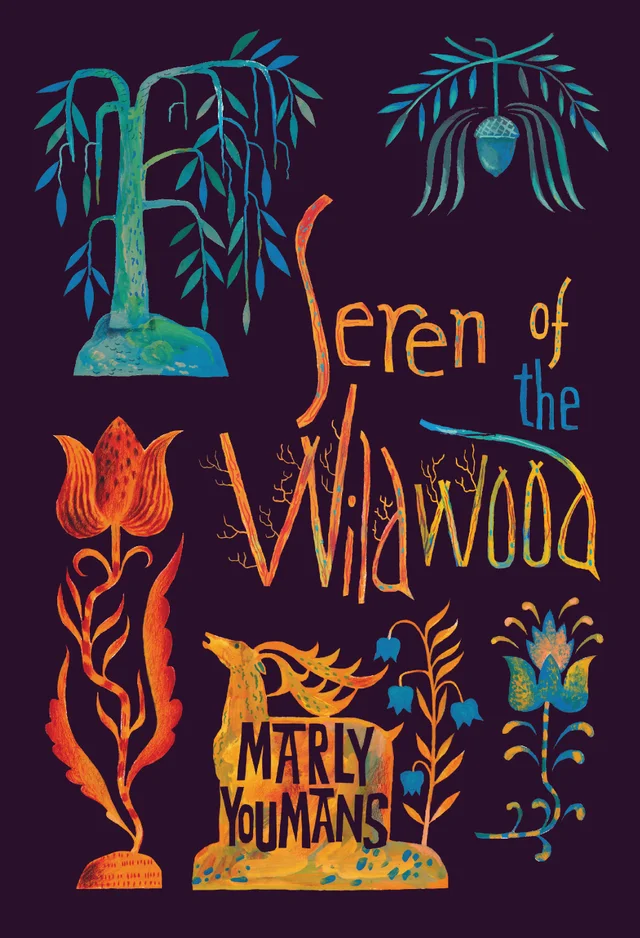
           Ideally, the maker who chases the transcendentals would possess the “wise-heartedness” attributed to the artists of the tabernacle in Exodus, and so use the plait of reason, nous, and bodily senses to create good things that add to the sum of beauty and truth in the world. In my recent book, Seren of the Wildwood, the eponymous heroine achieves something of wise-heartedness after seven years of journeys, peril, and sorrows in Wildwood. Transformation leads to a place where she looks back and retrieves out from raw, tumultuous years a desire to make that streams with soulfulness, yet is grounded in earthly things. She thinks

                                                     . . . how in secrecy

                     She might become a golden bowl of flame

                     In an enchanted world—this one, a place

                     Of paradise and hell and mundane hours,

                     Where she could learn to make, to sing her tale

                                                     Around

                                A hearth and wildwood blaze

                                On nights in winter crowned

                                By the strange, striking lays

                                That hold mortals spellbound (72.)

A wise-hearted pursuit of the transcendentals: yes, I think we might call it artistic. Making, in this view, can be regarded as part of the fulfilling of human nature as formed in the image and likeness of God.

           Wielding the imagination—making—in order to bring something worthy out of the generous profusion and welter of Creation is a simple though profound idea. Making does not need the complication of the Romantic vision of a suffering, unstable creator, nor does it need to proclaim Aestheticism’s “l’art pour l’art,” nor does it need to reject skill and embrace ugliness and transgression. It must not want to hammer out a message, for that is a work’s ruination. It must not try to cram everything the maker knows into the work. Making will fail if a maker does not honor the makers of the past and refuses to learn their craft and technique. Making will fail if a maker lets the unfairness of the present times and particularly in the world of the arts sap his spirit.

           People with the eyes to see the naked emperors of our world—the Repha’im kings of our day—already know that making can miss its mark entirely in execution (as in weak mimesis, ungainly form, axe-grinding, obsession with originality, domination by politics, kitsch, determination to shock or repulse, inappropriate feeling)  or in loveless purpose. We discern that missed mark in Genesis when Adam and Eve believe they can hide the shame of an act by stitching together leaves to make coverings for themselves. We see missed marks all around us, as in graffitied and decaying Brutalist architecture, in new Duchampian works influenced by his “readymades,” in lyrics of political hate, or in slatternly poems of worn-out transgression and shapelessness.

           Such creations are reductive; they diminish beauty and truth, rather than reaching for “the rendering strange of reality in order to make it clearer” (Mosley 23.) When a visionary Traherne sees children as “moving jewels,” he grasps at the strangeness of a paradox, joining together the stillness of gems to the liveliness of children at play, and in doing so reveals the human form as precious, alive with precious, sparkling light and color, a part of the wider Creation that bathes him in glory. This is revelation, “the rendering strange” that summons up beauty and truth.

           A maker should remember that we who make do not only make works that may be labeled as art. We also are co-making ourselves because whatever spirit that flows through a work as it is coming to fruition is also changing us for good or for ill. This, too, is part of what we may call the work of the imagination. Just as all humans ought to have a sound diet in order to thrive, we peculiar humans who have the desire to reach toward a higher making are best fed by strong, fine materials and purposes. And when we are done with a work, we are to yield to others what we have made out of the abundant stuff of Creation, which is our given, our great donnée.

           What does that mean for us as viewers, listeners, readers, receivers of what is made? We cannot experience the essence of a maker through what he or she has made, but we can experience the energies of the person and the beauties of a work. Such an encounter can be, to some greater or lesser degree, an immersion in the flowing energies that birth art, and a kind of renewing of the thing made. (This way of looking is a small reflection of the large Orthodox idea that we cannot know God’s essence but can experience his energies or attributes, for that grace radiates from his essence and is revealed to the soul.) For, “the beautiful does not exist for the artist and poet alone—though these can find in it more poignant depths of meaning than other men—so the world of Reality exists for all; and all may participate in it, unite with it, according to their measure and to the strength and purity of their desire” (Underhill 13.)

           And if the thing made by a poet or painter or choreographer or composer has captured enough of a sense of life, enough of the maker’s vital energies, it may continue to burn brightly and share its light with all for many years. It may even inspire and be generative for other makers, later in our linear time.   

4.

MAKERS AND LITURGY

As we enter now the timeless mystery

           The liturgy is a work of symbolic, participative art—it is a vessel, a form filled with adoration, spirit, and oblations meant to join human beings with the Trinity and the Divine Council, to feed men and women through “the holy and immortal mystery” of “our most essential bread,” filling them with divine, uncreated grace (Liturgy 40, 37.) Like a graft on an apple tree, a communicant is incorporated into the very body of Christ through the mystery of mysteries. In the Cherubic Hymn, those called to the Eucharist mystically “represent the Cherubim,” a reminder that they are one with the Divine Counsel. The liturgy lifts a fragment of Creation toward God, and sees that bread and wine transfigured. What is mortal touches the immortal; time and eternity greet each other. As then-Cardinal Joseph Ratzinger asserts in The Spirit of the Liturgy, “Christ himself is the bridge between time and eternity” (92.) Liturgy is a kind of procession over that bridge, into the strange light of the kingdom beyond.

           So too, in a far more modest way, human making can result in a shape, a vessel that spills over with mortal mystery—the inspired blending of attention, spirit, and human energies. The influx of power that inspires the poet and embodies itself in words has long been compared to the Holy Spirit, and no writer knows where her muse comes from, or where it goes. A writer can fiddle and make something out of words, or she can be borne on the flood of spirit that clothes itself in her very thoughts and words. Such imaging forth is mystery, and a faint, fractal likeness to the God who speaks the world into being. To repeatedly participate in works of art as maker or enjoyer is, like that crossing of a holy bridge into another kingdom, a way to see more clearly. And like the liturgy, words and musical notes and dance can be seen as procession; they move through time toward their right closure.

           Both religion and any art devoted to transcendental qualities are intensely countercultural for us, in a time when the world has been flattened, and all that exists for many has been reduced to material desires. Simultaneously, others have reached a Silicon-Valley hope-for-transcendence where some plot and hope that we can abandon the messiness of life and upload our minds into some technocratic cloud, where we may have faux material pleasures forevermore, or until the plug on the matrix is pulled. Others plan to have their frozen heads revived in some utopian and even more technology-mad age. Surely, we are already veering into that era; iPhones are glued to hands, AI-generated articles appear on Buzzfeed, bad ChatGPT poems pop up online, and we pause to glance at faux retro photographs from Midjourney. Whether pleasing or fleeing the flesh, life is dwindled down to material pleasures bodily felt, or to what can be known without the body, through some fabulous-seeming technology. As Ivan Ilyin warns in his 1937 Foundations of Christian Culture, “a people can stand on the absolute high point of technology and civilization, while in the arrest of spiritual culture (morality, science, art politics, and economy) they can be undergoing a period of degradation (19.)

           Christianity and transcendentally-inclined art resist all reductionism and show by their very presence that this world is more than what it appears to be, that the symbolic landscape around us is constantly speaking to us: that it may be broken but is good, beautiful. For a Christian, every tree rooted in earth and pointed toward heaven can recall the cross, and all water the baptism of Christ. Our home planet is alive with energies and mystery.

           We may look again to literature to find a more-than-seems world; the Gawain poet shows us how the strange and uncanny may crash into a gathering and drop its weird challenge. Rejoicing in human making, Keats gives to us the lovely “still unravish’d bride of quietness”: an urn. Dickinson joys in a route of evanescence, a wheel of emerald and cochineal: the hummingbird, bright spark of Creation. Vaughan recalls the time of his “Angel-infancy” when he felt “bright shoots of everlastingness.”

           Lovely, revelatory images take us back to Traherne’s “Eternity was manifest in the Light of the Day, and something infinite behind everything appeared which talked with my expectation and moved my desire.” In a question that may serve as a response to Traherne’s outpouring of beauty and his sense of a subsequent fall into a “dirty world,” theologian Timothy Patitsas speaks of the necessity of beginning with beauty and pure feeling, and asks whether faith might not be “the memory of theophany, the continuing to launch towards that divine supernova when it seems to have gone dark” (96.)

           The slow, powerful procession of the liturgy leads us to the light of Traherne’s “something infinite,” God the maker and giver, the sacrificer, the server, the one who loves his Creation. It teaches, hands down the apostolic faith, joins the human and divine together into one assembly, and allows what is mortal to brush against the infinite. For centuries, human makers mirrored those actions, serving the good of the thing made, passing down tradition and technique, seeking to learn and surpass their own previous work. The maker’s role began to show distinct signs of change during the Renaissance, a transition especially clear in painting, where artists moved from a focus on holiness to the fleshy and erotic in classical and even biblical subjects. The artist became a special, sensitive figure with a role set apart in the Romantic era, when poets and painters grasped after the sublime in nature. By the time we reach Surrealism, with its writers and painters who fulminate against societal structures of many sorts, “nothing is to be regarded as sacrosanct except the random destructive/creative will of the artist, who as a prime principle and presence eclipses God” (Jeffrey 300-301.)

           Today we often find that tradition, skill and craft, beauty, and the good of the made thing are rejected—tendencies that may be most vividly exposed in our out-of-control art market for “avant-garde” painting and sculpture but are present in other branches of the arts. What can liturgy say to this?

           A unified work of art proclaiming truth and beauty, liturgy upholds and offers the larger life that can be lived in Christ—a corrective to the trivialization, confusion, and technological chaos of the times. Liturgy simultaneously enlarges the maker’s conception of what life is and, thereby, the possibilities of art, while gifting us all with something our rebellious era heartily resists, a kind of modesty: knowledge of our own limits. That is, the liturgy shows useful ways of belonging: our place in family; our place in a community, past, present, and future; and our human limits, our place in the universe as creatures, part of the wider Creation, sharing in its fragility and its need to be stewarded. The journey of liturgy takes us to a place where we know our own modest place, yet can see Traherne’s “Eternity…manifest in the Light of the Day.”

A maker might yet find transformation in the presence of the Maker, and might come to honor not nature, an element outside of us, but Creation, of which she is a part.

O send out thy light and thy truth

___________

Marly Youman’s latest narrative poem Seren of the Wildwood may be purchased at Wiseblood Books: https://www.wisebloodbooks.com/store/p129/seren-of-the-wildwood-by-marly-youmans.html

Bibliography

Ilyin, Ivan. Foundations of christian culture. Translated by Nicholas Kotar, Waystone Press, 2019.

Jeffrey, David Lyle. In the Beauty of Holiness: Art and the Bible in Western Culture. William B. Eerdmans, 2017.

The Divine Liturgy of Saint Gregory the Great according to the usage of Cloud-Bearing Mountain Christian Retreat & Training Center and St. Herman of Alaska Church in the Catskills. 2023.

Maritain, Jacques. 1947. Art and scholasticism. Cluny Press, 2016.

Mosley, David Russell Being deified: poetry and fantasy on the path to god. Fortress Press, 2016.

Ratzinger, Joseph Cardinal. The spirit of the liturgy. Translated by John Saward, Ignatius Press, 2000.

Schmemann, Alexander. 1970. For the life of the world: sacraments and orthodoxy. St. Vladimir’s Seminary Press, 2018.

Stevens, Wallace. 1923. The collected poems of wallace stevens. Alfred A. Knopf, 1954.

Traherne, Thomas. “Centuries of meditation.” Seventeenth-century prose and poetry (4th ed), edited by Witherspoon, Alexander M. and Warnke, Frank J. Harcourt, Brace & World, 1963, 693-704.

Underhill, Evelyn. 1915. Practical Mysticism. Digireads.com Publishing, 2010.

Youmans, Marly. Seren of the wildwood. Wiseblood Books, 2023.

Metanoia: One Composer’s Catholic Journey

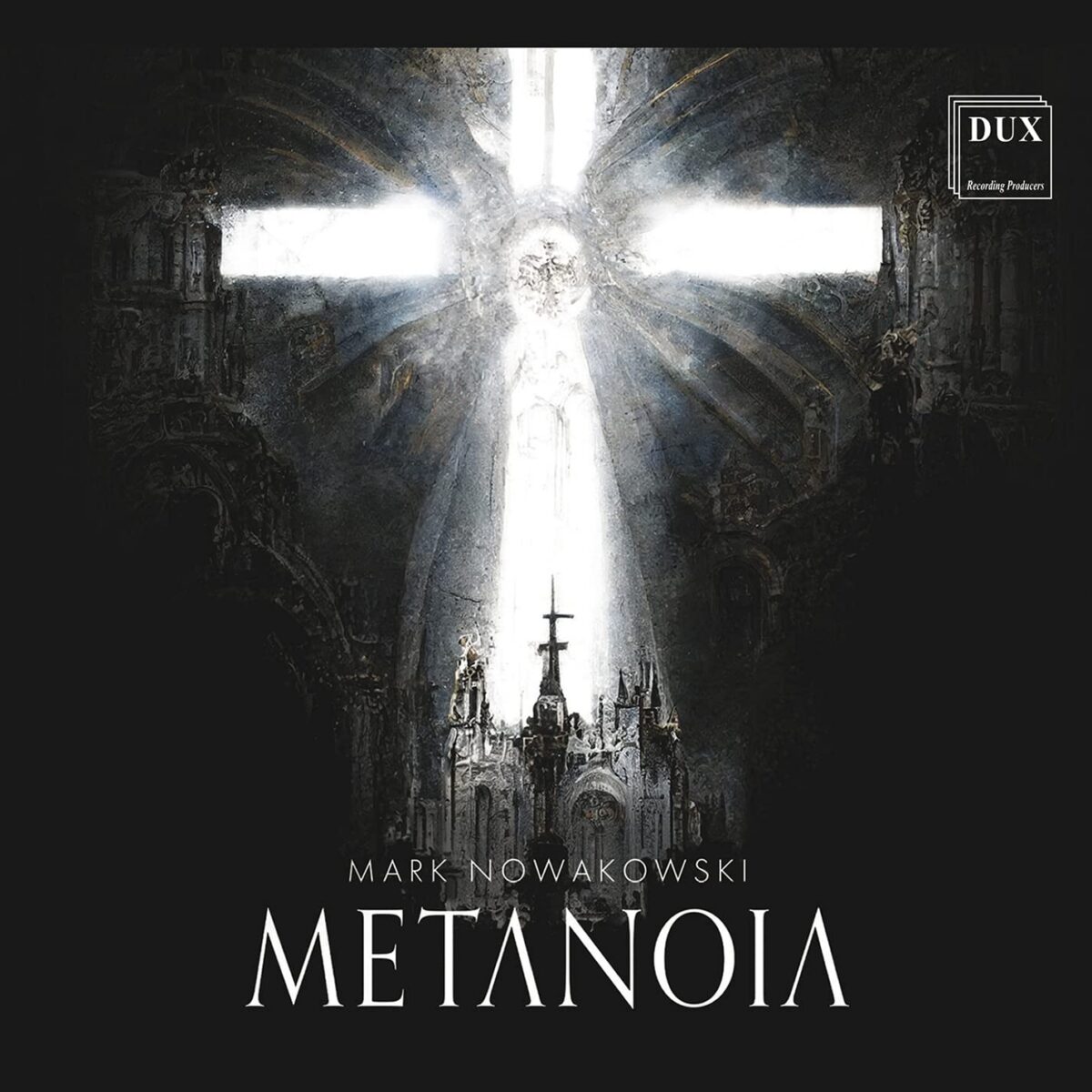
On May 19th I’ll be releasing my second album, Metanoia, published by the Polish label “DUX” and distributed internationally via Naxos. This is the story of a composer’s journey in creating new sacred music that brings people closer to God.

What is sacred music? This is the first question I wrestle with, for while the line between liturgical and non-liturgical music is at least somewhat clear, the question of what makes music “sacred” drifts into more fraught philosophical territory. Music itself points towards transcendent striving and the music most fully realized is one which engages our contemplative nature. Sacred music is that which makes us stop and contemplate what lies beyond the noise and distraction of the world: It points us toward God.

Even during a time of growing hostility to faith in general and Catholicism in particular within the concert hall, it is the works of Catholic and Orthodox composers which have continued to play a major part in our classical music.

The 20th century’s greatest composition pedagogue, Nadia Boulanger (1887-1979), was a deeply faithful Catholic and daily communicant, and most of her famous students (even those not implicitly Christian) retain a distinctly spiritual approach to their work.

One of her many contemporaries was Olivier Messiaen (1907-1992), a French composer whose compositions are marked by his Catholic faith and fascination with theology. Some secularists love his fascination with birdsong (which I suspect for Messiaen pointed to the universal harmonies of the Creator anyway). I rather prefer his Poèmes pour Mi, which strikes me as a historical musical prelude (and musical counterpart) to the deep theological meditations of John Paul II’s Theology of the Body.

Francis Poulenc’s (1899-1963) many sacred works, including his Gloria and Stabat Mater, reflect his deep spirituality and commitment to the Catholic Church. In midlife, when a dear friend died in a traffic accident, Poulenc made a pilgrimage to the Sanctuary of the Black Virgin in Rocamadour, triggering a profound spiritual revelation. His resulting Litanies for the Black Virgin for women’s chorus and organ was premiered by Nadia Boulanger during a London BBC concert.

Henyrk Górecki (1933-2010) was another Catholic whose works include luminous choral works and the best-selling Third Symphony, yes, but also a grouping of more challenging chamber works which invite deeper contemplation. (I’ve written about them here.)

Giya Kancheli (1935-2019) was a devout Orthodox Christian born in Soviet Georgia whose striking works, including his Liturgy for Viola and Symphony No. 6, are characterized by their meditative quality and evocative use of soundscapes. John Tavener (1944-2013) was an English convert to Orthodox Christianity. His masterworks include the record-setting The Protecting Veil and haunting Funeral Ikos.

Today the heirs of this line of composers include Arvo Pärt (Orthodox, but setting almost exclusively Catholic texts), and Sir James MacMillan. MacMillan’s compositions reflect his Catholic faith and Scottish identity, with works such as his St. John Passion and Symphony No. 5 receiving critical acclaim, though it is his Confession of Isobel Gowdie and his Sing a New Song which move me most profoundly. Pärt’s minimalist style is infused with religious motifs, evident in works such as his Magnificat and Tabula Rasa.

In Poland, Pawel Lukaszewski holds a dominant role among composers, and I think succeeded in his astounding Via Crucis in writing the first sacred masterwork of the 20th century. Lukaszewski in turn has inspired composers like Sebastian Szymanski, who writes truly gorgeous music.  Finally in North America we have our own Frank LaRocca, who is leading a new generation of Catholic composers in various stages of their career including Jeffrey Quick, Daniel Knaggs, Bobby Chastain, Xanthe Kraft, and others.

The next generation of Catholic composers should take heart: despite the hostility we encounter, both the origins of our craft and its modern manifestation are distinctly Catholic by nature, and I would go as far as to claim that a Catholic art needs a Catholic perspective to be most fully realized.

As to my own part, In my 2017 release for Naxos, Blood Forgotten, the string quartets featured within were deeply personal statements (as many string quartets are) and represented some of my most heady and complex music (as many string quartets do). There are rich statements of culture and philosophy here, yes, but also distinct moments that reach for the sacred in music. While the album was successful, a number of other diverse projects were already brewing, from chamber to choral to even electronic music. Over a period of eight years I collected the best recordings from these various collaborations, intent on assembling them into a distinctly Catholic vision of non-liturgical sacred music. I hope to craft and share music which challenges the listener and takes them on a journey, or perhaps provides contemplative fodder for their own spiritual journey. From this my second album, Metanoia, has been born.

The title track, “Metanoia,” was a collaboration with the Italian-based Monteverdi Cello Octet, with whom I developed an immediate connection despite the geographical distance between us. The piece explores the Gospel meaning of the Greek word “Metanoia,” which is often translated as “repent,” but in reality carries the deeper command to “change one’s manner of thinking.” There is difficulty of changing ingrained thoughts and habits, yes, but even more profoundly there is great struggle to change spiritual habits and enliven dead hearts; music for its part is the ideal vehicle with which to explore and express these often indescribable spiritual struggles.

Metanoia begins with strained and uncertain textures and builds into a rich melodic landscape before arriving at a place of fierce conflict. Eventually, the conflicting lines settle into an aggressive percussive repetition, while a new pleading melody emerges, threatening to explode into ecstasy before descending into a more uncertain ending: the journey goes on, as we have “put into the deep,” but Christ is with us, and our fundamental transformation continues.

It’s the most challenging work on the album and intentionally put first on the disc: This is contemplation, not easy listening.

We travel from Italy to Poland next with “Tu autem, Domine?” which is a gentler work, a meditation for mixed chorus that repeats and refashions its short text into a series of varied spiritual questions, which seem as much a plea as an impassioned demand. The questioning ultimately settles into a dramatic “Amen,” vacillating between uncomprehending resignation and peaceful acceptance. I explored the particular way that Poles approach God in our personal and historical difficulties in this work, which was beautifully brought out by Szymon Wyrzykowski and his wonderful “Chaps” choir in a recording session in Szczecin, Poland.

The album proceeds to “Before I formed you…,” a work for voices and baroque stringed instruments, arising from my frequent collaborations with Three Notch’d Road and violinist Fiona Hughes and bass-baritone Peter Walker. As a father of four, the meaning of this work is far from ambiguous for me, and our premieres with Three Notch’d Road featured Catholics pensively approaching me to see “if I really meant what I think you meant.” Indeed, I did. After all, I’ve had the privilege of witnessing beautiful little humans – full of personality and complexity – manifest into our universe, challenging and enlivening us with their precious presence.

To think of what this means, and how God cooperates with mere humans in the begetting of eternal beings, is a shattering reality that I wished to contemplate in this new work. The piece takes its text from Psalm 139:13-15, announcing “For thou didst form my inward parts,” and slowly growing in intensity as they declaim: “thou didst knit me together in my mother’s womb. My frame was not hidden from thee…”. The music takes a fragile and introspective turn with the singers stating: “when I was being made in secret, intricately wrought in the depths of the earth.” If the preceding words can be understood as an individual’s praise for their own creation, the reply from Jeremiah 1:5 is perhaps God’s answer. The strings transition into a modern and sparse sustaining texture as the singers state in unison “Before I formed you in the womb, I knew you,” at which point the sustain buzzes and grows with the words “and before you were born I consecrated you.” The piece is bookended by a variation of the opening string duo, a musical ellipsis implying the continuation of life’s drama beyond the musical expression itself.

All sacred music, properly understood, is prolife, but this hymn happens to use the same Biblical quote Archbishop Cordileone used to title his letter on the Eucharist, abortion and Communion.

Listen here:

"Before I formed you..."

The piano trio Reaching moves from mysterious textures to rampaging exchanges, pushing the University of Memphis Trio to their limits. Metaphorically, the piece is about “crabs in a bucket,” or a story that fishermen tell. When one of the crabs closer to the top sees the light and tries to escape, the other crabs reach up and pull their intrepid colleague back down. The moral of the story, of course, is that “people are like crabs in a bucket.” Anyone who strives to break the mundane will struggle through such things in their own life, and often we are dragged back down despite our best efforts. In such moments a repose is necessary, a re-gathering of strength, a prayer, and a renewed ascent begins.

Quo Vadis, Domine? is a 20-minute sacred drama set on the famous story from the early days of the Church, as famously dramatized towards the end of Henryk Sienkiewicz’s novel Quo Vadis. As a libretto, I set the very words of the scene from Sienkiewicz’s novel into a dialogue form, after which they were translated into Latin by a priest-scholar from the Confraternity of St. Peter (FSSP). Individual singers represent the characters in the story: Peter sung by countertenor, his boy traveling companion by soprano, and the words of Christ by Peter Walker’s resonant bass-baritone. When singing as a trio, the ensemble represents the narrator. This ancient economy of means allows for expansive storytelling, and if a poem can bring deeper spiritual insight and focused intensity into a minute event or observation, then music has the added advantage of also stretching out the emotional and contemplative material of such an encounter into temporal time.

The album concludes with Bogurodzica: Medytacja (“Mother of God: Meditation”) a work for cello duo and electronics which takes as its source material the famous Polish hymn of the same name. The initial low antiphonal exchanges between the cellists allow the electronically generated accompaniment to subtly enter, ushering in a rich tapestry of sounds almost entirely drawn from digitally manipulated recordings of the cello. It is, in many ways, a companion work to Blood, Forgotten, for solo violin, video and electronics, the title track of my debut 2017 Naxos release. I know that some listeners will see the words “cello and electronics” and flee, but it was my intent to go against the grain of so much pointillistic and unapproachable electronic music, and instead write something moving and beautiful where the cello – not the computer – takes the lead. There is a challenging contemplative arc to the piece, but my hope is at the end of this album, Bogurodzica will leave the listener in a timeless and expansive place.

As a Catholic composer, I hope that this work will inspire others to seek transformation and to embrace the challenges and opportunities of the spiritual life.

Composer Mark Nowakowski’s latest work Metanoia is available here: https://naxos.lnk.to/DUX1916

Kierkegaard’s Enormous Paradox: A New Poem

Sloucher crooked like a human question mark.

Flaneur of Copenhagen, Street-corner loafer.

Unscientific method-ist, proto-existentialist

Godseeker labeled philosopher by posterity.

Writing the opposite of what you intend.

Shifting persona. Hinting at ephemera.

Mystifying readers, teasing out truth.

How do I know you? Let me count the ways.

Humanities 101. Brandeis Freshman.

Great-genius-wannabe-me. Why study long-dead

Philosophers like Aristotle and you,

I sniffed, who got so much so wrong years ago?

Now at 77 I know you better, a recent taste

Acquired doing research to write this poem,

You who only knew post-Catholic Danish

Worship services with hours-long sermons.

Congregations dozing behind glazed eyes.

Memorized verses filed in their heads.

You weird-bodied sensitive like some of us who get you,

Heard Scripture as the living Word it is.

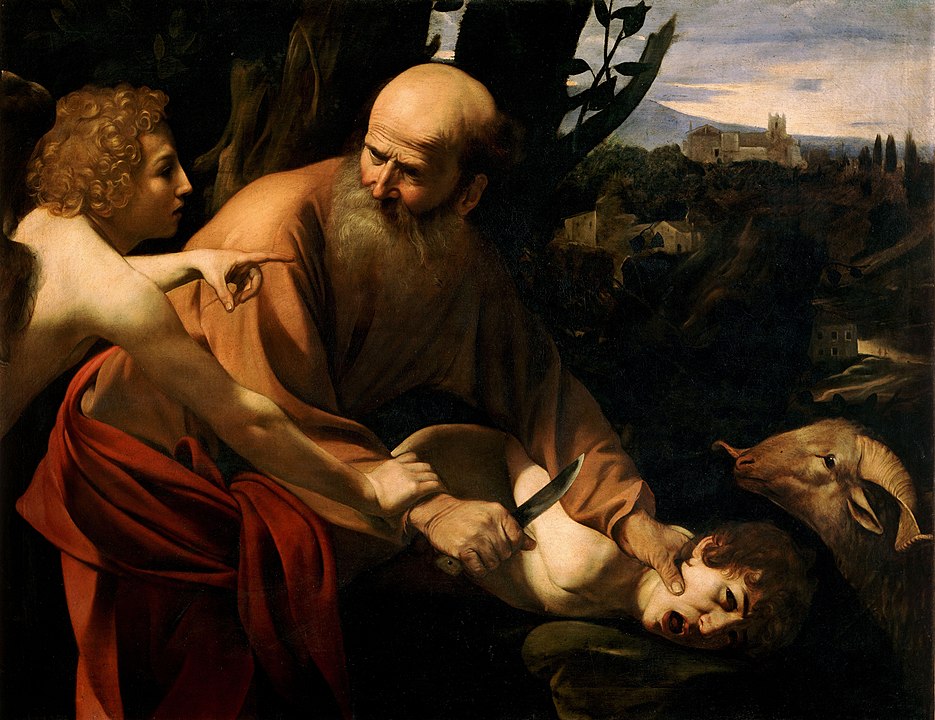
You eavesdropped when God told Father Abraham

To sacrifice Isaac, belov’d child of His promise.

Journeyed with that father, that son, the knife,

The binding rope, the fuel. Until with great relief  . . .

You all caught sight of the ram. Then you pondered

Whether Isaac ever got over his near immolation

By his own father’s hand. And why Abraham

Set his face like flint to do that monstrous deed.

Suspension of morality? Obedience über alles? I think not.

Did you forget or overlook what St. Paul told us?

Abraham walked with Him so long and knew Him so well.

He reasoned God could raise Isaac from the dead.

And why didn’t you consider this either, how later,

Much later after Abraham’s multitudinous offspring

Were long settled in the promised land, astoundingly

God Himself enabled what He asked Abraham to do?

Roseanne T. Sullivan is from the Boston area and currently lives in a Victorian in San Jose, California. Besides writing poetry, Sullivan writes memoir pieces, essays, and articles about sacred music, liturgy, art, and whatever else captures her Catholic imagination. This poem, “Kierkegaard’s Enormous Paradox,” has been selected for publication in Homage to Soren Kierkegaard, an anthology to be published by Wiseblood Books.

“Even reason can bring sorrow in its wake” The Banshees of Inisherin’s Luminous Tragedy

I know of a woman whose family banshee emitted blood-chilling shrieks from the lonely depths of the Irish countryside. She abruptly changed her travel plans, only to find out later there was a fatal pile up on the road she had intended to take.

Inisherin, Martin McDonagh’s fictional island, is traditional banshee territory. Yeats and Lady Gregory would have loved it.  The warnings in this tightly written film, though, mostly go unheeded.

Sheila Fitton’s old Mrs McCormick is the representative banshee. Wrapped in her hooded burlap cloak, her pale-faced appearances subtly suggest escalations of the grisly plot. You hardly notice her but she’s there all right. She’ll be smoking her clay pipe outside the general store, a mere meditative observer, or she’ll be trailing down the dusty road – watching. By the time she pops up in the dusk with her emphatic prophesy the film’s chief antagonists have put themselves beyond listening and listening seems to me the crux of this story.

Inisherin sits in dreamy isolation across the water from the west coast of Ireland. It is 1923 and on the mainland the Civil War is in full swing. The film can be viewed as a meditation on the stomach churning folly of that historic violence where neighbor murdered neighbor. Brendan Gleeson’s Colm, a fiddler, insists to his drinking buddy Colin Farrell’s Padraig, that they must stop meeting for their long established ritual pint at the pub. Colm needs silence to hear the music in his head, a tune he must write before he dies. Incredulous Padraig asks why he refuses to meet. ‘Because you’re boring,’ Colm replies, adding his draconian edict that Colm must never talk to him again at all.

Most writers and artists of a contemplative disposition can get that. The phone rings, the neighbour drops in, the needy relative demands an ear and the Trappist vocation becomes alluring. Music, prayer and poetry are born out of listening to the silence. But what use is the silence if you can’t hear the sound of someone’s breaking heart? Ridiculous a character though Padraig may be, I heard it and it made me cry.

Colm’s rather so-so jig finally emerges but not before Padraig has disobeyed the gagging order in awful, frantic increments and Colm has made good what initially seems a bizarre threat: to cut the fingers off of his fiddling hand if the prattle doesn’t stop. He has destroyed the very point of his longed for silence – a silence he is, I suspect, incapable of hearing. It is one of the film’s dreadful ironies. There’s too much noise in his own head, perhaps the noise of artistic conceit. His tune isn’t on the Mozart level he would like to think it, and it’s unlikely to survive him except down at the pub.

McDonagh’s brilliance as Inisherin’s writer/director and the stunning cast ensure that here is finally a film with enough meat in it to chew: His savage wit sheds a bleak light on something far more dark and painful.

Mrs McCormick knows, and the Church knows too, that whatever it is lies slightly beyond our ken and we fail to listen for it at our peril. Like banshees with their ancient wisdom, the faith is subtly signaled at every turn. An enormous statue of Our Lady cloaked in blue and white stands at a fork in the main road, the better route not chosen by either Padraig or Colm. The whole island turns out for Sunday Mass, the Latin rubric piously recited but the mystery of goodness it represents goes largely unheeded.  

Gary Lydon’s village policeman stands tall at Mass, a holy intermission in the ritual abuse of his own son.  Dominic, the film’s most touching character is played by Barry Keoghan who richly deserves his predicted Oscar. The boy’s brain is damaged, one suspects, by his father’s blows to the head and sexual abuse lurks as a ghastly subtext. There is pity and terror enough for Sophocles in Inisherin. McDonagh honors that but with the modern gloss of wry, dry absurdity.

The Church, in turn, provides a weary priest in David Pearse. He tries to talk sense into Padraig.  who cannot see sin in his cruel rejection of Colm nor in his self-mutilation. ‘How’s the despair?’ the priest asks in recognition of Padraig’s complex needs. And even though there is humor in the confessional exchanges, it’s a penetrating question neither answered nor addressed. The film opens with a rainbow on the water, the sunset illuminating roofs topped with crosses. The signs are all there but who sees them?

There is, however, someone who does listen: Kerry Condon’s Siobhan, the film’s raisonneur. And it needs one. As gormless Padraig’s sister, she has sense. When she isn’t mothering him and keeping their tiny house in order, she pores over books, an exotic pastime in Inisherin. ‘What are books?’ Colm asks her scornfully, comparing them to his music – ceilidh music which he thinks incomparable. ‘Why do you read sad books?’ her brother asks interrupting her perusal of Dostoyevsky. Siobhan actually thinks and acts upon her thought. As the feud between the two men heats up, she tries to make peace, but in vain.

She does seem to have read the Gospels because she is the only one who shows a modicum of self-sacrificial kindness. She invites Mrs McCormick in for tea, not qua banshee but as an elderly neighbour who might need a chat. Padraig shudders away from a mere smelly old person and Colm rudely rejects her succinct and timely intervention. As the brothers Grimm would have it, ignoring a crone usually has dire consequences; giving her an ear brings rewards. Whereas the two combatants finally destroy nearly everything of importance to them both, Siobhan manages to escape and not without banshee assistance.

There are so many levels of irony in this film that it is impossible to unravel them but one of the saddest is the suggestion – to me at any rate – that even reason can bring sorrow in its wake. Having given it her all to solve the insoluble imbroglio, Siobhan leaves Inisherin to be a librarian on the mainland. Before she goes, a mist-enshrouded Mrs McCormick summons her  across the water just as Siobhan encounters poor Dominic on the opposite shore. In a desperate sort of adolescent lust, which in the past she’s had to stop getting out of hand, he declares his love for her.  The poignance of this exchange on both sides is almost unbearable. She is very gentle, telling him it’s impossible. And it is. Of course it is. But there are tragic consequences.

Her heart is heavy as she goes. In a marvellous touch, the sail on the boat she takes is black. Her helpless brother waves frantically from the cliff. Alone in their little house now he lets his cow and pony wander freely in, his affinity with them stronger than with his more evolved sister. The final exchange between Padraig and Colm has, in fact, to do with animals. Colm has thrown his severed fingers at Padraig’s house where his pet miniature donkey eats one and chokes to death. Padraig has set Colm’s house on fire but has saved his dog. Meeting after this auto de fe, the only way they can communicate is through the donkey and the dog.

McDonagh has provided us with ancient Irish presence, the Church’s presence and the presence of sweet reason. None of them have worked in Inisherin but the deepest irony of all is he doesn’t suggest that they don’t. He suggests to me, rather, that they do because if we refuse or fail to listen to what they say or imply, then we lose what makes us human. Mother Nature claws us back.

Anne Redmon is the author of seven novels (Emily Stone; Music and Silence; Second Sight; The Genius of the Sea; The Judgement of Solomon; The Head of Dionysus; In Denial), an NUJ journalism course for prisoners and a Fellow of the Royal Society of Literature. She is married to theatre critic Benedict Nightingale and they live in London.

Reflections on the Chesterton Carol

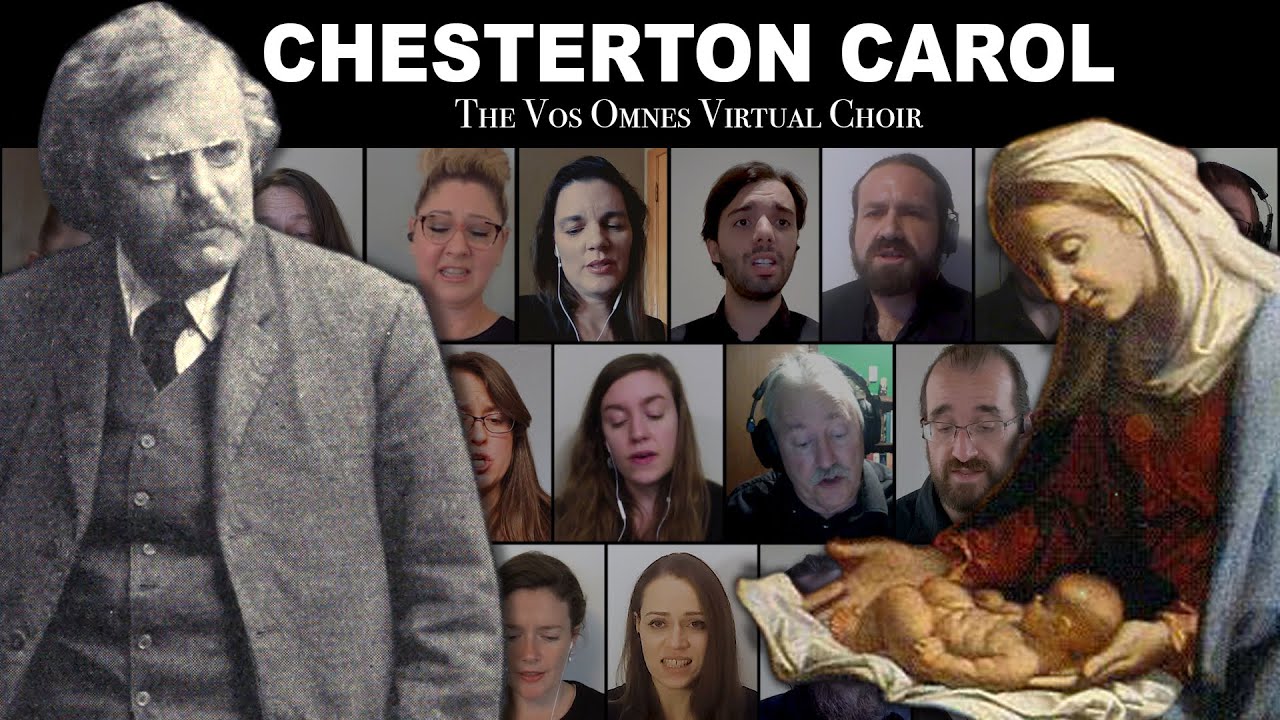
Sometime around 2010, contralto Imelda Franklin Bogue approached me to set the Christmas poem of G.K. Chesterton’s “A Christmas Carol” to music.

I was newly married, working on my doctorate, and glad for any paid commission during struggle times. I had also just finished reading Chesterton’s Orthodoxy, a very sophisticated intellectual work. So, reading the lyrics of the Chesterton’s A Christmas Carol, I was shocked at first by the seeming child-like simplicity in the text.

Yet on closer read, this simplicity is deceptive: Chesterton’s carol opens up into a deep contemplation on the shattering nature of the Incarnation.  There is also the sweet Marian devotion subtext, and the way the Christ child seems to grow in each stanza, from infancy (laying in Mary’s lap) to being a small child standing on her knee. In the first three stanzas, the parenthetical sections of each stanza look outward towards the world, disappearing in the second half of the final stanza, which strikes me either as the Parousia or its anticipation.

Naturally as a composer this excited me: a gorgeous rhythmically simple text with deep, intertwining theological themes. Chesterton’s words called to me for an introspective and complex setting. And yet Imelda wanted more of a simple carol, and so I set to work trying to imitate Chesterton’s approach in music: that of simplicity illuminating a deeper, richer meaning.

Writing a Christmas carol had always been a secret dream of mine:  As the son of Polish immigrants our holy days were saturated with singing the deep and rich carols of that region: deeply Catholic songs of clear mourning or soaring exaltation. Later I grew very fond of the English carol tradition, and I marinated in these two traditions as I set about to find the music for Chesterton’s Carol.

And so as is typical in the life of a modern classical or sacred music composer I hear the Carol sung beautifully once by Imelda in Christmas of 2011.  I hear a few encouraging compliments, and then it went on the shelf as most new compositions do. Today’s classical music and sacred music composers will spend months – even years – toiling away at works which are only performed once and then shelved.  Why?  I think this a logical consequence of the sundering between composers and audiences which took place as a result of the modernist revolution: we know longer “know” each-other; Meanwhile audiences naturally distrust new music after the near century of abuse they’ve been put through. The public have retreated into the safe haven of the dependable classics, which leaves composers who would dare to humbly submit new works to the tradition feeling marginalized and of course seeking outside sources of income.

Then there is the reality that the Church itself is no longer a major patron of the arts and the connect between composers and Catholic cathedrals and parishes has been severed.  The Benedict XVI Institutes remarkable efforts to heal this breach are deeply encouraging to me and to other sacred music composers.

Credit for the survival of the “Chesterton Carol” here goes to my wife, who insisted that the “Chesterton Carol” was some of my best work, and periodically pressed me to do more with it.

Its revival came in the most unlikely time: the Covid shutdowns. A daring small group of Catholic musicians I had worked to gather on Facebook brainstormed the question: how do we keep the music alive as the world shuts down? And so the Vos Omnes Virtual Choir was born. Our first virtual choir performance our own Frank LaRocca’s Agnus Dei from the Mass of the Americas. For the group’s third effort, we did the “Chesterton Carol.”

The Benedict XVI Institute’s sponsorship of this recording by the Vos Omnes Virtual Choir has generated more than 9,000 views, a very big concert hall that encourages all the musicians involved.  Our latest joint venture, a new setting of “Let All Mortal Flesh Keep Silence” has jumped to more than 7,000 views in just a few weeks.

Listen to the “Chesterton Carol” this Christmas here. May this beautifully performed rendition bring you close to the knee of Mary, moving from the tender beauty of the contemplation of a newborn infant to the apocalyptic adulation of the singing of the stars.  Merry Christmas.

Dr. Mark Nowakowski is a composer whose work has been performed across Europe and the United States. A professor at Kent State University at Stark, he will soon release his second portrait disc – Metanoia – through DUX Records; it is a follow-up to his critically acclaimed 2017 Naxos album “Blood, Forgotten.” He is also the composer for the Mass of the Ages trilogy.

[Editors Note: You can find the score of the Chesterton Carol by contacting Mark Nowakowski at his website below. The piece is currently available in three configurations (with the composer granting his permission for other arrangements):
*Voice & Piano
*SATB, Organ, Strings (with piano reduction)
*SATB and Chamber Orchestra (the version from this video)

WEBSITE: http://current.marknowakowski.com/available-pieces/]

CHESTERTON CAROL

“Can we break out of this prison of self?” The CAT interview with Phil Klay

Phil Klay is a novelist and a Marine Corps veteran. His short story collection Redeployment won numerous important prizes: the 2014 National Book Award for Fiction, the National Book Critics’ Circle John Leonard Prize for best debut work in any genre, and one of the 10 Best Books of 2014 by The New York Times. His novel Missionaries was named to the Wall Street Journal’s best 10 books of 2020 list. His writing has appeared in The New York Times, The Washington Post, The Wall Street Journal, The Atlantic, The New Yorker, and the Brookings Institution’s Brookings Essay series. He currently teaches fiction at Fairfield University. His latest work, the essay collection Uncertain Ground was released in May of 2022 with Penguin Press.

Catholic Arts Today’s contributing editor, Sarah Cortez, interviewed Klay about his vision as an artist and as a Catholic artist in Dallas during the 2022 Catholic Imagination Conference.

Sarah Cortez: In the story “Prayer in the Furnace” a line written by an older priest to a younger priest, an Army chaplain, caught my attention. It says: “Sin is a lonely thing.” I wondered if this is the appropriate lens through which to read all the stories in Redeployment, through the lens of the spiritual detachments that your characters endure: meaningful sex, memories of home, security of training, security of location, faith in God, faith in fellow humans. Are you consciously stripping away a man’s spiritual struts?

Phil Klay: It’s not that all these things must fail. Some props are more false than others. Sex with a prostitute is not going to do it in terms of connection or meaning. But the isolation, the alienation people experience was important to me. A central drama of the book is that the characters are trying to make contact. Are we isolated atomized creatures only experiencing things that are only ours? Is there a way to break out of this prison of self?  Are there points of contact?

It is important that the old priest (though he has never been to war) is not impressed with the horrors of war; not because war is not horrific but because horrible things are what humans often do: This is sin and its consequences. It is not fundamentally different than what he’s dealt with back at home, maybe more extreme, but the question remains the same: Can we escape from the prison of the self? Can contact can be made?

So in the longer story “Psychological Operations,” there are intertwined narratives of a character telling stories to a woman that he’s attracted to and a story of his relationship with his father along with multiple stories about insurgents. I did that not because I was interested in playing a metaphysical game of nesting Russian-doll narratives, but because of the way that language is being used in each of those iterations of the story while the character moves closer and closer to a space of genuine vulnerability.

Sarah Cortez:  One thing I enjoyed in your stories was the male humor: the visceral roughness and crudity. The fact that the characters are often facing death or dealing with its aftermath seems to ratchet up the humor?

Phil Klay: Rough humor is one way of bonding, a way of bluntly acknowledging a difference, then agreeing to laugh about it.  On the other hand, humor can also be used as a way to make distinctions and create barriers. Sexist humor often functions like that in male groups: You tell the joke that is inherently demeaning in front of the one woman who is present. That woman is then put in a bind: Either she laughs loudly and accepts the underlying premise of the joke, which is demeaning to women. Or she pushes back against it, in which case, she’s not a team player.

You can also see humor as positive. The amount of racial humor that went around among a very diverse Marine population was, and is, enormous. But humor was also a way of bluntly acknowledging differences and then making a conscious decision, like “we’re going to laugh about this rather than make an issue of it.”  I don’t want to overly idealize it, because it’s not like there wasn’t a double-edged sword to it, but humor could be a method for dealing with this distance and difference that results in bonding. If somebody says something that sort of bothers you or offends you, turning it into a joke is one way of acknowledging it without insisting on it being your way. The humor then is another way of saying, “Let’s just get past these things, together.”

Sarah Cortez: One of the moments that hit me the hardest in Redeployment was in “Bodies” when the young soldier at home on leave lies down on top of the covers of his ex-girlfriend’s bed with her. He knows she’s a pacifist and no longer loves him. When he held her hands a few moments earlier, her only response was to say, “I didn’t shave my legs today.” The way that she reacts is so far from what he needs.

Phil Klay:  But it’s also related to what he needs. It’s that hairline moment. It’s Frank O’Hara’s line: “I want to be at least as alive as the vulgar.” It’s not supposed to be where you stop. But it is being alive.

There’s something about sex for a lot of these characters who want connection. Sex often feels to people like it is the epitome of intimacy. That’s why sex can also be the most alienating thing, as it is in some of the stories, because the thing that is supposed to be most intimate is actually the moment when you feel most alone.

At a visceral level, the opaqueness of the other body in front of you makes the failure that much greater. And yet the characters come back to sex because it does have that aura that it will be a portal to connection. When it’s working, sex is about vulnerability, it’s about connection and intimacy. It’s about love. Sex can be about family and community, and so it can be about building a family, making sexual intimacy not just a moment of connection, but about your future, and your past as well. Sex is this thing, and, of course, sex is often this kind of substitute for experience, right? It’s often a substitute for God. But there’s a reason for that, right? Sex is sort of like a key to the self, a key to understanding. What matters most about sex is that it’s not like other human acts.

Sarah Cortez: You’ve said you consider yourself a Catholic writer. Tell us more about this.

Phil Klay:  Readers are free to take what they can from my work; if somebody who’s not interested in the religious themes isn’t necessarily missing everything about the book, they’re just focusing on something different. There are reviews of my novel Missionaries that were all about it being Catholic, and then there were reviews that were all about American military policy.  You’d almost think there were two different books, and to me that is fine. In some ways, I like that, I like the readers coming with different things that they’re interested in and taking different things away.

In fiction, it’s not like there’s a correct answer that everybody is supposed to come to. That’s not the point. Fiction is something that you come with your own world view and understanding, then you enter into this other world that has been created for you, and then you make something out of it. You have a creative response to it, so not everybody’s supposed to have the same response. Hopefully, a writer is able to hit different people at different levels.

But I do want people to be aware that the Catholicism is important to me, and not just because a priest shows up in the book, which is the most obvious thing. When you read a novel like Andre Dubus’ The Lieutenant, (which is being re-issued and is a wonderful novel), you can read it without any idea that he’s a Catholic author, or that religion is extremely important to him because there’s not a whisper of it in the book. It’s a military novel full of ritual and purpose and an institution that provides those things within a collective setting—and it’s about a character who is trying to find himself and his identity and a source of meaning in life through that purely secular institution. If you understand more of Dubus’ worldview and what matters to him, you understand that he’s writing about a world that his interest in is deeply related to his faith. He’s also showing skepticism about the depth and the extent to which a purely secular world can satisfy someone in those regards. It’s also deeply related to his faith, and so it adds a different layer and a different way of reading the book, and a different way of understanding what matters to the author. So, yes, of course, I want be known as that kind of author; I want to write in that way.

Sarah Cortez: You’ve said that stories that engage with the world and engage with the faith can be tools for the faithful to use. Could you tell us how you might see this happening?

Phil Klay: I wouldn’t still be a Catholic except for Flannery O’Connor’s “Parker’s Back.” In this story you find characters really grappling with the difficulties that people encounter. What drew me back to the faith was not a set of intellectual propositions, but rather more of a sense that a world view that is informed by Catholic sensibility is richer and truer to the beauty of reality and to real evil. The Catholic sensibility is attuned to the characters’ struggles.  You can have a character that is no longer Catholic that is struggling with the same crises.

Stories are deeply important to our faith. What we have are traditions, rituals, communal practices…and stories, stories. The Bible is a cacophony of stories that must be appreciated through literature. The stories about the saints. We are story-telling animals. For each age we must find stories that grapple with the world as we find it.

Sarah Cortez: Why do you teach creative writing?

Phil Klay: I like it. What’s not to like when you take your favorite thing in the world, and you share with students who are trying to express things that are important to them now? Storytelling is the best way for us to express that which is most vital to us. You can become utterly vulnerable on the page in fiction in a way that you can’t in any other form—and that is a glorious thing. It’s a thing that keeps us human.

Sarah Cortez is president and founder of Catholic Literary Arts, www.catholicliteraryarts.org. A Houston writer and editor with fourteen award-winning books to her credit, she is a fellow of the Dallas Institute of Humanities and Culture, a Scanlan fellow at the University of St. Thomas, and a former fellow of the Virginia Center for the Creative Arts. www.poetacortez.com

Defending St. Junípero Serra, with Holy Water, the Rosary—and the Arts

St. Junipero Serra, a holy man dedicated to the earthly and heavenly well being of Native Americans has been denounced as a racist, a genocidal monster. One CBS news report even libeled the saint as a slave owner.

On Juneteenth 2020, haters brought their ire against the founding father of California to San Francisco. Hundreds of protesters, many of them dressed in black, toppled and defaced statues in Golden Gate Park. Many figures whose statues were attacked had no apparent connection to racism or slavery. For example, the mob graffitied a monument to Cervantes and his characters, Don Quixote and Sancho Panza.

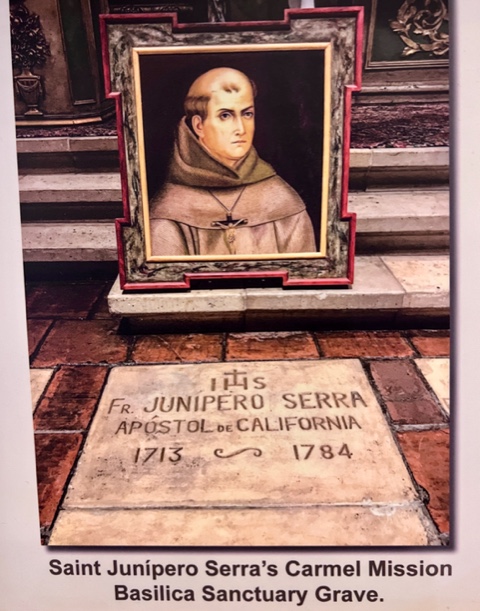
Prominent among the statues attacked that day was St. Junípero Serra’s. His statue was overturned. Both the statue and its pedestal were defaced with red spray paint. “Stolen Land” was scrawled on the pedestal.

Dismayed by the vandalism, I was happy to see Archbishop Cordileone take an unusual and gutsy step. Not stopping with issuing an eloquent statement of protest—which would likely be ignored even in the unlikely event it was read by Serra’s detractors, the archbishop also used powerful spiritual weapons at his disposal.

Park workers had cleaned the graffiti from the statue and taken it away to storage when the archbishop went with about two hundred of the faithful to the site of the empty pedestal. On that drizzly day, wearing an amaranth purple skull cap, and the amaranth cassock proper to his role as a bishop under a lace-trimmed alb, with a deep purple stole around his shoulders, Archbishop Cordileone blessed the area with holy water and performed a minor exorcism. He then led a rosary of reparation.

In a clip now posted at the archdiocesan website, the archbishop said, “An act of sacrilege occurred here that is an act of the evil one. Evil has made itself present here.”

Archbishop Cordileone went on to say he grew up in San Diego, near the first mission Serra founded in Alta California when it was under Spanish rule, the area which now makes up the state of California. So, he said, he has a heartfelt connection to the saint. “I’ve been feeling great distress and sort of a deep wound in my soul when I see these horrendous acts of blasphemy and disparaging of the memory of Serra —who was such a hero, such a great defender of the indigenous people of this land.”

Remarkably, the archbishop has also defended St. Junípero Serra in many other unique and creative ways—using the arts.

Through the Benedict XVI Institute for Sacred Music and Divine Worship that he founded, with the savvy assistance of Maggie Gallagher, the institute’s Executive Director, Archbishop Cordileone commissioned a new Mass setting, a painting, and a poem in honor of the saint. During a Zoom event, “The Making of Missa Sancti Juniperi Serra,” Gallagher said that following the Renaissance model of commissioning great works of art from within the heart of the Church, all of these works were funded by a generous patron, Mr. Terry Castor of San Diego, in honor of his deceased wife, Barbara. Anyone who celebrates the Missa Santi Juniperi Serra is asked to remember Barbara Castor in prayer.

Missa Sancti Juniperi Serra

During the ZOOM event on April 30, 2022, Archbishop Cordileone spoke about how the idea to commission a Mass in honor of St. Junípero Serra was formed.

The archdiocese would be hosting a Sacra Liturgia Conference at the end of June, an international event which, as the archbishop said, “brings together great minds and hearts of people who are working to promote and renew sacred liturgy in the Church and regain the beauty that the liturgy deserves. I thought that since the last day of the conference is July 1, the feast day of St. Junípero Serra, a perfect way to bring this to a conclusion would be to celebrate a Solemn High Pontifical Mass —in the extraordinary form because that’s the form of the Mass that St. Junípero Serra himself celebrated.”

The Mass would be celebrated in Mission Dolores Basilica, which was built in 1876 adjacent to the original Church of Mission San Francisco de Asis to accommodate larger congregations. Mission San Francisco was founded by Padre Francisco Palóu under the direction of St. Junípero Serra in 1776, and the adobe mission church built in 1791 is the oldest surviving structure in the city. (EWTN recorded the Mass, and you can view it at Cathedrals Across America—Solemn Mass for the Feast of St. Junípero Serra.)

Archbishop Cordileone continued, “I asked Frank to compose a Mass in honor of St. Junípero Serra that would be reflective of the mission era here in California.” This is the third Mass setting composed at the archbishop’s request by Frank La Rocca (franklarocca.com) , who is the Benedict XVI Institute’s composer in residence.

La Rocca then spoke about how he went about making his composition evoke the experience of what a Mass from that time would have been, “One important way is through the choice of the instruments accompanying the singers. It would be a small ensemble just like the ones they had in the missions of maybe a string quartet, a couple of flutes, perhaps a small portable organ.”

At the premiere, La Rocca’s music was performed on baroque-style string instruments and flutes to contribute to the authenticity, but modern instruments will be able to perform the music as well.

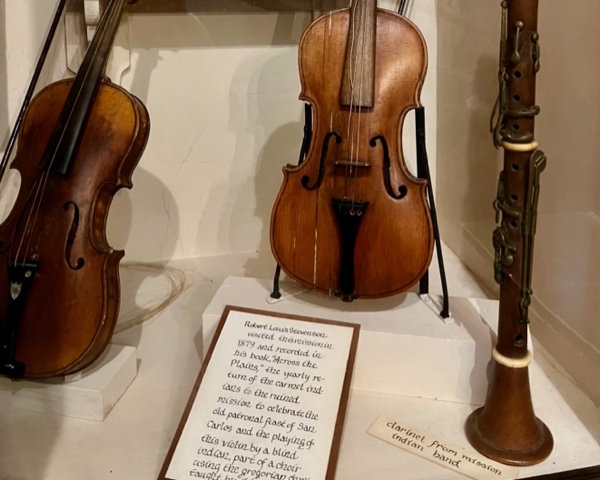
Musical instruments played to accompany Masses with Gregorian chants by the Indians in the Mission bands.

In addition, Frank La Rocca said he wove throughout his Mass setting the tune of one of St. Junípero Serra’s favorite hymns, “Salve Virgen Pura,”—”Hail Pure Virgin.”

“In addition to the hymn I wanted to make allusions to Gregorian chants from Missa Orbis Factor, which certainly would have been one of the most commonly heard Mass ordinaries in those days.”

La Rocca used the Salve as a Prelude, and worked it in as a thematic element of the music for the Mass, using the melody and derivatives of it in the music accompanying the ordinary the texts of the Mass. He wrote me later in an email that this technique is known as a “Parody”—a term that has nothing to do with mockery.

St. Junípero Serra and the American Saints Painting

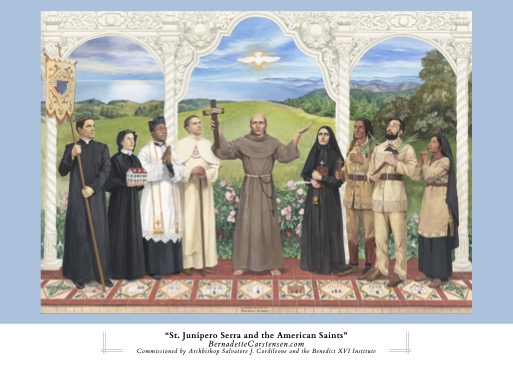
Figurative artist, Bernadette Carstensen (bernadettecarstensen.com) is Benedict XVI Institute’s painter in residence. During the Zoom event, she unveiled her commissioned painting “St. Junípero Serra and the American Saints.”

As Carstensen pointed out, the saints are standing in the painting against a classic California landscape on Mount Tamalpais with roses and columbine that grow there. Columbine also represents the Holy Spirit. The roses look to be Roses of Castile, of the kind St. Juan Diego found growing in winter and gathered into his tilma after the apparition of Our Lady of Guadalupe in Mexico.

The figure of St. Junípero Serra in the middle stands with arms upraised similar to the pose of his statue that was toppled in Golden Gate Park. From left to right on either side of Serra are Blessed Michael McGiveny; St. Elizabeth Ann Seton; Servant of God Father Augustus Tolton; Saint Damian of Molokai; Saint Mother Cabrini; a Native American representing the Huron Christian martyrs; St. René Goupil, representing the Jesuit martyrs, and St. Kateri Tekakwitha. At the saints’ feet are Spanish tiles depicting the nine missions founded by St. Serra. Below is a dedication to Barbara Castor.

The Liturgy of the Hours of Saint Junípero Serra

Benedict XVI Institute poet-in-residence James Matthew Wilson spoke about and read his poem, “The Liturgy of the Hours of Saint Junípero Serra.”

“I wanted to write the poem as a prayer . . . so we could read the poem and pray the poem.” Wilson said he used the rhyme royal scheme to honor St. Serra’s long and painful walk along El Camino Real—which in English means the royal road. Each stanza of seven lines, in iambic pentameter with a rhyme scheme of ABABBCC is about a different object from a different stage of Fr. Serra’s life starting from his youth in Mallorca, intended for us to ponder the object and think about what it can teach us about his spiritual life.

Eloquence beyond Words

Using the eloquence of the beauty of music and art, poetry, and architecture to defeat lies and ugliness is a profound idea. Research has shown that repeating the lies of opponents even when we have strong arguments against the lies may paradoxically strengthen belief in the lie among those who have believed it already. Besides, some people will not have heard the lie before, and it doesn’t help to spread it even further.

The arts are so convincing because they captivate people and grab people’s emotions, and even when they don’t completely bypass the intellect, they enrich the understanding.

A More Truthful Image

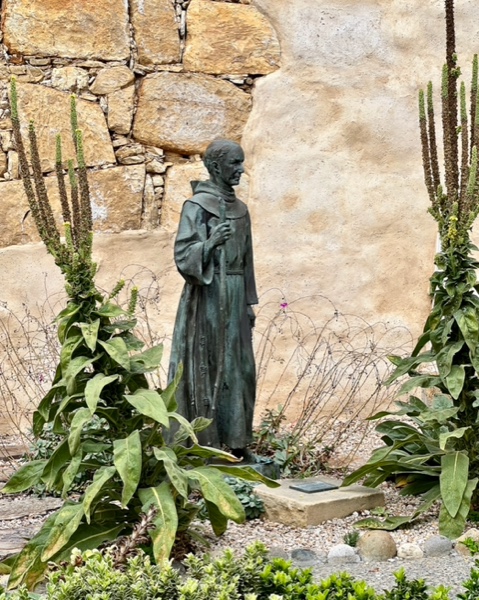
Recently I came across this review at website of the restored Carmel Mission where St. Junípero died and was buried, which portrays a more truthful image of the saint, “Walking through the primitive furnishings and reviewing the very basic library housed in the place, with tools and instruments available a couple of centuries ago illustrates the very primitive conditions in which the inhabitants lived and worked and the sacrifices made by the man that brought European culture and civilization to this part of America.”

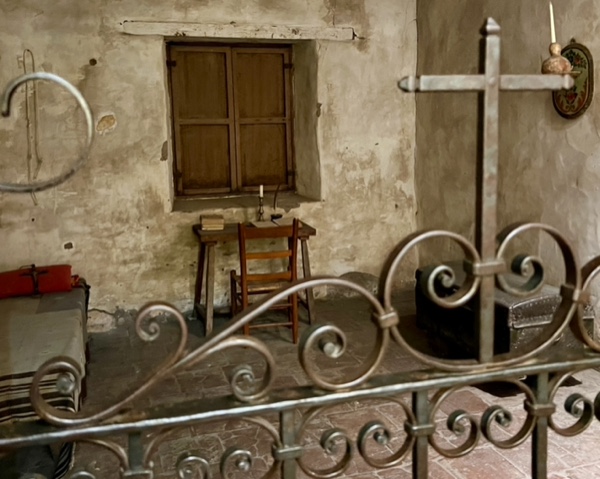
St. Junipero Serra’s ascetic cell at Mission Carmel, where he died and was buried.

This article is adapted from an essay that first appeared in the Fall 2022 Edition of Latin Mass Magazine. Republished with a few modifications, with permission.

My Burden Light: Poem

after François Mauriac

If you wish to resist the cross of Christ

Don’t you dare dream up a casual affair.

Follow Rimbaud. Pulled hair, soul sunken,  

Swear your friends fiends, rival Satan’s refusal,

Gutturally given out of season and drunken,

Scorning the Jesus who slept through the storm,

Spitting at nuns who tend your sad corps.

But deathbed, foul breath, you’ll mouth off bad faith:

Prepare everything in my room just so,

Arrange the candles and needle-worked lace.

Now let the chaplain confess my coarse soul.

White linen must pall every inch of this place.

The priest appears and makes ready the bread.

Consummatum est pax crosses over the dead.


Joshua Hren is founder of Wiseblood Books and co-founder of the MFA at the University of St. Thomas. He regularly publishes essays and poems in such journals as First Things and America, National Review and Commonweal, Public Discourse and LOGOS, Evangelization & Culture and The Lamp. Joshua’s books include: the novel Infinite Regress; the short story collections This Our Exile and In the Wine Press; the book of poems Last Things, First Things, & Other Lost Causes; Middle-earth and the Return of the Common Good: J.R.R. Tolkien and Political Philosophy; How to Read (and Write) Like a Catholic; and Contemplative Realism: A Theological-Aesthetical Manifesto.

Daniel Knaggs Composes Music as an Icon for the Sacred

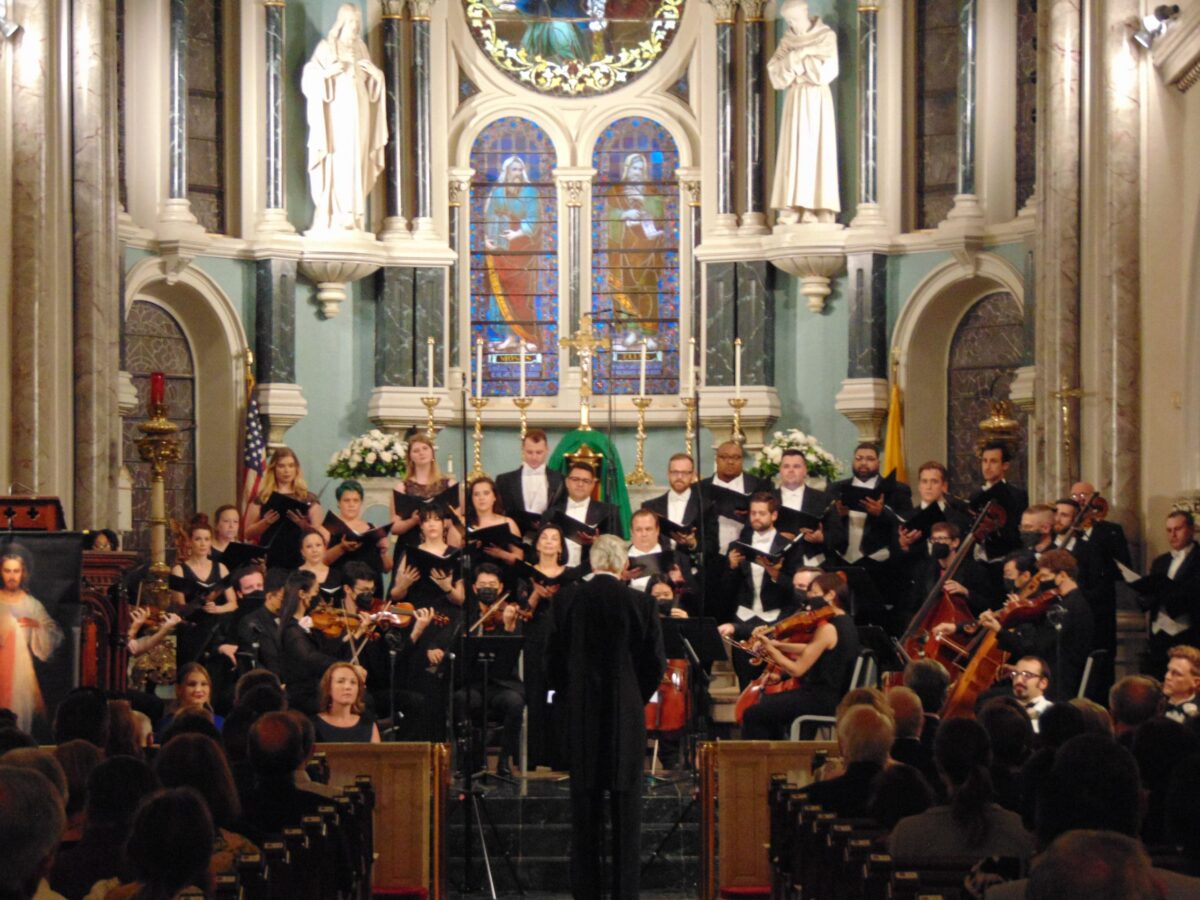
American composer Daniel Knaggs premiered his Two Streams, a cantata based on Jesus Christ’s message of Divine Mercy for mankind, last fall in Houston, Texas.  The concert celebrated the historic Church of the Annunciation’s 150-year anniversary in a gala evening event with almost 400 in attendance. The interior of the Romanesque-Gothic Church, a virtual jewel-box of carved marble, serene statues, and the original 19th-century stained glass, showcased the sacred music within vibrant architectural beauty.

Knaggs - Two Streams trailer

            Two Streams is Knaggs’ most substantial project in an award-winning career that includes commissions, prizes, and awards for composition from around the globe.  The initial impetus for the piece arose from Knaggs’ desire to compose music in response to his experiences in the Polish cities of Kracow, Warsaw, and Gdansk, the city now famous for the Solidarity movement’s founding and contribution to the downfall of Soviet Communism. Knaggs’ strong attraction to the Diary of St. Maria Faustina Kowalska, which revealed God’s message of Divine Mercy, provided the touchstone for the piece’s ultimate grounding and spiritual context. He says, “The idea of a God who is merciful to a fault disarms me. This is our God whose greatest attribute is His unending mercy for us and which He wants us to spread throughout the world.”  The sudden and premature death of Knaggs’ father just after the commissioning of the piece brought a deeply felt personal dimension to the spiritual reassurance of Christ’s Divine Mercy. The title of the piece, Two Streams, evokes the two rays emanating from the image Christ asked St. Faustina to have painted of His Divine Mercy: a white stream of life-giving grace and the red stream of purifying grace flowing from His heart.

            For Knaggs, the composition of music is a painstaking process.  He says, “You have to be in it for the long haul—to be able to work with a piece until every feature is right.”  Both spiritual and practical aspects influence a composer, like Knaggs, whose goal is participation in conveying metaphysical or spiritual aspects beyond daily reality.  He says, “In composing, we are indebted to what has come before us, for example, chant, polyphony. When you write music, you have the ability to bring in the register and range of voices, dynamics of soft and loud, keys and tonality to add to the meaning. One movement of Two Streams has no words, but I believe things are being conveyed. If someone tried to write music without a belief in the spiritual truths, the audience would know.”

            Two Streams has 14 movements based on texts from three sources: the Diary of St. Faustina, Scripture, and liturgical texts. The movements are arranged symmetrically with the first and last movements related, the second and the 13th, and so on.  Four hymns (songs) of Mercy are interspersed between the movements to ground the listener in both trust and joy. Each song  features a hymnic stanza sung in English with a subsequent hymn of Mercy sung in Latin. The intention is to depict a timeless scriptural echo of the content in each hymn’s stanza which then ripples eternally throughout the past, present, and future. An example of this structure is the Song of Mercy II sung by the mezzo-soprano soloist. While it is joyous, the hymn spills over into the contemplative Latin section with the words: “Show us your mercy, O Lord, and grant us your salvation.”

                        You gush forth from the Divine Trinity,

                        But from one single womb filled with love.

                        The mercy of the Lord will be revealed in the soul

                        In all its fullness when the veils falls.

                        Ostende nobis Domine misericordiam tuam. Et

                        salutare tuum da nobis.

While Knaggs, who has studied six languages, simultaneously composed versions of the entire cantata in English and Polish, the liturgical texts of both are in Latin and Greek with the Scriptural texts in Latin. The simple yet powerful words within the composition were chosen by Knaggs. He says, “[The words] speak to the fragility of the human experience. And they speak to the transcendent hope that God offers us.” The music forms a seamless and rich tapestry weaving together threads from many eras including Medieval, Renaissance, Baroque, Classical, Romantic, and contemporary to explore the much needed message of Divine Mercy. The beauty of the music during the premiere is already an argument in favor of its continued appeal to audiences, whether believers or non-believers in the Christian-Catholic faith. 

            The location of the Church of the Annunciation in the heart of Houston’s frenetic downtown entertainment district provided yet another way for Two Streams to reach out with its message of Divine Mercy to the surrounding community. The pastor of Annunciation, Rev. Fr. Paul Felix, says, “Our parish can feel the heartbeat of our community.  We want to facilitate and promote the positive interaction of faith and culture. We want to bring the culture into a regard of the deeper issues of faith and a consideration of substantive issues. I heard that even the singers during rehearsals were deeply touched by the message of Divine Mercy. This message was heard by the audience which included parishioners, benefactors, many new visitors, seminarians, priests, and faculty members from several universities.”  

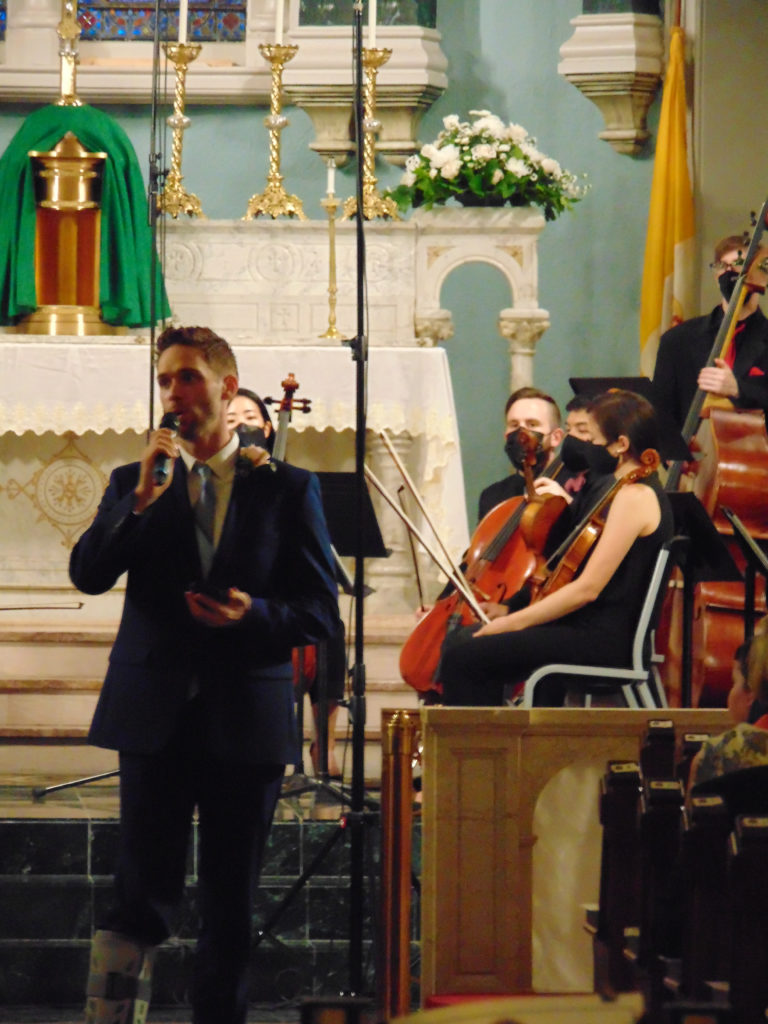
            The Two Streams premiere included the Houston Chamber Choir with director Robert Simpson, the 16-piece Kinetic string ensemble, the Annunciation Schola, and soloists Sasha Cooke, Chris Bozeka, Mark Diamond, and Caitlin Aloia. For Rev. Fr. Paul Felix, the experience of hearing the music for the first time was “very powerful and moving” with its harkening back to the eternal theme of Divine Mercy which informs so much of the daily work of a parish priest’s spiritual and corporal works of mercy, such as hearing Confessions, providing spiritual direction, visiting the sick, etc.  Rev. Fr. Felix says, “The Lord intervened to make St. Faustina the apostle of Divine Mercy.  It is so important for our time to listen.  God gave this message so people could find their way out of sin and evil through the redeeming love of Jesus.”

Knaggs’ most ardent wish for sacred music is that “the music conveys its own eloquence.” The mysterious resides inside music; the experience of hearing the metaphysical or spiritual content allows what Knaggs refers to as “music as an icon.  It is a window that points to a great reality. When people experience music that is not just about itself, they can experience realities beyond the music itself.  Maybe that person then sees there is more to life that just what’s here.  Music is a shared experience. It has a unique ability to reach inside the human heart.”

Sarah Cortez is president and founder of Catholic Literary Arts, www.catholicliteraryarts.org. A freelance writer and editor with fourteen award-winning books to her credit, she resides in Houston, TX. www.poetacortez.com

St. Kateri’s Gaze and the Iconography of John B. Giuliani

St. Kateri Tekakwitha “the Lily of the Mohawks” was born in the village of Ossernenon in present-day New York State, to Mohawk Chief Kenneronkwa and a woman raided from the Algonquin people.  Before her mother was taken captive  and adopted into the Mohawk tribe, French Catholic missionaries near Montreal had baptized and educated her, converting her to the Church.

At the frail age of four years, Tekakwitha lost her parents and younger brother to a smallpox outbreak that spared her life, but terribly scarred her skin and impaired her eyesight.  She followed in the moccasin steps of her mother and on Easter Sunday, April 18, 1676 at the age of 19, Tekakwitha assumed the baptismal name, “Catherine,” in honor of St. Catherine of Siena.  She disavowed marriage, instead vowing perpetual virginity, and eventually moved to the Jesuit mission village of Kahnake.  According to Father Pierre Cholonec, Tekakwitha said:

“I have deliberated enough. For a long time, my decision on what I will do has been made. I have consecrated myself entirely to Jesus, son of Mary, I have chosen Him for husband, and He alone will take me for wife.

Statue of Saint Kateri Tekakwitha at the Cathedral Basilica of St. Francis of Assisi, Santa Fe, New Mexico

The Jesuits characterized Kateri as reserved, averse to social gatherings and given to blanketing her scarred face. She slept on thorns, offering her suffering up for her family’s conversion, a Christian practice that for her recalled the traditional Iroquois ritual of drawing blood. She wanted to found a convent with a devout fellow convert, Anastasia (a friend of Tekawitha’s late mother) but the Jesuits told her she was “too young in faith.”

Hagiographers attested that on her death at age 24, witnesses watched her scars vanish, to leave her skin resplendently beautiful.  As early as 1684, her gravesite had become a place for pilgrimages.  

In 1885, American Catholics initiated the process for Kateri Tekakwitha’s canonization, followed by Canadian Catholics. As described on Wikipedia: “On January 3, 1943, Pope Pius XII declared her venerable. She was beatified as Catherine Tekakwitha on June 22, 1980, by Pope John Paul II.”

In his canonization homily, Pope Benedict XVI honored St. Kateri:

“There she worked, faithful to the traditions of her people, although renouncing their religious convictions until her death at the age of twenty-four. Leading a simple life, Kateri remained faithful to her love for Jesus, to prayer and to daily Mass. Her greatest wish was to know and to do what pleased God. She lived a life radiant with faith and purity.

Kateri impresses us by the action of grace in her life in spite of the absence of external help and by the courage of her vocation, so unusual in her culture. In her, faith and culture enrich each other! May her example help us to live where we are, loving Jesus without denying who we are. Saint Kateri, Protectress of Canada and the first Native American saint, we entrust to you the renewal of the faith in the first nations and in all of North America! May God bless the First Nations!”

Statue of Saint Kateri Tekakwitha by Joseph-Émile Brunet at the Basilica of Sainte-Anne-de-Beaupré, near Quebec City

This first American Indian saint resonates powerfully, for me and for many other Indigenous people, “loving Jesus without denying who we are.”

Walk the galleries of the Prairie Edge & Sioux Trading Post on the Dakota plains, and you will see some extraordinary works by the late John B. Giuliani, priest and painter, such as his Crow Trinity, his Cheyenne Virgin and Child and Sundancer Christ. Beneath the liberal, loquacious light from those floor-to-ceiling windows, the perfectly-mixed American Indian red ochre, corn-yellow, and gold maize of his icons flow in complete harmony and complement to the authentic Indigenous art surrounding them. There at that leisurely outland in Rapid City, the good Father stands beside Jim Little Wounded and Kevin Fast Horse, holding his own with no fear, beside Joanne Bird and Del Iron Cloud with confidence, despite Giuliani’s Byzantine style.

Perhaps against all odds, the predominant religion today among American Indians is Christianity, and in fact, given the intense and unrelenting spirituality which has always been characteristic of the culture, evidence of Christ is often the first one will encounter – as when entering, for instance, the Qualla Boundary, the Cherokee reservation inhabited by the Eastern Band of Cherokee Indians in North Carolina, where the most noticeable, immediately-recognizable structure is a church. Therefore, it should go without saying that our contemporary art scene must accept this reality, and then reflect its truth. As arts journalist, Grace Glueck, wrote in The New York Times, “Although Western art was raised on religion, 20th-century modernism more or less tuned it out. Yet in the last few decades artists, if not curators, have become more open to the subject…”²

Unfortunately, the onset of that “tuning-out” occurred precisely as North American Indians began coming into their own, in terms of conversion, and thus they were abandoned by the sophisticated art world as far as representation. Now more than ever, artists of faith in every discipline are justified in addressing this neglect of what is arguably the most difficult feat accomplished across the continent – the spiritual coercion of an entire race. Moreover, that representation should not relegate Native American Indians to mere conquests of elite and superior missionaries, but in accordance with the Scriptures which say of Christ: “…you ransomed people for God from every tribe and language and people and nation, and you have made them a kingdom and priests to our God, and they shall reign on the earth.” Wholly apart from any issue of “social justice,” spiritual justice demands their equal representation as sovereigns and savants – and saints.

Indigenous believers will find themselves well-represented at Giuliani’s sacramental “table.”  There is only one, not very impressive, painting of St. Kateri drawn by one who knew her.  So it is with more than a bit of wonder and consternation that, looking into his Mohawk Kateri III #92, it is as though I am gazing into the face of my own late mother, who was a direct descendant of an Algonquin born in the same generation as Saint Kateri, an Algonquin orphaned by the same smallpox which took Kateri’s likewise-Algonquin mother and Mohawk father. My amazement is not merely towards the actual features themselves, but the very attitude with which Father Giuliani has infused them. He has captured the soul of the Native American Indian with startling skill.

Saint Kateri’s expression is itself an embodiment of that stoic, borderline-suffering countenance which was my mother’s “thousand-yard-long stare.” Kateri is beatified by the beauty of a glinting bronze nimbus, full as a Beaver Moon, which was that calendar date of the “last call” for ancient Native American Indians to prepare for winter. It will appeal to the truly Indigenous, if only at an intuitive, vestigial level, signifying security amid worldly instability, recalling the ancestral memory of the beaver, symbol of that being who will provide warmth, our last and only hope and salvation by its sacrifice, keeping our hearts soft before the coming cold – a Christ figure from the Animal Kingdom, of sorts.

In the mythology of the Omaha people, we have in “Ictinike and the Four Creators,” a hero who visits a beaver which sacrifices its own son to provide him with food. Following this meal, the father beaver plunges the bones underwater, and the son is resurrected. Too, the Cherokee held a belief called “Cover the blood,” that an animal slain in hunting might be resurrected from its blood spilt by drops on the ground. A similar doctrine runs through the religion of many other tribes. ³

A statue of Saint Kateri Tekakwitha in Saint John Neumann Catholic Church, Sunbury, Ohio

Could it be that, just as early Indigenous missionaries employed the touchstones of the “old religion” to woo their people to the Good News, Father Giuliani unwittingly or knowingly reconnoitered the Beaver Moon, for her halo? Saint Kateri is the patroness of Native American Indians and First Nations peoples, of integral ecology and traditional ecological knowledge, so whether by divine inspiration or his own carnal understanding, this would seem perfectly decided – almost, in fact, an environmental “election.” As Saint Paul wrote, “…to all men, I have become all things, that by all means I may save some,” such an artistic interpretation of Kateri’s nimbus has the power to draw and unite all Nations, from the Southeastern Cherokee who called the Beaver Moon “nu-da-de-qua,” to the Northwestern peoples’ “alangitapi.”

Rather than emphasizing a voluminous veil at her crown, Giuliani downplays the fabric around the saint’s face, focusing on copious, blue folds less suggestive of a cotton mantle than of “Long Man River,” who washed away the despair and impure thoughts of Native ancestors. The sheer weight and width of this massive, dramatic headdress seem to invite viewers not to the mystery fringe of a mortal woman’s hair, but to the currents of living waters. But whereas the veil and white sheath she wears reflect the traditional iconography of the “White Man,” at their lower edge is seen the familiar attire of Native American culture, where a multi-colored, zigzag pantaloon border grazes the tops of Saint Kateri’s dainty feet in moccasins. Her feet are firmly planted at a modest space, in a field of wildflowers where stands of lilies arise on either side, giving testimony to her designation as the “Lily of the Mohawks.”

But the covering of Saint Kateri’s hair proves a much more profound and powerful outward sign of devotion to the Native American Indian viewer, than it does to the non-Native. The covering of the hair conveys a submission to the Christian faith as well as a cultural “assimilation” in a manner that white European Christians could never fully experience, for hair is sacred in Native American Indian culture, a source of ornamental service especially in worship at ceremonial events. An Amerindian’s long hair represents strong self-identity, even clan affiliation (as in the Cherokee “Long Hair Clan”). To throw away our hair is to practice self-mortification, even mourning akin to the Old Testament practice of rending one’s garments, an utter disregard of the ego which goes far beyond the customary cutting of a nun’s hair (symbolizing an end to feminine vanity). Thus Saint Kateri gains profound universal reactions of renunciation through this imagery, humility which contemplative American Indians both male and female will feel in a visceral way.

Also noteworthy in Giuliani’s “sacred Indian menagerie” is his iconography of the Lakota Holy Man, mystic and Catholic missionary, Nicholas Black Elk. While Black Elk is not officially a canonized saint, the Jesuits appointed him to the position of catechist after his baptism in 1904. Thereafter, Black Elk is credited with bringing hundreds of fellow Native American Indians into the faith. Devotions including the rosary and Sacred Heart were a vital part of his practices, thus it is perfect that Giuliani, in “Nicholas Black Elk #83,” has portrayed him with a strand of rustic and somewhat-crudely mismatched beads of natural wooden hue. While Giuliani’s use of lunar imagery might be debatable in the depiction of Kateri, here it is undeniable.

Behind Black Elk’s aureole, reminiscent of a hammered brass cymbal, a crescent moon hangs against the backdrop of a starry night sky. Punctuating the heavens, a celestial supernova swirls around his shoulders in orbits of streaked red and gold, giving the impression of enormous, interstellar wings. His face is un-romanticized and unerring in likeness to the mien of the one after whom it was modeled. There is no question that this is Black Elk as he appeared in the last years of his life. The illusion would be complete, except for the icon’s ragged monastic robe with its lowered hood, hidden behind the rough-hewn cloth of a garment whose yellow hues harmonize with the gold of the supernova “wings” on either side. This effect being so seamless, the viewer feels all the more that they are appendages, “feathered” outgrowths of the man himself. Again, here it seems there is more subtle symbolism at work, a hint at the antediluvian Birdman regalia of Native American Indians which elevated priests to their stature, conveying instant recognition at mere sight to every domestic clan and outside tribe.

Vestiges of this ancient diaconate are still visible today in the falcon dancer “vestments” seen at powwows for formal stomps and ceremonies. In the Southeastern Ceremonial Complex, the Birdman represented the Upper World, where its genesis was accompanied by sun, moon, and stars – the latter two which also appear in Giuliani’s icon. “The life of an Indian,” said Black Elk, “is like the wings of the air… That is why the Indian is always feathered up, he is a relative to the wings of the air.”

 If ancestral memory does indeed remain, passing down along with the “generational trauma” a hunger for and appreciation of unction both heavenly and carnal, then the Native American Indian viewer should find ample spiritual inspiration – and if not, Giuliani’s sublime suggestion of the ritual feathers is sufficient, imparting at least a dose of tangibility, reinforced through use of the red ochre and sunflower/corn silk yellow paints which were so common to the culture. The combination is found equally in authentic Buffalo Dreamer hand-painted rawhide shields and genuine turtle amulets on display nearby in the galleries of that Prairie Edge & Sioux Trading Post, authentic art by the Ute Nation and Oglala Lakota – Nicholas Black Elk’s own blood people.

Consequently, this priest’s art is art which has undoubtedly found its place. In a pastoral letter, Reverend Nicholas Black Elk wrote of the American Indians, “We all suffer in this land. But let me tell you, God has a special place for us when our time has come.” Surely if we read the signs and have ears to hear, that time has now come, with one of those special places living in the lasting works of John Giuliani.

Jennifer Reeser is a bi-racial writer of European American and Native American descent, the author of “Indigenous,” and “Strong Feather.” Her reviews have appeared in First Things, LIGHT, Able Muse, and elsewhere.

¹Despair Over The Pope https://www.nybooks.com/articles/2010/06/10/despair-over-pope/

2 Art Review: Creative Souls Who Keep the Faith of Challenge Its Influence https://www.nytimes.com/2000/04/21/arts/art-review-creative-souls-who-keep-the-faith-or-challenge-its-influence.htm

³History, Myths, and Sacred Formulas of the Cherokee, ©1900 by James Mooney, reprinted by Bright Mountain Books, 1992, p. 474

Subscribe to Our Emails